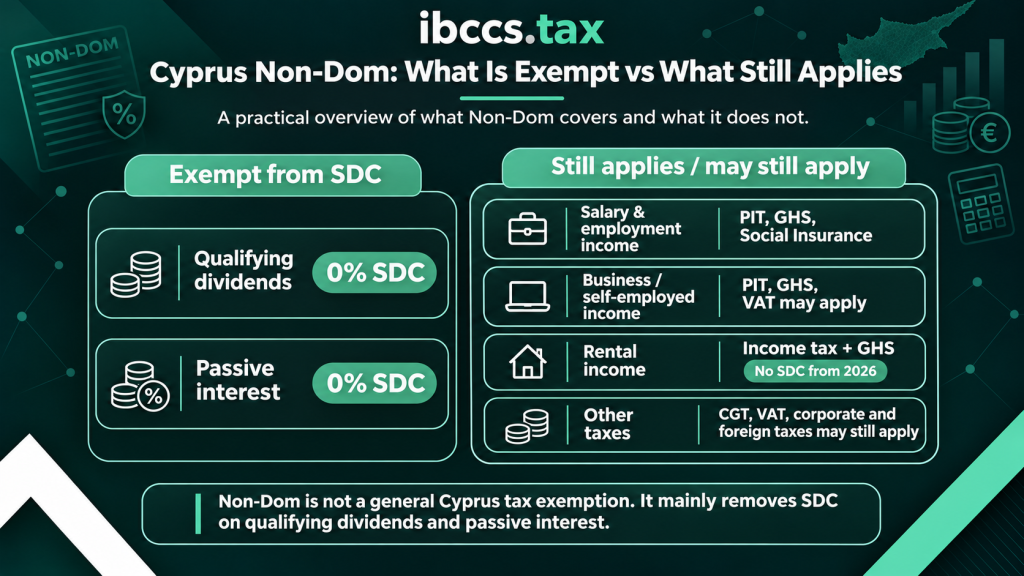
Cyprus Non-Dom status can be highly valuable for individuals whose income includes dividends and passive interest, because a qualifying Cyprus tax resident who is non-domiciled for Special Defence Contribution purposes is generally outside the SDC charge on those categories. The regime is therefore often described in shorthand as a “tax exemption”, but that description becomes misleading when it is applied to the individual’s entire financial position. Non-Dom is not a blanket exemption from Cyprus tax and it does not convert salary, business profits, rent, property gains or other taxable receipts into tax-free income.
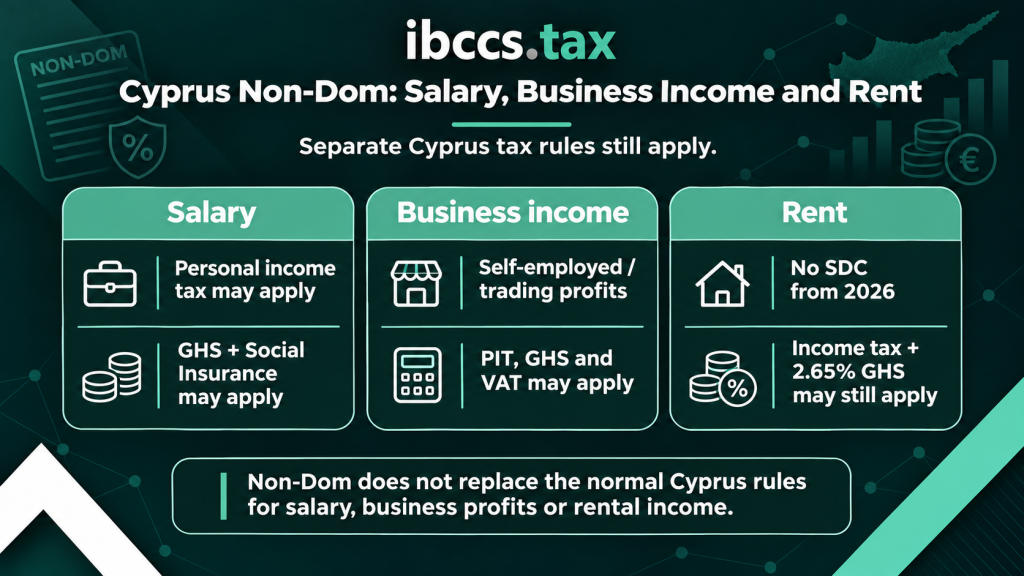
The correct way to analyse a Non-Dom individual is to identify the legal category of each income stream and then apply the relevant Cyprus rules to that category. Salary and business profits sit within the personal income tax framework. Rent remains relevant for income tax and GHS even though SDC on rental income was abolished from 2026. Gains connected with Cyprus immovable property can fall within Capital Gains Tax, while employment, self-employment and business activity can also create GHS, Social Insurance, VAT and reporting obligations. None of those liabilities disappears simply because the individual has Non-Dom status.
This guide focuses on the limits of the regime. It complements our main Cyprus Non-Dom guide, which explains the benefit itself, and our separate article on Non-Dom and GHS/GESY, which deals in detail with dividends and interest. The objective here is to show what still needs to be analysed after Non-Dom eligibility has been confirmed, so that a relocation or private-client plan is built around the complete Cyprus tax position rather than around one exemption in isolation.

- Cyprus Non-Dom is primarily an exemption from Special Defence Contribution on qualifying dividends and passive interest. It is not a general exemption from personal income tax, GHS, Social Insurance, VAT or Capital Gains Tax.
- Employment income and directors’ remuneration remain within the ordinary Cyprus income-tax and payroll framework. From 2026, personal income tax rates range from 0% to 35%, with the 0% band applying to taxable income up to €22,000.
- Separate employment or relocation incentives can reduce taxable salary where their own conditions are satisfied, including the 50% employment-income exemption and the newer 25% talent-repatriation exemption. Those incentives are separate from Non-Dom and should not be described as Non-Dom benefits.
- Self-employed and business profits remain subject to personal income tax and can also create GHS, Social Insurance, VAT and accounting obligations. Non-Dom does not turn trading or professional income into passive investment income.
- From the 2026 tax year, rental income is no longer subject to SDC for any individual. Rent can still be subject to personal income tax and GHS, so the removal of SDC is now a general Cyprus rule rather than a Non-Dom-specific advantage.
- Non-Dom does not provide a general Capital Gains Tax exemption. Cyprus CGT can apply at 20% to gains from Cyprus-situated immovable property and certain property-rich company interests, subject to the specific CGT rules and exemptions.
- Favourable treatment of many securities gains or gains on foreign immovable property comes from separate Cyprus income-tax and CGT rules, not from Non-Dom status.
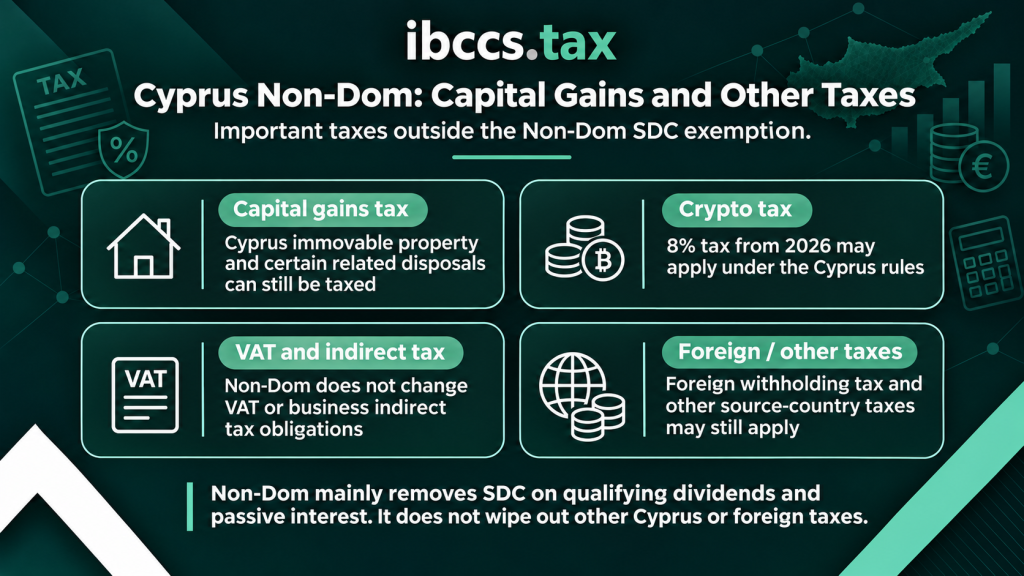
- From 2026, gains on many disposals of crypto-assets are subject to a separate 8% income-tax regime, while mining-related gains follow the general income-tax rules. Non-Dom does not exempt either category.
- A Non-Dom shareholder can still own a company that pays corporate tax, VAT, payroll costs or other business taxes. The shareholder’s personal SDC status does not transfer to the company.
- Foreign withholding tax and source-country taxation can still apply to income or gains even where Cyprus gives a favourable result. The overall position should therefore be reviewed cross-border, not only from the Cyprus side.
Quick Answer: What Does Cyprus Non-Dom Not Exempt?
Cyprus Non-Dom does not generally exempt salary, directors’ remuneration, self-employed or business profits, rental income, Cyprus property gains, GHS/GESY, Social Insurance, VAT, company-level taxes or foreign-source taxes. Its central tax benefit is much narrower: it generally removes Special Defence Contribution on qualifying dividend income and passive interest for a Cyprus tax resident who remains non-domiciled for SDC purposes.
That narrow scope is not a weakness in the regime; it is simply the correct legal boundary. Cyprus can still be attractive because several other income categories have their own exemptions, deductions or favourable rules, but those provisions need to be tested separately. An individual should therefore avoid using Non-Dom as a label for every favourable Cyprus outcome, because that makes the tax analysis difficult to support and can obscure liabilities that remain due.
The core distinction
Non-Dom answers an SDC question. It does not replace the separate Cyprus rules for income tax, GHS, Social Insurance, VAT, Capital Gains Tax, company taxation or foreign tax.
Why the Scope of Non-Dom Is Often Misunderstood
The misunderstanding usually starts with the most visible headline: a qualifying Non-Dom can receive dividends and passive interest without SDC. For an investor or founder, that can be a material benefit, so it naturally becomes the centre of the relocation discussion. The problem arises when the same conclusion is extended to salary, consulting income, rent or asset disposals without checking whether those receipts fall within the SDC framework at all.
Cyprus tax law separates income by legal and economic character. Employment income is taxed as employment income, business profits as business profits, rental income under the rental and income-tax rules, and gains under the relevant capital-gains, securities or special regimes. GHS and Social Insurance have their own contributor classifications, and VAT is generally driven by taxable business activity rather than personal domicile. A correct Non-Dom plan therefore starts with classification, not with the assumption that all foreign or investment-related income receives the same treatment.
Cyprus Non-Dom: What It Does and Does Not Cover at a Glance
| Income / tax area | Does Non-Dom exempt it? | Main Cyprus issue to review |
| Dividends | Generally removes SDC for a qualifying Non-Dom | GHS can still apply; foreign withholding and reporting remain relevant |
| Passive interest | Generally removes SDC for a qualifying Non-Dom | GHS can still apply; active/business interest may be classified differently |
| Salary / directors’ remuneration | No | Personal income tax, PAYE, GHS, Social Insurance and separate employment exemptions |
| Self-employed / business profits | No | Personal income tax, GHS, Social Insurance, VAT and accounting obligations |
| Rental income | No special Non-Dom exemption from 2026 | Income tax and GHS; SDC on rent abolished generally from 2026 |
| Cyprus property gains | No | Capital Gains Tax can apply under the CGT rules |
| Crypto gains | No | Separate 8% regime for many non-mining disposals from 2026; mining follows general rules |
| Company profits | No | Corporate tax and company-level compliance are separate from shareholder Non-Dom status |
| VAT / business indirect tax | No | VAT registration and reporting depend on business activity and transaction type |
Salary and Employment Income: Non-Dom Does Not Remove Personal Income Tax
Employment income is one of the clearest examples of a tax category outside the Non-Dom exemption. A Cyprus tax resident employee is subject to the ordinary personal income-tax framework on taxable employment income, together with payroll withholding and the relevant contribution rules. From the 2026 tax year, the personal income-tax bands are 0% up to €22,000, 20% from €22,001 to €32,000, 25% from €32,001 to €42,000, 30% from €42,001 to €72,000 and 35% above €72,000.
An individual can be fully Non-Dom for SDC purposes and still have a substantial PAYE liability on salary. The same applies to directors’ remuneration where the payment is remuneration for services rather than a valid dividend. The tax treatment follows the legal nature of the payment, so a company owner should not assume that replacing salary with an informal shareholder withdrawal produces a dividend simply because Non-Dom would be more favourable.
Separate employment incentives can reduce the taxable amount where the statutory conditions are satisfied. Cyprus has, among other provisions, a 50% exemption for qualifying first-employment remuneration above the relevant threshold and a newer 25% talent-repatriation exemption that can apply to qualifying employment or business income, subject to its own residence, timing, remuneration and experience conditions. These are income-tax exemptions in their own right. They can sometimes coexist with Non-Dom, but one does not arise because of the other.
GHS and Social Insurance Still Apply to Employment
Non-Dom also does not remove payroll contributions. Employees generally contribute to the Social Insurance Fund on insurable earnings and also bear employee GHS contributions, while the employer has its own Social Insurance, GHS and statutory fund obligations. Under the current Social Insurance framework, the main Social Insurance contribution is 8.8% for the employee and 8.8% for the employer, subject to the applicable insurable-earnings ceiling, with the State contributing separately.
For founders and owner-managers, this makes salary-versus-dividend planning a multi-layer calculation. Salary can create personal income tax and payroll contributions, while a dividend can be outside SDC for a Non-Dom but still carry GHS. The correct structure depends on the company’s distributable profits, corporate tax position, employment role, expected cash needs and documentation, not simply on selecting whichever payment has the lowest headline percentage.
For a detailed explanation of how dividends are taxed, see our Tax on Dividends in Cyprus guide.
Business and Self-Employed Income: Non-Dom Does Not Exempt Trading Profits
Profits from carrying on a business or profession are also outside the core Non-Dom exemption. A Cyprus tax resident who operates as a self-employed consultant, adviser, freelancer, sole trader or other professional is generally taxed on taxable business profits under the personal income-tax bands. The fact that clients are located abroad or payments arrive into a foreign bank account does not automatically convert the income into passive foreign income.
Self-employed activity can also create Social Insurance and GHS obligations. Under the current Social Insurance framework, a self-employed person generally pays 16.6% on the applicable insurable income, while GHS uses its own contribution rules and rates. The precise bases are not identical, and categories of self-employed persons can have prescribed insurable earnings, so the contribution computation should be separated from the personal income-tax calculation rather than treated as one combined tax rate.
Business activity can further create VAT, bookkeeping and filing obligations. Cyprus VAT registration is generally compulsory when the relevant taxable turnover exceeds the statutory threshold, currently €15,600 over a twelve-month period, while cross-border services and acquisitions can create registration or reporting obligations even where domestic turnover is below that figure. Non-Dom has no role in deciding whether a supply is subject to VAT, reverse charge, VIES or another indirect-tax rule.
Separate 25% Talent-Repatriation Exemption for Qualifying Business Profits
From 2025, Article 8(21B) introduced a separate 25% income-tax exemption for qualifying individuals who commence employment or business activity in Cyprus within the specified 2025-2030 window and meet the statutory conditions. The exemption can apply to qualifying employment remuneration or business profits, is capped at €25,000 per tax year and is available for a defined seven-year period where the relevant conditions continue to be met.
The Tax Department expressly distinguishes this incentive from the Non-Dom regime. Non-Dom concerns SDC on dividends and interest, while Article 8(21B) concerns income tax on qualifying employment or business income. The two regimes can potentially be relevant to the same person in the same year, but they should be documented and calculated independently.
Rental Income: No SDC From 2026, but Other Taxes Remain
Rental income is an area where older Non-Dom explanations can be especially misleading. Until the end of 2025, rental income could carry SDC, which meant domicile status affected one part of the rental-tax calculation. From the 2026 tax year, Cyprus abolished SDC on rental income generally. As a result, the absence of SDC on rent is no longer a special Non-Dom benefit and applies regardless of whether the individual is domiciled or non-domiciled.
Rent can nevertheless remain subject to personal income tax. For rental income from buildings, the Cyprus income-tax computation generally allows a deemed deduction of 20% of gross building rents together with qualifying capital allowances and interest connected with the acquisition, subject to the relevant rules. The resulting taxable rental income is then brought into the individual’s personal income-tax computation, so a Non-Dom landlord can still have a meaningful Cyprus income-tax liability.
GHS also remains relevant. The current Tax Department guidance applies a 2.65% GHS contribution to rental income for individuals, with the collection mechanism depending on the identity of the tenant and other circumstances. For foreign property, the source country can additionally tax the rental income under its domestic law, so foreign tax credits, treaty rules, expenses and local property obligations may need to be reconciled with the Cyprus return.
Capital Gains: Non-Dom Is Not a General CGT Exemption
Non-Dom status does not create a general exemption from Cyprus Capital Gains Tax. Cyprus CGT is a separate regime and currently applies at 20% to chargeable gains from the disposal of immovable property situated in Cyprus and to certain disposals of shares or interests in companies whose value is connected with Cyprus-situated immovable property. The tax applies when the gain falls within the CGT legislation rather than the income-tax rules, and domicile is not the test that removes the charge.
The 2026 tax reform broadened the property-rich company rules for indirect holdings. Where shares indirectly derive value from Cyprus immovable property, the relevant threshold was reduced from 50% to 20% of market value, subject to the detailed statutory provisions and any applicable double tax treaty. This is particularly important for private clients who hold Cyprus property through companies, partnerships or multi-layer structures and assume that a share disposal is automatically outside CGT.
The reform also increased the lifetime CGT exemptions available to individuals. From 2026, the general lifetime exemption is €30,000, the exemption for qualifying agricultural land is €50,000 and the exemption for a qualifying principal residence is €150,000, subject to the relevant conditions and the overall lifetime framework. These are CGT provisions available because the statutory conditions are met, not because the seller has Non-Dom status.
Securities and Foreign Assets: A Favourable Result May Come From Other Rules
Cyprus can still provide favourable outcomes for investment disposals, but the source of that treatment should be identified correctly. Gains from many qualifying securities are generally outside personal income tax, while Capital Gains Tax is focused on Cyprus immovable property and relevant property-rich interests. A gain on an ordinary foreign share portfolio can therefore have a very different Cyprus result from a gain on a Cyprus property company, even though the same individual holds Non-Dom status in both cases.
Likewise, a gain on immovable property situated outside Cyprus is generally outside the Cyprus CGT scope, although the country where the property is located may impose its own capital-gains or property tax. That favourable Cyprus outcome comes from the territorial scope of the CGT rules, not from Non-Dom. The distinction matters for planning, treaty analysis and documentation because the source country can still have primary taxing rights.
Crypto-Asset Gains: A Separate 8% Regime From 2026
Crypto-assets provide another useful example of why Non-Dom should not be treated as a universal investment exemption. From 1 January 2026, Cyprus introduced a special income-tax regime under which gains from the disposal of crypto-assets that were not acquired through mining are generally taxed at 8%. The special rule applies to disposals broadly defined to include sales, exchanges and certain other transactions, including transactions carried out in the course of a business.
Crypto-assets acquired through mining are treated differently and mining-related gains are taxed under the general income-tax rules. The Tax Department also distinguishes crypto-assets from assets that fall outside the statutory definition, which can then follow other income-tax provisions. In each case, Non-Dom does not provide the exemption because the relevant tax is income tax rather than SDC on dividends or passive interest.
GHS/GESY: A Separate Contribution From Non-Dom
GHS is one of the most important charges that can remain relevant to a Non-Dom individual. A qualifying Non-Dom can have 0% SDC on a dividend or passive-interest receipt and still have GHS on that same income. Income earners are currently subject to GHS at 2.65% on dividends, interest, rent and other relevant income, while employees and self-employed persons have separate classifications and contribution rates.
For natural persons, GHS contributions are generally capped by a maximum annual contribution base of €180,000 across the relevant income categories. The cap is not a Non-Dom allowance and should not be treated as one. Salary, pensions, self-employed activity, dividends, interest and rent can interact in determining how much of the annual base has already been used. For a detailed explanation and calculation examples, see Cyprus Non-Dom and GHS/GESY: What You Still Pay on Dividends and Interest.
VAT: Non-Dom Has No Effect on Business Indirect Tax
VAT is linked to taxable supplies, acquisitions, imports and the status of the person carrying on economic activity. It is not linked to personal domicile for SDC purposes. A Non-Dom individual who carries on a consulting, trading, digital or other business can therefore need to register for VAT, charge VAT where applicable, apply reverse charge, submit VIES statements or comply with OSS rules in the same way as another taxable person with the same transactions.
The domestic registration threshold is only one part of the analysis. Certain cross-border services, intra-EU acquisitions and other transactions can trigger VAT obligations on a different basis, while exempt or zero-rated activities have their own treatment. For this reason, VAT should be reviewed from the transaction flow and customer location rather than from the individual’s Non-Dom status. For the broader framework, see our VAT in Cyprus guide.
Company-Level Taxes Do Not Disappear Because the Shareholder Is Non-Dom
Founders sometimes focus on their personal Non-Dom status and overlook the fact that the company remains a separate taxpayer. A Cyprus tax-resident company can be subject to corporate income tax, VAT, payroll obligations, transfer pricing, withholding requirements and filing duties irrespective of whether its shareholder is domiciled or non-domiciled. The shareholder’s personal SDC exemption does not reduce the company’s taxable trading profits.
The separation becomes especially important where a founder relocates to Cyprus while continuing to manage a foreign company. Personal relocation can affect where management decisions are made and can create company-residence, permanent-establishment or payroll questions that are not solved by Non-Dom. The personal and corporate analyses should therefore be coordinated, particularly where the owner controls remuneration, dividend timing or cross-border operations.
Foreign Withholding Tax and Source-Country Tax Still Apply
Non-Dom only determines part of the Cyprus tax result. A foreign country can still impose withholding tax on dividends, interest, royalties or other payments under its domestic law, and a country where property is located can tax rent or gains arising from that property. The applicable double tax treaty may reduce or allocate those taxing rights, but Non-Dom itself does not force the foreign jurisdiction to give up tax.
This point is particularly important where Cyprus does not levy a corresponding tax against which a foreign tax credit could be used. If a Non-Dom individual receives a foreign dividend with 15% withholding at source and Cyprus SDC is zero, the withheld amount does not automatically become refundable in Cyprus. Treaty-relief-at-source procedures, local reclaim mechanisms and beneficial-ownership conditions may therefore have a greater practical impact than the Cyprus headline exemption.
Tax Filing and Record-Keeping Obligations Still Matter
A low or zero liability under one tax does not remove the wider filing framework. From the 2026 tax year, Cyprus broadened the individual income-tax return requirements for tax residents. Individuals with income within the scope of the Income Tax Law and many residents aged 25 to 70 can have a filing obligation even where deductions, exemptions or foreign tax credits reduce the final amount payable.
For a Non-Dom private client, the annual file should therefore support both exempt and taxable categories. Salary certificates, business accounts, dividend vouchers, broker statements, bank interest certificates, rental schedules, property purchase and sale documents, crypto transaction records, foreign withholding evidence and residence documentation can all be relevant. Good records are especially important where the same person has multiple types of income that follow different Cyprus tax rules.
Our Private Client Accounting in Cyprus guide explains the wider reporting and record-keeping requirements for individuals with multiple income sources and international investments.
Separate Cyprus Tax Advantages That Are Not Non-Dom Benefits
Cyprus contains several favourable tax rules that can sit alongside Non-Dom, but they should be described under their own legal basis. Qualifying employment income can benefit from separate employment exemptions. Certain returning talent can qualify for the 25% Article 8(21B) exemption on employment or business income. Many securities gains can have favourable treatment under the securities rules, and foreign immovable property gains generally fall outside Cyprus CGT because the property is not situated in Cyprus.
Keeping those provisions separate improves both compliance and planning. It allows the adviser to test each condition independently, identify which benefit could survive a future change in domicile status and avoid presenting a package of unrelated tax incentives as one “Non-Dom regime”. This becomes especially important for long-term residents approaching the 17/20 deemed-domicile threshold, because some favourable Cyprus rules can continue even when the SDC Non-Dom benefit itself changes.
What Cyprus Non-Dom Does Not Exempt: Practical Scenarios
Scenario 1: Employee with a foreign investment portfolio
An executive becomes Cyprus tax resident and qualifies as Non-Dom. The executive receives a Cyprus salary and foreign portfolio dividends. Non-Dom can generally remove SDC on the dividends, but the salary remains within the personal income-tax and payroll framework, and GHS can apply to both salary and dividends. If the executive qualifies for a separate employment-income exemption, that relief is calculated under its own conditions and should not be described as part of Non-Dom.
Scenario 2: Self-employed consultant serving overseas clients
A consultant lives and works from Cyprus and invoices clients in several countries. The fact that the clients and bank account are overseas does not make the fees passive foreign income. The consulting profits are business income and can be subject to personal income tax, GHS and Social Insurance, with VAT and VIES obligations depending on turnover and the location and status of customers. Non-Dom is relevant to qualifying dividends and passive interest, not to the consulting fees.
Scenario 3: Non-Dom landlord with Cyprus and foreign property
A Cyprus tax resident Non-Dom owns a rented apartment in Cyprus and a rental property abroad. From 2026, neither rental stream is subject to Cyprus SDC simply because SDC on rental income has been abolished generally. The Cyprus income-tax and GHS rules can still apply, while the foreign property can also be taxed in its source country. The foreign-tax and expense position should be reconciled in the annual Cyprus computation rather than treating rent as a Non-Dom-exempt category.
Scenario 4: Sale of shares in a Cyprus property structure
An investor with Non-Dom status sells shares in a company whose value is substantially derived from Cyprus immovable property. The investor cannot rely on Non-Dom to remove Capital Gains Tax. The property-rich company rules, the 20% indirect-value threshold introduced from 2026, listing status, acquisition history, treaty provisions and the actual gain calculation all need to be reviewed before concluding whether CGT applies.
Scenario 5: Investor realising crypto gains
A Non-Dom investor disposes of crypto-assets acquired as investments. If the gains fall within the special crypto regime introduced from 2026, they can be subject to the 8% income-tax rate even though the investor is exempt from SDC on qualifying dividends and passive interest. The result illustrates the basic rule: Non-Dom follows the type of tax and income category, not the fact that the asset is an investment.
Common Misconceptions About What Non-Dom Covers
“I am Non-Dom, so my salary is tax-free.” Incorrect. Salary remains employment income and is subject to the ordinary personal income-tax and payroll rules. A separate employment exemption may reduce taxable salary where its own conditions are met, but that is not the Non-Dom exemption.
“Foreign consulting fees are tax-free because the client is abroad.” Incorrect in many cases. If a Cyprus tax resident carries on the work as a business or profession, the fees can be taxable business income in Cyprus and may also create GHS, Social Insurance and VAT obligations.
“Rent is a Non-Dom benefit.” Outdated. SDC on rental income was abolished generally from the 2026 tax year, so the result no longer depends on domicile. Income tax, GHS and foreign property taxes can still remain relevant.
“Non-Dom means no capital gains tax.” Incorrect. Cyprus CGT has its own scope, particularly for Cyprus immovable property and relevant property-rich company interests. A favourable result on ordinary securities or foreign property may arise from separate rules, not from Non-Dom.
“If I own a Cyprus company, the company is also Non-Dom.” Incorrect. Non-Dom is an individual SDC concept. The company remains a separate taxpayer and its corporate tax, VAT, payroll and compliance obligations need to be reviewed independently.
“If Cyprus does not tax an item, no country can tax it.” Incorrect. Source countries can impose withholding, property tax, capital-gains tax or other charges under their own law. Treaty analysis and foreign compliance can remain necessary even where Cyprus gives an exemption or does not have taxing rights.
How to Review a Non-Dom Tax Position Properly
The most reliable method is to build an income-and-asset map rather than calculate one global “Non-Dom rate”. Each recurring receipt should be classified as salary, business income, dividend, interest, rent, pension, royalty or another category. Each significant asset disposal should then be tested under the relevant securities, crypto, income-tax or Capital Gains Tax rules. The GHS, Social Insurance and VAT layers should be reviewed separately because they use different contribution bases and triggers.
The second step is to connect the personal position with any companies, trusts, property holdings or foreign jurisdictions involved. A founder can have a favourable personal dividend result while the company still pays corporate tax. A landlord can have no SDC on rent but still face income tax and source-country property taxes. An investor can have an exempt securities gain but an 8% crypto gain in the same year. A category-by-category model produces a more defensible and commercially useful result than relying on the Non-Dom label alone.
How IBCCS TAX Can Help
IBCCS TAX supports internationally mobile individuals, founders, investors and private clients with Cyprus tax residency and Non-Dom planning as part of the wider personal tax position. Our work can include reviewing the individual’s residence and domicile profile, classifying salary, business income, dividends, interest, rent and investment gains, and modelling the interaction between personal income tax, SDC, GHS, Social Insurance and Capital Gains Tax.
Where the individual owns a company or operates a business, we can coordinate the personal analysis with corporate tax, payroll, VAT and accounting obligations in Cyprus. For clients with foreign investments or property, we can also review the Cyprus reporting position alongside foreign withholding, treaty relief and available tax credits. The objective is to use the Non-Dom regime where it genuinely applies while ensuring that other income and taxes are identified and documented correctly.
To discuss your position, see our Cyprus Non-Dom service, main Cyprus Non-Dom guide or broader Cyprus tax planning services.

Frequently Asked Questions: What Cyprus Non-Dom Does Not Exempt
1. Does Cyprus Non-Dom exempt salary?
No. Salary and directors’ remuneration remain within the ordinary Cyprus employment-income framework. Personal income tax, PAYE, GHS and Social Insurance can apply. Separate employment-income exemptions may be available where their own statutory conditions are satisfied.
2. What are the Cyprus personal income-tax bands from 2026?
From the 2026 tax year, taxable income up to €22,000 is taxed at 0%, followed by bands of 20% from €22,001 to €32,000, 25% from €32,001 to €42,000, 30% from €42,001 to €72,000 and 35% above €72,000.
3. Does Non-Dom exempt self-employed income?
No. Profits from a profession or business are generally subject to personal income tax and can also create GHS, Social Insurance, VAT and reporting obligations. The location of the client or bank account does not by itself change business income into passive investment income.
4. Can the 25% talent-repatriation exemption apply to a Non-Dom?
Potentially yes, if the individual separately satisfies the conditions of Article 8(21B). The 25% exemption is an income-tax incentive for qualifying employment or business income and is independent of Non-Dom, which concerns SDC on dividends and passive interest.
5. Does a Non-Dom pay tax on rental income?
Rental income can still be subject to personal income tax and GHS. From 2026, SDC on rental income was abolished for all individuals, so the absence of SDC on rent is no longer a special Non-Dom benefit.
6. Does Non-Dom exempt Cyprus Capital Gains Tax?
No. Cyprus CGT can apply at 20% to chargeable gains on Cyprus-situated immovable property and certain property-rich company interests. The CGT rules and exemptions apply independently of the individual’s Non-Dom status.
7. Are share-sale gains tax-free because of Non-Dom?
Not because of Non-Dom. Many gains on qualifying securities can have favourable Cyprus treatment under separate income-tax and CGT rules. Property-rich companies, listing status and other facts can change the result.
8. Does Non-Dom exempt gains on foreign property?
Non-Dom is not the reason foreign property gains may be outside Cyprus CGT. Cyprus CGT generally focuses on Cyprus-situated immovable property. The country where the foreign property is located may still tax the gain, so source-country and treaty rules remain important.
9. Does a Cyprus Non-Dom pay tax on crypto gains?
Potentially yes. From 2026, gains from many disposals of non-mined crypto-assets are subject to a separate 8% income-tax regime. Mining-related gains follow the general income-tax rules. Non-Dom does not exempt those gains.
10. Does Non-Dom remove GHS/GESY?
No. GHS is separate from SDC. Dividends and passive interest can be exempt from SDC for a Non-Dom while GHS still applies, subject to the applicable rates, annual contribution-base cap and any specific exemption.
11. Does Non-Dom remove Social Insurance?
No. Social Insurance depends on employment or self-employment and the applicable insurable-earnings rules. Non-Dom status does not change the employee, employer or self-employed contribution framework.
12. Does Non-Dom remove VAT obligations?
No. VAT is based on business activity and transaction type. A Non-Dom entrepreneur can still need VAT registration, VAT returns, reverse-charge accounting, VIES or OSS compliance where the relevant rules apply.
13. If I own a Cyprus company, does my Non-Dom status reduce its corporate tax?
No. The company is a separate taxpayer. Its corporate income tax, VAT, payroll, transfer-pricing and filing obligations are independent of the shareholder’s personal Non-Dom status.


Cyprus Non-Dom and Foreign Income: Dividends, Interest and Overseas Investments
Cyprus Non-Dom status is particularly relevant to internationally mobile investors,
Read More
What Cyprus Non-Dom Does Not Exempt: Salary, Business Income, Rent, Capital Gains and Other Taxes
Cyprus Non-Dom status can be highly valuable for individuals whose
Read More
Cyprus Non-Dom and GHS/GESY: What You Still Pay on Dividends and Interest
Cyprus Non-Dom status is commonly associated with a 0% Special
Read MoreImportant Note: This article provides general information and reflects the Cyprus tax framework reviewed in October 2026. Tax treatment depends on the individual facts and current rules; obtain transaction-specific tax and legal advice before relying on an exemption or implementing a structure.