

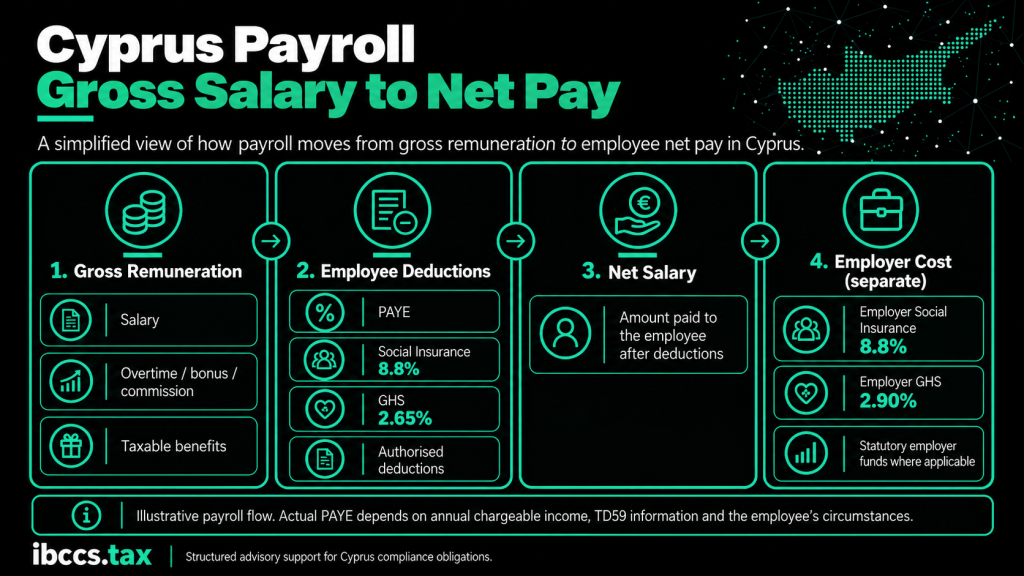
Payroll in Cyprus is more than transferring a net salary to an employee. A compliant payroll run brings together employment terms, gross remuneration, PAYE, Social Insurance, GHS, employer statutory funds, payslips, payment records and monthly and annual declarations.
The 2026 tax reform makes payroll particularly important because personal income tax bands changed, Tax For All is now central to employer tax reporting, and employers need to maintain a consistent monthly data trail that supports the annual employer return and each employee’s Certificate of Emoluments.
For the overall tax framework, see Tax in Cyprus. For contribution rates and caps, see Social Insurance in Cyprus.

- Cyprus payroll starts with the contractual gross remuneration and then calculates employee deductions and employer costs separately.
- PAYE is income tax withheld from employment income based on the employee’s expected annual chargeable income and the applicable personal income tax rules.
- From 2026, the first €22,000 of annual chargeable income falls within the 0% personal income tax band; the top 35% marginal rate applies only above €72,000.
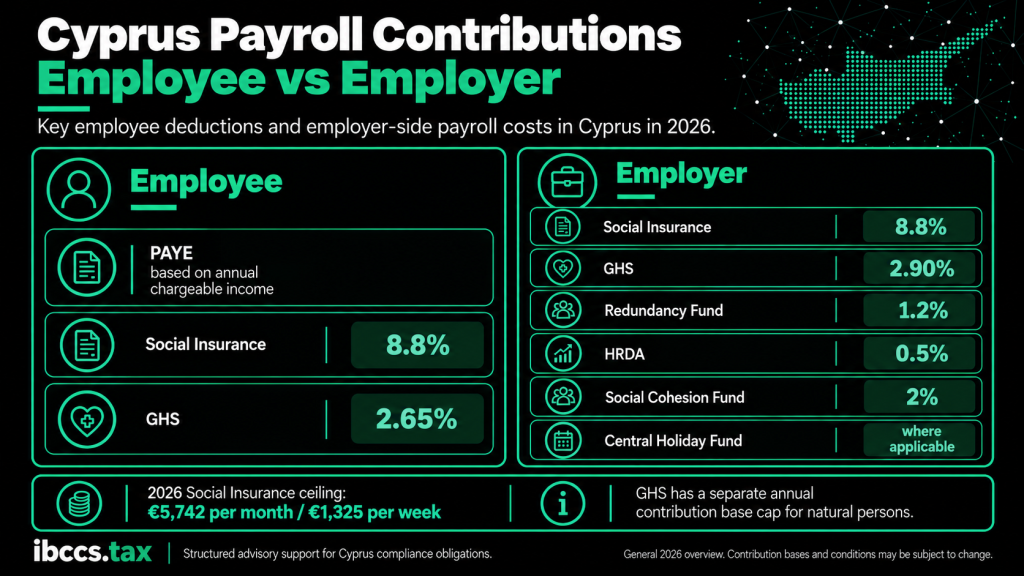
- Employee Social Insurance is 8.8% of insurable earnings in 2026 and the employer also pays 8.8%, subject to the relevant maximum-insurable-earnings rules.
- Employees generally pay GHS at 2.65% on salary and employers pay 2.90%. GHS follows its own contribution base and cap.
- Employers also have Redundancy Fund, Human Resource Development Fund, Social Cohesion Fund and potentially Central Holiday Fund obligations.
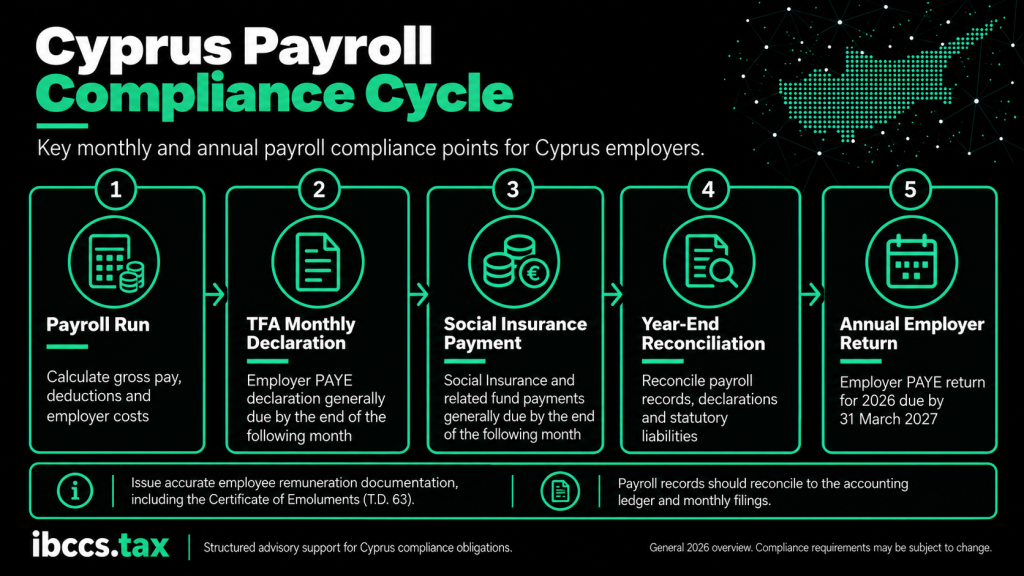
- Monthly PAYE and contribution withholding declarations are generally submitted through Tax For All by the end of the following month where the employer is within the filing obligation.
- The annual PAYE employer return for 2026 is due by 31 March 2027 under the new statutory timetable.
- Employers should issue accurate annual employee remuneration documentation, including the Certificate of Emoluments, and reconcile it to payroll and employer filings.
How Payroll Works in Cyprus
A payroll calculation normally starts with the employee’s gross salary and any additional remuneration such as overtime, bonuses, commission or benefits. The payroll process then determines which amounts are taxable, which are insurable, which are subject to GHS and which employer contributions apply. The employee’s deductions are subtracted from gross pay to arrive at net salary, while employer-only contributions form part of the company’s total employment cost.
| Payroll layer | Typical items |
| Gross remuneration | Salary, overtime, bonus, commission, taxable benefits |
| Employee deductions | PAYE, Social Insurance, GHS and any authorised deductions |
| Net pay | Amount payable to the employee after deductions |
| Employer statutory cost | Employer Social Insurance, GHS, Redundancy Fund, HRDA, Social Cohesion and Central Holiday Fund where applicable |
| Reporting | TFA PAYE declarations, Social Insurance reporting, annual employer return and employee documentation |
PAYE in Cyprus: How Income Tax Is Withheld
PAYE is the mechanism through which an employer withholds income tax from employment remuneration during the year. The payroll calculation should estimate the employee’s annual chargeable income and apply the progressive personal income tax bands rather than simply applying one flat rate to the monthly salary.
| Annual chargeable income | 2026 rate |
| Up to €22,000 | 0% |
| €22,001 – €32,000 | 20% |
| €32,001 – €42,000 | 25% |
| €42,001 – €72,000 | 30% |
| Over €72,000 | 35% |
The personal tax computation is explained in our Cyprus personal income tax guide.
TD59: Employee Information for PAYE
The employee normally completes the TD59 declaration each year so that the employer can take account of relevant information for PAYE withholding. The form can include other income, deductions or exemptions that affect the payroll calculation. Employers should retain the current declaration and update payroll where the employee’s circumstances change.
Employment exemptions, including the 50% expatriate employment exemption where the statutory conditions are satisfied, require a separate eligibility analysis. Payroll should not apply an exemption solely because the employee expects to qualify.
Social Insurance, GHS and Employer Contributions
| Contribution | Employee | Employer | Practical note |
| Social Insurance | 8.8% | 8.8% | Subject to the 2026 maximum insurable earnings ceiling for applicable funds |
| GHS / GESY | 2.65% | 2.90% | Separate annual GHS cap for natural persons |
| Redundancy Fund | – | 1.2% | Employer cost |
| HRDA Fund | – | 0.5% | Employer cost |
| Social Cohesion Fund | – | 2% | Employer cost; contribution base differs from Social Insurance ceiling |
| Central Holiday Fund | – | Where applicable | Depends on employer exemption / annual leave position |
For maximum insurable earnings and the self-employed framework, see Social Insurance in Cyprus.
Maximum Insurable Earnings in 2026
The 2026 Social Insurance maximum insurable earnings are €5,742 per month for monthly paid employees and €1,325 per week for weekly paid employees for the funds to which the ceiling applies. Higher salary does not necessarily mean every employer contribution is capped at that amount, because different funds can use different contribution bases.
Minimum Wage and Payroll
The Cyprus national minimum wage is expressed as a gross monthly amount. From 1 January 2026, the general levels are €979 gross per month during the first six months of continuous employment with the same employer and €1,088 gross per month after six months, subject to the scope and exclusions of the applicable Minimum Wage Order.
Payroll should track the six-month trigger automatically, especially for employees hired during the year. Part-time salaries should be reviewed on the appropriate pro-rata basis, and employer contributions sit on top of the gross employment cost.
See Cyprus minimum wage 2026 for the detailed rules.
Monthly Payroll Reporting Through Tax For All
Employer PAYE and contribution withholding declarations are filed electronically through Tax For All. Under the current framework, employers within the reporting obligation submit twelve monthly declarations and an annual declaration. The monthly deadline is generally the end of the month following the payroll month.
The monthly declaration can include income tax withheld, employee GHS and employer GHS. Payroll should therefore be finalised early enough to reconcile the payroll register, accounting entries and TFA liability before the due date.
| Payroll month | General PAYE filing / payment deadline |
| January | End of February |
| June | End of July |
| September | End of October |
| December | End of January of the following year |
Social Insurance Payment Deadline
Employer Social Insurance and the funds administered through the Social Insurance Services are generally payable by the end of the calendar month following the month for which the contributions are due. If the deadline falls on a weekend or public holiday, it moves to the next working day under the applicable payment rules.
Annual Employer PAYE Return
The annual employer income tax and contribution withholding return reconciles the year’s payroll information. For the 2026 tax year, the statutory filing deadline is 31 March 2027. This is a key change to the annual compliance timetable and should be built into the year-end close process.
The annual return should reconcile to the twelve monthly employer declarations, the payroll ledger, employee remuneration records and amounts actually paid to the Tax Department.
Certificate of Emoluments (T.D. 63)
The Certificate of Emoluments summarises an employee’s annual remuneration and relevant deductions. It is important both for the employer’s records and for the employee’s personal tax reporting, banking or other administrative requirements. The figures should reconcile to the payroll system and annual employer return.
IBCCS TAX provides support with the Certificate of Emoluments as part of broader payroll and accounting compliance.
Bonuses, Commissions, Benefits and Thirteenth Salary
Variable remuneration should be processed through payroll with the same discipline as base salary. A bonus or commission can affect PAYE, Social Insurance and GHS differently depending on the contribution bases and the employee’s cumulative annual position. A thirteenth salary should also be included in the relevant payroll and contribution calculations rather than treated as an informal payment outside the payroll system.
Benefits in Kind
Non-cash benefits can form part of taxable employment remuneration. Company cars, housing, allowances, private expenses and other benefits should be reviewed under the relevant valuation and payroll rules. The fact that the company pays an expense directly does not automatically remove the employee tax consequence.
Foreign Employees and Cross-Border Payroll
International employees can create additional questions: tax residency, place of work, Social Insurance coverage, EU A1 documentation, expatriate employment exemptions and foreign payroll withholding can all interact. A Cyprus employment contract does not by itself resolve which country taxes salary or which social-security system applies where duties are performed internationally.
Employers should also align payroll with immigration and right-to-work documentation, particularly for non-EU employees and internationally mobile directors or founders.
Directors and Shareholder-Employees
Owner-managers often receive a mix of salary, director remuneration and dividends. These payment types have different tax and contribution treatment. Salary is generally deductible for the company where incurred wholly and exclusively for the business and is subject to payroll rules; dividends are distributions from profits and are not payroll expenses.
The shareholder side is covered in our guide to tax on dividends in Cyprus.
Payroll Records and Accounting Reconciliation
Payroll should reconcile to the general ledger each month. Gross salaries, employee deductions, employer contributions, net salary payments and statutory liabilities should all match the payroll reports. Differences should be resolved before annual financial statements and tax returns are prepared.
Accurate bookkeeping in Cyprus is therefore part of payroll compliance, not a separate year-end exercise.
Common Cyprus Payroll Mistakes
- Using an outdated personal income tax band or Social Insurance ceiling.
- Failing to obtain or update employee TD59 information.
- Applying an employment tax exemption before eligibility is established.
- Capping GHS or Social Cohesion at the Social Insurance ceiling.
- Missing the six-month minimum wage increase.
- Paying bonuses outside payroll without reviewing tax and contribution treatment.
- Submitting monthly employer declarations that do not reconcile to payroll.
- Treating directors and shareholders as if salary and dividends have the same tax treatment.
- Leaving year-end reconciliations until after the annual employer return deadline.
Cyprus Payroll Compliance Checklist
- Employee and employer registrations are complete.
- Employment terms and salary agree to payroll setup.
- TD59 information is current.
- PAYE uses current tax bands and relevant exemptions only where supported.
- Social Insurance and GHS rates and caps are correctly applied.
- Employer funds are calculated on the correct bases.
- Minimum wage triggers are monitored.
- Monthly TFA and Social Insurance liabilities are filed and paid on time.
- Payslips and payroll records are retained.
- Annual employer return and Certificates of Emoluments reconcile to monthly payroll.
How IBCCS TAX Can Help With Payroll in Cyprus
IBCCS TAX provides payroll preparation services in Cyprus and Social Insurance services for local employers and international businesses with Cyprus teams. We can manage employee onboarding, monthly payroll calculations, PAYE, Social Insurance and GHS reporting, payslips, year-end reconciliation and related employer documentation.
For calendar planning, see Cyprus Tax Calendar 2027.

Frequently Asked Questions – Payroll in Cyprus
1. How is payroll calculated in Cyprus?
Payroll starts with gross remuneration, then calculates PAYE, employee Social Insurance, GHS and other authorised deductions to arrive at net pay. Employer statutory contributions are calculated separately and added to the employer’s total cost.
2. What is PAYE in Cyprus?
PAYE is the system under which employers withhold income tax from employment remuneration during the year based on the employee’s expected annual chargeable income and applicable tax rules.
3. What is the employee Social Insurance rate in 2026?
The employee rate is 8.8% of insurable earnings in 2026, subject to the applicable maximum insurable earnings ceiling.
4. What GHS is deducted from salary?
Employees generally contribute 2.65% of remuneration under the GHS framework, while employers contribute 2.90% separately.
5. When are monthly PAYE declarations due?
They are generally due by the end of the month following the payroll month under the current employer reporting framework.
6. When is the annual employer PAYE return for 2026 due?
The annual employer return for the 2026 tax year is due by 31 March 2027 under the new statutory timetable.
7. Does Cyprus have a minimum wage?
Yes. From 1 January 2026, the general national minimum wage is €979 gross during the first six months with the same employer and €1,088 after six months, subject to the scope and exclusions of the Minimum Wage Order.



Cyprus Non-Dom After 17 Years: Deemed Domicile and the Alternative SDC Method
Cyprus Non-Dom is often described as a 17-year tax benefit,
Read More
Cyprus Non-Dom Eligibility: Domicile of Origin, Domicile of Choice and the 17/20 Rule
Cyprus Non-Dom eligibility is often described too simply. A person
Read More
IBCCS TAX to Attend Plan ₿ Forum 2026 in Lugano, Switzerland
IBCCS TAX will be attending Plan ₿ Forum 2026 in
Read MoreImportant Note: This article provides general information on Cyprus tax and compliance rules. The correct treatment depends on the taxpayer, the nature and source of the income or transaction, tax residency and domicile, available exemptions, applicable double tax treaties and the facts of the case. It should not be treated as a substitute for transaction-specific tax or legal advice.