Cyprus has a relatively compact tax system, but the headline rates only tell part of the story. An individual, a self-employed professional, a Cyprus company and an international group can all be subject to different combinations of income tax, corporate income tax, VAT, Special Defence Contribution, General Healthcare System contributions, Social Insurance and capital gains rules.
The 2026 tax reform changed several core elements of that framework. Corporate income tax increased to 15%, the personal tax-free band rose to €22,000, the SDC rate on dividends linked to profits earned from 2026 was reduced to 5% for individuals who are within the SDC net, deemed dividend distribution was abolished for profits generated from 2026 onwards, and the filing framework became more structured through Tax For All.
This guide brings the main rules together in one place. It is designed as a hub: for detailed calculations and transaction-specific rules, follow our separate guides to Cyprus corporate tax, Cyprus personal income tax, VAT in Cyprus and Cyprus tax residency.

- The standard Cyprus corporate income tax rate is 15% from 1 January 2026.
- Personal income tax is progressive: the first €22,000 of annual chargeable income falls within the 0% band and the top 35% rate applies only to income above €72,000.
- The standard VAT rate is 19%, with reduced rates of 9%, 5% and 3% and 0% treatment for qualifying supplies.
- Cyprus tax residency for individuals can generally be established under the 183-day rule or, where all conditions are met, the 60-day rule. From 2026, the 60-day rule no longer requires the individual to be non-tax-resident in every other country.
- Qualifying Cyprus tax residents who are non-domiciled for SDC purposes can generally receive dividends and passive interest without SDC, although GHS and foreign-source tax consequences may still apply.
- For domiciled Cyprus tax-resident individuals, the SDC rate on actual dividends relating to profits earned from 2026 is 5%, while transitional rules can preserve the historical 17% rate for distributions from older profits.
- Employee Social Insurance is 8.8% of insurable earnings for both employee and employer in 2026, with a monthly maximum insurable earnings ceiling of €5,742 for the relevant funds.
- GHS is separate from Social Insurance. Employees generally contribute 2.65% on salary and employers 2.90%; self-employed individuals generally contribute 4%, while a natural person’s total annual GHS contribution base is capped at €180,000.
- Cyprus capital gains tax is separate from income tax and can apply to gains connected with Cyprus immovable property and certain property-rich entities.
- Tax filing and payment deadlines differ by taxpayer and tax type; businesses should run a compliance calendar rather than treating “tax return deadline” as one single date.
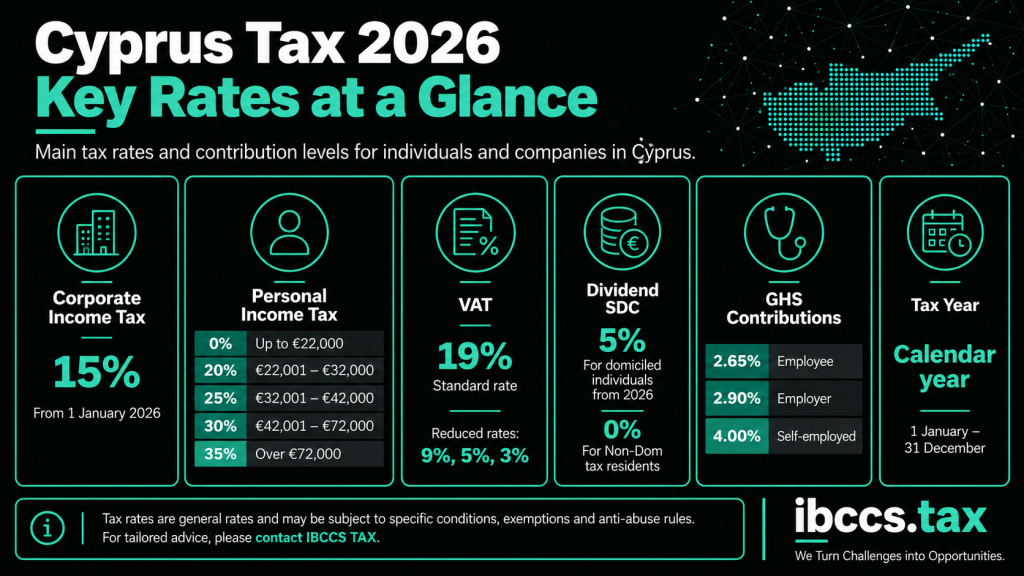
Cyprus Tax 2026: Key Rates at a Glance
| Tax / contribution | 2026 position | Who it commonly affects |
| Corporate income tax | 15% | Cyprus tax-resident companies and taxable Cyprus permanent establishments |
| Personal income tax | 0% to 35% | Employees, self-employed individuals and other individuals with chargeable income |
| Standard VAT | 19% | VAT-taxable supplies, subject to place-of-supply and exemption rules |
| Reduced VAT | 9%, 5%, 3% and 0% | Specified goods and services where statutory conditions are met |
| SDC on qualifying actual dividends | 5% for 2026 profits | Cyprus tax-resident and domiciled individuals; transitional 17% treatment can apply to older profits |
| GHS – employee | 2.65% | Employee remuneration, subject to the GHS framework |
| GHS – employer | 2.90% | Employer contribution on employee remuneration |
| GHS – self-employed | 4% | Self-employed remuneration |
| Social Insurance – employee / employer | 8.8% / 8.8% | Insurable employment earnings; state contributes separately |
| Capital Gains Tax | 20% | Relevant disposals connected with Cyprus immovable property and specified share disposals |
| Crypto gains special regime | 8% | Specified crypto disposals from 2026, subject to the statutory scope and exclusions |
A rate is not a complete tax answer
Cyprus may tax the same person under more than one framework. For example, an employee can have PAYE, Social Insurance and GHS deductions, while a shareholder can have dividend SDC and GHS considerations without personal income tax on the dividend itself.
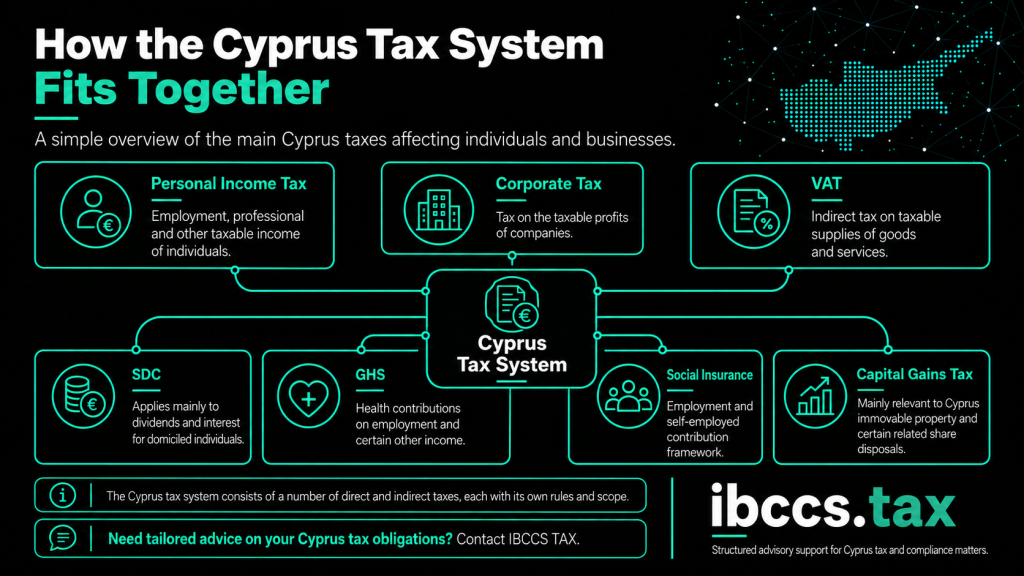
How the Cyprus Tax System Works
Cyprus uses a combination of direct taxes, indirect taxes and social or healthcare contributions. Income tax and corporate income tax apply to taxable income or profit. VAT applies to transactions rather than profit. SDC applies to specified passive income where the recipient falls within the SDC rules. GHS and Social Insurance follow separate contribution frameworks. Capital Gains Tax applies to specific gains rather than forming part of the ordinary income tax calculation.
That separation is important. A transaction can be exempt from one tax but still be relevant for another. Dividends received by an individual, for example, are generally outside personal income tax, but SDC and GHS may still need to be considered. A company can also have taxable accounting profit, VAT obligations and payroll liabilities at the same time, each with a different reporting timetable.
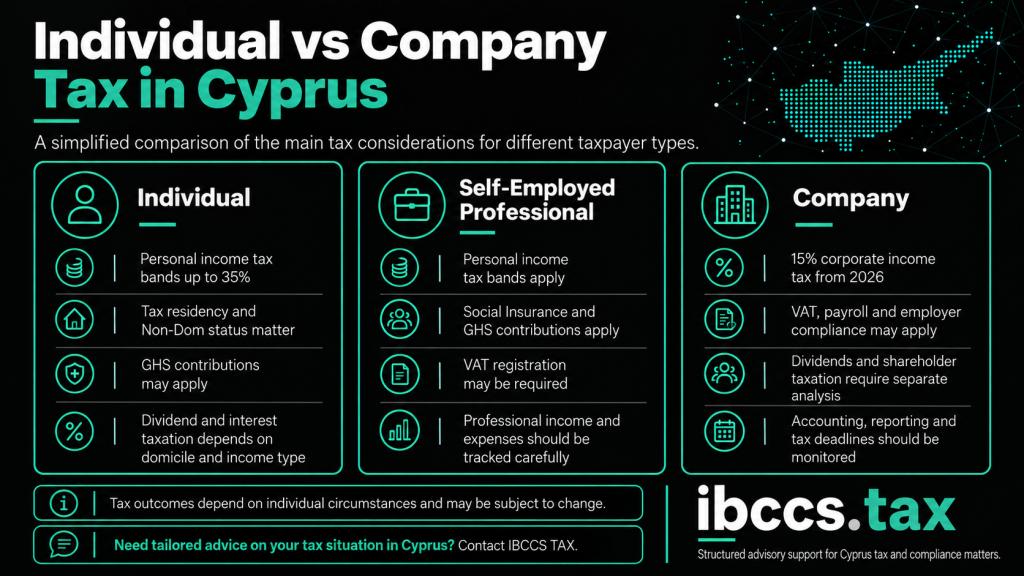
Individuals, Self-Employed Professionals and Companies: Different Tax Frameworks
| Profile | Main tax framework | Typical additional obligations |
| Employee | Personal income tax through PAYE | Social Insurance, GHS, annual tax return where required |
| Self-employed professional | Personal income tax on chargeable business profit | Social Insurance, GHS, provisional tax, VAT where applicable, bookkeeping and annual filing |
| Cyprus company | 15% corporate income tax on taxable profit | Provisional tax, VAT/VIES/OSS where relevant, payroll, financial statements and annual corporate filing |
| Investor / shareholder | Income classification determines treatment | SDC, GHS, CGT, foreign tax credits and reporting may apply |
| International group | Corporate and cross-border tax rules | Transfer pricing, withholding tax, PE, treaty, substance and Pillar Two issues may arise |
Personal Income Tax in Cyprus
Cyprus personal income tax is progressive. From the 2026 tax year, the first €22,000 of annual chargeable income falls within the 0% band. Moving into a higher bracket does not cause the whole income to be taxed at the higher rate; only the part within that band is taxed at that percentage.
| Annual chargeable income | Rate |
| Up to €22,000 | 0% |
| €22,001 – €32,000 | 20% |
| €32,001 – €42,000 | 25% |
| €42,001 – €72,000 | 30% |
| Over €72,000 | 35% |
For calculations, employment income, deductions and the 2026 reform changes, see our detailed Cyprus personal income tax guide.
Employment Income and PAYE
Employers generally withhold income tax from salary through PAYE based on the employee’s expected annual chargeable income and information provided for payroll purposes. Employees should provide the information required for the annual withholding calculation, including the relevant TD59 declaration where applicable. PAYE is only one part of payroll: Social Insurance and GHS deductions also need to be calculated and reported separately.
Businesses operating Cyprus payroll should coordinate PAYE with Payroll in Cyprus and the underlying Social Insurance in Cyprus requirements.
Self-Employment and Professional Income
A self-employed individual is taxed under the personal income tax bands rather than the corporate income tax rate. The calculation starts from business income and then considers allowable expenses, deductions and other adjustments. Social Insurance, GHS, provisional tax, VAT and annual reporting may all apply independently.
Our self-employed in Cyprus guide explains when operating personally can be appropriate and when a company structure may be considered.
Cyprus Corporate Tax
The standard corporate income tax rate is 15% for tax years beginning on or after 1 January 2026. Tax is charged on taxable profit, not gross revenue. Accounting profit is adjusted for exempt income, non-deductible expenses, capital allowances, tax losses and applicable incentives before the final taxable profit is established.
Important corporate features include the seven-year tax loss carry-forward from 2026, group relief subject to conditions, the Notional Interest Deduction on qualifying new equity and the IP Box regime, which provides an 80% deduction on qualifying IP profits under the nexus approach. Qualifying dividend income and gains from qualifying titles can also benefit from exemptions subject to the relevant rules.
For the complete corporate framework, see Cyprus Corporate Tax in 2026. Businesses considering incorporation can also review our Cyprus company formation guide.
Cyprus Tax Residency for Individuals
Tax residency determines the starting point for the scope of an individual’s Cyprus income tax position. The standard 183-day rule generally applies where an individual spends more than 183 days in Cyprus during the calendar year. Cyprus also has a 60-day rule for individuals who meet all of the statutory conditions.
From 2026, the 60-day test no longer requires the individual to prove that they are not tax resident in any other state. The other conditions remain relevant, including the Cyprus day count, the limit on days spent in another single country, a qualifying Cyprus business/employment/office connection and a permanent home in Cyprus.
Read the full conditions in our Cyprus tax residency 2026 guide. Internationally mobile individuals should also consider whether another country can claim tax residency and whether a double tax treaty tie-breaker is needed.
Cyprus Non-Dom and Special Defence Contribution
Cyprus domicile for SDC purposes is separate from tax residency. A qualifying Cyprus tax-resident individual who is non-domiciled can generally benefit from an exemption from SDC on dividend and passive interest income. This is one of the reasons the regime is relevant to entrepreneurs, investors and internationally mobile individuals relocating to Cyprus.
An individual can generally be deemed domiciled once they have been Cyprus tax resident for at least 17 of the preceding 20 tax years. From 2026, an eligible individual without a Cyprus domicile of origin who reaches that deemed-domicile point may elect for an alternative method that can extend the SDC exemption for two additional five-year periods, subject to a €250,000 payment for each five-year period and the statutory application requirements.
Non-Dom does not mean “no Cyprus tax”
The SDC exemption does not remove personal income tax, GHS, Capital Gains Tax, VAT or foreign tax obligations where those regimes apply. Each income stream should be classified separately.
Tax on Dividends in Cyprus
Dividend income received by an individual is generally not subject to Cyprus personal income tax. The main Cyprus questions are instead SDC and GHS, together with the source of the dividend and the recipient’s tax-residency and domicile position.
For Cyprus tax-resident and domiciled individuals, the SDC rate on actual dividends connected with profits earned from 1 January 2026 is 5%. Transitional rules are important: dividends paid from profits earned up to 31 December 2025 can remain subject to the historical 17% SDC rate if distributed within the relevant transitional period, including distributions made on or before 31 December 2031 where the conditions apply.
Our dedicated guide to tax on dividends in Cyprus explains domiciled, Non-Dom and GHS treatment, distributions by Cyprus companies and the transitional profit-year rules.
General Healthcare System (GHS / GESY) Contributions
GHS is a separate contribution from income tax and Social Insurance. Employees generally contribute 2.65% on salary and employers contribute 2.90%. Self-employed individuals generally contribute 4% on their remuneration. A 2.65% rate can also apply to income such as pensions, dividends, interest, rents and other relevant income.
For natural persons, the aggregate annual income base subject to GHS is capped at €180,000. The way the cap is applied can matter where the individual receives several categories of income. A Non-Dom exemption from SDC does not automatically create a GHS exemption.
Social Insurance in Cyprus
For employees, the Social Insurance Fund contribution rate in 2026 is 22.8% of insurable earnings in total: 8.8% paid by the employee, 8.8% by the employer and 5.2% by the state. The maximum insurable earnings for 2026 are €5,742 per month for monthly paid employees and €1,325 per week for weekly paid employees for the funds to which that ceiling applies.
Employers also contribute to the Redundancy Fund, Human Resource Development Fund and Social Cohesion Fund, and may have Central Holiday Fund obligations depending on their position. GHS is calculated separately. Self-employed persons generally pay 16.6% of the applicable insurable income as their Social Insurance contribution, with the state contributing separately.
For rates, caps, employer funds and payment deadlines, see Social Insurance in Cyprus.
VAT in Cyprus
Cyprus VAT forms part of the EU VAT system. The standard rate is 19%, with reduced rates of 9%, 5% and 3% and 0% treatment for qualifying supplies. The general domestic registration threshold is €15,600 of taxable transactions, while separate thresholds and registration triggers apply to intra-EU acquisitions and certain cross-border activities.
VAT should not be determined simply by where a company is incorporated. The nature of the supply, place of supply, customer status and customer location can create VAT, reverse-charge, VIES or OSS obligations even where domestic turnover is low.
Use our pillar guide to VAT in Cyprus for rates and returns, and the supporting guides on VAT registration in Cyprus, VIES registration and VAT for international services for detailed cross-border rules.
Capital Gains Tax in Cyprus
Cyprus Capital Gains Tax is generally charged at 20% on relevant gains from the disposal of immovable property situated in Cyprus and on specified disposals of shares in companies whose value is sufficiently connected with Cyprus immovable property. The 2026 reform changed aspects of the property-rich company rules and increased certain lifetime exemptions available to individuals.
CGT is distinct from ordinary income tax. A disposal that falls outside the Cyprus CGT scope can still require analysis under income tax, corporate tax or another regime depending on the taxpayer and nature of the transaction.
Crypto Tax in Cyprus From 2026
The 2026 reform introduced an 8% special mode of taxation for gains from specified crypto-asset transactions. The statutory regime covers qualifying disposals such as sales, exchanges, gifts and use of crypto as payment, while crypto acquired through mining falls outside the special regime. Losses are generally ring-fenced to qualifying crypto gains of the same year and cannot be carried forward under the ordinary tax-loss rules.
Rental Income in Cyprus
Rental income remains relevant for personal or corporate income tax depending on the owner. From 2026, SDC on rental income was abolished. GHS can still apply to relevant rental income of individuals, and the tax treatment of expenses, capital allowances, property use and cross-border ownership should be reviewed separately.
Withholding Taxes and International Payments
Cyprus generally does not impose withholding tax on ordinary dividends, interest and royalties paid to non-residents, but the position now includes targeted defensive measures. Payments to companies in EU non-cooperative jurisdictions and, from 2026, certain related companies in low-tax jurisdictions can be subject to specific withholding or non-deductibility rules. Treaty protection and the detailed conditions should be reviewed before payment.
International groups should also consider transfer pricing, permanent-establishment exposure, foreign tax credits, double tax treaties and, for very large groups, Pillar Two requirements.
Provisional Tax and Annual Tax Payments
Cyprus companies with taxable income and self-employed individuals within the provisional-tax framework generally pay provisional tax in two instalments: 31 July and 31 December of the relevant tax year. The estimate should be based on expected full-year taxable income and should be reviewed before year-end.
Where provisional taxable income is less than 75% of final taxable income, an additional 10% tax can apply to the relevant shortfall. Late payment can also trigger interest and monetary penalties, so estimate accuracy and payment timing are separate compliance questions.
See Cyprus Provisional Tax 2026 for the calculation process and the 75% rule.
Tax Returns and Tax For All
From the 2026 tax year, individual income tax returns are submitted through Tax For All. The statutory individual filing deadline is 31 July of the following year, subject to any extension granted by decree. The 2026 reform also broadened the individual filing obligation for Cyprus tax residents, including residents aged 25 to 70 even where income is low or nil, subject to the statutory framework and any exemptions introduced by order.
For companies and self-employed individuals required to prepare financial statements, the filing deadline for tax years from 2026 is 31 January of the second year following the tax year. For example, the 2026 corporate income tax return is due by 31 January 2028.
Individuals who need filing support can use our Cyprus IR1 income tax return service, while businesses can combine filing with accounting services in Cyprus and bookkeeping.
Cyprus Tax Compliance: What Businesses Should Monitor
- Corporate income tax and provisional tax estimates.
- VAT returns, VIES and OSS where relevant.
- PAYE, GHS and payroll reporting for employees.
- Social Insurance and employer fund contributions.
- SDC and GHS withholding on relevant dividends and interest.
- Accounting records, financial statements and audit requirements.
- Transfer pricing and related-party documentation.
- Annual corporate, personal and employer filings.
- Foreign tax credits, treaty relief and cross-border reporting where applicable.
For a date-driven view of these obligations, see our Cyprus Tax Calendar 2027.
How IBCCS TAX Can Help
IBCCS TAX combines tax advisory with implementation and ongoing compliance. We support Cyprus companies, founders, investors, employees, self-employed professionals and internationally mobile individuals with tax planning, registrations, accounting, payroll, VAT, Social Insurance, personal filings and cross-border coordination.
Depending on the case, support can combine tax planning services in Cyprus, accounting services in Cyprus, payroll preparation and Social Insurance services so that the tax analysis and the practical filings are aligned.

Frequently Asked Questions – Tax in Cyprus
1. What is the corporate tax rate in Cyprus in 2026?
The standard corporate income tax rate is 15% for tax years beginning on or after 1 January 2026. The rate applies to taxable profit after applicable tax adjustments rather than to gross turnover.
2. What are the personal income tax rates in Cyprus?
From 2026, the first €22,000 of annual chargeable income falls within the 0% band. The marginal rates then rise through 20%, 25% and 30%, with 35% applying only to the part of chargeable income above €72,000.
3. What is the VAT rate in Cyprus?
The standard Cyprus VAT rate is 19%. Reduced rates of 9%, 5% and 3%, as well as 0% treatment, apply to specified supplies subject to the statutory conditions.
4. Does Cyprus have a Non-Dom tax regime?
Yes. A qualifying Cyprus tax-resident individual who is non-domiciled for SDC purposes can generally benefit from an exemption from SDC on dividends and passive interest. Other taxes and GHS may still apply.
5. How are dividends taxed in Cyprus from 2026?
Dividends are generally outside personal income tax. For Cyprus tax-resident and domiciled individuals, SDC is 5% on actual dividends linked to profits earned from 2026, while transitional 17% treatment can apply to older profits. Qualifying Non-Dom individuals are generally exempt from SDC, but GHS can remain relevant.
6. How much is Social Insurance in Cyprus in 2026?
For employees, 8.8% of insurable earnings is paid by the employee and 8.8% by the employer, with a separate state contribution. Employers also have additional fund and GHS obligations.
7. When are Cyprus tax returns due?
Deadlines depend on the taxpayer and tax year. The statutory individual deadline is generally 31 July of the following year, subject to extensions. For corporate tax years from 2026, the deadline is 31 January of the second year following the tax year.
8. Is Cyprus tax only relevant to Cyprus-source income?
For Cyprus tax residents, worldwide income can fall within the Cyprus tax framework, subject to exemptions, foreign tax credits and treaty rules. Non-residents are generally taxed on relevant Cyprus-source income.
9. Is Cyprus still a low-tax jurisdiction after the 2026 reform?
Cyprus remains a competitive EU tax jurisdiction, but the correct analysis depends on the taxpayer and transaction. The 15% corporate rate is only one part of the system; exemptions, incentives, VAT, SDC, GHS, transfer pricing and substance requirements can materially affect the outcome.


Tax in Cyprus 2026: Complete Guide for Individuals and Companies
Cyprus has a relatively compact tax system, but the headline
Read More
Cyprus Corporate Tax in 2026: Rate, Taxable Profits, Exemptions and Filing Requirements
Cyprus corporate tax changed materially from 1 January 2026. The
Read More
Cyprus Companies at Risk of Strike-Off: 31 December 2026 Deadline for Overdue HE32 Annual Returns
Cyprus companies with overdue Annual Returns (HE32) and corresponding Financial
Read MoreImportant Note: This article provides general information on Cyprus tax and compliance rules. The correct treatment depends on the taxpayer, the nature and source of the income or transaction, tax residency and domicile, available exemptions, applicable double tax treaties and the facts of the case. It should not be treated as a substitute for transaction-specific tax or legal advice.