

Private client accounting is not simply a personal tax return prepared once a year. For internationally mobile individuals, entrepreneurs, investors and high-net-worth families, accurate Cyprus reporting depends on maintaining a clear record of income, investments, foreign taxes, company transactions and family structures throughout the year.
A private client may receive salary from one country, dividends from several companies, interest through international banks, rental income from foreign property, pension income, investment gains and distributions from a trust or family structure. The same person may also be a director or shareholder of companies whose accounts must be consistent with their personal tax position.
The purpose of private client accounting is to turn that complexity into a supportable annual reporting file that can be used for tax returns, foreign tax credits, banking, source-of-funds reviews and future tax planning.

- Private client accounting should begin with classification of each income and asset category, not with a single total for “foreign income”.
- Bank deposits alone are not sufficient evidence of taxable income. The legal source and nature of each payment should be identified.
- Investment accounts require more than a year-end portfolio value. Dividends, interest, disposals, fees, corporate actions and foreign taxes may need separate treatment.
- Non-Dom status can affect SDC on dividends and passive interest, but it does not remove GHS or all personal tax reporting obligations.
- Foreign rental income should be supported by property accounts, expenses, foreign tax evidence and ownership details.
- Foreign tax credits generally require evidence that the foreign tax was properly imposed and paid.
- Transactions between an individual and their company should reconcile with the company’s accounting records and corporate approvals.
- Multi-currency income should be converted consistently using an appropriate and supportable methodology.
- Trust, foundation and family-entity distributions should be classified before they are reported; the payment label alone may not determine its tax character.
- Source-of-wealth and source-of-funds records are increasingly important for banks, regulated advisers and major transactions.
- Annual compliance is easier when records are maintained throughout the year rather than reconstructed immediately before a filing deadline.
- Accounting and tax planning should operate as one process for clients with material international assets or business interests.
Quick Answer: What Does Private Client Accounting in Cyprus Include?
Private client accounting in Cyprus typically involves identifying and classifying worldwide income, maintaining supporting records, reconciling investment and bank statements, documenting foreign taxes, coordinating transactions with associated companies and preparing the information required for Cyprus personal tax compliance.
For Cyprus tax residents, the review can include salary, directors’ fees, dividends, interest, rent, pensions, investment disposals and other foreign income. Non-Dom status, SDC, GHS, foreign tax credits and double tax treaties must then be considered according to the nature of each item.
For more complex clients, the accounting process should also reconcile personal records with company accounts, trusts, foundations, jointly owned assets and source-of-wealth documentation. Tax planning is more reliable when the underlying records already support the position being claimed.
Who Needs Private Client Accounting in Cyprus?
Private client accounting is most relevant where a person’s financial affairs extend beyond a single salary and one local bank account. Typical clients include:
- high-net-worth individuals;
- internationally mobile entrepreneurs;
- shareholders of Cyprus and foreign companies;
- private investors with multi-jurisdiction portfolios;
- families owning property in several countries;
- individuals receiving foreign pensions;
- beneficiaries or settlors of trusts and foundations;
- professionals with salary and directors’ fees from different jurisdictions;
- families supported by a family office or external investment manager;
- individuals who have recently changed tax residence to Cyprus.
The level of wealth is not the only factor. A person with moderate assets in several jurisdictions can have a more complicated accounting position than a wealthier person whose investments are consolidated with one institution.
Why Private Client Accounting Is Different From Company Bookkeeping
Company bookkeeping normally starts with a defined legal entity. Business bank accounts, invoices, payroll, expenses and accounting policies are maintained within that entity.
A private client’s financial life is less contained. The individual may use several personal accounts, receive investment income automatically, own property jointly with a spouse, hold assets through companies and receive payments that do not arrive with a conventional invoice.
A reliable reporting picture therefore needs to be built from multiple sources, with transactions classified correctly for Cyprus tax purposes.
The work often involves three layers:
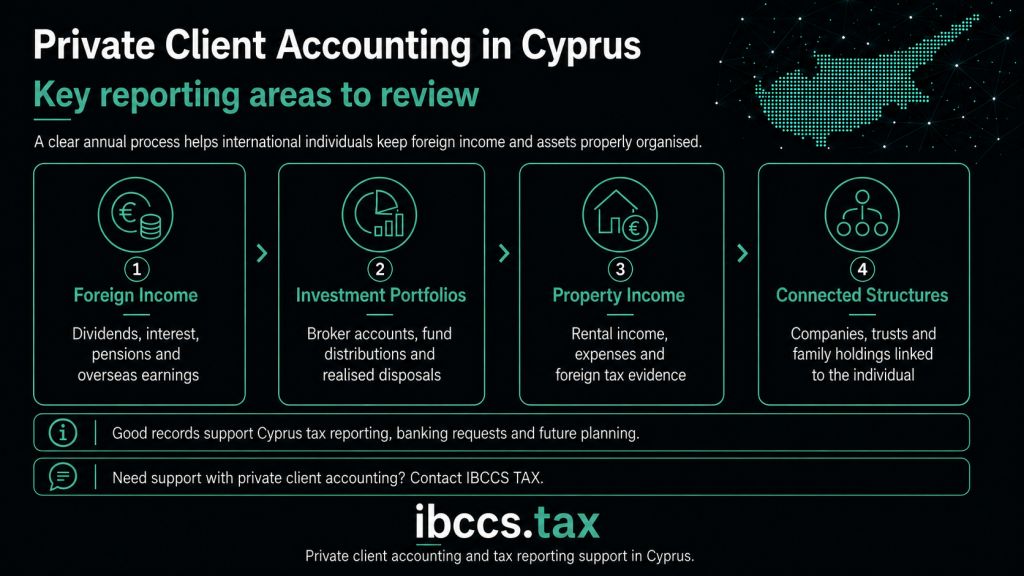
- Personal income and assets – salary, dividends, interest, property, pensions and investments.
- Connected entities – companies, partnerships, trusts, foundations and family structures.
- Cross-border evidence – foreign tax returns, withholding certificates, broker statements and treaty-related documentation.
This is why a private client accounting engagement should be designed around the individual’s full reporting map rather than only the final Cyprus tax return.
Build One Annual Private Client Reporting File
A well-organised private client should be able to produce one annual file explaining the income and significant transactions for the year. That file does not need to contain every personal purchase. It should contain the documents needed to support the items relevant to tax and compliance. A practical file may include:
- bank statements for material accounts;
- annual interest certificates;
- dividend statements and vouchers;
- broker tax and transaction reports;
- realised gains schedules;
- property rental accounts;
- pension certificates;
- company salary and dividend records;
- trust or foundation distribution documents;
- evidence of foreign tax paid;
- major sale, gift or inheritance documentation;
- travel and tax residency records where relevant.
This approach reduces the risk of discovering missing information after the return has already been prepared.
When an Annual Tax Return Service Is No Longer Enough
A straightforward personal tax return can be sufficient where an individual receives a limited number of clearly documented income streams. The position changes when the client’s financial activity first needs to be reconstructed before the annual tax return can be prepared. Ongoing private client accounting becomes more useful where the client has:
- several bank or brokerage accounts in different jurisdictions or currencies;
- regular dividends, interest, fund distributions or investment disposals;
- foreign rental property with expenses and tax paid abroad;
- companies that pay salary, directors’ fees, dividends, expenses or loan repayments to the individual;
- trust, foundation or family-entity distributions that require classification;
- material foreign withholding taxes or tax credits that need supporting evidence;
- frequent changes in portfolio composition, corporate actions or private investments;
- source-of-funds requests connected with property purchases, banking, investment or immigration matters;
- a planned sale, restructuring, gift, inheritance or other major transaction.
The distinction is practical rather than based on a fixed wealth threshold. If preparing the year-end return requires dozens of statements, explanations for unidentified payments and reconciliation of company transactions, a more structured accounting process is usually justified.
How Different Income Categories Should Be Recorded
The accounting process should classify income before applying the Cyprus tax treatment.
| Income or transaction | Records normally required | Main Cyprus review |
| Salary and bonuses | Payslips, employment certificate, payroll/tax statements | Personal income tax, employment exemptions where relevant, foreign tax and GHS/social insurance |
| Directors’ fees | Company resolutions, payment records, foreign tax statements | Source/treaty position, personal tax and company consistency |
| Dividends | Dividend vouchers, resolutions, broker/company statements | Income-tax exemption, Non-Dom/SDC, GHS, foreign withholding |
| Passive interest | Bank or broker statements, withholding certificate | Non-Dom/SDC, GHS and foreign tax |
| Rental income | Rental statements, invoices, expense records, tax assessment | Personal income tax, deductions, GHS and foreign tax credit |
| Foreign pension | Pension certificate and withholding statement | Standard Cyprus rates or available foreign-pension option, treaty treatment |
| Investment disposals | Purchase/sale confirmations, broker report, cost records | Asset classification, securities treatment, capital gains rules |
| Trust/foundation distributions | Distribution resolution, accounts, legal documents | Nature of payment, underlying income, control and residence |
| Company loans or repayments | Loan agreement, ledger, bank evidence | Legal character, interest, benefit and company/personal reconciliation |
| Sale of business or shares | Sale agreement, historic acquisition records, tax computations | Gain classification, foreign tax, treaty and residence timing |
The table is a starting point. A material transaction may require additional documentation depending on the jurisdiction and ownership structure.
Accounting for Foreign Dividends
Dividend income is common for Cyprus private clients who own businesses or investment portfolios. Foreign dividends received by individuals are generally exempt from Cyprus personal income tax. SDC should then be considered separately. A qualifying Cyprus Non-Dom is generally exempt from SDC on dividends, while GHS can remain applicable within the relevant contribution framework.
The accounting file should nevertheless capture the full dividend amount rather than only the net cash received. For example, if a foreign jurisdiction withholds tax before payment, the records should show:
- gross dividend;
- foreign withholding tax;
- net cash received;
- payer and jurisdiction;
- payment date;
- supporting statement or voucher.
Without the gross amount and tax evidence, the Cyprus return or foreign tax credit analysis can be incomplete.
IBCCS TAX’s Cyprus Non-Dom service can be coordinated with ongoing accounting where dividend and passive investment income form a significant part of the client’s profile.
Accounting for Foreign Interest and Cash Investments
International private clients may hold cash deposits, bonds, money-market instruments and other interest-bearing investments with several banks or brokers. Interest should be recorded by account and source. The statement should identify gross interest, foreign tax withheld, currency and the legal owner of the account.
For qualifying Non-Dom individuals, passive interest may generally be exempt from SDC, but GHS can still be relevant. Interest arising from an active financing business or another commercial activity may require a different classification. Joint accounts also require care. The bank statement may show both spouses, but the tax allocation should reflect beneficial ownership and the relevant facts rather than assuming an automatic 50/50 split in every case.
Investment Portfolio Accounting
A portfolio statement showing that an account increased from EUR 2 million to EUR 2.4 million does not reveal the taxable position. The change may include:
- additional capital contributions;
- withdrawals;
- realised gains;
- unrealised gains;
- dividends;
- interest or bond coupons;
- foreign withholding taxes;
- management fees;
- corporate actions;
- foreign exchange movements.
For Cyprus reporting, those components should be separated.
Realised and Unrealised Gains
A portfolio can have significant unrealised appreciation without a disposal. The accounting records should therefore distinguish market-value movements from realised transactions.
Where assets are sold, acquisition cost, disposal proceeds and instrument classification should be available. Cyprus generally provides favourable treatment for gains from qualifying securities, but not every investment product should be assumed to fall within the same definition.
Corporate Actions
Stock splits, mergers, demergers, rights issues, return of capital and in-specie distributions can affect cost basis and future tax treatment.
Broker reports do not always provide a tax analysis appropriate for Cyprus. Significant corporate actions should be reviewed when they occur rather than several years later when the asset is sold.
Multi-Currency Accounts and Foreign Exchange Records
Private clients commonly receive income in GBP, USD, CHF, AED and other currencies while reporting in Cyprus. A consistent conversion methodology is needed so that foreign income, tax credits and transaction values can be reported in euros.
The supporting file should preserve the original-currency amount and the euro amount used for Cyprus reporting. Where a transaction is material, the exchange rate and date methodology should also be traceable. This is particularly important for:
- property sales;
- large dividends;
- share disposals;
- pension lump sums;
- loans between the client and companies;
- investment portfolio transactions.
Using the bank’s net euro receipt as the only accounting record can conceal fees, withholding tax and the original transaction value.
Foreign Rental Property Accounting
A Cyprus tax resident may own residential, commercial or holiday property abroad. The property remains subject to local law and may be taxed in the country where it is situated. Cyprus reporting should then consider the gross rental income, allowable deductions, GHS, foreign tax credits and ownership structure.
From 2026, rental income is no longer subject to Cyprus SDC, but it remains relevant for income tax and GHS analysis. A complete property file should normally include:
- tenancy or platform statements;
- gross rent;
- agent commissions;
- repairs and maintenance;
- insurance;
- local taxes and service charges;
- financing information where relevant;
- foreign tax return or assessment;
- evidence of tax paid;
- co-ownership details.
For Cyprus reporting, the net amount transferred to the client’s bank account should not be treated as the complete rental-income record.
Foreign Pension Income
Foreign pensions should be recorded by pension source and type. From the 2026 tax year, qualifying foreign pension income can generally be taxed either under the normal Cyprus personal income tax scale or under the special 5% method on the amount exceeding EUR 5,000 per year. The appropriate option depends on the individual’s wider income profile, and any applicable double tax treaty should also be considered.
For accounting purposes, the client should keep annual pension certificates, gross income, tax withheld, pension type and the payer’s jurisdiction. Government-service pensions, private occupational pensions and other retirement arrangements should not automatically be treated as the same category.
Trusts, Foundations and Family Structures
A bank transfer from a trust is not enough information to prepare a defensible tax return. A proper review may need to establish:
- who established and funded the structure;
- who controls it;
- the client’s capacity as settlor, beneficiary, protector or other party;
- the nature of the underlying assets and income;
- whether the payment is income, capital, loan, reimbursement or another form of distribution;
- the residence of trustees or administrators;
- relevant foreign reporting.
The tax classification may depend on the legal documents and underlying facts rather than the description appearing on a bank payment. Complex trust and foundation matters should therefore be coordinated with tax and legal advisers before the annual return is finalised.
Personal Transactions With Cyprus or Foreign Companies
For entrepreneurs, one of the most important areas of private client accounting is the interface between the individual and companies they own or manage. Typical transactions include:
- salary;
- directors’ fees;
- dividends;
- shareholder loans;
- repayment of expenses;
- company-paid personal expenditure;
- asset transfers;
- sale or purchase of shares;
- capital contributions.
The personal record should reconcile with the company’s ledger and corporate documents. If company accounts show a shareholder loan while the individual believes the payment was a dividend, the mismatch should be resolved before tax returns are filed. Likewise, a dividend should be supported by the required corporate approvals and distributable profits rather than treated as a convenient accounting label after the cash has already been withdrawn.
For international company owners, our Cyprus tax planning for HNWIs explains the wider interaction between personal residence, company ownership and wealth structures.

Foreign Tax Credits and Withholding Tax Evidence
Foreign income can be taxed before it reaches Cyprus. Examples include withholding on dividends or interest, tax on foreign rental income and tax withheld from employment or pension income.
Where Cyprus permits relief, the credit is generally limited by the applicable rules and should be supported by evidence. A good foreign tax credit file may include:
- foreign tax return;
- tax assessment;
- official payment receipt;
- withholding certificate;
- dividend or pension statement;
- treaty documentation;
- reconciliation between gross income and net payment.
An unexplained deduction on a bank statement may not provide enough evidence that the amount represents creditable foreign tax.
GHS, SDC and Non-Dom Should Be Reconciled With the Income Records
Private client accounting should not treat SDC and GHS as separate year-end calculations disconnected from the income file.
Dividends, passive interest and rental income can have different treatment for income tax, SDC and GHS. Non-Dom status affects SDC but does not generally remove GHS on relevant income.
A clear schedule should therefore be maintained by income category, showing the gross amount, payer, foreign tax and applicable Cyprus treatment. This provides a clearer audit trail than working backwards from one annual contribution total.
Personal Income Tax Returns in Cyprus
From the 2026 tax year, Cyprus personal tax filing obligations are broader. Cyprus tax residents with gross income falling within the scope of the Income Tax Law are generally required to file regardless of age, and Cyprus tax residents aged 25 to 70 are generally required to file regardless of the amount of income, including where they have no income, subject to any specific exemptions introduced by decree.
A low or nil Cyprus tax liability therefore does not necessarily remove the filing obligation. The return may still need to reflect worldwide income categories even where an exemption, Non-Dom treatment or foreign tax credit reduces the final tax payable.
IBCCS TAX provides Cyprus IR1 income tax return services, including gathering and reviewing the financial information needed to support the filing. For complex profiles, the return should be the final output of an organised accounting process, not the first time the client’s foreign income is assembled.
Source of Wealth and Source of Funds Documentation
Private client accounting has value beyond tax returns. Banks, investment firms, property professionals and other regulated service providers may request evidence explaining how wealth was accumulated and where funds for a particular transaction originated.
Source of wealth explains the broader origin of the client’s wealth. Source of funds explains the money used for a specific transaction. Relevant evidence can include:
- company financial statements;
- historic dividend records;
- business sale agreements;
- employment income records;
- property sale documents;
- inheritance or gift documents;
- investment portfolio history;
- tax returns;
- trust distribution records;
- bank statements linking the source to the transaction.
Maintaining this documentation alongside annual tax records can make future property purchases, investments, bank onboarding and major transfers significantly easier to support.
CRS, Platform and Financial Institution Reporting: Consistency Matters
International financial institutions may report account and ownership information under automatic exchange-of-information frameworks. Certain digital platforms can also have reporting obligations under applicable transparency regimes.
The purpose of private client accounting is not to recreate every third-party reporting dataset. It is to ensure that the client’s own tax position is internally consistent with known accounts, entities and income streams.
A discrepancy does not automatically mean tax has been underpaid. It may arise because of joint ownership, gross-versus-net reporting, foreign exchange or a different legal classification. However, unexplained discrepancies should be investigated rather than ignored.
Family Members Should Be Accounted for Separately
Spouses and adult children can have different tax residence, domicile and ownership positions even where family wealth is managed together. A joint investment portfolio, family company or trust can therefore create several individual reporting positions. The accounting process should identify:
- legal and beneficial ownership;
- which family member receives each income stream;
- individual tax residence;
- Non-Dom status;
- gifts or transfers between family members;
- beneficiary distributions;
- company ownership and director roles.
One consolidated family spreadsheet can be useful operationally, but it should not replace individual tax analysis.
Accounting Before a Major Transaction
Private client accounting becomes particularly valuable before a company sale, large dividend, property acquisition, relocation or investment restructuring. An adviser can provide better planning when historic cost, ownership, available cash, foreign taxes and company balances are already known. For example, before a founder receives a substantial dividend, the review should confirm the dividend source, company approvals, shareholder loan position, foreign withholding, personal residence and expected Cyprus treatment. Before a portfolio transfer or asset sale, acquisition cost and historic ownership should be reconstructed early rather than during the transaction closing process.
What the Annual Private Client Accounting Process Looks Like
A well-organised private client accounting process should give the client a clear view of what information is needed, how it will be reviewed and what should be completed before the annual tax filing.
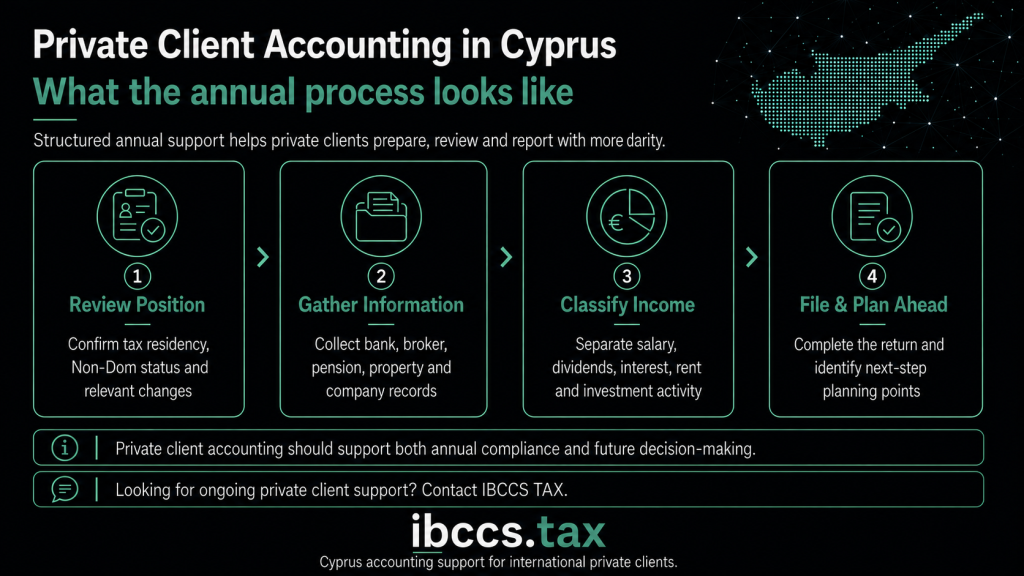
1. Review Your Tax Residency and Personal Position
The process normally starts with confirming your Cyprus tax residency, Non-Dom status and any material changes during the year. This can include a relocation, a new company, a change in employment, a major investment or a change in family circumstances.
2. Gather Income and Asset Information
Relevant information is then collected from banks, investment platforms, companies, pension providers, property managers and other sources. The objective is to create a complete picture of the income and transactions that may be relevant for Cyprus reporting.
3. Reconcile and Classify the Transactions
Different types of income should be identified separately. Salary, dividends, interest, rental income, investment disposals, company payments and distributions can all follow different tax rules, so they should not simply be treated as one category of foreign income.
4. Review the Cyprus Tax Treatment
Once the information is organised, the appropriate Cyprus tax treatment can be reviewed, including personal income tax, Non-Dom and SDC, GHS, foreign tax credits and any relevant double tax treaty considerations. More complex transactions may require additional tax or legal advice before the filing position is finalised.
5. Complete the Filing and Plan Ahead
The final stage is the preparation of the relevant Cyprus tax returns and supporting schedules. It is also an opportunity to identify upcoming transactions, documentation gaps or changes in residence, investments or company ownership that may require planning during the following year.
Good private client accounting should therefore do more than complete an annual tax return. It should give the client and their advisers a reliable financial and tax record that can also support future investment decisions, transactions, banking requirements and tax planning.
Quarterly and Event-Based Reviews Can Prevent Year-End Problems
Private client accounting does not necessarily require monthly bookkeeping in the same way as an operating company. For many internationally mobile clients, a quarterly or event-based review provides a better balance between control and unnecessary administration. A review during the year can be triggered by:
- a substantial dividend or distribution;
- the sale of shares, a business or investment property;
- a change in tax residence or a long period of international travel;
- opening or closing a significant brokerage or bank account;
- receiving a trust or foundation distribution;
- a major foreign tax payment that may later support a Cyprus tax credit;
- a transaction between the individual and an associated company;
- a bank, investment manager or lawyer requesting updated source-of-wealth documentation.
The purpose is not to file tax returns every quarter. It is to identify classification and documentation issues while the information is still available. A transaction that can be explained clearly in May is often much harder to reconstruct the following year after accounts have changed, advisers have moved or statements are no longer easily accessible.
Practical Private Client Scenarios
Scenario 1 – Entrepreneur With Several Foreign Companies
A Cyprus resident receives salary from one company, dividends from two others and periodically pays personal expenses through a corporate card.
The personal accounting file should reconcile salary and dividends with the company records, identify shareholder or director balances and ensure personal expenditure is not incorrectly classified as a business expense or dividend without proper documentation.
Scenario 2 – Investor With Multiple Brokers
An investor holds portfolios with three institutions in different currencies and receives dividends, bond interest and proceeds from securities disposals.
The review should consolidate the income categories, foreign withholding tax and realised transactions while preserving the underlying broker evidence. Portfolio market appreciation should be separated from realised income and gains.
Scenario 3 – Family With Foreign Property and Trust Distributions
A family owns rental property in two countries and receives distributions from a foreign trust.
Each family member’s ownership and beneficiary position should be established. Property income, foreign taxes and trust distributions should be documented separately before Cyprus reporting is prepared.
Scenario 4 – HNWI Relocates to Cyprus Midway Through the Year
A private client changes residence during the year while receiving dividends, salary and investment income before and after the move.
The review should establish a timeline of residence, income dates, foreign taxes and major transactions. Where another country also claims residence, treaty analysis may be required before the Cyprus return is finalised.
Common Private Client Accounting Mistakes
Recording Only Net Bank Receipts
Net cash can omit foreign withholding, processor fees or the legal nature of the payment. Tax reporting should start from the gross transaction where appropriate.
Using One Category for All Investment Income
Dividends, interest, securities disposals, fund distributions and derivatives can follow different tax rules.
Waiting Until the Filing Deadline to Collect Documents
Broker reports, foreign tax certificates and trust records can take time to obtain. Missing evidence may delay a foreign tax credit or create an incomplete return.
Treating Company Money as Personal Money
A shareholder should not use salary, dividends, loans and expense reimbursements interchangeably. Company and personal records must agree.
Assuming Non-Dom Removes the Need for Accounting
An exemption from SDC does not remove the need to identify dividends and interest, calculate GHS where relevant or maintain evidence for tax reporting.
Ignoring Joint and Family Ownership
A joint account or family structure should be allocated according to the real ownership and legal arrangements, not merely the names printed on a statement.
Private Client Accounting Document Checklist
For an annual review, the following documents may be required depending on the client’s circumstances:
- Cyprus and foreign bank statements.
- Annual interest certificates.
- Broker annual tax reports and transaction statements.
- Dividend vouchers and company resolutions.
- Payslips and employment certificates.
- Directors’ fee documentation.
- Rental statements and property expense records.
- Foreign pension statements.
- Foreign tax returns and assessments.
- Evidence of foreign tax paid or withheld.
- Trust or foundation distribution records.
- Shareholder/director loan account statements.
- Major purchase and sale agreements.
- Historic acquisition-cost documentation for disposed assets.
- Travel and tax residence information where relevant.
- Source-of-wealth or source-of-funds documentation for significant transactions.
The objective is not to collect paperwork for its own sake. Each document should support a clearly identified reporting or compliance requirement.
Tax Adviser or Accountant: Why Private Clients Often Need Both
A tax adviser may determine how a dividend, trust distribution, business sale or relocation should be treated. An accountant must then ensure that the transaction is supported by records, reflected consistently and included correctly in the relevant filings. For private clients, the two functions are closely connected. Tax planning without accounting can create a structure that is difficult to maintain. Accounting without tax advice can result in technically accurate records that fail to identify a better treatment or an emerging cross-border risk. An integrated approach is particularly valuable where the client owns companies, has significant foreign investment income or regularly changes jurisdictions.
What Good Private Client Accounting Should Deliver
The value of private client accounting is not measured by the number of spreadsheets produced. The output should make the individual’s financial position easier to understand, report and defend.
| Outcome | What it means in practice |
| Clear annual income map | Each material income stream is identified by source, legal nature, currency and supporting evidence. |
| Reconciled investment activity | Dividends, interest, disposals, fees, taxes and capital movements can be separated from changes in portfolio market value. |
| Consistent personal and company records | Salary, dividends, loans and expense reimbursements agree with the relevant company accounting and approvals. |
| Supportable foreign tax credits | Foreign taxes are linked to the corresponding income and supported by statements, certificates or assessments. |
| Ready source-of-funds file | Major transactions can be explained without rebuilding the client’s financial history from the beginning. |
| Forward-looking tax information | The adviser can identify issues before major distributions, disposals or residence changes rather than only reporting them afterwards. |
This creates a reliable base for tax advisory work. Planning recommendations are stronger when they are built on reconciled records rather than estimates or incomplete year-end information.
How IBCCS TAX Supports Private Clients
IBCCS TAX supports international individuals, investors, entrepreneurs and families with coordinated Cyprus tax and accounting services.
Our work may include:
- personal tax registration and IR1 preparation;
- annual foreign-income reporting;
- dividend, interest and GHS/SDC schedules;
- foreign rental income accounting;
- pension-income reporting;
- investment and securities transaction reviews;
- foreign tax credit documentation;
- shareholder and director account reconciliation;
- coordination with Cyprus and foreign company accounts;
- tax residency and Non-Dom reviews;
- source-of-wealth and source-of-funds support;
- international tax structuring and pre-transaction tax planning.
Where a client’s affairs include companies and wider international structures, IBCCS TAX can combine Cyprus accounting services with international tax planning and structuring so that personal and corporate reporting follows one coherent position.
A Private Client Accounting Engagement Should Remain Proportionate
Private client accounting should not create administration for its own sake. The level of detail should reflect the value, complexity and risk of the client’s financial activity. A person with one foreign pension and one rental property may need a much lighter process than an entrepreneur with several companies, brokers and family structures.
The objective is to identify the records that genuinely support tax compliance and future transactions, agree a practical collection process and keep the file current enough that material questions can be answered without a year-end reconstruction exercise. This proportional approach is particularly important for HNWIs and international families who want reliable oversight without turning personal finances into corporate-style monthly bookkeeping.
Turn International Financial Activity Into a Defensible Reporting Position
Private client accounting is most valuable when it gives the client and advisers a clear view of what was earned, where it came from, what foreign tax was paid and how personal transactions connect with companies and family structures. That visibility supports accurate Cyprus filings, better tax planning and smoother banking or transaction due diligence.
IBCCS TAX can review an existing reporting process or establish an annual private client accounting framework covering foreign income, investments, company transactions and Cyprus tax compliance. Request a Private Client Accounting & Tax Review
Frequently Asked Questions About Private Client Accounting in Cyprus
1. What is private client accounting?
Private client accounting is the organisation, classification and reporting of an individual’s personal and investment financial activity for tax and compliance purposes. It can include foreign income, investments, property, pensions, companies, trusts and family structures.
2. Do I need a private accountant if I am Cyprus tax resident?
Not every individual needs ongoing accounting support. It becomes more valuable where income comes from several countries, investments are substantial, foreign tax credits are required or the individual owns companies and other structures.
3. Does a Cyprus tax resident need to report foreign income?
Cyprus tax residents are generally considered under Cyprus rules in relation to worldwide income. The tax treatment can vary by category and exemptions may apply, but foreign income should not be ignored simply because it was paid to a non-Cyprus bank account.
4. Does Non-Dom status mean I do not need to report dividends and interest?
No. Non-Dom affects SDC treatment but does not make the income disappear for accounting and compliance purposes. GHS and other reporting requirements may still be relevant.
5. How should investment gains be recorded?
The accounting file should preserve acquisition cost, disposal proceeds, instrument type, dates and broker evidence. Unrealised market movements should be distinguished from actual disposals.
6. Can foreign tax be credited against Cyprus tax?
Potentially, where the relevant Cyprus rules or treaty allow a credit. Evidence that the foreign tax was properly imposed and paid should be maintained.
7. Do I need to keep records for foreign rental property?
Yes. Gross rent, expenses, ownership, foreign tax and proof of payment should be documented. The net cash transferred to Cyprus is not enough to establish the tax position.
8. How are UK, US or other foreign pensions handled?
The treatment depends on pension type, Cyprus rules and any applicable double tax treaty. The annual reporting file should include the gross pension income and any foreign tax information needed to determine the appropriate Cyprus treatment.
9. Should my personal accountant see my company accounts?
Where the individual receives salary, dividends, loans, expense reimbursements or other benefits from the company, coordination is highly advisable. Personal and corporate records should not contradict each other.
10. Why is source-of-funds documentation part of accounting?
It is not a tax return requirement in every case, but organised accounting records often provide the evidence banks and regulated professionals request when the client makes a large investment, property purchase or transfer.
11. When should private client accounting begin?
Ideally at the start of Cyprus tax residence or before a significant transaction. A clean opening position makes annual compliance and future planning easier than reconstructing several years of international activity later.
Cyprus Tax Calendar 2027: Key Tax Deadlines for Individuals and Companies
Cyprus tax compliance does not revolve around one annual deadline.
Read More
Tax on Dividends in Cyprus: SDC, GHS, Non-Dom and Company Distributions
Dividend taxation in Cyprus changed materially from 1 January 2026.
Read More
Payroll in Cyprus: PAYE, Social Insurance, GHS and Employer Obligations
Payroll in Cyprus is more than transferring a net salary
Read MoreDisclaimer: This article is for general information only and does not constitute tax, legal or financial advice. Professional advice should be obtained based on your specific circumstances.