

Cyprus Non-Dom eligibility is often described too simply. A person does not qualify merely because they hold a foreign passport, were born outside Cyprus or have recently moved to the island. The correct analysis combines the legal concept of domicile with the individual’s historical Cyprus tax-residence record and the statutory deemed-domicile rules that apply for Special Defence Contribution purposes. For internationally mobile individuals, the result can therefore depend as much on what happened ten or twenty years ago as on where they live today.
This distinction matters because Non-Dom is not a general tax exemption. It is a domicile classification that primarily determines whether a Cyprus tax resident falls within the Special Defence Contribution, or SDC, net on categories such as dividends and passive interest. The main Cyprus Non-Dom guide explains those tax consequences in detail. This article focuses on the question that comes before the tax calculation: who is actually eligible, how domicile of origin and domicile of choice interact, and when the 17-out-of-20-year rule can override the underlying domicile position.
The analysis is particularly important for three groups. The first is a new international resident with no previous Cyprus tax history, for whom the position can initially appear straightforward. The second is a returning resident who has lived in Cyprus in earlier years and may therefore have fewer years available before the deemed-domicile threshold is reached. The third is a person with a Cyprus domicile of origin who has lived abroad for a long period and may need to rely on one of the statutory exceptions rather than simply assuming that long-term absence is sufficient.
Because domicile is fact-sensitive and the 17/20 test is historical, eligibility should be reviewed against a documented timeline rather than a marketing label such as “17 years tax-free”. The objective is to identify the individual’s legal starting point, reconstruct Cyprus tax-residence years accurately and understand when the SDC domicile position could change.
For the broader tax consequences of the regime, see our Cyprus Non-Dom Status guide. For the separate residence tests, see our detailed Cyprus tax residency guide.

- Cyprus Non-Dom eligibility is determined by domicile rules and historical Cyprus tax residence, not by nationality or passport alone.
- Domicile of origin is normally acquired at birth. Under current Cyprus Tax Department guidance, it is generally the same as the father’s domicile at the time of birth, subject to specific exceptions.
- A domicile of choice can arise where an individual settles in a country with the intention of residing there permanently or indefinitely. The analysis depends on facts, conduct and intention rather than one document or registration.
- An individual with a Cyprus domicile of origin may still be treated as non-domiciled in specified circumstances, including where a domicile of choice outside Cyprus is acquired and maintained together with at least 20 consecutive years of non-Cyprus tax residence immediately before the relevant tax year.
- A separate historic exception exists for an individual with Cyprus domicile of origin who resided abroad for more than 20 consecutive years before 16 July 2015.
- Irrespective of domicile of origin, an individual who has been a Cyprus tax resident for at least 17 of the 20 years immediately before a tax year is deemed domiciled in Cyprus for SDC purposes.
- The 17/20 test looks backwards. Previous Cyprus tax-residence years can therefore shorten the period available to a returning resident even if the person has only recently moved back to Cyprus.
- The phrase “17-year Non-Dom period” is a useful shorthand only for a first-time resident with no relevant prior Cyprus tax-residence history and no other domicile issue that changes the analysis.
- •Current rules retain deemed domicile until the individual completes 20 years in which they are not Cyprus tax resident; following the 2026 reform, this long-term exit test should be distinguished from the separate 20-consecutive-year exception that applies to certain individuals with a Cyprus domicile of origin.
Quick Answer: Who Qualifies for Cyprus Non-Dom?
A Cyprus tax resident can generally benefit from Non-Dom treatment where they are not regarded as domiciled in Cyprus for SDC purposes. For an individual whose domicile of origin is outside Cyprus, the 17-out-of-20-year deemed-domicile rule is usually the central long-term statutory test: once the individual has been Cyprus tax resident for at least 17 of the 20 years immediately preceding a tax year, they are deemed domiciled regardless of their original domicile. Before that threshold is reached, an individual without a Cyprus domicile of origin will commonly fall within the Non-Dom framework, subject to the facts and the applicable law.
For an individual whose domicile of origin is in Cyprus, the analysis is different. Cyprus law provides specific exceptions, including a route based on acquiring and maintaining a domicile of choice outside Cyprus together with at least 20 consecutive years of non-Cyprus tax residence immediately before the relevant tax year. There is also a historic exception for individuals who had been abroad for more than 20 consecutive years before 16 July 2015. These exceptions are fact-sensitive and should not be reduced to a passport, birthplace or simple number-of-years test.
In all cases, the 17/20 rule can ultimately override the underlying domicile analysis. The practical eligibility review therefore needs two records in parallel: the legal domicile position and a year-by-year Cyprus tax-residence history.
For a broader understanding of personal income tax, corporate taxation and other obligations, see our comprehensive Tax in Cyprus guide
Core principle
The eligibility question is not “Am I foreign?” but “What is my domicile position for SDC purposes, and how many of the 20 tax years immediately before the relevant year have I been Cyprus tax resident?”
Cyprus Non-Dom Eligibility Framework
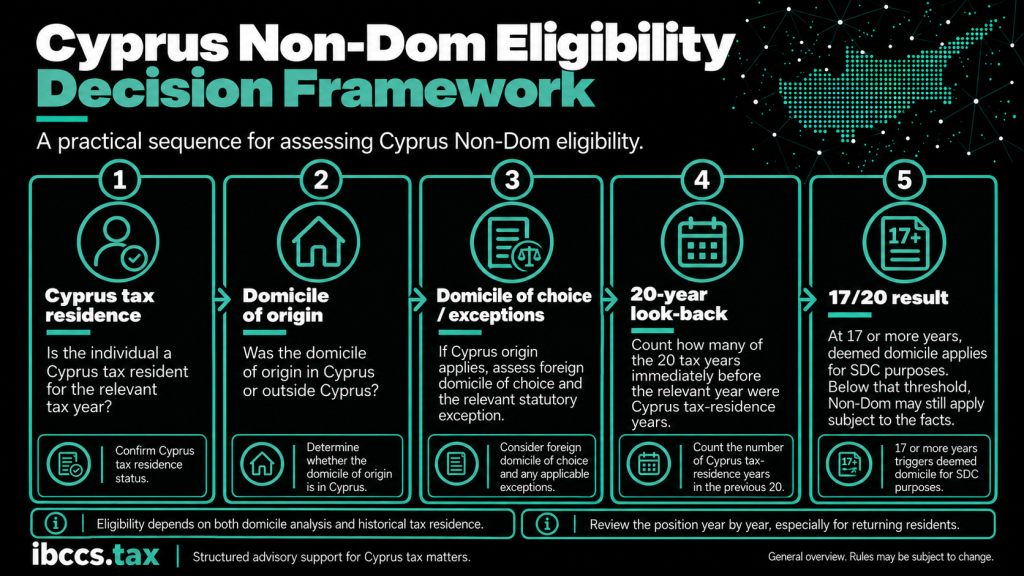
A reliable eligibility analysis works best as a sequence rather than as one yes-or-no question. The first step is to identify whether the individual has a Cyprus domicile of origin. The second is to determine whether any domicile-of-choice or long-term non-residence exception is relevant. The third is to reconstruct the 20-year Cyprus tax-residence look-back because the deemed-domicile rule can override the earlier result. Only after those questions are answered should the tax consequences for dividends, interest and other income be calculated.
| Step | Question | Why it matters |
| 1. Tax residence | Is the individual a Cyprus tax resident for the relevant tax year? | Non-Dom is most relevant once the individual is within the Cyprus resident tax framework; the residence test is separate from domicile. |
| 2. Domicile of origin | Was the individual’s domicile of origin in Cyprus or outside Cyprus? | This determines the starting point of the SDC domicile analysis and whether the Cyprus-origin exceptions may be required. |
| 3. Domicile of choice / exceptions | If Cyprus is the domicile of origin, has a foreign domicile of choice been acquired and maintained and are the statutory non-residence conditions satisfied? | Long-term residence abroad alone should not be assumed to satisfy the exception without the domicile-of-choice element. |
| 4. Historical residence | How many of the 20 tax years immediately before the relevant year were Cyprus tax-residence years? | At 17 or more, the individual is deemed domiciled irrespective of domicile of origin. |
| 5. Ongoing review | Could the domicile or residence timeline change in future years? | Eligibility is not static. A returning resident, long-term resident or person changing their permanent intentions may need the position revisited. |
What Does “Domicile” Mean in Cyprus?
Domicile is a legal concept and should not be confused with tax residence, nationality, citizenship, immigration status or a registered address. A person can be tax resident in Cyprus while remaining non-domiciled for SDC purposes, and two Cyprus tax residents with identical income can therefore have different SDC outcomes. Equally, living abroad for many years does not automatically change domicile if the legal requirements for a domicile of choice are not met or maintained.
For Cyprus Non-Dom purposes, the Tax Department refers to the Wills and Succession Law together with the statutory SDC rules. The framework distinguishes domicile of origin from domicile of choice and then overlays the 17/20 deemed-domicile rule. The key practical point is that domicile is not determined by one form or one visible connection; it is a legal status inferred from the relevant family position at birth, later residence, intention and conduct, and the specific statutory rules that apply for SDC.
This is why documentary evidence and the chronology of the individual’s life matter. Property ownership, family location, employment, business ties, permanent homes and statements of intention can be relevant to the wider factual picture, but none should be treated as a mechanical substitute for the legal test.
Domicile of Origin: The Starting Point
A domicile of origin is normally acquired at birth. Current Cyprus Tax Department guidance states that, as a general rule, it is the same as the father’s domicile at the time of the child’s birth. In exceptional circumstances, the mother’s domicile can be relevant, including where the child was born outside marriage or after the father’s death. The important point for tax planning is that domicile of origin is not simply the country shown on a birth certificate and is not automatically identical to nationality.
Domicile of origin is also unusually persistent. It continues until a domicile of choice is acquired and can revive if a domicile of choice is later abandoned without another domicile of choice being established. This persistence explains why people who have spent most of their adult lives outside Cyprus can still need a detailed domicile review when returning, particularly where their family history gives them a Cyprus domicile of origin.
For an individual whose domicile of origin is outside Cyprus, the SDC framework is often more straightforward in the early years of Cyprus residence because the person does not start from the general Cyprus-origin domicile position. However, the 17/20 deemed-domicile rule applies irrespective of domicile of origin, so a foreign-origin individual cannot assume that Non-Dom treatment continues indefinitely.
Domicile of Choice: Intention, Conduct and Long-Term Home
A domicile of choice can arise when an individual settles in a country with the intention of residing there permanently or indefinitely. The Tax Department emphasises that the existence of a domicile of choice is determined from the facts and circumstances, particularly the individual’s actions and conduct. This makes the concept more demanding than ordinary residence: spending a long period in a country, holding a residence permit or owning property there can support the factual picture, but none of those facts on its own necessarily proves a permanent or indefinite intention.
The intention element also needs to be consistent with conduct. Someone who has built a long-term family home, centralised personal and economic life in another country and has no settled plan to return elsewhere may present a different domicile profile from someone who has lived abroad for many years on temporary assignments while consistently treating Cyprus as the eventual permanent home. Because intention can change, domicile of choice should be reviewed when major life decisions alter the person’s long-term plans.
A domicile of choice continues until it is abandoned. It can be replaced by a new domicile of choice or, if no new choice is acquired, the domicile of origin can revive. For a person relying on a foreign domicile of choice as part of the Cyprus-origin exception, this continuity matters: the analysis is not limited to whether a foreign domicile of choice existed at some point in the past, but whether the relevant legal position is maintained when the exemption is being relied upon.
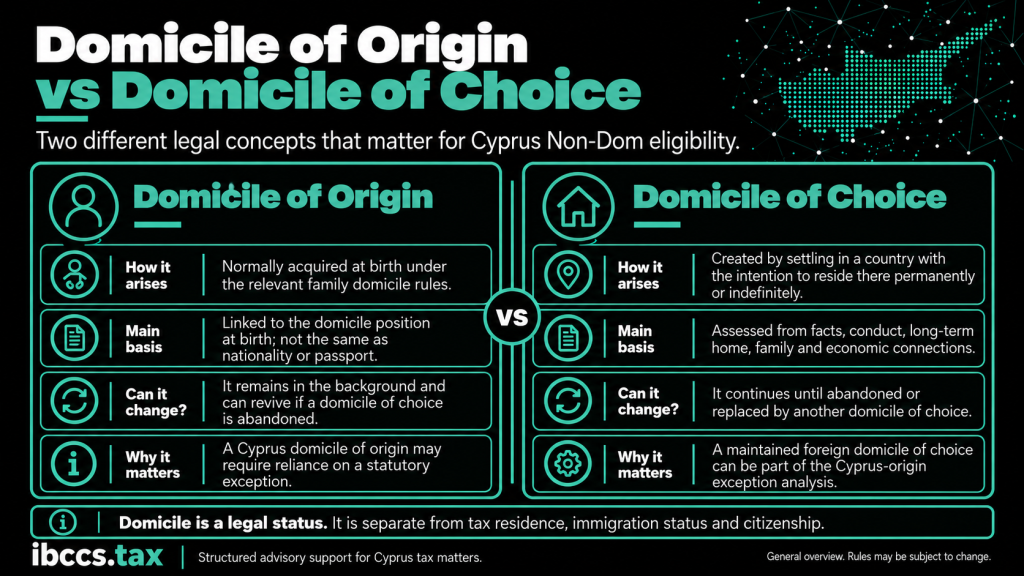
| Issue | Domicile of origin | Domicile of choice |
| How it arises | Normally acquired at birth according to the relevant family domicile rules. | Arises when a person settles in a country with the intention of residing there permanently or indefinitely. |
| Main evidence | Family and domicile position at birth, considered under the Wills and Succession framework. | Facts, conduct, long-term home, family and economic connections, and evidence of permanent or indefinite intention. |
| Can it change? | It remains in the background and can revive if a domicile of choice is abandoned. | Yes. It continues until abandoned or replaced by another domicile of choice. |
| Why it matters for Non-Dom | A Cyprus domicile of origin creates a different starting point and may require a statutory exception to remain outside the SDC domicile net. | A maintained domicile of choice outside Cyprus is part of one key exception for an individual with Cyprus domicile of origin. |
Can Someone With a Cyprus Domicile of Origin Still Be Non-Dom?
Yes, but the exception should be analysed carefully. Under current Cyprus Tax Department guidance, an individual with a Cyprus domicile of origin may be treated as not domiciled in Cyprus where the individual has acquired and maintains a domicile of choice outside Cyprus and was not a Cyprus tax resident for at least 20 consecutive years immediately before the relevant tax year. Both parts matter: the foreign domicile of choice and the long period of non-Cyprus tax residence. Treating the rule simply as “20 years abroad” misses the legal domicile requirement.
A separate historic exception applies to an individual with a Cyprus domicile of origin who resided abroad for more than 20 consecutive years before 16 July 2015. This reflects the transitional architecture introduced when the modern Non-Dom rules entered the SDC framework. Because that historic condition depends on facts from a defined period, it should be supported by reliable records rather than reconstructed only from current residence.
These exceptions are especially relevant to returning Cypriots and individuals with strong family connections to Cyprus. A Cypriot passport does not by itself answer the domicile question, just as a foreign passport does not automatically prove Non-Dom status. The starting point remains the legal domicile analysis, followed by the statutory exceptions and then the 17/20 deemed-domicile overlay.
Do not confuse the two “20-year” concepts
The 20 consecutive years of non-Cyprus tax residence used in the Cyprus-origin domicile-of-choice exception is a different rule from the 17/20 deemed-domicile test and from the post-deemed-domicile rule under which domicile is retained until 20 years of non-Cyprus tax residence have been completed. They answer different questions and should not be merged into one generic “20-year rule”.
The 17/20 Deemed-Domicile Rule
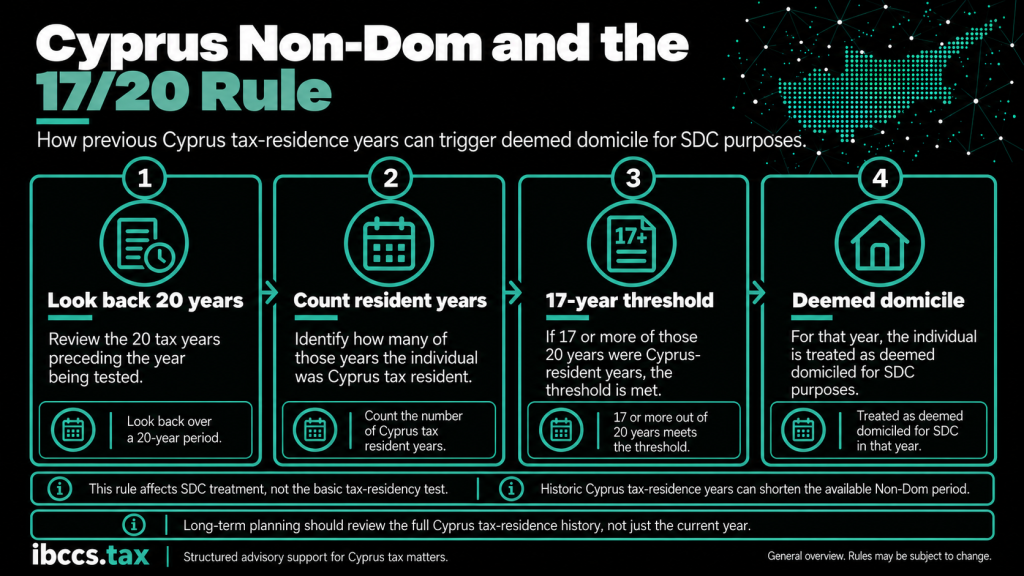
The 17-out-of-20-year rule is the most important long-term eligibility test in the Cyprus Non-Dom framework. Irrespective of the individual’s domicile of origin, a person who has been a Cyprus tax resident for income-tax purposes for at least 17 of the 20 years immediately before the relevant tax year is deemed to have a domicile in Cyprus for SDC purposes. Once that threshold is reached, the individual no longer relies on the ordinary Non-Dom position for SDC simply because their domicile of origin is outside Cyprus.
The wording “immediately before the tax year” is important. The test is a rolling look-back, not a one-time certificate that starts on the date of relocation. For each tax year, the adviser should look at the preceding 20 tax years and count how many of them were Cyprus tax-residence years under the Income Tax Law. If the count reaches 17, deemed domicile applies for the relevant year.
This is why the headline phrase “17 years of Non-Dom” can be misleading. It is broadly useful for a first-time Cyprus tax resident with no earlier Cyprus tax-residence years, but it is not a universal entitlement to 17 new years every time someone arrives or returns. A returning resident can bring earlier Cyprus tax-residence years into the rolling window and therefore reach the threshold sooner.
How the 17/20 Rule Is Counted in Practice
The safest way to apply the rule is to build a tax-year timeline rather than count years from a relocation date. Each year in the 20-year look-back should be classified as a Cyprus tax-residence year or a non-Cyprus tax-residence year according to the applicable Income Tax Law tests. Where the historical position is unclear, the underlying day counts, employment or business ties, permanent home and prior filings may need to be reconstructed before the domicile conclusion is finalised.
A person who becomes Cyprus tax resident for the first time in 2026 and remains continuously resident would, on a simple illustration, have 17 Cyprus tax-residence years by the end of 2042. For the 2043 tax year, the immediately preceding 20-year period is 2023-2042 and contains 17 Cyprus-resident years, so the deemed-domicile test can be reached from 2043. This example assumes no earlier Cyprus tax-residence years and no other fact that changes the domicile analysis.
A returning resident can reach the threshold earlier. Suppose an individual was Cyprus tax resident from 2018 through 2022, non-resident from 2023 through 2025 and resident again from 2026. For the 2038 tax year, the 20 years immediately preceding that year are 2018-2037. That window contains five earlier Cyprus-resident years plus twelve resident years from 2026 through 2037, producing 17 Cyprus-resident years in total. The deemed-domicile threshold can therefore arise in 2038 rather than 2043.
| Illustrative profile | Relevant residence history | What the example shows | |
| First-time resident | First Cyprus tax-residence year: 2026. No earlier Cyprus tax-residence years in the rolling window. | If residence continues, the 2043 tax year is the first simple illustration where the preceding 20 years can contain 17 Cyprus-resident years (2026-2042). | |
| Returning resident | Cyprus resident 2018-2022; non-resident 2023-2025; resident again from 2026. | For 2038, the preceding 20 years can contain 17 Cyprus-resident years: five earlier years plus twelve years after return. | |
| Interrupted residence | Long-term Cyprus residence includes several non-resident years within the rolling 20-year window. | Absence years reduce the count but do not automatically “reset” the test. Each relevant year requires a fresh 20-year look-back. | |
| Important The timeline examples are explanatory only. The actual count depends on whether the individual was a Cyprus tax resident in each historical tax year under the law then applicable. A relocation date by itself is not enough to establish the 17/20 result. |
|||
What Happens When the 17/20 Threshold Is Reached?
When the 17/20 threshold is reached, the individual is deemed domiciled in Cyprus for SDC purposes. This changes the treatment of categories that depend on domicile, particularly dividends and passive interest, unless another statutory mechanism applies. The tax impact should therefore be modelled before the first deemed-domicile year where material investment income or shareholder distributions are expected.
For a detailed explanation of SDC rates, dividend distributions and the tax treatment of different shareholder profiles, see our Tax on Dividends in Cyprus guide.
Current Tax Department guidance also states that deemed domicile is retained until the individual completes 20 years during which they are not a Cyprus tax resident for income-tax purposes. The 2026 reform changed the long-term context of this rule and also introduced an alternative SDC method for a limited category of individuals who do not have a Cyprus domicile of origin but become deemed domiciled because of the 17/20 test. That alternative method can provide two additional five-year periods in return for a €250,000 payment for each period, subject to statutory conditions.
Because that election involves a separate cost-benefit analysis, expected dividends, passive interest, residence horizon and wider estate or family planning, it deserves its own treatment rather than being reduced to an eligibility footnote. Our separate article on Cyprus Non-Dom after 17 years will examine the deemed-domicile transition and the alternative SDC method in detail.
Tax Residency and Non-Dom Eligibility Must Be Kept Separate
The 17/20 test uses Cyprus tax-residence years, but tax residency itself is determined under a different set of rules. Cyprus generally uses the 183-day rule and the 60-day rule to determine individual tax residence. The residence analysis therefore comes first: if a historical year was not a Cyprus tax-residence year under the Income Tax Law, it should not simply be counted because the person owned property, held a Cyprus passport or spent substantial time on the island.
This separation also prevents duplication within the IBCCS TAX content hub. The detailed day-counting rules, permanent-residence condition, employment or business connection and the post-2026 60-day framework belong in the dedicated tax residency guide. The Non-Dom eligibility article should instead use the resulting annual residence status as an input into the domicile timeline.
For individuals planning a move, our Change of Tax Residency to Cyprus service provides professional support with residency assessment and tax planning.
For clients with connections to more than one country, treaty residence can remain important for the wider tax outcome, but the Cyprus statutory 17/20 wording refers to Cyprus tax residence under the Income Tax Law. The residence and domicile analyses should therefore be coordinated rather than treated as interchangeable labels.
For the full residence tests and day-counting rules, see Cyprus Tax Residency: 60-Day and 183-Day Rules.
What Evidence Matters in a Non-Dom Eligibility Review?
Eligibility should be supportable from the individual’s records. For the 17/20 test, the most important evidence is a reliable year-by-year tax-residence history. Historic tax returns, tax-residency certificates, travel records, employment records and prior adviser files can help establish whether a particular year should be treated as Cyprus resident or non-resident. Where the person has moved frequently, the timeline should be completed before any long-term tax assumptions are made.
For domicile of origin, the relevant family and domicile facts at birth need to be identified. For domicile of choice, the evidence is broader because the test concerns permanent or indefinite intention as reflected in conduct. Long-term homes, family location, business and professional life, estate planning, property arrangements, statements of intention and the pattern of moves between countries can all contribute to the factual picture. The weight of any one factor depends on the individual’s circumstances.
The purpose of gathering evidence is not to create unnecessary paperwork. It is to ensure that the legal conclusion can be explained consistently if the individual changes adviser, receives a Tax Department query, plans a substantial dividend, reorganises investments or later approaches the deemed-domicile threshold. For high-value clients, a clear eligibility memorandum and residence timeline can be significantly more useful than relying on a generic Non-Dom label in annual compliance files.
For individuals with multiple income sources, overseas investments or complex financial arrangements, our Private Client Accounting in Cyprus guide explains the importance of accurate financial records and tax reporting.
| Area | Examples of relevant evidence | Why it matters |
| Historical tax residence | Tax returns, residency certificates, travel records, employment or business records, prior filings. | Supports the year-by-year classification required for the rolling 17/20 test. |
| Domicile of origin | Family domicile facts at birth and relevant civil or legal records. | Establishes the starting point of the domicile analysis. |
| Domicile of choice | Permanent homes, family and economic ties, long-term residence pattern, estate planning and evidence of intention. | Helps determine whether a foreign domicile of choice was genuinely acquired and is maintained. |
| Income profile | Dividend vouchers, interest statements, investment and company records. | Shows why the domicile result is commercially relevant and when a review should be prioritised. |
| Future plans | Expected length of Cyprus residence, relocation plans, family decisions and ownership changes. | Helps identify when 17/20 or long-term deemed-domicile planning needs to be addressed. |
Practical Cyprus Non-Dom Eligibility Scenarios
Scenario 1: First-time international resident with no Cyprus domicile of origin
An individual moves to Cyprus for the first time and has no Cyprus domicile of origin and no prior Cyprus tax-residence years. The immediate eligibility analysis is comparatively straightforward: the person enters the Cyprus tax-resident framework while remaining outside the SDC domicile net, subject to the normal facts. The main long-term control is the rolling 17/20 timeline. If the person remains resident continuously, the deemed-domicile issue should be reviewed well before the first year in which 17 of the preceding 20 years become Cyprus-resident years.
Scenario 2: Returning resident with earlier Cyprus tax-residence years
An individual spent several years as a Cyprus tax resident, moved abroad and later returns. It would be incorrect to assume that the person automatically receives a new 17-year Non-Dom period from the date of return. Earlier Cyprus-residence years can still fall within the rolling 20-year window and accelerate the deemed-domicile threshold. The first task is therefore to reconstruct the earlier residence years and project when the 17/20 count could be reached.
Scenario 3: Person with Cyprus domicile of origin after a long period abroad
A person with Cyprus domicile of origin has lived outside Cyprus for decades and plans to return. Long absence is relevant but not, by itself, the complete eligibility test. The adviser needs to assess whether the individual acquired and maintains a domicile of choice outside Cyprus and whether the required period of at least 20 consecutive years of non-Cyprus tax residence immediately before the relevant year is satisfied, or whether the historic pre-16 July 2015 exception is relevant. The person’s long-term intention on returning can also be important to the domicile-of-choice analysis.
Scenario 4: Long-term foreign-origin resident approaching 17/20
A foreign-origin individual has been Cyprus tax resident for many years and receives substantial annual dividends. The person may still be Non-Dom today, but the commercial risk lies in the upcoming deemed-domicile year. The residence timeline should be confirmed, expected investment income modelled and the next-stage planning considered before the threshold is reached. For an individual without Cyprus domicile of origin, the alternative SDC method introduced from 2026 may become relevant, but it should be evaluated separately from basic eligibility.
Common Non-Dom Eligibility Mistakes
“I am not Cypriot, so I automatically qualify.” Nationality is not the legal test. A foreign national can ultimately become deemed domiciled under the 17/20 rule, while a person with Cypriot nationality may fall within a statutory exception depending on domicile and residence history.
“I was born outside Cyprus, so my domicile of origin must be outside Cyprus.” Birthplace and domicile of origin are not the same concept. The Tax Department’s guidance links domicile of origin to the relevant parental domicile at birth, subject to exceptions.
“I lived abroad for 20 years, so I am definitely Non-Dom.” For an individual with Cyprus domicile of origin, the key exception involves both a maintained domicile of choice outside Cyprus and the required period of non-Cyprus tax residence. The historic pre-2015 exception is separate. A simple residence duration does not replace the legal test.
“The 17 years start again when I return to Cyprus.” Incorrect. The rule looks at 17 of the 20 years immediately before each tax year. Prior Cyprus tax-residence years can remain inside that rolling window and shorten the time before deemed domicile.
“A few years abroad reset the 17/20 rule.” Not necessarily. Non-resident years reduce the count in the rolling period, but the test must be recalculated year by year. Current rules also retain deemed domicile until the individual completes the required long-term period of non-Cyprus tax residence after deemed domicile has arisen.
“Once eligibility is confirmed, it never needs to be revisited.” Domicile of choice can be abandoned, residence history continues to evolve and the 17/20 threshold can approach. Long-term residents should treat Non-Dom as a monitored tax position, not a permanent label.
A Practical Eligibility Review Before Relying on Non-Dom
Before relying on the Cyprus Non-Dom position for a material dividend, investment portfolio or long-term relocation plan, the individual should have a clear answer to four questions. What is the domicile of origin? If Cyprus is the domicile of origin, which statutory exception is being relied upon and is the foreign domicile of choice still maintained? How many of the 20 tax years immediately before the relevant year were Cyprus tax-residence years? Finally, when does the projected residence timeline cause the 17/20 threshold to become relevant?
This review is deliberately different from a step-by-step application guide. The commercial value lies in reaching the correct eligibility conclusion and being able to support it with evidence, not in reproducing the Tax Department’s administrative process. Once the legal and factual position is clear, the appropriate documentation and implementation can be coordinated with the individual’s annual tax compliance and wider private-client file.
For clients with companies, investments or family structures in several countries, the eligibility review should also identify why the status matters. A person with little dividend or interest income may have a different planning priority from a founder expecting a substantial distribution or an investor approaching the 17/20 threshold. The tax analysis should therefore remain proportionate to the financial profile and future plans.
How IBCCS TAX Can Help With Cyprus Non-Dom Eligibility
IBCCS TAX can review Cyprus Non-Dom eligibility as part of a wider tax-residency and private-client analysis. This can include reconstructing historical Cyprus tax-residence years, identifying the domicile-of-origin position, assessing whether a domicile-of-choice exception is relevant and determining the first tax year in which the 17/20 deemed-domicile rule could apply. The objective is to establish a supportable timeline before tax consequences are modelled.
For returning residents and individuals with a Cyprus domicile of origin, the review can focus on the long-term non-residence history and the factual basis for any foreign domicile of choice. For internationally mobile founders and investors, the analysis can be integrated with dividend planning, GHS, foreign withholding tax, personal tax returns and the residence or management of connected companies. This avoids treating Non-Dom as an isolated status where the surrounding cross-border facts point to a more complex result.
Long-term residents approaching the 17/20 threshold can also benefit from an early forward-looking review. Where relevant, IBCCS TAX can assess the transition to deemed domicile and coordinate the analysis with the alternative SDC method and the individual’s expected income profile. Early review is generally more useful than waiting until the first deemed-domicile year, particularly where large distributions or portfolio restructuring are planned.
To discuss your position, see our Cyprus Non-Dom service or our broader Cyprus tax planning services.

Frequently Asked Questions About Cyprus Non-Dom Eligibility
1. Who is eligible for Cyprus Non-Dom status?
Eligibility depends on the individual’s domicile position and historical Cyprus tax residence. A person who is Cyprus tax resident but is not domiciled in Cyprus for SDC purposes can generally fall within the Non-Dom framework. The 17/20 deemed-domicile rule can ultimately override the underlying domicile position.
2. Does a foreign passport automatically make me Non-Dom in Cyprus?
No. Nationality is not the legal test. Domicile of origin, domicile of choice, the statutory exceptions and the 17-out-of-20-year residence history are more relevant to the SDC domicile analysis.
3. Is domicile of origin the same as country of birth?
No. Under current Tax Department guidance, domicile of origin is normally acquired at birth and is generally linked to the father’s domicile at that time, subject to specific exceptions. It should not be determined merely from birthplace or nationality.
4. What is domicile of choice?
A domicile of choice exists where an individual settles in a country with the intention of residing there permanently or indefinitely. It is assessed from the facts, circumstances, actions and conduct and continues until it is abandoned or replaced.
5. Can a person with Cyprus domicile of origin qualify as Non-Dom?
Potentially yes. One statutory route applies where the individual has acquired and maintains a domicile of choice outside Cyprus and has not been Cyprus tax resident for at least 20 consecutive years immediately before the relevant tax year. A separate historic exception can also apply to certain individuals who were abroad for more than 20 consecutive years before 16 July 2015.
6. What is the Cyprus 17/20 rule?
An individual who has been Cyprus tax resident for at least 17 of the 20 years immediately before a tax year is deemed domiciled in Cyprus for SDC purposes, irrespective of domicile of origin.
7. Does everyone receive exactly 17 new Non-Dom years when they move to Cyprus?
No. The phrase “17 years” is only a shorthand for a simple first-time-resident scenario. Previous Cyprus tax-residence years can remain inside the rolling 20-year window and cause a returning resident to reach deemed domicile earlier.
8. How are the 17 years counted?
The test is applied by looking at the 20 tax years immediately before the relevant tax year and counting how many were Cyprus tax-residence years under the Income Tax Law. It is therefore a rolling historical test rather than a fixed certificate period.
9. Does leaving Cyprus for a few years reset the 17/20 rule?
Not automatically. Non-resident years reduce the count in the rolling 20-year period, but prior Cyprus-resident years can remain relevant until they fall outside the window. Once deemed domicile has arisen, the separate long-term rule for ceasing that deemed status must also be considered.
10. What happens after I become deemed domiciled?
The individual enters the SDC domicile net for the relevant categories unless another statutory mechanism applies. From 2026, certain individuals without Cyprus domicile of origin can consider the alternative SDC method, subject to its own conditions and payment requirements.
11. Is tax residency the same as Non-Dom eligibility?
No. Tax residency is determined under the Cyprus residence rules, including the 60-day and 183-day tests. Domicile is a separate SDC concept. The annual tax-residence result is then used as an input when applying the 17/20 deemed-domicile rule.
12. When should eligibility be reviewed again?
A review is particularly important when a person returns to Cyprus after previous residence, changes long-term plans, approaches the 17/20 threshold, expects a significant dividend or interest receipt, or relies on a foreign domicile of choice as part of the Cyprus-origin exception.


Cyprus Non-Dom Eligibility: Domicile of Origin, Domicile of Choice and the 17/20 Rule
Cyprus Non-Dom eligibility is often described too simply. A person
Read More
IBCCS TAX to Attend Plan ₿ Forum 2026 in Lugano, Switzerland
IBCCS TAX will be attending Plan ₿ Forum 2026 in
Read More
Cyprus Non-Dom Status: Tax Benefits, Eligibility, Rules and How It Works
Cyprus Non-Dom status is one of the most important elements
Read MoreImportant Note: This article provides general information on Cyprus Non-Dom eligibility and reflects the framework reviewed in October 2026. Domicile is a fact-sensitive legal concept and the correct result depends on the individual’s domicile of origin, domicile of choice, historical Cyprus tax-residence years, long-term intentions and the statutory SDC rules applicable to the relevant tax year. The article should not be treated as a substitute for individual tax or legal advice, and the eligibility analysis should be coordinated with the person’s wider Cyprus tax-residency, income and cross-border position.