

Cyprus Non-Dom status is particularly relevant to internationally mobile investors, company shareholders and private clients whose wealth and income are spread across more than one country. The most visible benefit is the exemption from Special Defence Contribution on qualifying dividend income and passive interest for a Cyprus tax resident who remains non-domiciled for SDC purposes. For an individual with foreign companies, brokerage accounts, bank deposits, bond portfolios or other overseas investments, that exemption can materially change the Cyprus tax result.
The benefit, however, does not mean that foreign income or overseas investments can be treated as one tax-free category. Cyprus tax analysis is driven by the legal character of the income and the asset. A foreign dividend is different from bond interest, a gain on qualifying securities is different from a gain on foreign real estate, and a distribution from a private structure may need to be analysed differently from a listed-company dividend. General Healthcare System contributions, foreign withholding tax, double tax treaties, foreign tax credits and annual reporting can remain relevant even where Cyprus SDC is zero.
This guide focuses specifically on that cross-border investment layer. It explains how foreign dividends and interest interact with Non-Dom, how overseas portfolios should be classified, why the location of the bank or broker account does not determine the Cyprus result, and how foreign withholding taxes and treaty relief can affect the effective return. For a broader overview of the rules, including eligibility, the 17/20 deemed-domicile test and the scope of the exemption, see our main Cyprus Non-Dom guide.

- A Cyprus tax resident who qualifies as Non-Dom is generally exempt from SDC on dividend income and passive interest, including qualifying income arising outside Cyprus.
- Foreign dividends are generally outside Cyprus personal income tax for individuals, but GHS/GESY can still apply and the source country may levy withholding tax before the dividend is received.
- Passive foreign interest can generally fall within the Non-Dom SDC exemption, but interest arising from a business, financing activity or closely connected commercial activity may follow income-tax rules instead.
- GHS is separate from SDC. Income earners are generally subject to GHS at 2.65% on relevant dividends and interest, subject to the €180,000 maximum annual contribution base for a natural person.
- Cyprus Non-Dom is not a remittance-basis regime. Keeping income in a foreign bank or brokerage account does not by itself remove the need to analyse it under Cyprus tax and reporting rules.
- Gains from the disposal of qualifying securities can generally benefit from separate Cyprus tax exemptions. That favourable treatment comes from the securities rules, not from Non-Dom status.
- Not every fund, structured product, derivative or investment wrapper should automatically be assumed to be a qualifying security. The instrument and the legal nature of the return should be classified before the tax treatment is applied.
- Foreign real-estate income and gains follow different rules from listed securities. Rent can remain relevant for Cyprus income tax and GHS, while a genuine capital gain on foreign immovable property is generally outside Cyprus CGT but can be taxed in the property jurisdiction.
- From 2026, many gains from crypto-asset disposals fall within a separate 8% Cyprus income-tax regime. Non-Dom does not exempt crypto gains merely because the exchange, wallet or issuer is outside Cyprus.
- A foreign tax credit is generally limited to Cyprus tax attributable to the same income. If Cyprus imposes no corresponding tax because an exemption applies, foreign withholding tax may remain an unrecovered cash cost rather than producing a Cyprus refund.
- For substantial portfolios, reliable documentation should distinguish gross income, foreign tax withheld, net cash, realised gains, unrealised movements, fees, corporate actions and beneficial ownership. A year-end account value is not enough for a supportable Cyprus tax file.
Quick Answer: How Does Cyprus Non-Dom Affect Foreign Income?
Cyprus Non-Dom primarily affects the Special Defence Contribution layer on foreign dividends and passive interest. A qualifying Cyprus tax resident who is non-domiciled is generally exempt from SDC on those categories, whether the income is Cyprus-source or foreign-source. The exemption does not depend on bringing the funds into Cyprus and should not be confused with a remittance-basis system.
The remaining tax analysis continues separately. GHS can apply to relevant investment income, a source country may withhold tax, investment gains may fall within the Cyprus securities rules or another tax regime, and annual reporting obligations can remain. The practical result therefore depends on the income type, the legal instrument, the source country and the individual’s complete tax-residence and investment profile. For a broader explanation of the Cyprus tax framework beyond Non-Dom, see our Tax in Cyprus guide.
Foreign does not mean outside the Cyprus analysis
For a Cyprus tax resident, the location of the bank account, broker or payer is not the decisive factor. The legal nature of the income, the asset and the applicable Cyprus and treaty rules are more important than where the cash is held.
Foreign Income and Overseas Investments at a Glance
| Income / investment | Typical Cyprus Non-Dom position | What else to review |
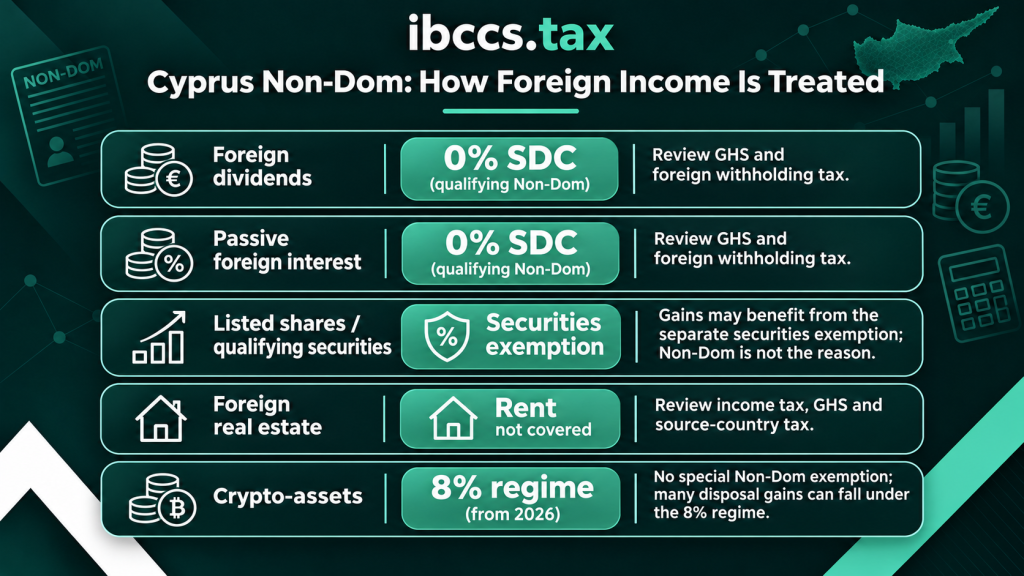
| Foreign dividends | Generally exempt from SDC for a qualifying Non-Dom; generally outside personal income tax | GHS, foreign withholding tax, treaty relief, company/distribution documentation |
| Passive foreign interest | Generally exempt from SDC for a qualifying Non-Dom | GHS, source-country tax, whether interest is truly passive or business-related |
| Listed shares / qualifying securities | Non-Dom is not the reason for the gain treatment | Whether the instrument qualifies as a security; separate Cyprus securities exemption; source-country rules |
| Bonds / money-market instruments | Coupons/interest and disposal gains may follow different rules | Passive-interest treatment, GHS, security classification, accrued interest, withholding |
| Funds / ETFs | Depends on the legal form and nature of distributions and gains | Dividend vs interest vs other distribution, security status, fund domicile and withholding |
| Foreign real estate | Non-Dom does not exempt rent; foreign property gain is not a Non-Dom benefit | Cyprus income tax/GHS on rent, source-country tax, foreign CGT, treaty and credit position |
| Private company holdings | Dividends may benefit from Non-Dom SDC exemption | Company residence, source withholding, valid dividend, loans/remuneration, future disposal |
| Crypto-assets | No special Non-Dom exemption | Special 8% regime from 2026 for many disposal gains; mining/business classification; reporting |
Foreign Dividends: The Core Cross-Border Non-Dom Benefit
Foreign dividends are often the most commercially important income stream for a Cyprus Non-Dom. Dividend income received by an individual is generally not subject to Cyprus personal income tax, while SDC is considered separately. Where the individual is Cyprus tax resident and qualifies as non-domiciled for SDC purposes, the dividend is generally outside the SDC charge. This can apply to distributions from listed companies, privately held foreign companies and other corporate holdings, provided the payment is legally and tax-wise characterised as a dividend.
The source country can still tax the payment. A company incorporated or tax resident abroad may be required to withhold tax from dividends before remitting the balance to the shareholder. The rate can depend on the domestic law of the payer jurisdiction, the relevant double tax treaty, the recipient’s treaty residence, beneficial-ownership conditions and whether relief is granted at source or through a later refund. The fact that Cyprus SDC is zero does not stop the foreign jurisdiction from applying its own rules.
The corporate documentation also matters. For owner-managed businesses, a payment labelled “dividend” should be supported by the company’s accounts, available distributable profits, shareholder rights and the required corporate approvals. If money is instead a salary, director fee, shareholder loan, return of capital or another type of payment, it should be analysed under the rules for that category. Non-Dom is not a mechanism for relabelling remuneration or extracting funds without regard to the legal form of the transaction.
For the detailed Cyprus rules on distributions, SDC, GHS and transitional treatment of Cyprus company profits, see our Tax on Dividends in Cyprus guide.
Foreign Interest Income: Passive Interest vs Business Interest
Passive foreign interest is the second principal income category associated with Non-Dom. A qualifying Cyprus tax resident Non-Dom is generally exempt from SDC on passive interest. This can be relevant to bank deposits, cash management accounts, bonds, notes and other interest-bearing investments. As with dividends, GHS and foreign-source taxation need to be reviewed separately, and the account being held outside Cyprus does not determine whether the income falls within the Cyprus tax framework.
Classification becomes particularly important where the individual is engaged in lending, financing or another commercial activity. Interest arising in the ordinary course of a business or closely connected with that business may be taxed under the income-tax framework rather than treated as passive interest for SDC purposes. The same economic return can therefore produce a different Cyprus result depending on why the loan or instrument is held, how frequently the activity is carried on and whether it forms part of a business.
Bond portfolios can illustrate the distinction between income and gains. Coupon or accrued interest is not the same as a gain on selling the security. A bond can therefore create an interest-income question while it is held and a separate securities-disposal question when it is sold or redeemed. The accounting and tax file should distinguish those components rather than recording only the net movement in the brokerage account.
SDC, GHS and Foreign Withholding Tax Are Three Different Layers
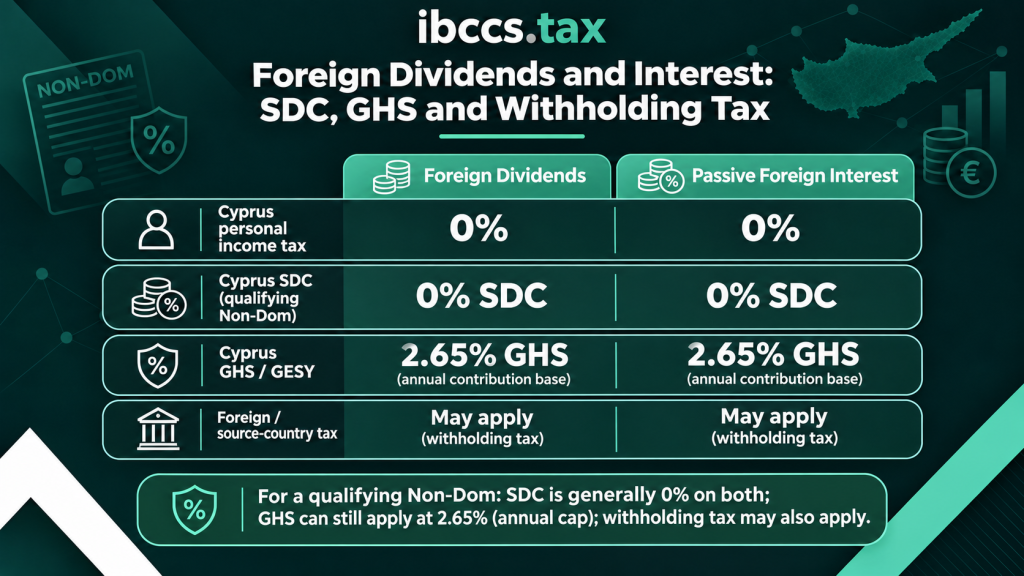
One of the most useful ways to analyse foreign investment income is to separate SDC, GHS and foreign withholding tax rather than describing them as one overall “tax rate”. For a qualifying Non-Dom, the SDC layer on dividends and passive interest can be zero. GHS can still apply because it is a separate contribution regime. The source country can then impose withholding tax under its own law before the payment reaches the Cyprus resident.
| Layer | Foreign dividend | Passive foreign interest |
| Cyprus personal income tax | Generally not imposed on dividend income of an individual | Passive interest is generally dealt with separately from business interest |
| Cyprus SDC for qualifying Non-Dom | Generally 0% | Generally 0% |
| Cyprus GHS/GESY | Can apply at 2.65%, subject to the overall annual contribution base | Can apply at 2.65%, subject to the overall annual contribution base |
| Foreign/source-country tax | Withholding may apply; treaty rate or refund may be available | Withholding may apply depending on payer, instrument and treaty |
Under the current GHS framework, income earners such as individuals receiving rent, interest and dividends are generally subject to a 2.65% contribution. For a natural person, the total maximum annual amount on which GHS contributions are paid is €180,000 across the relevant contributor categories. The cap is a contribution-base cap rather than a separate allowance for each account or each dividend, so salary, pension and investment income can interact in determining whether the annual maximum has been reached.
Our dedicated Cyprus Non-Dom and GHS/GESY guide explains the contribution base, mixed-income examples and practical reconciliation in more detail.
Overseas Investment Portfolios: Asset Classification Comes First
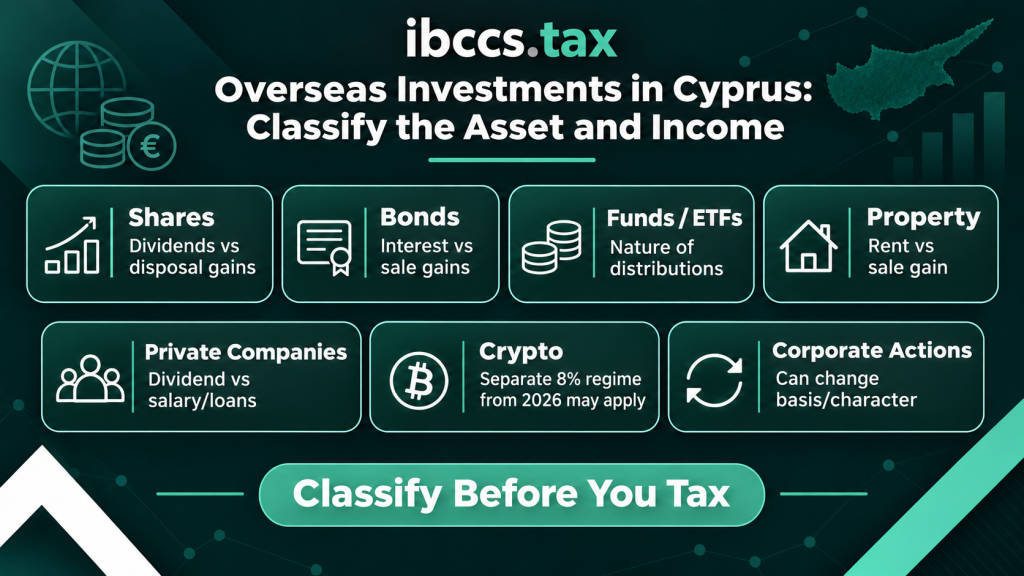
A diversified investment portfolio can contain several tax categories even when one broker presents everything on a single statement. Listed shares may produce dividends and disposal gains. Bonds may produce coupons, accrued interest and gains or losses on disposal. Funds and ETFs can make distributions with different legal characteristics. Structured notes may contain interest, options or derivative components. Foreign exchange movements, management fees and corporate actions can affect the accounting record without necessarily following the same tax treatment as the underlying security.
For Cyprus purposes, the portfolio should therefore be decomposed into transactions rather than assessed only by the change in market value. A movement from €2 million to €2.4 million during a year could reflect new capital, withdrawals, unrealised appreciation, realised disposals, dividends, interest, fees and foreign exchange. Only after those components have been separated can the correct Cyprus tax and GHS treatment be applied. This is especially important for private clients using several banks or brokers, because reporting formats are rarely standardised and a broker’s “income” category may not match the legal categories used in Cyprus tax law.
The same principle applies to beneficial ownership. Joint accounts, family investment vehicles, nominee arrangements and accounts held through companies or trusts should not be allocated for tax purposes solely by looking at the name printed on the statement. The underlying ownership, legal documentation and entitlement to income should be reviewed so that the Cyprus return and supporting file reflect the actual position.
For a wider perspective on managing substantial investment portfolios and international structures, see our Cyprus Tax Planning for HNWIs guide.
Gains on Shares and Qualifying Securities
Cyprus generally provides favourable treatment for gains from the disposal of qualifying securities or “titles”. The statutory definition is broad and can include shares, bonds, debentures and certain rights or derivative exposures connected with securities. Where the instrument falls within the relevant definition, gains on disposal can generally be exempt from Cyprus income tax. This treatment is a separate feature of Cyprus tax law and should not be attributed to Non-Dom status.
The classification should still be checked rather than assumed. Some investment products combine debt, derivatives, commodities, currencies or insurance features, and not every product marketed by a bank or broker as an “investment” necessarily falls within the same Cyprus definition. The treatment of returns during the holding period can also differ from the treatment of a disposal gain. Dividends, interest and disposal proceeds should therefore be analysed separately even where they arise from the same portfolio.
Cyprus Capital Gains Tax has its own scope, particularly in relation to Cyprus immovable property and interests in property-rich entities. Investors with shares or funds whose value is materially connected with Cyprus real estate should therefore avoid relying only on the general securities exemption. The underlying asset exposure and the specific CGT provisions should be reviewed where relevant. For a broader explanation, see What Cyprus Non-Dom Does Not Exempt.
Funds, ETFs and Other Collective Investments
Funds and ETFs are common in internationally diversified portfolios, but their tax analysis can be more nuanced than a direct holding of listed shares. A distribution may be legally treated as a dividend, interest, return of capital or another form of income depending on the fund structure, jurisdiction and documentation. The disposal of the fund interest may also need to be tested against the Cyprus definition of qualifying securities rather than assumed to follow the treatment of the underlying assets.
For large portfolios, the practical solution is to maintain the prospectus or legal description of material products, annual tax statements where available, distribution notices and a transaction history. Where a fund makes an unusual distribution or undergoes a merger, liquidation or reorganisation, the event should be reviewed when it occurs. Reconstructing the legal character several years later from cash movements alone can be difficult and can weaken the support for the treatment applied in Cyprus.
Bonds, Deposits and Cash Management
Cash and fixed-income investments often produce a combination of ordinary interest, accrued interest, premiums, discounts and gains on sale or redemption. A Non-Dom investor may benefit from the SDC exemption on passive interest, but the correct calculation still depends on identifying the amount and timing of the interest component. Foreign banks or issuers may also withhold tax, and certain instruments can have returns linked to equity, currency or another index rather than a simple fixed coupon.
Where a private client holds deposits in several currencies or across multiple banks, the records should show gross interest, tax withheld, currency, payment date and beneficial owner. This allows the GHS position to be reconciled and helps determine whether treaty relief or a foreign tax credit is relevant. It also avoids a common problem where only the net amount credited to the bank account is recorded, leaving no clear evidence of the gross foreign income or tax deducted at source.
Foreign Real Estate as an Investment
Overseas property sits outside the core Non-Dom exemption because rental income is not a dividend or passive interest category. From 2026, rental income is no longer subject to SDC in Cyprus generally, so the absence of SDC on rent is not a special Non-Dom advantage. A Cyprus tax resident can still need to consider personal income tax, GHS, allowable deductions, ownership structure and the tax imposed in the country where the property is located.
A genuine capital gain on immovable property situated outside Cyprus is generally outside the scope of Cyprus Capital Gains Tax because Cyprus CGT focuses on Cyprus-situated immovable property and relevant property-rich interests. The country where the foreign property is located may nevertheless tax the disposal, and a treaty can allocate taxing rights or affect the available relief. If the individual is carrying on property trading or development rather than holding a long-term investment, the profit can also require a different income-tax analysis.
Foreign property therefore illustrates why the phrase “foreign investment income” is too broad to determine the result. Rent, a sale gain, interest on financing and distributions from a property-holding company can all arise from the same economic investment but follow different tax rules.
Private Companies, Founder Holdings and Overseas Businesses
Founders and business owners often hold their most valuable overseas investment through shares in a private company rather than through a listed portfolio. A valid dividend from that company can fall within the Non-Dom SDC exemption, but the personal shareholder analysis does not answer the company-level questions. The foreign company may remain taxable in its jurisdiction of incorporation or residence, and moving the owner to Cyprus can create management-and-control or permanent-establishment considerations where strategic and commercial decisions are made from Cyprus.
The method of extracting value also matters. Salary, management fees, director remuneration, shareholder loans, capital reductions and dividends are not interchangeable. Each payment should be supported by the company’s legal and accounting records and should be classified consistently in both jurisdictions. A Non-Dom shareholder can have a highly favourable personal dividend position while the company itself continues to face corporate tax, transfer-pricing, payroll or VAT obligations.
Where a founder expects a future sale, the investment should also be reviewed well before the transaction. The Cyprus treatment of a disposal can depend on the nature of the security and any exposure to Cyprus immovable property, while the company or source jurisdiction may have its own exit-tax, capital-gains or withholding rules. Planning only the dividend stage can therefore miss the more significant tax event later in the investment lifecycle.
Crypto-Assets and Digital Investments
Crypto-assets should not be treated as if they were automatically equivalent to shares or other securities. From 1 January 2026, Cyprus introduced a special 8% income-tax regime for gains from many transactions involving crypto-assets, subject to the statutory rules. Gains from mining and certain business activity can follow the general income-tax framework rather than the special rate. The fact that an exchange, wallet provider or token issuer is outside Cyprus does not convert a crypto gain into a Non-Dom exemption.
For internationally mobile investors, cost basis and historic tax can also matter when crypto-assets were acquired before relocation. The Cyprus Tax Department has published guidance addressing foreign tax and transferred crypto-assets. Significant positions should therefore preserve acquisition records, wallet and exchange histories, evidence of transfers, foreign tax paid and the classification of transactions. The compliance burden can be disproportionate if these records are not retained contemporaneously.
Foreign Withholding Tax: Why 0% Cyprus SDC Does Not Mean 0% Global Tax
Foreign withholding tax is one of the most important practical limitations of a favourable Cyprus Non-Dom result. A source country may deduct tax from a dividend or interest payment before the cash reaches the investor. A double tax treaty can reduce the rate in some cases, but the lower rate may require a Cyprus Tax Residency Certificate, prescribed forms, proof of beneficial ownership or a refund claim after the payment has already been made.
This means that tax planning should ideally take place before a large distribution. If the investor waits until after the source country has withheld tax at a high domestic rate, obtaining a refund can require additional documentation, local advisers and a lengthy administrative process. For significant recurring dividends, it can be more efficient to establish the treaty-relief process in advance and ensure that the payer or custodian has the correct residency documentation on file.
Important cash-tax point
A Cyprus exemption does not automatically create a Cyprus refund of foreign tax. If the corresponding Cyprus tax is zero, there may be no Cyprus liability against which the foreign tax can be credited. Treaty relief at source or a refund from the foreign jurisdiction can therefore be more important than a Cyprus foreign-tax-credit claim.
Double Tax Treaties and Foreign Tax Credits
Cyprus has an extensive network of double tax treaties, and treaty provisions can affect dividends, interest, capital gains, pensions and other categories of foreign income. The treaty analysis begins with the individual’s tax residence and the legal source of the income. Where another country also treats the person as tax resident, the treaty residence position may need to be resolved before treaty benefits can be claimed reliably.
Where foreign tax has been properly imposed on income that is also taxed in Cyprus, Cyprus can generally provide a foreign tax credit subject to the applicable legislation or treaty. The credit is normally limited to the lower of the foreign tax actually paid or the Cyprus tax attributable to the same income. This limitation is particularly important for Non-Dom investors because a Cyprus SDC exemption can leave no corresponding SDC liability against which foreign withholding tax could be used.
The documentation should therefore show the gross income, foreign tax withheld or paid, legal basis for the tax, payment date and the relevant Cyprus treatment. A broker statement showing only net cash is rarely enough for a robust credit analysis. Tax assessments, withholding certificates, dividend vouchers and treaty forms should be retained where material.
Cyprus Tax Residency Certificate and Treaty Access
A Cyprus Tax Residency Certificate is frequently required where an individual receives investment income from another country and seeks treaty relief. Banks, companies, custodians or foreign tax authorities may request the certificate before applying a reduced withholding rate. Some jurisdictions use their own residence forms and require certification or stamping by the Cyprus Tax Department instead of accepting a generic certificate.
The certificate is evidence of Cyprus tax residence, but it does not by itself determine domicile or guarantee treaty entitlement. Beneficial ownership, the relevant treaty article and any competing residence claim can still matter. Where the investor maintains homes or significant ties in more than one country, Cyprus domestic residence rules and treaty tie-breaker provisions should be considered before relying on Cyprus residence for a cross-border payment.
The Location of the Bank Account Does Not Determine the Tax Result
A recurring misconception is that income kept in a foreign bank account or brokerage account is outside the Cyprus tax system until it is transferred to Cyprus. Cyprus Non-Dom does not operate on a general remittance basis. For a Cyprus tax resident, the tax analysis follows the nature and source of the income and the relevant exemption or charging provision, not the country in which the cash is deposited.
This distinction matters in both directions. Moving a dividend into Cyprus does not normally destroy the Non-Dom SDC exemption merely because the money is remitted. Conversely, leaving salary, business profits or other taxable income abroad does not make it exempt. Banking location is relevant for documentation, foreign withholding, currency and regulatory reporting, but it is not a substitute for income classification.
Realised Gains, Unrealised Gains and Portfolio Valuation
For investment portfolios, a year-end valuation can be economically useful but tax reporting usually requires more detail. Unrealised appreciation is different from a realised disposal, and cash movements can include dividends, interest, capital contributions, withdrawals and fees. Corporate actions such as stock splits, mergers, demergers, rights issues, tender offers and returns of capital can also change the cost basis or character of future receipts without producing an obvious taxable cash event at the time.
The accounting records should therefore maintain transaction-level data for material assets. Acquisition cost, disposal proceeds, dates, quantity, currency, fees and corporate-action history can all be relevant. This is especially important when an investor changes broker, transfers securities between custodians or holds assets for many years, because historic cost information can be lost during a transfer even though it remains important for a future analysis.
Currency Conversion and Multi-Currency Portfolios
International portfolios frequently operate in US dollars, pounds sterling, Swiss francs and other currencies while the Cyprus tax and accounting file is prepared in euro. The conversion methodology should be consistent and supportable. Gross income, foreign withholding, acquisition cost and disposal proceeds may need to be converted at appropriate dates or using a methodology accepted for the relevant reporting purpose.
Foreign exchange movements can also affect the apparent performance of the account without necessarily being taxed in the same way as the underlying asset. A portfolio may show a large euro gain because the foreign currency strengthened even where the security price itself moved very little. For large or complex portfolios, separating asset performance from currency movements improves both the tax analysis and the ability to reconcile the Cyprus return to the broker statements.
Annual Filing and Record-Keeping for Non-Dom Investors
A favourable tax result does not eliminate the need for an organised annual reporting file. From the 2026 tax year, Cyprus broadened the individual filing framework for tax residents, and internationally mobile investors should review their return obligations even where much of their investment income is exempt from personal income tax or SDC. GHS, foreign tax credits and the need to support the legal character of receipts can still require detailed information.
For an overview of personal taxation and reporting obligations for international residents, see our Cyprus Tax for Expats guide.
For a private client with overseas assets, the annual file should normally distinguish each material income and asset category. Useful records can include dividend vouchers, bank interest certificates, broker transaction reports, foreign withholding statements, tax assessments, acquisition and disposal records, fund distribution notices, corporate-action documentation and evidence of beneficial ownership. Where the person owns private companies, shareholder and board resolutions should reconcile with the personal tax treatment of distributions.
The goal is not to create unnecessary administration. The level of detail should be proportionate to the portfolio and the value of the transactions. However, complex investment structures become much harder to defend or reconstruct when the only retained evidence is a set of bank statements showing net receipts. Our Private Client Accounting in Cyprus guide explains the reporting architecture for multi-jurisdictional portfolios in more detail.
Practical Cyprus Non-Dom Foreign-Income Scenarios
Scenario 1: Founder receiving a dividend from a foreign company
A founder becomes Cyprus tax resident and qualifies as Non-Dom. A foreign operating company declares a substantial dividend. The Cyprus individual can generally be outside SDC on the dividend, while GHS may still apply within the annual contribution base. The company’s jurisdiction may withhold tax, so the founder should review treaty relief before payment and obtain the required Cyprus residency documentation. The company’s distributable profits and dividend approval should also support the legal character of the payment.
Scenario 2: Investor with foreign bank deposits and a bond portfolio
An investor receives interest from several banks and coupons from foreign bonds. Passive interest can generally benefit from the Non-Dom SDC exemption, but GHS remains relevant and some jurisdictions may withhold tax. The bond portfolio should distinguish coupon or accrued interest from gains or losses on sale. Where a bond qualifies as a security, the disposal gain can follow separate Cyprus securities rules rather than the passive-interest treatment.
Scenario 3: International brokerage account with shares, ETFs and funds
A private client holds listed shares, ETFs and investment funds through a foreign broker. Dividends can fall within the Non-Dom SDC exemption, but the legal nature of fund distributions should be confirmed. Disposal gains should be tested against the Cyprus definition of qualifying securities. Foreign withholding, corporate actions, fees and currency movements should be separately captured rather than relying on the change in the portfolio’s year-end value.
Scenario 4: Foreign rental property alongside a securities portfolio
A Cyprus Non-Dom receives dividends, interest and rent from property abroad. The dividends and passive interest can generally be outside SDC, while rent does not derive its treatment from Non-Dom. From 2026, rent is no longer subject to SDC generally, but personal income tax, GHS, allowable deductions and source-country property tax remain relevant. A later sale of the foreign property can also be taxed in the property jurisdiction even though a genuine foreign real-estate capital gain is generally outside Cyprus CGT.
Scenario 5: Investor holding significant crypto-assets before relocation
An investor becomes Cyprus tax resident while continuing to hold crypto-assets acquired abroad. Non-Dom does not create a crypto exemption. From 2026, many disposal gains fall within the separate 8% Cyprus regime, while mining or business activity can require a different analysis. Historic acquisition cost, foreign exit taxes, transfers between wallets and exchanges and the transaction history should be preserved so that later disposals can be supported.
Common Mistakes With Cyprus Non-Dom and Overseas Investments
Treating every foreign receipt as tax-free. Non-Dom primarily removes SDC from qualifying dividends and passive interest. Other receipts and gains require their own classification.
Ignoring GHS because SDC is zero. A Cyprus tax resident Non-Dom can have no SDC on a foreign dividend while still owing GHS on the same income, subject to the annual contribution base.
Recording only net foreign income. Net cash can hide foreign withholding tax and makes treaty or credit analysis difficult. Gross income and foreign tax should be recorded separately.
Assuming every investment gain is a securities gain. The legal instrument should be tested against the Cyprus definition; funds, structured products, crypto and property exposures can require different treatment.
Using the bank account location as the tax test. Cyprus does not generally apply a remittance basis to Non-Dom investment income. Foreign bank location does not replace classification or residency analysis.
Relying on a broker’s tax report as if it were a Cyprus tax return. Broker statements are designed for investment administration and can use categories that do not correspond to Cyprus tax law. Material transactions should be mapped to Cyprus categories.
Waiting until after a large dividend to consider treaty withholding. Relief at source can be easier than reclaiming excess foreign tax after payment. Significant distributions should be planned before the payment date.
Failing to keep cost and corporate-action records. Long-held investments can become difficult to analyse after broker transfers, mergers or restructurings if historic acquisition and event data are lost.
Foreign-Income Planning Checklist for Cyprus Non-Dom Investors
- Confirm Cyprus tax residency for the relevant tax year and identify any competing residence claim in another country.
- Confirm Non-Dom eligibility and understand the 17/20 timeline rather than treating the status as permanent.
- Create an inventory of foreign companies, bank accounts, brokers, funds, real estate, private investments and crypto-assets.
- Classify expected receipts into dividends, passive interest, business interest, rent, salary, capital returns and other categories before applying tax rates.
- Identify which assets are likely to fall within the Cyprus definition of qualifying securities and flag structured or unusual products for separate review.
- Estimate annual GHS exposure across salary, pension, dividends, interest, rent and other relevant categories, taking the €180,000 contribution base into account.
- Review foreign withholding rates and applicable double tax treaties before large dividends or interest payments are made.
- Obtain a Cyprus Tax Residency Certificate or foreign prescribed forms where needed for treaty relief.
- Retain gross income, withholding-tax, cost-basis, disposal and corporate-action evidence rather than only net bank movements.
- Coordinate personal Non-Dom planning with any foreign company that the individual owns or manages from Cyprus.
- Review foreign real estate, funds, private-company holdings and crypto separately rather than treating the whole portfolio as one class of investment.
- Set up an annual private-client accounting and tax-return process that reconciles foreign statements to the Cyprus reporting position.
How IBCCS TAX Can Help With Non-Dom and Foreign Investments
IBCCS TAX supports internationally mobile investors, founders, executives and private clients with the interaction between Cyprus tax residency, Non-Dom status and cross-border investment income. Our work can include reviewing foreign dividends and interest, classifying overseas portfolio income, assessing GHS, analysing foreign withholding tax and treaty relief, and coordinating the personal position with companies, private investments and other jurisdictions.
For clients with substantial portfolios, the tax analysis can be integrated with private client accounting so that broker statements, foreign tax certificates, company distributions and asset disposals are reconciled into one supportable annual file. This is particularly useful where the client has several banks, currencies, investment managers or family structures and where the tax position cannot be understood from one account statement or one source country in isolation.
We can also coordinate the investment-income review with the wider Non-Dom timeline, including eligibility, the 17/20 deemed-domicile rule and the Alternative SDC Method where relevant. The objective is to maintain a tax position that is technically correct, properly documented and practical as the client’s portfolio, residence and ownership structure evolve.
To discuss your position, see our Cyprus Non-Dom service, Cyprus tax planning services and Private Client Accounting in Cyprus guide.

Frequently Asked Questions About Cyprus Non-Dom and Foreign Income
1. Does Cyprus tax foreign dividends received by a Non-Dom?
Foreign dividends received by an individual are generally outside Cyprus personal income tax. A qualifying Cyprus tax resident Non-Dom is also generally exempt from SDC on dividends. GHS can still apply, and the source country may withhold tax before the dividend is paid.
2. Does a Cyprus Non-Dom pay tax on foreign interest?
Passive foreign interest is generally exempt from SDC for a qualifying Non-Dom. GHS can still apply to a Cyprus tax resident, and foreign withholding tax may arise. Interest connected with a business or financing activity can require a different income-tax classification.
3. Do I need to transfer foreign investment income to Cyprus for the Non-Dom exemption to apply?
No general remittance condition applies to the Non-Dom SDC exemption. The Cyprus analysis follows the person’s tax residence, domicile and the nature of the income rather than whether the cash is transferred into a Cyprus bank account.
4. If I keep dividends in a foreign bank account, are they outside Cyprus tax reporting?
Not necessarily. Account location does not determine the tax treatment. A Cyprus tax resident should review the annual filing and GHS position and maintain evidence of the gross dividend, withholding tax and legal source even where the money remains abroad.
5. Does GHS apply to foreign dividends and interest for a Cyprus Non-Dom?
GHS is separate from SDC. Under the current framework, income earners such as individuals receiving dividends and interest are generally subject to GHS at 2.65%, subject to the €180,000 maximum annual contribution base for a natural person.
6. Are gains on foreign shares taxable in Cyprus?
Gains from the disposal of qualifying securities can generally benefit from a separate Cyprus income-tax exemption, subject to the definition of the instrument and any relevant CGT rules. This favourable treatment is not created by Non-Dom status.
7. Are ETF and fund gains always tax-free in Cyprus?
No automatic conclusion should be made from the product label alone. The legal form of the fund or ETF, the nature of distributions and whether the interest qualifies as a security should be reviewed. Different components of the investment can follow different rules.
8. Is foreign rental income covered by Cyprus Non-Dom?
Non-Dom does not create a special exemption for rental income. From 2026, rental income is no longer subject to SDC generally, but Cyprus income tax, GHS, source-country tax, deductions and foreign tax credits can still be relevant.
9. Does Cyprus tax gains on foreign real estate?
A genuine capital gain on immovable property situated outside Cyprus is generally outside Cyprus Capital Gains Tax, but the country where the property is located can tax the disposal. If the activity is trading or development rather than long-term investment, income-tax considerations can also arise.
10. Can foreign withholding tax be refunded in Cyprus if I am Non-Dom?
Not automatically. A foreign tax credit is generally limited to Cyprus tax attributable to the same income. Where Cyprus imposes no corresponding tax because an exemption applies, the foreign tax may need to be reduced or recovered in the source country under the applicable treaty or domestic procedure.
11. Do I need a Cyprus Tax Residency Certificate for foreign investment income?
It is often required where a payer, custodian or foreign tax authority needs evidence of Cyprus residence before granting treaty relief or processing a withholding-tax refund. Some countries require their own form to be certified by the Cyprus Tax Department.
12. Are crypto gains exempt because I am Cyprus Non-Dom?
No. Non-Dom does not provide a crypto exemption. From 2026, many gains from crypto-asset transactions fall within a separate 8% Cyprus income-tax regime, while mining or business activity can follow the general tax rules.
13. Does Non-Dom apply to income from a foreign company I own?
A valid dividend from a foreign company can generally fall within the Non-Dom SDC exemption, but salary, director fees, loans and other payments follow their own rules. The company’s tax residence, management, substance and source-country obligations should also be reviewed separately.
14. What records should a Cyprus Non-Dom keep for an overseas investment portfolio?
A robust file normally includes gross income and withholding statements, broker transactions, acquisition cost, disposal proceeds, corporate actions, fund notices, dividend vouchers, interest certificates, currency information and evidence of beneficial ownership. The level of detail should be proportionate to the portfolio and transaction values.


Cyprus Non-Dom and Foreign Income: Dividends, Interest and Overseas Investments
Cyprus Non-Dom status is particularly relevant to internationally mobile investors,
Read More
What Cyprus Non-Dom Does Not Exempt: Salary, Business Income, Rent, Capital Gains and Other Taxes
Cyprus Non-Dom status can be highly valuable for individuals whose
Read More
Cyprus Non-Dom and GHS/GESY: What You Still Pay on Dividends and Interest
Cyprus Non-Dom status is commonly associated with a 0% Special
Read MoreImportant Note: This article provides general information on Cyprus Non-Dom, foreign income and overseas investment taxation and reflects the framework reviewed in October 2026. The correct treatment depends on the individual’s tax residence and domicile, the legal nature of each income stream and investment, the source jurisdiction, foreign withholding taxes, applicable double tax treaties, GHS, company or fund documentation and the facts of the case. Investment products and cross-border arrangements should be classified before a tax conclusion is applied, and the article should not be treated as a substitute for transaction-specific tax, legal or investment advice.