

Moving to Cyprus as a business owner can provide access to an established EU jurisdiction, a competitive tax framework and an extensive professional services infrastructure. However, an effective relocation strategy rarely begins and ends with registering a Cyprus company.
A business owner may be changing personal tax residence while retaining an existing foreign company, transferring selected operations to Cyprus, establishing a new holding or operating company, hiring employees locally or managing businesses across several jurisdictions. Each option creates a different combination of personal tax, corporate tax, legal, operational and compliance considerations.
The central question is therefore not simply whether Cyprus is attractive. It is how the owner’s residence, remuneration, company ownership, management responsibilities and existing international structure should work together after the move.
This guide explains the main issues that founders, consultants, shareholders, online business owners, technology entrepreneurs and investors should review before relocating to Cyprus in 2026. It focuses on situations in which the owner’s personal tax position and the operation of the business are closely connected.

- Personal relocation and company relocation are separate decisions that should be planned together.
- Cyprus tax residency may generally be established under the 183-day rule or the 60-day rule.
- From 2026, the Cyprus 60-day rule no longer requires the individual to demonstrate that they are not tax resident in another country. Dual residence and treaty questions may nevertheless arise.
- Qualifying Cyprus tax residents may benefit from Non-Dom status in relation to Special Defence Contribution on dividends and passive interest.
- Non-Dom status does not exempt salary, consulting income or business profits from normal taxation.
- A foreign company may create Cyprus corporate tax residency or permanent establishment exposure if it is effectively managed or operated from Cyprus.
- A Cyprus company is not always necessary, but it may be appropriate where operations, management, employees, intellectual property or customers are genuinely connected with Cyprus.
- Salary and dividends should be planned together with corporate profits, payroll, social insurance, GHS, the owner’s role and the wider international tax position.
- Genuine management, governance, documentation and economic substance are essential to a defensible Cyprus structure.
- Accounting, VAT, payroll, tax returns and corporate administration should be planned from the beginning rather than added after incorporation.
What Should You Review When Moving to Cyprus as a Business Owner?
A business owner planning a Cyprus relocation should review both the individual position and the business structure before implementing the move.
At the personal level, the main considerations include Cyprus tax residency, the previous country’s residence and exit rules, Non-Dom eligibility, salary, dividends, investment income and annual tax filing obligations. At the corporate level, the owner should assess whether to retain an existing foreign company, establish a Cyprus company, redomicile a company, register a branch or use Cyprus as part of a wider international structure.
The location from which the owner makes strategic and commercial decisions can also affect the tax residency or permanent establishment position of an existing foreign company. Incorporating a Cyprus entity does not, by itself, resolve these questions. The selected structure should reflect where the business is genuinely managed, where its people and assets are located, how revenue is generated and where the owner will perform their work.
Why Moving to Cyprus Is More Complex for a Business Owner
An employee relocating to Cyprus may primarily need to consider personal tax residency, employment income, payroll, social insurance and immigration status. A business owner normally has several additional layers to address because their personal activity may be closely connected with the commercial operation of the company.
The owner may perform services, act as a director, make strategic decisions, control company bank accounts, hold intellectual property and receive both salary and dividends. The business may also have customers, employees, contractors, premises or companies in several countries.
A personal move can therefore affect the company even where no shares, contracts or assets are formally transferred. The tax analysis may consider what happens in practice, including where decisions are made, where work is performed, where contracts are negotiated and where the business is commercially directed.
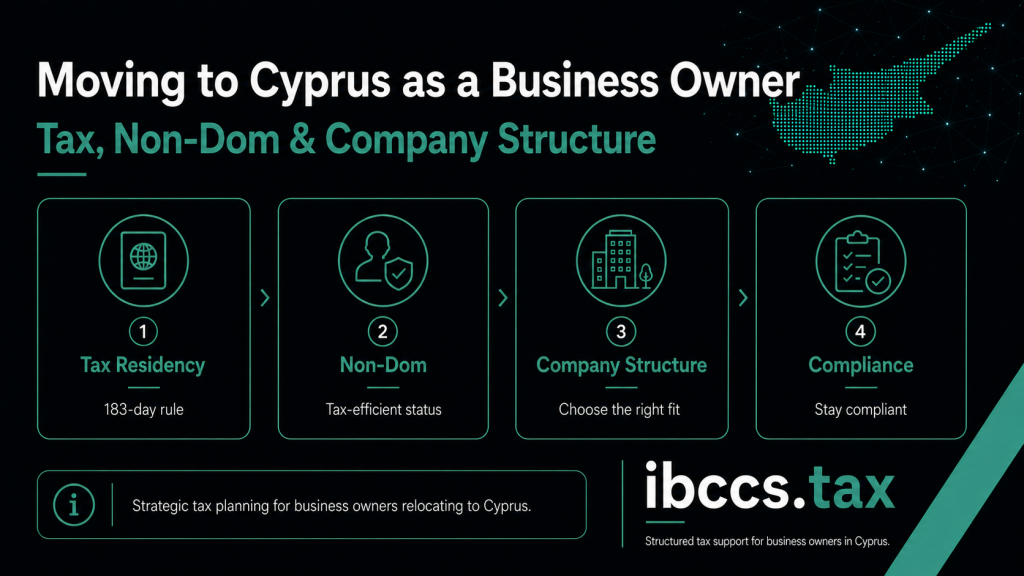
For these reasons, relocation by a business owner should normally be treated as a combined personal and corporate planning exercise. For a broader introduction to individual taxation and foreign income, see our guide to Cyprus tax for expats in 2026.
What Are You Actually Moving to Cyprus?
Before selecting a company structure, the owner should identify what is intended to move. The relocation may involve only the individual, the entire business, selected operational functions or a combination of personal and corporate elements.
| Relocation approach | What changes | Main issues to review |
| Personal relocation only | The owner becomes resident in Cyprus while the existing company remains abroad | Foreign company management, salary, dividends, permanent establishment and departure-country tax |
| Personal relocation with a new Cyprus operating company | The owner and commercial activity move to Cyprus | Company formation, contracts, staff, VAT, substance, payroll and profit extraction |
| Cyprus holding company with foreign operations | Cyprus becomes part of the ownership structure while operating companies remain abroad | Commercial purpose, dividend flows, management, beneficial ownership and transfer pricing |
| Company redomiciliation | The existing company transfers its registered office to Cyprus where legally permitted | Departure-country rules, continuity, contracts, assets, tax residency and post-redomiciliation compliance |
| Cyprus branch of a foreign company | The foreign company operates through a Cyprus establishment | Permanent establishment, local taxation, accounting and parent-company exposure |
| Partial operational relocation | Selected management, intellectual property, sales or support functions move to Cyprus | Functional analysis, transfer pricing, staff, substance and allocation of profits |
The appropriate route depends on the existing business, the owner’s responsibilities, customer and supplier locations, intellectual property, employees, future investment plans and expected exit strategy. The selected structure should support genuine commercial activity rather than being based only on a comparison of headline tax rates.
Planning a Personal and Business Move?
IBCCS TAX can review your current structure, expected Cyprus activity and personal tax position before the relocation is implemented. Request a Business Owner Relocation Review

Step 1 – Establishing Personal Tax Residency in Cyprus
Personal tax residency determines how Cyprus generally treats the owner’s income. It is separate from company registration, citizenship and immigration residence. Cyprus provides two principal individual tax residency tests: the 183-day rule and the 60-day rule.
The Cyprus 183-Day Rule
An individual who spends more than 183 days in Cyprus during a calendar year is generally considered Cyprus tax resident for that year.
This route is commonly relevant where the owner and their family relocate fully and Cyprus becomes their principal place of residence. Accurate day-count records and supporting documentation should still be maintained, particularly where the individual continues to travel frequently or retains substantial connections with another country.
The Cyprus 60-Day Rule in 2026
The 60-day rule may be relevant for internationally mobile business owners who maintain a genuine personal and economic connection with Cyprus but do not spend more than 183 days on the island.
In general, the individual must:
- spend at least 60 days in Cyprus during the relevant calendar year;
- not spend more than 183 days in any other single country during the same year;
- carry on a business in Cyprus, be employed in Cyprus or hold an office in a Cyprus tax-resident company;
- maintain the relevant business, employment or office connection during the tax year; and
- maintain a permanent home in Cyprus that is owned or rented.
From 1 January 2026, the previous condition requiring the individual not to be tax resident in another country has been removed. This creates additional flexibility, but competing residence claims should not be ignored.
Another country may continue to treat the owner as tax resident under its domestic legislation. Where both jurisdictions claim residence, an applicable double tax treaty and its tie-breaker provisions may need to be considered.
Our detailed guide explains the Cyprus 60-day and 183-day tax residency rules. IBCCS TAX also assists with the practical process of changing tax residency to Cyprus.
Leaving the Previous Country Is as Important as Entering Cyprus
Obtaining Cyprus tax residency does not automatically terminate tax residency or tax exposure in the jurisdiction from which the owner is moving.
The departure country may apply its own residence test, split-year rules, exit taxes, temporary non-residence provisions, controlled foreign company rules or broader anti-avoidance legislation. It may also retain taxing rights over locally sourced income, property, employment duties and business activity after the individual has relocated.
The review should establish when the previous tax residency may end and whether the owner will retain a home, family connections, working days or management responsibilities in that jurisdiction. The treatment of planned dividends, bonuses, directors’ fees, company restructurings and a future sale of shares or business assets should also be assessed before the move.
Sequencing can materially affect the result. A dividend, restructuring or disposal completed before the residence position changes may be treated differently from the same transaction completed after Cyprus tax residency has been established. Any exit tax, temporary non-residence rules, local-source income and deregistration obligations should therefore be addressed as part of the same relocation plan.
Step 2 – Assessing Cyprus Non-Dom Status
Cyprus Non-Dom status can form an important part of the personal tax position of a relocating shareholder, entrepreneur or investor. It is a classification used for Special Defence Contribution purposes. It is not an immigration status and does not replace the need to establish Cyprus tax residency.
A qualifying Cyprus tax resident who is non-domiciled in Cyprus may generally benefit from an exemption from SDC on dividend and passive interest income. The exemption can be relevant to income received from both Cyprus and foreign companies, subject to the applicable rules and the individual’s full circumstances.
IBCCS TAX assists with Cyprus Non-Dom eligibility, documentation and implementation.
What Cyprus Non-Dom Status Does Not Exempt
Non-Dom status should not be interpreted as a general zero-tax status. It does not remove personal income tax from salary, self-employment income, consulting fees or other active income, and it does not exempt a company from corporate income tax.
GHS contributions, social insurance, VAT, payroll obligations and annual filing requirements may continue to apply. Rental income, capital gains in applicable cases and income taxed in another jurisdiction should also be reviewed separately.
The distinction is particularly important for owner-managed businesses. The company may pay corporate tax on its taxable profits, while salary, dividends, benefits, directors’ fees and other payments received by the owner follow their own personal tax and contribution rules.
Step 3 – Deciding Whether You Need a Cyprus Company
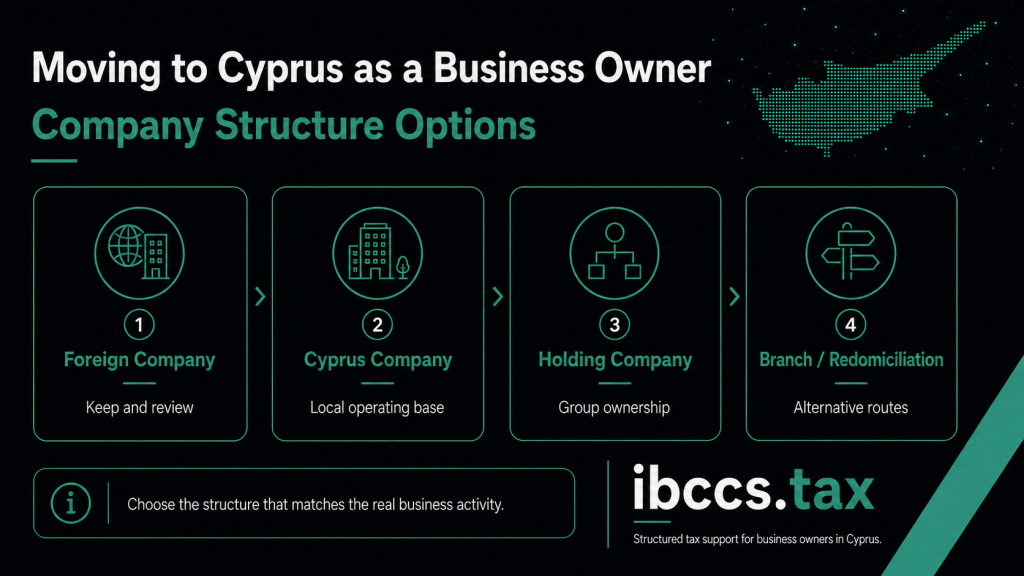
Moving to Cyprus does not automatically mean that the owner must establish a Cyprus company. Equally, retaining an existing foreign company is not always the simplest or most appropriate option. The decision should follow the business model. A Cyprus operating company may be appropriate where the owner will perform services from Cyprus, employ people locally, negotiate and conclude contracts from Cyprus or build a genuine operational base on the island.
A Cyprus holding company may be relevant where the commercial objective is to consolidate ownership of qualifying subsidiaries or investments. A branch may be suitable where a foreign company wants to conduct part of its activity in Cyprus while maintaining the parent entity, while redomiciliation may be considered where the existing jurisdiction and constitutional documents permit continuation into Cyprus.
The legal structure should reflect what the business will actually do after the relocation.
For a detailed overview of the incorporation process, see our guide to Cyprus company formation in 2026 and our service for company registration in Cyprus.
Option 1 – Retaining the Existing Foreign Company
Some owners relocate personally to Cyprus while retaining a company registered and operating in another jurisdiction.
This may be commercially appropriate where the company has established employees, licences, premises, contracts or customers in its existing location. However, the owner’s relocation can change how the company is managed and where part of its commercial activity is carried out.
The analysis should determine where strategic and commercial decisions will be made, where directors are resident and where the board exercises its authority. It should also examine where material contracts, financing arrangements and banking decisions are approved, where the owner performs day-to-day work and where key employees and contractors are located.
The company’s existing presence in its country of incorporation remains relevant, but a foreign registration certificate does not prevent Cyprus tax exposure. A company may need to assess whether it has become managed and controlled from Cyprus, whether it has created a Cyprus permanent establishment and whether its original jurisdiction continues to treat it as tax resident.
Management and Control of a Foreign Company
For a foreign-incorporated company, management and control can be an important factor when determining corporate tax residency. There is no single administrative action that creates genuine management and control. The position is assessed by examining the facts and the way the company operates in practice.
Relevant factors include the location and authority of the directors, the place where the board considers major commercial decisions and the jurisdiction from which senior management performs its functions. The analysis may also consider where important contracts, financing arrangements and banking decisions are approved, as well as where accounting records and corporate documentation are maintained.
No single factor should be viewed in isolation. What matters is whether the directors genuinely exercise authority and independent judgement, rather than merely confirming decisions that have already been made by the shareholder elsewhere.
Holding formal board meetings in Cyprus may therefore be insufficient where substantive decisions continue to be made in another country. Conversely, a foreign company may create Cyprus exposure where its controlling owner moves to Cyprus and begins directing the business from the island without updating the formal governance structure.
Permanent Establishment Risk
A foreign company may create a permanent establishment in Cyprus without becoming fully Cyprus tax resident. A permanent establishment analysis may consider whether the company has a fixed place of business, office or other premises in Cyprus. Employees, dependent agents, contract-concluding activity and the performance of core business functions from the island can also be relevant.
A home office should not automatically be dismissed as a private arrangement. Where it is used on a sustained basis to conduct essential company activity, negotiate or conclude contracts, manage personnel or serve customers, it may form part of the permanent establishment assessment. If a permanent establishment arises, part of the foreign company’s profits may be attributable to and taxable in Cyprus. The result depends on Cyprus law, any applicable double tax treaty and the functions, assets and risks connected with the Cyprus activity.
Keeping a Foreign Company After Relocation?
IBCCS TAX can assess management and control, permanent establishment exposure, remuneration and whether the existing company remains appropriate after the owner relocates. Speak to a Cyprus Tax Consultant
Option 2 – Establishing a Cyprus Operating Company
A Cyprus operating company may be appropriate where the business is genuinely transferring all or part of its activity to Cyprus.
The company may employ the owner, engage local or international staff, enter into customer contracts, own operational assets and invoice for products or services. Cyprus tax-resident companies are generally subject to corporate income tax at 15% on taxable profits under the framework applying from 1 January 2026.
Depending on the circumstances, the Cyprus tax system may also provide exemptions for qualifying dividend income and profits from the disposal of qualifying securities. Cyprus generally does not impose withholding tax on dividends paid to non-resident shareholders, subject to applicable defensive measures and anti-abuse rules.
A Cyprus company may also benefit from the country’s double tax treaty network, relevant EU rules, notional interest deduction on qualifying new equity and the IP Box regime for qualifying intellectual property income.
The headline corporate tax rate should not be considered in isolation. Deductibility of expenditure, transfer pricing, VAT, payroll, the source of income and the availability of exemptions can all affect the effective result. A broader overview is available in our article on the Cyprus Tax Reform 2026.
Cyprus IP Box for Technology and Software Businesses
The Cyprus IP Box may be relevant for companies deriving qualifying income from eligible intellectual property, including certain copyrighted software and patents.
Under the regime, an 80% exemption may apply to qualifying profits calculated under the nexus approach. With the standard corporate income tax rate at 15%, the resulting effective rate on qualifying IP profits can be approximately 3%.
Qualification depends on substantially more than operating a SaaS, software or online business. The analysis should identify the relevant intellectual property, establish who legally and economically owns it and determine where the development activity is performed.
Qualifying research and development expenditure, outsourced development, acquisition costs and related-party arrangements affect the nexus calculation. The company should also be able to track qualifying income and expenditure through appropriate accounting records and supporting documentation. Moving intellectual property to Cyprus can create tax, valuation, transfer pricing and exit consequences in the jurisdiction from which the IP is transferred. Ownership and licensing arrangements should therefore be reviewed before implementation rather than reconstructed after the transfer.
Option 3 – Using a Cyprus Holding Company
A Cyprus holding company may be considered where the owner has operating subsidiaries, investments or a future acquisition strategy across several jurisdictions. Its role may include holding shares, coordinating group governance, receiving dividends, arranging financing or supporting future acquisitions and disposals. The analysis should consider the treatment of dividends received from subsidiaries, the disposal of qualifying securities and any withholding taxes imposed by source countries.
Double tax treaty access, potential eligibility under EU rules and the treatment of outbound distributions should also be reviewed. Where the holding company enters into financing, licensing or management arrangements, transfer pricing and the commercial rationale for those transactions become relevant.
Substance and beneficial ownership are particularly important. A holding company should have a clear commercial function and sufficient governance to perform that function. It should not be inserted into an international structure solely because a generic holding diagram appears tax-efficient. Further information is available in our guide to using a Cyprus holding company.
Option 4 – Redomiciling an Existing Company
Redomiciliation can allow an eligible foreign company to continue its legal existence under Cyprus law without incorporating an entirely new company. This may be relevant where continuity of contracts, corporate history, licences, ownership or assets is commercially important. However, redomiciliation is not simply a change of registered address.
The departure jurisdiction must permit outward redomiciliation, and the company’s constitutional documents should support the process. Existing creditors, contractual restrictions, banking relationships, licences and employee arrangements may also need to be addressed. The tax consequences can include the termination or transfer of tax residency, the treatment of assets and retained earnings and potential exit charges in the departure jurisdiction. The Cyprus management, substance, accounting and compliance arrangements should therefore be prepared before the continuation becomes effective.
Redomiciliation can affect both the legal and tax position of the company and should be coordinated across every relevant jurisdiction.
Option 5 – Registering a Cyprus Branch
A foreign company may register a branch in Cyprus rather than establishing a separate subsidiary. A branch is not generally a separate legal entity from the foreign parent. The parent remains responsible for the branch’s obligations, while profits attributable to the Cyprus permanent establishment may be taxable in Cyprus.
This structure may be appropriate where the parent company wants to conduct a defined activity in Cyprus while retaining ownership, central contracting arrangements and corporate history abroad. It can also require detailed coordination between the parent company’s accounting records and the financial position attributable to the Cyprus branch. The choice between a branch and a subsidiary should take account of liability, taxation, customer contracts, licensing, profit repatriation, administrative requirements and the expected scale of the Cyprus operation.
Salary or Dividends – How Should the Owner Be Paid?
Profit extraction is one of the most important practical issues for an owner-managed company.
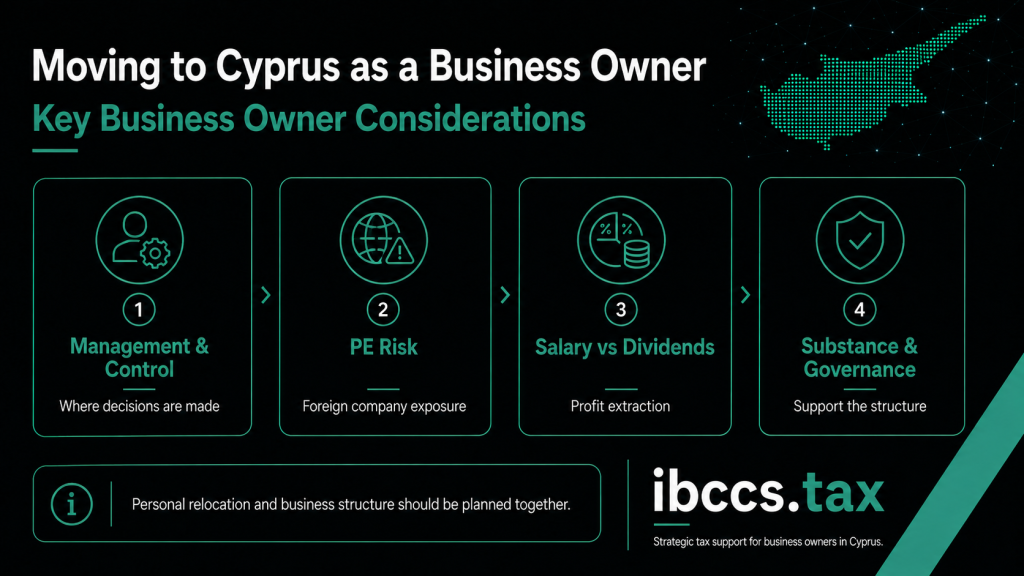
Salary and dividends have different legal, tax and accounting characteristics. The appropriate balance depends on the company’s profitability, the owner’s role, personal cash-flow requirements, social insurance, GHS, available employment exemptions, pension planning and the rules of any other relevant jurisdictions.
Salary
Salary may generally be deductible for the company where it satisfies the applicable business-purpose and deductibility requirements and the amount is commercially supportable. For the owner, salary may involve:
- progressive personal income tax;
- payroll withholding;
- social insurance;
- GHS contributions;
- employment documentation;
- monthly payroll administration; and
- annual employer reporting.
Qualifying individuals commencing employment in Cyprus may be eligible for employment income exemptions, subject to detailed conditions. Eligibility should be assessed before payroll and remuneration arrangements are finalised. For the current personal tax framework, see our guide to Cyprus personal income tax rates in 2026.
Dividends
Dividends are generally paid from distributable profits and are not deductible expenses of the company.
For an individual shareholder, dividends are generally exempt from Cyprus personal income tax. SDC should nevertheless be reviewed, although qualifying Non-Dom individuals may generally benefit from an exemption. GHS contributions may remain applicable.
Company law requirements and the availability of distributable reserves must also be respected. Depending on the circumstances, the source and period of the underlying profits may be relevant to the final treatment.
A business owner should not adopt an arbitrary low salary and distribute every remaining amount as dividends without reviewing the complete position. The arrangement should be commercially reasonable, properly documented and consistent with the owner’s actual responsibilities.
Directors’ Fees, Benefits and Personal Expenses
Business owners may receive more than salary and dividends. A company may pay directors’ fees, health insurance, accommodation, vehicle costs, travel expenses, pension contributions or other benefits.
The tax treatment depends on the legal character and business purpose of each payment. A genuine business expense may be deductible and reimbursable without creating the same consequences as a private expense, while a personal cost paid by the company may create a taxable benefit, non-deductible expenditure or a balance due from the shareholder.
The company should establish clear policies for travel, accommodation, vehicle use, medical insurance, pension contributions and home-office costs. Director loans, shareholder current accounts and the private use of company-owned property should be monitored through the accounting records rather than treated informally. Separating personal and corporate expenditure is essential for reliable bookkeeping, tax compliance and properly documented profit distributions.
Economic Substance and Corporate Governance
A Cyprus company should represent more than a certificate of incorporation and a registered address. The appropriate level of substance depends on the nature of the business. A holding company, software developer, consultancy and trading company will not necessarily require identical arrangements.
The assessment should focus on whether the company has the people, authority, premises, expenditure and records required to perform its actual commercial functions. Cyprus-resident directors should have sufficient knowledge and independence to make substantive decisions, while board minutes and resolutions should accurately reflect how those decisions were reached.
Operational businesses may also require employees or contractors, appropriate working premises, local accounting records and evidence of day-to-day activity. Banking functions, customer and supplier contracts, commercial correspondence, intellectual property management and risk control should be consistent with the stated Cyprus operating model.
Substance should follow the real business. Adding a local director or virtual office without transferring genuine decision-making will not necessarily create a defensible management position. Our guide to Cyprus economic substance requirements explains the practical factors businesses should consider.
Transfer Pricing and Related-Party Transactions
Business owners with companies in more than one jurisdiction may have transactions between related entities. These can include management services, consulting, loans, intellectual property licences, cost-sharing arrangements, employee secondments, distribution services, commissions and asset transfers.
Such transactions should be priced on an arm’s-length basis and supported by a genuine commercial rationale. The parties should be able to explain which functions are performed, which assets are used and which risks are assumed by each company.
Cyprus transfer pricing rules, local file requirements and summary information obligations may apply depending on the transaction category, relationship between the parties and applicable thresholds. Even where full documentation is not required, the calculation and commercial basis of the charge should remain supportable. Artificial management fees, undocumented loans or charges that do not reflect the actual conduct of the parties can undermine the wider international structure.
VAT and Cross-Border Sales
VAT should be reviewed before a Cyprus company begins issuing invoices.
The registration position depends on taxable turnover, the nature of the supplies and the location and status of the customer. A company providing services to foreign businesses may have a different VAT treatment from a business selling digital services or products directly to consumers.
The analysis should establish the applicable place-of-supply rules and whether the customer is acting as a business or consumer. Reverse-charge treatment, intra-EU services, imports, exports and digital transactions may require different invoicing and reporting procedures.
Depending on the activity, the company may need Cyprus VAT registration, VIES registration, OSS registration or a combination of these arrangements. The ability to recover input VAT will also depend on the nature of the company’s taxable and exempt activities and the availability of supporting documentation. IBCCS TAX provides VAT registration services in Cyprus and ongoing VAT administration for local and international businesses.
Employees, Payroll and Social Insurance
A company employing the owner or other personnel in Cyprus should implement payroll correctly from the first payment. The employer and employees may need to be registered with the relevant Cyprus authorities, and the employment terms should accurately reflect the role, remuneration and benefits. Payroll calculations should address PAYE withholding, social insurance, GHS contributions, annual leave and other employment obligations.
Monthly submissions, payslips and annual employer reporting should be incorporated into the company’s regular compliance process. Payroll should not be reconstructed at the end of the year after payments have already been made informally. Remote employees based in other countries can create additional payroll, permanent establishment, social security and employment law obligations in those jurisdictions. Their position should therefore be reviewed separately rather than automatically included in the Cyprus payroll.
Our Cyprus team provides payroll preparation services for owner-managed businesses, local employers and international companies.
Accounting and Ongoing Compliance
A successful relocation does not end when the company is incorporated or the owner receives a Tax Residency Certificate. The personal and corporate structure must be maintained through accurate records, timely filings and governance that remains consistent with the real operation of the business.
Personal Obligations May Include
- Cyprus tax registration and a Tax Identification Number;
- tax residency documentation;
- Non-Dom documentation;
- personal income tax returns;
- reporting of salary, dividends and foreign income;
- GHS payments;
- foreign tax credit documentation; and
- day-count and travel records.
Corporate Obligations May Include
- corporate tax registration;
- VAT, VIES or OSS registration where applicable;
- bookkeeping;
- preparation of financial statements;
- audit or other assurance requirements under the applicable framework;
- corporate income tax returns;
- provisional tax;
- payroll and employer returns;
- UBO Registry filings;
- annual returns to the Registrar;
- board minutes and statutory records;
- transfer pricing compliance; and
- maintenance of invoices, agreements and supporting documentation.
IBCCS TAX provides integrated accounting services in Cyprus, including bookkeeping services, financial statements, tax filings, VAT and payroll support.
Provisional Tax for Business Owners and Companies
Cyprus companies and self-employed individuals expecting taxable income during the year may need to consider provisional tax payments.
The estimated taxable income should be based on current bookkeeping and management information rather than an unsupported year-end estimate. Business owners should review turnover, deductible costs, remuneration and expected profits before the relevant instalment deadlines. Material under-declaration may result in an additional tax charge. Regular bookkeeping therefore supports not only statutory compliance but also more accurate tax forecasting, cash-flow planning and decisions about salary and dividend distributions.
Our dedicated article explains the Cyprus provisional tax deadlines and under-declaration rules.
Immigration Residence and Tax Residence Are Separate
A business owner also needs the legal right to live and, where applicable, work in Cyprus. EU and EEA citizens generally follow a different registration process from third-country nationals. Non-EU business owners may need an appropriate residence and work authorisation depending on their employment, company role, income and intended activity.
A residence permit does not automatically establish Cyprus tax residency. Equally, meeting a tax residency test does not by itself provide immigration status. The immigration, corporate and tax workstreams should therefore be coordinated. The selected residence route should permit the intended business or employment activity, while the company and remuneration arrangements should support both the immigration application and the tax plan. The timing of the application should also align with the intended date of relocation, access to housing and the position of accompanying family members.
IBCCS TAX provides integrated relocation services in Cyprus for entrepreneurs, executives and their families.
A Practical Business Owner Relocation Timeline
Early planning allows the owner to compare the available options before residence, company management and cash flows begin to change.
Six to Twelve Months Before the Move
During the initial planning stage, the main objective is to map the current personal and corporate position and identify decisions that could have different consequences before and after relocation. The review should establish the owner’s current tax residency, company ownership and role within each business. Any potential exit tax, planned dividend, bonus, business sale or intellectual property transfer should be identified at this stage. The owner should also consider where employees, offices, family members and homes will remain after the move. Immigration options and any relevant double tax treaty should be reviewed early enough to influence the timing and structure of the relocation.
Three to Six Months Before the Move
Once the current position has been mapped, the preferred Cyprus structure can be designed. This stage may involve selecting the appropriate tax residency route and deciding whether the existing foreign company should be retained, redomiciled, supplemented or replaced by a Cyprus entity. Management, substance, salary and dividend arrangements should be developed around the future operating model. Company incorporation, immigration documentation, housing, banking and payment onboarding may also begin during this period. Contracts, intellectual property arrangements, VAT treatment and payroll requirements should be reviewed before the business starts operating from Cyprus.
Immediately Before and After Arrival
The focus then shifts from planning to implementation. Relevant steps may include immigration registration, Cyprus tax registration and the preparation of day-count documentation. The Non-Dom process may also begin once the necessary conditions and evidence are available. Where a Cyprus company has been established, its contracts, banking, accounting and governance arrangements should become operational. Employment or directorship duties should commence in line with the planned tax and immigration position, while employer, payroll and VAT registrations should be completed where required.
During the First Year
The first year should be monitored throughout the year rather than reviewed only when tax returns become due. Travel days, management activity, salary, dividends and foreign income should be recorded as they arise. The company’s bookkeeping should be kept current so that profitability, provisional tax, VAT and distributable reserves can be assessed accurately. The owner should also confirm that the implemented governance and substance remain consistent with the intended structure. If employees, contracts, intellectual property or management responsibilities change, the tax and corporate position may need to be reviewed again.
Practical Business Owner Relocation Scenarios
Scenario 1 – Consultant With an Existing Foreign Company
A consultant moves to Cyprus but continues invoicing through a foreign company. The owner performs all services, negotiates contracts and controls payments from Cyprus.
The review should consider whether the foreign company may become managed and controlled from Cyprus or create a Cyprus permanent establishment. It should also compare retaining the existing company with establishing a Cyprus operating company and assess how the owner will receive salary or dividends.
Scenario 2 – SaaS Founder Relocating the Management Team
A founder moves to Cyprus with several senior employees, while development remains distributed across different countries.
The structure may involve a Cyprus operating or holding company, intellectual property ownership, employment, transfer pricing and an assessment of the IP Box regime. The company should document where development, management, sales and strategic decision-making take place.
Scenario 3 – Investor and Shareholder With Several Companies
An investor becomes Cyprus tax resident while remaining a shareholder and director of several foreign companies.
The personal review should cover dividends, interest, Non-Dom status and GHS. The corporate review should identify which companies are actively managed by the individual and whether their governance remains appropriate after the move.
Scenario 4 – Personal Relocation While Operations Remain Abroad
A business owner relocates with their family, but the company retains an established office, management team and employees in its existing jurisdiction.
Retaining the foreign company may remain commercially appropriate. The owner’s Cyprus activity should nevertheless be defined clearly, particularly where they remain a director, approve major decisions or work regularly from Cyprus.
Common Mistakes Business Owners Make
Registering a Cyprus Company Before Reviewing the Existing Structure
A new entity can create duplicate costs, contracts and compliance obligations if its function has not been defined. The current business, ownership structure and intended activity should be reviewed before incorporation.
Assuming Personal Relocation Has No Effect on a Foreign Company
Where the owner controls the business, moving the main decision-maker can alter the company’s corporate tax residency or permanent establishment profile.
Treating Non-Dom as a Complete Tax Exemption
Non-Dom is primarily relevant to SDC on dividends and passive interest. Salary, business income, corporate tax, GHS and reporting obligations remain separate considerations.
Continuing to Make All Decisions Informally
Important decisions should be made through the company’s governance structure and supported by minutes, contracts, accounting records and evidence of commercial consideration.
Selecting Salary and Dividends Based Only on Immediate Tax Cost
The appropriate remuneration strategy should consider the company’s profits, the owner’s employment duties, social insurance, GHS, personal cash flow and the rules of all relevant jurisdictions.
Ignoring VAT Until a Customer Requests a VAT Number
VAT treatment should be determined before invoices are issued, particularly for cross-border services, digital businesses and transactions with EU customers.
Using a Registered Address as a Substitute for Substance
A registered address is a statutory requirement, but it does not by itself demonstrate genuine business management or operational presence.
Delaying Accounting Until the End of the Year
Without current bookkeeping, the owner cannot reliably assess profits, provisional tax, VAT, distributable reserves or cash flow.
Business Owner Relocation Checklist
Before moving to Cyprus, a business owner should be able to answer the following questions:
- When will my current tax residency end?
- Will another country continue to treat me as tax resident?
- Will I qualify under the Cyprus 183-day or 60-day rule?
- Am I likely to qualify for Cyprus Non-Dom status?
- What salary, dividends, interest and other income will I receive?
- Do I own or manage any foreign companies?
- Where will strategic business decisions be made after the move?
- Could a foreign company become Cyprus tax resident or create a permanent establishment?
- Do I need a Cyprus operating company, holding company, branch or redomiciliation?
- Where will employees and contractors work?
- Where is the company’s intellectual property developed and owned?
- What VAT registrations and reporting will be required?
- What level of Cyprus substance reflects the real business?
- How will salary and dividends be documented and paid?
- Which personal and corporate tax returns will be required?
- What should be completed before leaving the previous jurisdiction?
- Does the selected immigration route permit the intended activity?
- Who will manage accounting, payroll, tax and corporate administration after the move?
Where several of these questions remain unanswered, the relocation should normally be reviewed before residence arrangements, contracts, company management or distributions are changed.
How IBCCS TAX Can Help
IBCCS TAX supports business owners throughout the Cyprus relocation, structuring and implementation process. Our work may include:
- review of the owner’s current personal and corporate position;
- Cyprus tax residency planning;
- assessment of the 60-day and 183-day rules;
- Non-Dom eligibility and implementation;
- departure-country and double tax treaty coordination;
- foreign company management and control review;
- permanent establishment analysis;
- selection of an appropriate Cyprus company structure;
- Cyprus company incorporation;
- holding, operating and ownership structuring;
- redomiciliation and branch considerations;
- salary and dividend planning;
- economic substance and corporate governance;
- transfer pricing considerations;
- VAT, payroll and employer registrations;
- accounting and bookkeeping in Cyprus;
- personal and corporate tax filings;
- ongoing corporate administration and compliance; and
- immigration and family relocation support.
Our Cyprus office combines local implementation with international tax, legal, accounting and corporate experience. Where several jurisdictions are involved, we coordinate the relevant personal and business issues so that the structure works in practice rather than only on paper. IBCCS TAX also provides broader international tax planning and structuring for entrepreneurs, investors, private clients and international groups.
Plan the Personal and Business Move Together
Moving to Cyprus as a business owner can create meaningful personal and corporate planning opportunities, but the relocation should be implemented as a coherent and commercially supportable structure.
The individual’s tax residency, Non-Dom status, remuneration and departure-country position should align with the location, management and genuine activity of the business. Company formation, accounting, payroll, VAT, governance and substance should then support that operating reality. IBCCS TAX can assess your existing companies, personal position and intended Cyprus activity before recommending and implementing an appropriate relocation strategy. Request a Business Owner Relocation Review.
Frequently Asked Questions: Moving to Cyprus as a Business Owner in 2026
1. Do I need to establish a Cyprus company when moving to Cyprus?
Not necessarily. A Cyprus company may be appropriate where the owner will operate, employ people, enter into contracts or manage the business from Cyprus.
In other cases, retaining the existing foreign company may remain possible, subject to management and control, permanent establishment and departure-country considerations.
2. Can I keep my foreign company after becoming Cyprus tax resident?
Yes, but the company’s operation should be reviewed. If the owner begins managing and controlling the company from Cyprus, the relocation may affect its corporate tax residency or create a Cyprus permanent establishment.
3. Does forming a Cyprus company make me Cyprus tax resident?
No. Personal tax residency is determined separately under the 183-day or 60-day rule.
Company ownership or directorship may help satisfy part of the 60-day rule, but all applicable conditions must be met.
4. Can a foreign company become Cyprus tax resident?
A foreign company may be considered Cyprus tax resident where it is managed and controlled from Cyprus. The outcome depends on where substantive decisions are made, the authority of the directors and how the company operates in practice.
5. What is the Cyprus corporate tax rate in 2026?
The standard Cyprus corporate income tax rate is 15% from 1 January 2026. The effective position may differ depending on taxable income, deductions, exemptions and applicable incentives.
6. Are dividends tax-free for Cyprus Non-Doms?
Dividends received by individuals are generally exempt from Cyprus personal income tax. Qualifying Cyprus Non-Dom individuals may also be exempt from SDC on dividends, although GHS and other obligations should still be considered.
7. Is salary taxable in Cyprus?
Salary received by a Cyprus tax resident is generally considered under the progressive personal income tax system. Payroll, social insurance and GHS may also apply, while qualifying employment exemptions may be available in certain circumstances.
8. Should a business owner take salary or dividends?
The appropriate balance depends on the owner’s role, company profitability, payroll obligations, social insurance, GHS, personal cash requirements and international position.
The outcome should be modelled based on the actual circumstances rather than selected using a standard formula.
9. Can I qualify for Cyprus tax residency by spending only 60 days there?
Potentially, provided all the remaining conditions of the 60-day rule are satisfied. The individual must maintain an appropriate Cyprus home and business, employment or office connection and must not spend more than 183 days in another single country.
10. Does the 60-Day Rule Mean I Cannot Be Tax Resident Elsewhere?
From 2026, Cyprus no longer requires an individual to demonstrate that they are not tax resident in another country to qualify under the Cyprus 60-day rule.
Another country may nevertheless claim tax residence under its own domestic legislation, in which case treaty analysis may be required.
11. Does a Home Office in Cyprus Create a Permanent Establishment?
It can be relevant, but the answer depends on the facts. The nature of the activity, permanence of the location, authority to conclude contracts and the role performed by the owner should all be reviewed.
12. Can I Move Intellectual Property to a Cyprus Company?
Potentially, but the transfer should be reviewed from legal, tax, valuation and transfer pricing perspectives.
The departure jurisdiction may impose tax, and the Cyprus IP Box applies only where the qualifying conditions and nexus requirements are met.
13. When Should Tax Planning Begin?
The review should ideally begin several months before the intended move. Major dividends, restructurings, company transfers, intellectual property transfers and disposals should be assessed before they take place.

IBCCS TAX to Attend Plan ₿ Forum 2026 in Lugano, Switzerland
IBCCS TAX will be attending Plan ₿ Forum 2026 in
Read More
Cyprus Non-Dom Status: Tax Benefits, Eligibility, Rules and How It Works
Cyprus Non-Dom status is one of the most important elements
Read More
Cyprus Tax Calendar 2027: Key Tax Deadlines for Individuals and Companies
Cyprus tax compliance does not revolve around one annual deadline.
Read More