

Georgia, the country in the Caucasus, continues to attract international entrepreneurs, freelancers, consultants, digital professionals and globally mobile business owners looking for a practical and tax-efficient base.
One of the best-known features of the Georgian tax system is the so-called 1% tax regime, which may be available to qualifying Individual Entrepreneurs who obtain Small Business Status. For the right type of activity and personal situation, this can create a simple and attractive structure for operating from Georgia.
However, the 1% regime should not be treated as a universal solution. It does not automatically apply to every business, every source of income or every person who registers in Georgia. The correct setup depends on the activity, client base, tax residency position, VAT exposure, banking requirements and long-term plans.
At IBCCS TAX, we assist entrepreneurs and internationally mobile individuals with practical structuring, registration and compliance support in Georgia. This guide explains how the Georgia 1% tax regime works in 2026 and what should be reviewed before relying on it.

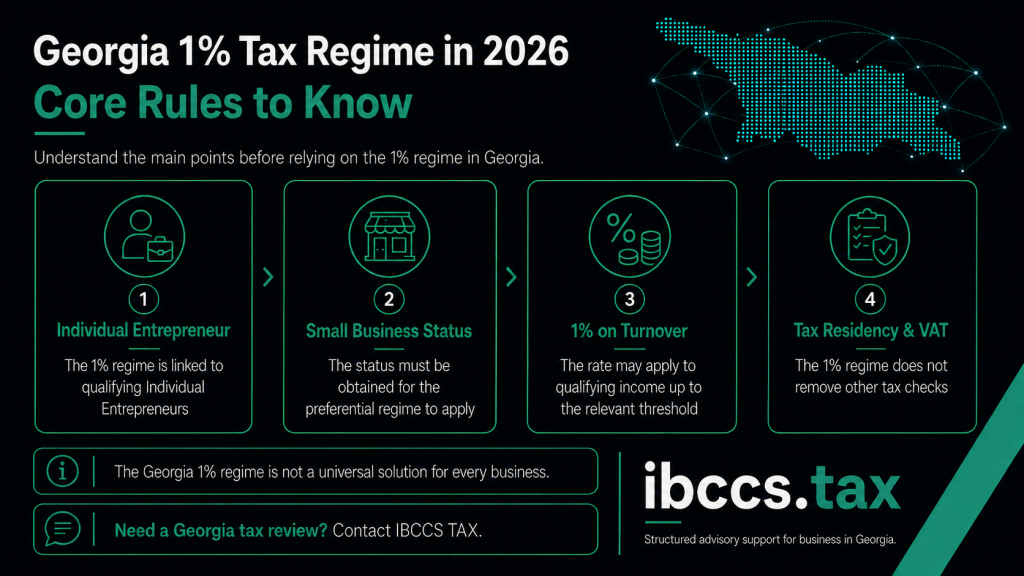
- Georgia’s 1% tax regime is generally linked to Individual Entrepreneurs with Small Business Status, not to standard Georgian LLCs.
- The preferential 1% rate may apply to qualifying business income up to the relevant annual threshold, subject to the activity, registration and compliance requirements.
- If the annual turnover exceeds the applicable limit, a higher rate may apply and the long-term availability of the status should be reviewed.
- Small Business Status does not automatically remove VAT, foreign tax residency, double taxation or banking considerations.
- Foreign entrepreneurs should review their full position before registration, especially if they live outside Georgia, work across borders or invoice clients in different countries.
- For many clients, the main question is not only whether the 1% regime exists, but whether it is the right structure for their personal and business situation.
What Is the Georgia 1% Tax Regime?
The Georgia 1% tax regime is a preferential tax treatment that may be available to qualifying individuals registered as Individual Entrepreneurs and approved for Small Business Status.
In simple terms, where the conditions are met, qualifying income may be taxed at 1% of turnover rather than under the standard personal income tax regime. This is one of the reasons why Georgia is often considered by freelancers, IT specialists, digital service providers, remote consultants and entrepreneurs with international clients.
The regime is attractive because it can be simple, cost-efficient and relatively easy to administer compared with more complex corporate structures. At the same time, it is important to understand that it is not the same as forming a Georgian company.
A Georgian LLC and an Individual Entrepreneur are different structures. If you are comparing options for a broader business setup, you may also want to review our guide to company formation in Georgia and our business registration in Georgia services.
Individual Entrepreneur in Georgia: What Does It Mean?
An Individual Entrepreneur, often referred to as an IE, is a business registration format for individuals carrying out business activities in Georgia.
It is commonly considered by solo professionals, freelancers, consultants, digital service providers and entrepreneurs who want a straightforward setup without incorporating a separate legal entity. For many internationally mobile individuals, this can be easier to manage than a company, especially at the early stage of activity.
However, an IE is not the same as an LLC. In many cases, an LLC may be better suited where the business has co-founders, employees, investment plans, commercial contracts, operational substance, shareholders or broader corporate requirements.
The right structure should be selected based on both tax and non-tax factors. These include liability, client expectations, banking, invoicing, commercial risk, future expansion and where the entrepreneur is personally tax resident.
Small Business Status in Georgia: How It Works
Small Business Status in Georgia is the special status that may allow an Individual Entrepreneur to benefit from the preferential 1% tax regime.
Registering as an Individual Entrepreneur alone is not enough. The person must also apply for and obtain Small Business Status, and the activity must be eligible. Some activities may be restricted or excluded, and some types of income may remain subject to different tax treatment even if the individual has the status.
Certain activities are specifically excluded from Small Business Status. These include activities requiring a licence or permit, currency operations, gambling, personnel-provision services and certain professional activities such as medical, architectural, legal, notarial, audit and consulting services, including tax consulting. The exact activity should therefore be reviewed before relying on the 1% regime.
This is why eligibility should be reviewed before registration. A structure that works well for one freelancer may not be suitable for another person with a different business model, residence position or client base.
For clients who want to compare Georgia with other international options, IBCCS TAX can also assist with broader international tax planning for entrepreneurs and cross-border structuring.
Georgia 1% Tax Rate: How It Works in Practice
Where the conditions are met, qualifying Small Business income is generally taxed at 1% while gross income from economic activities remains within GEL 500,000 during the calendar year.
For many entrepreneurs, this is the main attraction of the regime. The calculation is generally based on revenue rather than profit, which makes the structure relatively simple from a tax calculation perspective. This can be particularly useful for service-based businesses with limited expenses.
However, because the tax is based on turnover, the regime should still be reviewed commercially. A business with high operating costs, complex contracts or non-qualifying income may require a different approach.
If gross income from economic activities exceeds GEL 500,000 during the calendar year, the applicable Small Business tax rate increases to 3%. Importantly, the 3% rate applies from the beginning of the month in which the GEL 500,000 threshold is exceeded until the end of that calendar year. Growing businesses should therefore monitor turnover throughout the year rather than waiting until the annual calculation.
Does Georgia’s 1% Tax Regime Apply to LLCs?
No, the 1% tax regime is generally associated with Individual Entrepreneurs with Small Business Status, not standard Georgian LLCs.
A Georgian LLC is usually taxed under the corporate tax system. Georgia’s corporate tax framework is also attractive for many international businesses, particularly because corporate income tax is generally linked to profit distribution rather than retained profits.
This distinction is important. Some entrepreneurs search for “Georgia company 1% tax” and assume that they can register an LLC and pay 1% tax. In most cases, that is not the correct interpretation.
If you are deciding between an IE and an LLC, the analysis should include your activity, revenue level, business risk, ownership model, tax residency, banking requirements and future plans. You may also want to read our guide on Georgia corporate tax for a broader comparison.
Individual Entrepreneur vs LLC in Georgia: Which Structure Is Better?
There is no single answer. The better structure depends on the business and the person behind it.
An Individual Entrepreneur with Small Business Status may be suitable for a solo professional or freelancer who provides eligible services, has a relatively straightforward client base and wants a simple setup.
A Georgian LLC may be more appropriate where the business has shareholders, employees, commercial contracts, investment plans, licensing needs, operational substance or future expansion requirements.
For some clients, the IE route is a practical starting point. For others, a company structure may be more robust, especially where the business needs separation between the owner and the operating entity.
Before choosing, it is worth assessing both tax efficiency and practical implementation. A tax-efficient structure that creates banking, legal or compliance problems may not be the best solution in practice.
Who May Qualify for Georgia Small Business Status?
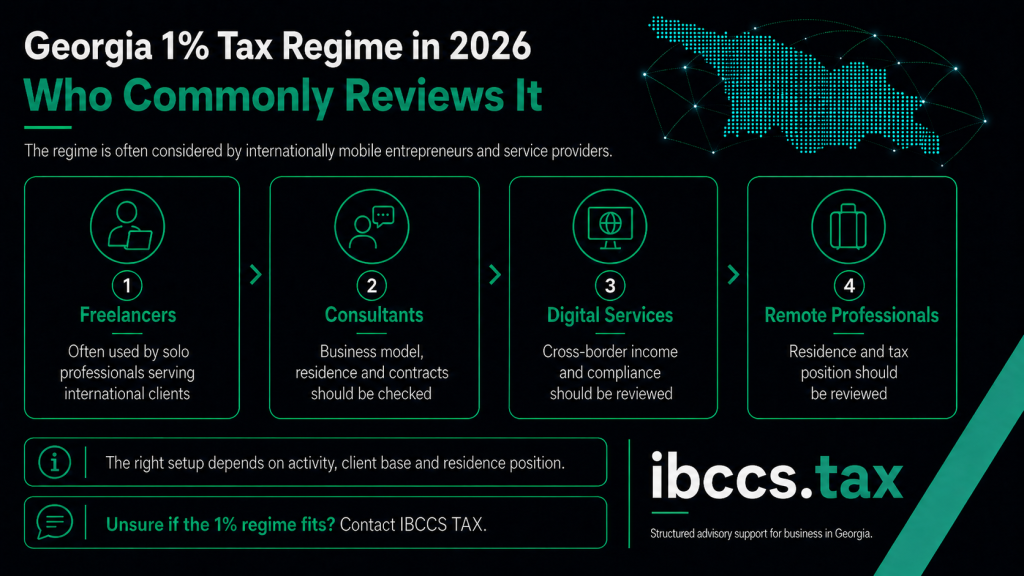
The regime is often considered by:
- freelancers working with international clients;
- IT professionals and digital service providers;
- remote consultants and independent contractors;
- marketing, creative and online service professionals;
- entrepreneurs relocating to Georgia;
- individuals comparing Georgia with other tax-efficient jurisdictions;
- internationally mobile professionals seeking a simple business base.
This does not mean that all such persons automatically qualify. The specific activity, source of income, client contracts and physical location of work may affect the analysis.
It is also important to check whether the individual has continuing tax obligations in another country. Registering in Georgia does not automatically end tax exposure elsewhere.
Georgia Tax Residency and Double Taxation Considerations
The Georgia 1% tax regime should be reviewed together with the individual’s tax residency position.
A person may register as an Individual Entrepreneur in Georgia, but that does not automatically mean that they are only taxable in Georgia. Other countries may continue to claim tax residency depending on physical presence, permanent home, centre of vital interests, business management, family situation or local domestic rules.
This is especially relevant for digital nomads, remote workers and entrepreneurs who travel frequently or maintain strong links with another country.
Georgia may be an attractive jurisdiction, but the planning should be coordinated. Tax residency, double tax treaties, source of income and foreign reporting requirements may all be relevant.
IBCCS TAX assists clients with international tax structuring and cross-border reviews where Georgia is part of a broader personal or business plan.
VAT and Georgia’s 1% Tax Regime
Small Business Status does not automatically remove VAT considerations.
VAT is a separate area and should be reviewed depending on the type of activity, turnover, place of supply, client location and whether services are provided to Georgian or non-Georgian customers. In some cases, VAT registration or reverse charge considerations may arise.
For many international service providers, the VAT position may be manageable, but it should not be ignored. A common mistake is assuming that the 1% income tax regime means there are no other tax or reporting obligations.
Before registration, entrepreneurs should review whether their activity may create VAT exposure, whether their clients require specific invoicing and whether their banking or accounting setup can support ongoing compliance.
VAT should be monitored separately from the Small Business Status turnover limit. Mandatory VAT registration generally arises when relevant VAT-taxable supplies exceed GEL 100,000 during any 12 consecutive months. This is a rolling threshold rather than a calendar-year test and is separate from the GEL 500,000 Small Business Status threshold.
For a detailed explanation of VAT registration, the 18% rate, monthly returns, input VAT, reverse charge and cross-border transactions, see our guide to VAT in Georgia in 2026.
How to Register as an Individual Entrepreneur in Georgia
Registration as an Individual Entrepreneur in Georgia can often be straightforward when documents are properly prepared. Depending on the circumstances, remote registration may be possible through a power of attorney. This can be useful for clients who want to prepare their structure before travelling or who are managing the process from abroad. The practical process usually involves reviewing eligibility, selecting the correct activity, preparing documents, completing registration and applying for the relevant tax status. Banking, tax portal access and accounting setup should also be arranged.
IBCCS TAX can support clients with registration, document preparation, legal address coordination, accounting and practical implementation through our Georgia offices in Tbilisi and Batumi.
For clients relocating personally, our expat services in Georgia may also be relevant.
Banking for Individual Entrepreneurs in Georgia
Banking should be treated as a separate practical workstream. Registration as an Individual Entrepreneur does not guarantee that a bank account will be opened automatically. Banks may review the client profile, nationality, residence, business activity, source of funds, client contracts and expected transaction flows.
This is particularly important for foreign entrepreneurs, crypto-related activity, international consulting, higher-risk industries or clients with complex cross-border operations. A good setup should therefore include not only tax registration, but also a practical review of payment flows, invoicing, banking expectations and compliance documentation.
Ongoing Compliance for Individual Entrepreneurs in Georgia
The 1% regime is simple compared with many other tax systems, but it is not compliance-free.
Individual Entrepreneurs with Small Business Status should maintain proper records, issue invoices where required, monitor turnover, file relevant declarations and make payments within the applicable deadlines.
Small Business tax declarations and the corresponding tax payment are generally due no later than the 15th day of the month following the reporting month. The entrepreneur should also retain the relevant tax source documents and maintain sufficient records to support the turnover and tax treatment reported.
This is an area where entrepreneurs often underestimate the practical work. Even a simple structure can create penalties or administrative issues if reporting is missed or if the business later becomes inactive without proper handling. Ongoing accounting support in Georgia can help ensure that the structure remains compliant and that the entrepreneur understands when additional action may be required.
Common Mistakes with Georgia’s 1% Tax Regime
The Georgia 1% tax regime can be highly attractive, but mistakes are common.
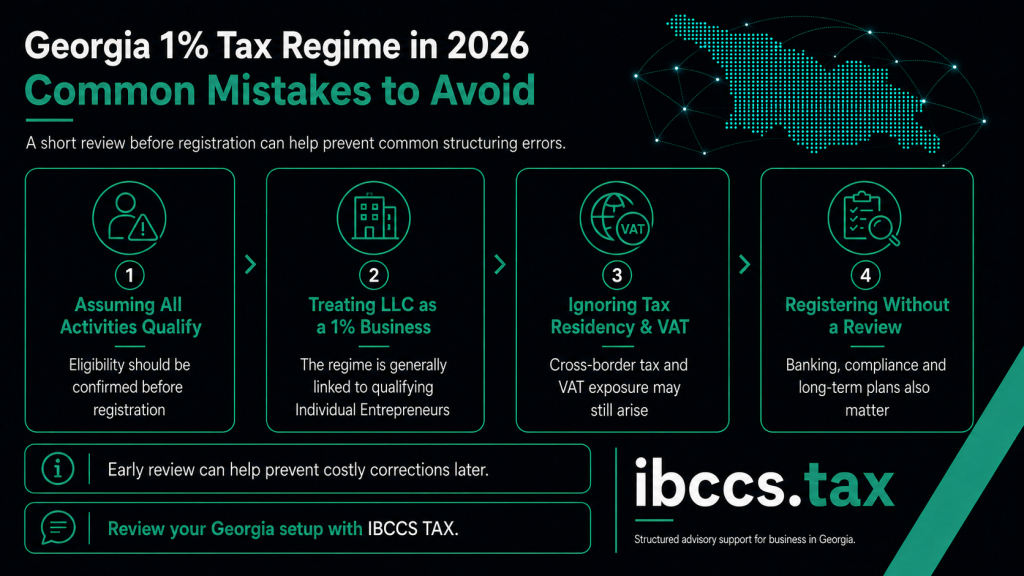
One mistake is assuming that every activity qualifies. The regime is not available for all types of services or income, and some professional or regulated activities may require separate review.
Another mistake is assuming that a Georgian LLC can automatically use the 1% regime. In most cases, the 1% regime is linked to Individual Entrepreneurs with Small Business Status, while LLCs follow a different tax framework.
A third mistake is ignoring tax residency. If a person lives or remains tax resident elsewhere, another country may still tax the income or require reporting.
A fourth mistake is overlooking VAT, banking and compliance. These areas can be just as important as the headline tax rate.
Finally, some entrepreneurs register quickly without considering whether the structure still makes sense if the business grows, changes clients or exceeds the relevant threshold.
Businesses should also monitor whether they continue to meet the conditions for Small Business Status. Where gross income exceeds the statutory threshold in consecutive years, or the entrepreneur begins carrying out an activity that is not permitted under the regime, continued eligibility can be affected. Changes in activity, turnover or business model should therefore trigger a fresh review of the status rather than assuming the original registration remains appropriate indefinitely.
When to Review Your Georgia 1% Tax Setup
A review is strongly recommended before registering if:
- you are not sure whether your activity qualifies;
- you live outside Georgia or travel frequently;
- you already have tax residency in another country;
- your clients are based in multiple jurisdictions;
- you expect turnover close to the relevant threshold;
- you provide consulting, financial, legal, advisory or regulated services;
- you are choosing between IE and LLC;
- you need a bank account for international business activity;
- you want to combine Georgia with another structure or jurisdiction.
A short review before registration can prevent costly corrections later.
Georgia 1% Tax Regime Support from IBCCS TAX
IBCCS TAX assists entrepreneurs, freelancers, investors and internationally mobile individuals with tax, legal and practical setup in Georgia. Our support may include:
- assessment of eligibility for Individual Entrepreneur and Small Business Status;
- comparison between IE and LLC structures;
- company or entrepreneur registration in Georgia;
- tax registration and practical setup;
- review of VAT and compliance obligations;
- accounting and monthly reporting support;
- banking preparation and documentation;
- tax residency and cross-border planning;
- broader structuring across Georgia, Cyprus, the UAE, Uzbekistan and other international markets.
For clients who are considering Georgia as part of a broader relocation or business plan, we can also support with doing business in Georgia, Georgia tax incentives for international businesses and coordinated international advisory.
If you are considering Georgia’s 1% tax regime, the most important step is to confirm whether it fits your actual situation before registration. Contact IBCCS TAX to review your activity, tax residency position and setup options.






FAQ: Georgia 1% Tax Regime, Individual Entrepreneur and Small Business Status
1. What is the Georgia 1% tax regime?
The Georgia 1% tax regime is a preferential tax treatment that may apply to qualifying Individual Entrepreneurs with Small Business Status. Where the conditions are met, qualifying income may be taxed at 1% of turnover up to the applicable threshold.
2. Does the 1% tax regime apply to Georgian LLCs?
In general, no. The 1% regime is usually linked to Individual Entrepreneurs with Small Business Status, not standard Georgian LLCs. A Georgian LLC is normally taxed under the corporate tax framework.
3. Can foreigners register as Individual Entrepreneurs in Georgia?
Foreign individuals may be able to register as Individual Entrepreneurs in Georgia, subject to proper documentation and practical requirements. Eligibility for Small Business Status should be reviewed separately.
4. Do I need to live in Georgia to use the 1% tax regime?
This depends on the facts. Registration and tax residency are separate issues. A person may register in Georgia, but their tax position in another country may still need to be reviewed.
5. Does Georgia’s 1% tax regime remove tax obligations in other countries?
No. Registering in Georgia does not automatically remove tax obligations elsewhere. Foreign tax residency, source of income, double tax treaties and local reporting rules may still be relevant.
6. What happens if turnover exceeds the relevant threshold?
If gross income from economic activities exceeds GEL 500,000 during the calendar year, the Small Business tax rate increases from 1% to 3% from the beginning of the month in which the threshold is exceeded until the end of that calendar year. Continued eligibility should also be reviewed where turnover remains above the relevant limit.
7. Is VAT included in the 1% tax regime?
No. VAT is a separate consideration. Depending on the type of activity, turnover, client location and place of supply, VAT registration or other VAT obligations may need to be reviewed.
8. Is the 1% regime suitable for consultants?
It depends on the type of consulting, the activity classification and the applicable rules. Some activities may require additional review or may not qualify. Professional advice should be obtained before relying on the 1% regime.
9. Can the registration be completed remotely?
In some cases, remote registration may be possible with a properly prepared power of attorney and supporting documents. Practical requirements should be checked before starting the process.
10. Why work with IBCCS TAX?
IBCCS TAX provides tax, legal, accounting and practical business support in Georgia and across multiple jurisdictions. We help clients assess whether the 1% regime is appropriate, complete registration and maintain the structure correctly after setup.
Georgia iGaming License in 2026: Online Casino, Slots & Sports Betting for International Operators
Georgia introduced a dedicated licensing framework in 2026 for the
Read More
Work Permit in Georgia for Foreigners: Right to Work, Employers, Self-Employed and Residence Rules
Georgia introduced a substantially more regulated labour migration framework in
Read More
Cezary Zieniuk to Join Free IMC Webinar on the New Geography of Global Mobility
On 23 September 2026, Cezary Zieniuk, Founder of IBCCS TAX
Read More