


Georgia continues to attract founders, consultants, investors and internationally mobile professionals looking for a jurisdiction that combines practical setup options, a business-friendly environment and comparatively clear tax rules. For many, the appeal is not only about tax efficiency. It is also about flexibility, accessibility and the ability to build or relocate with fewer barriers than in many other markets. As a jurisdiction, Georgia is increasingly part of serious cross-border planning discussions, especially for those evaluating company formation, relocation, individual activity, IT operations and real-estate-backed residency.
In a recent interview conducted by Samuela Davidova, Irakli Arjevanidze – Partner of IBCCS TAX Georgia discussed many of the themes international clients ask about most often: how the Georgian business environment works in practice, what makes the Georgian LLC attractive, how small business status is commonly viewed, why Georgia is often mentioned in connection with IT and international services, and what should be considered when relocation, work permits or real estate enter the picture.

- Georgia remains attractive for entrepreneurs looking at practical company formation and a business-friendly tax environment.
- The interview highlights the Georgian LLC, individual entrepreneurship and the importance of choosing the right structure from the start.
- Work permit and relocation considerations are now more relevant for those planning to live and work in Georgia.
- Real estate may also play a role in broader residency and diversification planning.
- Georgia offers real opportunities, but the legal and tax setup still needs to be handled properly.
Watch the Interview: 0% Tax in Georgia 2026: LLC, Work Permits & Why Entrepreneurs Are Relocating Here
If you are considering Georgia for business, relocation, IT activity, real estate or wider international structuring, the full interview with Samuela and Irakli is a strong place to start. It provides practical context around the topics most often raised by entrepreneurs, investors and globally mobile individuals who are assessing Georgia in 2026.
Why Georgia Continues to Attract International Entrepreneurs and Investors
There are several reasons why Georgia remains highly visible in conversations around international structuring and relocation. It sits at the intersection of Europe and Asia, offers relatively straightforward procedures in a number of business areas, and continues to appeal to clients who value commercial practicality. On top of that, the jurisdiction is frequently discussed because of its tax logic, its company formation process, the availability of small business status for qualifying activity, and the range of routes that can be relevant for entrepreneurs, remote professionals, service businesses and investors.
What matters in practice, however, is not the headline alone. Georgia may be appealing, but the right structure always depends on what the client is actually doing, where income is generated, where management and control sit, whether the person is relocating or remaining abroad, and how the legal and tax profile fits into the wider international picture. That is why at IBCCS TAX we approach Georgia not as a one-size-fits-all solution, but as a jurisdiction that can work very well when used properly and with the correct expectations.
Company Formation in Georgia: Why Founders Consider a Georgian LLC
For international founders exploring a practical entry point into the market, business registration in Georgia is often where the process begins. Georgia is frequently viewed as an accessible jurisdiction for launching a company, especially by entrepreneurs who want a structure that is commercially workable and comparatively straightforward to establish.
One of the reasons the Georgian LLC attracts attention is that it can be relevant in a wide variety of scenarios, from service-based businesses and international consulting operations to trading structures and selected operational entities. The key issue, however, is not simply how easy it is to register a company. The more important question is whether the chosen structure will remain suitable once accounting, tax compliance, invoicing, banking, contracts and immigration considerations are taken into account.
That is why many founders first look beyond the mechanics of incorporation and focus instead on whether a Georgian LLC genuinely fits the business model, the ownership profile and the long-term operational plan. In many cases, the answer depends not only on the business itself, but also on where the founders live, where the clients are located and how the company will actually be managed in practice.
Georgia Tax Environment: Why the Jurisdiction Stands Out
A major reason Georgia appears so often in business and relocation discussions is its broader tax environment. The Georgian system is widely viewed as attractive by entrepreneurs and internationally operating businesses assessing where to base or expand part of their operations, particularly where flexibility, retained earnings and practical structuring matter.
This broader framework is one of the reasons Georgia corporate tax is attracting more attention from founders and internationally operating businesses assessing where to base or expand their operations. The appeal, however, should not be reduced to simplistic tax messaging. A Georgian structure still needs to be suitable from a legal, commercial and cross-border perspective. For that reason, the serious discussion is rarely just about rates. It is about whether Georgia is the right operational and compliance fit.
For many clients, this is exactly where Georgia starts to stand out. The jurisdiction is often considered by businesses that want room for reinvestment, operational flexibility and a more practical approach to structuring than they may find elsewhere. At the same time, proper analysis remains essential, especially where the owners have tax ties to other countries or where the business operates internationally.
Small Business Status in Georgia and Individual Activity
For freelancers, consultants and solo operators, Small Business Status in Georgia is often one of the first topics that comes up, especially because qualifying activity may benefit from a preferential 1% tax rate on turnover up to GEL 500,000 annually. That threshold remains one of the most important practical reference points for people exploring Georgia as a base for individual business activity.
That said, a favourable regime does not automatically mean the structure is the right one. Operating as an individual entrepreneur is very different from running a limited liability company, and the practical implications can be significant in terms of liability, contracts, growth, staffing and international positioning. Some clients are best served by an individual structure. Others are better protected and better positioned through a company. The right answer depends on the nature of the activity and on the wider business and personal context.
This is also why Small Business Status should be treated as part of a broader discussion, not as a standalone headline. The tax treatment may be attractive, but the operational model, international profile and long-term plans still need to make sense.
IT Business in Georgia and International Service Structures
Georgia is also frequently discussed in connection with export-oriented service models, software development and international operations, which is one reason topics such as Georgia for business continue to attract interest from globally minded founders.
For many international clients, this is where Georgia becomes especially interesting. The jurisdiction is often evaluated not only as a place to register a company, but as a base for building teams, serving foreign clients and structuring certain qualifying business models in a more efficient way. This is particularly relevant for founders who are comparing Georgia with other jurisdictions in Europe, the Middle East or wider international markets.
As always, however, classification matters. It is not enough for a business to describe itself as “digital” or “online”. The underlying activity, commercial model and operational setup all need to be considered carefully. Where the structure is genuinely aligned with the business, Georgia can be highly compelling. Where it is not, a more tailored approach is needed from the outset.
Relocation to Georgia, Work Permits and Residence Planning
For founders, independent professionals, families and investors planning a longer-term move, expat services in Georgia become relevant not only from a practical relocation perspective, but also from the standpoint of legal status, work authorisation and residence planning.
In 2026, Georgia is also increasingly part of conversations around work-based presence and longer-term legal status. The current framework puts greater emphasis on the right to work for certain categories of foreign nationals, which makes relocation planning more important than before, particularly for those who want their business structure, tax position and residence route to work together in a coherent way.
In many cases, the real question is no longer simply whether Georgia is attractive, but how to approach it properly from both an operational and legal perspective. For some clients, this means assessing a work-based route. For others, it means looking at relocation, family planning, property ownership or a broader international structure that includes Georgia as one part of a longer-term plan.
Georgia Real Estate, Residency and Diversification Opportunities
For buyers looking beyond a simple property purchase, Georgia Real Estate Residency in 2026 is increasingly part of the wider discussion around diversification, relocation and long-term planning.
Georgia continues to attract attention from people who want to combine a real estate acquisition with broader strategic goals. For some, that means portfolio diversification. For others, it is about creating a second base, planning for residence options or adding flexibility to a wider international setup. In practice, this is one of the areas where business planning, personal mobility and investment considerations often begin to overlap.
This is also an area where clarity matters. Under the current legal framework, Georgia distinguishes between different residence routes connected with property and investment. The law includes a USD 150,000 equivalent in GEL threshold for a short-term residence permit based on qualifying non-agricultural real property, while USD 300,000 equivalent in GEL remains relevant to the investment residence permit framework. These are exactly the kinds of distinctions that make careful planning important, particularly for international buyers who are considering not only the property itself, but also tax exposure, family status, long-term residence and future exit.
What the Interview with Irakli Arjevanidze Covers
The interview with Samuela Davidova highlights the issues most often raised by entrepreneurs, investors and internationally mobile individuals considering Georgia. Rather than focusing on theory alone, the conversation touches on the practical questions that usually come first: whether Georgia is attractive for business, which structures are commonly considered, how the jurisdiction is viewed from a tax and operational perspective, and how relocation, real estate and longer-term planning may fit into the wider picture.
The interview is particularly relevant for those assessing Georgia as part of a broader business, relocation or investment strategy and looking for a more practical overview of the topics currently shaping interest in the jurisdiction.
How IBCCS TAX Can Support Business and Relocation in Georgia
At IBCCS TAX, we support clients looking at business registration in Georgia, expat services in Georgia and broader strategic matters linked to Georgia corporate tax, Georgia Real Estate Residency in 2026 and the wider environment for Georgia for business.
Georgia can be a highly effective jurisdiction when the structure matches the client’s commercial, personal and long-term objectives.






Georgia iGaming License in 2026: Online Casino, Slots & Sports Betting for International Operators
Georgia introduced a dedicated licensing framework in 2026 for the
Read More
Work Permit in Georgia for Foreigners: Right to Work, Employers, Self-Employed and Residence Rules
Georgia introduced a substantially more regulated labour migration framework in
Read More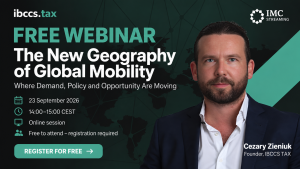
Cezary Zieniuk to Join Free IMC Webinar on the New Geography of Global Mobility
On 23 September 2026, Cezary Zieniuk, Founder of IBCCS TAX
Read More