

Georgia, the country located between Europe and Asia, has become one of the most practical jurisdictions in the region for entrepreneurs, international companies, investors and internationally mobile professionals. It offers a fast company registration process, a business-friendly environment and a tax system that can be attractive for both companies and individuals when the structure is chosen correctly.
Company formation in Georgia can often be completed quickly when the required documents are properly prepared. However, the real value of setting up in Georgia is not only speed. The more important question is whether the chosen structure fits the business model, tax position, banking needs and long-term plans.
For many foreign founders, the preferred structure is a Georgian Limited Liability Company, commonly referred to as an LLC. For solo professionals, freelancers and consultants, Individual Entrepreneur status with Small Business Status may also be worth considering, especially where the 1% tax regime is available.
At IBCCS TAX, we support clients with business registration, tax structuring, accounting and ongoing compliance through our offices in Tbilisi and Batumi. This guide explains how company formation in Georgia works in 2026, when an LLC is the right choice, when the 1% tax regime may apply and what foreign founders should consider before starting operations in Georgia.

- Georgia offers a fast and efficient company registration process.
- The most common structure for foreign founders is a Georgian Limited Liability Company, commonly referred to as an LLC.
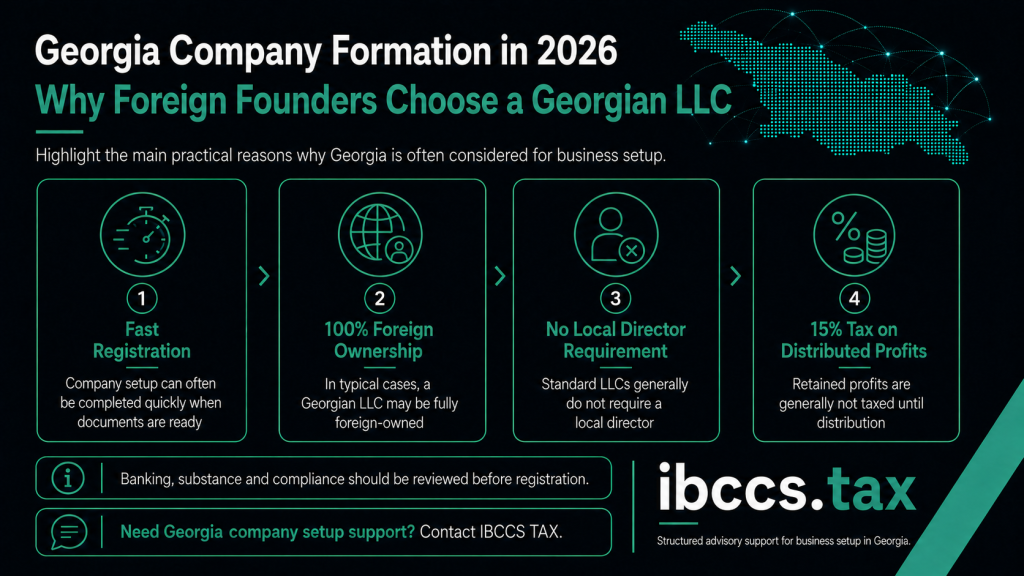
- In typical cases, a Georgian LLC can be 100% foreign-owned.
- There is generally no requirement for a local shareholder or local director.
- Georgia’s corporate tax model can be attractive for companies that reinvest profits.
- The standard corporate income tax rate is 15%, usually triggered on distributed profits or certain deemed distributions.
- The widely discussed 1% tax regime usually applies to qualifying Individual Entrepreneurs with Small Business Status, not to standard LLCs.
- Corporate bank account opening, accounting, tax compliance and substance planning should be considered before registration, not after.
- IBCCS TAX assists clients with the full setup process, including company registration, tax advisory, accounting, banking coordination and ongoing compliance.
Why Choose Georgia for Company Formation in 2026
Georgia offers a strong combination of speed, accessibility and strategic location. Positioned between Europe and Asia, the country can be attractive for service providers, consultants, trading companies, technology businesses, investors and founders looking for a regional base.
The registration process is relatively straightforward compared with many other jurisdictions. A company can often be registered within a short timeframe, provided that the documents are in order and the legal address, charter and shareholder details are properly prepared.
Georgia is also attractive because of its corporate tax model. In general terms, the system is based on an Estonian-style approach, where retained and reinvested profits are not taxed until they are distributed or treated as distributed. This can be useful for businesses that want to reinvest earnings into hiring, technology, inventory, expansion or working capital.
The country may also be relevant for trading, logistics and regional operations because of its geographic position and access to international markets. For selected cross-border business models, Georgia can be more than a simple incorporation jurisdiction and may serve as a practical base for commercial activity.
At the same time, Georgia should not be treated as a one-size-fits-all solution. The best structure depends on the business model, expected revenue, client geography, personal tax residence, risk profile, banking needs and whether the business requires employees, partners, investors or regulated activity permissions.
LLC in Georgia: The Best Company Structure for Most Foreign Founders
For most international founders, a Georgian Limited Liability Company is the standard structure for doing business in Georgia. It is flexible, widely understood and suitable for many types of commercial activity.
A Georgian LLC is commonly used for international service businesses, consulting companies, technology and software businesses, trading companies, e-commerce projects, local operating companies, holding structures and companies with multiple shareholders. It is also often suitable for businesses that plan to hire employees, enter into formal contracts, limit liability or build a scalable corporate structure.
An LLC is a separate legal entity. This means that, in general, the company is responsible for its own obligations, which is one of the main reasons why many founders prefer an LLC over operating personally as an Individual Entrepreneur.
For foreign clients, an LLC may also be more suitable when dealing with banks, payment providers, B2B clients, international contracts and commercial partners. It gives the business a formal corporate identity and creates a clearer separation between the founder and the company.
IBCCS TAX assists clients with the full business registration process in Georgia, including structure selection, document preparation, legal address coordination, registry filing and post-registration setup. Our role is not only to register the company, but to make sure the structure is practical, compliant and aligned with the client’s long-term plans.
Benefits of Registering an LLC in Georgia
A Georgian LLC offers several important advantages for foreign entrepreneurs and international businesses. These advantages are especially relevant for founders who want a flexible structure, international ownership and a practical operating base.
Fast LLC Registration in Georgia
Company registration in Georgia can often be completed within a short timeframe when the documents are ready and the application is properly prepared. This makes Georgia attractive for founders who need an efficient setup without unnecessary administrative delays.
Fast registration should still be supported by proper structuring. The company should be prepared with the correct charter, legal address, shareholder details, management structure and post-registration compliance plan.
100% Foreign Ownership of a Georgian LLC
In typical cases, a Georgian LLC may be fully owned by foreign shareholders. This allows international founders to control the company directly without requiring a local partner.
This feature is particularly useful for foreign investors, entrepreneurs and international groups entering the Georgian market. It also makes Georgia accessible for non-resident founders who want a local or regional business presence.
No Local Director Requirement in Typical LLC Structures
Georgia generally does not require a local director for standard LLC structures. This can simplify the setup for non-resident founders and international entrepreneurs.
However, tax residence, place of effective management, banking, substance and operational presence should still be reviewed. A company can be easy to register, but it still needs to be structured properly for tax, banking and commercial purposes.
No General Minimum Share Capital Requirement
A Georgian LLC can usually be established without a high minimum share capital requirement. This makes the structure accessible for startups, consultants, small businesses and international entrepreneurs.
The capital structure should still be appropriate for the business model. Banks, counterparties and commercial partners may consider whether the company is properly funded for its planned activity.
Georgian Corporate Tax on Distributed Profits
Georgia’s corporate tax system can be particularly attractive for businesses that reinvest profits. The standard corporate income tax rate is 15%, but in general, taxation is linked to profit distribution or certain deemed distribution events rather than simply accounting profit.
This can be beneficial for companies focused on expansion, as retained profits can often be used inside the business without immediate corporate income tax. Companies should still maintain proper accounting records and monitor transactions that may be treated as distributions or non-business expenses.
Strategic Location Between Europe and Asia
Georgia is located between Europe and Asia, with access to regional trade routes and growing business opportunities. This can be useful for companies involved in trade, logistics, consulting, technology, regional management or cross-border services.
For businesses operating across markets, Georgia can provide a practical base for management, contracting and operations. The suitability of Georgia should always be assessed together with the founder’s tax residence, customer locations, substance requirements and banking needs.
Practical Business Environment for International Founders
Georgia is known for a relatively straightforward business environment. For many founders, the main challenge is not registration itself, but choosing the correct structure, preparing proper documents, opening a bank account and staying compliant after incorporation.
This is why company formation should be treated as the first step in a broader business setup. IBCCS TAX supports clients with registration, tax advisory, accounting, legal coordination and ongoing compliance to help the company operate properly after incorporation.
Georgia 1% Tax Regime: Does It Apply to LLCs or Individual Entrepreneurs?
One of the most common reasons entrepreneurs search for company formation in Georgia is the well-known 1% tax regime. This point requires careful explanation because the 1% tax does not apply automatically to every business structure.
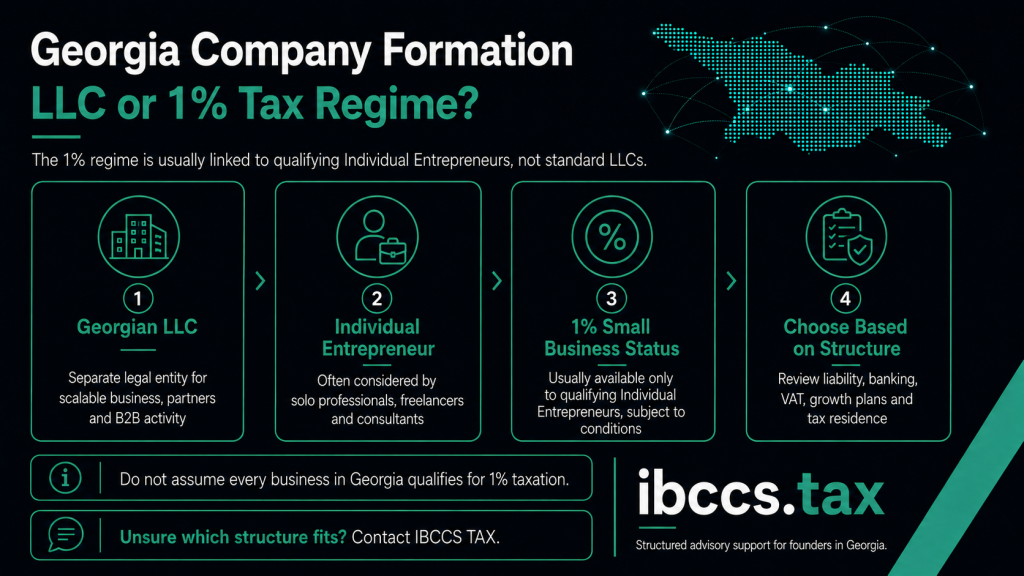
Georgia does offer a 1% tax regime in certain cases, but it is not a general corporate tax rate for LLCs. The 1% tax usually applies to qualifying Individual Entrepreneurs who obtain Small Business Status. This means that a standard Georgian LLC does not normally pay 1% corporate tax. A Georgian LLC is generally subject to the corporate tax system, where the standard corporate income tax rate is 15% and taxation is typically connected with distributed profits or certain deemed distributions.
The 1% regime may be highly attractive for qualifying individuals, especially freelancers, consultants, developers, designers, marketers and other independent professionals. However, eligibility depends on the type of activity, turnover, compliance status and other conditions. In simple terms, LLC taxation and Individual Entrepreneur taxation are different. The 1% tax regime is usually linked to qualifying Individual Entrepreneurs, not standard companies, and not all activities qualify for Small Business Status.
Learn more about Georgia 1% Tax Regime in 2026: Individual Entrepreneur and Small Business Status
Turnover thresholds and compliance rules must also be monitored carefully. VAT, payroll, withholding tax and international tax issues may still be relevant, which means the lowest headline tax rate is not always the best structure. This distinction is important. Many entrepreneurs hear about “1% tax in Georgia” and assume it applies automatically to every business, but the correct structure should be selected based on the actual business model, not only on the tax rate.
LLC vs Individual Entrepreneur in Georgia: Which Structure Is Better?
The choice between an LLC and Individual Entrepreneur status is one of the most important decisions when setting up in Georgia. Both options can be useful, but they serve different purposes and carry different legal, tax and commercial consequences.
| Feature | Georgian LLC | Individual Entrepreneur with Small Business Status |
| Legal status | Separate legal entity | Natural person carrying out business activity |
| Liability | Generally limited to company assets | Personal liability may apply |
| Typical use case | Companies, startups, trading businesses, multi-founder businesses, scalable projects | Freelancers, consultants, solo professionals, small service providers |
| 1% tax regime | Not generally applicable | May apply if eligible |
| Corporate tax | Standard 15% on distributed or deemed distributed profits | Not a corporate tax regime |
| Shareholders | Suitable for one or multiple shareholders | One individual |
| Investment readiness | Better for partners, investors and future restructuring | Limited scalability |
| Banking | Corporate bank account usually required | Banking approach depends on the case |
| Compliance | More formal accounting and reporting | Simpler in many cases, but still requires compliance |
A Georgian LLC is usually better where the business has partners, employees, significant commercial risk, international contracts, B2B clients, reinvestment plans or future investment needs. It gives the business a more formal structure and may be more practical for counterparties, banks and international commercial relationships.
Individual Entrepreneur status may be better for a solo professional with a simple service business, limited risk and activities that qualify for Small Business Status. The right answer depends on facts, including expected turnover, clients, country of tax residence, liability risk, contracts, banking requirements, VAT exposure and long-term growth plans.

Documents Required to Register a Company in Georgia
The documents required for company formation in Georgia depend on the structure, founder profile and whether the registration is carried out in person or remotely. For a standard LLC, the process usually requires clear identification of the shareholders, director, legal address and company rules.
In many cases, foreign founders should be prepared to provide a passport copy, proposed company name, Georgian legal address, details of the director and shareholder, and a charter or founding document. If the company is registered remotely, a power of attorney may also be required. Foreign documents may need to be notarised, apostilled or legalised, depending on the country where they are issued. Translation into Georgian may also be required for documents submitted to local authorities or used in official procedures.
Where the shareholder is another company rather than an individual, additional corporate documents may be required. These may include an extract from the foreign company registry, constitutional documents, details of directors and confirmation of authorised signatories.
The document stage is important because errors or inconsistencies may delay registration, banking or post-registration compliance. IBCCS TAX assists clients in preparing and coordinating the required documents so the registration process is handled efficiently.
How to Register a Company in Georgia Step by Step
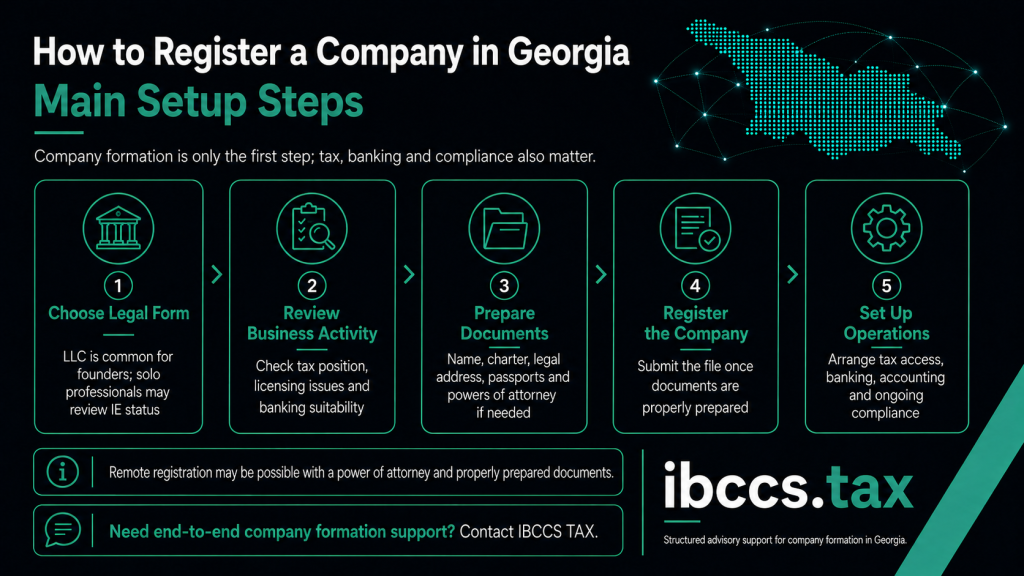
Company formation in Georgia is relatively efficient, but the process should be handled carefully. A fast registration is useful only if the company is also properly structured, bankable and compliant.
Choose the Right Legal Form for Your Georgia Business
The first step is choosing the correct legal form. For most foreign founders, this will be an LLC, while solo professionals may consider Individual Entrepreneur status if their activity and risk profile are suitable.
Other structures may be relevant for larger groups, regulated activities or specific investment arrangements. The legal form should be selected after reviewing the business model, tax position, liability exposure and future commercial plans.
Review the Business Activity Before Registration
Before registration, the activity should be reviewed from a legal, tax and banking perspective. Some business activities may require additional licences or permits, while others may affect access to special tax regimes such as Small Business Status, Virtual Zone or International Company Status.
If the activity is regulated or licensing-sensitive, IBCCS TAX can assist through our licensing services in Georgia. This is particularly important for businesses in financial services, gaming, crypto, investment-related activity or other sectors where additional analysis may be required.
Choose a Company Name for a Georgian LLC
The company name should be suitable for registration and practical for commercial use. It should also be appropriate for banks, clients and counterparties.
A clear and professional company name can support credibility in commercial relationships. It should be selected with both registry requirements and business positioning in mind.
Prepare the Charter and Incorporation Documents
The charter should not be treated as a simple formality. It can affect shareholder rights, management powers, decision-making, profit distributions, transfer of shares and future restructuring.
This is especially important for companies with more than one founder, investors, external financing or planned expansion. Our team can coordinate company formation together with legal services in Georgia where the structure requires more detailed legal documentation.
Secure a Legal Address in Georgia
A legal address is required for company registration and official correspondence. Foreign founders usually coordinate this through a local service provider.
The legal address should be reliable and suitable for receiving official communications. It should also be aligned with the company’s broader operational and compliance setup.
Submit the Company Registration Application
The application is submitted to the relevant registration authority in Georgia. If the documentation is complete, registration can often be completed quickly.
The registration stage should be coordinated carefully, especially where foreign documents, powers of attorney, translations or corporate shareholders are involved. Proper preparation helps avoid delays and post-registration corrections.
Set Up Tax Access and Compliance in Georgia
After incorporation, the company must be properly set up for tax administration and reporting. This includes access to the tax portal, correct taxpayer registration, assessment of VAT obligations and implementation of accounting processes.
IBCCS TAX provides tax advisory in Georgia for companies that need support with corporate tax, VAT, international tax, withholding tax, payroll tax and ongoing compliance. Early tax planning helps prevent issues with reporting, deductions, distributions and cross-border payments.
Open a Corporate Bank Account in Georgia
Bank account opening is often more detailed than company registration. Banks may request information about the business model, shareholders, source of funds, expected transactions, counterparties and jurisdictions involved.
Remote company registration may be possible in many cases, but banking should be assessed separately. Some banks may require additional documents, interviews or physical presence depending on the case.
Set Up Accounting and Bookkeeping in Georgia
Accounting should be organised immediately after incorporation. A Georgian company should maintain proper records, supporting documents, invoices, bank statements and tax filings.
IBCCS TAX provides accounting services in Georgia for local and international businesses, including bookkeeping, tax-compliant reporting, payroll and ongoing compliance support. Proper accounting is essential for monitoring corporate tax, VAT, payroll and deductible business expenses.
How Long Does It Take to Register a Company in Georgia?
Company registration in Georgia can often be completed quickly when the required documents are properly prepared. The legal registration stage may be relatively short, but the complete setup should also include tax access, accounting, banking and practical operational matters.
For foreign founders, the total timeline depends on several factors. These include whether the founder is present in Georgia, whether documents must be notarised or apostilled, whether a power of attorney is used, whether the shareholder is an individual or foreign company, and whether the business activity requires additional review.
The company may be registered before all operational matters are completed. However, a business should not begin active operations without confirming its tax, accounting, banking and compliance setup.
Remote Company Registration in Georgia for Foreign Founders
In many cases, foreign founders can register a company in Georgia remotely through a properly authorised representative. This usually requires a power of attorney and supporting documents, and depending on the country of signing, documents may need notarisation, apostille, legalisation and translation.
Remote setup can be practical for foreign clients who cannot travel to Georgia immediately. However, it is important to distinguish between company registration and full operational setup.
Even if the company is registered remotely, banking, tax, accounting and substance matters may require additional steps. Some banks or service providers may request enhanced due diligence, business explanations or direct communication with the founder.
For clients relocating to Georgia or combining company formation with personal setup, IBCCS TAX also provides expat services in Georgia. This can be useful where business registration is part of a broader relocation, tax residence or operational planning process.
Georgian LLC Taxation: Corporate Tax, VAT and Dividends
A Georgian LLC should be reviewed from several tax angles. The company’s tax position depends on its activity, transactions, profit distribution policy, employees, cross-border payments and whether any special tax regime applies.
Corporate Income Tax for a Georgian LLC
The standard corporate income tax rate is 15%. In general, Georgia’s model taxes distributed profits and certain deemed distributions, while retained profits used for business purposes are generally not taxed immediately.
This can be attractive for companies that want to reinvest profits rather than distribute them. Companies should still maintain proper documentation and review payments that may be treated as non-business expenses or deemed distributions.
Dividend Tax for Georgian Companies
Dividends may be subject to withholding tax, depending on the recipient and applicable rules. Where international shareholders are involved, double tax treaty access and beneficial ownership should be reviewed.
Dividend planning should be considered before profits are distributed. The shareholder’s country of tax residence may also affect the overall tax treatment.
VAT Registration for Companies in Georgia
VAT in Georgia should be assessed based on the company’s activities, turnover, place of supply and type of transactions. Businesses with local taxable supplies or turnover above the applicable threshold may need to register for VAT.
Even if a company is not VAT-registered at the beginning, this should be monitored continuously as the business grows. VAT can become particularly important for trading companies, local service providers, e-commerce businesses and companies with mixed domestic and international transactions.
Payroll Tax and Employment Compliance in Georgia
If the company hires employees or pays salaries, payroll taxes and reporting obligations become relevant. Employment contracts, payroll calculation and reporting should be set up correctly from the beginning.
Payroll should also be reviewed when founders work for their own Georgian company. The distinction between salary, dividends, service fees and other payments should be properly structured.
Withholding Tax and Cross-Border Payments from Georgia
Payments to non-residents may require withholding tax analysis. This is particularly relevant for management fees, royalties, service fees, dividends, interest and other cross-border payments.
International businesses should not assess Georgian tax in isolation. The founder’s personal tax residence, place of management, controlled foreign company rules, permanent establishment risk and treaty position in other countries may also matter.
Special Tax Regimes in Georgia Country for Entrepreneurs and IT Companies
Georgia offers several special regimes that may be attractive for certain businesses. These regimes can be useful, but they require proper eligibility analysis and ongoing compliance.
Small Business Status for Individual Entrepreneurs in Georgia
Small Business Status in Georgia is usually relevant for qualifying Individual Entrepreneurs. It may allow a 1% tax rate on qualifying turnover up to the applicable threshold, subject to conditions and activity restrictions. This regime can be highly attractive for freelancers and independent professionals. It is not suitable for every activity and should not be confused with LLC taxation.
Virtual Zone Company in Georgia for IT Businesses
The Virtual Zone regime may be relevant for certain IT companies providing qualifying services to clients outside Georgia. It can offer significant tax benefits for eligible businesses, but the activity, client base, documentation and substance should be reviewed carefully. This regime should be assessed before implementation rather than after registration. The company should be structured and documented in a way that supports the intended tax treatment.
International Company Status in Georgia
International Company Status may be available for certain qualifying activities, including selected IT and maritime activities. It can provide reduced tax rates and other benefits, but it is subject to specific conditions. A company should not assume it qualifies automatically. The activity, employees, operational setup and compliance obligations should be reviewed before relying on the regime.
Free Industrial Zone Options in Georgia
Free Industrial Zones may be relevant for certain manufacturing, trading or logistics businesses. This option is more specialised and should be assessed based on the business model and operational requirements. Special regimes should never be selected only because they appear tax-efficient. Eligibility, documentation, substance, banking and long-term defensibility are essential.
Mistakes to Avoid When Registering a Company in Georgia
Company formation in Georgia is efficient, but mistakes at the setup stage can create practical problems later. The most common issues usually come from choosing the wrong structure, misunderstanding the tax system or treating registration as a standalone formality.
Assuming the 1% Tax Applies to Every Georgian Company
This is one of the most common mistakes. The Georgia 1% tax regime usually applies to qualifying Individual Entrepreneurs with Small Business Status, not to standard LLCs.
A founder who wants access to the 1% tax regime should first confirm whether the activity qualifies. They should also review whether Individual Entrepreneur status is appropriate from a liability, banking, commercial and international tax perspective.
Registering an LLC Without Tax Planning
An LLC may be the right structure, but it should be aligned with corporate tax, VAT, dividend planning, payroll, cross-border payments and the founder’s personal tax position. Registration without tax planning can create avoidable compliance issues later.
Tax planning should be practical rather than theoretical. It should consider how the company will invoice clients, pay expenses, employ people, distribute profits and interact with other jurisdictions.
Ignoring Georgian Bank Account Requirements
Company registration can be fast, but bank onboarding can be more detailed. A clear business model, source of funds explanation and supporting documents should be prepared in advance.
This is especially important for foreign-owned companies, cross-border businesses and companies working with sensitive sectors or jurisdictions. Banking should be considered before registration so the company is structured in a way that supports account opening.
Using a Generic Charter for a Georgian LLC
A generic charter may be insufficient for businesses with multiple founders, future investment plans or complex decision-making needs. The charter can influence governance, share transfers, management rights and profit distributions.
For simple single-founder structures, a standard approach may be sufficient. For more complex businesses, the charter should be reviewed carefully before filing.
Forgetting Accounting and Tax Compliance After Incorporation
Registration is only the first step. A company must maintain accounting records, file tax declarations, monitor VAT and payroll obligations, and document business expenses properly.
Compliance should be set up immediately after incorporation. Delaying accounting or tax registration can create unnecessary administrative problems and increase the risk of incorrect filings.
Choosing a Georgia Business Structure Only Based on Tax
The lowest tax rate is not always the best structure. Liability, scalability, banking, client expectations, investment plans and cross-border rules can be equally important.
A structure that works for a freelancer may not work for a company with employees, shareholders and international clients. The right structure should support the business commercially, legally and tax-wise.
Is Georgia a Good Country to Register a Company in 2026?
Georgia can be a strong option if you want fast company registration, a flexible LLC structure, 100% foreign ownership in typical cases and a business-friendly environment. It may also be attractive if your company plans to reinvest profits, operate regionally or assess eligibility for special tax regimes. Georgia may require additional planning if your business is regulated, needs licences or permits, expects complex international payments or has shareholders tax resident in high-compliance jurisdictions. Additional review may also be needed where the business requires substance, involves financial services, crypto, gaming, investment activity or other sensitive sectors.
For many founders, Georgia works best when company formation is combined with proper tax, accounting, banking and legal planning from day one. This approach helps ensure that the company is not only registered, but also operational, compliant and suitable for long-term use.
Company Formation Services in Georgia by IBCCS TAX
IBCCS TAX provides end-to-end support for clients establishing and operating businesses in Georgia. Our services cover both the registration process and the post-registration matters that are essential for operating properly.
Our support may include selection of the appropriate business structure, LLC registration in Georgia, Individual Entrepreneur registration support, assessment of Small Business Status eligibility, coordination of legal address, preparation of incorporation documents and remote registration support through representative arrangements.
We also assist with tax registration, tax portal setup, corporate bank account coordination, VAT and corporate tax advisory, accounting and bookkeeping setup, payroll, employment tax, licensing assessment and ongoing compliance. This integrated approach is especially useful for foreign founders who need a practical setup rather than only a registered company.
Our Georgia team works from Tbilisi and Batumi and supports both local and international clients. As part of the wider IBCCS TAX network, we also assist clients who need cross-border structuring involving Georgia, Cyprus, the UAE, Uzbekistan or other jurisdictions. If you are considering company formation in Georgia, you can start with our business registration services in Georgia or contact our team through the IBCCS TAX contact page.
Choosing the Right Structure for Company Formation in Georgia
Company formation in Georgia can be fast, efficient and commercially attractive. For many international founders, a Georgian LLC offers flexibility, limited liability and a reinvestment-friendly corporate tax model. For qualifying solo professionals, Individual Entrepreneur status with Small Business Status may offer access to the Georgia 1% tax regime. The best structure depends on the business model, ownership, expected revenue, liability risk, banking needs and long-term plans.
IBCCS TAX supports clients with company formation, tax advisory, accounting and compliance in Georgia through our offices in Tbilisi and Batumi. If you are planning to register a company in Georgia, our team can help you choose the right structure and set it up correctly from the beginning. Contact IBCCS TAX to discuss company formation in Georgia.





FAQ: Company Formation in Georgia
1. Can a foreigner register a company in Georgia?
Yes. Foreigners can generally register and own a company in Georgia, the country located between Europe and Asia. In typical cases, a Georgian LLC can be 100% foreign-owned and does not require a local shareholder. Specific activities, banking requirements or licensing matters should still be reviewed before registration.
2. What is the most common company type in Georgia?
The most common structure for foreign founders is a Limited Liability Company. It is flexible, commercially practical and suitable for a wide range of business activities. A Georgian LLC is often used by consultants, trading companies, technology businesses, international service providers and companies with more than one shareholder. It is usually the preferred option when limited liability and scalability are important.
3. How long does company formation in Georgia take?
Company registration in Georgia can often be completed quickly when the documents are properly prepared. The legal registration stage may be short, but the full setup can take longer when banking, tax access, accounting and document preparation are included. Foreign founders should plan the process around the complete business setup, not only the registry approval. This is especially important where remote registration, corporate shareholders, bank onboarding or regulated activity review is involved.
4. Can I register a company in Georgia remotely?
In many cases, yes. Remote company registration may be possible through a properly authorised representative using a power of attorney and supporting documents. The exact document requirements depend on the founder’s country, signing procedure and company structure. Banking and operational setup should be reviewed separately, as they may involve additional checks.
5. What documents are needed to register a company in Georgia?
For a standard LLC, the process usually requires founder and director details, passport copies, a company name, a Georgian legal address and incorporation documents. If registration is carried out remotely, a power of attorney may also be required. Foreign documents may need notarisation, apostille, legalisation or translation. If the shareholder is a foreign company, additional corporate documents may be required.
6. Does Georgia have 1% corporate tax?
No. The 1% tax regime is not a general corporate tax rate for LLCs. The 1% tax usually applies to qualifying Individual Entrepreneurs with Small Business Status. A standard LLC is generally subject to Georgia’s corporate tax system.
7. What is the corporate tax rate in Georgia?
The standard corporate income tax rate is 15%. In general, Georgia’s model taxes distributed profits and certain deemed distributions, while retained profits used for business purposes are generally not taxed immediately. This can be attractive for companies that want to reinvest profits. Proper accounting and tax monitoring are still essential.
8. Is an LLC better than Individual Entrepreneur status?
It depends on the business model. An LLC is usually better for scalable businesses, partners, employees, commercial contracts, investment plans and limited liability. Individual Entrepreneur status may be better for qualifying solo professionals seeking a simpler setup and potential access to the 1% tax regime. The best option should be selected after reviewing tax, liability, banking and commercial factors.
9. Who can benefit from the 1% tax regime in Georgia?
The 1% tax regime may benefit qualifying Individual Entrepreneurs with Small Business Status. It is often relevant for freelancers, consultants and independent professionals. Eligibility depends on the activity, turnover and applicable restrictions. It should be reviewed before relying on the regime.
10. Do I need accounting after registering a company in Georgia?
Yes. A Georgian company should maintain proper accounting records, supporting documents and tax filings. Accounting should be set up immediately after incorporation. This helps monitor corporate tax, VAT, payroll, dividends and deductible business expenses.
11. Does a Georgian LLC need VAT registration?
Not always. VAT registration depends on the company’s activities, turnover and type of transactions. Even if VAT registration is not required immediately, the position should be monitored as the business grows. VAT can become relevant for local supplies, trading activity and certain service models.
12. Can a Georgian company open a bank account?
Yes. A Georgian company can open a corporate bank account, but bank account opening is subject to bank compliance checks. Banks may request information about the business model, shareholders, source of funds, expected transactions and counterparties. Foreign-owned companies should prepare a clear explanation of their activity before bank onboarding.
13. Is Georgia suitable for IT companies?
Georgia can be attractive for IT companies, especially where special regimes such as Virtual Zone or International Company Status may be relevant. These regimes can offer benefits, but eligibility should be assessed carefully. IT companies should also review client geography, substance, invoicing, employees, contractors and cross-border tax implications. The correct structure depends on how the business actually operates.
14. Is company formation in Georgia enough to reduce global tax?
No. A Georgian company is only one part of the analysis. Founders should also consider personal tax residence, management and control, permanent establishment risk, controlled foreign company rules, treaty access and substance requirements in other jurisdictions. Cross-border planning should be reviewed before relying on any tax outcome.
Georgia iGaming License in 2026: Online Casino, Slots & Sports Betting for International Operators
Georgia introduced a dedicated licensing framework in 2026 for the
Read More
Work Permit in Georgia for Foreigners: Right to Work, Employers, Self-Employed and Residence Rules
Georgia introduced a substantially more regulated labour migration framework in
Read More
Cezary Zieniuk to Join Free IMC Webinar on the New Geography of Global Mobility
On 23 September 2026, Cezary Zieniuk, Founder of IBCCS TAX
Read More