Cyprus Non-Dom status is commonly associated with a 0% Special Defence Contribution result on qualifying dividends and passive interest. That benefit is real, but it does not mean that the same income is automatically free from every Cyprus charge. For a Cyprus tax resident who is non-domiciled for SDC purposes, the General Healthcare System contribution – GHS, or GeSY – can still apply to dividends and interest even where SDC is fully exempt.
This distinction matters because SDC and GHS are separate regimes with different legal purposes, contribution rates, caps and collection mechanics. A shareholder can therefore receive a dividend that is outside SDC because of Non-Dom status and still have a 2.65% GHS liability. The same principle generally applies to passive interest. For internationally mobile investors, founders and private clients, the correct calculation should show the two layers separately rather than describing the income simply as “tax-free”.
This guide focuses specifically on that practical gap between Non-Dom and GHS. It explains how the 2.65% GHS rate applies to dividend and interest income, how the €180,000 annual contribution-base cap works, how salary and other income can use part of that cap, and how the collection route differs where GHS is withheld at source or must be paid through self-assessment. For the wider domicile framework, eligibility rules and the 17/20 test, see our main Cyprus Non-Dom guide and our dedicated Non-Dom eligibility article.

- Cyprus Non-Dom is primarily an SDC status. It can remove SDC on qualifying dividends and passive interest, but it does not generally remove GHS/GESY.
- Under the current GHS framework, income earners receiving dividends, interest or rent are generally subject to GHS at 2.65% on the relevant income.
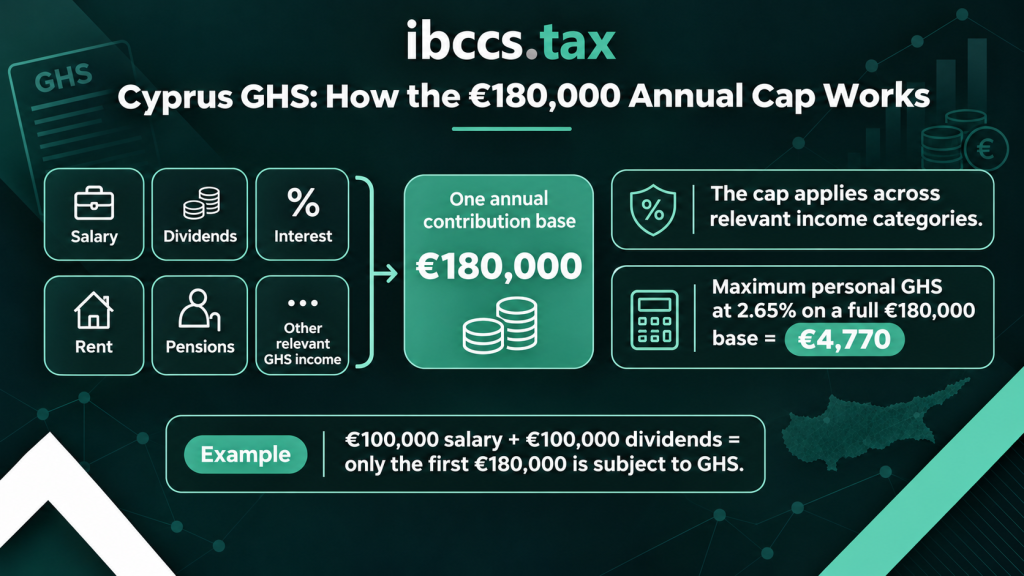
- For a natural person, the total maximum annual amount on which GHS contributions are paid is €180,000. The cap applies across relevant income categories, not separately to each dividend, bank account or investment source.
- A Cyprus tax resident Non-Dom can therefore have 0% SDC on a dividend but still pay 2.65% GHS, subject to the remaining annual contribution base.
- If €180,000 of the individual’s GHS contribution base has already been used by salary, self-employed income, pensions or other relevant income, further dividend or interest income may not create additional personal GHS contribution for that year.
- Where GHS is withheld on income above the annual cap, a refund procedure may be available. The responsible authority depends on how and where the excess contribution was collected.
- Cyprus tax residents generally bring both Cyprus-source and foreign-source dividends and interest into the relevant GHS analysis. Non-residents follow a different rule and generally do not pay GHS on dividends or interest.
- The 2026 reduction of SDC on certain dividends for domiciled individuals does not change the basic Non-Dom/GHS distinction. GHS remains a separate contribution.
- Foreign withholding tax, treaty relief and the legal classification of the income remain separate from both Non-Dom and GHS.
Quick Answer: Does a Cyprus Non-Dom Pay GHS on Dividends and Interest?
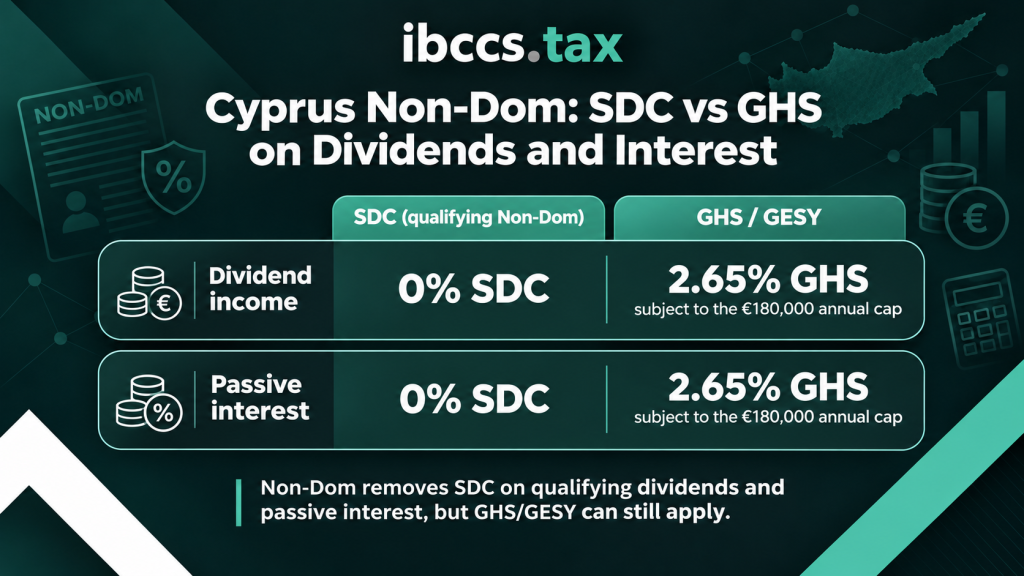
Yes, generally. A Cyprus tax resident who qualifies as non-domiciled for Special Defence Contribution purposes is generally exempt from SDC on dividend income and passive interest, but GHS/GESY is a separate contribution. Income earners are currently subject to GHS at 2.65% on dividends and interest, subject to the €180,000 maximum annual contribution base for a natural person and any specific exemption that may apply to the individual’s circumstances.
The practical result is that the same dividend can be subject to 0% SDC and 2.65% GHS. This is one of the most important points to communicate accurately when comparing Cyprus Non-Dom with other residence or tax regimes. The 2.65% is not an SDC rate and should not be described as a reduced Non-Dom tax; it is a contribution under the General Healthcare System.
Simple rule of thumb
For a Cyprus tax resident Non-Dom, analyse SDC and GHS separately. A 0% SDC outcome on dividends or passive interest does not automatically produce a 0% Cyprus charge on that income.
Why Non-Dom Does Not Remove GHS/GESY
The confusion arises because both SDC and GHS can apply to some of the same income categories, particularly dividends and interest, yet the two systems use different tests. Non-Dom status is relevant to the Special Defence Contribution rules. It determines whether a Cyprus tax resident falls within the SDC domicile net. GHS, by contrast, is a healthcare contribution framework that classifies contributors and income separately and does not use the Non-Dom exemption as a general exclusion.
For an individual who is Cyprus tax resident, domicile can therefore eliminate the SDC layer without changing the GHS layer. The Health Insurance Organisation lists “income earners”, including persons receiving rent, interest and dividends, at a current GHS rate of 2.65%. The Tax Department uses the same rate for interest, rent, dividends and other relevant income in its GHS guidance. This treatment is independent of whether the individual is domiciled or non-domiciled for SDC purposes.
That separation is especially important for private clients whose income is concentrated in investment returns. A person may have very little employment income but receive substantial dividends from a privately held company or a listed portfolio. The Non-Dom benefit can still be commercially significant because it removes SDC, but GHS should be included in cash-flow planning unless the annual contribution cap has already been reached or a specific exemption applies.
Cyprus Non-Dom: SDC vs GHS at a Glance
| Income / issue | SDC for qualifying Non-Dom | GHS/GESY position |
| Dividend income | Generally 0% SDC | Generally 2.65%, subject to the annual cap and specific exemptions |
| Passive interest | Generally 0% SDC | Generally 2.65%, subject to the annual cap and specific exemptions |
| Salary | Not an SDC/Non-Dom benefit | Employee GHS generally 2.65%; ordinary PAYE and other rules also apply |
| Self-employed income | Not an SDC/Non-Dom benefit | GHS generally 4.00% for self-employed remuneration, subject to the applicable framework |
| Rental income | SDC abolished generally from 2026 | GHS generally 2.65%; income tax and other rules can still apply |
The table shows why “Non-Dom = 0% tax” is too broad. Non-Dom can be decisive for SDC, but GHS, income tax, Social Insurance, foreign withholding and reporting obligations all continue to follow their own rules. The exact mix depends on the individual’s residence, income categories and wider structure.
GHS on Dividends for a Cyprus Non-Dom
Dividends are the most visible example of the distinction. Cyprus generally does not subject dividend income received by an individual to personal income tax, but dividends can be relevant to both SDC and GHS. A qualifying Cyprus tax resident Non-Dom is generally outside SDC on dividends. The GHS position is different: dividend income falls within the “income earner” category and is generally subject to the 2.65% contribution, subject to the annual contribution-base cap.
The source of the dividend does not by itself remove the GHS issue for a Cyprus tax resident. A dividend from a Cyprus company and a dividend from a foreign company should both be reviewed in the individual’s Cyprus GHS position. The collection mechanics can differ, however. A Cyprus payer may withhold GHS at source where the rules require it, while foreign dividends commonly require the recipient to deal with the contribution through self-assessment where no Cyprus withholding has occurred.
The 2026 tax reform reduced the SDC rate on actual dividends for individuals who are within the SDC net to 5% where the relevant distribution relates to profits earned from 1 January 2026, while transitional rules can preserve the historic 17% rate for older profits. This change affects the comparison with a domiciled shareholder, but it does not convert GHS into SDC or remove the 2.65% GHS layer for a Non-Dom. For the dividend reform and transitional treatment in detail, see our Tax on Dividends in Cyprus guide.
Illustrative Dividend Calculations
| Illustrative profile | SDC | GHS/GESY | |
| Cyprus tax resident Non-Dom receives €50,000 dividend; no other GHS income | Generally €0 | 2.65% x €50,000 = €1,325 | |
| Cyprus tax resident Non-Dom receives €200,000 dividend; no other GHS income | Generally €0 | 2.65% x €180,000 cap = €4,770 maximum personal contribution base result | |
| Cyprus tax resident Non-Dom already has €180,000 of relevant GHS contribution base before dividend | Generally €0 | No further personal GHS contribution should arise on the dividend once the annual cap is fully used, subject to correct reconciliation | |
| Illustrative figures only
The examples isolate the personal GHS layer to explain the mechanics. They do not include foreign withholding tax, company-level tax, PAYE, employer contributions, Social Insurance, treaty relief or any special exemption that may apply to a particular individual. |
|||
GHS on Interest for a Cyprus Non-Dom
Passive interest follows the same broad Non-Dom principle: a qualifying Cyprus tax resident who is non-domiciled is generally exempt from SDC on passive interest, but GHS can still apply at 2.65%. This is relevant to bank deposits, bonds, shareholder lending and other investment arrangements where the return is properly classified as interest income rather than as trading or business income.
Classification is important because not every amount labelled “interest” is treated identically for income-tax purposes. Interest arising in the ordinary course of a business or closely connected with a business can fall within the income-tax framework instead of the passive-interest SDC regime. Non-Dom should therefore not be used as a shortcut for all financing receipts. The legal source of the return, the relationship between lender and borrower and the reason the funds were advanced can all affect the analysis.
For genuine passive interest, however, the common private-client outcome is straightforward: SDC can be 0% because of Non-Dom status, while GHS remains at 2.65% on the relevant contribution base. Foreign-source interest can also carry source-country withholding or reporting obligations, so the Cyprus contribution should be viewed as one layer of the overall cross-border result.
How the €180,000 Annual GHS Cap Works
For every natural person, the total maximum annual amount on which GHS contributions are paid is €180,000. This is a cap on the contribution base, not a tax-free allowance and not a separate €180,000 cap for each income source. Salary, self-employed remuneration, pensions, dividends, interest, rent and other GHS-relevant income can interact in determining how much of the annual base remains available.
The Tax Department guidance applies an ordering of income categories when determining the first €180,000 that is subject to GHS. In practical terms, an individual with salary and investment income should not simply calculate 2.65% on every dividend or interest receipt without checking how much of the annual cap has already been used. This is particularly important for executives, founders and investors who receive income from several payers during the same year.
The maximum 2.65% personal contribution on a full €180,000 base is €4,770 for income taxed at that rate. However, the individual may also have self-employed income subject to a different GHS percentage, so a mixed-income case should be reconciled rather than reduced to a single multiplication. Employer GHS contributions are a separate employer-side liability and the Tax Department expressly distinguishes them from the individual’s €180,000 cap calculation.
| Illustrative income profile | How the cap can operate | Personal GHS illustration |
| €100,000 salary + €100,000 dividends | First €180,000 of relevant personal contribution base is subject to GHS; €20,000 lies above the annual base cap | Employee GHS on salary plus GHS on up to €80,000 of dividends can bring the personal total to €4,770 at 2.65%, assuming no other category/rate changes the calculation |
| €40,000 passive interest + €160,000 dividends; no other GHS income | Combined investment income is €200,000 but only €180,000 forms the maximum annual base | Maximum personal contribution at 2.65% = €4,770 |
| €180,000 relevant salary/pension base already used before a foreign dividend | Annual cap already reached | The later dividend should not increase the personal annual GHS contribution, subject to correct withholding/reconciliation |
What If GHS Is Withheld Above the €180,000 Cap?
Overpayments can arise where income comes from several sources and different payers withhold contributions without full visibility of the person’s aggregate annual income. Health Insurance Organisation guidance provides for a refund claim where GHS has been paid on income above the €180,000 annual maximum. Tax Department guidance also distinguishes between amounts refundable by the Tax Department and cases that must be claimed from the Health Insurance Organisation, depending on how the contribution was collected and whether the annual income exceeded the cap.
For a client with several salaries, pensions, dividends, bank accounts or foreign investment portfolios, the practical solution is to reconcile the GHS base at year-end rather than assume each individual withholding is final. The supporting file should show the gross income by category, GHS withheld or self-assessed, the date and payer, and the point at which the €180,000 limit was reached.
How GHS Is Paid on Dividends and Interest
The collection route depends on who pays the income and whether GHS is withheld at source. Cyprus guidance provides for withholding on interest and dividends by relevant payers, while overseas interest and dividends on which no Cyprus GHS has been withheld can require self-assessment by the individual. Under the current framework, self-assessment on overseas interest and dividends is generally dealt with on a six-monthly basis, with payment dates of 30 June and 31 December for the relevant tax year.
The administrative platform can change even where the underlying tax rule does not. For the 2026 tax year, the Tax Department announced transitional payment mechanics for SDC and GHS on interest and dividends through the Tax Portal while certain declarations were being transferred to Tax For All. An evergreen article should therefore explain the legal obligation and timing but avoid hard-coding a software workflow that may be replaced. Before a payment or filing is made, the current Tax Department notice should be checked.
| Typical situation | Common collection route | Practical point |
| Dividend or interest paid by a Cyprus person required to withhold GHS | GHS withheld and remitted at source | Confirm the gross amount and contribution withheld are reflected correctly in the individual’s records and tax return |
| Foreign dividend with no Cyprus GHS withholding | Self-assessment by the Cyprus tax resident | Current guidance generally uses 30 June and 31 December six-monthly payment dates |
| Foreign passive interest with no Cyprus GHS withholding | Self-assessment by the Cyprus tax resident | Keep bank/broker statements and identify the interest separately from business or trading income |
| Multiple sources causing aggregate base above €180,000 | Reconciliation/refund may be required | Track the annual cap across all relevant sources rather than by payer |
Foreign Dividends, Interest and Withholding Tax
GHS should not be confused with foreign withholding tax. A foreign company may withhold tax when paying a dividend, and a foreign bank, bond issuer or borrower may have its own domestic withholding rules for interest. Cyprus Non-Dom can remove SDC in Cyprus, and the €180,000 GHS cap can limit the Cyprus healthcare contribution, but neither rule automatically refunds or cancels tax charged by the source country.
Where a double tax treaty applies, the source-country rate may be reduced or a refund may be available, but the entitlement depends on treaty residence, beneficial ownership, procedural requirements and the legal character of the payment. The Cyprus return should also distinguish foreign tax from GHS. A foreign withholding amount is not simply offset against GHS because the two charges arise under different systems.
This is one reason why private-client reporting should preserve dividend vouchers, broker statements, bank certificates and withholding-tax evidence. The objective is to be able to reconcile the gross income, foreign tax, Cyprus SDC position and GHS contribution independently rather than relying only on the net amount that arrived in the bank account.
Cyprus Tax Resident Non-Dom vs Non-Resident: Why the Difference Matters
Non-Dom and non-resident are not interchangeable. A Non-Dom is typically a Cyprus tax resident who is outside the SDC domicile net. The person can therefore be within the Cyprus GHS framework on dividend and interest income even though SDC is exempt. By contrast, Health Insurance Organisation guidance states that a natural person who is not Cyprus tax resident pays GHS only on specified Cyprus-source income, earnings and pensions, with dividends and interest excluded from that non-resident contribution treatment.
This difference is another reason not to market Non-Dom as a “non-resident” regime. The tax planning benefit is created precisely because the individual can become Cyprus tax resident while retaining a non-domiciled SDC position. That combination brings advantages, but it also brings residence-based reporting and contribution obligations that would not apply in the same way to someone who remains outside Cyprus tax residence.
For the residence tests themselves, including the 60-day and 183-day rules, see our dedicated Cyprus Tax Residency guide. The residence analysis should be completed first; the Non-Dom and GHS analysis then sits on top of that result.
What Changed From 2026 – and What Did Not
The 2026 Cyprus tax reform changed several SDC rules but did not remove the basic GHS treatment of investment income. For domiciled individuals, the SDC rate on actual dividends linked to profits earned from 2026 was reduced to 5%, with transitional treatment for distributions from older profits. SDC on rental income was abolished generally from 2026. Passive interest for individuals within the SDC net continues to carry its own SDC rules.
For a broader overview of the current tax framework, see our Tax in Cyprus guide.
For a qualifying Non-Dom, the central result remains that dividend income and passive interest are generally outside SDC. The GHS layer remains separate. A Cyprus tax resident Non-Dom receiving these income categories should therefore continue to test the 2.65% contribution, the annual cap and the collection mechanism. The reform changes the comparator against a domiciled person, but it does not turn Non-Dom into a GHS exemption.
This distinction also makes the article evergreen. The headline Non-Dom benefit and the GHS framework should be monitored independently. If Cyprus later changes GHS rates, the annual cap or contribution categories, the GHS sections should be updated even if the domicile rules remain unchanged.
Cyprus Non-Dom GHS: Practical Scenarios
Scenario 1: Founder receives a large Cyprus-company dividend
A founder is Cyprus tax resident and qualifies as Non-Dom. The founder receives a €120,000 dividend from a Cyprus company and has no other GHS-relevant income during the year. The dividend is generally outside SDC because of Non-Dom status, but GHS can apply at 2.65%, producing an illustrative personal GHS contribution of €3,180. The company should also ensure that the dividend has been validly approved and that the applicable GHS withholding and reporting mechanics are followed.
Scenario 2: Executive has salary and foreign portfolio dividends
An executive earns €130,000 salary and receives €90,000 of foreign portfolio dividends. The person is Cyprus tax resident and Non-Dom. The dividends can generally be outside SDC, but salary has already used €130,000 of the natural person’s annual GHS contribution base. Only the remaining €50,000 of the €180,000 base is available before the cap is reached. The investment-income GHS calculation therefore needs to be coordinated with payroll rather than calculated in isolation.
Scenario 3: Investor receives foreign interest and dividends from several platforms
A Cyprus tax resident Non-Dom uses several banks and brokers and receives €35,000 of passive interest and €170,000 of dividends. No Cyprus GHS is withheld at source. The individual needs to identify the income correctly, deal with the applicable self-assessment process and apply the €180,000 annual contribution-base cap across the combined GHS-relevant income. Foreign withholding taxes shown by the brokers are tracked separately because they do not replace the Cyprus GHS calculation.
Scenario 4: Long-term resident reaches deemed domicile
A long-term Cyprus resident ceases to qualify for ordinary Non-Dom treatment under the 17/20 deemed-domicile rule. The SDC position can change materially, particularly for dividends and passive interest, but the GHS framework does not restart or disappear because domicile changes. The person should therefore model SDC and GHS separately and, where eligible, consider the Alternative SDC Method as a distinct planning decision. See our guide Cyprus Non-Dom After 17 Years for that analysis.
Common Mistakes With Non-Dom and GHS in Cyprus
“Non-Dom means dividends are completely tax-free.” Too broad. The dividend can be exempt from SDC and personal income tax while still carrying GHS at 2.65%, subject to the annual cap and any specific exemption.
“The €180,000 cap applies separately to dividends and interest.” Incorrect. It is the total maximum annual contribution base for a natural person across the relevant GHS income categories, not a separate allowance for each source.
“If a foreign dividend has already suffered withholding tax, no Cyprus GHS is due.” Incorrect as a general rule. Foreign withholding and Cyprus GHS are separate charges and must be analysed independently.
“Every payment should simply have 2.65% applied to it.” Too simplistic. The rate is important, but the annual cap, income ordering, existing salary/pension contributions, withholding already operated and possible exemptions also need to be reviewed.
“Non-Dom and non-resident have the same GHS treatment.” Incorrect. A Cyprus tax resident Non-Dom can be within GHS on dividends and interest, while a non-Cyprus tax resident generally does not pay GHS on dividends and interest under the non-resident rule.
“Once GHS is withheld, the amount is always final.” Not necessarily. Multiple payers can create an overpayment above the €180,000 annual cap, in which case reconciliation and a refund claim may be appropriate.
Record-Keeping and Annual Reconciliation
The practical burden of GHS is usually not the rate itself but keeping enough information to reconcile several income streams. A clean annual file should distinguish salary, pensions, self-employed income, dividends, passive interest, rent and any other GHS-relevant income. For dividends and interest, retain evidence of the gross amount, payer, source country, payment date, GHS withheld, foreign tax withheld and the legal nature of the payment.
This information also supports the Cyprus individual tax return. Current Tax Department return guidance requires Cyprus tax residents to report dividends and interest from both Cyprus and foreign sources and provides fields for GHS withheld. Where the individual has reached the €180,000 cap or has paid through several channels, the return and the supporting reconciliation should tell the same story.
For clients with several investment accounts, private companies or foreign income streams, the annual process is easier if records are collected throughout the year rather than reconstructed at filing time. Our Private Client Accounting in Cyprus guide explains the wider reporting and documentation framework for internationally mobile individuals.
Cyprus Non-Dom GHS: How IBCCS TAX Can Help
IBCCS TAX supports Cyprus tax residents, Non-Dom individuals, founders and private clients with the interaction between SDC, GHS and wider personal tax compliance. Our work can include reviewing the individual’s domicile and residence status, mapping dividend and interest income by source, calculating the available GHS contribution base, reconciling withholding and self-assessment, and coordinating the result with the annual personal tax return.
Where the client owns companies or receives significant shareholder distributions, we can also coordinate the personal GHS analysis with company accounting, dividend documentation, payroll and corporate tax considerations. For foreign portfolios, the review can incorporate source-country withholding evidence and double tax treaty questions so that SDC, GHS and foreign tax are not treated as one undifferentiated charge.
For founders considering a new corporate structure, we also provide company formation in Cyprus services, including incorporation and ongoing corporate support.
The objective is to make the Non-Dom benefit usable in practice. A 0% SDC conclusion is only one line of the calculation; the wider file should also show GHS, foreign tax, reporting and the remaining annual cap clearly enough to support the position over time. To discuss your circumstances, see our Cyprus Non-Dom service or our broader Cyprus tax planning services.

Frequently Asked Questions About Cyprus Non-Dom and GHS/GESY
1. Does a Cyprus Non-Dom pay GHS on dividends?
Generally yes. A qualifying Cyprus tax resident Non-Dom is generally exempt from SDC on dividends, but dividend income is normally within the GHS income-earner category at 2.65%, subject to the €180,000 annual contribution-base cap and any specific exemption.
2. Does a Cyprus Non-Dom pay GHS on interest?
Generally yes for passive interest. Non-Dom can remove SDC on passive interest, while GHS can still apply at 2.65%. Interest connected with a business can require a different income-tax classification, so the nature of the interest should be confirmed.
3. Is GHS the same as Special Defence Contribution?
No. SDC and GHS are separate regimes. Non-Dom is relevant to SDC, while GHS is a healthcare contribution with its own contributor categories, rates, cap and collection rules.
4. What is the GHS rate on dividends and interest?
Under the current framework, income earners receiving dividends and interest are generally subject to GHS at 2.65% on the relevant contribution base.
5. What is the €180,000 GHS cap?
For a natural person, €180,000 is the total maximum annual amount on which GHS contributions are paid. It applies across relevant income categories rather than separately to each dividend, bank account or payer.
6. What is the maximum GHS on investment income at 2.65%?
If the full €180,000 annual contribution base is subject to the 2.65% rate, the contribution is €4,770. A person with mixed income categories can have a more complex calculation because self-employed income, for example, uses a different GHS rate.
7. Does salary reduce the GHS cap available for dividends?
Yes. Salary is part of the natural person’s relevant GHS contribution base. If salary has already used part or all of the €180,000 annual base, that affects how much additional dividend or interest income can be subject to personal GHS.
8. Are foreign dividends subject to GHS in Cyprus?
For a Cyprus tax resident, foreign dividends are generally relevant to GHS in the same way as other dividend income. If no Cyprus GHS is withheld at source, self-assessment can be required. Foreign withholding tax is a separate issue.
9. Are foreign bank interest payments subject to GHS?
For a Cyprus tax resident, passive foreign interest is generally within the GHS framework. Non-Dom can remove SDC but does not generally remove the 2.65% GHS contribution.
10. When is GHS on foreign dividends and interest paid?
Where GHS has not been withheld at source, current Tax Department guidance generally provides for self-assessment on overseas dividends and interest on a six-monthly basis, with payment dates of 30 June and 31 December. Administrative processes should be checked for the relevant tax year.
11. Can I claim back GHS paid above the €180,000 cap?
Potentially yes. HIO guidance provides a refund process where GHS has been paid on income above the annual maximum. The correct refund route depends on how the contribution was collected and should be reconciled with the individual’s annual return.
12. Does the 2026 dividend SDC reduction change GHS for Non-Doms?
No. The reduction of SDC on certain dividends for domiciled individuals changes the SDC comparison, but GHS remains a separate contribution. A qualifying Non-Dom can still have 0% SDC and 2.65% GHS on the same dividend.
13. Does a non-Cyprus tax resident pay GHS on dividends and interest?
Generally no. HIO guidance states that a natural person who is not Cyprus tax resident contributes only on specified Cyprus-source income, earnings and pensions, excluding dividends and interest.
14. Is GHS on dividends deductible for Cyprus income tax purposes?
GHS contributions are reflected in the individual tax computation and current Tax Department guidance allows the calculated GHS contribution as an allowance in the tax calculation. The exact treatment should be confirmed in the relevant year’s return and personal computation.


Cyprus Non-Dom and Foreign Income: Dividends, Interest and Overseas Investments
Cyprus Non-Dom status is particularly relevant to internationally mobile investors,
Read More
What Cyprus Non-Dom Does Not Exempt: Salary, Business Income, Rent, Capital Gains and Other Taxes
Cyprus Non-Dom status can be highly valuable for individuals whose
Read More
Cyprus Non-Dom and GHS/GESY: What You Still Pay on Dividends and Interest
Cyprus Non-Dom status is commonly associated with a 0% Special
Read MoreImportant Note: This article provides general information on Cyprus Non-Dom, Special Defence Contribution and General Healthcare System rules and reflects the framework reviewed in October 2026. The correct result depends on tax residence, domicile, income classification, the sequence in which the €180,000 GHS contribution base is used, withholding already operated, source-country tax, applicable exemptions, double tax treaties and the facts of the case. Administrative payment and filing channels can change, so current Tax Department and Health Insurance Organisation guidance should be checked before making a payment or filing. This article should not be treated as a substitute for transaction-specific tax or legal advice.