
Cyprus Non-Dom status is one of the most important elements of the Cyprus personal tax framework for internationally mobile individuals, entrepreneurs, investors and private clients. Its value is often summarised as an exemption from Special Defence Contribution on dividends and interest, but that shorthand can also create confusion. Non-Dom is not a separate immigration status, it does not make all foreign income tax-free, and it does not remove the need to analyse Cyprus tax residency, General Healthcare System contributions, foreign withholding taxes or annual reporting obligations.
The correct analysis starts by separating three different questions. First, is the individual a Cyprus tax resident under domestic law and, where relevant, under an applicable double tax treaty? Second, what is the individual’s domicile position for Special Defence Contribution purposes? Third, how is each category of income treated once those two questions have been answered? The same person can therefore be fully tax resident in Cyprus, report worldwide income in Cyprus and still be outside the SDC net on qualifying dividends and passive interest because they are non-domiciled.
This guide explains the current Non-Dom framework as a practical planning and compliance tool rather than as a headline tax rate. It also reflects the changes introduced from 2026, including the abolition of SDC on rental income, the reduced SDC rate on certain actual dividends for domiciled individuals and the new alternative SDC method available to a limited category of long-term residents. The objective is to show where Non-Dom creates a genuine benefit, where other Cyprus taxes still apply and why domicile should be reviewed as part of a wider personal tax position rather than in isolation.
For the broader personal and business tax framework, see our Tax in Cyprus guide. For individuals relocating to Cyprus, our dedicated tax residency guide explains the 60-day and 183-day tests in detail.

- Cyprus Non-Dom is a domicile classification relevant primarily to Special Defence Contribution (SDC); it is not a separate residence permit, citizenship status or general exemption from Cyprus taxation.
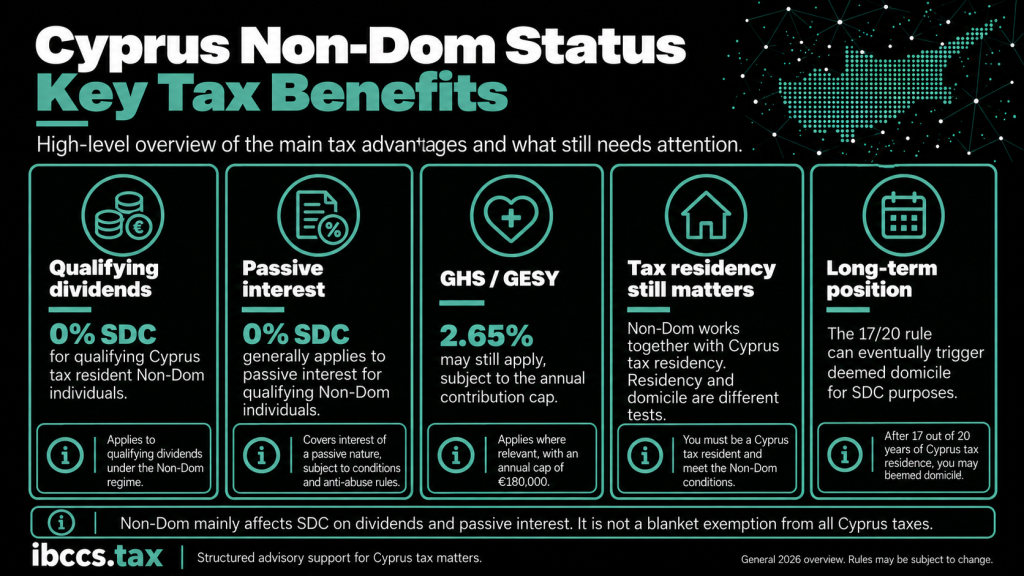
- A qualifying Cyprus tax resident who is non-domiciled for SDC purposes is generally exempt from SDC on dividend income and passive interest, whether the relevant income is Cyprus-source or foreign-source.
- Non-Dom status does not generally remove GHS/GESY. Cyprus tax residents who earn dividends, passive interest or other income within the GHS framework can still be subject to GHS, generally at 2.65%, subject to the €180,000 annual contribution-base cap for natural persons.
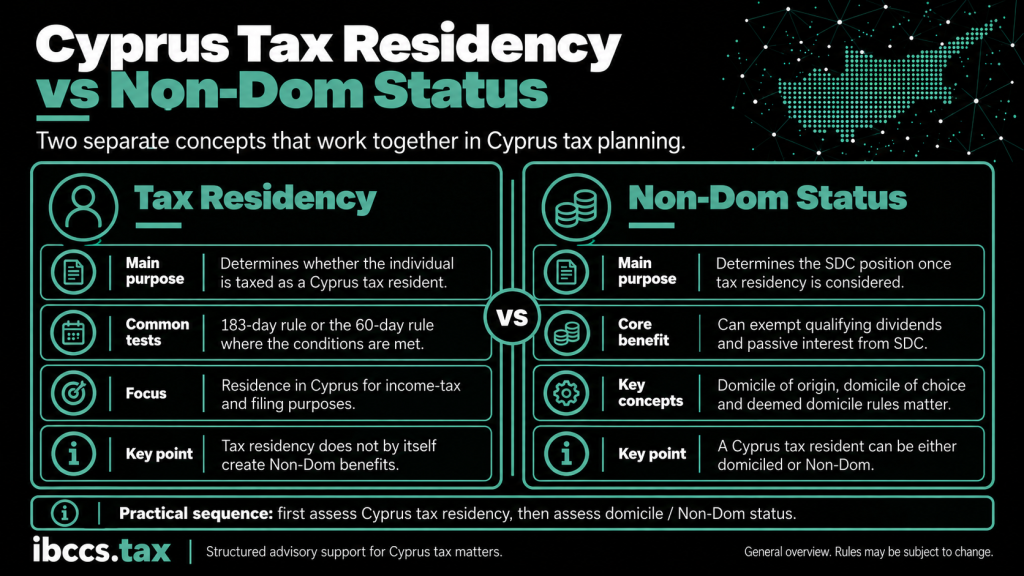
- Tax residency and domicile are separate tests. The 60-day and 183-day rules determine Cyprus tax residency; domicile determines whether an individual falls within the SDC net.
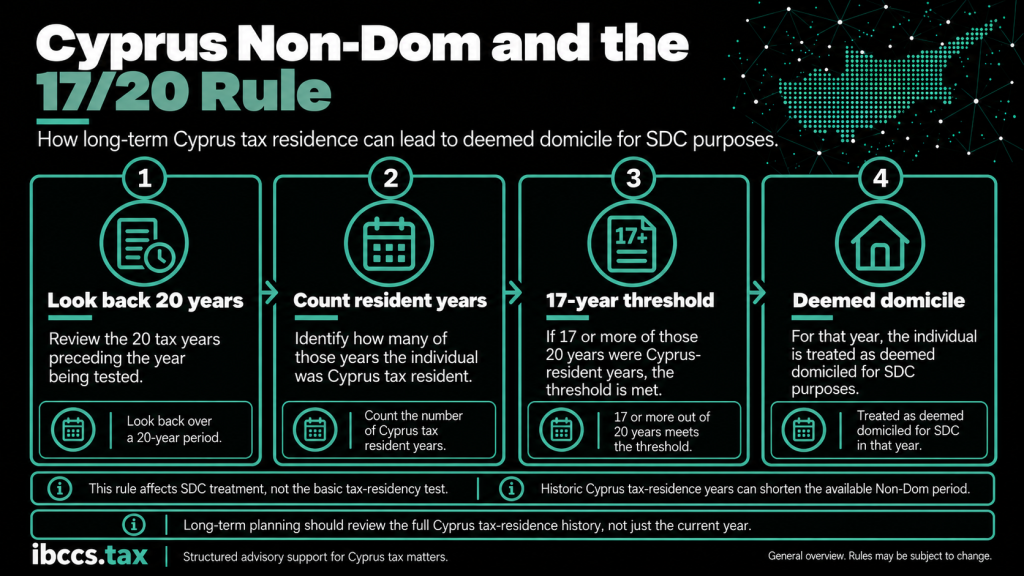
- The 17-out-of-20-year rule is central to long-term planning. An individual who has been Cyprus tax resident for at least 17 of the 20 years immediately before a tax year is deemed domiciled in Cyprus for SDC purposes, irrespective of domicile of origin.
- The often-used phrase “17-year Non-Dom period” is only a shorthand. Prior Cyprus tax residence can shorten the period available to a new or returning resident, so the historical residence timeline should be reviewed before relying on the headline number.
- From 2026, rental income is no longer subject to SDC for any individual. Rental income can still be relevant for personal income tax and GHS, so this is now a general Cyprus tax reform measure rather than a Non-Dom-specific benefit.
- From 2026, certain individuals without a Cyprus domicile of origin who become deemed domiciled under the 17/20 rule may elect into an alternative SDC method for two additional five-year periods by paying €250,000 for each period, subject to the statutory conditions.
- Foreign withholding tax, tax residence in another country, company residence, treaty rules and reporting obligations remain separate from Non-Dom. A 0% Cyprus SDC position does not guarantee a 0% overall tax outcome.
Quick Answer: What Is Cyprus Non-Dom Status?
Cyprus Non-Dom status describes a Cyprus tax resident who is not regarded as domiciled in Cyprus for the purposes of Special Defence Contribution. The practical consequence is that the individual is generally outside the SDC charge on dividend income and passive interest. This can be particularly relevant to founders receiving shareholder distributions, investors with substantial portfolios and internationally mobile individuals whose personal income is weighted towards dividends and investment returns rather than employment income.
Non-Dom does not create a parallel tax system. The individual remains subject to the ordinary Cyprus rules that apply to their other income, transactions and reporting profile. Salary and business income remain within the personal income tax framework, GHS can continue to apply to relevant categories of income, and foreign countries may impose withholding or other taxes before funds reach Cyprus. The correct result therefore depends on the legal nature of the income and the individual’s complete cross-border position, not simply on whether a Non-Dom confirmation has been obtained.
Important distinction
Non-Dom is best understood as an SDC status, not as a universal “zero-tax” regime. It can produce a significant result for dividends and passive interest, but each other income category must still be analysed under the relevant Cyprus and cross-border rules.
Cyprus Non-Dom vs Tax Residency: What Is the Difference?
Tax residency answers the question of whether an individual is treated as resident in Cyprus for tax purposes. Cyprus domestic law provides the 183-day rule and, where the cumulative conditions are satisfied, the 60-day rule. From 2026, the 60-day framework became more flexible because the previous condition requiring the individual not to be tax resident in any other state was removed. That domestic-law change does not eliminate the possibility of dual residence, so a double tax treaty may still need to determine treaty residence where another jurisdiction also treats the individual as resident.
Domicile is a different concept. For SDC purposes, it determines whether a Cyprus tax resident falls within the charge on categories such as dividends and passive interest. This means that two individuals can both be Cyprus tax residents, live in Cyprus for the same number of days and receive the same dividend, yet have different Cyprus SDC outcomes because one is domiciled and the other is non-domiciled.
The sequence matters in practice. Establishing Cyprus tax residency is normally the first step, because the Non-Dom benefit is relevant to an individual who is within the Cyprus tax-resident framework but outside the SDC domicile net. The residence analysis should therefore not be repeated inside every Non-Dom article or service page; instead, the two topics should be connected through clear internal links and a consistent factual record of days, ties and historical residence.
For the detailed residence tests, day-counting rules and the 2026 change to the 60-day rule, see Cyprus Tax Residency: 60-Day and 183-Day Rules.
| Question | Tax residency | Non-Dom / domicile |
| What does it determine? | Whether Cyprus treats the individual as tax resident under domestic law and, where relevant, treaty analysis. | Whether the individual falls within the Special Defence Contribution domicile net. |
| Main tests | 183-day rule or 60-day rule, subject to the statutory conditions. | Domicile of origin, domicile of choice, statutory exceptions and the 17/20 deemed-domicile rule. |
| Main tax effect | Brings the individual within the Cyprus resident tax and filing framework, subject to income classification and exemptions. | Can remove SDC on qualifying dividends and passive interest while the individual remains Cyprus tax resident. |
| Is it an immigration status? | No. Tax residence is separate from immigration or residence-permit status. | No. Non-Dom is a tax concept for SDC purposes. |
Who Can Qualify for Cyprus Non-Dom Treatment?
Eligibility cannot be determined from nationality alone. A foreign passport does not automatically make a person non-domiciled, and a person with Cypriot nationality is not automatically domiciled for every tax year. Cyprus applies domicile concepts that look at domicile of origin and domicile of choice together with statutory SDC rules that can override the underlying common-law position in particular circumstances. For long-term residents, the 17-out-of-20-year deemed-domicile rule becomes especially important.
A domicile of origin is normally acquired at birth and, as a general rule, follows the father’s domicile at the time of birth, subject to specific exceptions. A domicile of choice can be acquired where an individual settles in a country with the intention of residing there permanently or indefinitely. These are legal concepts that depend on facts and conduct rather than on a single registration, address or declaration, and a domicile of origin can revive if a domicile of choice is abandoned without another domicile of choice being acquired.
Cyprus law also contains specific routes under which an individual with a Cyprus domicile of origin may still fall outside the SDC domicile net. These include circumstances involving a maintained domicile of choice outside Cyprus together with the required long-term period of non-Cyprus tax residence, as well as the historic statutory rule for individuals who had resided abroad for more than 20 consecutive years before 16 July 2015. Because these exceptions are fact-sensitive, they should not be reduced to a generic checklist without reviewing the individual’s history.
Irrespective of domicile of origin, the long-term residence test can ultimately bring an individual within the Cyprus SDC domicile net. An individual who has been Cyprus tax resident for at least 17 of the 20 years immediately before the relevant tax year is deemed to be domiciled in Cyprus. This rule is why a Non-Dom review should include the person’s historic Cyprus tax-residence years, not only their current residence status or country of birth.
Why an eligibility review should be historical
A new resident with no previous Cyprus tax-residence years and a returning resident with substantial prior Cyprus residence may have very different remaining Non-Dom periods. The 17/20 test looks backwards, so the correct timeline should be reconstructed before making long-term tax assumptions.
How Long Can Cyprus Non-Dom Treatment Last?
Cyprus Non-Dom is frequently marketed as a 17-year benefit. For a person arriving in Cyprus with no relevant prior Cyprus tax-residence history, that description can be a useful shorthand, because the deemed-domicile rule is triggered when the individual has been Cyprus tax resident for at least 17 of the preceding 20 years. However, it should not be treated as a fixed 17-year certificate that begins automatically on the date of relocation.
The available period depends on the individual’s historic residence record. Someone who was Cyprus tax resident in earlier years may reach the 17/20 threshold sooner than a first-time resident. Conversely, leaving Cyprus does not necessarily reset the position immediately: the deemed domicile is retained until the individual completes 20 years during which they are not Cyprus tax resident for income tax purposes. This makes the residence timeline particularly important for people who move in and out of Cyprus over a long period.
From 2026, Cyprus introduced an additional planning route for a narrower category of long-term residents. An individual who does not have a Cyprus domicile of origin but becomes deemed domiciled solely because of the 17/20 rule may, subject to the statutory conditions, elect to use the Alternative Method of Imposition of Special Defence Contribution. The regime can extend the exemption period for two additional five-year periods, with a payment of €250,000 for each five-year period. It is a separate election with its own conditions and should be reviewed as a long-term planning decision rather than assumed to apply automatically.
Cyprus Non-Dom Tax Benefits at a Glance
The core Non-Dom benefit is the SDC exemption on dividend income and passive interest for qualifying Cyprus tax residents. The exemption can apply whether the income originates from Cyprus or abroad, which is why the regime is particularly relevant to internationally mobile shareholders and investors. The benefit is not dependent on remitting the income to Cyprus, and it should not be confused with a remittance-basis regime used in some other jurisdictions.
The analysis should nevertheless be income-specific. Dividends and passive interest have one set of rules, salary and business income another, and rental income changed materially from 2026 because SDC on rent was abolished for everyone. GHS is also a separate charge with its own rates and annual contribution-base cap. A reliable tax plan therefore maps each income category independently rather than treating the individual’s total foreign income as one single Non-Dom exemption.
| Income / issue | Non-Dom effect in Cyprus | What still needs to be reviewed |
| Dividends | Generally exempt from SDC for a qualifying Cyprus tax resident who is non-domiciled. | GHS can apply; foreign withholding tax, treaty relief, company-law validity and reporting still matter. |
| Passive interest | Generally exempt from SDC for a qualifying Cyprus tax resident who is non-domiciled. | GHS can apply; business-related interest can follow different income-tax treatment; foreign tax may arise. |
| Rental income | No special SDC advantage from 2026 because SDC on rental income has been abolished generally. | Personal income tax, GHS, expenses, ownership and foreign property tax / credits can still be relevant. |
| Salary / directors’ remuneration | No general Non-Dom exemption. | Personal income tax, PAYE where relevant, GHS, Social Insurance and any separate employment exemption. |
| Business / professional income | No general Non-Dom exemption. | Personal income tax, GHS or Social Insurance, permanent establishment and business classification. |
| Capital gains / investments | Non-Dom itself does not create a blanket capital-gains exemption. | Cyprus CGT scope, securities rules, Cyprus immovable property and foreign-country taxation must be considered. |
Dividends: The Most Visible Non-Dom Benefit
For many shareholders, dividends are the income category that makes Cyprus Non-Dom most commercially significant. A qualifying Cyprus tax resident who is non-domiciled is generally not subject to SDC on dividend income. This can apply to dividends from a Cyprus company as well as dividends from foreign companies, although the source country may impose withholding tax and the legal character of the payment should be confirmed before it is treated as a dividend.
The 2026 reform reduced the SDC rate on actual dividends for individuals who are within the SDC net to 5% where the distribution relates to profits earned from 1 January 2026. Transitional rules can preserve the historic 17% SDC rate for distributions by Cyprus tax-resident companies from profits of tax years up to and including 2025, generally within the transitional period ending 31 December 2031. A Non-Dom individual remains outside the SDC charge, but the reform is still relevant when comparing outcomes between non-domiciled and domiciled shareholders or planning for a future change in domicile status.
For the dividend rules, transitional treatment and company-distribution issues in detail, see Tax on Dividends in Cyprus.
Passive Interest: SDC Exemption, but Not Always a Zero-Tax Outcome
Passive interest is the second major category associated with Non-Dom. A qualifying Cyprus tax resident who is non-domiciled is generally exempt from SDC on passive interest. This can be relevant to bank deposits, fixed-income portfolios and other investment arrangements, but the tax classification should be reviewed because interest that arises in the ordinary course of a business or is closely connected with that business can follow income-tax treatment rather than the passive-interest SDC framework.
The SDC exemption also does not eliminate foreign-source taxation. A foreign bank, bond issuer or other payer may operate under the law of another country, and that country may impose withholding or reporting obligations before Cyprus is considered. The Cyprus analysis should therefore be coordinated with the source-country position and any applicable double tax treaty instead of treating the Non-Dom exemption as the final step in the calculation.
GHS/GESY Still Matters for Non-Dom Individuals
One of the most common errors in Non-Dom planning is to equate a 0% SDC result with a 0% Cyprus charge on investment income. The General Healthcare System is separate from SDC. Under the current framework, income earners such as individuals receiving dividends and interest are generally subject to GHS at 2.65%, and for a natural person the total maximum annual amount of income on which GHS contributions are paid is €180,000 across the relevant categories.
The cap is a contribution-base cap, not a €180,000 tax-free allowance and not a separate cap for each income source. The person’s salary, pension, investment income and other GHS-relevant categories can interact in determining when the annual maximum has been reached. For internationally mobile individuals, residence also matters: a person who is not Cyprus tax resident generally pays GHS only on the specified Cyprus-source categories, and dividends and interest are excluded from that non-resident contribution treatment.
Non-Dom does not mean “no GHS”
A Cyprus tax resident Non-Dom can have 0% SDC on a dividend and still have GHS on that dividend. The SDC and GHS positions should therefore be shown separately in calculations, advice and client communications.
Rental Income After the 2026 Reform
Older Cyprus Non-Dom articles often list rental income together with dividends and interest as an SDC benefit. That is now outdated. From the 2026 tax year, rental income is no longer subject to Special Defence Contribution in Cyprus, so the absence of SDC on rent is no longer a benefit that distinguishes a Non-Dom individual from a domiciled individual.
Rental income remains relevant for the wider tax computation. Depending on the facts, personal income tax and GHS can still apply, and foreign property can create source-country tax, expenses, foreign tax credit and ownership questions. For private clients with multiple properties, the practical issue is therefore accurate classification and documentation rather than relying on Non-Dom status to remove every Cyprus charge connected with rent.
Clients with foreign property, investment accounts and multiple income streams may also find our Private Client Accounting in Cyprus guide useful for the reporting and record-keeping side of the analysis.
What Changed for Non-Dom Planning From 2026?
The 2026 Cyprus tax reform did not abolish the Non-Dom regime, but it changed the context in which the regime should be explained. The most visible change is the reduction of SDC on actual dividends for domiciled individuals from the historic 17% rate to 5% for distributions linked to profits earned from 2026, while transitional rules can continue to apply to older profits. Non-Dom therefore remains valuable, but the comparison against a domiciled shareholder is no longer the same as it was under the pre-2026 headline rates.
The reform also abolished SDC on rental income from 2026, which removes an outdated distinction found in many older summaries of Non-Dom. At the same time, Cyprus introduced the alternative SDC method for certain individuals who do not have a Cyprus domicile of origin and who become deemed domiciled under the 17/20 rule. This creates a new long-term planning question for established residents approaching the end of the standard Non-Dom window.
Separately, the 60-day tax-residency rule became more flexible from 2026 because the prior condition requiring an individual not to be tax resident in another country was removed. That change affects the route into Cyprus tax residence rather than the domicile test itself, but the two topics interact operationally. A person can now satisfy Cyprus domestic tax residence while also being treated as resident elsewhere under another country’s domestic law, making treaty residence and cross-border coordination more important rather than less important.
What Cyprus Non-Dom Does Not Exempt
A robust Non-Dom article should be as clear about the limits of the regime as it is about the benefits. Non-Dom does not generally exempt employment income, directors’ remuneration, professional fees or business profits from personal income tax. Those categories remain subject to the ordinary Cyprus rules and may also interact with PAYE, GHS, Social Insurance, permanent-establishment questions or separate employment-income exemptions where their own statutory conditions are met.
Non-Dom also does not create a universal exemption for capital gains. Cyprus capital gains tax has its own scope, particularly in relation to Cyprus immovable property and certain interests in property-rich entities. At the same time, gains on qualifying securities can have favourable treatment under separate provisions of Cyprus tax law. The correct explanation is therefore that the tax result follows the relevant capital-gains or securities rules, not that Non-Dom itself makes investment disposals tax-free.
The same principle applies to pensions, trusts, foundations, shareholder loans and other non-standard receipts. A payment label does not determine the Cyprus treatment. Before applying a Non-Dom conclusion, the legal and tax character of the receipt should be established, the payer and source country identified, and any company or trust documentation reconciled with the individual’s reporting position.
Foreign Income, Withholding Tax and Double Tax Treaties
Cyprus Non-Dom can be particularly attractive to individuals with foreign dividends and passive interest, but it only determines the Cyprus SDC layer. A foreign jurisdiction can still impose withholding tax on a dividend or interest payment under its domestic law. The amount may depend on the payer’s country, the recipient’s treaty residence, beneficial-ownership conditions, domestic exemptions and whether treaty relief is available at source or only through a refund procedure.
Foreign tax credits also need to be matched to the correct Cyprus tax category. If Cyprus does not impose the corresponding tax because an SDC exemption applies, a foreign withholding amount does not automatically become refundable in Cyprus. The wider structure should therefore be reviewed before the payment is made, particularly where the individual controls the distributing company or has flexibility over the timing and form of remuneration.
For founders and owner-managers, the personal Non-Dom analysis should also be coordinated with company tax residence and management. Moving personally to Cyprus does not automatically move a foreign company, and receiving dividends from an overseas company does not by itself resolve where that company is managed or taxed. Personal relocation and corporate structuring should therefore be planned together where the shareholder continues to direct an international business from Cyprus.
For founders and shareholders, see Moving to Cyprus as a Business Owner for the interaction between personal relocation, company residence, salary and dividends.
Practical Non-Dom Scenarios
Scenario 1: International investor with foreign dividends and interest
An investor becomes Cyprus tax resident and qualifies as non-domiciled for SDC purposes. The individual receives portfolio dividends from several countries and interest from foreign banks. Cyprus SDC can generally be eliminated on the qualifying dividend and passive-interest income, but GHS can still apply and each source country may impose withholding tax. The planning value therefore comes from combining the Cyprus exemption with treaty analysis, portfolio documentation and an accurate annual reporting file rather than assuming every incoming payment is automatically tax-free.
Scenario 2: Founder receiving salary and dividends from a company
A founder moves to Cyprus and continues to manage a trading company. Salary remains employment income and follows the ordinary personal income tax and contribution rules, while a valid dividend can fall within the Non-Dom SDC exemption. The company’s residence, payroll obligations, dividend approval process and source-country withholding still need to be considered, so the personal Non-Dom position should be integrated with the corporate structure rather than used as a substitute for it.
Scenario 3: Long-term resident approaching the deemed-domicile threshold
A person has been Cyprus tax resident for many years and is approaching the point at which the 17/20 deemed-domicile rule becomes relevant. The immediate task is to reconstruct the historical residence timeline and determine the first tax year in which deemed domicile could apply. If the individual does not have a Cyprus domicile of origin, the alternative SDC method introduced from 2026 may also need to be evaluated as a separate long-term decision, taking into account expected dividends, passive interest, time horizon and the €250,000 payment for each five-year period.
Scenario 4: Non-Dom with rental property and investment income
A Cyprus tax resident Non-Dom receives foreign rent, dividends and interest. The dividends and passive interest may benefit from the SDC exemption, while rental income no longer carries SDC from 2026 regardless of domicile. That does not mean the rent disappears from the Cyprus tax analysis: income tax, GHS, foreign property tax, expenses and foreign tax credits can still need to be reviewed. The correct result is therefore a category-by-category computation rather than one overall Non-Dom rate.
Non-Dom Status Does Not Remove Tax Filing and Record-Keeping Obligations
A low Cyprus tax liability is not the same as having no reporting obligation. From the 2026 tax year, Cyprus broadened the individual filing framework, and many Cyprus tax residents are required to submit an income tax return even where exemptions, Non-Dom treatment or foreign tax credits reduce the final amount payable. The return and supporting records should therefore reflect the individual’s worldwide income categories consistently with the Non-Dom and GHS treatment being claimed.
For internationally mobile individuals, good records should include more than a Non-Dom confirmation. Travel and tax-residence records, historic Cyprus residence years, dividend vouchers, interest certificates, broker statements, foreign withholding evidence, company resolutions, rental schedules and source-of-funds documentation can all be relevant. These records make the position easier to support if the person changes adviser, receives a bank compliance query, applies treaty relief or later approaches the 17/20 threshold.
The level of documentation should remain proportionate to the person’s profile. A client with one salary and one dividend does not need the same reporting architecture as a founder with several companies, foreign brokers, trusts and property. The objective is to maintain enough evidence to explain the legal source of each material receipt and the tax treatment applied to it, without creating unnecessary administration.
For individuals with several foreign accounts, investments or connected entities, our Private Client Accounting in Cyprus guide explains how to build a supportable annual reporting file.
Common Cyprus Non-Dom Misconceptions
“Non-Dom means all foreign income is tax-free.” Incorrect. The regime primarily affects SDC on qualifying dividends and passive interest. Salary, business income, rent, GHS, capital gains and foreign-source taxes must be analysed under their own rules.
“A foreign passport automatically gives Non-Dom status.” Incorrect. Nationality is not the legal test. Domicile of origin, domicile of choice, statutory exceptions and the 17/20 deemed-domicile rule can all be relevant.
“Everyone gets exactly 17 years.” Too simplistic. The 17/20 rule depends on the person’s prior Cyprus tax-residence history, so returning residents can reach the threshold earlier than first-time residents.
“Non-Dom removes GHS on dividends and interest.” Incorrect for Cyprus tax residents. GHS is a separate contribution regime and can apply even where SDC is fully exempt.
“Rental income is a special Non-Dom exemption.” Outdated from 2026. SDC on rental income has been abolished generally, so rental income should now be analysed under income tax, GHS and any foreign-country rules.
“Once Non-Dom is confirmed, no further review is needed.” Risky. Residence history, income mix, company ownership and the 17/20 timeline can change. Long-term residents should review the position before the deemed-domicile threshold is reached, not after.
How to Use Non-Dom in a Wider Cyprus Tax Plan
The strongest Non-Dom planning starts with the individual’s actual economic life rather than with a tax label. Advisers should identify where the person will live, how tax residency will be established, which countries may also claim residence, what companies and investment accounts are owned, how income is expected to arise and whether major transactions are planned. Only then can the SDC exemption be placed in context with personal income tax, GHS, foreign withholding and corporate tax considerations.
The analysis should also look forward. A founder who expects to retain and reinvest profits may have different priorities from an investor who expects substantial annual dividends. A person planning to remain in Cyprus for five years has a different horizon from someone building a permanent family base and approaching the 17/20 threshold. The goal is not to maximise one isolated exemption but to create a tax position that remains administratively workable, supportable and aligned with the individual’s long-term plans.
This is also why Cyprus Non-Dom should be coordinated with succession, company and private-client planning where relevant. Domicile can have legal significance beyond one annual tax calculation, and internationally mobile families can have different residence and domicile positions for each spouse or adult child. A family-level strategy can be useful operationally, but each individual’s tax position should still be analysed separately.
How IBCCS TAX Can Help With Cyprus Non-Dom
IBCCS TAX supports internationally mobile individuals, entrepreneurs, investors and private clients with Cyprus tax residency and Non-Dom planning. Our work can include reviewing the individual’s Cyprus and foreign residence history, assessing domicile and the 17/20 timeline, identifying the Cyprus treatment of dividends, interest and other income, and coordinating the personal tax analysis with companies, investments and cross-border obligations.
Where Non-Dom treatment is appropriate, we can assist with the documentation and implementation required to support the position and coordinate it with ongoing Cyprus tax compliance. For long-term residents, we can also review the transition towards deemed domicile and whether the alternative SDC method introduced from 2026 is relevant to the individual’s expected income and time horizon. The purpose is to build a defensible personal tax position rather than simply obtain a status without considering what happens afterwards.
For more complex profiles, Non-Dom can be combined with private client accounting, personal tax returns, dividend planning, tax residency support and corporate tax advice. This integrated approach is particularly useful where the individual owns several companies, receives investment income from multiple countries or expects significant changes in remuneration, ownership or residence over the coming years.
To discuss your position, see our Cyprus Non-Dom service or our broader Cyprus tax planning services.

Frequently Asked Questions About Cyprus Non-Dom Status
1. What is Cyprus Non-Dom status?
Cyprus Non-Dom status refers to a Cyprus tax resident who is not treated as domiciled in Cyprus for Special Defence Contribution purposes. The main practical benefit is generally an exemption from SDC on dividend income and passive interest, while other taxes and contributions continue to follow their own rules.
2. Do I need to be Cyprus tax resident to benefit from Non-Dom?
The regime is primarily relevant to individuals who become Cyprus tax resident but remain non-domiciled for SDC purposes. Non-residents are already outside the ordinary Cyprus SDC charge on dividends and interest, so Non-Dom is most important when the person enters the Cyprus resident tax framework.
3. Is Non-Dom the same as the 60-day rule?
No. The 60-day rule is one route to Cyprus tax residency, while Non-Dom is a domicile classification relevant to SDC. A person can qualify as Cyprus tax resident under either the 60-day or 183-day rule and then have a separate domicile assessment.
4. Are dividends tax-free for a Cyprus Non-Dom?
A qualifying Cyprus tax resident Non-Dom is generally exempt from SDC on dividends, but GHS can still apply and a foreign source country may impose withholding tax. The underlying distribution must also be validly characterised as a dividend, and reporting obligations can remain.
5. Does a Cyprus Non-Dom pay tax on interest?
Passive interest is generally exempt from SDC for a qualifying Non-Dom, but GHS can apply to Cyprus tax residents. Interest connected with a business can follow different income-tax treatment, so the nature of the interest should be confirmed before applying the passive-income exemption.
6. Does Non-Dom exempt rental income?
From 2026, rental income is no longer subject to SDC in Cyprus generally, so this is no longer a special Non-Dom benefit. Rental income can still be relevant for personal income tax, GHS and foreign tax where the property is outside Cyprus.
7. How does the 17/20 rule work?
An individual who has been Cyprus tax resident for at least 17 of the 20 years immediately before a tax year is deemed domiciled in Cyprus for SDC purposes. Previous Cyprus residence therefore matters, and the commonly quoted “17-year Non-Dom period” should not be assumed without checking the historic timeline.
8. Can Non-Dom treatment continue after the 17/20 threshold?
From 2026, a limited alternative SDC method is available to certain individuals who do not have a Cyprus domicile of origin but become deemed domiciled because of the 17/20 rule. Subject to the statutory conditions, it can extend the exemption period for two additional five-year periods in return for a payment of €250,000 for each period.
9. Does Non-Dom mean I do not need to file a Cyprus tax return?
No. Non-Dom affects SDC treatment but does not remove the wider Cyprus filing framework. From 2026, filing obligations for Cyprus tax residents are broader, and an individual can need to file even where exemptions or credits reduce the final tax payable.
10. Can I be Non-Dom and still pay tax in another country?
Yes. Cyprus Non-Dom does not prevent another country from taxing income under its domestic law, withholding tax at source or treating the individual as resident. Double tax treaties and foreign tax credit rules may therefore remain important even when Cyprus SDC is zero.
11. Is Cyprus Non-Dom an immigration or residence-permit status?
No. It is a tax concept used for Special Defence Contribution purposes. Immigration status, legal residence, permanent residence and citizenship are separate matters and should not be used as substitutes for the tax-residency and domicile analysis.
12. When should a long-term Cyprus resident review their Non-Dom position?
The position should be reviewed before the individual reaches the 17/20 deemed-domicile threshold, particularly where significant dividend or interest income is expected. An early review allows time to reconstruct residence history, assess the alternative SDC method where relevant and coordinate the decision with wider personal and corporate planning.


Cyprus Non-Dom Status: Tax Benefits, Eligibility, Rules and How It Works
Cyprus Non-Dom status is one of the most important elements
Read More
Cyprus Tax Calendar 2027: Key Tax Deadlines for Individuals and Companies
Cyprus tax compliance does not revolve around one annual deadline.
Read More
Tax on Dividends in Cyprus: SDC, GHS, Non-Dom and Company Distributions
Dividend taxation in Cyprus changed materially from 1 January 2026.
Read MoreImportant Note: This article provides general information on Cyprus tax and Non-Dom rules and reflects the framework reviewed in October 2026. The correct treatment depends on the individual’s tax residence, domicile history, income classification, source country, company and investment structure, applicable double tax treaties and the facts of the case. Non-Dom, GHS, foreign withholding and filing obligations should therefore be reviewed together, and the article should not be treated as a substitute for transaction-specific tax or legal advice.