

Georgia has developed a more structured environment for innovative businesses, technology founders and growth companies. For entrepreneurs, the opportunity is no longer limited to fast company registration or relatively straightforward operating costs. Georgia now has a formal innovation framework that can provide qualifying startups with status-based tax benefits, while local and international funding programmes continue to create opportunities for companies that can demonstrate a credible product, team and growth plan.
The important point is that a startup and an Innovative Startup are not automatically the same thing. A founder can register a Georgian company and build a startup without holding a special status. Innovative Startup Status is a separate regime with defined eligibility, funding, audit and annual compliance requirements, and it should be assessed only where the company genuinely fits the framework.
At IBCCS TAX, we support founders with company registration in Georgia, legal structuring, tax, accounting and investor-readiness work through our teams in Tbilisi and Batumi. This guide explains how to establish a startup in Georgia, how Innovative Startup Status works in 2026 and what founders should put in place before seeking funding or scaling operations.

Why Georgia Is Attracting Startup Founders
Georgia appeals to founders because it combines relatively accessible company formation with a growing technology and innovation ecosystem. A Georgian company can often be established quickly, foreign founders can generally own the company directly, and the country provides access to local talent, regional markets and an expanding network of accelerators, investors and public innovation programmes.
For a startup, however, incorporation speed is not the main strategic advantage. The more important question is whether the structure is suitable for fundraising, hiring, intellectual property ownership, commercial contracting and future international expansion. A company that is easy to register but difficult to invest in or difficult to diligence will create friction at the first serious funding round.
Founders comparing the broader business environment can review our guide to company formation in Georgia. That article covers LLCs, Individual Entrepreneurs and general setup considerations, while this guide focuses specifically on the startup lifecycle and the innovation framework.
Startup Company Setup in Georgia
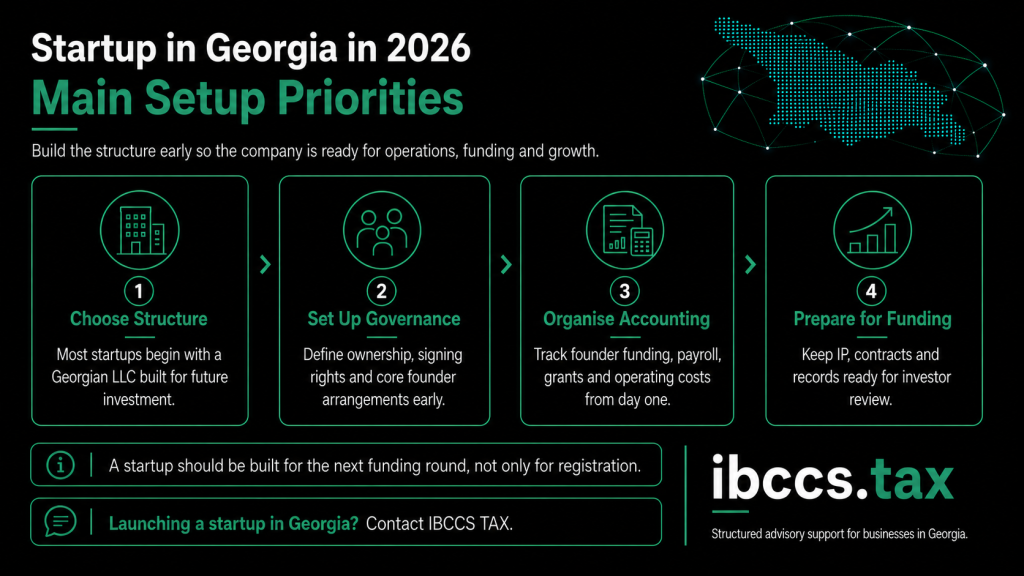
Most startup projects need a legal entity before they can sign investment agreements, employ staff, own intellectual property or contract with customers. In Georgia, a Limited Liability Company is commonly used because it provides a separate corporate vehicle and can support multiple shareholders, governance arrangements and future investment rounds.
Choose the Legal Structure with Future Funding in Mind
An early-stage founder may be tempted to choose the simplest possible structure and postpone governance decisions. That can work for a small owner-managed business, but a startup expecting external investment should think ahead. Share classes, voting rights, reserved matters, founder vesting, transfer restrictions and future dilution can become important as soon as outside capital is introduced.
Our detailed guide to LLC registration in Georgia explains the standard Georgian LLC framework for foreign founders. Startup founders should use that structure as a base, then add governance and investment terms that reflect the planned funding model.
Register the Company and Operational Accounts
Company registration is only the first implementation step. A startup also needs a legal address, tax access, accounting procedures, banking, signing authorities and a clear document workflow. Where founders are located in different countries, powers of attorney, corporate approvals and banking documentation should be coordinated before commercial activity begins.
The startup should also define who is authorised to bind the company, who controls online banking, how expenses are approved and how founder funding is documented. These controls may feel formal at an early stage, but they become important when investors review historical transactions and governance.
Set Up Accounting from the Beginning
Accurate bookkeeping is especially important for startups applying for status or funding because historical expenditure, grant use and investment flows may need to be evidenced. Our accounting services in Georgia can be coordinated with the incorporation so that contracts, invoices, payroll and founder funding are recorded consistently from the first reporting period.
What Is Innovative Startup Status in Georgia?
Innovative Startup Status is a formal status under Georgia’s innovation framework for an entrepreneurial company that carries out innovative activity and meets the statutory eligibility conditions. The status is designed to support businesses developing an innovative product, process or service and is administered through Georgia’s Innovation Registry framework.
The regime should not be confused with Virtual Zone Person Status, International Company Status or Small Business Status. Those regimes address different activities and tax models. A startup may be innovative in a commercial sense but still fail the statutory requirements for Innovative Startup Status if the funding route, financial evidence or activity test is not met.
Who Can Qualify for Innovative Startup Status?
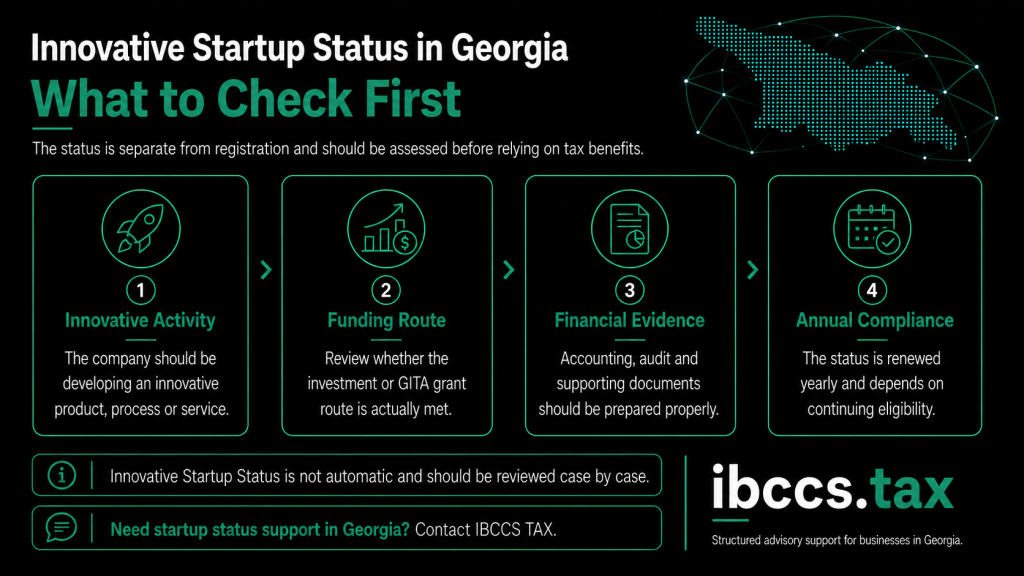
The current framework requires the applicant to be an entrepreneurial company carrying out innovative activity. It must develop an innovative product, process or service and must be able to demonstrate that the business activity described in the application is genuinely connected with the funding or investment relied upon for the status.
The applicant must also be in good standing. In particular, the official criteria require that the company has no outstanding tax liabilities, is not listed in the debt registry and is not subject to insolvency or liquidation proceedings. Founders should therefore review the company’s tax and legal position before starting the application process rather than treating these checks as a final administrative step.
Investment and GITA Grant Routes
A qualifying startup must generally satisfy one of two funding routes within the relevant two-year period. The first route is at least GEL 100,000 of investment actually received from qualifying sources such as an investment fund, an angel investor network or a member of such a network, or an accelerator. Funding from other sources does not automatically satisfy this specific status test simply because it is commercially described as investment.
The alternative route is qualifying grant funding from Georgia’s Innovation and Technology Agency. Under the current criteria, the relevant GITA grant amount is at least GEL 150,000 and the grant agreement must fall within the permitted two-year window. The exact funding documentation should be reviewed before application because an investment agreement alone may not be enough where the minimum amount has not actually been received.
The Innovative Activity Test
The company needs to show that innovation is central to the business rather than a small side project. Current official guidance states that where a company has both innovative and non-innovative activity, more than 50% of its income and expenses should be substantially related to the innovative activity for status purposes.
This makes accounting classification and project documentation important. Product-development expenses, payroll, outsourced development, research costs and commercial revenue should be organised so that the company can demonstrate how the innovative activity operates in practice.
Documents and Financial Evidence
The application process is more demanding than ordinary company registration. Current official guidance requires an audited statement of profit and loss and other comprehensive income covering the relevant reporting period, together with an assurance report addressing the relationship between the company’s income, expenditure and the activity described in the application. Even a company with no revenue or expenses may need an audited zero statement.
Foreign-language documents need to be supported by notarised Georgian translations, and the status application itself is submitted in Georgian. Founders should therefore allow enough time for audit, assurance, translation and supporting corporate documents rather than scheduling the application around an expected tax benefit date.
Innovative Startup Tax Benefits in Georgia
The support mechanism is phased over the life of the status rather than providing one permanent rate from day one. This is important for financial modelling because a startup that expects to remain in Georgia for several years should look at the full ten-year trajectory, not only the first period.
| Status period | Employment income tax | Corporate profit tax |
| Years I-III | 0% on qualifying employment income, subject to statutory conditions and salary cap | No separate reduced startup profit-tax rate is listed for this first phase |
| Years IV-VI | 5% on qualifying employment income | 5% under the Innovative Startup support mechanism |
| Years VII-X | 10% on qualifying employment income | 10% under the Innovative Startup support mechanism |
The official guidance currently states that the salary benefit is capped at GEL 10,000 per month per employee for the relevant preferential treatment, and that the support mechanism does not remove pension contribution obligations. The company should model payroll carefully, especially where founders, executives and technical employees have different remuneration levels.
The status becomes usable from the first day of the month following the positive decision to grant it. It is therefore important to distinguish the application date, approval date and effective date when planning payroll or other transactions.
How Long Does Innovative Startup Status Last?
The status is granted for one year and can be extended for additional one-year periods, subject to continued compliance. It may be maintained continuously for up to ten years. The company should apply for extension before the current period expires and be ready to demonstrate that the activity and eligibility conditions remain satisfied.
The status should be managed as an ongoing compliance project. The official framework includes revocation grounds where eligibility is no longer maintained, the status is abused or the company obtains certain other preferential statuses. Because the status can be granted only once, loss of the status can have long-term consequences for a company that intended to rely on the regime throughout its growth stage.
Innovative Startup vs Virtual Zone or International Company Status
Technology founders often ask whether Innovative Startup Status is automatically better than Virtual Zone Person or International Company Status. There is no universal answer because the regimes address different facts. Innovative Startup Status is connected with innovation, qualifying funding and a phased support mechanism. Virtual Zone focuses on qualifying IT produced in Georgia and supplied abroad, while International Company Status is designed around listed activities, experience and local substance requirements.
A company should not assume that these regimes can simply be stacked. Under the current Innovative Startup rules, obtaining International Company or Virtual Zone status can be a ground for revocation of Innovative Startup Status. Our comparison of Virtual Zone vs International Company Status in Georgia explains the IT regimes in more detail.
Founders comparing a wider range of preferential regimes can also review Georgia tax incentives for international businesses. The right choice should follow the operating model, employees, customer profile, funding history and expected profit extraction.
Startup Funding in Georgia
Funding in Georgia can come from several channels, including founders, angel investors, accelerators, venture funds, corporate investors, public innovation programmes and international grant schemes. However, founders should separate two questions: whether funding is commercially available and whether a particular source qualifies for a specific tax or status rule.
For Innovative Startup Status, only the defined investment and GITA grant routes count toward the status funding test. A startup may raise money from another investor and still have a strong business, but that investment may not satisfy the status criteria. The investment source and legal documentation should therefore be reviewed before the funding round closes if the status is part of the business plan.
Grant and Funding Programmes for Startups in Georgia
In addition to GITA programmes, Georgian startups may also explore international and development-backed funding opportunities, depending on the company’s sector, stage and the calls available at the time. These may include programmes supported by EU4Business, EBRD, ESTDEV, UNDP and other innovation, digitalisation and SME funding initiatives.
Each programme has its own eligibility criteria, funding priorities, budgeting requirements and application process. A company should therefore assess the funding opportunity together with its business plan, financial forecasts, legal structure and supporting documentation rather than treating grant applications as a standalone exercise.
IBCCS TAX provides Grant & Funding Application Support in Georgia, including preparation of grant proposals, financial models, budgets, supporting documentation and coordination of the legal, tax and compliance information required for the application.
Preparing a Georgian Startup for Investment
Investor readiness is a combination of legal, financial and commercial preparation. Investors are not only assessing the product. They are also asking whether the founders own what they claim to own, whether the cap table is accurate, whether employee and contractor arrangements are documented, whether tax filings are current and whether the company can provide reliable financial information.
| Investor-readiness area | What should be prepared | Why it matters |
| Ownership and cap table | Founder shares, options, previous investments and dilution history | Allows investors to understand control and economic ownership |
| Intellectual property | IP assignments, software ownership, trademarks and contractor clauses | Confirms that the company owns the assets investors are funding |
| Financial model | Revenue assumptions, runway, hiring plan and funding use | Supports valuation, funding need and scenario analysis |
| Corporate records | Charter, shareholder decisions, director authorities and key contracts | Reduces legal uncertainty during due diligence |
| Data room | Legal, tax, accounting, commercial and technical evidence | Makes due diligence faster and signals professional management |
Legal Documents Every Startup Should Review
A startup can operate for months with informal arrangements, but those arrangements often become a problem during investment. The legal documentation should reflect who owns the company, who contributes what, how decisions are made and what happens if a founder leaves or a new investor joins.
Founders and Shareholders Agreements
Founders should agree on equity, decision-making, roles, vesting or leaver principles, transfer restrictions and the process for resolving deadlocks. Once external shareholders are introduced, the governance framework may also include reserved matters, information rights, pre-emption, drag-along and tag-along provisions depending on the transaction.
Intellectual Property and Contractor Agreements
Software code, designs, trademarks, algorithms, datasets and other intellectual property should be owned or properly licensed by the company. A common startup problem is that a founder or contractor created the core product before incorporation and no formal assignment was completed. That gap can become a material issue in due diligence.
Investment Documents
Investment agreements, term sheets, convertible instruments and similar documents should be aligned with Georgian corporate law and the company’s charter. The legal and accounting treatment of an instrument should be reviewed before signing, particularly where the investor is outside Georgia or the financing will convert into equity later.
IBCCS TAX provides legal services in Georgia covering corporate and commercial law, contracts, employment, intellectual property and investment-related documentation. For startup founders, the objective is to build a legal framework that can survive investor due diligence rather than simply produce documents for the company file.
Tax and Accounting Compliance for Startups
A startup may be loss-making or pre-revenue, but it still needs accounting discipline. Bank charges, founder loans, grants, development expenses, employee salaries and contractor invoices should be recorded correctly. Where the company is applying for Innovative Startup Status, those records can become part of the evidence supporting the activity and funding history.
Routine compliance should be coordinated with strategic tax advice where the company has foreign founders, international customers, group transactions or future fundraising. Our taxation services in Georgia can be combined with accounting so that the company understands both filing obligations and the wider tax consequences of its structure.
Can Foreign Founders Start a Startup in Georgia?
Foreign founders can generally establish and own a Georgian LLC, subject to standard registration and documentation requirements. A local shareholder is not generally required for the ordinary LLC structure. This makes Georgia accessible to international teams that want to establish an operating company, development centre or regional startup base.
Foreign ownership does not eliminate cross-border issues. The founders should review where management decisions are made, how salaries and dividends are taxed in their home jurisdictions, whether intellectual property is transferred into the Georgian company and whether a foreign parent or holding company is needed for fundraising. These decisions should be made before the cap table becomes complicated.
Where the startup is part of a wider international structure, a review of international tax structuring can help coordinate the Georgian company with the founders’ residence, future investors and any foreign holding or operating entities.
Common Mistakes Startup Founders Make in Georgia
One common mistake is treating company registration and startup structuring as the same task. Registration creates the entity, but the founder still needs governance, IP ownership, accounting, banking and investment documentation. Fixing these items during due diligence is usually slower and more expensive than addressing them during setup.
Another mistake is assuming that any startup can obtain Innovative Startup Status. The regime has specific innovation, funding, financial evidence and good-standing tests. A company should confirm the route before building its budget around the tax benefits.
Founders also underestimate the importance of clean accounting and IP ownership. Investors may accept commercial uncertainty, but they are much less comfortable with unclear ownership of the core product, unexplained related-party payments or missing corporate approvals.
Finally, a startup should not select a tax status only because it has the lowest headline rate. The status should fit the company’s team, revenue, activity and funding profile and should remain workable when the business scales.
Startup Support in Georgia from IBCCS TAX
IBCCS TAX supports founders from the initial setup through investment readiness and ongoing operations. We can coordinate the corporate, legal, tax and accounting workstreams so that the structure is designed as one project rather than as a series of disconnected filings.
Our support may include Georgian company registration, review of Innovative Startup Status eligibility, preparation of corporate and investment documents, IP and contract review, accounting setup, tax modelling, payroll, investor-readiness work and support with due diligence materials. Where a funding round or grant application is planned, we can also help organise the financial information and corporate records that investors or programme administrators are likely to request.
Founders planning a startup in Georgia can contact IBCCS TAX to review the company structure, status eligibility, legal documentation and ongoing compliance requirements before launch or fundraising.
Build the Company for the Next Funding Round, Not Only for Registration
Georgia can offer an attractive platform for an innovative business, but the strongest startup structures are designed for what happens after incorporation. Ownership, IP, tax, accounting, employment and investor rights should support the next stage of growth instead of becoming obstacles when the first serious investor arrives.
Innovative Startup Status can be valuable where the company genuinely meets the criteria, but it should sit inside a wider operating plan. A founder who understands the funding route, keeps clean financial records and prepares legal documentation early is better positioned to use the Georgian framework effectively and to raise capital with fewer avoidable complications.

FAQ: Starting a Startup in Georgia
1. Can a foreigner start a startup in Georgia?
Yes. Foreign individuals can generally establish and own a Georgian LLC, subject to the usual registration and documentation requirements. The wider tax, banking and founder-residence position should still be reviewed.
2. Does every startup in Georgia qualify for Innovative Startup Status?
No. Innovative Startup Status is a separate preferential status with defined innovation, funding, financial evidence and good-standing requirements. A newly incorporated technology company does not receive the status automatically.
3. What investment is required for Innovative Startup Status?
The current investment route generally requires at least GEL 100,000 actually received within the relevant two-year period from qualifying sources such as an investment fund, angel investor network or member, or accelerator. Other investment sources do not automatically satisfy this specific test.
4. Can a GITA grant qualify a company for Innovative Startup Status?
Yes, the current framework provides a grant route where the qualifying GITA grant amount is at least GEL 150,000 and the grant agreement falls within the required two-year period.
5. How long is Innovative Startup Status valid?
The status is granted for one year at a time and can be renewed annually, subject to continuing compliance, for up to ten years.
6. What tax benefits does Innovative Startup Status provide?
The support mechanism is phased. Current rules provide 0% employment income tax in years I-III, 5% employment income tax and 5% corporate profit tax in years IV-VI, and 10% rates for both in years VII-X, subject to the statutory conditions and salary cap.
7. Is there a salary cap for the startup employment tax benefit?
Current official guidance states that the preferential treatment applies up to GEL 10,000 of salary per employee per month. Pension contribution obligations are not removed by the support mechanism.
8. Can an Innovative Startup also be a Virtual Zone or International Company?
The regimes should not be assumed to operate together. Under the current Innovative Startup framework, obtaining International Company or Virtual Zone status can be a ground for revocation of Innovative Startup Status.
9. Does a startup need audited financial information to apply for the status?
The current application framework requires an audited profit and loss and other comprehensive income statement for the relevant period, together with an assurance report addressing the link between activity, income, expenditure and funding.
10. What legal documents should a startup prepare before fundraising?
Common priority documents include a clean charter and corporate records, founders or shareholders agreements, IP assignments, employment and contractor agreements, investment documents and an organised cap table and data room.
11. Does a pre-revenue startup still need accounting?
Yes. A pre-revenue startup can still have founder funding, development expenditure, payroll, grants, bank fees and contracts that need to be recorded. Clean accounting also supports future due diligence and status applications.
12. Can IBCCS TAX help with startup setup and funding preparation?
Yes. IBCCS TAX can coordinate company registration, legal and tax structuring, accounting, status eligibility, investor-readiness documentation and ongoing compliance for startups operating in Georgia.






IBCCS TAX to Attend Plan ₿ Forum 2026 in Lugano, Switzerland
IBCCS TAX will be attending Plan ₿ Forum 2026 in
Read More
Georgia iGaming License in 2026: Online Casino, Slots & Sports Betting for International Operators
Georgia introduced a dedicated licensing framework in 2026 for the
Read More
Work Permit in Georgia for Foreigners: Right to Work, Employers, Self-Employed and Residence Rules
Georgia introduced a substantially more regulated labour migration framework in
Read MoreDisclaimer: This article is for general information only and does not constitute tax, legal or financial advice. Professional advice should be obtained based on your specific circumstances.