

Georgia, the country in the Caucasus, offers a relatively straightforward environment for company registration, but incorporation is only the beginning of the legal lifecycle. Once a Georgian company starts signing contracts, hiring employees, licensing intellectual property, raising capital or operating in a regulated sector, the quality of its legal framework becomes as important as the registration itself.
This is particularly relevant for foreign-owned businesses. International founders often manage their Georgian company from abroad, work with clients in several jurisdictions and bring legal documents from another corporate environment. Those arrangements need to work under Georgian law while remaining practical for banks, investors, employees, counterparties and the wider international group.
At IBCCS TAX, our legal services in Georgia cover corporate and commercial law, contracts, employment, intellectual property, licensing, regulatory matters, due diligence and dispute support. This guide explains the main legal requirements foreign founders should review when establishing, operating and growing a Georgian company.

- Company registration does not complete the legal setup; governance, contracts, employment, intellectual property, licences and ongoing corporate records should be addressed as the business begins operating.
- Foreign individuals and foreign companies can generally own shares in a Georgian LLC, but ownership, management and authorised-signatory arrangements should be documented clearly.
- A multi-founder or investor-backed company should align its charter, shareholder arrangements and internal approval rules before disagreements or fundraising expose gaps.
- Commercial contracts should reflect the actual transaction, governing law, payment flows, liability, intellectual property and dispute-resolution strategy rather than rely on generic foreign templates.
- Foreign employee arrangements require particular care following Georgia’s 2026 labour migration changes, because work activity rights, exemptions, employer reporting and immigration status can overlap.
- Intellectual property created by founders, employees and contractors should be properly owned or licensed by the company before fundraising, licensing or a sale process.
- Regulated activities, personal data processing, banking KYC and cross-border group arrangements may create legal obligations beyond ordinary company registration.
- IBCCS TAX can coordinate legal support with company registration, tax and accounting so that the legal framework follows the company’s real operating model.
Why Legal Compliance Matters After Company Registration
A company can be correctly registered and still have weak legal foundations. Problems often appear later when a bank asks for ownership evidence, a customer disputes the scope of a contract, an employee leaves with confidential information, a regulator questions an activity or an investor discovers that the company never obtained clear rights to its core software or brand.
The purpose of legal structuring is not to create paperwork for its own sake. It is to make ownership, authority, commercial obligations and risk sufficiently clear for the company to operate, finance itself and resolve issues without relying on informal understandings. Founders still at the incorporation stage can review our company formation in Georgia guide and our business registration in Georgia service so that the legal setup is planned alongside incorporation rather than several months later.
Can Foreigners Own and Manage a Georgian Company?
Foreign individuals and foreign legal entities can generally hold shares in a Georgian company, including a limited liability company. This makes Georgia accessible for international founders, overseas groups and investors that want a locally registered operating entity without introducing a Georgian shareholder merely for incorporation purposes.
Foreign ownership does not remove the need for a clear governance structure. The company should identify who the shareholders are, who has authority to represent the company, who can sign contracts or operate bank accounts and which decisions require shareholder approval. Where directors or shareholders live outside Georgia, the legal arrangements should also be coordinated with tax residence, management and control and the practical expectations of banks and counterparties.
For founders focused specifically on the LLC structure, our guide to LLC registration in Georgia explains ownership, registration, tax, banking and post-incorporation considerations in more detail.
What Legal Documents Does a Georgian LLC Need?
The exact document set depends on the ownership, activity and stage of the business, but a Georgian LLC normally needs more than its registry extract and incorporation documents once it starts operating. The objective is to create a legal record that explains who owns the company, who can act for it, how key transactions are approved and how the company manages relationships with employees, customers, suppliers and investors.
For a small single-owner business the framework can remain relatively lean. A company with several founders, external financing, employees, intellectual property or regulated activity usually needs a broader document set and more regular legal housekeeping.
| Legal area | Typical documents | Why it matters |
| Corporate governance | Charter, registry extracts, shareholder and director decisions, signing-authority records | Confirms ownership, representation, approvals and governance rules. |
| Founder and shareholder arrangements | Founders agreement, shareholders agreement, investment documents, share-transfer documentation | Reduces uncertainty around control, funding, transfers, exits and future investment. |
| Commercial contracts | Customer, supplier, distribution, lease, financing and service agreements | Defines the transaction, payment terms, liability, termination and dispute strategy. |
| Employment and contractors | Employment agreements, contractor agreements, policies, confidentiality and IP clauses | Documents workforce obligations and protects confidential information and work product. |
| Intellectual property | IP assignments, licences, trademark filings, developer agreements and domain records | Shows that the company owns or controls assets it commercialises. |
| Regulatory and data protection | Licences, permits, privacy notices, processing arrangements and regulator correspondence | Supports lawful activity and compliance where sector or data rules apply. |
| Financing and corporate changes | Loan agreements, shareholder funding records, capital decisions and investment approvals | Creates evidence for banking, accounting, due diligence and future transactions. |
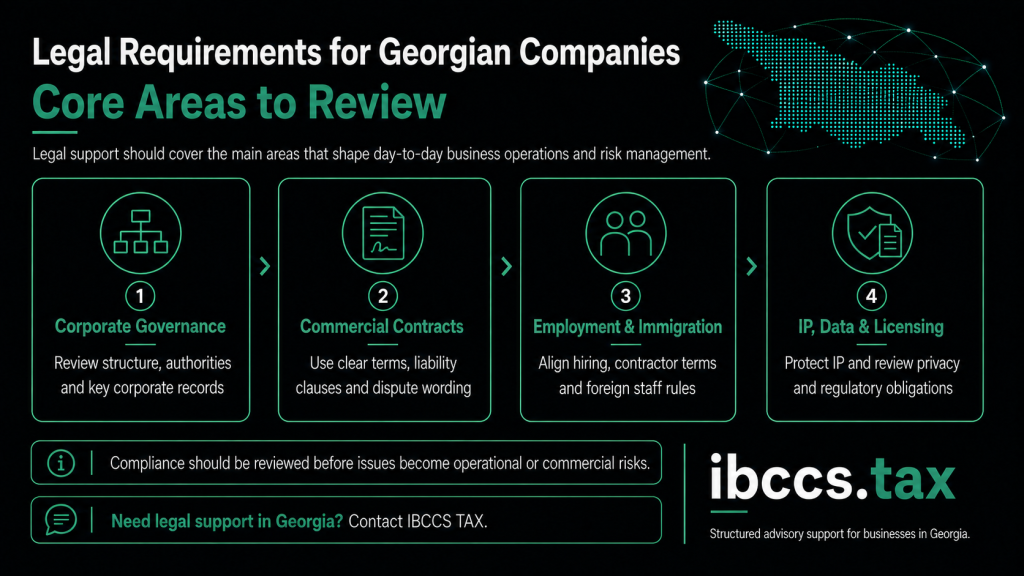
Corporate Governance for a Georgian LLC
A Georgian LLC is flexible, but flexibility should not be confused with the absence of governance. The company should have clear rules identifying its shareholders, management authority, decision-making procedures and the circumstances in which shareholder approval is required. These rules are particularly important when the company has more than one founder or when the owners do not participate in day-to-day management.
Charter and Shareholder Arrangements
A simple charter may be sufficient for a straightforward single-owner company, but a multi-founder or investor-backed business usually needs more detail. Share-transfer restrictions, pre-emption rights, decision thresholds, information rights, reserved matters, funding obligations and exit provisions should be considered before the company reaches a point where different interests emerge.
Where founders agree important commercial terms outside the charter, a shareholders or founders agreement may be appropriate. The documents should be coordinated so that private arrangements do not create uncertainty about the company’s registered governance structure or the powers that third parties can rely on.
Director and Signing Authority
The company should be clear about who can represent it, sign contracts and control banking. Foreign-owned businesses sometimes grant broad authority to several people for convenience, but that approach can create control risk as transaction values increase or the management team changes.
Internal approval limits can separate day-to-day authority from decisions that require shareholder consent. Financing, distributions, major asset transfers, related-party agreements, litigation settlements and material contracts often justify documented approvals even where ordinary operations are delegated to management.
Corporate Decisions and Evidence
Important corporate decisions should be documented consistently. Informal agreement between founders may work while relationships are good, but banks, investors, auditors and courts may later require evidence of how a transaction was authorised and whether the person signing had the relevant power.
A practical company file should therefore contain current constitutional documents, corporate decisions, powers of attorney, shareholder records and material agreements. This record becomes increasingly important when the company raises finance, changes ownership or prepares for due diligence.
Ongoing Corporate Compliance for Georgian Companies
Legal compliance continues after incorporation. Changes to registered data, management, ownership or constitutional documents may require filing or other formal action, while internal records should remain consistent with the public registry, bank KYC profile and accounting records.
Keeping Registry Information Current
A company should have a process for legal review when its shareholders, managers, legal address or other registered information changes. Allowing the public registry, bank records and internal documents to diverge can create problems when a contract needs to be signed urgently or when a bank performs periodic due diligence.
Foreign corporate shareholders should also keep their own supporting documents current. Changes in upstream ownership, directors or authorised representatives may need to be reflected in Georgian records or provided to banks and counterparties even where the Georgian company itself has not changed shareholders.
Shareholder Funding and Corporate Changes
Loans, capital contributions, shareholder advances and repayments should be documented according to their actual legal and commercial character. Treating every transfer from an owner as an informal cash injection can create confusion for accounting, taxation, bank source-of-funds reviews and later investment negotiations.
The same principle applies when shares are transferred, new investors enter or ownership percentages change. Corporate approvals, transfer documents, investment terms and registry filings should be coordinated so that the legal and financial records tell the same story.
Legal Requirements for Georgian Companies: Commercial Contracts in Georgia
Contracts are one of the most practical sources of legal risk for an operating company. A Georgian business may have routine agreements with customers, suppliers, landlords, distributors, developers, payment providers and professional advisers, but the legal terms should still reflect the real transaction and the risks the company can reasonably accept.
Customer and Supplier Agreements
Commercial agreements should identify the scope of work or goods, pricing, invoicing, acceptance, delivery, warranties, liability, termination and dispute procedures. Where products or services cross borders, the contract should also address currency, taxes, payment mechanics, delivery terms and which party is responsible for regulatory, customs or local compliance where relevant.
Templates can improve efficiency, but they should not be treated as universal. A SaaS subscription, wholesale supply agreement, software development contract and consulting engagement create different legal risks and normally require different liability, intellectual property, service-level and termination provisions.
Cross-Border Contract Clauses
International contracts often need additional clauses dealing with sanctions, export controls, data transfers, withholding taxes, intellectual property use and the location of services. The Georgian company should understand whether it is contracting as the principal supplier, an agent, a distributor or a group service provider because that role affects both legal obligations and commercial risk.
Contracts between related companies deserve the same discipline as third-party agreements. A management, development, licence or financing agreement should describe real functions and payment terms rather than exist only as a year-end document created to support an accounting entry.
Governing Law and Dispute Resolution
International founders often use contracts governed by foreign law. That may be appropriate in some transactions, but the choice should be deliberate and consider where counterparties and assets are located, whether judgments or arbitral awards can be enforced and whether the chosen forum is proportionate to the likely value of a dispute.
A dispute clause copied from an investor template can create unnecessary cost if it requires expensive proceedings in a distant jurisdiction for a relatively modest commercial claim. A practical contract balances legal protection with enforceability, evidence, cost and the continuing commercial relationship.
Legal Requirements for Georgian Companies: Employment Law and Hiring in Georgia
A company hiring employees should use written employment documentation that reflects the role, remuneration, working arrangements, confidentiality, leave, termination and ownership of work product. As the team grows, internal policies can provide a consistent framework for data security, expenses, remote work, use of company systems, disciplinary processes and workplace conduct.
Employees and Contractor Arrangements
Contractor arrangements should be documented separately from employment. Calling someone an independent contractor does not by itself resolve every legal or tax issue, so the company should consider the actual relationship, level of control, exclusivity, location, deliverables and use of company resources before relying on a contractor model.
Where contractors create software, designs, content or other intellectual property, the agreement should also address ownership, confidentiality and the right to use third-party materials. This avoids a common due-diligence problem where the company paid for work but cannot show that it acquired the rights needed to commercialise it.
Foreign Employees and Georgia’s 2026 Labour Migration Rules
Where a Georgian company hires foreign nationals, employment and immigration compliance need to be considered together. Georgia’s labour migration framework changed materially in 2026 and now applies work activity, reporting and procedural rules to many foreign employees and self-employed foreigners who do not hold permanent residence, while also providing defined exemptions and special categories.
The correct position depends on the worker, activity, residence status and working arrangement, so employers should check the current rules before relying on older practice. Our detailed article on Georgia’s 2026 labour migration and work permit changes explains the updated framework, including short-term professional activities, exemptions, employer reporting and work activity permit considerations.
Legal Requirements for Georgian Companies: Intellectual Property for Georgian Companies
For technology, creative and product businesses, intellectual property can be the company’s most valuable asset. The legal issue is not only whether a trademark or patent can be registered; the company should first confirm that it owns or has sufficient rights to use the work created by founders, employees, contractors and external development teams.
Founder, Employee and Contractor IP
A common problem arises when a product was developed before the company existed or when external developers created important code under contracts that did not clearly transfer intellectual property. Investors and buyers will normally ask for evidence that the company owns or controls the software, designs, content and other assets on which the business depends.
Assignments and licence provisions should identify the relevant rights, territory, duration and permitted use with enough precision for the actual business model. Confidentiality, access to source code and treatment of third-party or open-source components may also require review for technology companies.
Trademarks, Domains and Commercial IP
Brand assets should be managed deliberately rather than left in the personal name of a founder without a commercial reason. Trademark filings, domain registrations and licences between group companies should reflect who uses the brand, who owns it and whether the company can continue using it if ownership or management changes.
For companies operating internationally, Georgian protection may be only one part of the strategy. The key markets, customer locations, product roadmap and licensing model should determine where registration or contractual protection is most valuable.
Legal Requirements for Georgian Companies: Personal Data Protection and Privacy Compliance
Georgian companies that collect customer, employee, applicant or website-user information should review their obligations under Georgia’s personal data protection framework. The rules apply to the processing of personal data in Georgia and can affect how a company collects information, communicates purposes, stores records, uses service providers and responds to data-subject requests.
The level of documentation should reflect the company’s actual processing. A small B2B service business may need a relatively straightforward privacy framework, while a platform, marketplace, health-related business or company processing larger volumes of sensitive information may require more detailed policies, contracts, security measures and impact analysis.
Cross-Border Data and Third-Party Providers
Foreign-owned companies often use cloud platforms, payroll providers, CRM systems and group companies located outside Georgia. The legal review should identify where personal data is sent, which party acts as controller or processor and whether contracts and safeguards support the transfer and use of that information.
Privacy documents should also reflect what the business actually does. A generic website notice copied from another jurisdiction may not accurately describe Georgian processing activities, employee data or the systems used by the local company.
Licensing and Regulated Activities in Georgia
Many ordinary commercial activities can be conducted without a sector-specific licence, but regulated industries require separate analysis before launch. Financial services, virtual asset activity, payments, certain healthcare or pharmaceutical activities, gaming and other regulated sectors may involve licences, permits, registrations or ongoing supervisory obligations.
The legal review should begin before the company signs customers or commits to an operating model. IBCCS TAX provides licensing services in Georgia for businesses that need support assessing the regulatory route, preparing documentation and coordinating the application process.
Changing Business Activities
A company that begins with an unregulated activity can later move into a regulated area as its product evolves. New payment functionality, custody of client assets, financial intermediation or regulated digital services can change the legal analysis even if the legal entity itself remains the same.
Material changes in activity should therefore be reviewed before launch rather than after revenue begins. Licensing, contracts, banking and tax treatment often interact, and the company may need to adjust more than one part of its operating model.
Legal Requirements for Georgian Companies: Banking, KYC and Legal Documentation
Corporate banking is not only an administrative task. Georgian and international banks may request registry extracts, constitutional documents, shareholder and beneficial-owner information, ownership charts, identification documents, customer or supplier contracts and explanations of expected transaction flows.
The legal framework should support the story presented to the bank. If the company describes itself as a software developer but its contracts, invoices and ownership documents suggest a different activity, onboarding or later transaction reviews can become more difficult. Keeping governance, contracts and business descriptions aligned also helps when payment providers or major counterparties perform their own due diligence.
Cross-Border Legal Risks for Foreign-Owned Companies
A Georgian company owned or managed internationally may need to coordinate local corporate law with foreign tax, contract and regulatory requirements. Registration in Georgia does not determine every legal consequence of activity performed, managed or marketed in another jurisdiction, especially where the group has employees, customers or management functions abroad.
Management and Control
Where shareholders and directors live abroad, the company should review where strategic decisions are made and whether another jurisdiction may attribute tax residence, permanent establishment or other obligations to the Georgian entity. Corporate governance and tax analysis should therefore be aligned instead of treating board decisions and international tax residence as unrelated topics.
For structures involving several jurisdictions, IBCCS TAX can combine corporate legal review with international tax structuring so that ownership, management, financing and tax consequences are considered together.
Related-Party and Group Agreements
International groups commonly use management, development, licensing, loan, cost-sharing or service agreements between related companies. Those contracts should describe real functions, deliverables and commercial terms and should be coordinated with transfer pricing, withholding tax, accounting and the actual movement of funds.
The same discipline applies when a Georgian company holds intellectual property or performs services for a foreign parent. Legal ownership, operational substance and the invoicing model should be coherent enough to withstand both commercial due diligence and tax review.
Investment, Fundraising and Shareholder Changes
Bringing a new investor into a Georgian company changes more than the cap table. The transaction may require amendments to corporate documents, shareholder approvals, investment or subscription agreements, updated governance rights and registration of ownership or management changes.
Existing founders should understand dilution, voting rights, reserved matters, liquidation preferences, transfer rights and exit mechanisms before signing a term sheet. Startups and growth companies should also ensure that intellectual property, employment, accounting and shareholder funding records are ready for review, because a strong commercial opportunity can still be delayed by incomplete legal housekeeping.
Legal Due Diligence Before an Acquisition or Investment
Investors, lenders and buyers typically review whether the company owns what it claims to own, has authority to operate, can continue its key contracts and has undisclosed liabilities that could affect value. The review is much easier when records have been maintained throughout the company’s lifecycle rather than assembled only after a transaction is announced.
What Legal Due Diligence Usually Covers
A legal due-diligence review commonly covers corporate ownership and governance, material customer and supplier contracts, financing, employees and contractors, intellectual property, licences and permits, property or lease rights, litigation, regulatory correspondence and significant related-party arrangements. The scope should reflect the transaction and the sector rather than follow a generic checklist without prioritisation.
Sellers should organise these documents in a structured data room and resolve obvious inconsistencies before external review begins. Missing signatures, outdated registry data, undocumented shareholder loans or unclear IP ownership can create negotiation leverage for the buyer even where the underlying business is performing well.
Preparing a Company for Investor or Buyer Review
Preparation should include a reconciliation between legal, accounting and operational records. Share ownership should match the registry, material contracts should be signed by authorised persons, employee and contractor records should support the workforce structure and accounting entries should correspond with financing and related-party agreements.
Companies preparing for investment can coordinate the legal review with accounting services in Georgia and taxation services in Georgia so that legal documents, financial records and tax treatment are consistent before due diligence starts.
Disputes, Claims and Enforcement
Legal support is most effective before a dispute, but companies should also have a process for responding when claims arise. Formal notices, payment disputes, employee conflicts, shareholder disagreements and regulatory correspondence should be reviewed promptly because deadlines, admissions and early communications can materially affect the company’s position.
The dispute strategy should follow the commercial objective. Court proceedings or arbitration may be necessary in some cases, while a negotiated settlement or mediation can produce a better business result in others. The legal analysis should consider evidence, enforceability, cost, urgency and whether the commercial relationship is worth preserving.
Common Legal Mistakes Made by Foreign-Owned Companies
One common mistake is treating incorporation documents as the complete legal framework. A company can be validly registered while still lacking appropriate contracts, IP assignments, shareholder rules or internal approvals, and those gaps often remain invisible until a dispute, bank review or investment round exposes them.
Another mistake is importing foreign templates without adapting them to the Georgian company or transaction. A foreign-law employment agreement, group contract or shareholders agreement may contain useful concepts, but it should be checked for consistency with Georgian law, the company’s charter and the practical enforcement strategy.
Foreign founders also sometimes mix personal and company decisions. Informal shareholder funding, undocumented related-party payments, verbal approvals and personal ownership of company IP can complicate tax, banking and due diligence. Regulated businesses face an additional risk if they focus on tax efficiency before confirming that the activity is legally permitted and bankable.
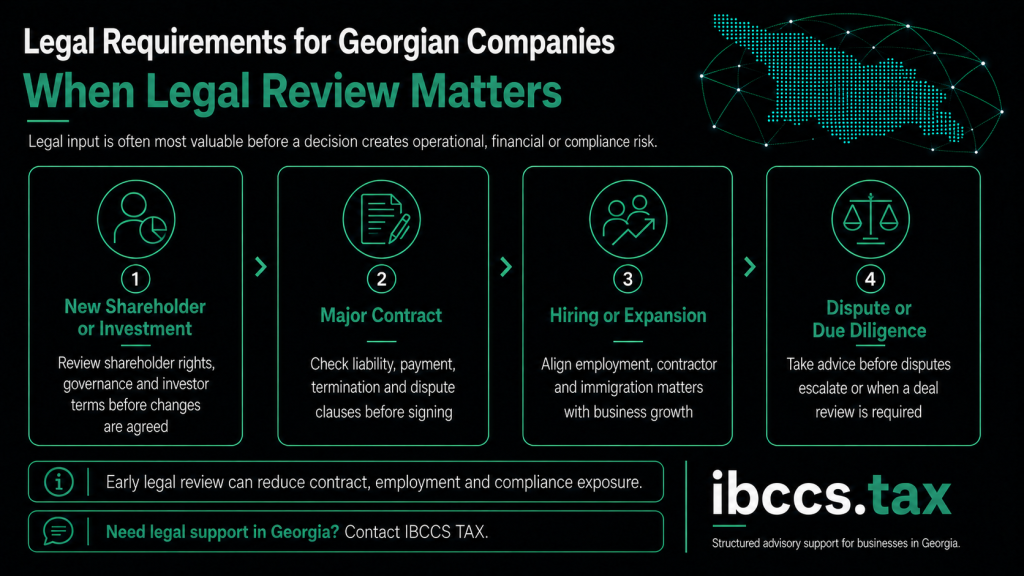
When Should a Foreign-Owned Company Seek Legal Review?
A company does not need a lawyer to review every routine decision, but certain changes are good triggers for a focused legal check. The aim is to review the transaction before commitments are made, while the structure, contract or approval route can still be adjusted without unnecessary cost.
- A new shareholder, investor or financing round is being introduced.
- The company is signing a material customer, supplier, distribution, lease or financing agreement.
- Employees or contractors are being hired, particularly foreign nationals or key product developers.
- Founders are transferring intellectual property, changing ownership or moving assets between group companies.
- The business is entering a regulated activity, adding payment functionality or expanding into a new market.
- A bank, investor or buyer has requested enhanced KYC, due diligence or ownership documentation.
- A dispute, regulatory notice or material employee issue has arisen.
- The Georgian company is becoming part of a wider international group or changing its cross-border management and financing arrangements.
How IBCCS TAX Supports Companies with Legal Services in Georgia
IBCCS TAX provides integrated legal support for local and foreign-owned Georgian companies throughout the business lifecycle. Our work can begin with incorporation and governance, continue through contracts and employment, and extend to licensing, intellectual property, investment transactions, due diligence and disputes as the company grows.
Our legal services may include company formation and corporate changes, shareholder and founders agreements, commercial contract drafting and review, employment documents, intellectual property support, data-protection and regulatory review, licensing assistance, transaction support and representation in civil, administrative or alternative dispute processes where appropriate.
Legal advice can also be coordinated with accounting services in Georgia, taxation services in Georgia and company registration in Georgia so that corporate decisions, contracts and transactions are implemented consistently across the legal and financial records.
Companies that need support with a new legal issue or want to strengthen their ongoing framework can contact IBCCS TAX to discuss the requirements relevant to their activity in Georgia.
Legal Requirements for Georgian Companies: Build Legal Compliance into the Operating Model
The strongest legal framework is one that supports the company’s commercial objectives without becoming disconnected from daily operations. Governance should match how decisions are actually made, contracts should match how services or goods are actually delivered, and intellectual-property documents should match who actually creates and controls the product.
For foreign founders, this approach is particularly valuable because it creates a clear Georgian legal foundation while leaving room for international growth. Regular legal review at key stages can reduce friction with banks, employees, customers and investors and make future financing, restructuring or sale transactions easier to execute.

FAQ: Legal Requirements for Georgian Companies
1. Can foreigners own a Georgian company?
Yes. Foreign individuals and foreign legal entities can generally hold shares in a Georgian company. The ownership, management and authorised-signatory structure should still be documented clearly and kept consistent with registry and banking records.
2. Does a Georgian LLC need a local shareholder?
A standard Georgian LLC generally does not require a Georgian shareholder merely because the company is foreign-owned. Sector-specific restrictions or regulated activities should still be checked separately where relevant.
3. What legal documents does a Georgian LLC need?
The exact set depends on the business, but common documents include the charter, shareholder and director decisions, commercial contracts, employment or contractor agreements, IP assignments, financing documents and any licences or privacy documentation required for the activity.
4. Does a Georgian LLC need a shareholders agreement?
Not every company needs one. A single-owner business may operate with its charter and corporate decisions, while companies with several founders or investors often benefit from a separate agreement covering governance, transfers, funding, reserved matters and exit rights.
5. Can a Georgian company use foreign-law contracts?
Foreign law can be chosen for some international contracts, but the choice should be deliberate. The company should consider enforceability, the dispute forum, the location of assets and whether mandatory Georgian rules still affect part of the relationship.
6. What employment documents should a Georgian company have?
The documentation depends on the workforce, but companies commonly need written employment terms, confidentiality and IP provisions and, as the team grows, internal policies covering operational and data-security matters.
7. Do foreign employees need work activity permits in Georgia?
The answer depends on the worker, activity, residence status and whether an exemption applies. Georgia changed its labour migration framework in 2026, so employers should review the current work activity and reporting rules before relying on previous practice.
8. How should a company protect software created by contractors?
The contractor agreement should clearly address ownership or assignment of the relevant intellectual property, confidentiality, deliverables and permitted use of third-party materials. Payment for development should not be treated as a substitute for clear IP documentation.
9. Does every Georgian company need a licence?
No. Many ordinary commercial activities do not require a sector-specific licence, but regulated industries may require licences, permits, registrations or supervisory approval. The intended activity should be checked before launch.
10. Does Georgian data protection law apply to ordinary companies?
It can. Companies processing personal data relating to employees, customers, applicants or users should assess the Georgian data-protection rules relevant to their processing, security, notices, service providers and cross-border transfers.
11. What legal documents do banks ask foreign-owned companies for?
Banks commonly request registry extracts, constitutional documents, shareholder and beneficial-owner information, identification documents, ownership charts, contracts and explanations of expected transaction flows. The exact requirements depend on the company and its risk profile.
12. What should be checked before an investor buys shares in a Georgian company?
The parties should review ownership, governance, material contracts, employees, intellectual property, financing, tax and accounting, licences, data protection and disputes. The investment documents and corporate filings should then reflect the agreed rights and capital changes.
13. When should a Georgian company obtain ongoing legal support?
A simple business may need legal advice only at specific stages, while a growing, regulated or internationally owned company may benefit from ongoing support for contracts, employment, governance and compliance. The level of support should follow the complexity and pace of operations.
14. Why use IBCCS TAX for legal services in Georgia?
IBCCS TAX combines corporate and commercial legal support with tax, accounting, licensing and company registration services. This allows foreign-owned companies to coordinate legal documentation with the wider operational and compliance structure in Georgia.





Georgia iGaming License in 2026: Online Casino, Slots & Sports Betting for International Operators
Georgia introduced a dedicated licensing framework in 2026 for the
Read More
Work Permit in Georgia for Foreigners: Right to Work, Employers, Self-Employed and Residence Rules
Georgia introduced a substantially more regulated labour migration framework in
Read More
Cezary Zieniuk to Join Free IMC Webinar on the New Geography of Global Mobility
On 23 September 2026, Cezary Zieniuk, Founder of IBCCS TAX
Read MoreDisclaimer: This article is for general information only and does not constitute tax, legal or financial advice. Professional advice should be obtained based on your specific circumstances.