

Georgia offers several preferential tax regimes for specific business models. Special Trading Company Status is one of the most specialised. It is designed for companies that trade foreign goods through customs warehouses and use Georgia as part of an international re-export or distribution chain, rather than as a conventional domestic import market.
The regime can provide a significant profit tax advantage for qualifying trading activity, but it is also tightly defined. A Special Trading Company cannot operate like an ordinary Georgian wholesaler, cannot freely mix permitted trading with local services and must be structured for the status from the beginning. Customs flows, warehouse arrangements, contracts, banking and accounting therefore need to be planned before registration.
At IBCCS TAX, we assist international traders and foreign founders with business registration in Georgia, tax analysis, customs coordination and ongoing compliance through our teams in Tbilisi and Batumi. This guide explains how Special Trading Company Status works, which activities are permitted and what should be reviewed before establishing the structure.

- Special Trading Company Status is intended for defined trading in foreign goods through customs warehouses, including re-export and sales while goods remain under the warehouse procedure.
- The company must be established for the purpose of obtaining the status, and the status is granted by the Georgian tax authority as part of the registration-stage structure.
- Profit distributions earned from permitted Special Trading Company activities can qualify for an exemption from Georgian corporate profit tax.
- The company may not import trading goods into the Georgian domestic market itself, purchase Georgian goods for resale, provide services to Georgian businesses or operate its own customs warehouse.
- Limited additional Georgian-source income may be allowed, but statutory thresholds and the nature of the income must be monitored carefully.
- The tax benefit does not remove customs, VAT, excise, banking, documentation or accounting requirements.
- The regime is best suited to a genuine international trading model with clearly mapped suppliers, customers, warehouse operators and payment flows.
Why Special Trading Company Status Requires Planning Before Registration
A standard Georgian LLC can be registered first and refined operationally afterwards. A Special Trading Company is different because the Tax Code links the status to a company created for that specific purpose at the time of registration. This makes the initial structure, stated activity and application process especially important.
The business model should therefore be tested before documents are filed. The founders need to know where the goods originate, which customs warehouse will hold them, whether the company will re-export them or sell them while they remain in the warehouse, who will handle customs declarations and whether any part of the proposed activity falls outside the permitted scope.
Planning also protects the commercial side of the project. A tax-efficient company that cannot open an appropriate bank account, document its source of funds or coordinate inventory with the warehouse will not operate effectively. Registration should be the final step in the design process, not the first assumption.
What Is a Special Trading Company in Georgia?
A Special Trading Company, often shortened to STC, is a company granted a specific status under the Georgian Tax Code in order to carry out defined transactions involving foreign goods. The core model is based on customs warehouse activity and re-export rather than the ordinary import and sale of goods into the Georgian market.
The company remains a Georgian enterprise with local corporate, accounting and administrative obligations. The status changes the tax treatment of permitted trading profits and limits the activities the company may conduct. It should not be treated as a general licence for any international trade or as a zero-compliance company.
Founders who are still deciding between a standard LLC and a preferential regime should first review our guide to company formation in Georgia. The Special Trading Company route is appropriate only where the actual goods flow matches the statutory model.
Who May Consider Special Trading Company Status?
The regime may be relevant to international trading groups, distributors and re-export businesses that purchase foreign goods, place or retain them under a customs warehouse procedure in Georgia and then sell or re-export them without the STC itself importing the goods into Georgian free circulation.
Typical commercial scenarios can include regional distribution, consolidation of goods from several foreign suppliers, onward sales to customers in other countries and transfers of foreign goods between enterprises while the goods remain in a customs warehouse. The structure may also be considered where Georgia provides a practical logistics location between Europe, Central Asia, the Caucasus and wider regional markets.
It is less suitable for a company whose main objective is domestic wholesale, retail, manufacturing, local service provision or the purchase of Georgian-origin goods for resale. Those activities generally require a standard LLC or another structure rather than Special Trading Company Status.
How the Special Trading Company Model Works in Practice
The legal status is only one part of the operating model. In practice, the company needs a coordinated chain connecting the foreign supplier, freight or logistics provider, customs warehouse, Georgian customs representative, customer, bank and accounting provider. Each party should understand who owns the goods and which customs procedure applies at each stage.
Foreign Goods and the Customs Warehouse Procedure
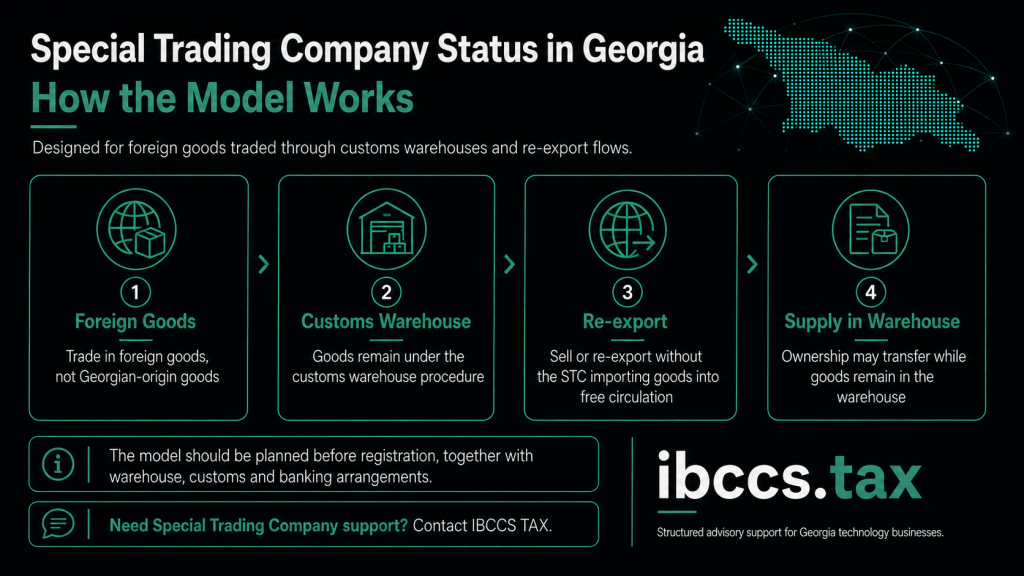
The regime is centred on foreign goods held in a customs warehouse. Goods under this procedure have not been imported by the STC into Georgian free circulation. Their customs status, value, quantity and movement should be supported by warehouse records and customs documentation that can be matched with the company’s purchase and sales records.
The warehouse arrangement should be agreed before trading begins. The STC may use a customs warehouse operated by another authorised party, but it may not itself own or operate a customs warehouse under the restrictions of the regime. The service agreement should cover access to records, inventory confirmation, release instructions and responsibility for customs formalities.
Re-export of Foreign Goods
A Special Trading Company may re-export foreign goods from a customs warehouse. This is the clearest use case for the regime: goods enter the Georgian customs territory under the warehouse procedure and subsequently leave Georgia for a customer or destination abroad without being imported into the Georgian domestic market by the STC.
The commercial documents should correspond with the customs flow. Purchase contracts, sales contracts, invoices, transport documents and warehouse releases should identify the goods consistently and support the dates and values recorded in the accounting system.
Supply of Goods While They Remain in a Customs Warehouse
The Tax Code also allows an STC to supply foreign goods in a customs warehouse to another Special Trading Company or to an enterprise without that status. This can support transactions where ownership changes while the goods remain under customs control.
A sale to a Georgian buyer does not mean that the STC itself imports the goods. Where the buyer later brings the goods into Georgian free circulation, the buyer or another responsible party must handle the import procedure and the related customs and tax obligations. Contracts should make this allocation clear.
Purchasing Foreign Goods from Other Enterprises
An STC may purchase foreign goods from an enterprise without Special Trading Company Status for subsequent re-export or supply in a customs warehouse. The statutory rules include a customs-value condition, so transaction pricing and customs records need to be reviewed together rather than handled by separate teams.
Related-party transactions require particular attention. The company should be able to demonstrate the customs value, commercial terms and relationship between the parties, and should maintain documents supporting why the transaction falls within the permitted activity.
Permitted Activities of a Special Trading Company
The permitted scope should be translated into an internal operating policy that staff, logistics providers and accountants can follow. The company should approve only transactions that fit the model and refer unusual contracts for review before signing.
| Permitted area | Practical meaning | Key evidence |
| Re-export of foreign goods | Foreign goods may leave Georgia from a customs warehouse for a destination abroad. | Purchase and sales contracts, customs declarations, transport records and warehouse releases. |
| Supply in a customs warehouse | Ownership of foreign goods may be transferred while the goods remain under the customs warehouse procedure. | Warehouse inventory, title-transfer documents, invoices and buyer instructions. |
| Purchase for re-export or warehouse supply | Foreign goods may be purchased from a non-STC enterprise subject to the statutory customs-value condition. | Supplier contract, customs value evidence and matching warehouse records. |
| Certain limited additional income | Some exempt income, qualifying fixed-asset disposals and limited Georgian-source income may be permitted. | Separate accounting, statutory threshold monitoring and transaction-specific tax review. |
Activities a Special Trading Company May Not Conduct
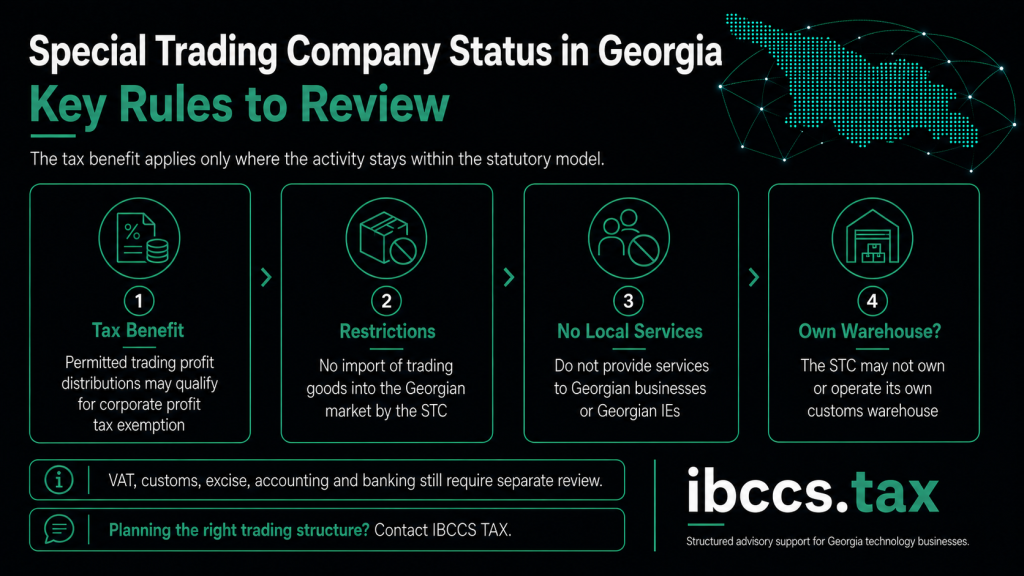
The restrictions are as important as the tax benefit. An STC may not import trading goods into Georgia, except for assets intended for the company’s own fixed-asset use. It may not purchase Georgian goods inside Georgia for subsequent supply and may not provide services to a Georgian enterprise, Georgian individual entrepreneur or the Georgian permanent establishment of a foreign enterprise.
The company may not operate its own customs warehouse. It must use a separate warehouse operator and maintain a clear division between the STC’s trading role and the regulated customs warehousing function. Attempting to combine the two can undermine the structure and create regulatory exposure.
Breaches can lead to substantial penalties and may affect the status. The safest approach is to classify each proposed revenue stream and goods flow before it is accepted, rather than relying on a year-end review after prohibited transactions have already occurred.
Special Trading Company Tax Benefits
The principal attraction is the Georgian profit tax exemption available for profit distributions earned from permitted Special Trading Company activities. This can make the regime commercially valuable for a genuine re-export and customs warehouse trading operation with significant margins.
The exemption should be understood within Georgia’s distributed-profit system. It does not mean that every payment made by the company or every category of income is automatically tax-free. The source of the profit, the transaction type and the statutory exclusions must be identifiable in the accounting records.
Profit Tax on Permitted Trading Income
Georgia generally taxes companies when profits are distributed or when specified payments are treated as deemed distributions. For an STC, profit distributions derived from permitted activities can fall within a specific exemption. The company should therefore maintain a reliable calculation showing which accumulated profit relates to qualifying trading and which amounts arise from other income or asset transactions.
A broader explanation of the distributed-profit model is available in our guide to Georgia corporate tax. The STC exemption should be applied within that wider framework rather than treated as an entirely separate accounting system.
Dividend and Shareholder Tax Considerations
An exemption at company level does not automatically determine the final tax position of the shareholder. Georgian withholding tax, the shareholder’s country of tax residence, controlled foreign company rules and local dividend taxation may still need to be considered.
Foreign founders should model the full extraction route before relying on a headline corporate rate. The most efficient local regime may produce a different outcome once dividends, management, financing and foreign reporting are included.
VAT, Customs Duties and Excise
Special Trading Company Status is not a blanket VAT or customs exemption. The treatment depends on the customs procedure, movement of the goods, place and nature of the supply, and whether the goods are released into Georgian free circulation by another party. Excise and product-specific controls may also apply to certain goods.
The STC, warehouse operator and customs representative should agree who prepares each declaration and who bears taxes, duties and compliance costs. The accounting team should receive the final customs documents so that the tax records match the physical goods flow.
Can a Special Trading Company Earn Other Income?
The Tax Code allows certain additional income, but the permission is narrow. It can include income otherwise exempt from profit tax, income from the sale of fixed assets used in the company’s economic activity for more than two years and limited other Georgian-source income.
The general Georgian-source income category is subject to two simultaneous annual limits: it must not exceed GEL 1,000,000 and must not exceed 5% of the customs value of foreign goods brought into Georgia by the company. Both tests should be monitored during the year, not only after the annual accounts are prepared.
Additional income should be recorded separately from permitted core trading. The company should confirm before entering a side contract whether the revenue is allowed, how it affects the exemption and whether it creates VAT, withholding or other tax obligations.
Special Trading Company vs Standard Georgian LLC
A standard LLC offers much broader commercial flexibility, while an STC offers a targeted tax benefit for a tightly defined trading model. The correct choice depends on what the company will actually do, not only on the expected tax rate.
| Area | Special Trading Company | Standard Georgian LLC |
| Core business | Foreign goods, customs warehouse transactions and re-export. | Broad range of lawful trading, service and operational activities. |
| Status timing | Purpose-built structure with status addressed at registration. | Can be registered and later adapt its activities, subject to licensing and tax rules. |
| Domestic market | STC itself cannot import trading goods into Georgia or buy Georgian goods for resale. | May import, buy and sell in Georgia subject to customs, VAT and sector rules. |
| Services | Cannot provide services to Georgian businesses, IEs or Georgian PEs. | May provide local and international services. |
| Profit tax | Qualifying permitted trading profits may benefit from exemption. | Standard 15% distributed-profit model generally applies. |
| Customs warehouse | Must use a separate operator and may not own the warehouse. | May contract with or, subject to authorisation, operate relevant facilities. |
| Best suited to | Dedicated international trading and re-export flows. | Mixed activities, domestic trade, services and general operations. |
Can Foreign Founders Own a Special Trading Company?
Foreign individuals or foreign corporate shareholders can generally own a Georgian company, including a company established for Special Trading Company Status. A local shareholder is not normally required for a standard foreign-owned structure.
Foreign ownership does not reduce the need for transparent beneficial ownership, source-of-funds evidence and commercial documentation. Banks and counterparties may ask for the group structure, shareholder records, expected trading corridors, supplier contracts and explanations of why Georgia is used in the logistics chain.
Where the shareholder is a foreign company, incorporation documents, registry extracts and authorised-signatory evidence may need apostille or legalisation and Georgian translation. The documentation path should be confirmed before the registration date is planned.
How to Register a Special Trading Company in Georgia
The process should combine legal registration, the tax status application and operational implementation. Treating these as unrelated tasks can result in a registered entity that does not meet the status requirements or cannot perform the intended trade.
Map the Trading and Customs Flow
The first step is to prepare a transaction map showing suppliers, countries of origin, transport routes, warehouse location, customers, title transfer points and the expected customs procedure. The review should also identify whether any goods are restricted, licensed, excisable or subject to sanitary, veterinary, product safety or sanctions controls.
A financial model should be prepared at the same time. It should cover expected sales, margins, freight, warehousing, customs representation, insurance, bank charges and the timing of supplier and customer payments.
Prepare a Purpose-Built Georgian Company
Because the status is linked to a company established for that purpose, the incorporation documents and activity description should be aligned with the permitted STC model. Shareholders, management powers, legal address and authorised representatives should be confirmed before filing.
Where the founders need a broader legal review, IBCCS TAX can coordinate registration with legal services in Georgia, including corporate documents and commercial agreements.
Apply for Special Trading Company Status
The status is granted by the Georgian tax authority and evidenced by a certificate. The application package should be prepared together with the company registration so that the purpose and activity are clear from the outset.
The exact filing documents and procedural steps should be confirmed at the time of application. Changes in shareholders, management, activity or the proposed goods flow should be reviewed before they are implemented, because the status is linked to continuing compliance with the statutory conditions.
Implement Warehouse, Customs, Banking and Accounting
After registration, the company needs agreements with the warehouse and customs service providers, access to the Revenue Service systems, a corporate bank account and an accounting process capable of reconciling goods, contracts, invoices and customs values.
The first transaction should not occur until responsibilities are documented. The company should know who issues release instructions, who prepares export or re-export declarations, who confirms inventory and how the accounting provider receives the required records each month.
Documents Commonly Required for an STC Setup
The exact package depends on the shareholders, goods and trading model, but the following categories are commonly relevant. Additional documentation may be requested by the tax authority, bank, customs representative or warehouse operator.
| Document area | Typical documents | Purpose |
| Shareholders and management | Passports, foreign company extracts, constitutional documents, ownership chart and powers of attorney. | Supports incorporation, beneficial ownership and authorised-signatory checks. |
| Business model | Trading flow memorandum, supplier and customer profile, expected countries and product list. | Explains why the company fits the STC regime and supports banking review. |
| Goods and customs | Commodity codes, origin data, customs values, transport documents and product permits where relevant. | Supports customs classification and permitted activity analysis. |
| Warehouse and logistics | Draft warehouse agreement, freight arrangements and customs representation mandate. | Confirms the operational chain and division of responsibilities. |
| Tax and accounting | Projected revenue, margin model, invoicing process and document flow. | Allows profit tax, VAT and compliance procedures to be established before trading. |
Accounting and Ongoing Compliance for a Special Trading Company
Preferential status increases the need for detailed accounting. The company must be able to separate permitted trading profit, additional income, fixed-asset transactions and any payment that may fall outside the exemption. A general profit and loss statement without transaction-level support may not be sufficient.
Inventory records should reconcile the quantity and value of goods purchased, held in each warehouse, sold and re-exported. Differences between commercial invoices, customs values and bank payments should be explained, especially where freight, insurance, commissions or related parties are involved.
Companies can review our accounting services in Georgia for ongoing bookkeeping, tax reporting and status-specific record keeping.
Banking and Payment Flows for International Trading Companies
Banks usually assess international trading businesses more closely than simple local service companies. The STC should be prepared to identify suppliers, customers, countries, goods, payment currencies, expected transaction values and the commercial reason for routing goods through Georgia.
Payment flows should correspond with contracts and customs records. Third-party payments, unexplained advances, rapid movement of funds, sanctioned jurisdictions or goods with dual-use or regulatory sensitivity can lead to enhanced due diligence or declined transactions.
Bankability should therefore be tested before incorporation. The structure may be legally available but commercially unsuitable if the banking profile, goods or geographic corridors fall outside the risk appetite of Georgian or international banks.
Common Mistakes with Special Trading Company Status
A common mistake is treating the status as a general trading exemption. The permitted activities are narrowly connected to foreign goods, customs warehouses and re-export. Domestic imports, Georgian-origin goods and local services cannot simply be added as secondary activities without consequences.
Another mistake is registering an ordinary LLC first and assuming the status can be added later. The legal framework requires the company to be established for the STC purpose, so the route should be confirmed before incorporation documents are filed.
Founders also underestimate the warehouse and customs documentation. If inventory, customs values, invoices and payments cannot be reconciled, the company may struggle to prove that profits arose from permitted transactions. Weak records can also create problems with banks and customers.
A further risk is focusing only on corporate profit tax. VAT, customs, excise, shareholder taxation, foreign tax residence, transfer pricing and sanctions compliance can materially affect the commercial result and should be reviewed as part of the same project.
When Special Trading Company Status May Not Be the Right Structure
The regime is unlikely to fit a business that intends to import goods into Georgia for local wholesale or retail, buy Georgian goods for resale, provide services to Georgian customers or mix trading with a wide range of unrelated income. A standard Georgian LLC will usually provide more flexibility for those activities.
It may also be unsuitable where the business does not have a credible customs warehouse and re-export model, cannot maintain transaction-level records or expects banking restrictions on its products or trading corridors. A theoretical tax advantage should not override operational reality.
Companies comparing several Georgian regimes can review our broader article on Georgia tax incentives for international businesses. The selection should follow the business model rather than the other way around.
Special Trading Company Support from IBCCS TAX
IBCCS TAX assists international traders, foreign founders and business groups with the legal, tax and practical stages of a Special Trading Company setup. Our work begins with the proposed goods and payment flow, because eligibility and implementation depend on how the business will operate in practice.
Our support may include structure review, Georgian company registration, preparation and coordination of the status application, legal address, review of warehouse and commercial arrangements, tax analysis, accounting setup and ongoing compliance. We can also coordinate with customs, logistics and banking professionals where the project requires specialist implementation.
Where the Georgian company forms part of a wider group, we can combine the local setup with international tax structuring covering shareholder taxation, related-party transactions, financing and the interaction with the founder’s or parent company’s jurisdiction.
Build the Trading Model Before Applying for the Status
Special Trading Company Status can be a strong solution for a genuine re-export and customs warehouse business, but it is not a shortcut for ordinary trading. The benefit depends on keeping the company within the permitted scope and maintaining evidence that connects each profit stream with the relevant goods and customs procedure.
The best time to review the structure is before the Georgian company is incorporated and before warehouse, supplier or customer contracts are signed. Early planning makes it possible to adjust the transaction chain, select appropriate service providers and confirm that banking and compliance will support the intended volume.
Contact IBCCS TAX to discuss Special Trading Company Status, company registration and ongoing tax and accounting support in Georgia.

FAQ: Special Trading Company Status in Georgia
1. What is a Special Trading Company in Georgia?
A Special Trading Company is a Georgian company granted a specific tax status for defined transactions involving foreign goods in customs warehouses, including re-export and supply while the goods remain under the warehouse procedure.
2. What is the main tax benefit of Special Trading Company Status?
Profit distributions derived from permitted STC activities can qualify for an exemption from Georgian corporate profit tax. The company must identify the source of the profit and comply with the permitted activity rules.
3. Can an existing Georgian LLC apply for STC status?
The Tax Code links the status to a company established for that purpose at the time of registration. Founders should therefore confirm the route before incorporating an ordinary LLC rather than assuming the status can be added later.
4. Can a foreigner own a Special Trading Company in Georgia?
Yes, a Georgian company can generally be foreign-owned. The shareholders and beneficial owners should still provide the documentation required for registration, tax, customs and banking checks.
5. Can an STC import goods into the Georgian market?
The STC itself may not import trading goods into Georgia, except for fixed assets intended for its own use. A buyer may separately import goods purchased in a customs warehouse, subject to the applicable customs and tax rules.
6. Can a Special Trading Company buy Georgian goods for resale?
No. The statutory restrictions prohibit an STC from buying Georgian goods within Georgia for subsequent supply.
7. Can an STC provide services to Georgian companies?
No. A Special Trading Company may not provide services to a Georgian enterprise, Georgian individual entrepreneur or the Georgian permanent establishment of a foreign enterprise.
8. Can a Special Trading Company own a customs warehouse?
No. The regime prohibits the STC from having a customs warehouse. It normally needs to contract with a separate authorised warehouse operator.
9. Can an STC earn income outside its core trading activity?
Certain additional income may be allowed, including limited other Georgian-source income. The statutory categories and annual thresholds must be monitored and recorded separately.
10. Does STC status remove VAT and customs obligations?
No. VAT, customs duties, excise and product controls depend on the goods and transactions. The status primarily addresses profit tax on permitted activity and does not replace a customs or VAT analysis.
11. What accounting records should an STC maintain?
The company should maintain contracts, invoices, bank records, customs declarations, warehouse inventory, transport documents, customs values and separate records for qualifying and non-core income.
12. Is Special Trading Company Status suitable for domestic wholesale?
Usually not. A business importing and selling goods in the Georgian domestic market generally needs the flexibility of a standard LLC and the ordinary customs and VAT framework.
13. Why use IBCCS TAX for an STC setup?
IBCCS TAX combines Georgian company registration, tax advisory, accounting and cross-border structuring. This allows the legal status, customs flow, banking profile and ongoing compliance process to be designed as one coordinated project.





Georgia iGaming License in 2026: Online Casino, Slots & Sports Betting for International Operators
Georgia introduced a dedicated licensing framework in 2026 for the
Read More
Work Permit in Georgia for Foreigners: Right to Work, Employers, Self-Employed and Residence Rules
Georgia introduced a substantially more regulated labour migration framework in
Read More
Cezary Zieniuk to Join Free IMC Webinar on the New Geography of Global Mobility
On 23 September 2026, Cezary Zieniuk, Founder of IBCCS TAX
Read MoreDisclaimer: This article is for general information only and does not constitute tax, legal or financial advice. Professional advice should be obtained based on your specific circumstances.