Choosing between self-employment and a Cyprus limited company is one of the most important structural decisions for a consultant, freelancer, independent professional or owner-managed business. The two options can support similar commercial activities, but they differ significantly in legal identity, taxation, Social Insurance, access to profits, accounting obligations and exposure to business risk.
The comparison should not be reduced to the personal income tax rate versus the Cyprus corporate income tax rate. A company creates a separate legal and accounting framework, while the owner must decide how profits will be retained or extracted. Self-employment is usually simpler, but the individual remains personally connected to the business income and liabilities.
The appropriate structure depends on expected profit rather than turnover alone, how much cash the owner needs personally, whether funds will be reinvested, the level of contractual risk, plans to employ people and the administrative framework the business can support. Tax residency, Non-Dom status and the location of customers may also affect the final position.
This guide provides a practical comparison of self-employment and a Cyprus company and explains when a formal structure review is appropriate. It is designed to support a commercial decision, not to suggest that one option is automatically better for every business owner.

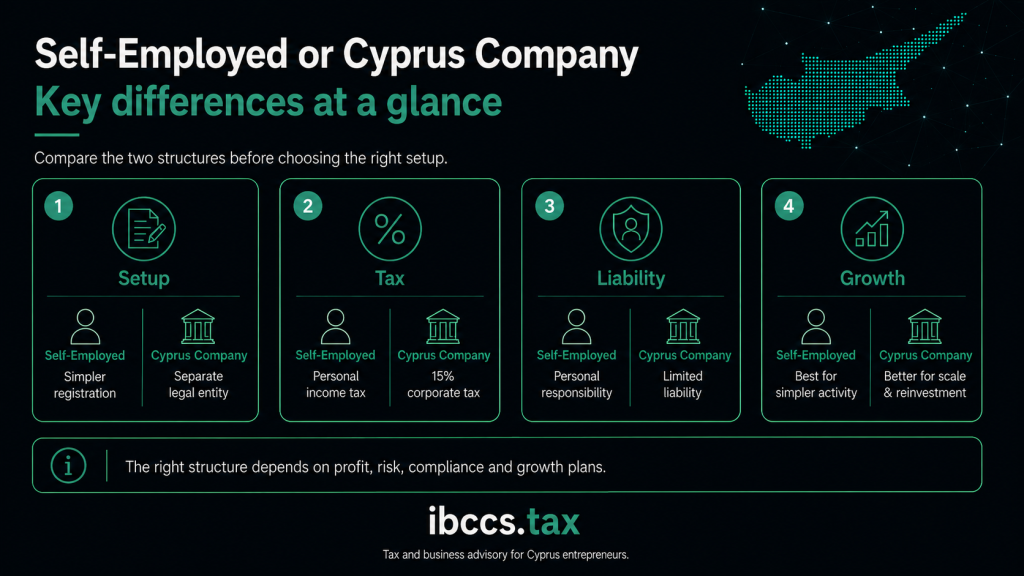
- Self-employment and a Cyprus company can both be used to provide professional services, but they create different legal, tax and accounting positions.
- A self-employed individual and the business are not separate legal persons. A Cyprus company has its own legal identity, assets, contracts and liabilities.
- Self-employed profits are taxed under the progressive personal income tax bands. A Cyprus company is generally taxed at 15% on taxable corporate profits.
- The corporate tax rate is not the owner’s final personal tax rate. Salary, dividends, benefits, reimbursements and loans must be analysed separately.
- Self-employed Social Insurance is generally calculated at 16.6% of the applicable insurable income, while GHS applies separately under the healthcare contribution framework.
- A company can retain post-tax profits for working capital and reinvestment without immediately transferring the money to the shareholder personally.
- Self-employment normally has a lower administrative burden, while a company requires separate accounting records, financial statements, corporate filings and governance.
- Limited liability can be commercially important, but it does not protect an owner from personal guarantees, misconduct or every statutory responsibility.
- VAT treatment depends mainly on the supplies, customers and jurisdictions involved. Forming a company does not automatically remove or reduce VAT obligations.
- The structure should be reviewed before hiring staff, transferring contracts, introducing a partner or making substantial investments through the business.
Quick Answer: Is It Better to Be Self-Employed or Open a Cyprus Company?
Self-employment may be suitable where the activity is relatively straightforward, business risk is limited and most profits will be used personally. The individual is taxed on chargeable business profit under the progressive personal income tax system and generally pays self-employed Social Insurance and GHS contributions.
A Cyprus company may be more appropriate where the business will retain and reinvest profits, employ a team, involve partners or investors, own intellectual property or enter into contracts with greater risk. The company is a separate legal person and is generally subject to 15% corporate income tax on taxable profits under the current framework, but payments to the owner require separate treatment.
There is no universal profit or turnover threshold at which a company always produces a better result. The decision should be modelled using expected profit, owner withdrawals, salary, dividends, Social Insurance, GHS, Non-Dom status, company compliance costs and commercial objectives.
Self-Employed vs Cyprus Company: At-a-Glance Comparison
| Area | Self-employed individual | Cyprus limited company |
| Legal identity | The individual and business are the same legal person. | The company is a separate legal entity. |
| Liability | The owner is generally personally responsible for business obligations. | Shareholder liability is generally limited, subject to guarantees and legal exceptions. |
| Tax on profits | Chargeable business profit is taxed under progressive personal income tax bands. | Taxable company profit is generally subject to 15% corporate income tax. |
| Access to cash | Business profit belongs directly to the individual; drawings do not determine the taxable profit. | Company funds reach the owner through salary, dividends, reimbursements, loans or other properly documented payments. |
| Social contributions | Self-employed Social Insurance and GHS are assessed under the applicable rules. | Payroll contributions apply to salary; dividends and other income follow separate personal rules. |
| Profit retention | Profit forms part of the individual’s personal business result even if cash remains in the business account. | Post-tax profit may be retained in the company for working capital or reinvestment. |
| Accounting and reporting | Usually simpler, although bookkeeping, tax returns, VAT and formal financial statements may still be required. | Separate accounting records, financial statements, tax filings, Registrar filings and corporate administration are required. |
| Ownership and growth | Not designed for share ownership, investors or succession through equity. | Shares can support co-owners, investment, succession and changes in ownership. |
| Commercial perception | Can be appropriate for personal professional services and smaller activities. | Often preferred for larger contracts, teams, platforms, counterparties and institutional relationships. |
Self-Employed or Cyprus Company?
A tailored comparison should measure tax, contributions, compliance costs, retained profit and commercial risk using your expected business figures. Request a Structure Review
The Core Legal Difference
The legal distinction between the two structures affects contracts, liabilities, banking, ownership and the way the business can develop. It should be considered before the tax comparison because the lowest immediate tax outcome may not provide the right commercial framework.
Self-Employment: The Individual Is the Business
A self-employed person contracts with clients personally and earns the business income directly. Assets used in the activity generally belong to the individual, and the owner remains responsible for customer claims, business debts and contractual obligations.
A business name can be registered and separate branding may be used, but this does not create a separate legal person. The owner should therefore consider professional indemnity insurance, contractual limitations, data protection, sector regulation and the value of any assets exposed to business risk.
For a detailed explanation of registration, tax, VAT and bookkeeping, see our complete guide to operating as self-employed in Cyprus.
Cyprus Company: A Separate Legal Person
A Cyprus limited company has its own legal personality. It can enter into contracts, hold a bank account, own equipment or intellectual property, employ staff and incur liabilities separately from the shareholder.
This separation can support commercial credibility and risk management, but it also requires discipline. Company money is not the shareholder’s personal money, and business decisions must be reflected through proper contracts, resolutions, invoices, payroll and accounting records.
Limited liability is not absolute. A bank, landlord or major customer may request a personal guarantee, and directors remain responsible for complying with company, tax, employment and insolvency obligations.
How Self-Employed Profits Are Taxed in Cyprus
A self-employed individual is generally taxed on chargeable business profit rather than gross turnover. Qualifying business expenses and applicable deductions reduce the accounting result to the amount considered under the personal income tax system.
Under the current personal income tax framework applying from the 2026 tax year, the first €22,000 of annual chargeable income falls within the 0% band. Progressive marginal rates apply above that level.
| Annual chargeable income | Marginal tax rate |
| Up to €22,000 | 0% |
| €22,001 – €32,000 | 20% |
| €32,001 – €42,000 | 25% |
| €42,001 – €72,000 | 30% |
| Over €72,000 | 35% |
These are marginal bands. Reaching a higher band does not mean that the entire profit is taxed at the highest percentage. The final position also depends on other personal income, permitted deductions, loss relief and the individual’s complete circumstances.
Self-employed tax should be reviewed together with Social Insurance, GHS and provisional tax. A comparison that considers only personal income tax will understate the full cost of the structure.
Further information is available in our guide to Cyprus personal income tax rates and individual filing obligations.
Social Insurance and GHS for Self-Employed Individuals
Self-employed Social Insurance is generally calculated at 16.6% of the applicable insurable income. The contribution basis can depend on the occupational category, with an actual-earnings approach potentially available in qualifying circumstances.
GHS is separate from Social Insurance. Self-employed earnings are generally subject to GHS at 4% under the current framework, up to the applicable overall annual contribution cap. Other income received by the individual may also be considered under its relevant GHS rate.
These contributions can materially affect a self-employed versus company comparison. The result should be calculated using the owner’s expected profit and remuneration rather than applying one headline percentage to turnover.
IBCCS TAX can assist with registration as a sole trader with the Cyprus Social Insurance system and the related tax registration process.
How a Cyprus Company and Its Owner Are Taxed
A Cyprus tax-resident company is generally subject to corporate income tax at 15% on taxable profits under the current framework. The taxable result is calculated at company level after considering deductible business expenditure, tax adjustments and any applicable reliefs.
The corporate tax rate is only the first part of the analysis. The shareholder does not personally own the company’s bank balance, and the method used to access company funds creates separate tax, payroll, GHS and documentation consequences.
A company can be useful where post-tax profits will remain available for marketing, equipment, product development, acquisitions, staff or working capital. Where the owner needs to withdraw nearly all available profit for personal living costs, the difference between the two structures may be less significant once the complete extraction and compliance position is considered.
Salary From the Company
A shareholder or director may receive salary for work performed for the company. Salary is considered under the personal income tax bands and normally brings PAYE, Social Insurance, GHS and employer compliance obligations.
The amount should reflect the actual role, duties and commercial position. Payroll must be operated properly, and the company should not describe irregular personal withdrawals as salary only after the accounting year has ended.
Dividends
Dividends are distributions of profits after the company has dealt with its corporate tax position and confirmed that distributable reserves are available. They are not a substitute for payroll where the payment is, in substance, remuneration for employment.
The shareholder’s treatment depends on tax residency, domicile status, GHS and any foreign tax considerations. A qualifying Cyprus tax resident who is non-domiciled for Special Defence Contribution purposes may generally benefit from an SDC exemption on dividends, although GHS can still be relevant.
Dividend planning should therefore be coordinated with the company’s accounts, board documentation and the individual’s personal tax position. It should not be based only on the assumption that dividends are always tax-free.
For private-client planning, see our service for Cyprus Non-Dom assessment and implementation.
Expense Reimbursements, Loans and Other Payments
A company may reimburse genuine business expenditure paid personally by the owner, provided that the cost belongs to the company and is supported by appropriate records. Reimbursements should not be used to transfer personal living costs to the business.
Director or shareholder loan accounts require careful monitoring. An unexplained debit balance can create tax, legal and audit issues, while informal withdrawals make it difficult to distinguish salary, dividends, loans and expenses.
The payment policy should be designed before regular withdrawals begin and then followed consistently through the bookkeeping and corporate records.
Profit Retention and Cash Flow
Profit retention is one of the most important differences between the structures. A self-employed person is generally taxed on the business profit for the year even when some cash remains in the business account. The money is still part of the individual’s activity rather than a separate corporate reserve.
A company pays tax on its own taxable profit and can retain the remaining amount for business purposes. Personal tax and contribution consequences associated with salary or dividends arise when payments are made or credited under the applicable rules.
This can make a company more suitable for a high-margin activity that does not require the owner to withdraw all earnings. It may be less relevant where the owner needs most of the cash personally and the company would function mainly as a payment channel.
Questions to Ask About Profit and Cash
- What level of annual profit is expected after genuine business expenses?
- How much cash must be withdrawn for personal living costs?
- How much can remain in the business for at least the next twelve to twenty-four months?
- Will retained funds be used for staff, technology, equipment, marketing or acquisitions?
- Is the income stable enough to justify fixed annual company compliance costs?
- Will the owner receive other salary, rental, investment or foreign income?
Accounting, Audit and Annual Compliance
Self-employment generally has a simpler compliance framework, but it still requires invoices, records, tax filings, provisional tax calculations and VAT compliance where applicable. The absence of a company does not remove the need for reliable bookkeeping.
From the 2026 tax year, a self-employed individual whose gross business income exceeds €120,000 generally enters the framework for formal financial statements subject to the applicable audit or review requirements. Adequate records remain necessary below that threshold.
A Cyprus company requires its own accounting records and annual financial statements. It must also deal with corporate tax filings, provisional tax, annual returns to the Registrar of Companies, beneficial ownership information and payroll or VAT obligations where relevant. The applicable audit or review requirement should be confirmed based on the company’s size and circumstances.
| Compliance area | Self-employed | Cyprus company |
| Bookkeeping | Required to support profit, expenses, VAT and personal tax. | Separate company bookkeeping and bank reconciliation are required. |
| Tax return | Income is reported through the individual’s tax position. | The company files its own corporate tax return; the owner may also file personally. |
| Financial statements | Formal audited/reviewed financial statements may be required above the applicable threshold. | Annual financial statements are required and are subject to the applicable audit or review framework. |
| Registrar filings | No annual company return, although a business name or licence may require updates. | Annual return, company changes and beneficial ownership information must be maintained. |
| Payroll | Not applicable to drawings; employees create employer obligations. | Required for salary paid to directors or employees. |
| Governance | Decisions are made by the owner personally. | Directors, shareholder decisions, resolutions and corporate records must be maintained. |
| Professional cost | Usually lower for a straightforward activity. | Higher recurring cost due to accounting, corporate and statutory compliance. |
IBCCS TAX provides ongoing bookkeeping services in Cyprus and broader accounting support for both self-employed individuals and companies.
VAT: Does the Structure Change the Answer?
VAT should not be used as the main reason to choose between self-employment and a company. The analysis depends primarily on what is supplied, where the customer is located, whether the customer is a business or consumer and whether a platform acts as agent or supplier of record.
The domestic Cyprus VAT registration threshold for taxable supplies is generally €15,600 over the relevant twelve-month period, but cross-border services, EU acquisitions and digital sales can create separate obligations. VIES, reverse-charge invoicing or OSS may be relevant regardless of whether the supplier is an individual or company.
Changing structure requires a fresh VAT implementation. The company will have a separate Tax Identification Number and VAT registration, while the individual may need to deal with outstanding returns, assets, invoices and deregistration or continuation of a separate activity.
Our accounting team can assess VAT registration and de-registration in Cyprus together with VIES and OSS requirements.
Liability, Contracts and Commercial Risk
Tax savings may be smaller than the cost of one significant commercial dispute. The legal structure should therefore reflect the value of contracts, the possibility of professional claims, the use of subcontractors, customer data, product liability and any commitments made to landlords, suppliers or lenders.
Self-employment exposes the individual more directly because the business does not have a separate legal identity. Insurance and contractual terms can reduce risk, but they do not create the same separation as a company.
A company can isolate some operational liabilities within the corporate entity, although directors must still act lawfully and responsibly. Personal guarantees, negligence, regulatory breaches and certain tax or insolvency matters can create personal exposure despite the limited-liability structure.
Employees, Contractors, Partners and Investors
A self-employed individual can employ staff and engage contractors, but the arrangement becomes more complex as the team grows. Employer registration, payroll, Social Insurance, GHS, employment contracts and worker classification must be handled correctly.
A company generally provides a clearer framework for a growing team. Employment contracts, management responsibilities and business assets can be held by one entity rather than being tied personally to the founder.
Where a second owner, investor or successor will participate, a company is usually more practical because ownership can be represented through shares. Shareholders’ agreements, different share rights and transfer provisions can then be used to document the commercial arrangement.
Intellectual Property, Platforms and Business Assets
Consultants, software developers, creators and online businesses may build valuable intellectual property, domains, customer databases, software, brands or platform accounts. The owner of those assets should be clear from the beginning.
Under self-employment, the assets generally belong personally to the individual unless another arrangement applies. A company can own and license business assets, but transfers from the founder require legal, tax, valuation and contractual analysis.
Platforms and payment providers may also impose their own onboarding rules. A decision to move to a company should therefore be implemented across contracts, platform profiles, invoicing and bank or EMI accounts rather than only through the incorporation certificate.
Is There a Profit Threshold at Which a Company Is Always Better?
No universal threshold can determine the correct answer for every business. Online comparisons often use turnover, apply one tax rate and assume that the shareholder can access all company cash without a second layer of analysis. This produces an incomplete and sometimes misleading result.
The relevant figure is usually expected accounting and taxable profit after genuine expenses. The model must then consider personal income tax, self-employed Social Insurance, GHS, company tax, salary, dividends, other personal income and the cost of annual corporate compliance.
The use of cash is equally important. A company may become attractive at a lower profit where substantial funds can be retained and reinvested, while self-employment may remain practical at a higher turnover where margins are modest and most cash is withdrawn personally.
Commercial factors can override a narrow tax result. A company may be justified by liability, customer requirements, ownership or investment plans even where the immediate tax saving is limited. Conversely, incorporating a small low-risk activity solely to access the corporate tax rate can create unnecessary cost and administration.
What a Proper Comparison Should Calculate
- expected annual turnover and deductible business expenditure;
- taxable profit under each structure;
- self-employed Social Insurance and GHS;
- company tax and the proposed salary or dividend policy;
- the owner’s other personal income and available reliefs;
- Non-Dom status and the personal treatment of dividends;
- cash required personally and profit available for retention;
- accounting, audit or review, payroll and company administration costs;
- VAT and cross-border compliance;
- business risk, contracts, staff, intellectual property and future ownership.
Do Not Rely on a Generic Turnover Threshold
IBCCS TAX can compare the structures using your expected profit, withdrawals, retained cash and compliance requirements. Request a Self-Employed vs Company Calculation
When Self-Employment in Cyprus May Be the Better Fit
Self-employment can remain appropriate where the owner provides a personal service, has limited commercial exposure and does not need a formal ownership or investment structure. The lower administrative burden may allow the individual to focus resources on developing the activity.
It may be particularly suitable where profits are still uncertain, most earnings are required personally and the business does not hold significant assets or employ a substantial team. The owner should nevertheless maintain proper records and review the position as the activity develops.
Common Indicators Supporting Self-Employment
- The service is performed primarily by the owner personally.
- Contractual and professional risk is manageable and appropriately insured.
- Most annual profit will be withdrawn for personal expenditure.
- There is no immediate need for shareholders, investors or equity-based succession.
- The activity has limited staff, assets and long-term contractual commitments.
- The owner values a simpler accounting and administrative framework.
- The business is being tested before a longer-term structure is selected.
When a Cyprus Company May Be the Better Fit
A company can be appropriate where the activity is established, profitable and expected to operate beyond the personal work of the founder. The structure can support retained earnings, employment, contracts, ownership changes and the separation of business assets from the individual.
The company route requires a genuine corporate process. It should not be selected if the owner intends to continue treating all business money as personal cash or is unwilling to maintain separate accounts, contracts and records.
Common Indicators Supporting a Company
- A meaningful part of annual profit can remain in the business for reinvestment.
- The activity involves higher contractual, professional or operational risk.
- Employees, contractors or a management team are being developed.
- A partner, investor or successor will require a formal ownership interest.
- The business owns or is building valuable intellectual property and other assets.
- Larger clients or platforms prefer to contract with a company.
- The founder wants clearer separation between personal and business finances.
- The activity may be sold, expanded internationally or transferred in the future.
For the incorporation process and ongoing requirements, review our Cyprus company formation guide.
IBCCS TAX also provides an end-to-end service for company registration in Cyprus.
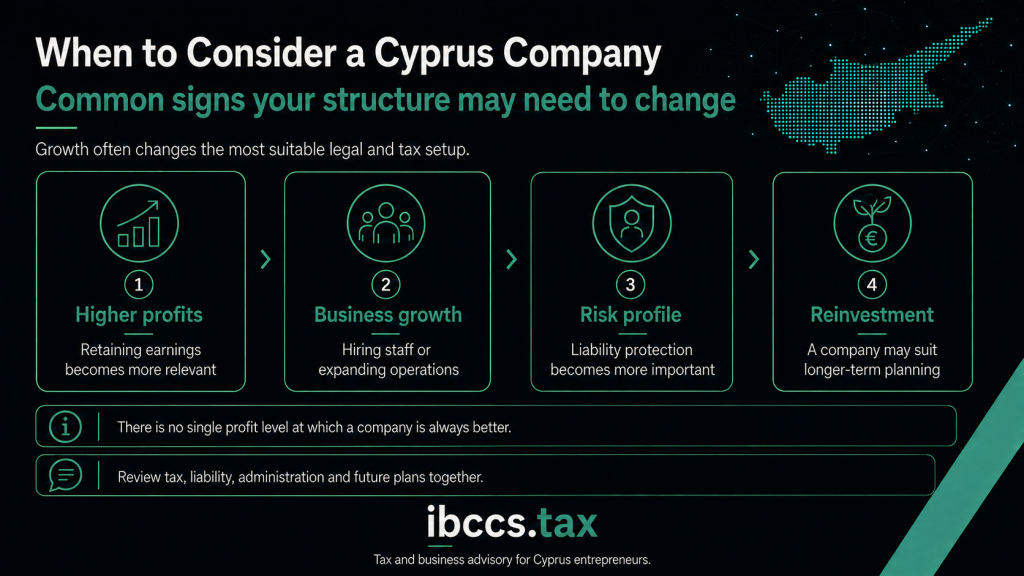
Self-Employed vs Company in Cyprus: Practical Comparison Scenarios
Scenario 1 – Independent Consultant With Limited Overheads
A consultant provides services personally to several foreign business clients. The activity has limited risk, no employees and modest equipment costs, while most profit is needed for personal living expenses. Self-employment may remain practical, subject to correct VAT, VIES, Social Insurance and personal tax compliance. A company should not be assumed to produce a better result simply because the turnover has increased.
Scenario 2 – Software Developer Building a Product
A developer earns consulting income but is also funding a software product, engaging contractors and retaining cash for development. A company may provide a clearer home for contracts, intellectual property and reinvestment. The comparison should include how the founder will be paid, whether the IP is transferred or developed by the company and whether any specialised tax regime is genuinely available.
Scenario 3 – Content Creator With Several Platforms
A creator receives advertising, sponsorship, subscription and affiliate income. The activity is becoming commercially significant, involves subcontractors and generates profits above the owner’s personal spending needs. A company may improve contractual organisation and profit retention, but platform accounts, VAT, payment providers and rights to content must be transferred correctly.
Scenario 4 – Local Professional With Higher Liability Risk
A professional provides services directly to clients and could face material claims if work is defective. A company may support risk separation and insurance arrangements even where the immediate tax difference is limited. Professional licensing rules and personal responsibility for regulated work must still be considered.
Scenario 5 – Growing Business With Staff and a Future Partner
A sole trader employs several people and plans to introduce a commercial partner. A company is generally better suited to documenting ownership, decision-making and profit participation. The transition should occur before the partner contributes funds or starts acquiring economic rights informally.
International Clients, Tax Residency and Non-Dom Status
The customer’s location does not by itself determine whether self-employment or a company is better. A Cyprus tax resident who performs services from Cyprus generally needs to consider those business profits within the Cyprus tax framework, even where payments come from foreign clients or accounts.
A Cyprus company also requires a genuine corporate and management framework. The place where strategic decisions are made, contracts are approved and the business is operated remains relevant to tax residency, substance and cross-border exposure.
Non-Dom status does not exempt self-employed business profit from personal income tax. Its main relevance in this comparison is usually the personal treatment of dividends and passive interest received by a qualifying Cyprus tax resident from a company or investment structure.
An internationally mobile business owner should coordinate the company decision with personal tax residency, foreign permanent establishment risks, previous-country rules and any duties performed while travelling.
IBCCS TAX provides integrated tax consulting and tax planning services in Cyprus for individuals, business owners and companies with cross-border activities.
How to Change From Self-Employed to a Cyprus Company
The transition should be treated as a business transfer rather than a simple change of invoice name. The company and the individual are different legal and tax persons, and the implementation date must be clear.
A planned transition helps prevent income, expenses, VAT and liabilities from being recorded by the wrong person. It also gives clients, banks, platforms and suppliers enough time to update contracts and payment arrangements.
Recommended Transition Steps
- Compare the expected self-employed and company positions using realistic profit and cash-flow assumptions.
- Incorporate the company and complete tax, beneficial ownership and any required VAT registrations.
- Select a commercial transfer date and identify which work is earned before and after that date.
- Replace or novate customer, supplier, platform, lease and contractor agreements where necessary.
- Open the company bank or payment accounts and direct new company income to the correct account.
- Review the transfer of equipment, stock, domains, software, intellectual property and other business assets.
- Set up company bookkeeping, invoicing, expense approval and document retention procedures.
- Implement payroll, salary, dividend and expense reimbursement policies for the owner.
- Deal with the individual’s outstanding invoices, VAT returns, provisional tax and final self-employed records.
- Confirm whether the self-employed registration should be closed or retained for a genuinely separate activity.
Transferring assets or an established business can create tax, VAT, valuation and legal consequences. The correct treatment depends on what is transferred, its value and whether consideration is paid or credited.
Business owners combining the transition with a relocation or wider reorganisation should also review our guide to moving to Cyprus as a business owner.
Common Mistakes When Choosing a Structure
Comparing Only 35% Personal Tax With 15% Corporate Tax
This ignores the progressive bands, deductible expenses, Social Insurance, GHS, owner remuneration, dividends and corporate compliance costs. The correct comparison is based on the complete cash and tax position.
Using Turnover Instead of Profit
Two businesses with identical turnover can have very different margins. Tax is generally based on profit, while cash-flow and commercial risk may justify different structures.
Assuming Company Money Is Personal Money
Company funds must be transferred through a properly documented category. Informal drawings can create loan-account, tax, payroll and audit issues.
Ignoring Liability and Contract Requirements
A small tax advantage may be outweighed by personal exposure to a major contract, employee claim or professional dispute.
Forming a Company Without Budgeting for Compliance
Bookkeeping, financial statements, corporate filings, payroll, tax and governance continue every year, including periods of limited activity.
Waiting Too Long to Transfer the Business
A late transition can make it harder to move contracts, platforms, assets, VAT and staff. The structure should be reviewed before a partner, investor or major new client is introduced.
Using Non-Dom as a General Business-Tax Exemption
Non-Dom status does not remove tax on self-employed business profits or salary. Its relevance must be assessed by income category.
Self-Employed vs Cyprus Company Decision Checklist
- Estimate annual turnover, operating expenses and accounting profit for at least the next two years.
- Identify how much cash is required personally and how much can remain in the business.
- Calculate personal income tax, Social Insurance and GHS under the self-employed route.
- Calculate company tax and the proposed salary, dividend and reimbursement position.
- Include accounting, audit or review, payroll and corporate administration costs.
- Assess VAT, VIES and OSS under both structures.
- Review contractual, professional and operational risks.
- Confirm whether clients, platforms, banks or payment providers require a corporate counterparty.
- Identify employees, contractors, partners or investors expected to join the business.
- Confirm ownership of intellectual property, equipment, domains and customer relationships.
- Review tax residency, Non-Dom status and other personal income.
- Consider whether the business may be sold, transferred or expanded internationally.
- Plan the transition date and treatment of existing contracts, invoices and assets.
- Select a structure that can be maintained through proper records and annual compliance.
Self-employed vs Cyprus Company: How IBCCS TAX Can Help
IBCCS TAX supports consultants, freelancers, creators and owner-managed businesses in selecting and implementing an appropriate Cyprus structure. Our work connects the tax calculation with legal form, Social Insurance, VAT, accounting and the owner’s personal position.
The objective is not to recommend a company in every case. It is to identify the structure that fits the expected profit, cash requirements, commercial risk and growth plan, and then implement it consistently.
- self-employed versus Cyprus company tax and cash-flow modelling;
- review of personal income tax, Social Insurance and GHS;
- salary, dividend and owner-remuneration planning;
- Cyprus company formation and post-incorporation registration;
- Social Insurance, tax, VAT, VIES and OSS registrations;
- bookkeeping and accounting for self-employed individuals and companies;
- payroll and employer compliance;
- personal and corporate tax return preparation;
- review of contracts, business assets and intellectual property before transfer;
- implementation of the change from self-employed to a company;
- ongoing Cyprus and cross-border tax consulting.
Our broader accounting services in Cyprus support both personal business activities and Cyprus companies throughout the annual compliance cycle.
Choose the Structure Based on the Full Business Position
Self-employment and a Cyprus company can both provide appropriate operating frameworks, but they serve different commercial and financial needs. The decision should combine tax, Social Insurance, GHS, access to cash, liability, administration, ownership and the expected direction of the business.
A simple personal activity may not benefit from the cost and governance of a company. A growing business with retained profits, staff, valuable assets or higher contractual exposure may outgrow self-employment before a generic turnover threshold suggests that it should.
IBCCS TAX can compare the structures using realistic figures, explain the practical consequences and coordinate registration, company formation, accounting and ongoing compliance. Where an existing activity needs to move to a company, the transition can be planned across contracts, invoices, VAT, assets and owner remuneration.
Frequently Asked Questions – Self-Employed vs Cyprus Company
1. Is a Cyprus company always more tax-efficient than self-employment?
No. The result depends on profit, expenses, Social Insurance, GHS, salary, dividends, retained cash, other personal income and annual company costs. A company can be more suitable without producing an immediate tax saving, while self-employment can remain efficient for a straightforward activity.
2. What is the tax rate for a self-employed person in Cyprus?
Chargeable self-employed profit is generally considered under the progressive personal income tax bands. Under the current framework, the first €22,000 is taxed at 0%, followed by marginal rates of 20%, 25%, 30% and 35%.
3. What is the corporate income tax rate in Cyprus?
Cyprus tax-resident companies are generally subject to corporate income tax at 15% on taxable profits under the current framework.
4. Does the 15% company rate include tax paid by the shareholder?
No. The company and shareholder are separate taxpayers. Salary, dividends, benefits, reimbursements and loans can create separate personal tax, Social Insurance, GHS and documentation consequences.
5. Can a self-employed person retain profits in the business?
Cash can remain in the business account, but the annual business profit is generally part of the individual’s personal taxable position. A company can retain post-tax profit as a separate corporate reserve for working capital or reinvestment.
6. At what profit should I form a Cyprus company?
There is no universal threshold. The decision should be based on expected profit, personal withdrawals, retained cash, contributions, compliance costs, risk and growth plans.
7. Does a company protect all personal assets?
No. Limited liability provides important separation, but personal guarantees, misconduct, negligence and certain director or statutory obligations can still create personal exposure.
8. Do both structures need VAT registration?
Potentially. VAT depends on the activity, turnover, customer type and location. Cross-border transactions can create VAT, VIES or OSS obligations under either structure.
9. Can a Cyprus company pay all profits as dividends?
Dividends require distributable reserves and proper corporate approval. The company and shareholder position should be reviewed, and salary may still be appropriate where the owner works for the company.
10. Does Cyprus Non-Dom status exempt self-employed income?
No. Non-Dom status mainly affects Special Defence Contribution on dividends and passive interest. Self-employed business profit and salary remain subject to their relevant tax and contribution rules.
11. Can I start as self-employed and incorporate later?
Yes. This is common, but the transfer should be planned. Contracts, invoices, VAT, assets, intellectual property, staff and outstanding income must be allocated correctly between the individual and company.
12. Can a non-EU national choose either structure?
The tax and company comparison does not itself create a right to work or operate a business in Cyprus. Immigration and work authorisation must be reviewed separately before the activity begins.
13. Can IBCCS TAX calculate both options before I decide?
Yes. IBCCS TAX can prepare a tailored comparison based on expected profit, owner withdrawals, retained cash, Social Insurance, GHS, company tax and ongoing compliance costs, and then support the selected structure.
Cyprus Tax Calendar 2027: Key Tax Deadlines for Individuals and Companies
Cyprus tax compliance does not revolve around one annual deadline.
Read More
Tax on Dividends in Cyprus: SDC, GHS, Non-Dom and Company Distributions
Dividend taxation in Cyprus changed materially from 1 January 2026.
Read More
Payroll in Cyprus: PAYE, Social Insurance, GHS and Employer Obligations
Payroll in Cyprus is more than transferring a net salary
Read MoreDisclaimer: This article is for general information only and does not constitute tax, legal or financial advice. Obtain professional advice for your circumstances.