
Operating as self-employed in Cyprus can be a practical way to provide professional services, work as a freelancer or build a small owner-managed business without immediately incorporating a company. The structure is generally simpler than a Cyprus limited company, but it still involves formal registration, taxation, Social Insurance, GHS, bookkeeping and, where applicable, VAT obligations.
The right structure depends on more than the amount of revenue generated. A consultant serving international clients may face different VAT and record-keeping requirements from a local tradesperson, digital creator or independent professional. Personal liability, business risk, reinvestment plans and the need to hire staff can also affect whether self-employment remains appropriate as the activity develops.
Self-employed individuals are taxed on chargeable business profits under the Cyprus personal income tax system. This means that gross turnover, deductible expenses, Social Insurance, GHS, provisional tax and annual reporting should be considered together rather than as separate administrative matters.
This guide explains how self-employment works in Cyprus, how to register, which tax and accounting obligations commonly arise and when moving the activity to a Cyprus company may be commercially or financially appropriate.

- A self-employed business is not a separate legal person from its owner. The individual contracts, earns income and bears business liabilities personally.
- Registration normally involves the Social Insurance Services and the Cyprus Tax Department, with VAT-related registrations considered separately.
- Self-employed profits are taxed under the Cyprus personal income tax bands, not the corporate income tax rate.
- Under the current personal income tax framework, the first €22,000 of annual chargeable income falls within the 0% band, with progressive rates applying above that level.
- Self-employed Social Insurance is generally calculated at 16.6% of the applicable insurable income, while GHS is a separate contribution under the healthcare framework.
- The €15,600 domestic VAT registration threshold is important, but cross-border transactions can create VAT or VIES obligations independently of that threshold.
- Accurate bookkeeping is required to support income, expenses, VAT, provisional tax and the annual personal tax return.
- From the 2026 tax year, the gross-income threshold for compulsory audited financial statements for self-employed individuals increased to €120,000.
- There is no universal turnover or profit level at which every self-employed person should form a Cyprus company. The correct choice depends on profit, risk, remuneration, reinvestment and compliance costs.
- A structure review should take place before the activity grows beyond the practical limits of self-employment, not only after accounting or legal problems have appeared.
Quick Answer: How Does Self-Employment Work in Cyprus?
A person operating as self-employed in Cyprus carries on the business personally rather than through a separate limited company. The individual normally registers with the Social Insurance Services, obtains a Cyprus Tax Identification Number and assesses whether VAT, VIES or OSS registration is required for the activity.
Tax is generally calculated on chargeable profit rather than gross turnover. Business income is reduced by expenses that satisfy the applicable deductibility rules, and the remaining profit is taxed under the progressive personal income tax bands. Social Insurance and GHS contributions must be assessed separately, while provisional tax may be payable during the year.
Self-employment may be appropriate for a relatively straightforward professional or service activity. A Cyprus company may become more suitable where profits grow, funds are reinvested, staff or partners are introduced, contractual risk increases or the owner requires a more structured separation between personal and business finances.
Who Can Operate as Self-Employed in Cyprus?
Self-employment can apply to a broad range of individuals who carry on an independent trade, profession or service activity. The practical registration and licensing requirements depend on the nature of the work, the individual’s immigration position and whether the activity is regulated.
Typical examples include independent consultants, software developers, designers, marketing professionals, content creators, coaches, tradespeople, therapists, photographers, online educators and other professionals who contract directly with clients. A person may work with local clients, foreign clients or a combination of both, but cross-border income can require additional VAT and tax analysis.
Certain professions require licences, professional registration or approval from the relevant Cyprus authority. Registering with Social Insurance and the Tax Department does not replace sector-specific authorisation. The right to work on a self-employed basis must also be considered separately for non-Cypriot individuals.
Self-Employed, Sole Trader or Freelancer: Is There a Difference?
The expressions self-employed, sole trader, sole proprietor and freelancer are often used interchangeably in everyday business language. In practice, they generally describe an individual carrying on an activity personally rather than through a separate company.
“Freelancer” usually describes the commercial way in which services are provided, often to several clients on a project or retainer basis. “Self-employed” is more directly connected with the individual’s Social Insurance, tax and business status. A “sole trader” may also use a registered business name, but the business remains legally connected to the individual owner.
The terminology used on a website or invoice does not determine the tax treatment. The authorities and professional advisers will consider the legal arrangement, contracts, activity, records and registration status of the individual.
Is Self-Employment the Right Structure for Your Activity?
Self-employment can be suitable where the business is relatively straightforward, the owner performs most of the work personally and the level of contractual or operational risk is manageable. It can also provide a practical starting point while an individual tests a new service, builds a client base or develops stable revenue.
The simplicity should not be overstated. The individual remains personally responsible for tax, contributions, customer obligations and business debts. Income and expenditure still need to be recorded, invoices must be issued correctly and VAT must be assessed based on the actual transactions.
Where the activity requires employees, external investment, significant retained profits, intellectual property ownership or higher contractual protection, a company may provide a more appropriate operating framework. The decision should reflect how the business is expected to develop over the next several years, not only its position on the registration date.
How to Register as Self-Employed in Cyprus
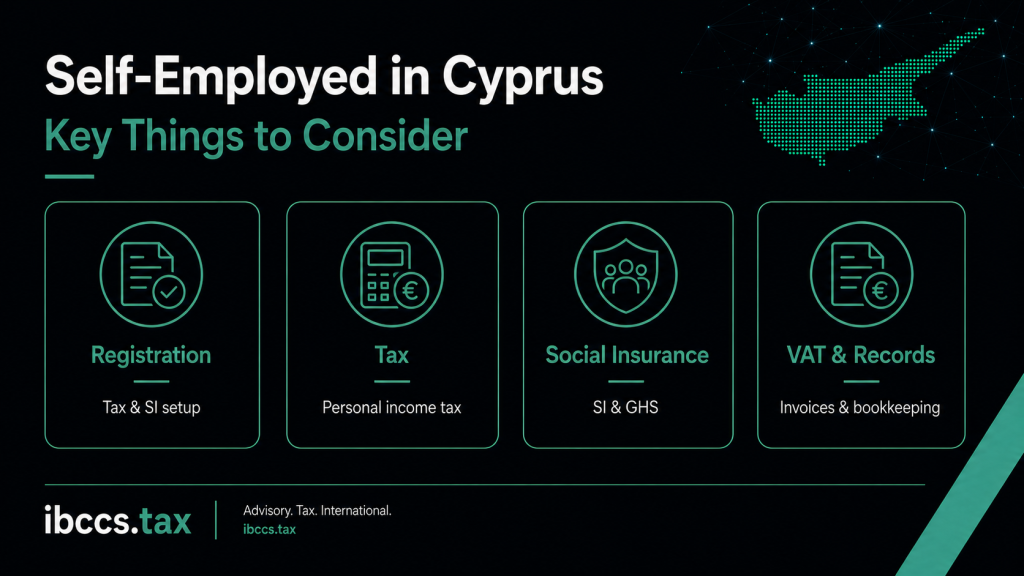
Registration is usually simpler than incorporating a Cyprus company, but several registrations can be involved. The correct sequence depends on the activity and whether the individual already has a Cyprus Social Insurance number, Tax Identification Number and immigration status permitting the intended work.
| Registration area | Why it matters | Typical consideration |
| Social Insurance | Establishes the individual as self-employed for contribution purposes | Occupational category, insurable earnings, start date and supporting identification |
| Tax registration | Provides the Tax Identification Number required for tax filings and payments | Personal details, activity, address and commencement information |
| VAT | Required where the applicable registration conditions are met | Turnover, transaction type, customer location and expected activity |
| VIES | Relevant to specified intra-EU business transactions | EU business customers or suppliers and valid VAT numbers |
| OSS | Can simplify VAT reporting for qualifying EU cross-border B2C sales or services | Customer location, digital services, e-commerce and platform role |
| Business name or licence | May be needed for branding or regulated activities | Nature of profession, sector rules and local approvals |
Social Insurance Registration
A self-employed person generally registers with the Social Insurance Services using the applicable application and supporting identification documents. The registration should reflect the actual commencement date and the nature of the activity, because the occupational category can affect the insurable earnings used to calculate contributions.
IBCCS TAX assists with registration as a sole trader with the Cyprus Social Insurance system, including preparation of the application and review of the applicable contribution position.
Tax Registration and Tax Identification Number
The individual should also be registered with the Cyprus Tax Department and hold a valid Tax Identification Number. This number is used for personal income tax filings, provisional tax, self-assessment and other tax interactions.
Where assistance is required, our team provides support with obtaining a Cyprus Tax Identification Number and coordinating the registration with the individual’s ongoing tax obligations.
VAT, VIES and OSS Registration
VAT registration should not be treated as an automatic step for every new self-employed activity. The review should consider current and expected turnover, what is supplied, the place of supply and whether customers are businesses or consumers.
A person providing services to VAT-registered businesses in other EU Member States may require VAT and VIES registration even where Cyprus domestic turnover is below the standard threshold. A person selling qualifying digital services or goods to EU consumers may need to consider the One Stop Shop framework.
Starting a Self-Employed Activity in Cyprus?
IBCCS TAX can coordinate Social Insurance, tax registration, VAT assessment and the accounting process required after registration. Request a Self-Employed Registration & Compliance Review.
Immigration Status and the Right to Work as Self-Employed
Tax and Social Insurance registration do not, by themselves, give a foreign national the right to live or work in Cyprus. Immigration status should be established separately and should permit the intended self-employed activity.
EU and EEA citizens generally follow the relevant registration process after establishing residence and activity in Cyprus. The documentation can include evidence of self-employment and Social Insurance registration. Third-country nationals require a residence and work route that specifically supports the proposed activity; not every permit allows independent work.
The immigration plan should therefore be reviewed before the business begins operating. A tax-efficient or administratively simple structure is not workable if the individual’s residence permission does not authorise the activity.
EU citizens and their family members can review our practical service for the Cyprus residence permit and Yellow Slip process.
How Are Self-Employed Individuals Taxed in Cyprus?
A self-employed individual is generally taxed on chargeable profit from the business under the Cyprus personal income tax system. The calculation begins with business income and then considers allowable expenditure, deductions and other adjustments required under the applicable rules.
Turnover and taxable profit are not the same. A business may receive €80,000 from clients but have a lower chargeable profit after properly supportable business expenses. Conversely, money retained in the business bank account still belongs to the individual and is not automatically excluded from personal taxation merely because it has not been withdrawn for private use.
The individual’s complete tax position may also include employment income, rent, pensions, dividends or other sources. Personal income tax is calculated on the relevant total chargeable income, while GHS, Social Insurance, VAT and foreign tax credits follow their own rules.
Current Cyprus Personal Income Tax Rates
Under the personal income tax bands applying from 2026, the first €22,000 of annual chargeable income falls within the 0% band. Higher marginal rates apply only to the part of income within each subsequent band.
| Annual chargeable income | Marginal tax rate |
| Up to €22,000 | 0% |
| €22,001 – €32,000 | 20% |
| €32,001 – €42,000 | 25% |
| €42,001 – €72,000 | 30% |
| Over €72,000 | 35% |
Our detailed guide to Cyprus personal income tax rates explains the progressive bands and includes practical calculation examples.
Net Profit, Not Gross Turnover
Income tax is generally based on taxable business profit, not on every euro invoiced. This makes accurate expense classification and bookkeeping essential. A deduction should be connected with the production of taxable business income and supported by appropriate records.
The fact that an expense was paid from a business account does not make it deductible. Equally, a valid business expense should not be omitted merely because the individual paid it personally. The underlying purpose, evidence and accounting treatment are more important than the payment method alone.
Social Insurance for Self-Employed People in Cyprus
Self-employed persons are generally required to contribute to the Cyprus Social Insurance system. Under the current framework, the self-employed portion is 16.6% of the applicable insurable income, with an additional state contribution under the overall Social Insurance framework.
Contributions are commonly based on insurable earnings determined by occupational category, experience and activity rather than simply the accounting profit shown in the annual tax return. An application to use actual earnings may be available where the statutory conditions and evidence are satisfied.
Payments are generally made quarterly. The registration date and occupational classification should therefore be correct from the start, as delayed registration or an inappropriate category can create contribution arrears or require later corrections.
Social Insurance provides access to relevant social security benefits subject to the applicable contribution conditions. It should be included in financial forecasts when comparing self-employment with employment through a Cyprus company.
GHS Contributions for Self-Employed Individuals
The General Healthcare System contribution is separate from personal income tax and Social Insurance. Self-employed earnings are generally subject to GHS at 4% under the current framework, up to the applicable annual contribution limit.
The collection mechanism can involve amounts paid through Social Insurance and, where earnings exceed the relevant insured basis, additional amounts considered through the tax process. The individual’s return should therefore reconcile the GHS position with the business profit and contributions already paid.
An individual receiving other income, such as rent, dividends, interest or pensions, may also have GHS obligations on those categories at the applicable rates. The annual cap applies across the person’s relevant contribution base rather than separately to each source.
VAT for Self-Employed Professionals and Freelancers
VAT is one of the areas in which a straightforward self-employed activity can become technically complex. The correct treatment depends on the nature of the service or goods, the contractual customer, the customer’s location and whether an online platform acts as an intermediary or as the supplier to the end customer.
Cyprus VAT Registration Threshold
A person carrying on taxable activities in Cyprus is generally required to register for VAT when taxable turnover exceeds €15,600 during a period of 12 consecutive months. Registration can also be required where it is expected that the threshold will be exceeded within the relevant forward-looking period.
The threshold should not be used as the only test. Certain cross-border services, acquisitions or business models can require VAT registration even where domestic sales remain below €15,600. Voluntary registration may also be available and can be commercially useful in appropriate cases, particularly where the business incurs recoverable input VAT.
Services to EU Business Customers and VIES
A Cyprus self-employed professional providing services to a VAT-registered business in another EU Member State may apply the business-to-business place-of-supply rules and reverse-charge mechanism, subject to the nature of the service and evidence of the customer’s VAT status.
The transaction can require Cyprus VAT registration and inclusion in VIES reporting. The customer’s VAT number should be validated, and invoices should contain the appropriate information. The fact that no Cyprus VAT is charged does not mean that no VAT compliance obligation exists.
IBCCS TAX provides support with VIES registration in Cyprus and the ongoing review of intra-EU reporting obligations.
Sales to Consumers and OSS
Self-employed individuals selling qualifying digital services, goods or other covered supplies to consumers in several EU Member States may need to account for VAT based on the customer’s location. The One Stop Shop can allow eligible VAT to be reported through one Member State instead of requiring separate registrations in every customer country.
The correct treatment depends on what is supplied and whether a marketplace or platform is considered to make the supply to the customer. Contracts, checkout information, customer location evidence and platform statements should be reviewed before the OSS position is determined.
Further assistance is available through our Cyprus OSS registration service and ongoing OSS administration support.
VAT Returns and Ongoing Administration
VAT registration creates recurring responsibilities, including VAT invoices, transaction records, return preparation and timely payment of any liability. A business with several currencies, EU customers or digital platforms should not wait until the filing deadline to identify how transactions should be classified.
Our team provides VAT registration and de-registration services in Cyprus as well as ongoing VAT administration for local and international activities.
Bookkeeping and Records for Self-Employed Individuals
Bookkeeping is the operational foundation of the self-employed tax position. It provides the information required to calculate business profit, prepare provisional tax estimates, complete VAT returns and support the annual personal income tax return.
At a minimum, the records should enable income and expenditure to be traced from the underlying invoice or statement through to the bank or payment account. The system should also identify VAT, foreign currencies, unpaid invoices, business assets and any personal amounts introduced into or taken from the activity.
Invoices, Receipts and Supporting Documents
Invoices and receipts should contain the information required for the transaction and the person’s registration status. Supplier invoices, contracts, expense receipts and proof of payment should be retained in an organised format.
Where a client or platform issues self-billing statements, those records should be reconciled with the revenue recorded. A bank deposit by itself may not explain gross income, fees, withholding tax or refunds deducted before payment.
Foreign Clients, Multiple Currencies and Payment Platforms
A freelancer may receive payments through banks, electronic money institutions, card processors or online platforms. These sources should be reconciled separately, especially where charges and currency conversions reduce the amount received.
Transactions should be recorded in the reporting currency using a consistent conversion method. Exchange differences, processor fees and foreign withholding tax should be identified instead of being absorbed into one unexplained net figure.
Separate Business and Personal Finances
A self-employed business is legally connected to the individual, but separate financial organisation remains important. A dedicated bank or payment account can make reconciliations easier and reduce the risk of personal spending being recorded as a business deduction.
Personal withdrawals are not business expenses. Conversely, money introduced by the owner is not business revenue. The bookkeeping should distinguish income, deductible costs, private drawings and capital introduced by the individual.
IBCCS TAX provides bookkeeping services in Cyprus for self-employed professionals and owner-managed businesses, including transaction posting, bank reconciliations and VAT-ready records.
What Expenses Can a Self-Employed Person Deduct?
An expense is not deductible simply because it is useful or desirable. The principal question is whether it is incurred for the purpose of producing taxable business income and whether it is supported by sufficient evidence.
Some costs are clearly connected with the activity. Others have both business and private use and require a reasonable allocation. Primarily private expenditure should not be converted into a business deduction merely because the person works independently or promotes a personal brand.
| Expense category | Examples | Accounting approach |
| Clearly business-related | Professional software, business insurance, subcontractors, advertising, accounting fees and client-specific travel | Normally considered where the business purpose and evidence are clear |
| Mixed business and private use | Telephone, internet, vehicle, home office and equipment used personally | A supportable business allocation may be required |
| Capital expenditure | Computers, cameras, machinery, furniture and other long-term assets | May be treated through capital allowances rather than an immediate full deduction |
| Primarily private | Ordinary clothing, family travel, personal living costs and non-business entertainment | Normally not deductible merely because the person is self-employed |
| Additional evidence required | Foreign travel, training, gifts, benefits and payments to related persons | Contracts, agendas, business rationale and market support may be needed |
Receipts should be accompanied by enough context to explain the business purpose. A payment card statement can demonstrate that money was spent, but it may not show what was purchased or why the cost relates to the activity.
Provisional Tax for Self-Employed Individuals
Self-employed individuals expecting chargeable business income may need to pay provisional tax during the relevant tax year. The provisional calculation estimates the annual taxable profit and the income tax expected to arise under the personal rates.
The liability is generally paid in two equal instalments on 31 July and 31 December. The estimate can be revised before the end of the year where revenue, expenses or expected profit change.
If the provisional taxable income is below 75% of the final taxable income, an additional 10% tax charge can apply to the difference. Current bookkeeping is therefore important: it allows the estimate to be based on actual business performance rather than a rough figure prepared shortly before the deadline.
Our guide to Cyprus provisional tax deadlines and under-declaration rules explains the instalments and the consequences of an insufficient estimate.
Personal Tax Returns and Financial Statements
Self-employed income is reported through the applicable Cyprus personal income tax return. The filing should reconcile the business profit with Social Insurance, GHS, provisional tax, foreign income and any other amounts relevant to the individual.
Filing dates and mandatory-return requirements can be set through legislation and annual decrees. A self-employed person should therefore confirm the applicable deadline for each tax year rather than relying on a previous year’s filing calendar.
IBCCS TAX provides professional Cyprus personal income tax return preparation and filing for self-employed individuals, including cases involving foreign clients and additional income sources.
When Are Audited Financial Statements Required?
The requirement to prepare audited financial statements depends on the current statutory threshold and the individual’s gross business income. From the 2026 tax year, the threshold for compulsory audited financial statements for self-employed individuals increased from €70,000 to €120,000 of gross income.
The threshold concerns gross income rather than taxable profit after expenses. A person approaching the threshold should therefore monitor invoiced and earned business revenue during the year and arrange the accounting records early enough for the required financial statements and tax return process.
Even where audited financial statements are not compulsory, the individual must still maintain adequate records to support the tax return. The absence of a statutory audit does not remove the obligation to account accurately for income, expenses, VAT and contributions.
Working With Foreign Clients From Cyprus
A person who lives and performs services from Cyprus should not assume that income is outside Cyprus merely because the customer or paying bank is abroad. The place where the work is performed, the individual’s tax residence and the nature of the activity are central to the analysis.
Foreign clients create additional questions concerning VAT, currency conversion, withholding tax and double tax relief. Contracts should identify the customer, service, fee, payment terms and responsible contracting party. Where foreign tax is withheld, the individual should retain the certificate or other evidence needed to assess a Cyprus foreign tax credit.
The individual should also consider whether regular travel or a fixed working location in another country creates registration, tax or Social Insurance exposure there. A Cyprus self-employed registration does not automatically override another jurisdiction’s right to tax locally performed activity.
Operating a Self-Employed Business From Home
Many consultants, freelancers and digital professionals operate from a Cyprus residence. A home address can be used for certain activities, but planning rules, lease terms, insurance and sector-specific restrictions should be considered.
Home-office expenditure often has mixed private and business use. Rent, utilities, internet and equipment should not automatically be deducted in full. Any business allocation should be reasonable, consistently applied and supported by the way the space and services are actually used.
Activities involving customers, stock, food, specialised equipment or regulatory inspections may require dedicated premises. The suitability of a home office therefore depends on the actual business rather than the administrative convenience of using a residential address.
Hiring Employees or Using Subcontractors
A self-employed individual can develop beyond a one-person activity, but hiring staff introduces employer registration, payroll, PAYE, Social Insurance, GHS and employment-law obligations. These responsibilities should be established before the employee starts work.
Independent subcontractors should also be classified correctly. A written services agreement and invoice do not necessarily determine the relationship if the individual works under conditions that are substantively similar to employment.
As the team grows, the business owner should reconsider whether personal self-employment remains the most appropriate legal and risk structure. A company can provide clearer employment, ownership and governance arrangements, although it also creates additional compliance obligations.
Self-Employed vs Cyprus Company
The choice between self-employment and a Cyprus limited company should be based on the complete commercial and financial position. Comparing the top personal income tax rate with the corporate tax rate is not sufficient.
| Area | Self-employed individual | Cyprus limited company |
| Legal identity | The individual and the business are not separate legal persons | The company is a separate legal entity |
| Liability | The owner is generally personally responsible for business liabilities | Shareholder liability is generally limited, subject to guarantees and legal exceptions |
| Income tax | Chargeable profit taxed under progressive personal income tax bands | Taxable company profit generally subject to 15% corporate income tax |
| Access to profits | Business profit belongs directly to the individual | Funds reach the owner through salary, dividends, reimbursements or other documented payments |
| Social contributions | Self-employed Social Insurance and GHS apply | Payroll contributions apply to salary; dividends follow separate personal rules |
| Administration | Generally simpler registration and compliance | Corporate records, accounting, annual filings and governance are required |
| Growth and ownership | Less suitable for investors, partners or share-based ownership | Shares can support co-owners, investment and succession |
| Business risk | Personal and business exposure are closely connected | Can create clearer separation of contractual and operational risk |
| Reinvestment | Profit is generally part of the individual’s taxable business result | Post-tax profits can be retained and reinvested by the company |
When Self-Employment May Be Appropriate
Self-employment may be suitable where the person provides a relatively straightforward service, has limited business risk and expects to withdraw most earnings for personal use. It can also be appropriate during an early stage when revenue is still being tested and there is no need for external ownership or a formal team structure.
The lower administrative burden can be valuable, but only where records and compliance remain manageable. Simplicity should not be confused with the absence of tax, VAT or accounting obligations.
When a Cyprus Company May Be More Appropriate
A company may be appropriate where the business generates profits that can be retained and reinvested, requires employees or partners, holds intellectual property or enters into contracts with greater commercial risk. Some clients, platforms and investors may also prefer or require a corporate counterparty.
The owner’s remuneration must then be planned correctly. Company money does not automatically become personal money, and withdrawals should be documented as salary, dividends, expense reimbursements, loans or another legally supportable category.
For a wider review of the company route, see our Cyprus company formation guide and our end-to-end service for company registration in Cyprus.
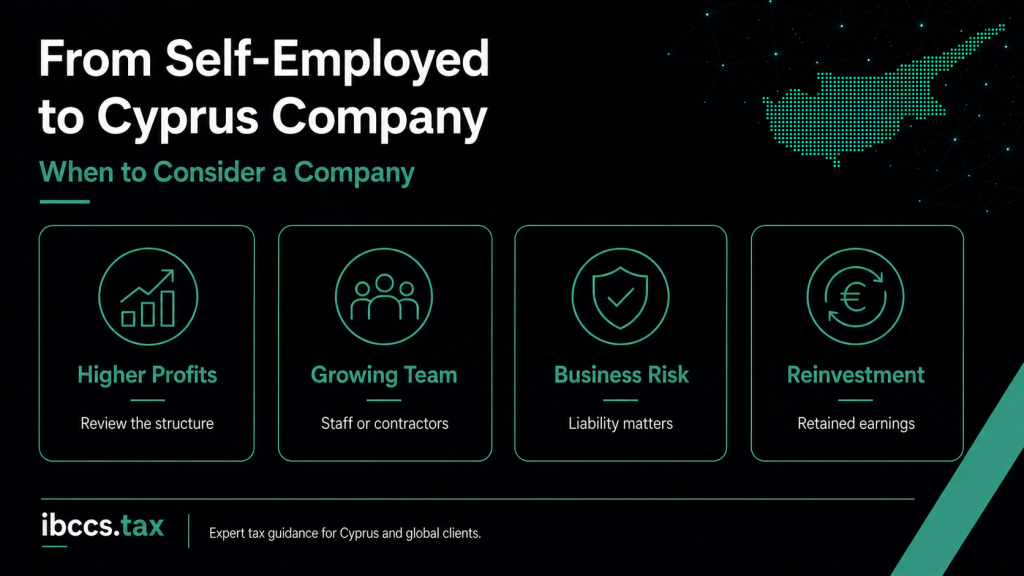
Self-Employed or Cyprus Company?
The answer depends on profit, Social Insurance, GHS, risk, reinvestment and how money will be used. A tailored comparison can identify both the tax and commercial implications. Request a Self-Employed vs Company Review.
Is There a Profit Level at Which a Company Is Always Better?
There is no reliable universal threshold at which every self-employed person should form a company. A comparison based only on annual turnover can be misleading because tax is normally calculated on profit, while the company route also involves corporate compliance and a second layer of decisions about salary and dividends.
Two individuals with the same turnover can have different results. One may incur substantial deductible expenses and withdraw all available cash, while the other may have high margins and retain profits for investment. Social Insurance, GHS, Non-Dom status, employment exemptions, family circumstances and the cost of ongoing company administration can also affect the comparison.
The legal and commercial factors may justify a company even where the immediate tax saving is limited. Conversely, a person with high turnover but low business risk and limited retained profit may decide that self-employment remains practical. The decision should be modelled using the expected profit and cash-flow strategy rather than a generic online threshold.
Changing From Self-Employed to a Cyprus Company
A self-employed person can later move an established activity to a company, but the transition should be planned. Existing contracts, customer relationships, assets, intellectual property, employees, VAT registration and outstanding invoices may need to be transferred or replaced.
The company should have its own contracts, invoices, bank account and accounting records from the agreed commencement date. Payments earned personally before the transfer should not be recorded automatically as company revenue, while expenses and liabilities should be allocated to the correct period and legal person.
Assets transferred to the company can require valuation, tax and VAT review. The owner should also implement a salary, dividend and reimbursement policy instead of continuing to use business funds in the same way as during self-employment.
Business owners planning a broader relocation or restructuring can also review our guide to moving to Cyprus as a business owner.
Practical Self-Employed Scenarios
Scenario 1 – Consultant With International Business Clients
A consultant is resident in Cyprus and invoices several VAT-registered companies in other EU countries. The structure may remain relatively simple, but the individual should assess Cyprus VAT and VIES registration, issue correct reverse-charge invoices and maintain records supporting the customer’s VAT status. Personal income tax, Social Insurance, GHS and provisional tax apply to the resulting business position.
Scenario 2 – Freelance Software Developer
A developer works independently for foreign clients and uses several software subscriptions, computer equipment and subcontractors. The bookkeeping should distinguish current expenses from capital items, reconcile foreign-currency receipts and review whether VAT registration is required. If profits grow and the developer wants to hire a team or retain funds for product development, a Cyprus company comparison becomes relevant.
Scenario 3 – Professional Content Creator
A creator receives platform advertising, sponsorship and subscription income. Net platform payouts may include fees, refunds, currency conversion and withholding tax. The individual should reconcile the gross revenue and assess whether self-employment remains appropriate as the activity becomes more scalable and commercially complex.
Our dedicated guide explains Cyprus tax and accounting for content creators, including platform income, VAT, expenses and the comparison with a Cyprus company.
Scenario 4 – Local Professional With a Home Office
An independent professional serves clients in Cyprus and works partly from home. The person should issue proper invoices, assess the domestic VAT threshold and maintain evidence for business expenditure. Home costs require a reasonable allocation, and any professional licensing requirements should be addressed independently of the tax registration.
Scenario 5 – Growing Activity With Staff and Retained Profit
A sole trader has stable profits, engages several people and wants to reinvest cash into marketing and equipment. Personal liability and employment administration have become more significant. A company may provide a clearer operating framework, but the comparison should include corporate tax, payroll, dividends, company accounting and the cost of ongoing compliance.
Common Self-Employed Tax and Accounting Mistakes
Starting Work Before Completing the Required Registrations
Delaying Social Insurance, tax or VAT registration can create arrears, penalties and inconsistent commencement dates. The registration plan should be established before or when the activity begins.
Recording Only Net Bank Deposits
A net payment may already include platform fees, bank charges, refunds or foreign withholding tax. Recording only the deposit can understate revenue and expenses and make VAT reporting difficult to reconcile.
Mixing Personal and Business Expenses
Using one account for every transaction makes bookkeeping less reliable and increases the risk of private expenditure being claimed incorrectly. Personal drawings and money introduced into the business should be recorded separately from revenue and deductible costs.
Assuming Foreign Clients Remove Cyprus Tax Obligations
A service can remain part of the Cyprus tax position even when the customer and payment account are abroad. Foreign clients also create VAT, currency and treaty questions that should be reviewed rather than ignored.
Ignoring VAT Until the Threshold Is Exceeded
Cross-border services can require VAT or VIES registration independently of the domestic turnover threshold. The VAT analysis should be completed before invoices are issued to EU customers or consumers.
Preparing Bookkeeping Only at the End of the Year
Late reconstruction makes it difficult to estimate provisional tax, recover VAT correctly and identify missing documents. Monthly or quarterly bookkeeping gives the owner a current view of profit and obligations.
Using a Generic Turnover Threshold to Decide on a Company
A company decision should take account of profit, retained cash, risk, contributions, owner remuneration and compliance costs. A single turnover number cannot provide a reliable answer for every business.
Self-Employed in Cyprus: Registration and Compliance Checklist
- Confirm that the individual’s immigration status permits self-employed activity in Cyprus.
- Identify the commencement date and the correct occupational activity.
- Complete Social Insurance registration and confirm the contribution basis.
- Obtain or update the Cyprus Tax Identification Number.
- Determine whether a business name, professional licence or sector approval is required.
- Map local, EU and non-EU customers and the services or goods supplied.
- Assess Cyprus VAT registration, VIES and OSS before issuing invoices.
- Set up invoices and record-keeping procedures that match the registration status.
- Use a dedicated bank or payment account where practical.
- Establish regular bookkeeping and bank reconciliation.
- Separate business expenses, mixed-use costs, capital expenditure and private drawings.
- Calculate Social Insurance and GHS within the applicable framework.
- Review provisional tax before the July and December instalments.
- Monitor gross income in relation to the audited financial statement threshold.
- Prepare the annual personal income tax return and supporting documents.
- Retain evidence of foreign withholding tax and cross-border transactions.
- Review whether the activity should remain self-employed as profit, staff and risk grow.
- Coordinate any future transfer to a Cyprus company before changing contracts or invoicing.
How IBCCS TAX Can Help Self-Employed Professionals
IBCCS TAX supports consultants, freelancers, creators and independent professionals throughout the self-employed business cycle, from initial registration to ongoing accounting and the later comparison with a Cyprus company.
Our integrated approach connects registration, tax, Social Insurance, VAT and bookkeeping so that the activity is implemented consistently rather than through disconnected applications and year-end corrections.
- registration as a sole trader with the Cyprus Social Insurance Services;
- Cyprus Tax Identification Number registration and tax account coordination;
- VAT, VIES and OSS assessment and registration;
- bookkeeping, bank reconciliation and transaction classification;
- VAT returns and ongoing compliance administration;
- Social Insurance, GHS and provisional tax coordination;
- personal income tax return preparation and filing;
- review of deductible expenses and supporting documentation;
- foreign-client and cross-border VAT analysis;
- self-employed versus Cyprus company modelling;
- Cyprus company formation where a corporate structure becomes appropriate;
- ongoing tax consulting for growing owner-managed businesses.
Our broader accounting services in Cyprus include bookkeeping, VAT, personal tax returns and related compliance support.
Plan the Structure and Ongoing Compliance Together
Self-employment in Cyprus can provide a practical and flexible framework for consultants, freelancers and independent professionals. The structure works best when registration, tax, Social Insurance, GHS, VAT and bookkeeping are established as one coordinated process from the beginning.
The appropriate structure can change as the business develops. Higher profits, retained cash, staff, intellectual property and contractual exposure may justify moving the activity to a Cyprus company, while a simpler business may continue to operate effectively as self-employed.
IBCCS TAX can review the intended activity, complete the required registrations and provide ongoing accounting and tax compliance. Where the business is already established, we can compare the existing self-employed position with the cost and practical implications of a Cyprus company. Request a Self-Employed Registration or Structure Review.
Frequently Asked Questions About Self-Employment in Cyprus
1. How do I register as self-employed in Cyprus?
The process generally includes registration with the Social Insurance Services and the Cyprus Tax Department. VAT, VIES, OSS, a business name or a professional licence may also be required depending on the activity and customers.
2. How much income tax does a self-employed person pay in Cyprus?
Self-employed profits are generally taxed under the progressive personal income tax bands. Under the current framework, the first €22,000 of annual chargeable income is taxed at 0%, with marginal rates of 20%, 25%, 30% and 35% applying to higher bands.
3. Is tax calculated on turnover or profit?
Personal income tax is generally calculated on chargeable business profit rather than gross turnover. Allowable business expenditure and other applicable adjustments affect the final taxable amount.
4. What Social Insurance does a self-employed person pay?
The self-employed contribution is currently generally 16.6% of the applicable insurable income. The calculation can be based on occupational categories, with the possibility of an actual-earnings approach in qualifying circumstances.
5. Do self-employed individuals pay GHS?
Yes. Self-employed earnings are generally subject to GHS at 4% under the current framework, up to the applicable annual contribution cap. Other income categories may also be subject to GHS at their relevant rates.
6. When must a self-employed person register for VAT?
Domestic VAT registration is generally required when taxable turnover exceeds €15,600 during 12 consecutive months or is expected to exceed the threshold within the applicable period. Cross-border transactions can create separate registration obligations.
7. Do freelancers with EU business clients need VIES?
Potentially. Qualifying services supplied to VAT-registered businesses in other EU Member States can require VAT registration, reverse-charge invoicing and VIES reporting even where no Cyprus VAT is charged.
8. Do I need an accountant if I am self-employed?
An accountant is not merely a filing provider. Regular bookkeeping helps establish taxable profit, VAT, provisional tax, expenses and cash flow. Professional support is particularly valuable where the activity has foreign clients, several payment methods or growing turnover.
9. Do self-employed individuals need audited financial statements?
From the 2026 tax year, compulsory audited financial statements generally apply where a self-employed individual’s gross business income exceeds €120,000. Adequate records remain required below the threshold.
10. Can I deduct home-office expenses?
A supportable business proportion of qualifying costs may be considered where the home is genuinely used for the activity. Full private rent, utilities or household costs should not automatically be treated as deductible.
11. Is it better to be self-employed or form a Cyprus company?
There is no universal answer. Self-employment can suit a simpler activity, while a company may be more appropriate for retained profits, staff, partners, intellectual property, contractual risk or investment. The tax and commercial position should be compared together.
12. What is the corporate tax rate if I form a Cyprus company?
Cyprus tax-resident companies are generally subject to corporate income tax at 15% on taxable profits under the current framework. Payments from the company to the owner require separate treatment as salary, dividends or another properly documented category.
13. Can a non-EU citizen register as self-employed in Cyprus?
Tax registration alone is not sufficient. A third-country national must hold an immigration status that authorises the intended independent activity. The residence and work route should be confirmed before the business begins.
14. Can I move from self-employed to a company later?
Yes, but the transition should be planned. Contracts, invoices, assets, VAT, employees, intellectual property and outstanding income may need to be transferred or separated between the individual and the new company.
15. Do self-employed people pay provisional tax?
Self-employed individuals expecting chargeable business income may need to submit a provisional tax estimate and pay the expected liability in instalments on 31 July and 31 December.
16. Can IBCCS TAX handle registration, bookkeeping, VAT and the personal tax return?
Yes. IBCCS TAX can coordinate Social Insurance and tax registration, VAT-related registrations, bookkeeping, provisional tax, personal income tax filing and a later self-employed versus company review.
Tax in Cyprus 2026: Complete Guide for Individuals and Companies
Cyprus has a relatively compact tax system, but the headline
Read More
Cyprus Corporate Tax in 2026: Rate, Taxable Profits, Exemptions and Filing Requirements
Cyprus corporate tax changed materially from 1 January 2026. The
Read More
Cyprus Companies at Risk of Strike-Off: 31 December 2026 Deadline for Overdue HE32 Annual Returns
Cyprus companies with overdue Annual Returns (HE32) and corresponding Financial
Read MoreDisclaimer: This article is for general information only and does not constitute tax, legal or financial advice. Professional advice should be obtained based on your specific circumstances.