

A UAE business license is the formal authorization that allows a company, branch or individual establishment to conduct approved economic activities. The license identifies what the business may do, which authority supervises it and, in many cases, where it may operate.
Choosing the correct license is one of the most important stages of UAE company formation. The selected activity can affect the legal form, ownership, premises, external approvals, visas, banking profile, Corporate Tax position and the ability to work directly with customers in the UAE.
A license should not be selected solely because it is inexpensive or can be issued quickly. A structure that does not accurately reflect the real business model can create problems when the company opens a bank account, signs contracts, applies for employee visas, imports goods or expands into regulated activities.
This guide explains the main UAE business license types, the differences between mainland and Free Zone licensing, the application process and the compliance work required after issuance. Entrepreneurs planning the wider incorporation can also review our guide on how to set up a business in the UAE.

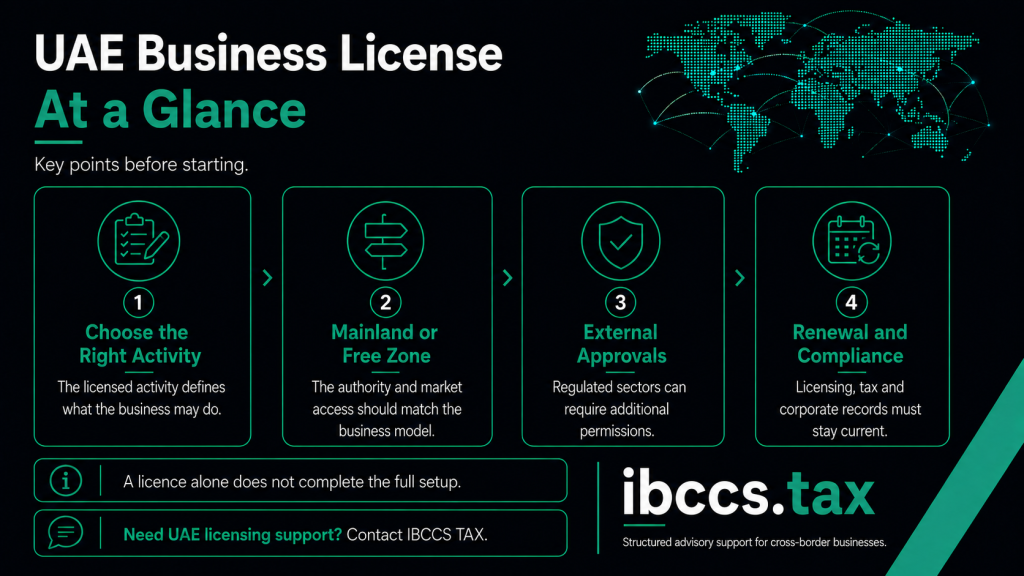
- The licensed activities determine what the business is legally permitted to do.
- A business license is not the same as the company’s legal form or certificate of incorporation.
- At the federal level, the principal license categories include commercial, professional, industrial, tourism, agricultural and crafts licenses.
- Emirates and Free Zones may use additional categories, packages and license names for particular business models.
- A mainland license is issued by the competent economic authority in the relevant Emirate, while a Free Zone license is issued by the selected Free Zone authority.
- Initial approval allows the formation process to continue but does not authorize the business to begin operating.
- Regulated activities can require approval from ministries, municipal authorities, sector regulators or professional bodies.
- A physical business address or an approved facility is normally required, although the type of premises depends on the activity and licensing route.
- The final cost depends on the authority, activities, legal form, premises, approvals, visas and annual compliance.
- The license must be renewed, amended when material details change and formally cancelled if the business closes.
- Corporate Tax, VAT, accounting, beneficial ownership and employment obligations apply separately from the license.
What Is a UAE Business License?
A UAE business license confirms that the competent licensing authority has approved the entity to carry out the economic activities stated on the document. It commonly records the business name, license number, legal form, licensed activities, address, ownership or management details and validity period.
The license defines the authorized scope of business. A consultancy license does not automatically permit the sale of goods, while a general trading activity may not cover regulated products or specialist services. The wording should correspond to the company’s website, contracts, invoices, staff and expected transactions.
A company can sometimes combine more than one compatible activity on the same license. Compatibility, authority rules and external approvals must be checked before unrelated activities are added under one entity.
Business License, Legal Form and Company Registration Are Different
The business license, legal form and company registration perform different functions. The legal form determines the structure of the entity, including whether it is an LLC, branch, sole establishment, partnership or another permitted vehicle. The incorporation documents establish the entity and its ownership or governance.
The license authorizes the activities. A mainland LLC and a Free Zone company may both hold consulting licenses, but they remain different legal and regulatory structures. Similarly, two LLCs can hold different license types because one trades goods and the other provides professional services.
Understanding the distinction prevents a common structuring error: choosing an entity because of its name or package without confirming whether its license permits the intended business model. A wider overview is available in our guide to the types of companies in the UAE.
Who Issues Business Licenses in the UAE?
Mainland Licensing Authorities
Mainland licenses are issued by the economic licensing authority responsible for the relevant Emirate. In Dubai, mainland licensing is administered through the Department of Economy and Tourism, while Abu Dhabi and the other Emirates operate their own economic registration and licensing systems.
Federal legislation applies across the UAE, but the available services, activity codes, premises rules and local procedures can differ between Emirates. A company should therefore confirm the requirements of the exact authority rather than rely on a generic UAE checklist.
Free Zone Authorities
Each Free Zone licenses companies and branches established within its regulatory area. Some zones support a broad range of activities, while others are designed around sectors such as logistics, media, technology, finance, commodities, healthcare or manufacturing.
Free Zone terminology and packages are not uniform. The same activity may have different names, facility requirements and operating permissions in two different zones. The license should be assessed together with the Free Zone regulations and the company’s route to mainland customers.
Federal and Sector Regulators
Certain businesses require approval from a federal or specialist regulator in addition to the primary economic license. These approvals can apply to financial services, insurance, healthcare, education, transport, recruitment, industrial production, food, media and other regulated activities.
An economic authority may issue the final license only after the specialist regulator has approved the applicant, qualifications, premises, capital or operating procedures. The sector approval should be identified before premises are leased or substantial setup costs are committed.
Main Types of Business Licenses in the UAE
The UAE recognizes several broad license categories. The exact activity list and terminology can vary by Emirate and Free Zone, so the following categories should be treated as a practical framework rather than a substitute for checking the selected authority.
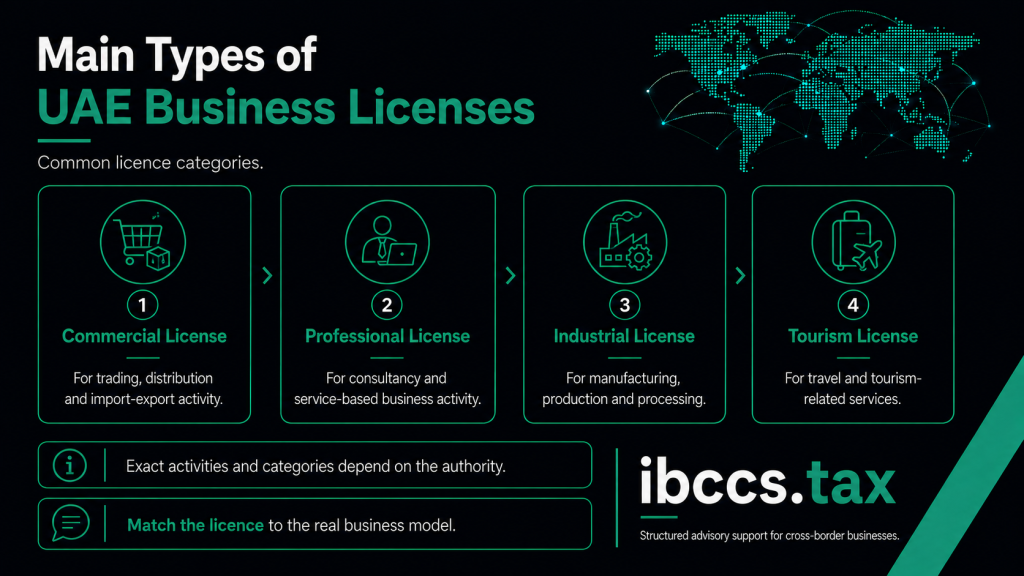
Commercial License
A commercial license generally covers trading and commercial activities, including the purchase and sale of goods, import and export, distribution, logistics and other approved transactions. The products or categories covered by the license should be stated accurately.
A commercial license does not automatically authorize every product. Food, medical products, telecommunications equipment, chemicals and other regulated goods can require product registrations, customs procedures or approvals from specialist authorities.
Professional License
A professional license generally covers services based on expertise, qualifications or intellectual work. Examples can include consulting, technology services, design, accounting, engineering, education and other professional activities.
Some professions require evidence of qualifications, experience, membership or approval from a professional regulator. The ownership and legal form available for a professional business depend on the activity and the relevant authority.
Industrial License
An industrial license is used for manufacturing, production, assembly, processing and related industrial activities. It normally involves more extensive premises, environmental, health and safety, municipality and industrial approvals than a standard office-based license.
The company should define the production process, raw materials, equipment, facility, utilities and expected workforce before applying. Industrial licensing should be coordinated with customs, tax, supply-chain and product-certification requirements.
Tourism License
A tourism license applies to approved travel, tour, hospitality and tourism-related activities. Depending on the business, additional approval may be required from the tourism authority responsible for the relevant Emirate.
A travel agency, hotel, tour operator and holiday-home business have different operating and premises requirements. The applicant should not rely on one general tourism category to cover all customer-facing services.
Agricultural License
An agricultural license may cover farming, crop production, livestock, agricultural support and other permitted activities. The project can require land, environmental, veterinary, food-security or municipal approvals.
The location and physical operation are central to this license. A holding or trading company connected to agriculture does not necessarily require the same license as the entity conducting the farming activity.
Crafts or Occupational License
Crafts and occupational licenses generally apply to activities performed through manual skill, technical expertise or a defined trade. The terminology and permitted activities differ between Emirates.
Workshops and customer-facing premises may need municipal, safety or technical approval. The applicant should confirm whether the activity is treated as professional, commercial, industrial or occupational by the selected authority.
E-Commerce, E-Trader and Digital Licenses
Online businesses must hold a license that covers the products or services sold through digital channels. An e-commerce activity may be included within a commercial or professional license, while some authorities offer specific e-trader, virtual or digital license products.
The license does not replace consumer-protection, advertising, data, product, VAT or customs obligations. A business selling physical products online should also review storage, fulfilment, returns and import arrangements.
Freelance and Individual Professional Permits
Certain authorities offer freelance or individual professional permits for approved activities. These can be suitable for a person providing services independently without the wider structure of a conventional company.
The legal, liability, tax, visa and banking position should be reviewed carefully. A freelance permit may not support employees, external investment, substantial trading activity or the same contractual framework as an LLC.
Special, Dual and Instant License Products
Some Emirates and authorities offer special license products, including instant, dual, virtual, home-business or SME licenses. These are local licensing solutions rather than uniform national categories.
A dual or additional permit can allow an eligible Free Zone business to conduct specified activity outside its zone, subject to the relevant conditions. It should not be assumed that every Free Zone company can operate freely throughout the mainland without additional authorization.
Mainland vs Free Zone Business License
| Factor | Mainland license | Free Zone license |
| Issuing authority | Economic authority in the relevant Emirate | Selected Free Zone authority |
| Typical market focus | Direct UAE and international operations | Zone-based, specialist or international operations |
| Activities | Mainland activity list and sector approvals | Activities permitted by the selected zone |
| Premises | Facility appropriate to the activity and Emirate | Facility or package approved by the zone |
| Mainland activity | Generally available within the approved license | May require an additional permit, branch or distributor |
| Ownership | 100% foreign ownership available for many activities | Generally available with 100% foreign ownership |
| Tax | Standard Corporate Tax regime | Standard regime or conditional Qualifying Free Zone treatment |
| Best suited to | Businesses needing broad direct local operations | International or sector-focused business models |
The most suitable licensing route depends on the actual customer market and operating model. Our dedicated guides explain mainland company formation in the UAE, Dubai Free Zone company formation and the wider benefits of UAE Free Zones.
How to Choose the Correct UAE Business Activity
The economic activity is the foundation of the licensing process. It affects the license category, legal form, ownership, external approvals, facility requirements and whether the business can serve customers directly in the intended market.
The activity should be selected from the official list used by the licensing authority. A marketing description such as technology company, trading business or consultant is not precise enough for the application.
Match the License to Contracts and Revenue
The activity should correspond to how the company will generate revenue. Contracts, invoices and bank transactions should be understandable when compared with the license.
A mismatch can delay bank onboarding, create customer concerns or expose the company to licensing violations. The company should add or amend activities before expanding into a materially different line of business.
Check Whether Activities Can Be Combined
Some compatible activities can be included on one license, while others require a separate entity, branch, facility or regulator. Combining unrelated services and trading activities can affect legal form, tax, VAT and banking.
The decision should consider operational separation and liability, not only whether the authority technically allows the activities to appear together.
Identify Regulated Activity Before Applying
A regulated activity may require qualified managers, minimum capital, professional indemnity insurance, facility inspections or prior regulator approval. These conditions can materially change the cost and timeframe.
The applicant should identify the final regulator and approval path before reserving premises or preparing corporate documents.
Step-by-Step Process to Obtain a UAE Business License
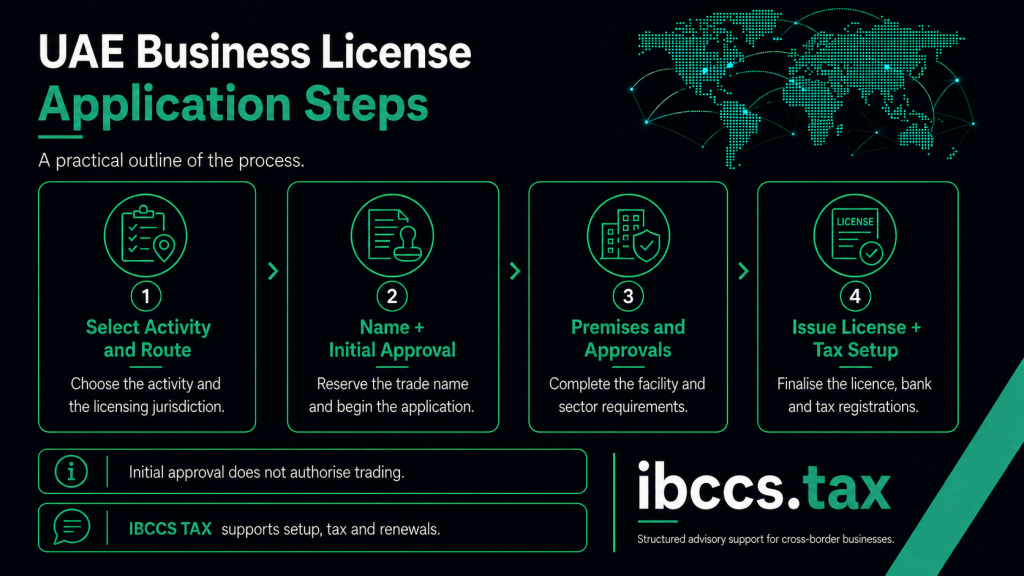
Step 1: Define the Business Model
The founders should define the products, services, customers, delivery model and expected countries of operation. The license must support the real commercial activity rather than a broad future concept.
The review should also identify whether the business needs employees, visas, stock, a warehouse, customer-facing premises or direct access to the mainland.
Step 2: Choose the Emirate and Licensing Route
The company should compare mainland and Free Zone options, together with the location of customers, regulators, suppliers and staff. The selected jurisdiction should support the activity and long-term operating plan.
A low-cost authority may not be appropriate where the business needs specialist approvals, a large facility or direct local market access.
Step 3: Select the Legal Form
The founders must choose the legal structure that fits ownership, liability and governance. Common options include an LLC, single-owner LLC, sole establishment, branch and Free Zone company.
The legal form and license should be considered together. The authority may restrict certain activities to particular forms or impose different documentary requirements.
Step 4: Select the Exact Activities
The proposed activities should be matched to the official activity codes of the licensing authority. Each activity should be reviewed for ownership, regulatory and facility conditions.
The company should avoid selecting a generic activity that does not accurately cover its contracts, products or services.
Step 5: Reserve the Trade Name
The proposed business name must comply with the rules of the selected authority and should reflect the legal form and activity. Restricted words, government references or names already in use can be rejected.
Trade-name approval does not provide trademark protection. A separate trademark review and registration can be appropriate where the brand is commercially important.
Step 6: Obtain Initial Approval
Initial approval confirms that the authority has no preliminary objection to the proposed establishment. It allows the application to proceed to the documentation, premises and external-approval stages.
Initial approval does not authorize the company to begin trading, employ staff or issue invoices.
Step 7: Obtain External Regulatory Approvals
The applicant must secure any approvals required by ministries, municipalities, professional bodies or sector regulators. The required sequence differs according to the activity.
Some approvals can be conditional on premises, qualifications, capital, insurance, operational manuals or security checks.
Step 8: Secure the Required Premises or Facility
The company normally needs an approved business address, office, retail unit, warehouse, workshop or industrial facility. The premises should satisfy the activity, visa and inspection requirements.
A flexi-desk or shared facility may be sufficient for some Free Zone service businesses but unsuitable for a clinic, restaurant, trading warehouse or manufacturing operation.
Step 9: Prepare the Corporate Documents
Depending on the legal form, the shareholders prepare the Memorandum of Association, resolutions, manager appointments, beneficial ownership information and other declarations.
Foreign corporate shareholders may need legalised and translated certificates, constitutional documents and board resolutions.
Step 10: Submit the Final Application and Pay Fees
The final application includes the approved activity, legal form, trade name, corporate documents, premises and external consents. The authority reviews the package and issues a payment request where the conditions are met.
The quoted fees should be checked carefully because additional facility, chamber, municipality, immigration or regulatory costs may be separate.
Step 11: Receive the Business License
Once the application is approved and the fees are paid, the authority issues the license and related registration documents. The company may then begin approved activity subject to completing any post-licensing conditions.
The license should be reviewed immediately to confirm the name, ownership, management, activities, address and validity details.
Step 12: Complete Post-Licensing Registrations
After licensing, the company may need immigration and labour files, Corporate Tax registration, VAT registration, customs registration, sector permits, accounting systems and a corporate bank account.
The company should not assume that the business is fully operational when the license alone is issued.
Documents Commonly Required for a UAE Business License
The document package depends on the licensing authority, legal form, shareholders, activities and external approvals. The following lists provide a general framework rather than one universal checklist.
Individual Shareholders
- passport copy and personal details;
- proof of residential address;
- UAE visa and Emirates ID, where applicable;
- contact details and proposed shareholding;
- manager and authorized-signatory information;
- Ultimate Beneficial Owner declarations;
- professional qualifications or experience evidence where required;
- source-of-funds or business-background information where requested.
Corporate Shareholders
- certificate of incorporation or current company extract;
- constitutional documents;
- certificate of incumbency or equivalent evidence of current status;
- board or shareholder resolution approving the UAE entity;
- group ownership chart and Ultimate Beneficial Owner information;
- authorized-signatory documents and powers of attorney;
- passports and address documents for relevant individuals;
- legalisation, attestation and certified translation where required.
Activity and Premises Documents
- trade-name reservation and initial approval;
- business plan where required by the activity or authority;
- tenancy or facility documentation;
- external regulator approvals;
- technical, environmental or safety documents;
- professional certificates or manager approvals;
- product, customs or industrial documentation where relevant.
The document requirements should be confirmed before foreign documents are legalised. Authorities and banks can require different validity periods, certification formats and ownership evidence.
Activities That Commonly Require External Approval
External approval is determined by the specific activity and Emirate. Common examples include healthcare, education, insurance, financial services, recruitment, transport, tourism, food, industrial production, legal services, auditing, real estate and media.
The specialist regulator can impose conditions that do not appear in a standard company-formation package. These may include professional qualifications, locally approved managers, capital, insurance, technical systems, premises inspections and operational policies.
The company should not advertise or conduct the regulated activity until the required license and sector approvals are effective.
How Much Does a UAE Business License Cost?
There is no single UAE business license price. The total depends on the Emirate, mainland or Free Zone route, number and type of activities, legal form, premises, shareholders, visas and external approvals.
| Cost component | What affects it |
| Trade name and initial approval | Authority, name and application route |
| License and registration | Activities, legal form and jurisdiction |
| External approvals | Regulated or specialist business activity |
| Corporate documents | Number and type of shareholders |
| Premises or facility | Office, desk, retail, warehouse or industrial unit |
| Immigration and labour setup | Visa requirements and staffing |
| Document legalisation | Corporate shareholders and country of issue |
| Tax and accounting | Corporate Tax, VAT, bookkeeping and audit |
| Annual renewal | License, premises, permits, visas and compliance |
A realistic budget should separate one-off incorporation costs from annual operating and compliance expenses. Promotional first-year packages may exclude renewals, premises, visas, accounting, audit or regulatory approvals.
How Long Does It Take to Obtain a UAE Business License?
A straightforward license can often be issued efficiently once the activity, documents and approvals are complete. Digital portals and integrated services can reduce processing time for standard applications.
The timeframe increases where the company has corporate shareholders, foreign legalised documents, regulated activities, specialist premises or several external approvals. Visa and bank-account processes follow separate timelines.
The company should distinguish the date on which the license is issued from the date on which the entire business is ready to operate.
What a UAE Business License Does and Does Not Permit
The license permits the activities listed on it, within the geographical and regulatory scope of the issuing authority. It does not authorize unrelated activities, eliminate sector regulation or guarantee access to every customer market.
A Free Zone license does not automatically provide unrestricted mainland access. A mainland license does not automatically permit regulated services, operations from unapproved premises or activity in every Emirate without additional requirements.
The license also does not guarantee residence visas, government tenders, a corporate bank account or a particular tax outcome. Each of these areas involves separate conditions and approvals.
Visas and Employment After Licensing
An operating company can generally proceed with the relevant establishment, immigration and labour registrations after licensing. Shareholder and employee visa eligibility depends on the legal form, facility, authority and individual approval.
A company hiring staff must comply with work permits, employment contracts, payroll, insurance and the applicable labour framework. Visa capacity should be reviewed before selecting a minimal facility package.
IBCCS TAX provides UAE immigration assistance for shareholders, employees and dependent family members.
Corporate Bank Account After License Issuance
A licensed UAE company can apply for a corporate bank account, but approval is subject to the bank’s independent due-diligence process. The bank reviews the owners, source of funds, activity, customers, suppliers, countries and expected transactions.
The license should be consistent with the business plan and supporting contracts. A generic or incorrectly selected activity can make the banking profile more difficult to explain.
The company should prepare for banking before incorporation where the ownership, transactions or countries involved are complex.
Corporate Tax, VAT and Accounting After Licensing
The business license does not replace tax registration. A UAE juridical person subject to Corporate Tax must register with the Federal Tax Authority within the applicable timeframe. A newly incorporated Resident juridical person generally has three months from incorporation, establishment or recognition to submit its Corporate Tax registration application.
Under the standard regime, taxable income up to AED 375,000 is subject to 0%, while the portion above that amount is generally subject to 9%. Free Zone companies must separately determine whether the conditions for Qualifying Free Zone Person treatment are satisfied.
VAT registration is mandatory for a UAE-resident business when taxable supplies and imports exceed AED 375,000 over the relevant period or are expected to exceed that amount within the prescribed timeframe. Voluntary registration can be available from AED 187,500.
The company should implement bookkeeping, invoicing and document-retention systems when operations begin. Systems should also be capable of adapting to the UAE’s developing structured electronic invoicing framework.
Further information is available in our guide to UAE Corporate Tax and through our UAE accounting and tax services.
Renewing a UAE Business License
A business license must be renewed in accordance with the validity period and rules of the issuing authority. Renewal commonly requires the company to maintain valid premises, current corporate information and any external approvals connected to the activity.
The business should start the review before expiry because tenancy, regulator, immigration or shareholder documents may need to be updated. A company should not assume that an expired license can be ignored while it remains inactive.
Operating without a valid license can create fines, restrictions on government and immigration services, contractual issues and difficulties with banks or counterparties.
Amending a UAE Business License
The license and corporate records should be amended when the company changes its activities, trade name, address, ownership, management or legal form. Certain changes also require amendments to the constitutional documents and beneficial ownership records.
The company should complete the amendment before conducting the new activity or presenting outdated details to customers, banks and tax authorities. A corporate change can also require updates to Corporate Tax, VAT, customs, immigration and sector registrations.
Suspending or Placing a License on Hold
Some authorities offer procedures that allow an eligible business to place its license on hold or suspend activity for a limited period. The conditions and consequences differ by authority and legal form.
Suspension should not be treated as automatic relief from tax, accounting, creditor, employee or contractual obligations. The company must confirm which registrations remain active and what filings are still required.
Cancelling a UAE Business License
A company that ceases activity should formally cancel its license and complete the required closure or liquidation process. Allowing a license simply to expire can lead to continuing fines and unresolved government records.
The process can involve shareholder resolutions, appointment of a liquidator, creditor notices, cancellation of employee and immigration files, tax deregistration, regulator clearances and settlement of liabilities. The requirements depend on the legal form and authority.
Corporate Tax and VAT deregistration are separate from the commercial license cancellation. The company should maintain records and complete final returns or declarations where required.
Business License Verification and Official Records
The UAE provides official systems through which businesses and counterparties can check license information. The National Economic Register consolidates business license data held by government authorities, while individual Emirates and Free Zones provide their own verification tools.
Companies should ensure that their public license information, ownership records and internal corporate documents remain consistent. Banks, customers and regulators can compare these records during due diligence.
Ongoing Compliance Beyond the Business License
A valid license is only one part of ongoing compliance. The company must also maintain accounting records, tax registrations, beneficial ownership information, corporate approvals, premises, employee files and any sector permits.
Related Party transactions, imports, regulated products, advertising, data processing and consumer-facing activity can create additional obligations. These should be assigned to responsible persons within the business rather than reviewed only at annual renewal.
IBCCS TAX provides UAE corporate management services for companies requiring license administration, corporate maintenance and coordinated ongoing compliance.
Practical UAE Business License Examples
Consultancy Serving International and UAE Clients
A consultancy plans to provide advisory services from Dubai to local and overseas clients. The company must select the appropriate professional activity and decide whether a mainland or Free Zone license provides the required customer access.
The founders should also review office, visa, VAT, Corporate Tax and banking requirements. A broad consulting description may not cover regulated legal, financial or investment advice.
Trading and E-Commerce Company
A business plans to import consumer products and sell through an online platform. The license should cover trading and e-commerce, while the company may also need customs, product and warehouse registrations.
The supply chain, importer-of-record position and ability to sell directly into the mainland should be confirmed before the business begins purchasing stock.
Technology Company With Employees
A software business requires a license, private office and several employee visas. A technology-focused Free Zone or mainland professional license may be suitable depending on customers and operating location.
The company should verify that the selected facility supports the required visa capacity and that the license covers development, consulting and any digital products sold.
Manufacturing Business
A manufacturer needs an industrial facility, equipment, environmental approval and access to logistics infrastructure. The industrial license is only one part of the wider approval process.
Facility, utilities, safety, customs, product certification, tax and workforce planning should be coordinated before the project commits to land or machinery.
Foreign Company Establishing a UAE Branch
An international company wants to extend its existing business into the UAE through a branch. The branch license should generally reflect activities supported by the parent company and may require parent resolutions and legalised documents.
The parent remains responsible for the branch’s liabilities, and the setup should be compared with a separately incorporated UAE subsidiary.
Common UAE Business Licensing Mistakes
Choosing the Cheapest License Without Reviewing Operations
A low-cost package may not support the company’s customers, activities, facility, employees or banking profile. The decision should be based on the full operating model.
Confusing the License With the Legal Form
The license authorizes activities, while the legal form determines the entity’s ownership and liability framework. Both must be selected correctly.
Using a Generic Activity That Does Not Match Contracts
The activity should correspond to the services or goods described in contracts, invoices and bank transactions. A mismatch can create regulatory and commercial difficulties.
Assuming Initial Approval Allows Trading
Initial approval permits the application to continue but does not authorize the business to operate. The final license and any external approvals must be effective.
Ignoring External Regulator Requirements
Regulated businesses can require qualifications, capital, inspections or specialist approvals. These requirements should be identified before incorporation.
Assuming a Free Zone License Provides Unlimited Mainland Access
Mainland activity can require an additional permit, branch, distributor or other approved arrangement. The route to customers should be confirmed in advance.
Treating Bank Account Opening as Automatic
Banks review the ownership and commercial profile independently. A business license does not guarantee an account.
Delaying Tax and Accounting Setup
Corporate Tax registration, VAT analysis and bookkeeping should begin promptly. The commercial license does not remove these obligations.
Allowing the License to Expire Instead of Cancelling It
An unused company should be formally renewed, suspended or cancelled according to the authority’s procedures. Expiry alone does not complete closure.
Failing to Amend the License When the Business Changes
New activities, ownership, management or premises should be reflected in the official records before the company relies on the changed structure.
How IBCCS TAX Can Assist
UAE business licensing requires coordination between activity selection, legal form, jurisdiction, premises, external approvals, immigration, banking and tax. The license should support the business from its first contract through future expansion. At IBCCS TAX, we assist clients with:
- mainland and Free Zone licensing comparisons;
- selection of the appropriate Emirate and licensing authority;
- review of business activities and legal forms;
- trade-name reservation and initial approval;
- UAE company and branch formation;
- external regulatory approvals;
- corporate and shareholder documentation;
- license issuance, renewal and amendment;
- investor and employee visas;
- corporate bank-account coordination;
- Corporate Tax and VAT registration;
- bookkeeping, payroll and financial reporting;
- license cancellation and company closure coordination;
- corporate management and ongoing compliance.
Our UAE company formation services support clients from the initial structure review through licensing and post-incorporation implementation.
Need a UAE Business License?
The right license depends on the business activity, customers, premises, employees, ownership and long-term plan. Reviewing these factors before the application can reduce amendments, delays and unnecessary costs. Contact IBCCS TAX to discuss the appropriate UAE licensing and company formation route with our team.

Frequently Asked Questions About UAE Business Licenses
1. What is a UAE business license?
A UAE business license authorizes a company, branch or establishment to conduct the economic activities stated on the license. It is issued by the relevant mainland or Free Zone authority.
2. What is the difference between a business license and a trade license?
Trade license is commonly used as a general term for an economic license. Commercial license more specifically refers to trading and commercial activities, while other categories cover professional, industrial, tourism, agricultural and craft activities.
3. What are the main types of business licenses in the UAE?
The broad federal categories include commercial, professional, industrial, tourism, agricultural and crafts licenses. Emirates and Free Zones can offer additional products and activity-specific licenses.
4. Can one UAE license include several activities?
It can be possible to include several compatible activities, subject to the rules of the licensing authority and any external approvals. Unrelated or regulated activities may require separate arrangements.
5. Can a foreigner own 100% of a UAE licensed business?
Full foreign ownership is available for many mainland activities and is generally available in Free Zones. Strategic or regulated activities can remain subject to additional conditions.
6. Is a mainland license better than a Free Zone license?
Neither is universally better. Mainland is often suitable for broad direct UAE activity, while a Free Zone can suit international or specialist operations. The choice depends on the business model.
7. Does a Free Zone business license allow work on the mainland?
Not automatically in every case. The company may require an additional permit, branch, distributor or another approved route depending on the activity and Emirate.
8. Do I need an office for a UAE business license?
A business normally needs an approved address or facility. The required premises can range from a shared workspace to a retail unit, warehouse or industrial facility.
9. How much does a UAE business license cost?
The cost depends on the authority, activities, legal form, premises, shareholders, visas and regulatory approvals. Annual renewal and compliance costs should also be included.
10. How long does it take to obtain a UAE business license?
A straightforward license can often be issued efficiently when the documents and approvals are ready. Regulated activities, corporate shareholders and specialist premises can extend the process.
11. Does initial approval allow the company to operate?
No. Initial approval allows the formation process to continue but does not authorize trading. The final license and any required sector approvals must be issued.
12. Can I obtain a UAE business license remotely?
Many steps can be completed remotely or through digital portals, depending on the authority, activity and shareholder documents. Banking, immigration and regulated activities may involve additional procedures.
13. Does a UAE business license include residence visas?
The license can enable an eligible operating company to apply for shareholder and employee visas, but visa approval and capacity depend on the structure, facility and immigration rules.
14. Does a UAE business license guarantee a bank account?
No. Banks conduct independent due diligence and can request evidence of ownership, source of funds, customers, suppliers and expected activity.
15. Does a licensed UAE company need Corporate Tax registration?
A UAE juridical person subject to Corporate Tax must register within the applicable timeframe. Newly incorporated Resident juridical persons generally have three months from incorporation or establishment.
16. When is VAT registration required?
A UAE-resident business generally must register when taxable supplies and imports exceed AED 375,000 over the relevant period or are expected to exceed the threshold. Voluntary registration may be available from AED 187,500.
17. How often must a UAE business license be renewed?
The validity and renewal period are determined by the issuing authority and license. The expiry date should be checked on the license, and renewal preparations should begin in advance.
18. Can I change the activities on my UAE business license?
Yes, subject to authority approval and any external consents. The company should complete the amendment before conducting the new activity.
19. What happens if a UAE business license expires?
The company can face fines, restrictions and operational difficulties. A business that does not intend to renew should complete the formal suspension or cancellation process.
20. How do I cancel a UAE business license?
Cancellation depends on the legal form and authority and can require resolutions, liquidator procedures, visa and labour cancellation, creditor clearances and tax deregistration.




Cezary Zieniuk to Join Free IMC Webinar on the New Geography of Global Mobility
On 23 September 2026, Cezary Zieniuk, Founder of IBCCS TAX
Read More
UAE Business License Guide: Types, Requirements, Costs and Renewal
A UAE business license is the formal authorization that allows
Read More
Why Start a Business in the UAE? Strategic Advantages and Practical Considerations
The United Arab Emirates has developed into an established international
Read MoreDisclaimer: This article provides general information and does not constitute legal, tax, investment or immigration advice. UAE business licensing requirements vary according to the Emirate, authority, Free Zone, legal form, activity, ownership, premises and applicable legislation. Professional advice should be obtained before applying for, amending, renewing, suspending or cancelling a UAE business license.