

The United Arab Emirates offers a wide range of structures for entrepreneurs, investors and international groups establishing a business in the country. Depending on the proposed activity, a business may operate through a mainland company, a Free Zone entity, a branch of an existing company or a specialised holding or international corporate structure.
These options are not interchangeable. The structure selected can affect shareholder liability, ownership, permitted activities, access to customers, office and visa requirements, banking, taxation, governance and future investment.
One of the most common mistakes is to compare “mainland”, “Free Zone” and “LLC” as though they were three equivalent company types. In practice, the founder must usually make three connected but separate decisions: where the entity will be registered, what legal form it will use and which business activities it will be licensed to conduct.
The appropriate structure should therefore be selected around the commercial model and long-term objectives of the business rather than solely on the basis of incorporation cost or speed. Entrepreneurs preparing to establish an entity can also review our practical guide on how to set up a business in the UAE.

- Mainland, Free Zone and offshore describe different registration or operating environments rather than identical legal forms.
- The Limited Liability Company is one of the most commonly used structures for UAE operating businesses.
- Many mainland activities permit 100% foreign ownership, although regulated and strategic activities can remain subject to additional requirements.
- Free Zone companies are generally fully foreign-owned, but their access to the mainland market depends on the licence, activity and relevant approvals.
- A Free Zone licence does not automatically provide a 0% UAE Corporate Tax rate.
- A branch is an extension of its parent company and does not normally provide the same legal separation as a subsidiary.
- A sole establishment can expose its owner to personal liability.
- Offshore and international business companies are generally used for holding, investment and cross-border structuring rather than ordinary UAE operations.
- A holding company describes the purpose of an entity rather than one universal UAE legal form.
- The correct structure depends on business activity, customer location, liability, ownership, tax, banking, visas, premises and expansion plans.
Legal Form, Setup Jurisdiction and Business Licence
Before comparing the different types of companies in the UAE, it is important to distinguish three separate elements of the setup.
| Element | Examples | What it determines |
| Registration jurisdiction | Mainland, Free Zone or international corporate registry | Licensing authority, operating environment, facilities and market access |
| Legal form | LLC, partnership, joint-stock company or branch | Legal personality, liability, ownership and governance |
| Licensed activity | Trading, consultancy, professional, industrial or regulated activity | What the business is legally authorised to conduct |
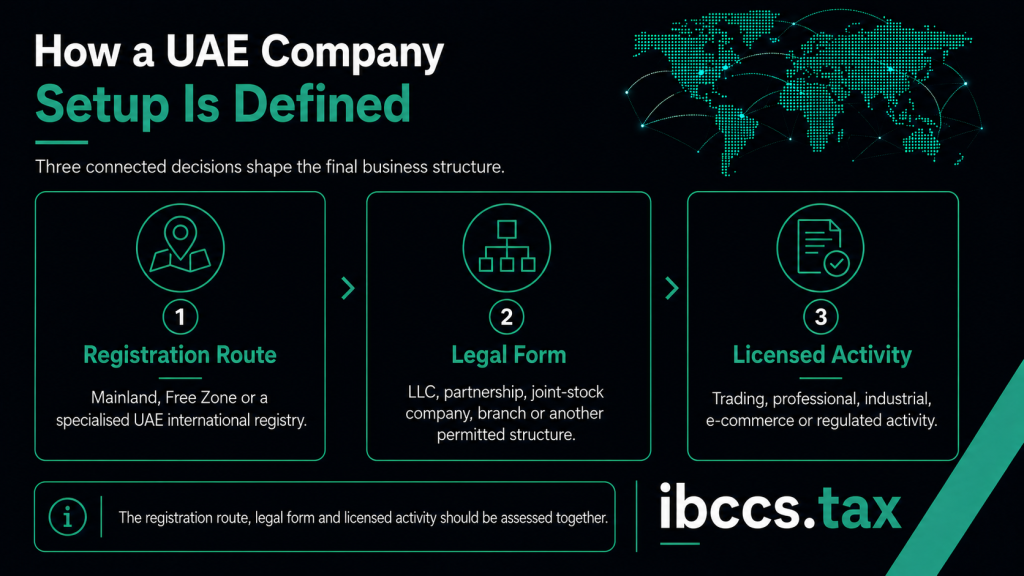
A founder may therefore establish a mainland LLC, a Free Zone limited liability company or a branch in either a mainland or Free Zone jurisdiction. The final structure is a combination of the jurisdiction, legal form and approved activities.
The principal company forms recognised under the UAE commercial companies framework include the General Partnership, Limited Partnership, Limited Liability Company, Public Joint Stock Company and Private Joint Stock Company. Local licensing systems may also make structures such as sole establishments and civil companies available for particular activities.
Mainland Companies in the UAE
A mainland company is licensed by the competent economic authority in the relevant Emirate. In Dubai, for example, mainland entities are registered and licensed through the Department of Economy and Tourism. A mainland setup is commonly selected by businesses requiring direct access to customers throughout the UAE, local offices, employee visas, commercial contracts and the ability to undertake activities outside a particular Free Zone.
Mainland is not itself a legal form. A mainland business may operate through an LLC, partnership, joint-stock company, sole establishment, civil company or branch, depending on its activity and the regulations of the relevant Emirate.
Many mainland commercial activities permit full foreign ownership. This does not mean that 100% foreign ownership is available without conditions in every sector. Activities with strategic significance and regulated businesses can remain subject to sector-specific approvals, ownership requirements or other restrictions.
Limited Liability Company (LLC)
The Limited Liability Company is one of the most widely used company types in the UAE. It is suitable for many trading, consultancy, technology, professional, hospitality and service businesses, subject to the activities approved on its licence.
An LLC has separate legal personality from its shareholders. Their liability is generally limited to their participation in the company, although personal liability can still arise in exceptional circumstances, including fraud, unlawful conduct or personal guarantees.
The LLC is often the starting point for businesses that require limited shareholder liability, direct UAE market access, employee and investor visas and a scalable operating structure.
Depending on the applicable licensing framework, an LLC may be established with a single owner or with multiple shareholders. The company’s constitutional documents should regulate management powers, voting, transfers of ownership, profit distributions and decision-making.
An LLC should not be treated as a standard document-only product. Where there is more than one shareholder, the Memorandum of Association and any shareholders’ agreement should reflect the commercial arrangement rather than relying exclusively on statutory default provisions.
Single-Owner LLC
A single-owner LLC allows one individual or corporate shareholder to own the entire company while retaining the limited-liability characteristics of an incorporated entity.
This can be preferable to a sole establishment where the business involves meaningful contractual, employment or operational risk. It can also provide a clearer corporate structure for accounting, banking, investment and future changes in ownership.
Sole Establishment
A sole establishment is owned by one natural person. It can be used for certain commercial, professional and service activities, depending on the Emirate and the owner’s eligibility.
The principal distinction from an LLC is liability. A sole establishment does not generally provide the same separation between the owner and the business. The owner can therefore be personally responsible for debts and obligations arising from the activity.
A sole establishment may be appropriate for a small individual practice where the commercial risk is limited and no external shareholders are expected. It can become less suitable where the business plans to employ a substantial team, take on significant liabilities, raise investment or introduce additional owners.
Civil or Professional Company
A civil or professional company may be available to individuals providing recognised professional services. The exact conditions, ownership requirements and liability treatment depend on the activity and the relevant licensing authority.
This structure is more commonly associated with professional activity than general commercial trading. It should not be assumed that every consulting or professional business must use a civil company, as an LLC or Free Zone company may also be available depending on the circumstances.
General Partnership
A General Partnership is established by partners who are directly involved in the business and are generally jointly responsible for its obligations.
Because of this wider personal liability, it is less commonly used by international founders than an LLC. It may nevertheless be relevant to specific closely held businesses where the partners understand and accept the liability and governance implications.
The partnership agreement should deal clearly with management, contributions, profit distribution, admission of new partners, withdrawal and dispute resolution.
Limited Partnership
A Limited Partnership includes at least one general partner and one or more limited partners.
The general partner manages the business and generally has broader responsibility for its obligations. A limited partner’s liability is usually restricted to their agreed contribution, provided they do not participate in management in a manner inconsistent with their limited-partner status.
This distinction can make the structure useful in specialised investment or family-business arrangements, although it is less frequently selected for standard operating companies.
Private Joint Stock Company
A Private Joint Stock Company provides a more formal share-capital and governance framework than a typical LLC.
It can be suitable for larger privately owned businesses, family groups, institutional investment structures and companies preparing for substantial capital raising. Its governance, capital and administrative requirements are generally more extensive than those of an LLC.
For most early-stage or owner-managed businesses, a Private Joint Stock Company may be unnecessarily complex. It becomes more relevant where the planned shareholder base, financing model or governance requirements justify the additional formality.
Public Joint Stock Company
A Public Joint Stock Company is designed for larger enterprises that may offer shares to the public or seek a listing on a securities market.
It is subject to significant capital, governance, regulatory, reporting and disclosure obligations. This structure is not generally used for routine SME or founder-led company formation.
Public Joint Stock Companies are most relevant to major corporate groups, financial institutions, regulated enterprises and businesses seeking access to public capital markets.
Free Zone Companies in the UAE
A Free Zone company is established and licensed under the regulations of a particular UAE Free Zone authority.
The UAE has numerous Free Zones focusing on industries such as technology, commodities, logistics, media, manufacturing, healthcare, professional services and financial activities. Each zone has its own regulations, permitted activities, facilities, visa arrangements and licensing packages.
Common Free Zone Company Forms
Common Free Zone entity designations include the Free Zone Establishment, often abbreviated as FZE; the Free Zone Company, often abbreviated as FZCO or FZC; the Free Zone Limited Liability Company; and a branch of a UAE or foreign company.
The terminology is not uniform across every Free Zone. The legal form, shareholder requirements and permitted activities must therefore be checked against the rules of the selected zone rather than inferred from the suffix alone.
When a Free Zone Company May Be Suitable
A Free Zone can provide a streamlined setup process, full foreign ownership, sector-specific infrastructure and integrated office and visa packages.
A Free Zone company may be suitable where the business provides services to international clients, operates in a specialised industry ecosystem, trades through appropriate customs and logistics arrangements, requires a UAE entity with limited direct mainland activity or benefits commercially from the reputation and network of the selected zone.
The decision should be based on the individual Free Zone and its rules. The term “Free Zone company” covers many different regulatory and commercial environments.
Mainland Market Access
A Free Zone licence does not necessarily authorise unrestricted direct business activity throughout the UAE mainland.
Depending on the activity and the relevant authorities, a Free Zone company may need an additional licence, mainland branch, distributor, local company or another approved arrangement to conduct particular activities directly on the mainland.
The practical position should be checked before signing contracts or issuing invoices. Requirements can differ between goods, professional services, regulated activities, online business and transactions with customers located inside a Free Zone.
Free Zone Corporate Tax
Free Zone companies are within the UAE Corporate Tax regime and generally must register for Corporate Tax.
A Qualifying Free Zone Person may benefit from a 0% Corporate Tax rate on Qualifying Income where all applicable conditions are met. Non-qualifying taxable income and profits attributable to certain Permanent Establishments can be subject to the standard 9% rate. Further details are available in our guide to UAE Corporate Tax.
A Free Zone company should therefore not be selected only because it is presented as “tax-free”. The activity, customer profile, substance, contracts, income classification and ongoing compliance requirements must be reviewed.
Branches of UAE and Foreign Companies
A branch allows an existing UAE or foreign company to establish a presence in another jurisdiction or Emirate without incorporating a separate subsidiary.
The branch operates under the legal identity of its parent company. It does not generally have separate legal personality, and the parent remains responsible for the branch’s activities and obligations.
A branch may be suitable where the parent wants to operate directly under its existing name, the group does not require separate shareholders in the UAE operation, contracts must be entered into by the parent, the parent is prepared to accept direct exposure to the branch or continuity of experience and commercial history is important.
The permitted activities of the branch are normally connected to those of the parent and remain subject to approval by the relevant UAE licensing authority. Regulated or sector-specific activities may require additional authorisations.
Representative Offices
A representative office is more limited than an operating branch.
It is generally used to promote the parent company, develop business relationships, undertake market research and provide liaison or coordination support. It does not normally carry out the same revenue-generating activities as an appropriately licensed branch or subsidiary.
A representative office may be suitable where an international company wants to establish an initial presence in the UAE without immediately entering into local commercial contracts.
Where the UAE office will invoice customers, sign commercial agreements or directly provide services, an operating company or branch is usually more appropriate.
Offshore and International Business Companies
The term “offshore company” is commonly used for entities registered through specialised UAE international corporate registries.
These structures are generally used for cross-border, investment and private-wealth purposes rather than standard operating activity in the UAE. Potential uses include owning shares in subsidiaries, holding investments or intellectual property, asset-holding and succession arrangements, joint ventures, project vehicles and international financing.
An offshore or International Business Company should not be treated as a substitute for a mainland or operational Free Zone company. A classic international company does not generally provide the same operating licence, employee visa capacity, physical premises or direct UAE market access.
The rights and limitations of the entity depend on the regulations and products of the particular registry. The generic label “offshore company” is not sufficient to determine how the structure can be used.
Holding Companies and Special Purpose Vehicles
Holding Companies
A holding company is an entity established primarily to own shares, investments, intellectual property, real estate interests or other assets.
“Holding company” describes the function of the entity rather than one specific legal form. A UAE holding structure might use a mainland LLC, a Free Zone company, a dedicated Special Purpose Vehicle or an International Business Company.
The appropriate vehicle depends on the nature and location of the assets, financing, tax residency, treaty access, succession, banking, substance and whether the entity will also conduct active business.
A holding company generally separates ownership of assets from operating activities. International groups and family-owned businesses should review holding structures together with international business structuring and the tax position of the shareholders.
Special Purpose Vehicles
A Special Purpose Vehicle is created for a specific and defined purpose.
An SPV may be used to hold one asset or investment, isolate a project from wider operational liabilities, facilitate a joint venture, hold intellectual property, support financing or structure real estate and private investment ownership.
An SPV is not usually intended to conduct broad, unrestricted operating activity. Its constitutional documents, licence and permitted purpose should correspond to the transaction or asset for which it was established.
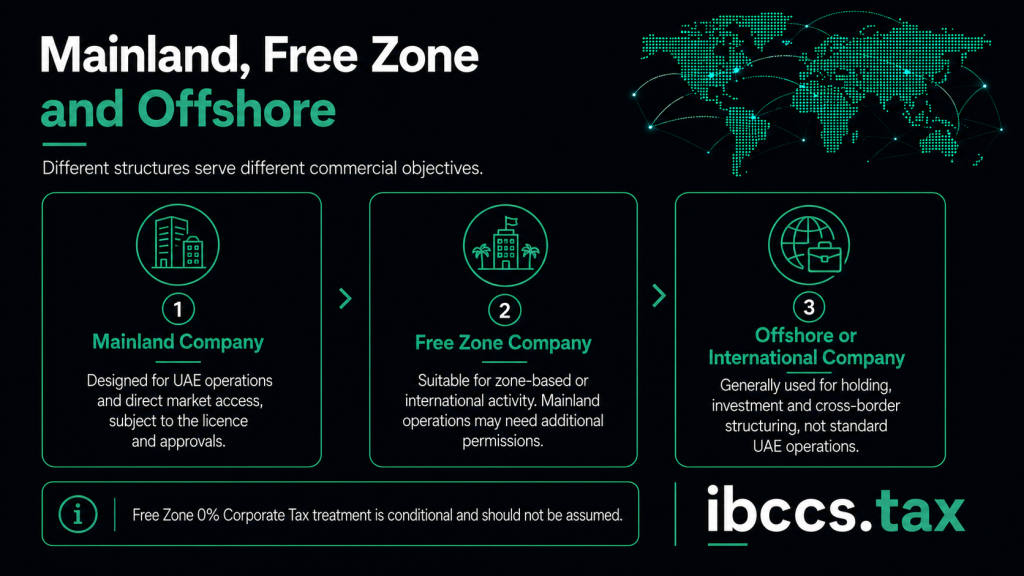
Mainland vs Free Zone vs Offshore
| Feature | Mainland operating company | Free Zone operating company | Offshore or international company |
| Typical purpose | Operating business serving the UAE and international markets | Zone-based, specialised or international operations | Holding, investment and cross-border structuring |
| Common legal form | LLC, partnership, joint-stock company or branch | FZE, FZCO, FZ-LLC or branch | Company limited by shares, SPV or other registry structure |
| Separate legal personality | Yes for incorporated companies | Yes for incorporated Free Zone companies | Generally yes |
| Direct mainland activity | Broad, subject to the licence | May require additional approval or structure | Generally not a standard operating licence |
| Foreign ownership | Often 100%, subject to activity | Generally 100% | Generally 100% |
| Employee and investor visas | Available, subject to setup | Available, subject to facilities and package | Classic structures generally do not provide standard visa eligibility |
| Physical office | Usually required according to the licence | Flexi-desk, office, warehouse or facility depending on the zone | Usually registered-agent based |
| Corporate Tax | Standard regime generally applies | Free Zone regime may apply conditionally | Corporate Tax position requires separate review |
| Best suited to | Local and regional operating businesses | International, specialised and zone-based businesses | Holding and investment structures |
Subsidiary vs Branch
An international group entering the UAE will often compare a subsidiary with a branch.
A subsidiary is a separately incorporated UAE company owned by the parent. It has its own legal personality, constitutional documents, accounts and liabilities.
A branch is legally connected to the parent. It can provide direct continuity with the foreign company, but its obligations remain the responsibility of the parent.
The choice should consider liability separation, customer and contracting requirements, banking, regulatory approvals, accounting, Corporate Tax, transfer pricing, future investors and potential sale or restructuring.
A subsidiary is often preferable where the group wants to ring-fence the UAE operation or may introduce new shareholders. A branch may be suitable where direct parent-company responsibility and commercial continuity are more important.
How Company Type Affects UAE Tax and Compliance
The company’s legal form and registration jurisdiction can affect its tax and compliance position, but the company name alone does not determine the result.
Mainland and Free Zone companies are generally within the UAE Corporate Tax regime. Free Zone 0% treatment is conditional, while mainland companies generally apply the standard 0% and 9% taxable-income bands.
VAT is a separate assessment. A business must generally register when its taxable supplies and imports exceed the mandatory VAT threshold. A company can require Corporate Tax registration without being required to register for VAT.
The company should also consider bookkeeping, financial statements, transfer pricing, beneficial ownership reporting, licence renewal, payroll and employment compliance, customs registrations, record retention and sector-specific reporting.
IBCCS TAX provides accounting and tax services in the UAE for mainland and Free Zone businesses. Individual founders conducting business personally should also review our guide to UAE personal income tax and tax residency.
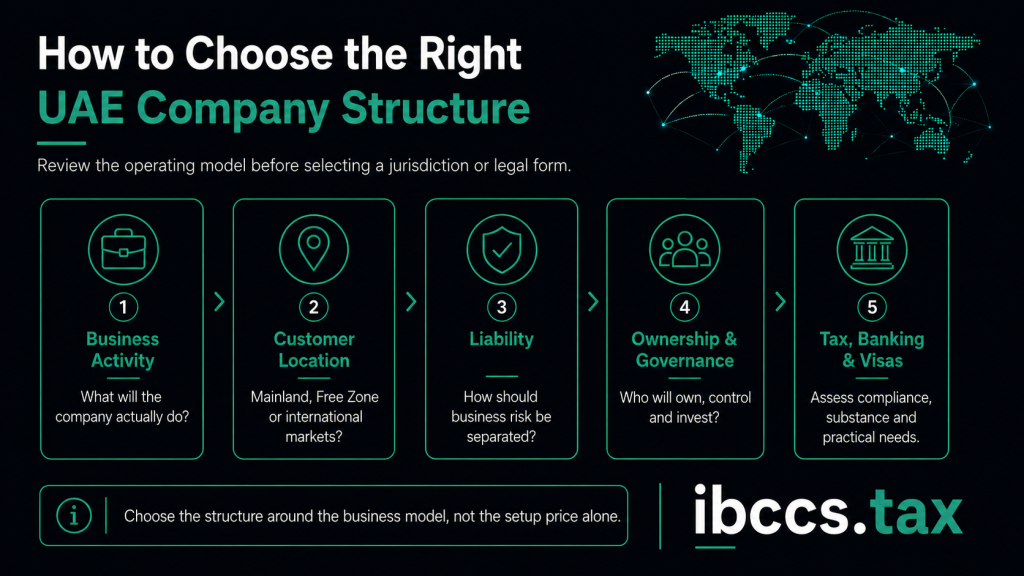
How to Choose the Right UAE Company Structure
The correct company type should be selected by working backwards from the proposed commercial activity.
Business Activity and Regulatory Approvals
The first question is what the company will actually do. Trading, consultancy, e-commerce, technology, manufacturing, real estate and regulated financial services can require different licences, jurisdictions and approvals.
The activity stated on the licence should correspond to the company’s website, contracts, invoices, banking profile and actual operations.
Customer Location and Market Access
A business serving UAE customers directly may require a different setup from a company working mainly with international clients.
Founders should establish whether customers will be located on the mainland, inside a Free Zone or outside the UAE. They should also determine where contracts will be signed, services delivered and goods imported or stored.
Liability Protection
An incorporated company can provide separation between its shareholders and its commercial liabilities.
A sole establishment offers less liability protection, while a branch connects liabilities directly to its parent. An LLC or subsidiary may be more appropriate where the business will enter significant contracts, employ staff or assume operational risk.
Ownership and Governance
The structure should accommodate the current and future shareholders.
The constitutional documents should address voting rights, management authority, transfers of shares, profit distributions, deadlock, admission of investors, exit arrangements and succession.
A structure suitable for one consultant may not work for a multi-founder startup or an international group.
Premises, Visas and Employees
Office and facility requirements differ significantly between jurisdictions.
A low-cost Free Zone package may provide limited visa capacity or only a shared desk. A trading, manufacturing or logistics business may require a warehouse, dedicated office, customs registration or regulated premises.
Corporate Tax, VAT and Accounting
The setup should be assessed under Corporate Tax and VAT before incorporation.
A Free Zone company should not be selected solely for an assumed 0% rate. A mainland company should not be rejected simply because the standard Corporate Tax regime applies, as commercial and operational suitability is often more important than the headline rate.
The founders should also understand the accounting, audit, transfer pricing and record-keeping obligations that will apply after incorporation.
Banking and Commercial Substance
Banks review the commercial substance of the company rather than only its incorporation certificate.
Typical considerations include shareholder background, business activity, source of funds, customer and supplier countries, expected transaction volumes, office, employees and the company’s connection with the UAE.
The legal structure and licence should correspond to the banking profile presented during account opening.
Long-Term Growth and Exit
The structure should accommodate realistic future plans.
A founder should consider whether the business is likely to employ more staff, bring in investors, open additional branches, sell across the UAE, hold intellectual property, establish foreign subsidiaries, raise external finance or be sold or restructured.
Selecting the correct structure at the outset can avoid unnecessary migrations, licence amendments, transfers of contracts and duplicated compliance later.
Practical Examples: Types of Companies in UAE
Consultant Serving International Clients
A consultant working mainly with clients outside the UAE may consider a Free Zone company, mainland professional structure or sole establishment. The decision should reflect liability protection, visa requirements, turnover, customer expectations, banking, Corporate Tax and whether UAE-based clients will also be served.
Trading Business Selling Across the UAE
A business importing products and selling directly throughout the UAE may require a mainland LLC or a Free Zone company supported by the appropriate mainland, customs and distribution arrangements. The importer-of-record position, warehouse, supply chain and customer contracts should be established before incorporation.
Technology Startup Seeking Investment
A startup expecting external investment should avoid selecting a structure solely because it is the cheapest available package. The founders should consider share issuance, governance, intellectual property ownership, employee incentives, investor expectations and possible future holding-company arrangements.
Foreign Group Entering Dubai
A foreign group may establish a UAE subsidiary or register a branch. A subsidiary can ring-fence the UAE operation and accommodate future investors. A branch preserves direct continuity with the parent but exposes the parent to branch liabilities.
Family Holding International Investments
A family holding investments or subsidiaries may not need a standard operating company. A dedicated holding company, SPV or international company may provide clearer asset separation, governance and succession planning, subject to tax, substance, banking and reporting considerations.
Common Mistakes When Choosing a UAE Company Type
Choosing Only on Setup Cost
A low initial price can hide limitations involving activities, visas, facilities, customs, banking or mainland access. Correcting the structure later can involve additional licences, closures, transfers of contracts and new bank-account applications.
Treating a Free Zone as Automatically Tax-Free
A Free Zone company is within the Corporate Tax regime. The 0% rate is conditional and applies only to Qualifying Income of a Qualifying Free Zone Person.
Confusing a Branch With a Subsidiary
A branch is an extension of its parent rather than a separately owned company. This difference affects liability, accounting, governance, contracts and potential future investment.
Using an Offshore Company for Active UAE Operations
A classic offshore or international company is generally not a substitute for a licensed UAE operating business. The structure may be appropriate for holding or investment purposes but not for employing staff and conducting unrestricted commercial activity inside the UAE.
Selecting the Wrong Licensed Activity
The selected activity must match the actual business. A mismatch can create problems with banks, customers, regulators, tax authorities and counterparties.
Ignoring Ongoing Compliance
Company formation is the beginning of the compliance process rather than the end. The business may require accounting, Corporate Tax, VAT, payroll, beneficial ownership updates, licence renewals, audits and other filings.
How IBCCS TAX Can Assist
Choosing the right UAE company structure requires coordination between licensing, legal form, taxation, accounting, banking, immigration and the founders’ wider international position. At IBCCS TAX, we assist clients with:
- comparison of mainland, Free Zone and international structures;
- selection of legal form and licensed activities;
- UAE company incorporation;
- branch and subsidiary registration;
- holding-company and SPV structuring;
- preparation and coordination of corporate documents;
- investor and employee visa support;
- corporate bank-account assistance;
- Corporate Tax and VAT registration;
- accounting and ongoing compliance;
- restructuring of existing UAE companies;
- international ownership and tax planning.
Our UAE company formation services provide coordinated support from the initial structuring decision through incorporation, licensing, banking and ongoing administration.
Planning to Establish a Company in the UAE?
The appropriate company type depends on what the business will do, where its customers are located, who will own it and how it is expected to develop. Contact IBCCS TAX to discuss the appropriate UAE structure for your business with our team.

Frequently Asked Questions About UAE Company Types
1. What are the main types of companies in the UAE?
The principal legal company forms include the Limited Liability Company, General Partnership, Limited Partnership, Private Joint Stock Company and Public Joint Stock Company. Depending on the jurisdiction and activity, businesses may also operate through sole establishments, civil companies, Free Zone companies, branches and international corporate structures.
2. What is the most common company type in the UAE?
The LLC is one of the most commonly used structures for operating businesses because it provides separate legal personality, limited shareholder liability and flexibility across many activities.
3. Is mainland a legal form?
No. Mainland describes the registration and licensing jurisdiction. A mainland entity may operate as an LLC, partnership, joint-stock company, sole establishment, civil company or branch.
4. What is an FZE?
An FZE is a Free Zone Establishment. The designation is commonly used by some Free Zones for an incorporated entity, often with a single shareholder. Terminology and shareholder rules differ between Free Zones, so the regulations of the selected zone must be checked.
5. What is an FZCO?
FZCO generally means Free Zone Company. Some Free Zones use the designation for entities with one or more shareholders. The exact legal meaning depends on the regulations of the selected zone.
6. Can a foreigner own 100% of a mainland company?
Full foreign ownership is available for many mainland activities. Certain regulated or strategic activities can remain subject to additional approvals or ownership requirements.
7. Can a Free Zone company trade on the mainland?
The company may require an additional licence, mainland branch, distributor or another approved arrangement, depending on its activity and jurisdiction. The position should be verified before direct mainland operations begin.
8. Does a Free Zone company automatically pay 0% Corporate Tax?
No. A Free Zone Person must meet the Qualifying Free Zone Person requirements, and the 0% rate applies only to Qualifying Income.
9. What is the difference between a branch and a subsidiary?
A subsidiary is a separately incorporated company owned by the parent. A branch is an extension of the parent company and does not normally have separate legal personality.
10. What is a representative office?
A representative office is generally limited to promotional, liaison and market-development activities. It does not normally carry out the full commercial activities of an operating branch or subsidiary.
11. Is a holding company a legal form?
Not by itself. The term describes the function of an entity that holds shares or other assets. A holding company may use an LLC, Free Zone company, SPV or international company as its legal vehicle.
12. Can an offshore company operate in the UAE?
A classic offshore or international company generally does not provide a standard licence for active operations in the UAE. A mainland company, Free Zone operating company or branch may be required.
13. Which type of UAE company is best?
There is no single structure that is best for every business. The correct choice depends on activity, customers, ownership, liability, employees, premises, banking, taxation and future growth.




Cezary Zieniuk to Join Free IMC Webinar on the New Geography of Global Mobility
On 23 September 2026, Cezary Zieniuk, Founder of IBCCS TAX
Read More
UAE Business License Guide: Types, Requirements, Costs and Renewal
A UAE business license is the formal authorization that allows
Read More
Why Start a Business in the UAE? Strategic Advantages and Practical Considerations
The United Arab Emirates has developed into an established international
Read MoreDisclaimer: This article provides general information and does not constitute legal, tax or investment advice. UAE company formation requirements depend on the Emirate, Free Zone, business activity, ownership, regulatory approvals and current legislation. Professional advice should be obtained before establishing, acquiring or restructuring a UAE business.