

A UAE mainland company is often the preferred structure for businesses that want to operate directly in the local market, maintain premises, employ staff and build a long-term commercial presence in the country. Mainland companies can conduct the activities listed on their licences and, subject to the relevant approvals, work with private-sector and government customers across the UAE.
The formation process is generally efficient, but the right result requires more than reserving a trade name and obtaining a licence. The legal form, business activities, ownership, premises, immigration requirements, tax registrations and banking profile should all reflect how the company will operate in practice.
A poorly selected activity or structure can create restrictions when the business begins hiring, signing contracts, opening a bank account or expanding into regulated sectors. Entrepreneurs comparing different routes can review our broader guide to the types of companies in the UAE and our overview of how to set up a business in the UAE.

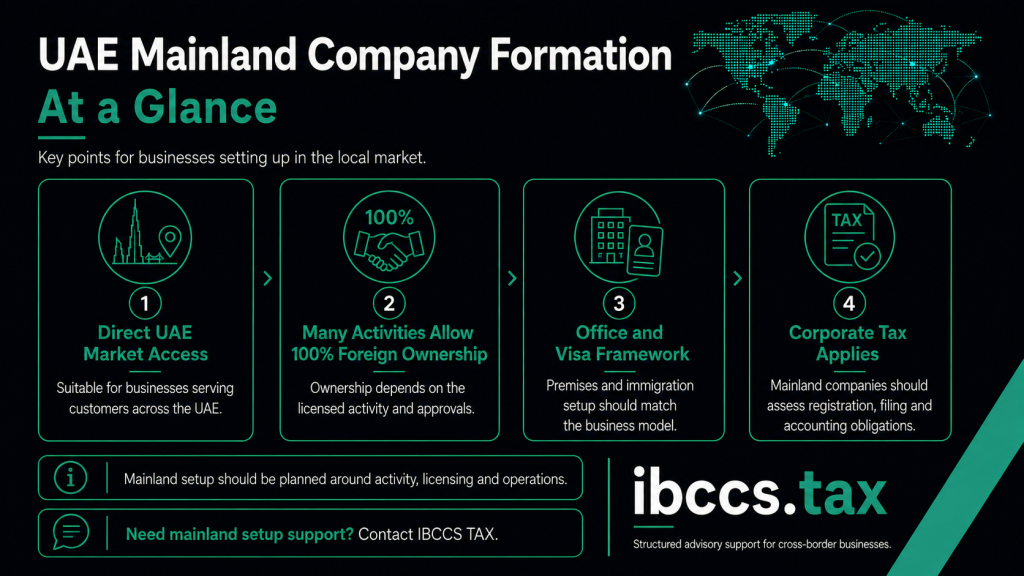
- A mainland company is licensed by the competent economic authority in the relevant Emirate.
- Many mainland activities allow 100% foreign ownership, although strategic and regulated sectors can remain subject to additional conditions.
- Mainland is a registration and licensing environment rather than one legal form; the company may be an LLC, partnership, branch, sole establishment or another permitted structure.
- The Limited Liability Company is the most common structure for many trading, professional and service businesses.
- The permitted activities, legal form and trade licence must match the company’s actual operations.
- Office and premises requirements depend on the activity, Emirate and licensing conditions.
- A mainland company is generally within the UAE Corporate Tax regime and must assess VAT, accounting and filing obligations separately.
- Investor and employee visas require post-licensing immigration and establishment procedures.
- Corporate bank-account approval is a separate due-diligence process and is not guaranteed by incorporation.
- The total cost should include licensing, premises, immigration, approvals, accounting, tax and annual renewal rather than the incorporation fee alone.
What Is a Mainland Company in the UAE?
A mainland company is a business registered and licensed by the economic authority responsible for the relevant Emirate. In Dubai, mainland businesses are licensed through the Department of Economy and Tourism, while the other Emirates use their respective economic development and licensing authorities.
The term mainland does not identify one particular legal form. It describes the licensing environment in which an LLC, partnership, branch, sole establishment, civil company or joint-stock company may be established, depending on the activity and applicable rules.
A mainland company can generally carry out its licensed activities in the UAE without being confined to a specific Free Zone. Additional permits, branch registrations or sector approvals can still be required where the company operates from multiple locations, enters another regulated activity or expands into a different Emirate.
Who Should Consider a UAE Mainland Company?
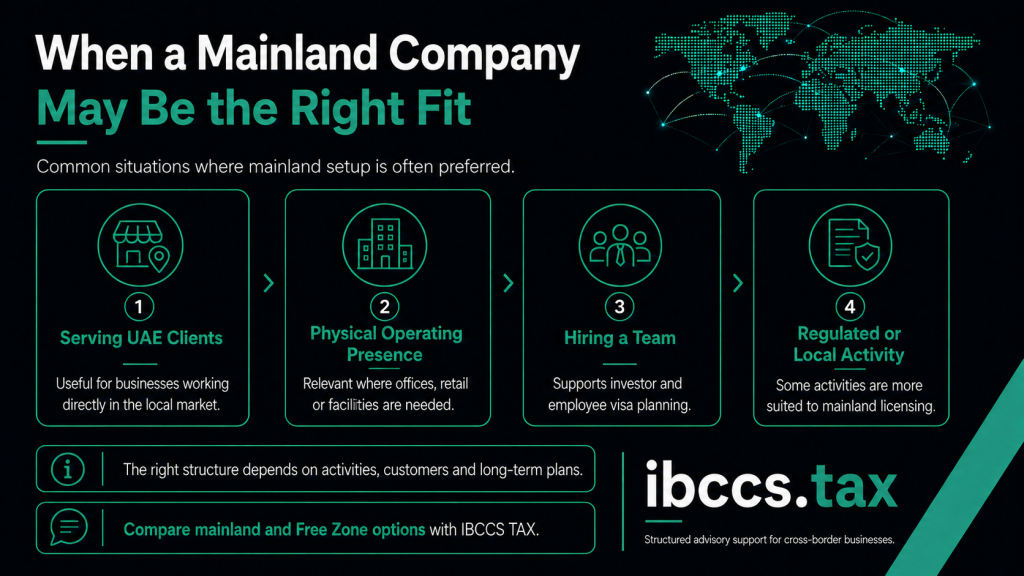
A mainland structure is commonly suitable for businesses that plan to serve customers directly in the UAE, maintain a local office or facility and employ a team. It can also be appropriate where the activity requires approvals that are more naturally aligned with the mainland licensing framework.
The structure may be particularly relevant for retail, hospitality, construction, healthcare, education, real estate-related services, professional services, trading and other businesses that need an operational presence outside a Free Zone. The precise licence and approvals will depend on the nature of the activity rather than the general description of the business.
A mainland company can also be suitable for international groups establishing a UAE subsidiary or branch. The decision should consider liability, ownership, contracts, transfer pricing, governance and whether the parent company wants a separately incorporated entity or a direct branch presence.
Mainland Company vs Free Zone Company
| Factor | Mainland company | Free Zone company |
| Typical market focus | Direct UAE and international operations | Zone-based, specialist or international operations |
| Licensing authority | Economic authority in the relevant Emirate | Selected Free Zone authority |
| Mainland activity | Available within the approved licence and permits | May require an additional permit, branch or structure |
| Foreign ownership | 100% available for many activities | Generally 100% |
| Premises | According to the activity and mainland licence | According to the selected zone and package |
| Corporate Tax | Standard UAE Corporate Tax regime | Conditional Free Zone regime may apply |
| Best suited to | Businesses requiring broad local operations | International or specialised business models |
Neither structure is universally better. The correct choice depends on customer location, activity, facility requirements, staffing, Corporate Tax and the operating permissions needed by the business. A detailed Free Zone comparison is available in our guide to Dubai Free Zone company formation.
Legal Forms Available for Mainland Businesses
Limited Liability Company
The Limited Liability Company is one of the most widely used structures for mainland company formation in the UAE. It has separate legal personality, and shareholder liability is generally limited to the value of their participation, subject to personal guarantees, unlawful conduct and other circumstances in which liability may extend beyond the company.
An LLC can be suitable for trading, consultancy, technology, hospitality, professional services and many other activities. It may have one shareholder or multiple shareholders, depending on the applicable rules, and its constitutional documents should clearly regulate management, voting, ownership transfers and profit distribution.
Single-Owner LLC
A single-owner LLC allows one individual or corporate shareholder to own the company while retaining the benefits of a separately incorporated entity. This can provide a clearer liability and governance framework than a sole establishment, particularly where the company will employ staff, enter material contracts or hold business assets.
The structure can also support future investment or restructuring because ownership interests can be transferred or additional shareholders introduced through the appropriate corporate procedures.
Sole Establishment and Civil Company
A sole establishment may be available for certain commercial, professional or service activities. The business is owned by one natural person, and the owner does not generally benefit from the same liability separation available through an LLC.
A civil or professional company may be available for recognised professional activities, subject to the licensing rules of the relevant Emirate. The liability, ownership and management arrangements should be reviewed carefully because these structures are not automatically equivalent to an LLC.
Branch of a UAE or Foreign Company
A branch allows an existing company to operate in the UAE under the legal identity of its parent. It is not a separately owned subsidiary, and the parent remains responsible for the branch’s obligations and activities.
This structure can be suitable where an established group wants direct continuity with the parent company, but it does not provide the same liability ring-fencing as an LLC subsidiary. The branch activities, parent documents and regulatory approvals must be reviewed before registration.
Partnership and Joint-Stock Structures
General Partnerships, Limited Partnerships, Private Joint Stock Companies and Public Joint Stock Companies are available for particular ownership, governance and capital requirements. These structures are generally more specialised than an LLC and can involve wider personal liability or more formal governance and regulatory obligations.
They may be appropriate for family businesses, investment structures, larger privately held groups or companies seeking access to public capital. Most founder-led SMEs will usually begin by assessing an LLC before considering these alternatives.
Foreign Ownership of UAE Mainland Companies
Foreign investors can own 100% of many UAE mainland companies. The historical assumption that every foreign-owned mainland business requires a UAE national shareholder holding 51% is no longer correct for a broad range of activities.
Full foreign ownership is not unconditional in every sector. Activities with strategic impact and businesses regulated by specialist authorities can remain subject to additional ownership rules, approvals, capital requirements or governance conditions.
Ownership should therefore be confirmed against the exact activity code and Emirate before incorporation. A general statement that a company is engaged in consulting, trading or technology may not be sufficient where the proposed licence contains several distinct activities.
Benefits of Establishing a Mainland Company in the UAE
Broad Access to the UAE Market
A mainland company can generally provide goods and services directly in the UAE within the scope of its approved licence. This can simplify contracting with local customers compared with structures that require an additional mainland permit, distributor or branch.
The company must still comply with sector rules, location permits and any requirements applying in another Emirate. Broad market access should be understood as operational flexibility within the approved regulatory framework rather than permission to conduct unrestricted activities.
Flexible Office and Operating Locations
Mainland companies can select premises that suit the licensed activity, including offices, retail units, workshops, clinics, restaurants and industrial facilities. The premises and tenancy documentation must meet the requirements of the relevant licensing and municipal authorities.
This flexibility can support businesses that need customer-facing locations or multiple branches. Each additional location may require separate approvals, licence amendments or branch registrations, so expansion should be planned before long-term leases are signed.
Access to Private and Government Contracts
A mainland company can contract directly with private-sector customers throughout the UAE and may be eligible to register with government procurement systems. Participation in public tenders is not automatic and can depend on vendor registration, activity, experience, local content, classification and project-specific requirements.
Businesses targeting regulated or public-sector work should review the procurement and classification requirements at the formation stage. The legal structure, ownership and financial records may affect eligibility for particular contracts.
Workforce and Immigration Framework
A mainland company can sponsor investor, manager and employee residence visas after completing the relevant immigration and establishment procedures. Visa capacity depends on the licence, premises, staffing requirements and approval of the competent authorities.
Employment contracts, payroll, health insurance and the Wages Protection System should be planned alongside the immigration process. IBCCS TAX can coordinate formation with UAE immigration assistance for shareholders, employees and dependent family members.
Scalable Operating Structure
A mainland LLC can support additional activities, premises, shareholders and employees as the business grows, subject to the necessary amendments and approvals. It can also be used as an operating subsidiary within a wider international group.
The initial constitutional documents should anticipate the expected governance and investment model. A company formed for one owner may need different management and transfer provisions if external investors or business partners are likely to join later.
Step-by-Step UAE Mainland Company Formation Process
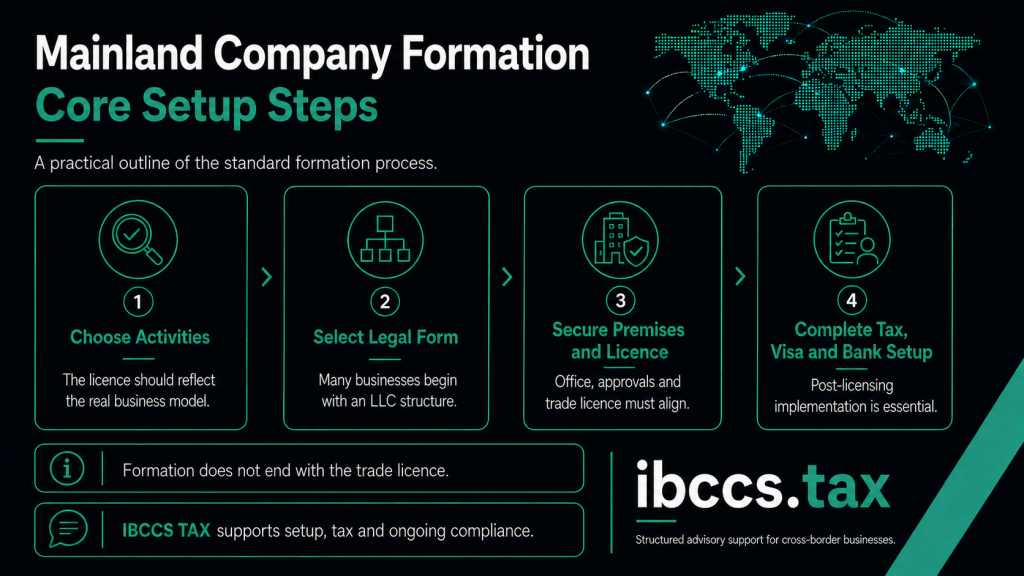
Step 1: Define the Business Activities
The process begins by identifying the exact activities the company will conduct. The selected activity codes determine the available legal forms, licensing authority, external approvals, premises and whether full foreign ownership is available.
The licence should match the company’s website, contracts, invoices and banking profile. Selecting an activity only because it is cheaper or easier to approve can create operational and compliance issues after incorporation.
Step 2: Select the Emirate and Licensing Authority
The shareholders should decide in which Emirate the mainland company will be registered and where its principal operations will be located. Dubai, Abu Dhabi and the other Emirates have separate economic authorities and local procedures, even though the federal company framework applies across the UAE.
The choice should reflect customers, premises, sector approvals, staffing and the practical location of management. A company should not select an Emirate solely on the basis of incorporation cost if its actual operations will be elsewhere.
Step 3: Choose the Legal Form and Ownership Structure
The founders must select the legal form that fits the liability, ownership and governance requirements of the business. For many operating businesses, this will be an LLC or single-owner LLC, while a branch or professional structure may be more suitable in specific circumstances.
The ownership structure should identify the shareholders, Ultimate Beneficial Owners, managers and authorised signatories. Corporate shareholders can require additional resolutions, certificates and legalised documents.
Step 4: Reserve the Trade Name
The proposed trade name must comply with the rules of the relevant Emirate and should correspond to the company’s activity and legal form. Protected, regulated or misleading words can require additional approval or be rejected.
The name reservation does not by itself authorise the company to operate. It is an early formation step used in the initial approval and licensing process.
Step 5: Obtain Initial Approval and External Consents
Initial approval confirms that the licensing authority has no preliminary objection to establishing the business, but it is not the final trade licence. Certain activities require approval from a specialist regulator, municipality, ministry or professional authority.
Healthcare, education, transport, food, real estate, financial services and other regulated sectors can involve additional documentation, qualifications, premises inspections or capital requirements.
Step 6: Prepare the Constitutional and Corporate Documents
The shareholders prepare and sign the Memorandum of Association, manager appointments, resolutions and declarations required for the selected structure. The documents should accurately reflect ownership, authority, voting and profit-distribution arrangements.
Foreign corporate documents may require notarisation, legalisation, attestation and certified translation. The exact requirements depend on the country of issue, shareholder type and licensing authority.
Step 7: Secure Suitable Business Premises
The company normally needs premises that comply with the activity and licensing requirements. The tenancy agreement, registration and municipal approvals form part of the licence process or post-approval implementation.
The premises should be assessed for customer access, staff, visa capacity and regulatory inspections. A business that needs a clinic, warehouse or retail unit cannot rely on an office arrangement designed for a small consultancy.
Step 8: Obtain the Mainland Trade Licence
Once the approvals, documents and premises requirements are complete, the authority issues the trade licence covering the approved activities. The company may also receive its commercial registration and related establishment details.
The licence must be renewed and amended when activities, premises, ownership or management change. Conducting an unlicensed activity can create contractual, banking and regulatory risks.
Step 9: Complete Labour, Immigration and Establishment Registrations
A company intending to sponsor visas or employ staff must complete the relevant establishment, immigration and labour registrations. The process may include an establishment card, immigration file and employer registration.
Investor and employee visas involve separate applications, medical examinations, Emirates ID procedures and insurance. Employment should not begin until the company and individual have the appropriate approvals.
Step 10: Register for Corporate Tax and Assess VAT
A newly incorporated UAE juridical person subject to Corporate Tax generally must apply for registration within the prescribed timeframe. Corporate Tax is calculated on taxable income, with the standard 0% and 9% rate bands applying under the ordinary regime.
VAT is assessed separately and mandatory registration generally depends on taxable supplies and imports. The company should also determine whether customs, Excise Tax or sector-specific tax obligations apply.
Step 11: Open the Corporate Bank Account
Bank-account opening is a separate due-diligence process. The bank will review ownership, business activity, source of funds, customers, suppliers, expected transactions and the connection between the company and the UAE.
A clear licence, realistic business plan, supporting contracts and consistent ownership documents can improve the application. Incorporation does not guarantee approval, and the bank may request additional evidence of commercial substance.
Step 12: Implement Accounting and Ongoing Compliance
The company should implement bookkeeping, invoicing, document retention and tax processes from the start of operations. Corporate Tax, VAT, payroll, beneficial ownership and licence-renewal obligations should be assigned to responsible persons.
IBCCS TAX provides accounting and tax services in the UAE for mainland companies requiring bookkeeping, Corporate Tax, VAT, payroll and ongoing compliance support.
Documents Commonly Required
The documents required for mainland company formation depend on the legal form, shareholders, activities and licensing authority. An individual shareholder will usually provide identity, address and immigration information, while a corporate shareholder must provide a wider set of constitutional and ownership documents.
Individual Shareholders
- passport copy and personal identification details;
- proof of residential address;
- UAE visa and Emirates ID, where applicable;
- contact details and proposed ownership information;
- manager and authorised-signatory details;
- Ultimate Beneficial Owner information;
- professional qualifications or approvals for regulated activities.
Corporate Shareholders
- certificate of incorporation or registration extract;
- constitutional documents;
- certificate of incumbency or equivalent current company extract;
- board or shareholder resolution approving the UAE company;
- ownership chart identifying the Ultimate Beneficial Owners;
- passports and proof of address for relevant individuals;
- power of attorney, where required;
- legalisation, attestation and translation of foreign documents.
A business plan, lease, external approval or evidence of experience may also be required depending on the activity. The documentation should be confirmed before foreign documents are legalised because the exact format can differ between authorities.
How Much Does Mainland Company Formation Cost?
There is no single reliable price for UAE mainland company formation. The cost depends on the Emirate, legal form, number and type of activities, premises, shareholders, external approvals, immigration requirements and the level of professional support needed.
| Cost component | What affects it |
| Trade-name and initial approvals | Emirate, name and application route |
| Company registration and licence | Legal form and licensed activities |
| External approvals | Regulated or specialist activity |
| Corporate documents | Number and type of shareholders |
| Premises | Office, retail unit, clinic, warehouse or other facility |
| Immigration and labour setup | Visas, establishment registrations and staffing |
| Document legalisation | Corporate shareholders and foreign documents |
| Tax and accounting | Corporate Tax, VAT, bookkeeping and audit requirements |
| Annual renewal | Licence, premises, immigration and ongoing compliance |
A realistic budget should distinguish one-off incorporation costs from annual operating and compliance expenses. Selecting the cheapest licence without considering premises, banking, tax and staffing can produce a structure that requires expensive amendments later.
How Long Does Mainland Company Formation Take?
A straightforward mainland company can often be licensed efficiently once the activity, ownership, documents and premises are approved. The formation timeframe depends on the Emirate, legal form, shareholder documents and whether external regulators are involved.
Corporate shareholders, regulated activities, foreign document legalisation and specialised premises can extend the process. Visa applications and bank-account opening follow separate timelines and should not be treated as part of the licence-issuance period.
Office, Visas and Employment Requirements
The premises must be appropriate for the company’s licensed activity and may require tenancy registration, municipality approval or inspection. Office requirements for a consultancy differ materially from those applying to a restaurant, medical practice, warehouse or industrial operation.
A company employing staff must comply with the applicable UAE labour framework, employment contracts, payroll and the Wages Protection System. Visa and employee capacity depend on the business, premises and approval of the relevant authorities rather than one fixed rule for all mainland companies.
Owners relocating to the UAE can combine incorporation with our UAE relocation assistance and immigration support.
UAE Corporate Tax, VAT and Accounting
A mainland company incorporated in the UAE is generally a Resident Juridical Person for Corporate Tax purposes. The ordinary rate structure provides 0% on taxable income up to AED 375,000 and 9% on the portion exceeding that amount.
The AED 375,000 amount is a taxable-income rate threshold rather than a general company-registration threshold. Newly incorporated juridical persons subject to Corporate Tax must register within the applicable deadline, prepare financial information and file the annual Corporate Tax Return.
VAT is separate from Corporate Tax and is based on taxable supplies and imports. The company must also maintain records, review Related Party transactions, retain supporting documents and determine whether audited financial statements are required under tax, licensing or sector rules.
Further information is available in our guide to UAE Corporate Tax.
Corporate Bank Account Considerations
The bank will assess whether the proposed account is consistent with the company’s licence, ownership and commercial purpose. A mainland licence can provide a clear operating framework, but it does not remove the bank’s obligation to complete independent due diligence.
The application can require contracts, invoices, financial projections, source-of-funds evidence, group information and details of expected countries and transaction volumes. The company should avoid presenting a generic setup that does not match the business activity described to the bank.
Ongoing Compliance for Mainland Companies
A mainland company must maintain its trade licence, premises, corporate records and Ultimate Beneficial Owner information. Changes in ownership, management, activities or address should be completed through the appropriate amendment procedures.
The company may also need to manage Corporate Tax, VAT, accounting, payroll, immigration, customs and sector-specific filings. Compliance should be treated as part of the operating model rather than a year-end administrative exercise.
Practical Examples
Professional Services Company Serving UAE Clients
A consultancy intends to maintain an office in Dubai, employ staff and provide services directly to UAE customers. A mainland LLC can provide an appropriate operating structure, subject to selecting the correct professional activities and any required approvals.
The owners should review Corporate Tax, VAT, employment and banking before issuing contracts. Full foreign ownership may be available, but this should be confirmed against the exact activity.
Trading Company Importing and Selling Products
A business plans to import goods, store them in the UAE and sell directly to retailers and commercial customers. A mainland trading company can support local sales, but the company must also arrange the appropriate customs, product and warehouse registrations.
The supply chain should identify the importer of record, product approvals, storage location and VAT treatment. The licence must cover the actual products and trading activities.
Foreign Group Establishing a UAE Subsidiary
An international group wants a separately incorporated UAE operating company with local staff and contracts. A mainland LLC subsidiary can ring-fence the UAE operation from the foreign parent and provide a clear local governance structure.
The group should review transfer pricing, management authority, funding, service agreements and the tax treatment of payments between the entities.
Foreign Company Registering a Branch
A foreign company wants to operate directly under its existing legal identity and does not require separate shareholders in the UAE. A branch can provide continuity with the parent, but the parent remains responsible for its liabilities.
The branch activities, corporate documents and regulatory approvals should be confirmed before registration. A subsidiary may be preferable where liability separation or future investment is important.
Common Mainland Company Formation Mistakes
Assuming a UAE National Shareholder Is Always Required
Many mainland activities allow full foreign ownership. The correct ownership position depends on the exact activity and any strategic or sector-specific restrictions.
Choosing a Licence That Does Not Match the Business
The licensed activities should reflect the company’s contracts, website, invoices and bank transactions. A mismatch can cause problems with regulators, customers and banks.
Treating the Licence as the End of the Setup
After licensing, the company may still need immigration, labour, Corporate Tax, VAT, customs, banking and accounting registrations. These steps should be included in the implementation plan.
Signing a Lease Before Confirming the Activity
The premises must be suitable for the proposed activity and approvals. A location should not be committed to before the licensing and regulatory requirements are understood.
Using Fixed Cost Estimates Without Reviewing the Structure
Licence, premises, visas and approvals vary substantially. A tailored budget is more reliable than a generic headline price.
Ignoring Banking and Commercial Substance
A newly formed company must still demonstrate a genuine business purpose, clear ownership and realistic transaction profile. Incorporation alone does not guarantee banking approval.
Delaying Accounting and Tax Registration
Bookkeeping and tax obligations begin with the company’s financial activity. Delayed implementation can create incomplete records, missed deadlines and avoidable corrections.
How IBCCS TAX Can Assist
Mainland company formation requires coordination between legal structure, licensing, premises, immigration, banking, accounting and tax. The setup should support the company’s actual operations rather than provide only the fastest route to a trade licence. At IBCCS TAX, we assist clients with:
- mainland and Free Zone structure comparisons;
- selection of legal form and licensed activities;
- trade-name reservation and initial approvals;
- mainland LLC, branch and professional company formation;
- corporate and shareholder document preparation;
- external regulatory approvals;
- premises and licensing coordination;
- investor and employee visas;
- corporate bank-account support;
- Corporate Tax and VAT registration;
- bookkeeping, payroll and financial reporting;
- corporate management and annual compliance;
- international ownership and group structuring.
Our UAE company formation services provide coordinated support from the initial structure review through licensing and post-incorporation implementation. Established companies can also use our UAE corporate management services for ongoing administration.
Planning to Establish a Mainland Company in the UAE?
The appropriate mainland setup depends on the business activity, customer base, premises, ownership, staffing and long-term plans. Addressing these factors before incorporation can reduce the need for licence amendments and restructuring after operations begin. Contact IBCCS TAX to discuss mainland company formation and ongoing business support with our UAE team.

Frequently Asked Questions About UAE Mainland Company Formation
1. What is a mainland company in the UAE?
A mainland company is a business licensed by the competent economic authority in the relevant Emirate. It can generally conduct its approved activities in the UAE, subject to sector, premises and local licensing requirements.
2. Can a foreigner own 100% of a UAE mainland company?
Full foreign ownership is available for many mainland activities. Strategic-impact and regulated sectors can remain subject to additional ownership conditions or approvals.
3. What is the most common mainland company structure?
The Limited Liability Company is one of the most common structures because it provides separate legal personality, limited shareholder liability and flexibility for many commercial and professional activities.
4. Is a local sponsor required for every mainland company?
No. The historical 51% UAE ownership requirement no longer applies to many activities. The exact ownership rules must be checked against the proposed activity and sector.
5. Can a mainland company operate anywhere in the UAE?
A mainland company can generally conduct its licensed activities across the UAE, but additional location, branch or sector approvals may be required. The licence does not authorise activities outside its approved scope.
6. Does a mainland company need an office?
The company normally needs premises appropriate to its activity and licensing requirements. The type of facility and supporting tenancy documentation depend on the Emirate and business model.
7. Does a mainland company pay UAE Corporate Tax?
A mainland company is generally within the UAE Corporate Tax regime. The ordinary rate is 0% on taxable income up to AED 375,000 and 9% on the portion above that threshold.
8. Does every mainland company need VAT registration?
No. VAT registration depends on the level and nature of taxable supplies and imports. Corporate Tax and VAT are separate registrations with different rules.
9. Can a mainland company sponsor visas?
A mainland company can generally sponsor investor and employee visas after completing the relevant immigration and establishment procedures. Approval and capacity depend on the licence, premises and staffing requirements.
10. How much does mainland company formation cost?
The cost depends on the Emirate, legal form, activities, premises, approvals, visas and documentation. A tailored quotation should include both formation and annual compliance costs.
11. How long does it take to form a mainland company?
A straightforward setup can be completed efficiently once the approvals and documents are ready. Regulated activities, corporate shareholders and specialised premises can extend the process.
12. Can a mainland company bid for government contracts?
A mainland company may be eligible to register with government procurement systems, but tender participation depends on vendor registration, classification, experience and project-specific conditions.
13. What happens after the trade licence is issued?
The company may need immigration and labour registrations, Corporate Tax and VAT registration, bank-account opening, accounting systems and sector-specific approvals before it is fully operational.




Cezary Zieniuk to Join Free IMC Webinar on the New Geography of Global Mobility
On 23 September 2026, Cezary Zieniuk, Founder of IBCCS TAX
Read More
UAE Business License Guide: Types, Requirements, Costs and Renewal
A UAE business license is the formal authorization that allows
Read More
Why Start a Business in the UAE? Strategic Advantages and Practical Considerations
The United Arab Emirates has developed into an established international
Read MoreDisclaimer: This article provides general information and does not constitute legal, tax or investment advice. UAE mainland company formation requirements vary according to the Emirate, legal form, business activity, ownership, premises, regulatory approvals and applicable legislation. Professional advice should be obtained before establishing, acquiring or restructuring a UAE business.