For companies operating in Cyprus, compliance is not just an administrative task. It is part of responsible business management, financial discipline and long-term corporate stability.
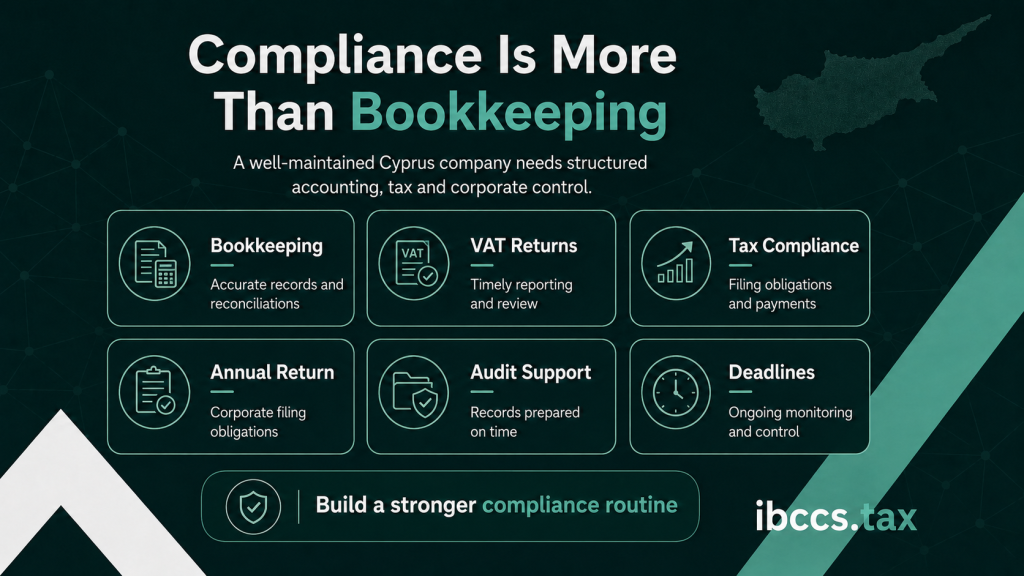
A Cyprus company may benefit from an attractive business environment, access to the European Union market, a developed professional services sector and a well-established corporate framework. However, these advantages are most effective when the company is properly maintained, its accounting records are accurate, and its tax and corporate obligations are monitored on an ongoing basis. In practical terms, staying compliant in Cyprus means much more than submitting one tax return at the end of the year. It involves bookkeeping, accounting records, VAT review, tax filings, Annual Return obligations, audit preparation, payroll where applicable, corporate administration, deadline monitoring and regular communication with advisors.
Many compliance issues do not arise because a company intentionally ignores its obligations. They often arise because the compliance process is fragmented. Documents may be collected too late. Bank reconciliations may be delayed. VAT questions may be reviewed only shortly before a deadline. Corporate filings may be treated separately from tax compliance. The company may grow, but its accounting and reporting procedures may remain informal.
This is why the choice of the right accounting and tax partner in Cyprus is so important. A good partner does not simply process documents. A good partner helps a company create structure, maintain control and identify potential compliance risks before they become urgent.
At IBCCS TAX, we support companies in Cyprus with accounting, VAT, tax compliance, corporate filings and ongoing advisory. Our role is to help business owners keep their companies organised, compliant and ready for the next stage of growth.
Why Compliance in Cyprus Should be Managed Throughout the Year
Compliance is often associated with deadlines. In reality, good compliance starts much earlier. A company that waits until the end of the year to organise its accounting records may face unnecessary pressure. Missing invoices, unreconciled bank accounts, unclear supplier balances, incorrect VAT treatment or incomplete documentation can all create delays and additional work. The same applies when tax obligations, payroll matters or Annual Return filings are not tracked throughout the year.
A structured compliance process helps the company maintain clarity. It allows management to understand the company’s financial position, identify reporting obligations in advance and avoid treating compliance as a last-minute emergency.
For Cyprus companies, year-round compliance usually includes:
- regular bookkeeping;
- collection and organisation of accounting documents;
- bank reconciliations;
- review of invoices and expenses;
- VAT monitoring and VAT return preparation where applicable;
- review of tax obligations and filing deadlines;
- preparation for annual financial statements and audit procedures;
- Annual Return and corporate filing coordination;
- payroll and social insurance compliance where employees are involved;
- ongoing review of deadlines and outstanding obligations.
This process should be practical and proportionate. A small local trading company, a Cyprus holding company, a consulting business, an e-commerce company and a group structure will not all have the same needs. However, they all require a clear compliance framework. The key is not to overcomplicate administration. The key is to ensure that the company has the right level of support for its size, activity, risk profile and reporting obligations.
What Does Staying Compliant in Cyprus Mean For a Company?
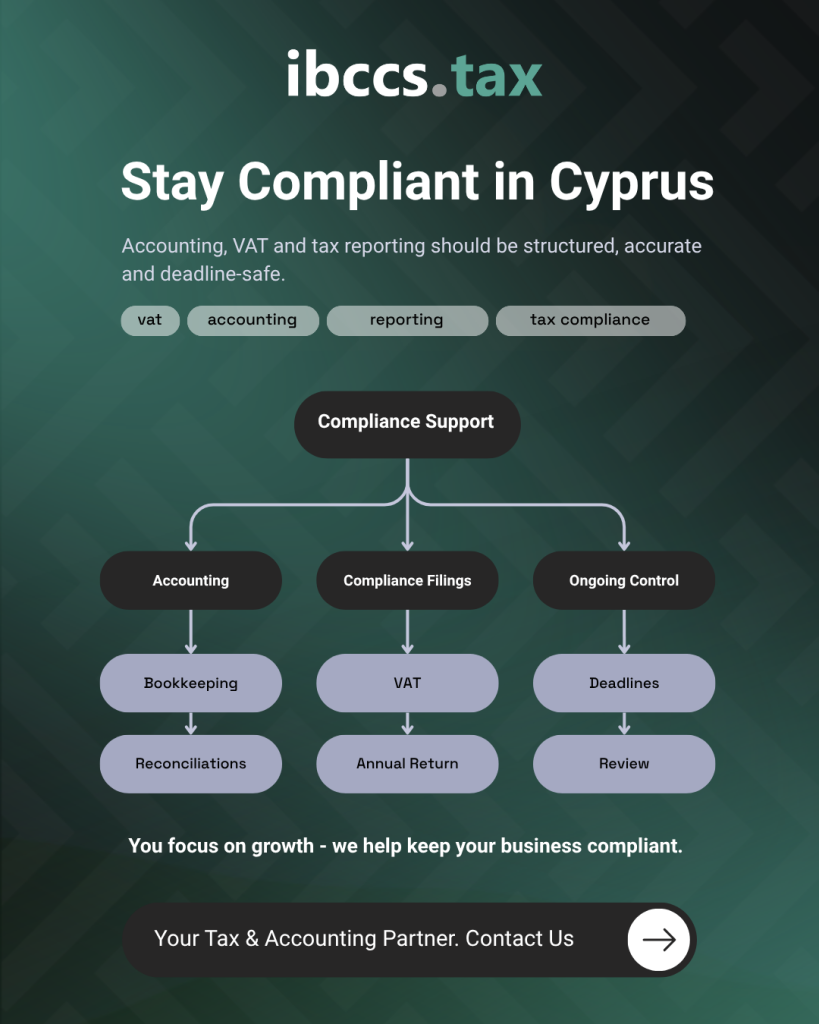
Staying compliant in Cyprus means ensuring that the company meets its accounting, tax, VAT and corporate obligations in a timely and accurate manner. For many companies, this includes several connected areas:
Accounting records
The company should maintain accurate accounting records that reflect its transactions, income, expenses, assets and liabilities. These records support tax filings, VAT reporting, audit preparation and management decision-making.
Learn more about our Accounting Services in Cyprus
Bookkeeping and reconciliations
Invoices, receipts, bank statements and supporting documents should be recorded and reconciled regularly. Reconciliations help identify missing documents, incorrect entries, unpaid invoices and unexplained balances.
Learn more about Bookkeeping services in Cyprus
VAT reporting
Where VAT registration and VAT reporting are required, the company must ensure that VAT returns are prepared accurately and submitted on time. VAT treatment should also be reviewed when the business has cross-border transactions, digital services, EU clients, non-EU clients or complex invoicing arrangements.
Learn more about VAT registration & De-registration in Cyprus
Tax compliance
Tax compliance may include corporate income tax matters, provisional tax, tax returns, payment deadlines, tax computations and supporting documentation. For companies with international activity, tax treatment may require additional review.
Annual Return and corporate filings
Cyprus companies have corporate compliance obligations, including the Annual Return. This is not simply a tax matter. It forms part of the wider administration and maintenance of the company.
Learn more about Annual Return for Cyprus companies
Audit and financial statements
Where applicable, the company should be prepared for the annual audit process. Good accounting records make audit coordination more efficient and reduce the risk of delays.
Learn more about Audit for Cyprus companies and Financial Statements for Cyprus companies
Payroll and social insurance
Companies with employees or directors receiving remuneration may also need payroll, PAYE and social insurance support.
Learn more about Payroll Services in Cyprus
Ongoing review
Compliance is not only about filing forms. It also involves monitoring whether the company’s activity has changed in a way that creates new obligations.
These areas are connected. Weak bookkeeping can affect VAT reporting. Late reconciliations can affect tax preparation. Missing corporate filings can affect the company’s good standing. Poor communication can create unnecessary delays. That is why accounting, tax and corporate compliance should be managed as one coordinated process.
Accounting is the Foundation of Tax Compliance in Cyprus
Accounting is often viewed as a back-office function. In reality, it is the foundation of tax compliance and financial control. Reliable accounting records help the company understand its position and meet its obligations. They support VAT returns, tax filings, audit preparation, management accounts, cash flow planning and communication with banks, investors or advisors.
When bookkeeping is updated regularly, the company can identify issues early. For example, management can see whether customer invoices remain unpaid, whether expenses are supported by proper documentation, whether supplier balances are correct and whether bank accounts reconcile with accounting records. When accounting records are delayed, the opposite happens. Questions accumulate. Documents become harder to locate. VAT positions are reviewed too late. Audit preparation becomes more difficult. Management may not have a clear financial picture when making business decisions.
For companies in Cyprus, professional accounting support in Cyprus is therefore not only about compliance. It is also about visibility and control.
A strong accounting process should help answer practical questions such as:
- Are all invoices and expenses recorded correctly?
- Are bank accounts reconciled?
- Are intercompany balances properly tracked?
- Are VAT transactions classified correctly?
- Are accounting records ready for tax review?
- Is the company prepared for audit procedures?
- Are management reports available when needed?
- Are there outstanding liabilities that require attention?
Business owners do not need accounting for the sake of accounting. They need accounting that helps them run the company with confidence.
Bookkeeping in Cyprus Should be Accurate, Timely and Commercially Useful
Bookkeeping is one of the most basic elements of company compliance, but it is also one of the most important. If bookkeeping is inaccurate or delayed, the quality of tax and VAT reporting will suffer. The accountant may not have enough information to prepare filings properly. The tax advisor in Cyprus may not have the data needed to identify relevant issues. The auditor may need additional time to review the records.
Good bookkeeping should not be limited to recording transactions mechanically. It should be structured in a way that reflects the company’s actual business activity. For example, a company may need to track:
- local and international sales;
- EU and non-EU clients;
- service income and product income;
- reimbursed expenses;
- director expenses;
- payroll costs;
- related-party transactions;
- intercompany loans;
- supplier payments;
- professional fees;
- recurring subscriptions;
- bank charges and payment processor fees.
The more international or complex the company’s activity becomes, the more important proper classification is. This is particularly relevant for Cyprus companies used by international entrepreneurs, consultants, holding structures, technology businesses, e-commerce operators or groups with cross-border transactions. These companies may have straightforward legal structures, but their accounting can still require careful treatment.
VAT Compliance in Cyprus Requires Regular Monitoring
VAT is one of the areas where regular review is especially important. Not every Cyprus company is automatically required to register for VAT. The need for VAT registration and VAT reporting depends on the company’s activity, turnover, transaction type, place of supply rules and other relevant factors.
For companies that are VAT registered, VAT compliance is not only about submitting a return. It may involve reviewing invoices, checking input VAT, assessing output VAT, considering cross-border treatment, monitoring VIES obligations where applicable and maintaining supporting records. VAT can become particularly important where a company in Cyprus:
- provides services to EU or non-EU clients;
- receives services from foreign suppliers;
- sells goods or digital products;
- works with marketplaces or payment platforms;
- has intra-EU transactions;
- issues invoices to business and non-business customers;
- has mixed taxable and exempt activities;
- incurs significant input VAT.
A last-minute VAT review can create unnecessary risk. If VAT treatment is unclear, it is better to address the issue before invoices are issued or contracts are finalised. A proactive accounting and tax partner in Cyprus can help the company understand whether VAT obligations apply, what records should be maintained and how VAT reporting should be handled.
Tax Compliance in Cyprus Should be Linked to the Company’s Real Activity
Tax compliance should reflect the commercial reality of the company. A Cyprus company may be used for trading, consulting, intellectual property, holding activities, investment activity, group operations or local business. Each business model may create different tax questions.
For example, the tax position of a local service company may be very different from the tax position of an international holding company. A company with employees may have different obligations from a company with no payroll. A company with cross-border transactions may require more detailed review than a purely domestic business. Tax compliance may involve:
- corporate tax return preparation;
- provisional tax considerations;
- review of deductible expenses;
- analysis of income streams;
- review of related-party transactions;
- withholding tax considerations where relevant;
- assessment of supporting documentation;
- coordination with accounting records;
- review of deadlines and payment obligations.
For international companies, tax compliance should also be coordinated with the wider structure. This is especially important when the company has shareholders, directors, clients, suppliers or related entities in other jurisdictions. Good tax compliance is therefore not only technical. It is also practical. It should be based on how the company actually operates.
Annual Return and Corporate Filings Are Part of Compliance
For Cyprus companies, compliance is not limited to accounting and tax. The Annual Return in Cyprus is an important corporate filing obligation. It relates to the company’s statutory information and forms part of the broader corporate compliance framework.
Corporate compliance may also involve keeping company records updated, maintaining information about directors, shareholders, secretary, registered office, share capital and other statutory matters. This distinction matters. Some business owners think only about tax compliance, while corporate filings are treated as secondary administrative matters. In practice, both areas are important for maintaining a company properly.
A company may be tax-compliant but still have corporate administration issues. Equally, a company may have its corporate records in order but still have weak accounting or tax reporting. A well-maintained Cyprus company should address both. This is why it is often useful to work with a provider that understands the connection between accounting, tax compliance and corporate administration.
Compliance is Broader Than Accounting and Tax
Although this article focuses mainly on accounting, VAT and tax compliance, company administration can be broader.
Different companies may require different levels of support depending on their activity, ownership structure, management, employees, banking needs, regulatory profile and international exposure. In addition to accounting and tax services, a Cyprus company may need support with:
- registered office services;
- company secretary services;
- corporate resolutions;
- changes of directors or shareholders;
- share transfers or share capital changes;
- certificates and company searches;
- powers of attorney;
- payroll administration;
- social insurance registration and declarations;
- UBO-related matters;
- banking support;
- audit coordination;
- substance-related documentation;
- international tax structuring support.
Not every company needs all of these services. A small owner-managed business may require a practical accounting and VAT package. A foreign-owned company may require accounting, corporate administration and tax advisory. A group company may need more detailed reporting, intercompany documentation and cross-border tax review. The important point is that compliance support should match the company’s real situation. A one-size-fits-all approach is rarely the best solution.
Why Deadlines Matter for Cyprus Companies
Deadline management is a core part of compliance. Even when a company has good intentions, problems can arise if obligations are not monitored. A missed deadline can create administrative pressure, additional work and unnecessary disruption.
Deadlines may relate to accounting, VAT, tax filings, payments, payroll, Annual Return, audit preparation or corporate filings. The exact calendar depends on the company’s circumstances. A proper compliance calendar helps ensure that:
- documents are collected on time;
- accounting records are updated regularly;
- VAT matters are reviewed before filing deadlines;
- tax payments are planned in advance;
- audit preparation is not delayed;
- Annual Return filing is monitored;
- management knows what is due and when.
This is where a reliable accounting and tax partner adds value. The business owner should not need to manage every compliance deadline manually. The role of the advisor is to help create a system where obligations are visible, tracked and handled in a timely manner.
The Value of a Proactive Accounting and Tax Partner in Cyprus
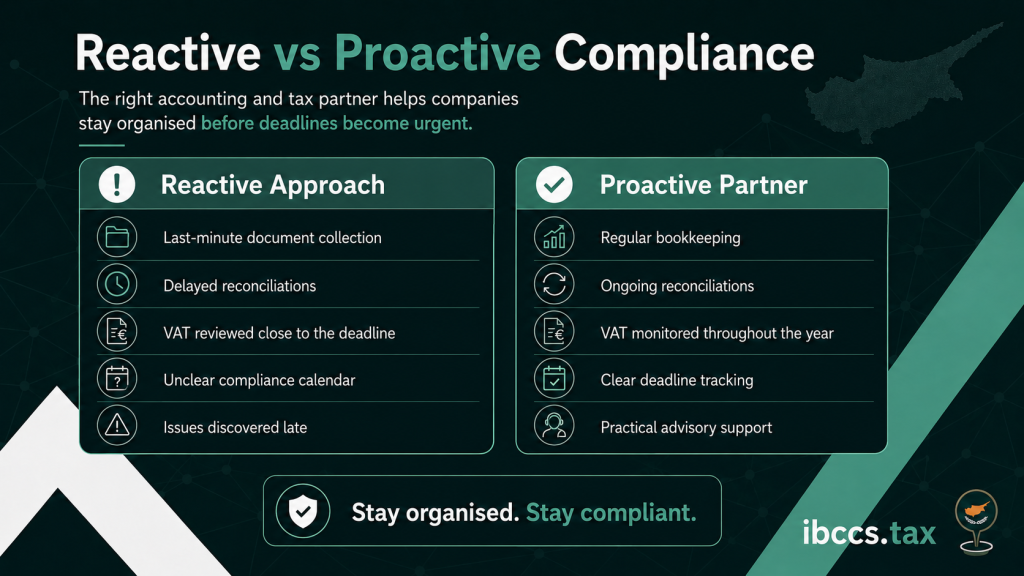
The difference between a reactive provider and a proactive partner can be significant. A reactive provider may only ask for documents shortly before a deadline. A proactive partner helps the company establish a routine. A reactive provider may only process information. A proactive partner asks questions when something does not look right. A reactive provider may focus on filings. A proactive partner also considers whether the accounting and tax process supports the business.
For companies in Cyprus, the right partner should help with:
- setting up a practical accounting process;
- advising what documents should be collected;
- maintaining accurate books;
- performing regular reconciliations;
- reviewing VAT obligations;
- preparing VAT returns;
- supporting tax compliance;
- coordinating Annual Return and corporate filings;
- preparing for audit;
- monitoring key deadlines;
- advising when transactions may require additional tax review.
This does not mean that every issue requires complex advisory work. Many companies simply need disciplined accounting, timely filings and clear communication. However, when more complex matters arise, it is important that the accounting partner knows when to involve tax advisors or other specialists.
International Business Owners Need Coordinated Cyprus Support
Many companies established through company registration in Cyprus are owned or managed by international entrepreneurs, investors or groups. In such cases, compliance can be more complex because the business may involve several jurisdictions. For example, a Cyprus company may have:
- foreign shareholders;
- non-resident directors;
- clients outside Cyprus;
- suppliers in the EU or outside the EU;
- related companies in other countries;
- international bank accounts;
- remote employees or contractors;
- cross-border service flows;
- holding or investment activity.
These features do not automatically create problems. However, they do mean that accounting and tax compliance should be reviewed carefully. International business owners often need a partner who can explain Cyprus obligations clearly, communicate in a practical way and coordinate accounting, tax and corporate administration under one framework.
At IBCCS TAX, we work with local and international clients who require Cyprus accounting, VAT, tax compliance and wider business advisory support. Our experience with cross-border matters allows us to support companies not only from a local filing perspective, but also from a broader operational and structuring perspective.
Signs Your Cyprus Company May Need Stronger Compliance Support
A company may benefit from reviewing its accounting and tax support if:
- accounting records are updated only shortly before deadlines;
- VAT returns are prepared under time pressure;
- bank reconciliations are not performed regularly;
- management does not have a clear overview of compliance deadlines;
- Annual Return or corporate filings are not actively monitored;
- there is uncertainty about outstanding tax or VAT obligations;
- the company has grown but its accounting process has not changed;
- communication with the accountant is mostly reactive;
- invoices and expenses are not clearly classified;
- cross-border transactions are increasing;
- the company has employees but payroll and social insurance processes are not clearly organised;
- management does not receive practical explanations of what needs to be done and why.
These signs do not necessarily mean that a company has a serious compliance problem. However, they may indicate that the compliance process needs to become more structured. A company should not wait until a deadline, audit request or tax query creates pressure. It is better to review the process early and establish a routine that supports the business throughout the year.
Cyprus Company Compliance Checklist for Business Owners
Every company is different, but the following checklist can help business owners assess whether their Cyprus company is properly organised.
- Bookkeeping
The company should maintain accurate records of invoices, expenses, receipts, bank statements and supporting documents.
- Reconciliations
Bank accounts, customer balances, supplier balances and key accounting records should be reconciled regularly.
- VAT review
The company should understand whether VAT registration is required and whether VAT returns, VIES reporting or other VAT-related obligations apply.
- Tax compliance
Tax filing deadlines, tax computations and payment obligations should be monitored throughout the year.
- Annual Return
The company’s Annual Return and related corporate filing obligations should be tracked and handled properly.
- Audit preparation
Accounting records and supporting documents should be prepared in a timely manner for the annual audit where applicable.
- Corporate records
Information regarding directors, shareholders, secretary, registered office and share capital should be kept up to date.
- Payroll and social insurance
Where the company has employees or payroll obligations, PAYE, payroll records and social insurance matters should be properly managed.
- Management information
Business owners should be able to obtain meaningful financial information when needed, especially if the company is growing or making strategic decisions.
- Advisory review
Significant transactions should be discussed with an accountant or tax advisor before they are completed, not only after they have already happened.
How IBCCS TAX Supports Cyprus Companies
IBCCS TAX provides accounting, tax compliance, VAT, corporate services and advisory support for companies in Cyprus. Our team assists local and international clients with practical, commercially grounded support designed to help companies remain organised and compliant.
Depending on the needs of the company, our support may include:
- bookkeeping and accounting records;
- preparation of financial reports;
- VAT registration and VAT return support;
- VIES reporting where applicable;
- tax compliance and tax return support;
- Annual Return coordination;
- corporate filing support;
- audit coordination;
- payroll and social insurance support;
- ongoing advisory for business owners;
- support for international structures and cross-border matters.
We understand that different businesses have different needs. Some companies require basic bookkeeping and VAT support. Others require a more comprehensive accounting, tax and corporate administration package. More complex international structures may require ongoing advisory and coordination across jurisdictions. Our objective is to help each company build a compliance process that is practical, reliable and appropriate for its activity.
Compliance is a Business Routine, Not a Year-end Emergency
Staying compliant in Cyprus requires structure, consistency and communication. For business owners, the value of good compliance is not only avoiding problems. It is also peace of mind. When the accounting records are accurate, VAT matters are monitored, tax filings are planned, corporate obligations are tracked and deadlines are under control, management can focus on business growth.
A well-maintained Cyprus company is easier to manage, easier to audit, easier to explain to banks or investors and better prepared for future opportunities. Compliance should not be seen as a burden. It should be treated as part of the company’s operating discipline. At IBCCS TAX, we help Cyprus companies stay organised, compliant and deadline-safe through accounting, VAT, tax compliance, corporate filings and ongoing advisory support. You focus on growth – we help keep your business compliant.
Need Accounting and Tax Compliance Support in Cyprus?
If your company requires accounting, VAT, tax compliance or corporate filing support in Cyprus, IBCCS TAX can assist you with a structured and practical approach. Contact our team to discuss how we can support your company’s ongoing compliance and help you maintain better control over your obligations.
Frequently Asked Questions
1. What does company compliance in Cyprus include?
Company compliance in Cyprus usually includes accounting records, bookkeeping, VAT reporting where applicable, tax filings, audit coordination, Annual Return filing, corporate record maintenance, payroll where relevant and monitoring of applicable deadlines.
2. Does every Cyprus company need accounting records?
Yes. Cyprus companies should maintain proper accounting records that reflect their transactions, income, expenses, assets and liabilities. These records support tax compliance, audit preparation and business management.
3. What is the Annual Return in Cyprus?
The Annual Return is a corporate filing obligation for Cyprus companies. It relates to the company’s statutory information and forms part of the broader corporate compliance framework.
4. Is VAT registration required for every Cyprus company?
Not every Cyprus company is automatically required to register for VAT. VAT obligations depend on the company’s activity, turnover, transaction type and other relevant factors. A review should be carried out to determine whether VAT registration or VAT reporting is required.
5. Why is regular bookkeeping important for tax compliance?
Regular bookkeeping ensures that financial data is accurate and available when needed. It supports VAT reporting, tax return preparation, audit work, management decisions and deadline planning.
6. Why should a company use one partner for accounting and tax compliance?
Using one coordinated accounting and tax partner can improve communication, reduce gaps between bookkeeping and tax reporting, and help ensure that deadlines, filings and advisory matters are managed consistently.
7. Can IBCCS TAX support foreign-owned Cyprus companies?
Yes. IBCCS TAX supports Cyprus companies owned by local and international business owners, including entrepreneurs, investors and groups with cross-border structures. Our team assists with accounting, VAT, tax compliance, corporate filings and ongoing advisory.
Cyprus Tax Calendar 2027: Key Tax Deadlines for Individuals and Companies
Cyprus tax compliance does not revolve around one annual deadline.
Read More
Tax on Dividends in Cyprus: SDC, GHS, Non-Dom and Company Distributions
Dividend taxation in Cyprus changed materially from 1 January 2026.
Read More
Payroll in Cyprus: PAYE, Social Insurance, GHS and Employer Obligations
Payroll in Cyprus is more than transferring a net salary
Read More