
Choosing the right Cyprus accountant is an important decision for every company operating in or through Cyprus. Accounting is not only about recording invoices or preparing annual filings. For companies, entrepreneurs and international business owners, the right accounting firm in Cyprus should help maintain compliance, support tax efficiency, provide reliable reporting and identify issues before they become costly problems.
Cyprus remains one of the most attractive business jurisdictions in the European Union, particularly for international companies, holding structures, consultants, technology businesses, investment activities and entrepreneurs relocating to the island. However, a Cyprus company also has ongoing accounting, tax, VAT, payroll and corporate compliance obligations that must be managed correctly.
At IBCCS TAX, we provide accounting services in Cyprus for local and international companies, combining practical bookkeeping and compliance support with broader tax advisory and corporate services. This integrated approach is especially important for businesses that need more than basic accounting.
What Does a Cyprus Accountant Do?
A Cyprus accountant supports a company with the financial records, tax filings and compliance obligations required to operate properly in Cyprus. The exact scope depends on the size of the company, the type of activity, the number of transactions, whether the company is VAT registered, whether it has employees and whether it operates internationally.
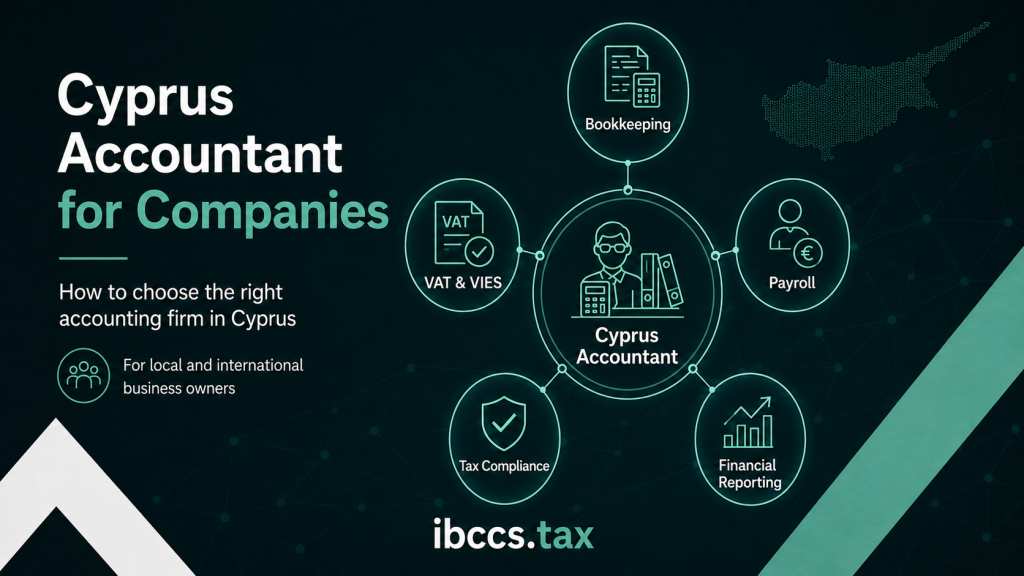
For a Cyprus company, accounting support may include:
- bookkeeping and maintenance of accounting records;
- classification and reconciliation of invoices, receipts and bank transactions;
- preparation of management accounts;
- VAT registration and VAT return preparation;
- VIES reporting, where applicable;
- payroll and social insurance support;
- preparation of financial statements;
- coordination with auditors, where audit is required;
- corporate income tax return support;
- annual return and corporate compliance coordination;
- communication with the Cyprus Tax Department and other authorities;
- advisory support linked to accounting, tax and business operations.
A professional accountant in Cyprus should not only process financial information. They should also help the company understand its obligations, monitor deadlines and maintain accurate records that support both tax compliance and business decision-making.
Why Companies Need Reliable Accounting in Cyprus
Every Cyprus company must maintain proper accounting records. These records are the foundation for financial statements, tax filings, VAT compliance, corporate reporting and potential communication with authorities.
For international companies, reliable accounting is even more important. A company may have foreign clients, foreign shareholders, overseas income, multiple currencies, intra-group transactions, cross-border services, directors in different jurisdictions or substance requirements that need to be reflected correctly in the records. Poor accounting can lead to practical and regulatory problems, including:
- missed tax or VAT deadlines;
- inaccurate financial statements;
- incorrect VAT treatment;
- weak documentation for business expenses;
- payroll or social insurance issues;
- lack of clarity on company profitability;
- difficulty preparing for audit;
- problems with banks or payment providers;
- challenges when applying for tax residency certificates;
- increased risk during tax authority reviews.
A good Cyprus accountant helps reduce these risks by keeping the company’s records accurate, organised and aligned with its actual business activity.
Accountant, Bookkeeper, Tax Advisor and Auditor: What Is the Difference?
When choosing an accounting firm in Cyprus, it is useful to understand the difference between several roles that are often connected but not identical.
A bookkeeper usually handles day-to-day recording of financial transactions. This may include invoices, expenses, bank reconciliations and basic categorisation of accounting data.
An accountant provides wider accounting and compliance support. This may include bookkeeping review, management accounts, VAT returns, payroll, tax return preparation, financial statements and communication with authorities.
A tax advisor focuses on tax planning, structuring, interpretation of tax rules and risk assessment. Tax advisory becomes important when a company is being registered, restructured, expanding internationally, applying for tax residency, reviewing VAT exposure or planning how profits should be distributed. You can read more in our guide on how to choose a tax consultant in Cyprus and our article on when professional tax advisory becomes essential.
An auditor reviews or audits financial statements in accordance with the applicable requirements. In Cyprus, audit and accounting are related but separate functions. A company may need accounting support throughout the year and audit coordination after the financial statements are prepared.
For many companies, the best solution is not choosing only one type of support, but working with a firm that can coordinate accounting, tax, VAT, payroll and corporate compliance in a consistent way.

Key Accounting Obligations for Cyprus Companies
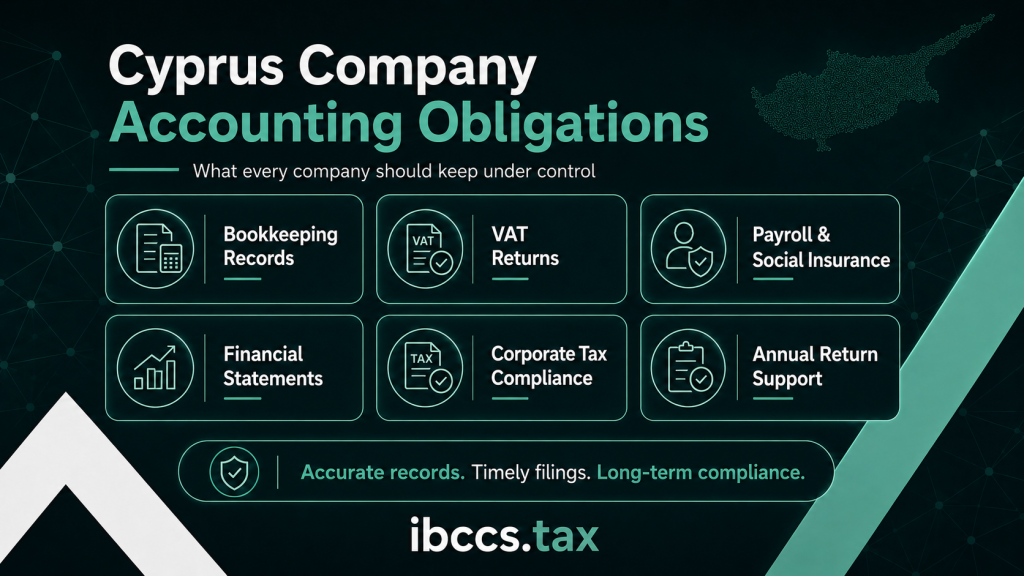
A Cyprus company must keep proper accounting records and comply with recurring tax and corporate obligations. The exact requirements depend on the company’s activity, size, registration status and structure, but the main areas usually include the following.
Bookkeeping and Accounting Records in Cyprus
Companies must maintain accurate books and records that reflect their transactions. This includes sales invoices, purchase invoices, bank statements, expense documentation, contracts, payroll records and other financial information.
The quality of bookkeeping affects everything that follows: VAT returns, tax filings, management accounts, financial statements and audit preparation.
Financial Statements in Cyprus
Cyprus companies generally need financial statements prepared in accordance with applicable accounting standards. These statements form the basis for tax compliance, corporate reporting and audit, where required.
Accurate financial statements also help company owners understand profitability, assets, liabilities and the financial position of the business.
Corporate Income Tax Compliance in Cyprus
A Cyprus company must assess and report its taxable income. Corporate tax compliance requires accurate accounting records, proper classification of expenses and income, and consideration of tax adjustments where applicable.
For businesses operating internationally, corporate tax compliance may also involve reviewing income sources, related-party transactions, management and control, withholding tax considerations and double tax treaty implications.
VAT and VIES in Cyprus
VAT can be one of the most important compliance areas for Cyprus companies. Whether VAT registration is required depends on the nature of the business, turnover, type of services or goods supplied, customer location and cross-border activity.
Businesses providing services to EU or non-EU clients should pay particular attention to place of supply rules, reverse charge treatment, input VAT recovery and invoicing requirements.
IBCCS TAX provides VAT administration services in Cyprus and VIES administration services for companies that need support with VAT registration, reporting and ongoing compliance.
Payroll and Social Insurance in Cyprus
If a Cyprus company employs staff, it must comply with payroll, social insurance and employer reporting obligations. Payroll should be handled carefully, especially when employees, directors, contractors or internationally mobile individuals are involved.
Payroll errors can create tax, social insurance and employment-related issues. Professional support helps ensure that calculations, declarations and payments are handled correctly.
Annual Return and Corporate Compliance in Cyprus
Accounting is closely connected with corporate administration. A Cyprus company may need support with annual returns, corporate records, UBO filings and other recurring obligations.
A reliable accounting firm should help clients understand which obligations are included in the service scope and which require separate corporate, legal or administrative support.
When Should You Appoint an Accountant in Cyprus?
A company should ideally appoint an accountant as soon as possible after incorporation, and in many cases even before the company starts trading. Early accounting setup helps ensure that invoices, bank accounts, expenses, VAT treatment and records are organised correctly from the beginning. You should speak to a Cyprus accountant when:
- registering a new Cyprus company;
- opening a business bank account or payment provider account;
- issuing the first invoices;
- receiving payments from local or international clients;
- considering VAT registration;
- hiring employees or paying directors;
- working with contractors or related companies;
- operating across borders;
- preparing financial statements;
- switching from another accounting provider;
- reviewing whether your current accounting records are complete;
- preparing for growth, investment or restructuring.
For new companies, accounting setup should not be treated as an afterthought. Correct systems and procedures at the beginning can prevent delays, errors and compliance problems later.
How to Choose the Right Cyprus Accountant for Your Company
Choosing the right accountant in Cyprus requires more than comparing monthly fees. The accounting firm should understand your business model, your compliance obligations and the level of support you actually need.
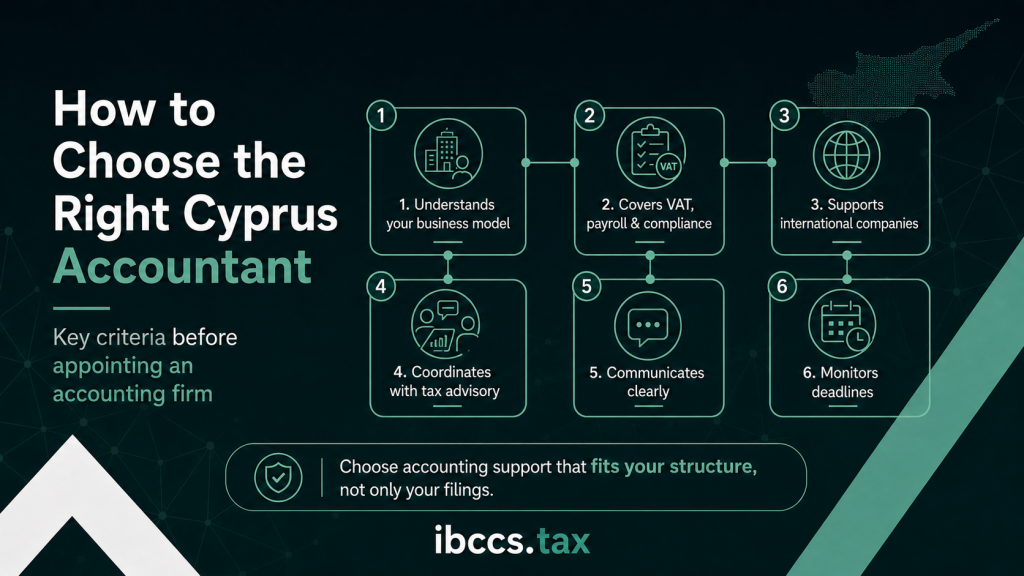
Check Whether They Understand Your Business Activity
A Cyprus accountant should understand how your company earns income. A service company, holding company, trading business, consulting company, technology business and investment structure may each have different accounting and tax considerations.
The accountant should ask practical questions about your activity, clients, jurisdictions, invoices, bank accounts, contracts, employees, shareholders and expected transaction volume.
Confirm the Scope of Services
Accounting service packages can vary significantly. Before appointing an accounting firm, it is important to understand what is included. Key points to clarify include:
- bookkeeping frequency;
- VAT return preparation;
- VIES reporting;
- payroll support;
- management accounts;
- tax return support;
- financial statement preparation;
- audit coordination;
- annual return support;
- communication with authorities;
- advisory support;
- deadline monitoring.
A clear scope helps avoid misunderstandings later.
Make Sure VAT and Tax Compliance Are Covered
VAT and tax compliance are areas where many companies need proactive support. Your accountant should be able to identify whether VAT registration may be required, how invoices should be issued and whether the company’s transactions create specific reporting obligations.
For companies with cross-border clients or suppliers, this becomes especially important.
Look for International Experience
Many Cyprus companies are owned or managed by international entrepreneurs, investors or groups. In these cases, accounting cannot be viewed only from a local perspective. International experience matters when the company has:
- foreign shareholders;
- directors in different jurisdictions;
- international clients;
- foreign bank accounts or payment providers;
- intra-group transactions;
- cross-border services;
- intellectual property income;
- substance considerations;
- tax residency certificate needs;
- double tax treaty considerations.
An accountant with international experience can help ensure that records, reporting and compliance support the wider tax and business structure.
Consider Communication and Responsiveness
Good accounting support depends on clear communication. The company should know what documents are needed, when deadlines apply, what filings are due and whether any issue requires attention.
For foreign-owned Cyprus companies, communication in English and the ability to explain local obligations clearly are often essential.
Ensure Accounting and Tax Advisory Are Coordinated
Accounting records are not separate from tax planning. The way transactions are recorded, invoices are issued and expenses are documented can directly affect tax compliance. For companies that need wider planning, it is beneficial to work with a firm that can coordinate accounting with tax planning services in Cyprus, VAT, payroll, corporate services and international structuring.
Why Limassol-Based Accounting Support Can Be Valuable
Limassol is one of Cyprus’s main business centres and a key location for international companies, professional services, shipping, technology, investment and relocation activity. Many foreign-owned Cyprus companies, entrepreneurs and investors prefer working with accounting and tax professionals who understand the needs of international clients based in or connected to Limassol.
Working with accountants in Limassol, Cyprus can be particularly useful when a company needs direct access to a local team, coordination with tax advisors, support with banks or service providers, and practical understanding of the business environment. IBCCS TAX is based in Limassol and supports companies across Cyprus and internationally through accounting services in Cyprus, tax advisory, company formation and corporate compliance support.
Accounting for International and Foreign-Owned Cyprus Companies
Foreign-owned Cyprus companies often have more complex needs than purely local businesses. They may be part of an international group, owned by non-resident shareholders, managed by foreign directors or involved in cross-border transactions. In these cases, accounting should support the company’s wider tax and compliance position. This may involve documenting commercial activity, maintaining clear records, supporting substance, preparing reports for shareholders and ensuring that tax filings reflect the actual business model.
International companies should pay particular attention to:
- management and control;
- director and shareholder arrangements;
- transactions with related parties;
- cross-border invoicing;
- VAT treatment of international services;
- supporting documentation for expenses;
- banking and payment provider requirements;
- consistency between accounting records and corporate documents;
- tax residency certificate requirements;
- dividend and remuneration planning.
A Cyprus accountant for international companies should be able to work closely with tax advisors, corporate service providers and management to ensure that the company remains compliant and properly documented.
Common Mistakes When Choosing an Accountant in Cyprus
Choosing the wrong accounting support can create practical problems over time. Some of the most common mistakes include the following.
Choosing Based Only on the Lowest Fee
Low fees may look attractive, but accounting is a compliance-critical function. If the service does not include proper review, VAT support, communication or deadline management, the company may face additional costs later.
Not Clarifying What Is Included
Some companies assume that bookkeeping, VAT, payroll, tax returns, annual returns and audit coordination are all included in one package. In practice, these services may be priced separately.
The scope should be confirmed before engagement.
Separating Accounting from Tax Advice
A company may have technically correct bookkeeping but still have tax risks if the wider structure is not reviewed. Accounting and tax advisory should work together, particularly for international structures.
Ignoring VAT Until It Becomes a Problem
VAT should be considered early, especially for companies providing services across borders. Waiting too long can lead to incorrect invoices, missed registrations or filing issues.
Waiting Until Year-End
Accounting should be maintained throughout the year. Waiting until year-end can make it harder to reconstruct records, identify missing documents or correct issues before deadlines.
Assuming All Cyprus Accountants Provide International Support
Not every accountant has experience with foreign-owned companies, international structures, tax residency issues, cross-border VAT or management and control considerations. If your company operates internationally, this experience matters.
How Much Does an Accountant in Cyprus Cost?
Accounting fees in Cyprus depend on the company’s activity and complexity. There is no single price that applies to every company, because the workload can differ significantly. Factors that influence accounting fees include:
- number of monthly transactions;
- number of bank accounts and payment providers;
- VAT registration status;
- VIES reporting requirements;
- payroll and number of employees;
- volume of invoices and expenses;
- number of currencies;
- reporting frequency;
- management accounts requirements;
- corporate structure;
- related-party transactions;
- level of tax advisory support needed;
- whether the company requires additional corporate services.
A simple company with limited activity will usually require a different scope than a trading company, consulting business, technology company, holding structure or international group company. For this reason, IBCCS TAX provides accounting fee proposals based on the client’s actual situation, expected workload and compliance requirements.
How IBCCS TAX Supports Companies Looking for a Cyprus Accountant
IBCCS TAX provides accounting and compliance support for Cyprus companies, foreign-owned companies, entrepreneurs, investors and international business owners. Our services include bookkeeping, accounting records, VAT administration, VIES reporting, payroll support, management accounts, financial statement preparation support, tax compliance coordination and corporate administration support.
We also assist clients with company registration in Cyprus, tax planning services in Cyprus, VAT, payroll, tax residency planning and international structuring. This allows clients to work with one coordinated team rather than separating accounting, tax and corporate compliance into disconnected processes.
Our approach is practical and client-specific. We review the company’s business model, ownership structure, expected transaction volume, VAT position, payroll needs and international exposure before recommending the appropriate scope of accounting support.
Speak to a Cyprus Accountant
If you are registering a Cyprus company, operating an existing business or reviewing your current accounting arrangements, professional support can help you maintain compliance and make better business decisions.
IBCCS TAX supports companies with accounting services in Cyprus, including bookkeeping, VAT, payroll, tax compliance and reporting for local and international businesses. Contact us to discuss your company’s accounting needs and identify the right level of support.
Frequently Asked Questions – Cyprus Accountant for Companies
1. Do I need an accountant for a Cyprus company?
Yes. A Cyprus company must maintain proper accounting records and comply with tax, corporate and reporting obligations. An accountant helps keep the company’s records organised and supports filings such as VAT returns, tax compliance and financial reporting.
2. What does an accountant in Cyprus do?
An accountant in Cyprus may assist with bookkeeping, accounting records, VAT returns, VIES reporting, payroll, financial statements, corporate tax compliance, annual return support and communication with authorities.
3. How do I choose an accountant in Cyprus?
You should consider the accountant’s experience with Cyprus companies, VAT, payroll, tax compliance, international clients, communication standards, service scope and ability to coordinate accounting with tax advisory and corporate compliance.
4. What is the difference between an accountant and a tax advisor in Cyprus?
An accountant usually focuses on records, reporting, VAT, payroll and compliance. A tax advisor focuses on tax planning, structuring, interpretation of tax rules and risk assessment. Many companies need both types of support.
5. Is VAT included in accounting services in Cyprus?
VAT may be included or priced separately depending on the accounting firm and the scope of work. Companies should clarify whether VAT registration, VAT returns, VIES reporting and VAT advisory are included in the service package.
6. Do I need a Limassol accountant if my company is registered in Cyprus?
Not necessarily, but working with accountants in Limassol can be valuable for companies that want access to a local business hub, direct communication and support from professionals experienced with international clients and Cyprus-based companies.
7. Can a Cyprus accountant help with payroll?
Yes. If a Cyprus company has employees, an accountant or payroll provider can support salary calculations, payslips, social insurance obligations and employer reporting requirements.
8. Can IBCCS TAX support foreign-owned Cyprus companies?
Yes. IBCCS TAX supports foreign-owned Cyprus companies with accounting, VAT, payroll, tax compliance, company formation, corporate services and international tax advisory.
9. How much does accounting in Cyprus cost?
Accounting fees depend on the company’s activity, transaction volume, VAT status, payroll needs, reporting frequency, number of bank accounts, currencies and complexity of the structure. IBCCS TAX provides tailored fee proposals based on the actual scope of work.
10. Can IBCCS TAX support both accounting and tax advisory?
Yes. IBCCS TAX provides accounting services, tax planning, VAT support, company registration, corporate services and international structuring support in Cyprus. This helps clients maintain consistency between accounting records, tax compliance and wider business planning.
Cyprus Tax Calendar 2027: Key Tax Deadlines for Individuals and Companies
Cyprus tax compliance does not revolve around one annual deadline.
Read More
Tax on Dividends in Cyprus: SDC, GHS, Non-Dom and Company Distributions
Dividend taxation in Cyprus changed materially from 1 January 2026.
Read More
Payroll in Cyprus: PAYE, Social Insurance, GHS and Employer Obligations
Payroll in Cyprus is more than transferring a net salary
Read More