

Cyprus can provide an attractive operating and intellectual property framework for software as a service businesses, software developers and technology companies commercialising proprietary platforms. The Cyprus IP Box is often presented through its headline effective tax rate, but the real analysis begins much earlier: identifying the qualifying software, mapping who developed it, confirming who owns the relevant rights and determining which profits are genuinely connected to that intellectual property.
A SaaS company does not qualify simply because it sells access to software. Subscription revenue may include several economic components, such as the right to use proprietary code, hosting, onboarding, implementation, support, data services and other operational functions. The company must be able to distinguish the income attributable to qualifying intellectual property from income generated by non-qualifying services, marketing assets or third-party products.
The nexus approach also links the tax benefit to the company’s own research and development expenditure. In-house development and outsourcing to unrelated developers are generally treated differently from acquiring completed software or outsourcing development to associated companies. For international groups, the ownership model, transfer pricing, development agreements and substance in Cyprus can be as important as the software itself.
This guide explains how the Cyprus IP Box can apply to SaaS and software companies, the main qualification tests, the treatment of development and outsourcing, the records needed to support the nexus calculation and the situations in which a Cyprus tax ruling should be considered.

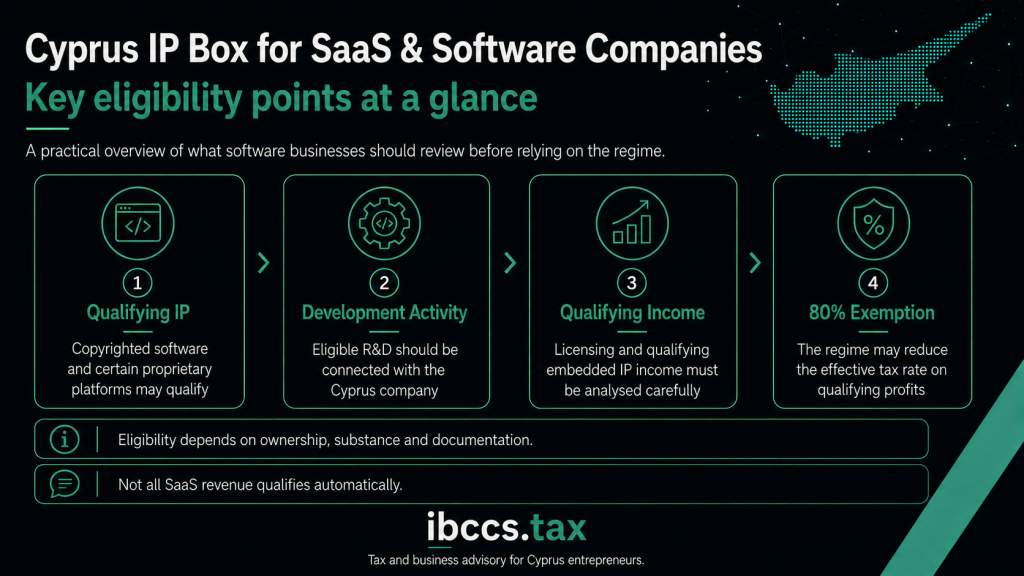
- Copyrighted software can qualify, but a SaaS business model or technology label does not create eligibility by itself.
- The Cyprus IP Box provides an 80% deduction on qualifying profits, not an 80% reduction of gross revenue.
- The commonly referenced 3% effective rate assumes that the relevant profit is fully qualifying under the nexus calculation.
- In-house R&D and development outsourced to unrelated parties can support the qualifying expenditure numerator.
- Software acquisition costs and development outsourced to related parties generally reduce the nexus fraction, subject to the permitted uplift.
- Trademarks, brands, domain names, customer lists, image rights and other marketing-related intangibles do not generally qualify.
- SaaS subscriptions may contain qualifying IP income and non-qualifying service income, which may require a supportable allocation.
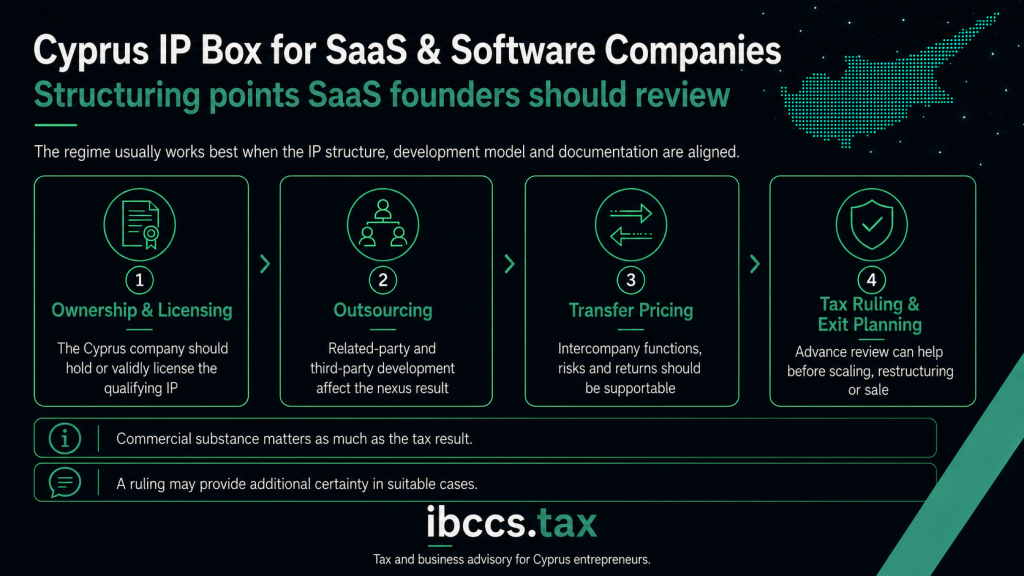
- The Cyprus company should have clear legal and economic rights to the software, supported by employment, contractor, assignment and licence agreements.
- Intercompany development, licensing and distribution arrangements must follow the arm’s-length principle and be supported by transfer pricing analysis.
- A tax ruling can provide greater certainty, but it does not replace annual nexus calculations, accounting records or ongoing compliance.
- Large multinational groups within the scope of Pillar Two should assess whether a local IP Box benefit may be affected by global minimum tax rules.
Quick Answer: Can a SaaS or Software Company Use the Cyprus IP Box?
Potentially, yes. Copyrighted software can be a qualifying asset under the Cyprus IP Box, and a Cyprus tax-resident company may claim an 80% deduction on qualifying profits calculated under the nexus approach. With the current 15% corporate income tax rate, the effective tax rate on fully qualifying IP profits may be approximately 3%.
The 3% figure is not an automatic rate applied to all SaaS revenue. The company must identify qualifying software, demonstrate the development activity connected with it, calculate the nexus fraction, allocate income and direct expenditure correctly and maintain reliable legal, technical, accounting and transfer pricing documentation.
Where software is acquired from another party, developed mainly by related companies abroad or bundled with substantial service income, only part of the profit may qualify, or the regime may not provide a meaningful benefit. A technical eligibility review should therefore be completed before the structure, contracts and accounting model are finalised.
Why SaaS Requires a More Detailed IP Box Analysis
A traditional licensing business may receive a clearly identified royalty for a specific intellectual property right. SaaS businesses are often more complex. Customers commonly pay one recurring fee for continuous access to a platform, hosting, updates, security, support, data processing and other services.
The tax analysis should therefore identify what the customer is paying for and which functions create the profit. A proprietary algorithm or software platform may be central to the service, but the business may also depend heavily on sales teams, customer success, implementation specialists, data suppliers, cloud infrastructure or regulated services. The IP Box applies to qualifying IP profit, not automatically to every margin earned by a technology company.
This distinction is especially important for platforms combining software with consulting, managed services, marketplace activity, advertising, payment processing or access to third-party content. The more mixed the revenue model becomes, the more important it is to design a clear allocation methodology and maintain records that can be reconciled with the company’s contracts and accounts.
How the Cyprus IP Box Works
Under the current Cyprus framework, up to 80% of qualifying profits derived from qualifying intangible assets may be deducted for corporate income tax purposes. Only the remaining 20% of the qualifying profit is subject to the standard corporate income tax rate.
With the standard Cyprus corporate income tax rate at 15%, fully qualifying IP profit can therefore produce a headline effective tax rate of approximately 3%. This result can be expressed as 15% corporate tax applied to 20% of qualifying profit.
The calculation has several stages. The company first determines the overall income attributable to the qualifying asset after relevant direct expenditure. The nexus fraction is then applied to establish the qualifying profit. The 80% deduction is applied to that qualifying profit, while any non-qualifying profit remains subject to the ordinary corporate tax treatment.
Why the 3% Effective Rate Is Not Automatic
A company may have copyrighted software and still obtain an effective rate above 3% on the overall product profit. This can happen where the nexus fraction is below 100%, part of the subscription relates to non-qualifying services, the software was acquired, development was outsourced to associated parties or the company cannot sufficiently track income and expenditure by asset.
The 3% rate should therefore be treated as a potential outcome for fully qualifying profits rather than as a general Cyprus tax rate for software businesses. A commercially realistic model should compare the expected IP Box benefit with the cost of development, substance, transfer pricing, accounting and annual compliance.
For a broader overview of the regime, see our guide to the Cyprus IP Box regime, qualifying assets and tax benefits.
Which Software and Technology Assets May Qualify?
The most relevant qualifying asset for a SaaS or software company is usually copyrighted software. Patents and certain other legally protected, innovative intangible assets may also qualify where the statutory conditions are satisfied.
The analysis should identify the specific asset rather than describing the business generally as a technology company. A platform may contain several software modules, applications, algorithms, APIs, databases, integrations and development layers. The company should determine whether these components form one qualifying asset, several identifiable assets or a broader product family requiring consistent tracking.
| Asset or right | Potential IP Box treatment |
| Proprietary SaaS platform | Potentially qualifying where the software is copyright-protected, identifiable and connected to qualifying R&D activity. |
| Internally developed application or software product | Potentially qualifying, subject to ownership, nexus, income and documentation requirements. |
| Patented technology or patented software-related invention | Potentially qualifying where the relevant patent rights and income are held by the claimant. |
| Algorithms and technical modules | May form part of qualifying copyrighted software, but should be mapped to the protected product and development records. |
| Mobile or web application | Potentially qualifying where the application is proprietary software and the company satisfies the wider conditions. |
| AI-enabled software product | Potentially qualifying where the proprietary software can be identified; the use of third-party models, data or APIs must be separated and documented. |
| Trademark, brand or product name | Generally non-qualifying because marketing-related intellectual property is excluded. |
| Domain name, customer list and goodwill | Generally non-qualifying. |
| Third-party software resold or white-labelled | The reseller does not normally have qualifying development expenditure or ownership of the underlying IP. |
| General know-how or business process | Does not automatically qualify unless it falls within a legally recognised qualifying category and satisfies the required conditions. |
Copyrighted Software Must Be More Than a Label
Calling a platform “proprietary” in marketing materials is not sufficient. The company should be able to describe what software it owns, how the product was created, which versions or modules generate revenue and how the rights were acquired from founders, employees and contractors.
Technical records can be highly relevant. Product specifications, source-code repositories, version histories, release notes, development tickets, architecture documents and testing records help demonstrate the existence and evolution of the software. These materials should be consistent with the legal agreements and accounting records used for the nexus calculation.
Open-Source Code and Third-Party Components
The use of open-source libraries, cloud infrastructure, third-party APIs or external tools does not necessarily prevent proprietary software from qualifying. Modern software products commonly combine proprietary and third-party components.
The company should nevertheless identify which elements it has developed and owns, comply with the relevant open-source and commercial licences and avoid treating third-party technology as if it were internally developed qualifying IP. Where a substantial part of the product value comes from licensed technology, the income and expenditure analysis may require further segmentation.
Does SaaS Subscription Revenue Qualify?
SaaS subscription income can potentially include qualifying income where customers pay for access to proprietary copyrighted software. The legal form of the customer contract is not the only consideration. The company must assess the economic source of the profit and identify any material non-qualifying elements included in the subscription.
Where software is licensed or made available through a hosted model, the qualifying income may be embedded in the product price rather than separately described as a royalty. A supportable methodology is therefore required to determine the profit attributable to the qualifying software.
| Revenue stream | Main IP Box consideration |
| Recurring access to proprietary SaaS software | Potentially qualifying to the extent the profit is attributable to the qualifying software. |
| Software licence fees | Potentially qualifying where the licence relates to qualifying IP owned or properly exploited by the Cyprus company. |
| Implementation and configuration | Often service income; may require separation from the software component. |
| Custom development for a client | Treatment depends on who owns the resulting IP and whether the company retains or transfers the rights. |
| Maintenance and product updates | May be connected to the qualifying software, but the facts and contractual model should be reviewed. |
| Customer support and managed services | Not automatically qualifying; material service margins may need to be excluded or separately analysed. |
| Marketplace commission | Depends on whether the profit derives from qualifying software or from intermediary and commercial functions. |
| Advertising revenue | Does not automatically qualify merely because advertisements are displayed through a software platform. |
| Data services and analytics | May require separation between proprietary software, data rights and service activity. |
| Resale of third-party software | Generally outside the company’s qualifying IP profit unless the company also owns qualifying proprietary components. |
| Sale or disposal of proprietary software | May require a separate analysis of the asset, transaction character, nexus, valuation and applicable tax rules. |
Mixed Contracts and Revenue Allocation
Many SaaS agreements combine platform access, onboarding, support and professional services within one price. The company should avoid allocating the entire contract margin to software without analysing the functions performed and value delivered.
A reasonable allocation may use separate pricing, cost-plus service margins, comparable standalone prices, usage data or another method consistent with the business model and transfer pricing principles. The methodology should be applied consistently and reconciled with invoicing, management reporting and statutory accounts.
Cyprus IP Box Eligibility Review
Before relying on the headline effective rate, map the software asset, development chain, revenue streams and nexus expenditure. IBCCS TAX can review whether the proposed structure is technically supportable and commercially practical. Request an IP Box eligibility review

The Nexus Fraction for Software Companies
The nexus approach is designed to ensure that the tax benefit follows genuine research and development activity. It limits the proportion of IP income that can receive preferential treatment by comparing qualifying expenditure with the overall expenditure incurred in relation to the asset.
In simplified form, the calculation is:
Qualifying profit = (Qualifying expenditure + permitted uplift) / Overall expenditure × Overall income
| Term | Practical meaning for a software company |
| Qualifying expenditure (QE) | R&D expenditure incurred by the Cyprus company itself and qualifying development outsourced to unrelated parties, subject to the applicable rules. |
| Uplift expenditure (UE) | A limited uplift designed to recognise certain acquisition and related-party outsourcing costs. It is generally capped at the lower of 30% of qualifying expenditure or the relevant acquisition and related-party outsourcing costs. |
| Overall expenditure (OE) | Qualifying expenditure plus relevant acquisition costs and development expenditure outsourced to associated parties. |
| Overall income (OI) | Net income derived from the qualifying asset after the relevant direct expenditure, calculated under the applicable rules. |
The fraction cannot exceed 100%. Where the Cyprus company performs or directly funds most of the qualifying development itself, the nexus result may be high. Where the company mainly holds acquired software or relies on related development companies abroad, the fraction may be materially lower.
In-House Development
Payroll and other direct R&D costs incurred by the Cyprus company in developing, improving and maintaining the qualifying software can generally support qualifying expenditure. The company should be able to identify which employees or founders performed development work, the projects they worked on and how the expenditure relates to the qualifying asset.
Not every employee cost is R&D expenditure. Sales, marketing, general administration, customer support and routine operational functions should not be included simply because they support the software business. Where individuals perform mixed roles, a reasonable and documented allocation may be required.
Development Outsourced to Unrelated Parties
Payments to independent, unrelated software developers or development studios can generally form part of qualifying expenditure where the work relates directly to the qualifying asset. The Cyprus company should control the project, bear the relevant development risk and obtain the required intellectual property rights under clear written agreements.
Invoices alone may not be sufficient. The company should retain statements of work, development specifications, delivery records, source-code access, acceptance documentation and evidence that the contractor is unrelated for nexus purposes.
Development Outsourced to Related Companies
Development performed by an associated company is generally included in overall expenditure but not in the core qualifying expenditure numerator. This can reduce the nexus fraction even where the related development company has a substantial technical team and performs genuine work.
This point is highly relevant to international software groups that place the IP owner in Cyprus while maintaining developers in another group company. The arrangement may still be commercially valid, but the expected IP Box result should be modelled before implementation, and the intercompany development fee must be supported under transfer pricing rules.
Acquired Software and Existing IP
The cost of acquiring completed software or intellectual property is generally included in overall expenditure rather than qualifying expenditure. A company that purchases a mature platform and performs little further development may therefore receive limited or no benefit under the nexus approach.
Further development after acquisition can improve the nexus position over time where the Cyprus company incurs qualifying expenditure connected with the asset. The company must retain historical expenditure data because the nexus calculation is cumulative over the life of the qualifying asset.
Who Should Own the Software?
The legal owner of the software should be identified before the IP Box calculation is considered. For early-stage SaaS businesses, code may initially be created by a founder personally, by freelancers or through a foreign company. Incorporating a Cyprus company does not automatically transfer those rights.
Employment and contractor agreements should address intellectual property ownership, confidentiality, source-code access and the assignment of rights. Where software is transferred to the Cyprus company, the transaction may require legal documentation, valuation, transfer pricing analysis and a review of tax consequences in both Cyprus and the jurisdiction from which the asset is transferred.
Developing the Software in the Cyprus Company From the Outset
A structure is generally easier to support where the Cyprus company commissions or performs development from the beginning, bears the cost and risk, owns the resulting rights and commercialises the product. This creates a clearer connection between the claimant, the qualifying expenditure and the income.
The company should still maintain proper contracts and product-level records. Founder involvement should be documented through employment, service or contribution arrangements rather than assumed informally.
Transferring Existing Software to Cyprus
Moving existing software into a Cyprus company can create immediate and long-term consequences. The transferor jurisdiction may impose tax on the disposal or migration of the intellectual property, and the asset should normally be transferred at an arm’s-length value where related parties are involved.
Acquisition cost can also reduce the Cyprus nexus fraction. A transfer should therefore not be recommended solely because the Cyprus company can potentially access the IP Box. The analysis should compare the tax cost of migration, future nexus, legal ownership, financing, transfer pricing, substance and the expected holding period.
Licence Model or Ownership Model
A Cyprus operating company may own the software, license it from another group company or license it to distributors and operating entities. Each model creates a different nexus, transfer pricing and substance position.
Where the Cyprus company only receives a contractual licence to use software owned elsewhere, it should not assume that it can claim the IP Box as if it owned and developed the underlying asset. The legal rights, development responsibilities, income stream and expenditure profile should be reviewed together.
Development Activity and Economic Substance in Cyprus
The nexus approach is expenditure-based, but the wider structure should also reflect commercial reality. A Cyprus IP company that claims to own and exploit core software should have the governance and operational capacity appropriate to its role.
The required level of substance depends on the business model. Relevant factors can include where product strategy is determined, who controls development, where technical and commercial decisions are made, where employees or contractors are managed, who bears product risk and where key contracts are negotiated and approved.
There is no universal headcount or office formula that guarantees eligibility. A founder-led software company with a focused local team can have a different but credible profile from a large international group. The important point is consistency between the company’s stated role, actual decision-making, expenditure, contracts, banking, payroll and accounting records.
Read more about Cyprus economic substance and practical operating requirements.
Transfer Pricing for SaaS and IP Structures
Transfer pricing becomes relevant whenever the Cyprus company enters into transactions with associated persons. Common examples include contract development, software licensing, central services, financing, distribution, technical support and the transfer of existing software.
The pricing should reflect the functions performed, assets used and risks assumed by each entity. For intellectual property structures, particular attention is normally given to the entities performing and controlling the development, enhancement, maintenance, protection and exploitation of the IP.
A Cyprus company should not receive the majority of group IP profit merely because the software is legally registered in its name. The return must be consistent with the company’s actual contribution, decision-making, financial capacity and risk control. Conversely, a Cyprus company that genuinely develops, manages and commercialises the software should ensure that intercompany agreements and pricing reflect that role.
Typical Controlled Transactions
- R&D or software development services provided by a related company to the Cyprus IP owner.
- Licensing of software by the Cyprus company to related operating or distribution companies.
- A Cyprus operating company paying royalties to a foreign IP owner.
- Transfer of existing software, source code or customer-related rights between group companies.
- Central management, technical, marketing or support services connected with the software business.
- Intercompany financing used to fund development or acquisition of IP.
Cyprus transfer pricing rules may require a Summary Information Table and, where the relevant thresholds are exceeded, a Local File. Even below the Local File threshold, the company should retain sufficient support for the arm’s-length nature of controlled transactions.
See our overview of Cyprus transfer pricing rules and documentation.
Should a SaaS Company Apply for a Cyprus IP Box Tax Ruling?
A Cyprus IP Box tax ruling is not a substitute for the legislation or annual compliance, but it can provide greater certainty on the intended treatment before a material structure is implemented.
A ruling is particularly relevant where the software product and revenue model are complex, the business combines IP and services, the development chain involves several jurisdictions, existing software will be transferred to Cyprus or the expected benefit is commercially significant.
Questions a Ruling Application May Address
- Whether the identified software falls within the qualifying asset category.
- How the proposed income stream is connected with the qualifying asset.
- The intended nexus methodology and treatment of development expenditure.
- The proposed allocation of mixed SaaS, licence and service income.
- The treatment of the ownership, licensing or development structure described in the application.
The ruling request should accurately describe the commercial facts and be supported by the relevant legal, technical and financial documents. A favourable ruling based on one set of facts may not protect a materially different operating model. Changes in development, ownership, revenue streams or group arrangements should therefore trigger a review.
IBCCS TAX assists with eligibility analysis, preparation and implementation of a Cyprus IP Box tax ruling application.
Accounting and Documentation for the Cyprus IP Box
A technically sound structure can still fail in practice if the company cannot produce reliable records. The nexus calculation requires cumulative expenditure tracking, while the qualifying profit calculation requires a clear connection between income, direct expenditure and the relevant asset.
For a SaaS business, the accounting system should be designed before the first annual calculation rather than reconstructed after the year-end. Product, project or cost-centre reporting can help separate qualifying development from support, marketing, hosting, implementation and other non-qualifying expenditure.
| Documentation area | Examples of supporting evidence |
| Legal ownership | Founder assignments, employment clauses, contractor assignments, licence agreements, acquisition documents and group agreements. |
| Technical evidence | Product specifications, source-code repositories, version history, release notes, development tickets and testing records. |
| Development expenditure | Payroll, contractor invoices, project allocations, time records and evidence of whether developers are related or unrelated. |
| Income by product or asset | Subscription reports, licence invoices, customer contracts, product-level management accounts and revenue allocation methodology. |
| Direct expenditure | Hosting, data, third-party licences, support, maintenance and other costs attributable to the relevant income stream. |
| Transfer pricing | Intercompany agreements, functional analysis, benchmarking, allocation keys and controlled-transaction documentation. |
| Corporate substance | Board records, product and investment decisions, local employment, premises, operational evidence and banking activity. |
| Annual nexus schedule | Cumulative qualifying expenditure, uplift, overall expenditure, overall income and reconciliation to the tax computation. |
Tracking Expenditure by Asset or Product Family
A company with one core platform may be able to maintain one coherent nexus schedule, provided the product and expenditure can be identified reliably. A company with several unrelated products, acquired modules or distinct software families may need separate tracking.
The chosen approach should reflect the way the business is managed and should not be changed opportunistically from year to year. Where expenditure supports several products, a reasonable allocation method should be documented and applied consistently.
Development Records for Founders and Mixed-Role Employees
Founders and senior employees often divide their time between coding, product strategy, fundraising, sales and management. Treating their entire remuneration as qualifying R&D expenditure may not be supportable.
Time records do not need to become unnecessarily burdensome, but the company should have a reasonable basis for identifying the development element. Project logs, tickets, sprint records and management allocations can support the accounting analysis when they reflect the actual work performed.
IBCCS TAX provides accounting services in Cyprus that can be coordinated with the annual IP Box and corporate tax calculation.
Illustrative Nexus Example for a Software Company
The following simplified example demonstrates why the effective rate can be higher than 3% when development is acquired or outsourced to related parties. It is provided only to illustrate the mechanics and does not replace a full tax computation.
| Illustrative item | Amount or result |
| Overall income from the software asset after relevant direct expenditure | €1,000,000 |
| Qualifying expenditure: own development and unrelated-party R&D | €400,000 |
| Related-party development expenditure | €200,000 |
| Acquisition cost of software or IP | €100,000 |
| Overall expenditure | €700,000 |
| Permitted uplift: lower of 30% of QE (€120,000) or relevant non-qualifying costs (€300,000) | €120,000 |
| Nexus fraction: (€400,000 + €120,000) / €700,000 | 74.29% |
| Qualifying profit: 74.29% × €1,000,000 | €742,900 |
The 80% deduction would apply to the qualifying profit of approximately €742,900. The remaining non-qualifying element of the overall income would continue to be taxed under the ordinary corporate rules. The resulting effective tax rate on the total €1,000,000 would therefore be higher than 3%.
The example also shows why an international group should model the nexus result before deciding where to place the IP and development functions. A lower Cyprus operating cost does not compensate for a weak nexus if most development is performed by related companies elsewhere.
IP Box Planning for Common SaaS Development Models
Founder Develops the Product and Relocates to Cyprus
A founder may arrive in Cyprus with a product that was partly developed personally or through a previous company. The first step is to establish who currently owns the source code and related rights. A transfer or contribution to the Cyprus company should be documented and valued, and any tax consequences in the previous jurisdiction should be reviewed.
Future development performed or commissioned by the Cyprus company can support the nexus position, but historical acquisition cost and development data may remain relevant. The founder’s ongoing technical and management roles should also be documented through an appropriate legal and remuneration arrangement.
Cyprus Company With Local Developers
A Cyprus company employing or directly engaging developers and commercialising its own software can present a strong factual profile. The company should maintain payroll, project and technical records and demonstrate that product and development decisions are genuinely made through the Cyprus business.
Local development does not eliminate the need to distinguish R&D from sales, support and administrative expenditure. It does, however, create a clearer connection between the taxpayer, the expenditure and the product income.
Cyprus IP Owner With an Unrelated Overseas Development Studio
Outsourcing to an independent development studio can support qualifying expenditure where the Cyprus company controls the project, bears the development risk and receives the necessary IP rights. The contractual and operational evidence should show that the Cyprus company is not merely receiving a finished product without meaningful involvement.
Cyprus IP Owner With a Related Development Subsidiary Abroad
This model can create a genuine international development structure, but the related-party development cost normally reduces the nexus fraction. The intercompany fee must also be arm’s length, and the Cyprus company should have the capacity to control the development and assume the risks attributed to it.
A ruling or pre-implementation review is often advisable because the expected benefit may differ materially from the headline 3% rate.
SaaS Platform Using Third-Party Models, Data or Infrastructure
AI-enabled, fintech, analytics and data products may rely on third-party models, databases, APIs, cloud services or regulated infrastructure. The company should identify the proprietary software layer and determine whether the customer value and profit are generated by that layer or substantially by externally licensed inputs and services.
The cost and income connected with third-party elements should be mapped carefully. A business may still have qualifying software, but the entire product margin should not automatically be treated as qualifying IP profit.
Exit Planning and the Disposal of Software or a SaaS Business
Exit planning should begin before a sale process is advanced. The tax outcome can differ depending on whether the buyer acquires shares in the Cyprus company, the software asset, customer contracts or a combination of assets and rights.
An asset sale may require analysis of the qualifying IP rules, the character of the disposal, nexus history, valuation and transfer pricing. A share sale is generally analysed at shareholder level and may produce a different Cyprus and foreign tax outcome. Earn-outs, deferred consideration, founder retention and post-sale licensing can also change the treatment.
Where software was previously transferred into Cyprus, the seller should retain the original valuation and migration documentation. Buyers commonly review IP ownership, contractor assignments, open-source compliance, development records, tax rulings and nexus calculations during due diligence. Weak documentation can reduce transaction value even where the commercial product is successful.
Pillar Two and Large Technology Groups
Large multinational enterprise groups and large-scale domestic groups within the scope of the global minimum tax rules should assess the Cyprus IP Box at group level. A low local effective rate may be affected by a qualified domestic top-up tax or other Pillar Two mechanisms.
The general scope is based on consolidated annual revenue of at least €750 million, subject to the statutory multi-year test, exclusions and detailed rules. For an in-scope group, the commercial value of the Cyprus IP Box cannot be assessed solely by applying the local 3% headline rate. Deferred tax, substance-based exclusions, jurisdictional blending and top-up tax calculations may materially affect the final result.
Smaller SaaS businesses and most early-stage technology companies will generally be outside this threshold, but the issue becomes relevant during rapid international growth, acquisitions or integration into a larger group.
When the Cyprus IP Box May Not Be the Right Solution
The regime should not be used as a default recommendation for every online or technology business. A standard Cyprus company taxed at the ordinary corporate rate may be more appropriate where the business does not own qualifying IP, the software is mainly acquired, the development chain cannot be documented or the expected qualifying profit is limited.
The IP Box may also provide little practical benefit where the company is loss-making for an extended period, most profit is generated by services or marketing, the group is subject to Pillar Two top-up tax or the cost of restructuring and compliance exceeds the expected tax saving.
Warning Signs That Require Further Review
- The company describes itself as a SaaS business but cannot identify the software rights it owns.
- Most of the platform was acquired or developed by a related company abroad.
- Founder and contractor agreements do not assign intellectual property to the Cyprus company.
- Subscription income includes substantial consulting, support or managed services with no allocation.
- The company has no project-level accounting or historical R&D expenditure data.
- The proposed structure places legal ownership in Cyprus but leaves all product decisions and risk control elsewhere.
- The 3% rate is used in forecasts without a nexus calculation.
- A major transfer or exit is planned before valuation, transfer pricing and previous-country tax have been reviewed.
Practical Implementation Roadmap
A Cyprus IP Box structure should be implemented through coordinated tax, legal, technical and accounting work. The following sequence reduces the risk of designing the corporate structure before the qualifying facts are understood.
- Map the product and intellectual property: Identify the proprietary software, modules, patents, third-party components and marketing intangibles.
- Confirm ownership and development history: Review founders, employees, contractors, previous companies, acquisitions and licence arrangements.
- Model the nexus fraction: Classify own R&D, unrelated outsourcing, related-party outsourcing and acquisition costs using historical and forecast data.
- Analyse the revenue model: Separate software, licensing, implementation, support, managed services, advertising and other commercial income.
- Design the Cyprus company role: Determine whether the company will develop, own, license and commercialise the software and what substance is required.
- Review transfer pricing: Document related-party development, licensing, services, financing and any transfer of existing IP.
- Consider a tax ruling: Prepare a ruling application where the asset, income allocation or structure is material or technically sensitive.
- Build the accounting process: Create product-level reporting, cumulative nexus schedules and annual reconciliations before the first tax return.
- Review annually: Update the calculation and structure when development teams, products, revenue streams, ownership or group arrangements change.
Common Cyprus IP Box Mistakes Made by Software Companies
Assuming all SaaS revenue qualifies
Subscription income may include software, hosting, implementation, support and other services. The qualifying element must be identified and supported.
Using the 3% rate without calculating nexus
The effective rate depends on the qualifying profit, not merely on the existence of software.
Ignoring founder and contractor ownership
A company cannot rely on software rights that were never legally assigned to it.
Treating all technology expenditure as R&D
Sales, customer success, general management and routine support should not be included as qualifying expenditure without a proper basis.
Outsourcing all development to a related company
The structure may be commercially genuine, but related-party development generally weakens the nexus result.
Moving mature IP to Cyprus without modelling the acquisition cost
A transfer can trigger foreign tax and reduce the Cyprus nexus fraction.
Separating tax advice from accounting implementation
The tax model must be reflected in invoices, management accounts, product records and annual tax computations.
Obtaining a ruling and then changing the business model
A ruling depends on the facts presented. Material changes should be reviewed before relying on the original position.
Cyprus IP Box Checklist for SaaS and Software Companies
- What specific software or patented technology is expected to qualify?
- Who legally owns the source code and related rights today?
- Have founders, employees and contractors assigned the relevant rights correctly?
- Which company performs and controls the development activity?
- Which R&D costs are incurred directly by the Cyprus company?
- Which developers are unrelated and which belong to associated companies?
- Was any software acquired or transferred into the structure?
- Can historical expenditure be tracked over the life of the asset?
- Which subscription or licence income is attributable to qualifying software?
- Which parts of the revenue relate to support, implementation, data, hosting or other services?
- Are product-level income and direct costs available from the accounting system?
- Do intercompany development and licensing arrangements follow the arm’s-length principle?
- Does the Cyprus company have operational capacity and decision-making consistent with its role?
- Would a tax ruling provide useful certainty before implementation?
- Could Pillar Two affect the benefit at group level?
- Has the future sale, licensing strategy or transfer of the software been considered?
How IBCCS TAX Supports SaaS and Software Companies
IBCCS TAX supports founders, technology companies and international groups considering Cyprus for software development, intellectual property ownership and commercial operations. Our approach combines tax analysis with practical implementation and ongoing accounting. Our work may include:
- Cyprus IP Box eligibility and feasibility reviews;
- mapping of qualifying software, development functions and ownership;
- nexus calculations using historical and forecast expenditure;
- review of SaaS subscription, licence and service income;
- Cyprus company formation and corporate implementation;
- tax ruling preparation and coordination with the Cyprus Tax Department;
- transfer pricing analysis for development, licensing and related services;
- review of economic substance and management arrangements;
- accounting design for product-level income, expenditure and annual nexus tracking;
- support with software transfers, valuations and exit planning;
- annual corporate tax, accounting and compliance support.
The IP Box should form part of a wider Cyprus tax planning and international tax structuring review where founders, companies and development teams are located in several jurisdictions.
Request a Cyprus IP Box Review
A successful Cyprus IP Box structure should be built around the real software product, development activity and commercial model. The objective is not merely to place intellectual property in a Cyprus company, but to create a structure that can be explained, documented and maintained through annual tax and accounting compliance.
IBCCS TAX can review the proposed software asset, revenue streams, ownership, nexus expenditure, outsourcing model, transfer pricing and substance before implementation. Where appropriate, we can also prepare the Cyprus tax ruling application and coordinate the company’s ongoing accounting and compliance.
Discuss Your SaaS or Software Structure With IBCCS TAX
Request a coordinated review of Cyprus IP Box eligibility, company structure, development expenditure and the practical steps required to implement and maintain the position. Contact IBCCS TAX
Frequently Asked Questions About the Cyprus IP Box for SaaS and Software Companies
1. Can a SaaS company qualify for the Cyprus IP Box?
Yes, potentially. A SaaS company may qualify where it owns or properly exploits qualifying copyrighted software, incurs qualifying development expenditure and can support the income and nexus calculation. The SaaS delivery model does not create automatic eligibility.
2. Is all SaaS subscription income taxed at 3%?
No. The approximately 3% effective rate applies only to fully qualifying IP profit under the current 15% corporate tax rate and 80% deduction. Non-qualifying service income and profit excluded by the nexus fraction remain subject to the ordinary corporate tax treatment.
3. Does copyrighted software qualify in Cyprus?
Copyrighted software can be a qualifying intangible asset. The company must still demonstrate ownership or relevant rights, qualifying development activity, income attributable to the asset and appropriate documentation.
4. Do websites and mobile applications qualify?
A proprietary web or mobile application may qualify where it constitutes copyrighted software and the wider conditions are satisfied. A marketing website, domain name or brand does not qualify merely because it is digital.
5. Can AI software qualify?
Potentially. The company should identify the proprietary software it has developed and separate the role and cost of third-party models, data, APIs and infrastructure. Using AI technology does not itself establish eligibility.
6. Do trademarks and brands qualify?
No. Marketing-related intellectual property, including trademarks, brands and image rights, does not generally qualify under the Cyprus IP Box.
7. Can development outsourced to freelancers qualify?
Development outsourced to genuinely unrelated parties can generally support qualifying expenditure where it relates directly to the asset and the Cyprus company controls the work and receives the relevant rights.
8. What happens if developers work through a related company abroad?
Related-party development expenditure generally forms part of overall expenditure but not the core qualifying expenditure numerator. This can reduce the nexus fraction and should be modelled together with transfer pricing.
9. Can a Cyprus company buy existing software and claim the IP Box?
Acquired software may be a qualifying asset, but the acquisition cost generally reduces the nexus result because it is included in overall rather than qualifying expenditure. The benefit may improve through further qualifying development carried out after acquisition.
10. Does the software development team need to be in Cyprus?
There is no single requirement that every developer must be physically located in Cyprus. However, the nexus rules distinguish own and unrelated-party R&D from related-party outsourcing, and the company’s wider substance and control should reflect its stated role.
11. Is a Cyprus IP Box tax ruling mandatory?
No, but it can provide greater certainty where the software, income allocation, development chain or cross-border structure is material or complex. Annual compliance remains required even where a ruling is obtained.
12. What records are required?
The company should maintain legal ownership documents, technical development evidence, expenditure records, product-level income and costs, related-party agreements, transfer pricing support and an annual cumulative nexus schedule.
13. Can the IP Box apply to a software sale?
The treatment depends on the nature of the asset and transaction, the nexus history and whether the transaction is an asset disposal or a share sale. Exit planning should be completed before contractual terms are finalised.
14. Does Pillar Two remove the Cyprus IP Box benefit?
Not necessarily, but groups within the global minimum tax rules should model the incentive at group level because a low local effective rate may be affected by top-up tax mechanisms.
15. Can IBCCS TAX handle the company, ruling and annual accounting?
Yes. IBCCS TAX can coordinate eligibility review, Cyprus company formation, tax structuring, ruling support, transfer pricing, accounting, corporate compliance and the annual IP Box calculation.
Cyprus Tax Calendar 2027: Key Tax Deadlines for Individuals and Companies
Cyprus tax compliance does not revolve around one annual deadline.
Read More
Tax on Dividends in Cyprus: SDC, GHS, Non-Dom and Company Distributions
Dividend taxation in Cyprus changed materially from 1 January 2026.
Read More
Payroll in Cyprus: PAYE, Social Insurance, GHS and Employer Obligations
Payroll in Cyprus is more than transferring a net salary
Read MoreDisclaimer: This article is for general information only and does not constitute tax, legal or financial advice. Professional advice should be obtained based on your specific circumstances.