
Professional Tax in Cyprus refers to municipal business charges, rather than a national tax on company profits or personal earnings. Depending on the business and municipality, a local authority may charge an annual fee to a legal entity carrying on business and a separate fee relating to business premises. The amount and payment requirements depend on the municipality, the type of activity and the company’s classification.
This is relevant to Cyprus limited companies, international groups, companies using professional registered-office providers and self-employed individuals. A business may be up to date with corporation tax and Registrar filings but still have municipal Professional Tax or Professional Licence Fee obligations. Companies that are inactive, have changed address or believe they fall within a different category should also review their municipal assessment and provide any supporting documentation required.
This guide explains who may need to pay Professional Tax in Cyprus, how municipal fees are calculated, what to budget for, the deadlines applying in 2026 and the circumstances in which a charge may be reduced, corrected or challenged.

-
- Professional Tax is municipal, not a percentage of taxable profit and not the 15% Cyprus corporate income tax.
- Section 56 of the Municipalities Law (Law 52(I)/2022) distinguishes charges connected with business premises / carrying on a trade from annual fees imposed on legal entities.
- A registered-office address, business activity and, where relevant, operations in another municipality can affect the local-fee review. The law includes a specific rule concerning operations in a second municipality for more than 60 working days.
- The Fifth and Sixth Schedules of the Municipalities Law set statutory ceilings for different categories; municipalities determine the applicable assessment. Around €250 may be used as a provisional annual budget for some companies, but it is not a fixed national rate.
- The former €350 annual company fee paid to the Registrar of Companies was abolished from 2024 onwards. That change did not abolish municipal Professional Tax.
- A company that describes itself as dormant should not automatically ignore a bill. Municipal authorities may ask for an independent auditor or accountant certificate and other evidence.
- Payment deadlines depend on the municipality. Limassol has extended its 2026 deadline for Professional Tax and specified related charges to 30 November 2026.
- If a bill seems incorrect, verify the municipality, year, company details, fee category and supporting evidence before the local objection or payment deadline.
Quick Answer: What Is Professional Tax in Cyprus?
Professional Tax is the term commonly used for municipal fees connected with commercial or professional activity in Cyprus. It is not an additional percentage of income tax payable on business profits. Municipal notices may refer to a ‘Professional Tax’, ‘Professional Licence Fee’, ‘annual business fee’ or ‘fee to carry on business’. The charging category shown on the assessment determines the applicable obligation.
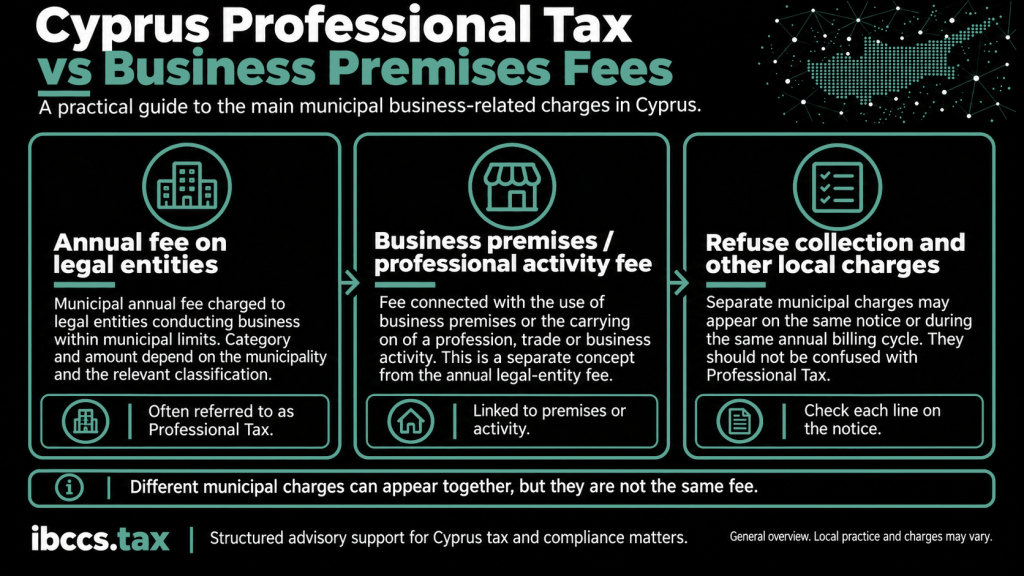
Section 56 of the Municipalities Law 52(I)/2022 covers permissions and fees relating to premises used for a business, profession or trade. It also provides for annual fees on legal entities conducting business within municipal boundaries. These obligations are governed by different statutory categories under the Fifth and Sixth Schedules.

Is Professional Tax a National Cyprus Tax?
No. Professional Tax is a municipal charge, separate from the national taxes administered by the Cyprus Tax Department, such as corporate income tax and VAT. The local authority issues the assessment based on the relevant business, legal entity or premises.
This distinction is important when incorporating a company. In addition to the 15% corporate income tax rate, VAT registration and statutory filings, founders need to consider municipal registrations, business-premises permissions and annual local charges. Our How to Register a Company in Cyprus guide explains the wider incorporation process.
The Legal Basis: Section 56 and Two Different Fee Schedules
Section 56 of the Municipalities Law distinguishes fees relating to premises and professional activity from annual fees on legal entities. Each category has its own rules and statutory limits, so the fee depends on the nature of the business and the assessment issued by the relevant municipality.
| Legal mechanism | What it covers | Statutory reference |
| Business premises / professional activity fee | A fee connected with maintaining or using a building, place or professional premises for business, trade, industry or professional activity. The statute contains natural-person and legal-person categories. | Section 56(1), 56(5); Fifth Schedule |
| Annual fee on legal entities | Annual municipal fees on legal persons conducting business within municipal limits, classified by statutory categories. | Section 56(6)–(9); Sixth Schedule |
| Business premises licence / permission | The requirement to obtain appropriate municipal permission for premises used for business, subject to the statutory provisions and exceptions. | Section 56(1)–(4) |
| Refuse collection and other local charges | Separate municipal assessments that may be issued on the same notice or during the same annual billing cycle. | Separate municipal charging powers and council decisions |
A business may receive more than one municipal charge, particularly where it operates from commercial premises. However, an annual legal-entity fee, a premises-related fee and a refuse-collection charge are separate categories. Their application depends on the company’s circumstances and the municipality’s charging rules, including any provisions for shared offices or premises managed by a service provider.
Who Has to Pay Professional Tax in Cyprus?
Municipal Professional Tax can affect Cyprus limited companies and other legal entities, businesses whose registered office or management is administered by professional service providers, businesses operating from commercial premises and certain self-employed professionals. Liability is determined by the applicable statutory and municipal classification rather than by company registration alone.
Cyprus Limited Companies and Other Legal Entities
For a typical Cyprus limited company, the annual legal-entity fee under section 56(6) and the Sixth Schedule is often the starting point. The statute distinguishes private companies by employee-count categories and also includes separate categories for public companies, specified regulated industries, partnerships or joint ventures, entities serviced through law, accounting or administration offices, and residual legal persons. The actual invoice can be lower than the statutory ceiling.
A business with no staff does not necessarily fall outside the law: the first employee band includes private companies with up to five employees. Conversely, the relevant category can change as the business grows, changes legal form or moves its administration. Company formation, registered-office choice and ongoing corporate services in Cyprus should therefore be coordinated rather than treated as unrelated filings.
Companies With a Professional Registered Office
Many internationally owned Cyprus companies use lawyers, accountants, auditors or licensed administrative service providers for registered-office or management services. The Sixth Schedule contains a category for legal entities whose registered office or management is provided through these professional offices. Municipalities may also distinguish between standalone companies, group entities and other business classifications.
For companies using a professional registered office in Limassol, the municipal fee can depend on whether the entity operates independently, belongs to a qualifying corporate group or falls within a sector-specific category. The municipality may require supporting evidence for group status or any dormant-company exemption. The amount payable should be taken from the company’s current municipal assessment and the applicable local policy.
Self-Employed Professionals and Individuals
Professional Tax is not limited to incorporated companies. Section 56(5) and the Fifth Schedule include categories for individual professionals and self-employed tradespeople. Municipal notices may therefore apply to natural persons as well as legal entities carrying on activity within the municipality.
Self-employed individuals should check whether their work, premises or professional activity falls within a local fee category. Registration for VAT or Social Insurance does not by itself determine the municipal assessment, and operating from home does not automatically establish an exemption.
How Is Professional Tax Calculated?
There is no single nationwide percentage of turnover or profit that determines Cyprus municipal Professional Tax. The assessment depends on the particular fee type. Statutory factors include the form and category of the entity, number of employees in some categories, sector or business activity, the use of premises and – in specified cases – the fact that a registered office or management is provided through a professional-services office. Municipal councils then apply their decisions within the statutory framework.
For legal entities, the Sixth Schedule sets maximum annual charges by category. The table below shows selected statutory ceilings. The amount actually invoiced may be lower, depending on the municipality and the business classification.
| Sixth Schedule category | Statutory annual ceiling |
| Private Ltd company with up to 5 employees | €1,000 |
| Private Ltd company with more than 5 and up to 15 employees | €1,500 |
| Private Ltd company with more than 15 and up to 30 employees | €2,500 |
| Private Ltd company with more than 30 employees | €4,000 |
| Legal person whose registered office and/or management is provided by specified professional services offices | €4,000 |
| Certain companies in specified insurance, shipping, aviation, banking or investment-related categories | €10,000 |
The Fifth Schedule applies to premises and professional-activity fees under section 56(5) and contains separate ceilings. These include €50 for self-employed craftspeople, €200 for individual professionals and €150 for private companies with no more than five employees, alongside other categories. Fifth Schedule amounts are distinct from the Sixth Schedule’s annual legal-entity fee limits. A company operating from business premises may need to consider both types of assessment.
Where business activity starts in the second half of the year, the Fifth and Sixth Schedules provide for half-year charges in the relevant circumstances. The municipality will need to establish the applicable category and the actual start of operations; incorporating a company mid-year does not necessarily settle the issue by itself.
The final charge is determined by the local authority and the relevant assessment year. Companies should check the applicable fee category, any available objection process and the amount appearing on their notice. Municipalities such as Strovolos publish specific rules for professional licence fees and challenges to assessments.
How Much Is Professional Tax in Cyprus? Is €250 Per Year Correct?
For certain Cyprus companies, particularly those using a professional registered office or administrative services arrangement, approximately €250 per year may be included as an indicative municipal-fee allowance in a formation or operating budget. It is not a standard nationwide charge. The actual amount may be higher or lower depending on the municipality, the type of entity and the local assessment.
Municipal assessments can vary significantly between businesses. Relevant factors include whether the company is active, the type of company, the number of employees, the use of commercial premises and whether the business qualifies for a group or dormant-company classification. Where a company receives separate notices for different charges, each assessment should be checked against its own legal basis.
In Limassol, the municipality has published a policy covering professionally administered legal entities, including categories for standalone companies, groups and shipping businesses. These distinctions may affect the annual fee and the documentation required. For 2026, businesses should rely on their current assessment and clarify the applicable category directly with the municipality if the notice is unclear.
The examples below show how different company circumstances can affect the municipal assessment:
| Business situation | What may apply | What to check |
| Active Cyprus Ltd using a professional registered office | Annual legal-entity assessment; approximately €250 may be budgeted provisionally | Current municipal invoice, office arrangement and legal-entity classification |
| Company with employees and commercial premises | Annual fee category and potentially separate premises-related charges | Employee band, business use of premises and local council assessment |
| Company belonging to a corporate group | Municipality-specific classification or group treatment | Evidence of group structure and any accountant/auditor certificate required |
| Dormant or inactive company | Potential relief where local municipal policy permits | Dormant-status criteria, activity and assets, required professional evidence |
| Business operating in more than one municipality | Charges may be assessed for different locations or premises | Registered office, permanent workplace, operating days and type of fee |
When planning the cost of establishing a Cyprus company, a provisional allowance of around €250 per year may be used for municipal Professional Tax or licence fees, subject to the final municipal assessment. Businesses should also establish whether any administrative handling fees, business-premises charges or refuse-collection fees are separate from that estimate.
Does the Registered Office Determine Which Municipality Charges the Fee?
The registered-office address is important, particularly where a legal entity is administered by a local professional-services provider. However, it should not be used as a substitute for examining where the company actually conducts its business. Under section 56(7), an entity headquartered in one municipality and charged the annual legal-entity fee there is generally not charged the same annual legal-entity fee by another municipality unless it has a permanent place of work there or conducts its business there for more than 60 working days in the year. These days do not need to be consecutive.
This rule is particularly relevant to companies whose registered office and operating premises are in different municipal areas. It does not remove other possible premises-related or refuse-collection charges, and it does not determine corporate tax residence. Each assessment must be considered in relation to the business location and the charge being imposed.
When a company moves its registered office, the Registrar also has its own change-notification requirements. The official Registrar guidance states that Form HE2 must be filed within 14 days of the change. Municipal billing records may need a separate update, especially where notices continue to be sent to an old address. For practical administrative support, see our corporate services in Cyprus.
Professional Tax vs Other Cyprus Company Charges
Professional Tax should be distinguished from other business costs, including premises-licence fees, refuse collection, the former Registrar annual levy and national taxes. They arise under different rules and should be recorded separately in the company’s compliance calendar and accounts.
| Charge | Who administers it? | Key distinction |
| Municipal Professional Tax / annual legal-entity fee | Relevant municipality | Local business-related annual assessment; category and deadline vary. |
| Municipal business premises licence / professional activity charge | Relevant municipality | Relates to use of business premises or professional activity; check section 56 and municipal practice. |
| Municipal refuse collection fee | Relevant municipality | Separate charge, often notified alongside business fees. |
| Former €350 annual company fee | Registrar of Companies | Abolished from 2024 onwards; older-year liabilities may remain. |
| Corporate income tax | Cyprus Tax Department | National tax on company taxable profits; standard rate 15% from 2026. |
| VAT | Cyprus Tax Department | Separate turnover- and transaction-based indirect-tax rules. |
The Registrar’s former €350 annual company fee was abolished from 2024 onwards. Municipal Professional Tax and other local charges remain separate obligations. For details of the wider tax system, see our Cyprus corporate tax guide and Tax in Cyprus.
Professional Tax in Limassol, Nicosia, Larnaca and Other Municipalities
Municipalities across Cyprus may apply different fees, payment channels and deadlines. Following local-government boundary changes in 2024, companies should confirm which municipality or municipal district administers their registered office or business premises, particularly where older documents still contain former district descriptions.
Limassol: 2026 Professional Tax Payment Extension
Limassol Municipality announced on 27 October 2026 that the payment deadline for its 2026 Professional Tax, refuse-collection charges and business-premises use fees was extended to Monday, 30 November 2026. Payments can be made through the municipality’s collection offices, online payment system or mobile app. Businesses that have not received a notice should contact the municipal collection office to check whether a charge is due.
The 30 November 2026 extension applies to Limassol and should not be used as a payment deadline for businesses assessed by other municipalities. Check the municipality named on the notice and any changes to the company’s registered office or premises. Read the Limassol Municipality’s 2026 notice.
Strovolos and Other Nicosia Municipalities
Strovolos Municipality publishes guidance on Professional Licence Fees, written objections and a 10% surcharge for late payment. Businesses beginning or resuming operations in Strovolos may also need to provide their details to the municipality within one month. Companies operating elsewhere in the Nicosia area should follow the rules of the municipality responsible for their own location.
Larnaca and Paphos Districts
Larnaca Municipality issued company-related municipal tax notices in August 2026, with payment available through citizen service centres and JCC. In the Paphos district, Ierokipia Municipality has its own Professional Tax assessment and objection process, including published late-payment surcharges. Businesses should follow the amount and due date applicable to their municipality rather than applying Limassol’s arrangements to another district.
If a notice comes from an unfamiliar municipality or refers to an outdated address or district, confirm the issuing authority and the company or premises to which the assessment relates. Any error should be raised promptly with supporting records and within the applicable objection period.
When Is Professional Tax Due, and How Is It Paid?
The payment deadline is typically set through the municipal assessment or annual notice. For annual legal-entity fees, section 56(8) provides that payment is due on the date set by the municipal council within the year to which the charge relates. This is different from a national filing deadline. The invoice may be payable online, through a local payment platform or at a municipal cashier depending on the authority.
Late-payment surcharges and objection periods depend on the municipality. Published guidance from Strovolos and Ierokipia includes a 10% surcharge in specified circumstances. Companies should keep their municipal notices and payment receipts in their accounting records and track deadlines separately for each business location.
What to Do When You Receive a Municipal Professional Tax Notice
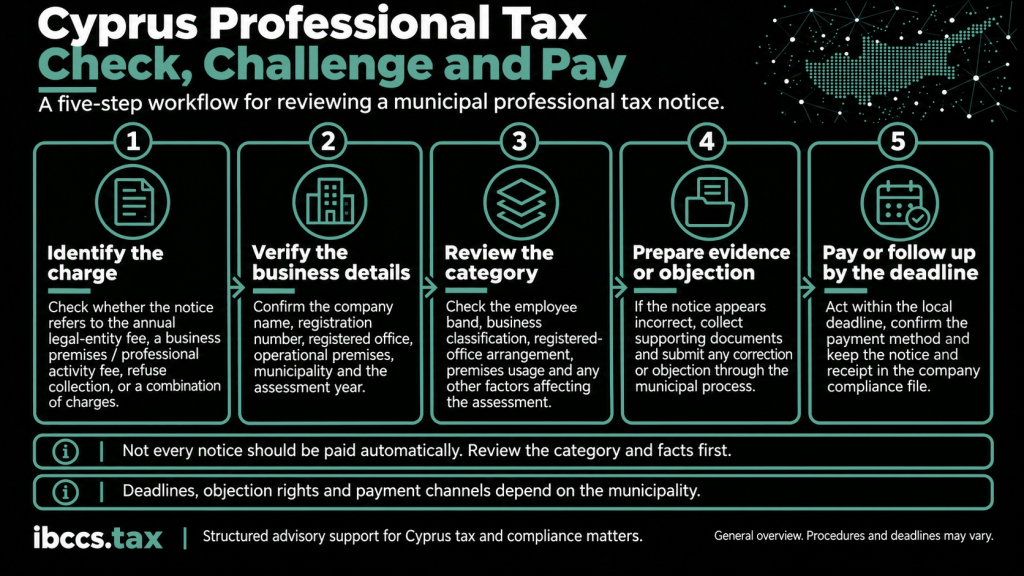
Municipal Professional Tax notices should be checked before payment. A review of the following five points can help identify incorrect classifications, duplicated charges or available relief:
- Identify the charge. Is it the annual legal-entity fee, a business-premises licence / professional-activity fee, refuse collection or a combination of charges?
- Verify the entity and location. Confirm the company’s legal name, registration number, current registered office, operational premises and municipality.
- Check the year and assessment category. Review the employee band, professional-services office classification, sector or premises usage where relevant.
- Consider relief, correction or objection. If the company is dormant, has moved, was duplicated in the billing system or appears wrongly classified, collect the evidence requested by the municipality.
- Act by the local deadline. Submit an objection or supporting documents through the approved municipal channel and confirm payment arrangements, surcharges or any suspension position in writing.
Submitting an objection does not necessarily suspend the payment deadline. Companies should follow the procedure and any written instructions issued by the municipality. Our accounting services in Cyprus can help with recording and retaining municipal assessments and payment evidence alongside wider compliance records.
Can Dormant Companies Be Exempt From Professional Tax?
A dormant company may qualify for relief under the applicable municipal policy, but exemptions are not automatic. The absence of sales or a company’s internal description as ‘inactive’ does not necessarily meet the municipality’s criteria. Limassol has published dormant-company requirements within its policy for professionally administered entities, while other municipalities may request a certificate from an independent accountant or auditor.
The company’s assets, liabilities and actual activities are relevant to a dormant-status assessment. Where an entity continues to hold shares, property, receivables, intellectual property or other assets, a municipality may conclude that it does not meet the criteria for exemption even if there is no trading revenue. Holding and investment companies should therefore examine their position carefully.
A company seeking an exemption should obtain the appropriate accountant’s or auditor’s confirmation, provide the prescribed documents and submit its request within the municipality’s deadline. The decision depends on the local policy and the company’s circumstances.
Can Professional Tax Be Challenged or Reclassified?
Municipalities may allow businesses to object to an assessment or request that their fee category be corrected. Strovolos provides for written objections within the relevant period, while Ierokipia has published evidence requirements for classification challenges. Supporting documents can include employee records, VAT returns, payroll information and confirmation from an auditor or accountant.
The strongest objections identify a specific discrepancy, such as a duplicate assessment, incorrect employee band, old registered-office address, premises no longer in use or supported dormant-company status. Company extracts, leases, payroll records and financial statements may help demonstrate the correct position.
Practical Examples: Different Companies, Different Local Fee Questions
Example 1: A New Cyprus Consulting Ltd With No Employees
A founder incorporates a consulting Ltd in Cyprus and uses a registered-office provider. The company has not yet hired employees and has limited first-year turnover. It should not assume that no municipal fee arises solely because profits are low or because the company is in its first year. The review should identify the relevant municipality and whether the annual legal-entity fee or a professional registered-office policy applies. The company should also check whether premises-related fees are charged by another operator for the shared office.
Example 2: A Trading Company With an Office and Warehouse
A trading company maintains its registered office in one municipality and operates a warehouse in another. Its local compliance position is more complex than a single-head-office invoice. Section 56(7) addresses annual legal-entity fees where business is also conducted in another municipality, including the >60-working-day criterion; separate premises and refuse charges may still need to be assessed. The practical solution is to review each notice and premises location independently rather than pay duplicate charges without checking their basis.
Example 3: A Holding Company With No Revenue but Investments
A holding company reports no ordinary trading income during the year but owns shares in subsidiaries. Management assumes that this makes the company dormant. Under a restrictive municipal dormant-company definition such as the one published in Limassol’s professional-registered-office policy, holding assets can prevent that conclusion. The municipal exemption analysis should therefore be based on the actual asset and activity position and the requested professional certificate, not simply on turnover.
Example 4: A Company That Moves Its Registered Office
A company changes its registered-office provider from one municipality to another. The Registrar is notified of the change, but a municipal invoice still arrives at the old provider. The appropriate response is to verify the assessment year, the address and the period during which the company was associated with each municipality. Evidence of the change and confirmation of the current invoicing records can help avoid duplicate or misdirected future notices.
Why Professional Tax Matters in Cyprus Company Compliance
Professional Tax forms part of a Cyprus company’s wider compliance obligations. A company may have completed all its national tax and Registrar filings but still owe a separate local fee. Payments to the Tax Department, Registrar and municipality satisfy different requirements and should not be treated as interchangeable.
For established businesses, a coordinated record of legal entities, registered offices, business premises, municipal notices, contacts and deadlines helps avoid missed payments and duplicated assessments. Maintaining these records also makes it easier to challenge an incorrect classification and ensure that municipal fees are properly recorded. See our bookkeeping services in Cyprus.
How IBCCS TAX Can Help With Municipal Professional Tax
IBCCS TAX assists Cyprus companies with the administrative and accounting requirements associated with municipal notices. Our support can include checking company and registered-office details, liaising with the relevant municipality, preparing documentation for a classification review and incorporating municipal charges into the company’s bookkeeping and compliance schedule.
For new businesses, we can address these matters alongside company formation in Cyprus and registered-office arrangements. Established companies and groups may benefit from our corporate services in Cyprus and ongoing accounting services in Cyprus. Assessments involving a disputed legal interpretation may require additional case-specific legal advice.
If your company has received a Professional Tax notice, is planning a new office or needs assistance with its ongoing compliance, contact IBCCS TAX. We can review the relevant municipal obligations and advise on the next steps based on your company’s circumstances.
Frequently Asked Questions About Professional Tax in Cyprus
1. What is Professional Tax in Cyprus?
Professional Tax commonly refers to municipal charges connected with business or professional activity. The legal framework includes business-premises / professional-activity fees and annual fees on legal entities. It is not a separate percentage tax on profits.
2. Is Professional Tax the same as corporate income tax?
No. Corporate income tax is a national tax on taxable profits. Municipal Professional Tax or Professional Licence Fees are locally assessed charges with their own categories and payment notices.
3. How much is Professional Tax in Cyprus in 2026?
There is no single nationwide amount. The municipality assesses the fee according to the applicable legal category and local decision. Around €250 can be a budgeting estimate for some companies, but the amount due is determined by the individual municipal assessment.
4. Does every Cyprus company pay Professional Tax?
Not necessarily the same fee or at the same rate. Legal form, municipality, activity, registered office, premises, classification and any valid exemption need to be reviewed. A company should check the relevant notice or contact the municipality.
5. Do self-employed professionals have to pay?
Potentially. The Fifth Schedule includes categories of individual professionals and self-employed trades, and local notices can cover natural persons. The applicable fee depends on the municipality and the relevant premises or activity.
6. Is the €350 annual company levy still payable?
The Registrar of Companies abolished its €350 annual company fee from 2024 onwards, although obligations for earlier years may remain. That reform did not remove separate municipal Professional Tax and business fees.
7. Does a company with no employees pay?
A lack of employees is not an automatic exemption. The Sixth Schedule includes a private-company category with up to five employees; other categories and municipal policies may also be relevant.
8. Does a registered-office-only company have to pay?
The registered-office and/or professional-administration arrangement may be relevant to its annual municipal category. The result should be confirmed with the local authority rather than inferred from having no separate trading premises.
9. Can a dormant company be exempt?
Yes, where the municipality’s policy provides for an exemption and the company satisfies its dormant-status requirements. Supporting documents, including an accountant’s or auditor’s certificate, may be necessary.
10. What is the 2026 Professional Tax deadline in Limassol?
Limassol Municipality announced an extension to 30 November 2026 for the 2026 Professional Tax and specified related municipal charges. This does not establish the deadline for another municipality or future years.
11. What if I never received a municipal tax notice?
Contact the municipality, confirm the business details and ask whether an assessment exists. Not receiving a notice should not be treated as proof that no fee is due.
12. Is Professional Tax payable in multiple municipalities?
Section 56(7) restricts the imposition of the same annual legal-entity fee by another municipality where a company has its headquarters elsewhere, with an exception connected to permanent workplace or more than 60 working days of activity. Other municipal premises charges require separate analysis.
13. Can I dispute the amount?
Many municipalities allow objections or reclassification requests within their published procedures and deadlines. Evidence supporting the correct legal category, employee count, premises use or exemption is usually central.
14. Is Professional Tax deductible for corporation tax?
Business deductibility is a separate income-tax question and depends on the nature of the charge, applicable rules and proper accounting treatment. It should not be assumed solely because a municipality issued the invoice; the company’s accountant should review the expense in context.
15. Are late-payment penalties the same throughout Cyprus?
No. Payment dates and surcharges are set under the relevant municipal rules. Some municipalities publish 10% late-payment surcharges, but the amount and conditions should be checked on the company’s own notice.
16. Is Professional Tax always €250 per year in Cyprus?
No. Approximately €250 is only an indicative budgeting allowance for some companies, not a national tariff. The relevant municipality determines the charge according to the legal-entity classification, activity and other circumstances. The amount shown on the current assessment is the starting point for payment or any request for correction.


Professional Tax in Cyprus: Municipal Fees, Who Pays, Deadlines and Exemptions
Professional Tax in Cyprus refers to municipal business charges, rather
Read More
Moving to Cyprus from Italy: Tax Benefits, Residency, Non-Dom & Business Relocation
Moving from Italy to Cyprus is a decision about more
Read More
Cyprus Non-Dom After 17 Years: Deemed Domicile and the Alternative SDC Method
Cyprus Non-Dom is often described as a 17-year tax benefit,
Read MoreGeneral Information: This article provides general information on Professional Tax, Professional Licence Fees and related municipal charges in Cyprus as at 4 November 2026. Fees, deadlines and exemptions depend on the applicable municipality, legal category, assessment year and individual circumstances. Companies should check their current municipal notices and obtain professional advice where the classification, liability or tax treatment is uncertain.