

Cyprus remains one of the most attractive jurisdictions in Europe for entrepreneurs, investors, international groups, and business owners looking for a recognised corporate framework, EU access, and a practical environment for cross-border operations.
At the same time, company registration in Cyprus is not just about filing a few forms. A proper setup requires the right legal structure, accurate corporate documentation, KYC and beneficial ownership checks, filings with the Registrar of Companies, and post-incorporation registrations such as tax, VAT where applicable, and UBO reporting.
This is where many businesses make avoidable mistakes. A company can be incorporated, but if the structure is not aligned with the intended activity, ownership, substance needs, tax position, or banking expectations, the setup may create delays, compliance issues, or unnecessary complications later.
At IBCCS TAX, we support clients with end-to-end company formation in Cyprus, ongoing corporate services in Cyprus, and broader tax planning in Cyprus. In this guide, we explain how to register a company in Cyprus, what documents are typically required, what happens after incorporation, and what to consider before you proceed.

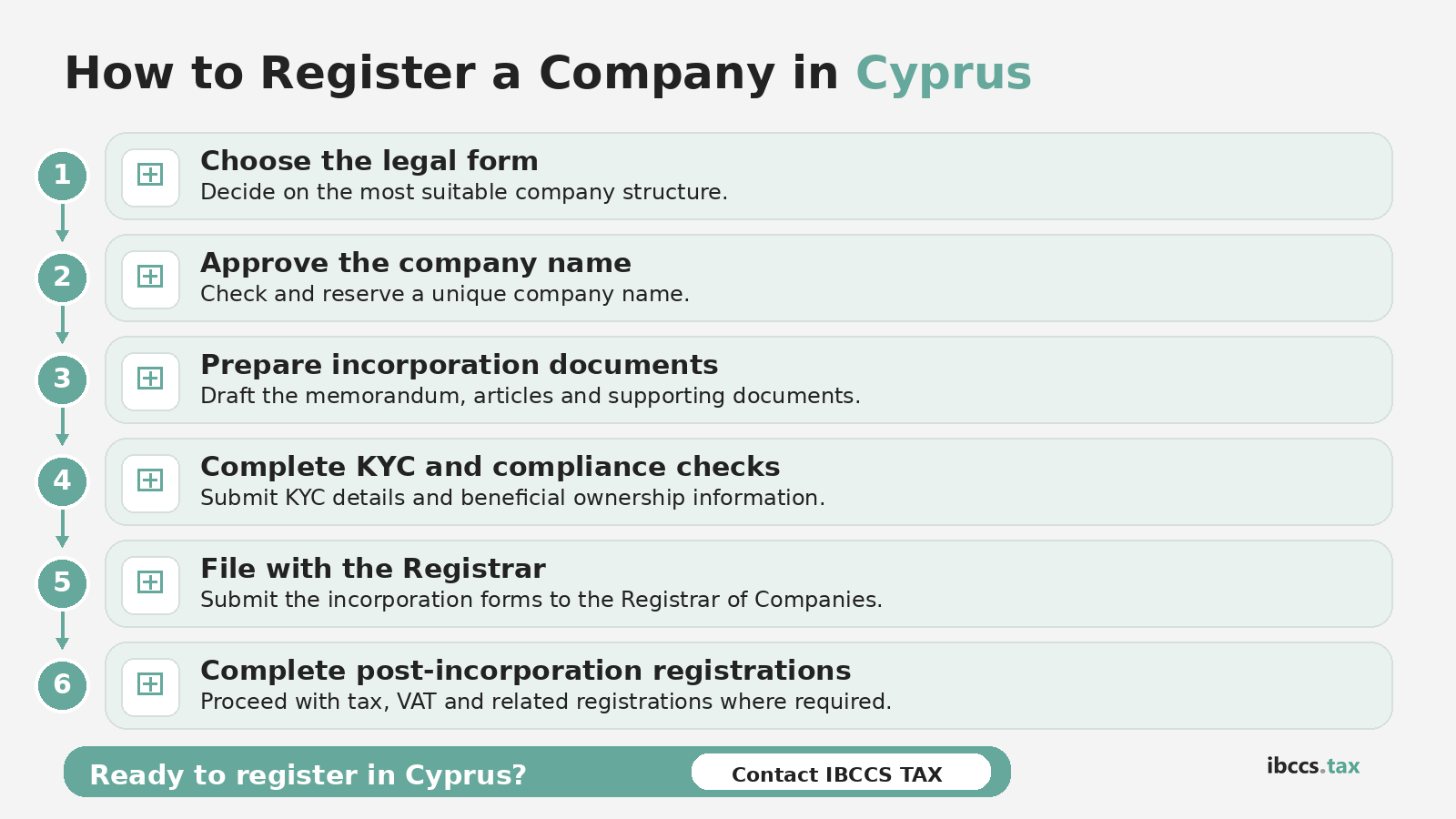
In most cases, registering a company in Cyprus involves the following steps:
- Choose the right legal form.
- Select and approve the company name.
- Prepare the incorporation documents.
- Complete shareholder, director and UBO compliance checks.
- File the company with the Registrar of Companies.
- Obtain the incorporation certificates.
- Complete post-incorporation registrations and compliance steps.
For most foreign founders and international businesses, the most common vehicle is a Cyprus Limited Liability Company.
Why Businesses Choose Cyprus for Company Registration
Cyprus is often chosen by business owners and groups that need a recognised EU corporate structure, access to professional services, and a jurisdiction that can support trading, consulting, holding, technology, intellectual property, and wider international activities.
However, the real advantage is not simply the jurisdiction itself. The benefit comes from setting up the right structure and managing the company properly from the beginning. In practice, a successful Cyprus setup usually depends on aligning the legal form, business model, ownership chain, governance, tax registrations, and post-incorporation administration.
For some businesses, a straightforward Cyprus limited liability Company is the right solution. For others, the more important question is not only how to register a company, but whether the registration should be preceded by a structuring review, a tax assessment, or a wider look at management and control.
That is why at IBCCS TAX we do not treat incorporation as a standalone filing exercise. We approach it as part of a broader legal, tax and operational framework.
Step 1: Choose the Right Legal Form
Before registering anything, the first question is what kind of entity should actually be used.
In many cases, the preferred solution is a Cyprus Limited Liability Company (Ltd).
That said, the right structure always depends on the intended use of the company. The key questions usually include:
- Will the company carry out trading activities, provide services, hold shares, or own intellectual property?
- Will the company need VAT registration from the outset?
- Will it require a physical office, employees, or local operational presence?
- Will the shareholders be individuals or corporate entities?
- Will the company need banking, EMI onboarding, or sector-specific licensing?
- Is the objective only incorporation, or also Cyprus tax residency and substance?
Choosing the wrong structure at the beginning can be one of the most expensive mistakes in the whole process. It may lead to unnecessary restructuring, delays in onboarding, additional professional work, or a mismatch between the legal form and the business reality.
If the registration is part of a wider international structure, it often makes sense to review the setup together with tax planning in Cyprus before incorporation starts.
Step 2: Reserve and Approve the Company Name
The next step is the approval of the company name with the Registrar of Companies.
This may look simple, but name approval often causes avoidable delays. Proposed names are commonly rejected when they are too similar to an existing registered name, contain restricted words, or suggest activities that require special licensing or permission.
As a practical rule, it is best to prepare several name options in order of preference. This reduces back-and-forth and helps move the incorporation process faster.
Where the proposed name refers to regulated terms or may imply special activities, it may be necessary to obtain additional approvals or submit supporting documentation.
Step 3: Prepare the Incorporation Documents
Once the structure and name are clear, the incorporation documents need to be prepared.
For a Cyprus company, the main corporate documents usually include:
- Memorandum and Articles of Association
- details of the registered office
- details of the first directors and secretary
- details of shareholders, shareholding structure, and share capital
This stage is not only technical. It is also strategic. The drafting of the corporate documents should reflect what the company is actually meant to do, how it will be owned, and how it will be governed.
Where amendments, updates or ongoing filings are likely to be needed later, this stage should also be aligned with your broader corporate services in Cyprus requirements.
Step 4: Complete KYC and Compliance Checks
This is one of the most important practical stages in the process.
Even where incorporation itself appears straightforward, the matter can be slowed down significantly if KYC, AML, or beneficial ownership documentation is incomplete, inconsistent, or not aligned with the real ownership chain.
Depending on the case, the required supporting documentation may typically include:
For individual shareholders or directors
- passport copy
- proof of residential address
- tax identification details where relevant
- source of funds or source of wealth support where required
For corporate shareholders
- certificate of incorporation
- constitutional documents
- register extracts
- board resolutions where required
- group structure chart up to the ultimate beneficial owner
For more complex structures
- ownership charts
- beneficial ownership declarations
- explanations of the business model
- information on expected activity, counterparties, and jurisdictions involved
In practice, many delays happen not because the Cyprus filing process is unclear, but because the ownership and compliance package is not fully prepared.
Minimum Requirements for a Cyprus Limited Liability Company
A Cyprus Limited Liability Company generally requires:
- at least one shareholder
- at least one director
- a company secretary
- a registered office in Cyprus
- memorandum and articles of association
- submission of the required incorporation forms and supporting documentation
From a legal incorporation perspective, the appointment of a Cyprus-resident director is not always mandatory in every case. However, where the objective is for the company to have Cyprus tax residency and appropriate management and control in Cyprus, this should be assessed carefully based on the business model, operational reality and wider structure.
For founders relocating personally together with the business, this often needs to be coordinated with change of tax residency to Cyprus or non-domicile status in Cyprus.
Step 5: File the Company with the Registrar
Once the corporate documents and compliance package are ready, the incorporation application is filed with the Registrar of Companies.
From a practical standpoint, this stage requires precision. Names, dates, passport details, addresses, shareholding details and corporate particulars must match across the documentation. Even small inconsistencies can lead to questions, corrections or delays.
If the objective is simply to get the company incorporated in the most efficient way, the most relevant service page to support this article is register a company in Cyprus.
Step 6: Receive the Incorporation Certificates
Once the company is approved, the standard corporate certificates are issued.
These typically include:
- Certificate of Incorporation
- Certificate of Directors and Secretary
- Certificate of Shareholders
- Certificate of Registered Office
These are usually the first documents requested by banks, payment providers, counterparties, accountants, auditors, licensing bodies and other institutions.
At this point, many business owners think the process is complete. In reality, incorporation is only the first major milestone.
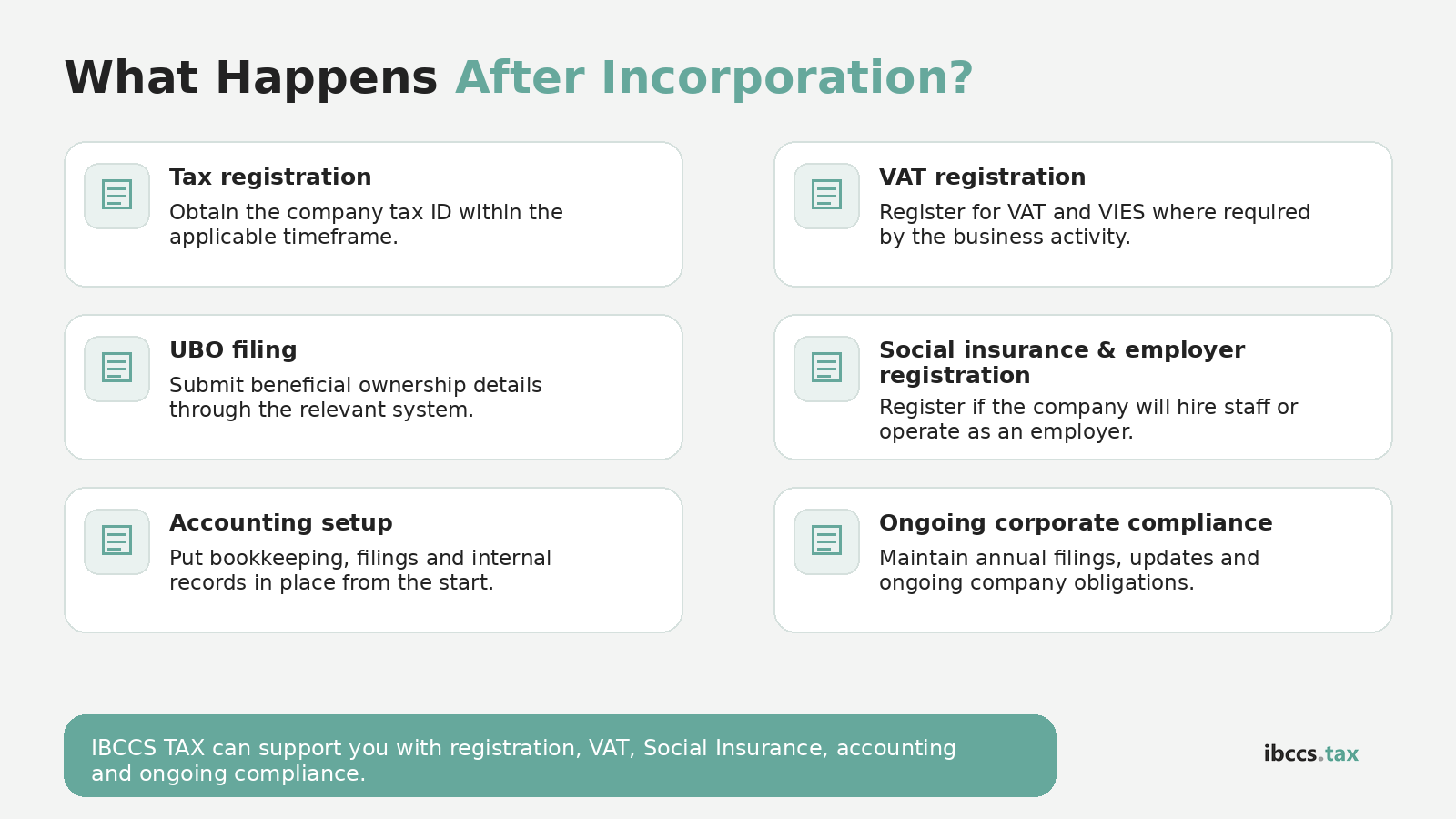
Step 7: Complete Tax, VAT and Other Post-Incorporation Registrations
Once the company is incorporated, it may still need to complete several important registrations and compliance actions depending on its intended operations.
Tax registration
A newly incorporated company should proceed with taxpayer registration and obtain its tax number within the applicable timeframe.
VAT registration
VAT registration depends on the business activity and the relevant triggers. Some businesses need VAT registration from the outset, while others may only register once the applicable threshold or condition is met.
UBO Reporting
Where applicable, beneficial ownership details must be filed through the relevant system as part of the company’s ongoing compliance obligations. In practice, entities within scope should ensure that their UBO information is identified, documented, and organised correctly from the outset. Your ownership structure should therefore be prepared properly from the beginning, not after incorporation is completed. You can read more about this topic in our article on UBO reporting in Cyprus.
Social insurance and employer registration
If the company will hire employees or commence operations requiring employer registration, those steps should also be planned in parallel. IBCCS TAX also provides support for registration of a company to social insurance in Cyprus.
Ongoing corporate and regulatory compliance
Once active, the company may also need ongoing accounting services in Cyprus, annual return support, updates to company particulars, financial statements, audit where applicable, payroll, VAT filings, tax filings, and wider corporate services in Cyprus.
Documents Typically Required from Shareholders and Directors
While every case is different, the documentation package typically includes some combination of the following:
For individuals
- passport copy
- proof of address
- CV or professional background summary in some cases
- tax number or tax residency information where relevant
- source of funds or source of wealth support where required
For corporate shareholders
- incorporation certificates
- memorandum and articles
- registers or extracts
- directors’ and shareholders’ details
- ownership structure chart
- UBO declarations
For operational onboarding
- business description
- expected countries of activity
- expected counterparties or client profile
- expected turnover range or transaction profile
- website or commercial materials where available
This is especially important if the company will later need banking, EMI onboarding, accounting services in Cyprus, tax planning in Cyprus, or more specialised structuring.
If the business will involve qualifying IP or technology-led operations, it may also make sense to review the Cyprus IP Box regime at the planning stage.
How Long Does Company Registration in Cyprus Take?
There is no single fixed timeline that applies to every case.
In practice, the timeline usually depends on:
- whether the company name is approved quickly
- how fast the KYC package is completed
- whether the ownership structure is simple or layered
- whether the activity is regulated
- whether post-incorporation steps are prepared in parallel
A simple case can move relatively quickly. A more complex case involving corporate shareholders, group structures, regulatory elements, or enhanced compliance checks can take materially longer.
The most common reason for delay is not necessarily the filing itself. It is often incomplete documentation, unclear ownership, or a mismatch between what the client wants to achieve and what has actually been prepared.
Common Mistakes That Delay Company Registration
Choosing the company type too quickly
A company may be easy to register, but not suitable for the real business model, tax position or operational plans.
Submitting weak or inconsistent KYC
Mismatches in names, addresses, ownership details or supporting documents are one of the most common causes of delay.
Focusing only on incorporation
Tax registration, VAT, UBO, annual filings and operational readiness should be considered from the beginning.
Ignoring substance and governance
Where Cyprus is intended to play a meaningful role in the business structure, governance and management should reflect that reality.
Treating banking as a separate issue
Even though banking is not part of the Registrar filing, onboarding expectations often affect how the company should be documented and described from the outset.
These are exactly the points where experienced end-to-end support makes a difference.

Why Work With IBCCS TAX for Cyprus Company Registration
At IBCCS TAX, we support clients not only with the registration of a Cyprus company, but also with the broader legal, tax and operational considerations that often determine whether the setup works properly in practice.
Our support can include:
- pre-incorporation structuring review
- company registration in Cyprus
- preparation and coordination of documentation
- KYC and ownership support
- tax planning in Cyprus
- accounting services in Cyprus
- corporate services in Cyprus
- registration of a company to social insurance in Cyprus
- non-domicile status in Cyprus
- change of tax residency to Cyprus
For some clients, a standard company formation process is enough. For others, the correct approach is to review the structure first and then proceed with incorporation once the legal, tax and practical framework are clear. That distinction matters.
Ready to Register a Company in Cyprus?
Registering a company in Cyprus can be a smooth and efficient process when the structure is right, the documentation is prepared properly, and the post-incorporation obligations are handled from the start.
But the most important question is not only how to register a company in Cyprus. It is how to register the right company, in the right way, for the right business objective.
If you are planning to set up a company in Cyprus and want the process handled properly from the beginning, IBCCS TAX can support you with end-to-end registration and ongoing corporate, tax and compliance assistance.
To discuss your case, contact IBCCS TAX. If your setup involves international ownership, tax planning, substance considerations or wider structuring, you can also start from our Cyprus tax planning services page.


Frequently Asked Questions About Registering a Company in Cyprus
1. Can a foreigner register a company in Cyprus?
Yes, foreign individuals and foreign-owned groups can register companies in Cyprus, subject to the relevant compliance, identification and corporate filing requirements.
2. Can a Cyprus company be registered remotely?
In many cases, yes. Subject to proper KYC, document execution and compliance requirements, much of the process can be handled remotely through professional support.
3. What is the most common company type in Cyprus?
In most business cases, the most common choice is a Limited Liability Company (LTD).
4. Do I need a local director?
Not every incorporation case legally requires a Cyprus-resident director as a pure company law matter. However, if Cyprus tax residency, management and control, or substance are part of the objective, the director and governance structure should be reviewed carefully.
5. Do I need a company secretary?
Yes. A Cyprus company setup typically includes the appointment of a company secretary as part of the standard company framework.
6. Do I need a registered office in Cyprus?
Yes. A registered office address forms part of the standard incorporation and ongoing company framework in Cyprus.
7. What happens after incorporation?
Depending on the activity, the company may need tax registration, VAT registration, social insurance registrations, UBO reporting, accounting setup and further compliance work.
8. Is company registration in Cyprus enough on its own?
Not always. If the company is part of a wider international structure, a pre-incorporation review and a proper tax and substance assessment may be just as important as the incorporation itself.

Cyprus Tax Calendar 2027: Key Tax Deadlines for Individuals and Companies
Cyprus tax compliance does not revolve around one annual deadline.
Read More
Tax on Dividends in Cyprus: SDC, GHS, Non-Dom and Company Distributions
Dividend taxation in Cyprus changed materially from 1 January 2026.
Read More
Payroll in Cyprus: PAYE, Social Insurance, GHS and Employer Obligations
Payroll in Cyprus is more than transferring a net salary
Read More