
Cyprus is increasingly considered by German entrepreneurs, company owners, professionals, investors and families looking for a different European base without leaving the EU legal and business environment. For a German citizen, the immigration side of the move is relatively straightforward because EU free-movement rights continue to apply. The more important planning questions usually concern tax residency, Non-Dom status, employment or self-employment, the treatment of an existing German business and the practical implementation of the move.
A relocation should not be approached as a comparison of two headline tax rates. Moving the individual, moving a company and changing tax residence are separate legal and tax events. A German founder can live in Cyprus while retaining a GmbH in Germany, but the way that company is managed after the move may create new corporate tax questions. An investor may qualify for Cyprus Non-Dom treatment, while German-source income or assets can continue to require German reporting or taxation. A senior employee may be able to combine EU residence rights with a Cyprus employment structure and, where the conditions are met, a substantial Cyprus employment-income exemption.
The strongest plan therefore starts with the life and business that will actually exist after the move. Residence registration, work status, Cyprus tax residency, personal income, company ownership, banking, payroll and annual compliance should support the same real-life arrangement. IBCCS TAX relocation services in Cyprus combine the Cyprus-side immigration, tax, company and ongoing compliance work needed to implement that position.
This guide is written from the Cyprus perspective. It explains the practical Cyprus residence and tax framework for German citizens and highlights the German issues that should be reviewed with an appropriately qualified German tax adviser before departure.

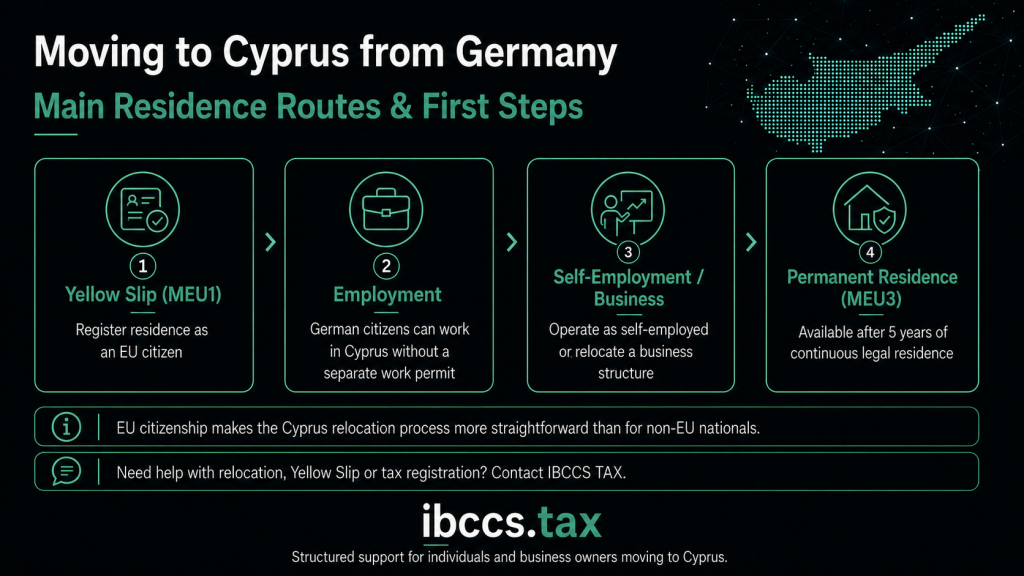
- German citizens can live and work in Cyprus under EU free-movement rules; a separate Cyprus work permit is generally not required for an EU citizen.
- For residence beyond three months, the individual generally registers for an EU Registration Certificate / Yellow Slip (MEU1) within the applicable registration period.
- EU residence registration and Cyprus tax residency are different. The Yellow Slip does not by itself determine where the person pays tax.
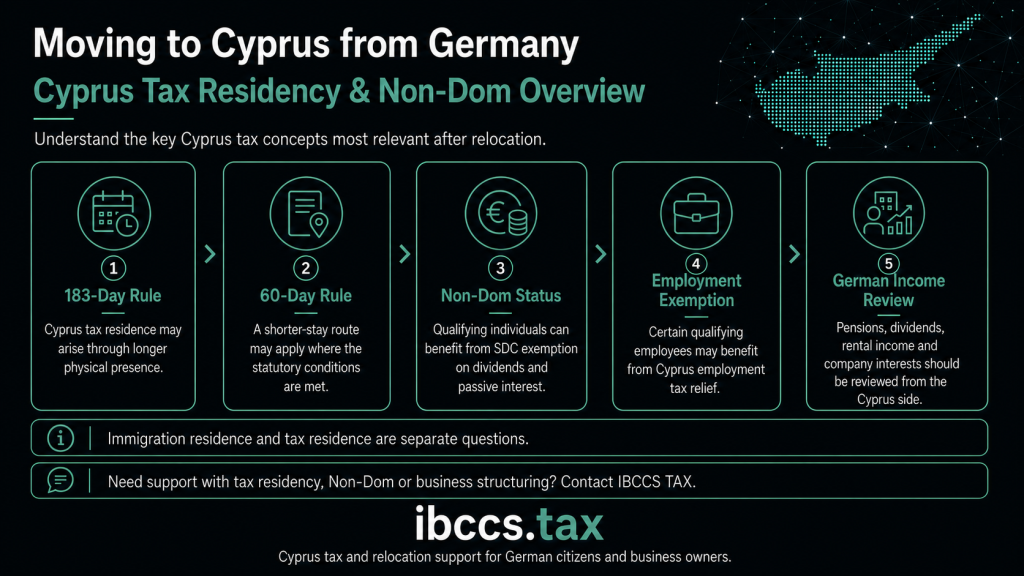
- Cyprus tax residency may generally arise under the 183-day rule or, if all conditions are met, the 60-day rule.
- Qualifying Cyprus tax residents who are non-domiciled for SDC purposes may generally be exempt from SDC on dividends and passive interest; GHS/GESY and source-country taxation may still need to be considered.
- Qualifying individuals commencing employment in Cyprus with annual remuneration above EUR 55,000 may be eligible for a 50% employment-income exemption for up to 17 years, subject to the detailed conditions.
- German founders and substantial shareholders should obtain German advice before departure because German exit taxation may apply to qualifying shareholdings.
- Continuing to manage a German GmbH from Cyprus can create Cyprus corporate tax residence, permanent establishment, payroll or governance questions for the company.
- A Cyprus company can be appropriate for a business that is genuinely moving its management and operations to Cyprus, but it should not be incorporated only to achieve a lower headline tax rate.
- German and Cyprus tax positions should be coordinated before the move, particularly where the individual retains a GmbH, German real estate, investments, pensions or significant German-source income.
Quick Answer: Can German Citizens Move to Cyprus?
Yes. German citizens are EU citizens and can move to Cyprus without obtaining an entry visa or separate work permit. For stays of more than three months, they generally need to register their residence in Cyprus through the EU Registration Certificate process, commonly referred to as the Yellow Slip or MEU1. The residence basis can be employment, self-employment, study or sufficient resources together with the required healthcare cover.
The immigration registration does not automatically make the individual Cyprus tax resident. Cyprus tax residency is determined separately, generally under the 183-day rule or, where all conditions are satisfied, the 60-day rule. From 2026, the 60-day framework became more flexible because the previous condition requiring the individual not to be tax resident in another state was removed. This makes coordination with Germany more important, not less, because domestic residence claims can overlap.
For qualifying Cyprus tax residents, Non-Dom status may provide an exemption from Special Defence Contribution on dividend and passive interest income. German entrepreneurs, shareholders and investors should nevertheless review any German exit-tax, continuing residence, company, property or source-income issues before assuming that a Cyprus tax position ends all German exposure.
Moving to Cyprus from Germany. Who Is This Guide For?
This guide is intended for German citizens and German residents who are considering a move to Cyprus or have recently relocated and want to understand the main Cyprus-side decisions before finalising their residence, employment, business or tax structure.
It is particularly relevant to consultants and freelancers, founders and GmbH shareholders, senior employees, technology professionals, investors and HNWIs, families planning a long-term move and people whose work can be moved from Germany to an international or Cyprus-based structure. It is also relevant where one family member moves first while property, a business or other financial connections remain in Germany.
The right solution depends on the real purpose of the move. Someone relocating for employment will have a different tax and compliance position from an investor living from dividends, a consultant becoming self-employed or a founder who continues to manage a German company from Limassol.
Moving to Cyprus From Germany: Start With EU Residence Registration
The immigration position for a German citizen is materially simpler than for a non-EU national. EU citizens can enter Cyprus with a valid identity card or passport and have the right to reside for up to three months without additional residence formalities. Where the move becomes longer-term, Cyprus requires the individual to register under the EU residence framework.
For most German citizens establishing a life in Cyprus, the relevant document is the Registration Certificate for Union Citizens, commonly known as the Yellow Slip or MEU1. The application should reflect the actual basis of residence: employment, self-employment, study or sufficient resources. The document is not a tax certificate and should not be confused with Cyprus tax residency or Non-Dom status.
Can German Citizens Work in Cyprus?
Yes. As EU citizens, Germans have access to the Cyprus labour market and may work as employees or carry on self-employed activity subject to the normal Cyprus registration, tax, Social Insurance and any profession-specific licensing rules. The practical registration file should match the activity that will actually be performed.
This distinction matters for entrepreneurs. A German consultant who will personally provide services from Cyprus may register as self-employed or use a Cyprus company depending on the commercial and tax position. A German founder joining a Cyprus company as an employee or director should coordinate the Yellow Slip, payroll, Social Insurance and tax treatment rather than treating each process separately.
Yellow Slip / MEU1 for German Citizens
A German citizen intending to remain in Cyprus for more than three months generally applies for the MEU1 Registration Certificate within four months of arrival. The supporting evidence depends on the residence basis. An employee typically relies on employment evidence, while a self-employed person should demonstrate the registered activity. A financially self-sufficient person follows a different evidentiary route and must demonstrate sufficient resources and appropriate healthcare cover.
IBCCS TAX supports EU citizens with the Cyprus Yellow Slip / MEU1 application, including review of the residence basis, document set and consistency between the immigration application and the intended work or business activity.
| Residence profile | Typical Cyprus position | Main implementation point |
| Employee | MEU1 / Yellow Slip based on employment | Employment evidence, Social Insurance and payroll should align. |
| Self-employed professional | MEU1 / Yellow Slip based on self-employment | Register the activity and coordinate tax, Social Insurance and VAT where applicable. |
| Business owner / director | MEU1 supported by the actual employment, office or economic activity | Company role, remuneration and personal tax position should be documented consistently. |
| Financially self-sufficient individual | MEU1 based on sufficient resources | Resources and healthcare cover must support the residence basis. |
| Student | EU registration based on study | Study enrolment, resources and healthcare requirements should be reviewed. |
Permanent Residence for EU Citizens After Five Years
EU citizens who have resided legally in Cyprus for five consecutive years can generally acquire the right of permanent residence, subject to the applicable continuity conditions. The permanent-residence documentation is commonly associated with the MEU3 process.
For a German citizen, this EU route is normally more relevant than an investment-based permanent-residence programme designed for third-country nationals. The long-term relocation plan should therefore focus on lawful EU residence, tax residency and the practical integration of work, business and family life in Cyprus rather than purchasing an immigration status that is not needed.
Planning a Move From Germany to Cyprus?
The most useful first step is to coordinate your Cyprus residence basis, expected work or business activity and intended tax position before the move is implemented. Request a Cyprus Relocation & Tax Review.
Immigration Residence and Cyprus Tax Residence Are Separate
One of the most important concepts for a German citizen moving to Cyprus is that a Yellow Slip does not determine tax residency. Immigration law answers whether the individual has the right to live in Cyprus. Tax law determines where the individual is tax resident and how income is taxed and reported.
A German citizen may obtain an MEU1 soon after arrival but fail to satisfy either Cyprus tax-residence test in that calendar year. Conversely, a person with a clear Cyprus day count and qualifying Cyprus connections may become Cyprus tax resident while still having significant German ties that need to be reviewed under German domestic law and the Germany-Cyprus double tax treaty.
The correct plan therefore uses a residence calendar. It should record arrival and departure dates, the expected Cyprus home, employment or business activity, German travel and any major dividends, asset sales or business events planned around the relocation.
Cyprus Tax Residency for German Citizens
Cyprus generally provides two main routes to individual tax residency: the 183-day rule and the 60-day rule. The correct route depends on how the person will actually live and work, not simply on which rule appears more tax-efficient.
The 183-Day Rule
An individual who spends more than 183 days in Cyprus during the relevant calendar year is generally Cyprus tax resident for that year. This is often the most straightforward route for a German family, retiree or professional who moves fully to Cyprus and makes the island the main home.
Accurate travel records remain important, particularly where the person continues to visit Germany regularly, maintains a German home or travels extensively for business. Tax residence should be supportable with the actual day count and evidence rather than assumed from the relocation date.
The 60-Day Rule
The 60-day rule can be relevant to internationally mobile founders, directors, consultants and executives who maintain a genuine Cyprus connection without spending more than 183 days on the island. The remaining conditions generally include at least 60 days of presence in Cyprus, not spending more than 183 days in any other single country, maintaining a permanent home in Cyprus and having the required business, employment or office connection in Cyprus during the year.
From 1 January 2026, Cyprus removed the former condition requiring an individual using the 60-day rule not to be tax resident in any other country. This increases flexibility under Cyprus domestic law. It does not mean that Germany or another country must automatically accept Cyprus as the individual’s only tax residence.
Our detailed guide explains the Cyprus 60-day and 183-day tax residency rules, while our tax residency service covers eligibility, documentation and practical implementation.
Can You Be Tax Resident in Germany and Cyprus?
Potentially, yes, under domestic rules. Becoming Cyprus tax resident does not by itself prove that German tax residence has ended. A home retained in Germany, time spent there, family circumstances and other German connecting factors can remain relevant under German law.
Germany and Cyprus have a double tax treaty. Where both countries treat the individual as resident under domestic rules, treaty residence and the allocation of taxing rights may need to be reviewed. IBCCS TAX can advise on the Cyprus position and coordinate with the client’s German tax adviser where the answer depends on German residence rules, German filings or a formal German tax interpretation.
Cyprus Non-Dom Status for German Entrepreneurs and Investors
For German shareholders, investors and internationally mobile private clients, Cyprus Non-Dom status can be one of the most relevant tax considerations after Cyprus tax residency is established. It is a Cyprus tax classification for Special Defence Contribution purposes; it is not an immigration status and does not replace the residence analysis.
A qualifying Cyprus tax resident who is non-domiciled for SDC purposes may generally receive dividend income and passive interest without SDC. This can be relevant to an individual receiving dividends from a German, Cyprus or international company or holding a substantial investment portfolio. Dividend and interest income can still require consideration of GHS/GESY, foreign withholding tax, treaty relief and annual reporting.
Non-Dom should therefore be treated as part of an integrated personal tax position rather than advertised as a universal 0% tax regime. IBCCS TAX Non-Dom services cover eligibility, implementation and coordination with Cyprus tax residency and ongoing compliance.
What Non-Dom Does Not Cover
Non-Dom status does not exempt every type of income. Salary, self-employment income, business profits, rental income, Social Insurance, GHS/GESY and some investment or capital-gains situations follow separate rules. German-source taxation can also remain relevant depending on the income or asset involved.
A German founder who receives dividends may have a favourable Cyprus SDC position but still need to review German withholding, the company’s tax residence and the German departure position. A consultant earning active fees from Cyprus does not convert those fees into passive tax-exempt income simply by obtaining Non-Dom status.
Employment Income: The Cyprus 50% Exemption for Qualifying New Employees
Cyprus also offers a significant incentive for certain individuals who commence employment in the Republic. Under the current framework, a qualifying employee with annual employment remuneration above EUR 55,000 may be able to claim a 50% exemption on qualifying Cyprus employment income for up to 17 years, subject to detailed conditions including the required prior non-residence profile.
For a German executive, founder or senior specialist relocating into a genuine Cyprus employment role, this provision can be as important as Non-Dom status. The two incentives apply to different income categories: the employment exemption concerns qualifying remuneration from employment, while Non-Dom primarily affects SDC on dividends and passive interest.
Eligibility should be checked before payroll is finalised. The analysis should confirm the employment start date, prior Cyprus tax-residence history, expected annual remuneration and the actual duties performed in Cyprus. The exemption should not be assumed merely because salary exceeds the threshold.
Germany vs Cyprus: What Actually Changes After Relocation?
A useful comparison should focus on how the individual’s legal and tax position changes after a genuine relocation, not on a marketing claim that one country is simply ‘high tax’ and the other ‘low tax’. Germany and Cyprus use different tax systems, social frameworks and corporate rules. The relevant result depends on the person’s income, assets, company interests and where activity is actually performed.
| Area | Germany – high-level context | Cyprus after a genuine relocation |
| EU residence / work | German citizens already benefit from EU free movement. | No visa or separate work permit is generally required; MEU1 / Yellow Slip registration applies for longer residence. |
| Personal tax residency | German residence must be assessed under German domestic rules. | 183-day or 60-day rule can establish Cyprus tax residency, subject to treaty coordination if Germany also claims residence. |
| Dividends / passive interest | German taxation can apply under German domestic rules and source rules. | Qualifying Cyprus Non-Dom residents may be exempt from SDC; GHS/GESY and foreign withholding can remain relevant. |
| Employment income | German payroll and income-tax rules apply while employment remains German-connected. | Cyprus PIT, Social Insurance and payroll apply where employment is genuinely moved; a 50% employment exemption may be available to qualifying new employees. |
| Corporate tax context | The current combined nominal tax burden on German corporations is typically just under 30%, including local trade tax, with variation by municipality. | Cyprus tax-resident companies are subject to 15% corporate income tax under the current framework. |
| Company management | A German GmbH is subject to German corporate rules and may remain German tax resident. | Managing the same company from Cyprus can create additional Cyprus residence or PE questions; incorporation alone does not resolve the issue. |
The corporate-tax comparison is only a context point. It does not mean that a German company’s profits can simply be shifted to a Cyprus company by changing invoices or opening a bank account. Tax results should follow real management, people, contracts, functions, assets and risk. A genuine business relocation may support a different structure; an artificial relocation may create more problems than it solves.
What Happens to Common German Income and Assets After Moving to Cyprus?
Once the individual becomes Cyprus tax resident, German-linked income should be reviewed by category. The Cyprus return and tax treatment depend on what the income actually represents. The German side may retain taxing rights over specific German-source income, and treaty relief or foreign tax credits may need to be coordinated.
| Income / asset | Main Cyprus-side considerations | German-side point to confirm |
| German salary / employment | Cyprus PIT, where duties are performed, payroll, Social Insurance and any employment exemption. | German residence, German workdays and any continuing German payroll obligation. |
| GmbH dividends | Cyprus dividend treatment, Non-Dom / SDC, GHS/GESY and documentation. | German withholding, departure-year rules and shareholder-specific German treatment. |
| German bank interest | Non-Dom / SDC and GHS/GESY; maintain statements for Cyprus reporting. | Any German withholding or reporting requirement. |
| German rental property | Cyprus reporting, income classification, GHS/GESY and potential foreign tax credit. | German property and landlord tax obligations. |
| German pension | Cyprus pension treatment and treaty coordination. | Pension type and German taxation under the treaty. |
| Shares / funds / investments | Cyprus classification of income and disposals; Non-Dom may affect dividends and passive interest. | German residence or source rules and any departure-related rules. |
| Self-employed / consulting income | Cyprus PIT or company tax, VAT, Social Insurance and business structure. | Whether a German permanent establishment, business registration or continuing German tax exposure remains. |
German Tax Issues to Review Before Leaving Germany
IBCCS TAX does not position a Cyprus relocation article as a substitute for German tax advice. For many people, the Cyprus side is straightforward once the structure is known. The area that should not be left until after departure is the German exit position, particularly for founders, shareholders, property owners and individuals expecting a major transaction.
Confirm When German Tax Residence Ends
Moving into a Cyprus apartment or obtaining a Yellow Slip does not automatically end German tax residence. German residence should be assessed independently under German law. The answer can be particularly important in the year of departure, where the individual spends time in both countries, retains accommodation in Germany or has family and business links there.
The German adviser should confirm the domestic German position and any filing steps. IBCCS TAX can then align the Cyprus day count, tax registration and treaty position with that conclusion.
German Exit Tax / Wegzugsbesteuerung
German founders and substantial shareholders should obtain German advice before moving because the German exit-tax rules under Section 6 of the Foreign Tax Act (AStG) can apply to qualifying company interests when German unlimited tax liability ends or Germany’s taxing rights are otherwise restricted. The current framework includes a residence-history test and applies by reference to qualifying shareholdings under German law.
This is not an area where a Cyprus structure should be designed first and the German consequences considered later. The value of the shareholding, the ownership history, any planned sale, restructuring or dividend and the expected duration of the relocation can materially affect the German analysis. Where exit tax may apply, a German tax adviser should lead that part of the project before the move.
The Cyprus planning can then address what happens after departure: personal tax residency, Non-Dom, how the shareholder is remunerated, whether management of the company changes and whether a Cyprus company or other structure is commercially appropriate.
German Property, Pensions and Investments
Retaining assets in Germany does not prevent a move to Cyprus, but it can preserve German source-country obligations. German real estate is the clearest example because the property remains physically situated in Germany. Pensions, investments and other income should also be classified rather than treated as one generic category of ‘foreign income’.
The practical goal is not to eliminate every German connection. It is to know which connections remain and ensure that Cyprus tax returns, foreign tax credits, bank reporting and German filings all describe the same position.
What Happens to a German GmbH When the Owner Moves to Cyprus?
This is one of the most important business questions for German founders. A GmbH does not automatically become a Cyprus company because the shareholder moves. At the same time, the company’s tax position cannot be analysed only by looking at its German registered office if the way it is managed changes materially after the founder relocates.
A founder who becomes Cyprus resident and continues to make strategic decisions from Cyprus may need to review where the company is effectively managed, whether Cyprus corporate tax residence or a Cyprus permanent establishment can arise, whether payroll should change and whether intercompany or management arrangements remain supportable.
Relevant facts can include where substantive board decisions are taken, who negotiates important contracts, where banking and treasury decisions are controlled, where key employees work and whether the founder’s Cyprus activity goes beyond shareholder oversight into day-to-day management. Formal meeting minutes should reflect genuine decision-making rather than being used to contradict how the business actually operates.
Our guide to moving to Cyprus as a business owner explains the interaction between personal tax residency, company ownership, remuneration and the location of business management in more detail. For international structures, IBCCS TAX international tax structuring can coordinate the Cyprus corporate position with advisers in the other jurisdictions involved.
Keep the GmbH or Establish a Cyprus Company?
There is no automatic answer. A German GmbH may remain entirely appropriate where the customers, employees, contracts, assets and operational management remain in Germany and the Cyprus-based owner has a limited role. In another case, the founder may genuinely move the management team, commercial activity and future growth to Cyprus, making a Cyprus operating company or group structure more coherent.
The decision should consider the full operating model: customer location, staff, management, IP, banking, profit reinvestment, investors, financing and future exit plans. Tax should be one component of the decision, not the only component.
When a Cyprus Company May Fit a German Entrepreneur
A Cyprus company can provide a clear operating platform for a German entrepreneur who genuinely relocates business activity to Cyprus. Under the current framework, a Cyprus tax-resident company is generally subject to 15% corporate income tax on taxable profits. Company-level taxation should be considered together with the owner’s salary, dividends, Social Insurance, GHS/GESY and personal tax residency.
A Cyprus company may be particularly relevant where the founder will manage the business from Cyprus, employ or contract staff, sign new customer agreements through the Cyprus entity, reinvest profits or build a new international business from the island. It can also provide a clearer separation between personal and business finances than self-employment.
Incorporation by itself does not create substance or move an existing business. Contracts, bank accounts, invoicing, employees, management, IP and accounting should be transferred or established consistently with the chosen model. IBCCS TAX company registration in Cyprus includes incorporation and practical post-registration implementation, while our accounting services in Cyprus cover bookkeeping, VAT, payroll, financial statements and ongoing tax compliance.
Moving a Business to Cyprus?
A company structure should be selected after reviewing where the business will actually be managed, how the owner will be paid and which functions will remain in Germany. Request a Business Relocation & Structure Review
Self-Employment in Cyprus for German Freelancers and Consultants
A German freelancer or consultant does not necessarily need a limited company on the first day of the move. EU citizens can operate on a self-employed basis in Cyprus subject to the relevant Social Insurance, tax and, where applicable, VAT registrations. Self-employment can be practical where the activity is relatively simple and the owner personally performs most of the work.
The business should still be structured correctly. Revenue from German or other EU clients can create VAT and VIES considerations, while personal income tax, Social Insurance, GHS/GESY, provisional tax and bookkeeping should be established from the start. Retaining a German business registration or permanent establishment may also create cross-border issues that need to be coordinated.
Our guide to self-employment in Cyprus explains registration, tax, VAT, accounting and when a company may become more appropriate. Entrepreneurs deciding between the two structures can also review Self-Employed or Cyprus Company.
Social Insurance, Healthcare and Payroll After the Move
Tax residence is only one part of the relocation. A German employee or self-employed professional working from Cyprus should also establish which social-security system applies and complete the relevant Cyprus registrations where required. EU social-security coordination rules can be relevant where employment or activity continues across more than one Member State.
A straightforward Cyprus employment arrangement normally requires Cyprus payroll and Social Insurance implementation. A self-employed activity requires its own Social Insurance registration and contribution position. Cross-border or temporary arrangements can be more complex and should be reviewed based on where work is physically performed and the employment or business relationship.
The important point is consistency. The Yellow Slip residence basis, employment contract or self-employed registration, tax return and Social Insurance record should not describe different versions of the same activity.
A Practical Germany-to-Cyprus Relocation Roadmap
| Stage | What to review | Typical output |
| 1. German pre-departure review | German tax residence, exit tax, GmbH interests, property, pensions, investments and planned transactions. | A clear list of German issues to resolve before departure. |
| 2. Cyprus residence plan | Employment, self-employment, business ownership, family circumstances and accommodation. | Correct MEU1 / Yellow Slip basis and document plan. |
| 3. Cyprus tax-residence plan | 183-day or 60-day route, day count, home and required Cyprus connection. | Tax residency timetable and supporting evidence. |
| 4. Non-Dom / employment incentives | Dividend, interest, salary and investment profile. | Eligibility assessment and implementation plan. |
| 5. Business structure | Keep German company, establish Cyprus company, self-employment or group structure. | Commercially coherent structure and remuneration approach. |
| 6. Registrations & compliance | TIN, Social Insurance, VAT/VIES, payroll, accounting and tax returns. | Operational compliance framework from the first year. |
| 7. Ongoing coordination | German-source income, travel, company management and future transactions. | Consistent annual reporting in Cyprus and Germany where required. |
Practical Germany-to-Cyprus Relocation Scenarios
Scenario 1 – German Consultant Moves to Cyprus
A marketing or technology consultant leaves Germany, rents a home in Cyprus and continues serving German and international business clients. The Cyprus review should determine whether self-employment or a company is more appropriate, complete the MEU1, establish tax residency, register for Social Insurance and assess VAT/VIES. The German adviser should confirm when German tax residence ends and whether any German business presence remains.
Scenario 2 – GmbH Founder Relocates to Limassol
A founder owns a significant interest in a German GmbH and plans to manage the company from Cyprus. Before moving, German advice should address potential exit taxation and the ongoing German company position. The Cyprus review should then assess personal tax residency, Non-Dom, remuneration, management and control, permanent establishment and whether the existing group structure still reflects where the business is run.
Scenario 3 – German Investor With Dividend and Portfolio Income
An investor moves permanently to Cyprus and receives dividends from companies and income from bank and investment accounts. The main Cyprus issues are tax residency, Non-Dom eligibility, GHS/GESY and the classification and reporting of each income stream. German withholding or source-country issues should be identified separately rather than assuming that Cyprus Non-Dom removes every tax outside Cyprus.
Scenario 4 – Senior German Executive Joins a Cyprus Company
A senior executive relocates with their family and starts a new Cyprus employment role. The project should coordinate EU residence registration, payroll, Social Insurance, Cyprus tax residency and whether the 50% employment-income exemption is available. If the executive retains German directorships or substantial workdays in Germany, those connections should be reviewed with the German adviser.
Common Mistakes When Moving From Germany to Cyprus
Assuming the Yellow Slip Creates Cyprus Tax Residency
MEU1 is an immigration registration document. Tax residency depends on the separate 183-day or 60-day tests.
Assuming Cyprus Tax Residency Automatically Ends German Residence
Germany applies its own domestic residence rules. A German home, family situation or continuing presence may need to be reviewed separately.
Treating Non-Dom as a General Tax-Free Regime
Non-Dom mainly affects SDC on dividends and passive interest. Salary, self-employment, rent, GHS/GESY and other obligations remain separate.
Moving Before Checking German Exit Tax
For qualifying shareholders, the German exit-tax analysis should be completed before the move, not after residence has already changed.
Managing a GmbH From Cyprus Without Reviewing the Company
A personal relocation can change the corporate tax risk of a company where real management and commercial decisions move with the founder.
Forming a Cyprus Company Only Because the Rate Is 15%
A company needs a genuine commercial role, proper management, contracts, accounting and where appropriate substance. The headline rate is not a substitute for an operating model.
Ignoring VAT and Social Insurance
A consultant serving German or other EU clients may have VAT/VIES and Social Insurance obligations even where the income-tax position appears straightforward.
Waiting Until the First Tax Return to Review the Move
Residence days, employment arrangements, dividends, company management and registrations often need to be planned during the year. Some decisions cannot be corrected efficiently after year-end.
Moving From Germany to Cyprus: Practical Checklist
- Confirm the intended departure date and obtain German advice on the German residence position.
- Review German exit-tax exposure before relocating if you own a substantial interest in a GmbH or other company.
- List German property, pensions, investments and other income that will remain after the move.
- Decide whether you will be employed, self-employed, financially self-sufficient or operating through a Cyprus company.
- Secure suitable Cyprus accommodation and prepare the MEU1 / Yellow Slip documentation.
- Choose the intended Cyprus tax-residency route: 183-day or 60-day rule.
- Maintain a detailed travel calendar covering Cyprus, Germany and other countries.
- Assess Cyprus Non-Dom eligibility based on your tax-residence and domicile history.
- If employed in Cyprus, assess whether the 50% employment-income exemption may apply.
- Review any German GmbH or foreign company that you will continue managing from Cyprus.
- Compare self-employment and a Cyprus company based on profit, risk, reinvestment and compliance – not only turnover.
- Complete Cyprus tax, Social Insurance, VAT/VIES and payroll registrations where applicable.
- Set up bookkeeping and document retention for foreign income, withholding taxes and business transactions.
- Coordinate German and Cyprus advisers before major dividends, disposals, restructurings or company sales.
- Review the position annually if your travel pattern, business structure or family circumstances change.
How IBCCS TAX Supports German Clients Moving to Cyprus
IBCCS TAX supports entrepreneurs, professionals, investors and families with the Cyprus side of relocation and the practical implementation that follows. The objective is to align residence, tax and business decisions rather than treat the Yellow Slip, Non-Dom, company formation and accounting as disconnected services.
- Cyprus relocation planning and EU residence / Yellow Slip support;
- tax residency analysis under the 183-day and 60-day rules;
- Cyprus Non-Dom eligibility and implementation;
- personal tax registration and ongoing Cyprus tax compliance;
- assessment of qualifying Cyprus employment tax exemptions;
- self-employed registration and structure reviews;
- Cyprus company formation and corporate administration;
- accounting, bookkeeping, VAT, VIES, payroll and financial reporting;
- Cyprus tax review of German and other foreign income;
- corporate tax-residence and management review for owners of German or international companies;
- international tax structuring and coordination with foreign advisers;
- pre-transaction and business-relocation planning where a founder, company or investment structure is moving to Cyprus.
Where a matter turns on German tax law – including German residence, Wegzugsbesteuerung, German source taxation or German company filings – the German adviser should confirm that part of the position. IBCCS TAX can coordinate the outcome with the Cyprus residence, tax and corporate implementation so that both sides of the move remain consistent.
Plan the Move Before the Tax and Business Position Changes
Moving from Germany to Cyprus can be operationally straightforward for an EU citizen, but the tax and business consequences deserve planning before the move rather than after it. The residence registration, Cyprus tax-residency route, Non-Dom position, employment or self-employed status and any company structure should describe the way the individual will actually live and work.
For German business owners and investors, the most important additional step is to coordinate the German departure position before making irreversible decisions. German exit tax, a retained GmbH, German property or a future transaction can require German advice even where Cyprus becomes the person’s long-term home.
IBCCS TAX can coordinate the Cyprus relocation, tax residency, Non-Dom, company, accounting and ongoing compliance work and liaise with the client’s German adviser where German-specific analysis is required.
Considering a Move From Germany to Cyprus?
Review the Cyprus residence, tax and business structure before you relocate, register a company or change the way an existing German business is managed. Request a Germany-to-Cyprus Relocation & Tax Review
Frequently Asked Questions About Moving to Cyprus From Germany
1. Can German citizens move to Cyprus without a visa?
Yes. German citizens are EU citizens and can enter and reside in Cyprus under EU free-movement rules. For residence beyond three months, they generally register for the EU Registration Certificate / MEU1 within the applicable period.
2. Do German citizens need a work permit in Cyprus?
A German citizen does not generally need a separate work permit to take employment or work as self-employed in Cyprus. The individual still needs to complete the appropriate EU residence, Social Insurance, tax and any profession-specific registrations.
3. What is the Yellow Slip for German citizens?
The Yellow Slip is the common name for the EU Registration Certificate used by EU citizens residing in Cyprus for more than three months. For German citizens, the relevant form is generally MEU1, depending on the family circumstances.
4. Does a Yellow Slip make me Cyprus tax resident?
No. Immigration residence and tax residence are separate. Cyprus tax residency is generally determined under the 183-day or 60-day rules.
5. Can a German citizen use the Cyprus 60-day tax residency rule?
Potentially, yes, if all remaining statutory conditions are satisfied. From 2026, Cyprus removed the former condition requiring the individual not to be tax resident in another country, although dual-residence and treaty issues can still arise.
6. Can German citizens qualify for Cyprus Non-Dom status?
Potentially, yes. The individual must first be Cyprus tax resident and then satisfy the Cyprus domicile rules for SDC purposes. Qualifying Non-Doms may generally be exempt from SDC on dividends and passive interest, while GHS/GESY and foreign-source tax may still be relevant.
7. Is Cyprus corporate tax really 15%?
Yes. Under the current framework, Cyprus tax-resident companies are generally subject to 15% corporate income tax on taxable profits. The rate should be considered together with substance, management, owner remuneration and the wider business structure.
8. What happens to my German GmbH if I move to Cyprus?
The GmbH does not automatically move to Cyprus. However, if strategic and commercial management is performed from Cyprus, the company may need a Cyprus corporate tax residence or permanent-establishment review in addition to its German position.
9. Does Germany charge exit tax when I move to Cyprus?
German exit taxation can apply to qualifying shareholdings and circumstances. It is a German-law question that should be reviewed before departure by an appropriately qualified German adviser, particularly for founders and substantial shareholders.
10. Can I work as self-employed in Cyprus and keep German clients?
Yes, in principle. The Cyprus activity should be registered correctly, and tax, Social Insurance, VAT/VIES and any continuing German business presence should be reviewed based on the facts.
11. Can I keep property in Germany after moving to Cyprus?
Yes. Retaining German property does not prevent a Cyprus relocation, but German property income and disposals can remain subject to German rules and should also be coordinated with Cyprus reporting once the owner is Cyprus tax resident.
12. Can I become permanently resident in Cyprus as a German citizen?
EU citizens who have resided legally in Cyprus for five consecutive years can generally acquire the right of permanent residence, subject to the applicable continuity rules. This is an EU residence route rather than the investment-based programme used by many non-EU nationals.
13. Should I get German and Cyprus tax advice before moving?
For a straightforward employee with no significant German assets, the project may be relatively simple. Coordinated advice is particularly important where the person owns a GmbH, holds significant investments, retains German property, expects a business sale or may be exposed to German exit taxation.
Cyprus Tax Calendar 2027: Key Tax Deadlines for Individuals and Companies
Cyprus tax compliance does not revolve around one annual deadline.
Read More
Tax on Dividends in Cyprus: SDC, GHS, Non-Dom and Company Distributions
Dividend taxation in Cyprus changed materially from 1 January 2026.
Read More
Payroll in Cyprus: PAYE, Social Insurance, GHS and Employer Obligations
Payroll in Cyprus is more than transferring a net salary
Read MoreDisclaimer: This article is for general information only and does not constitute tax, legal or financial advice. German tax matters should be confirmed with an appropriately qualified German adviser, and professional advice should be obtained based on your specific circumstances.