

International iGaming and online betting businesses rarely operate through a single company performing every function. A group may combine a licensed operator, software or platform company, intellectual property owner, development teams, marketing functions, payment relationships and management activities across several jurisdictions.
For that reason, tax efficiency cannot be assessed by looking at a headline corporate tax rate alone. The structure should reflect where the regulated activity is lawfully licensed, which entity contracts with customers, who owns and develops the technology, where key decisions are made, which companies assume commercial risk and how value moves between related parties.
Cyprus can be relevant to licensed online betting businesses and international gaming groups as a location for tax-resident companies, software development, intellectual property, management, holding or other legitimate corporate functions. The Cyprus tax and corporate structure must, however, remain consistent with the licensing rules in the markets where the business operates and with the functions that are legally permitted and actually performed in each jurisdiction.
Regulatory scope: This guide focuses on tax, corporate, accounting and international structuring. It does not provide gaming-law or licence-application advice. Any player-facing betting or gaming activity, and any Cyprus-based function that may itself be regulated, should be confirmed with appropriately qualified gaming counsel before implementation. In Cyprus, Class B licensing covers online betting; the Republic does not provide a general online casino licence.

- A gaming licence and a tax structure solve different issues. Regulatory permission determines whether an activity may be carried on; it does not by itself determine where all group profits should be taxed.
- The first step is to map the business model: licensed online betting operator, foreign-licensed gaming operator, B2B software provider, game developer, platform or aggregator, affiliate, IP owner, management company or a combination of these functions.
- Cyprus licenses online betting through the Class B framework. It does not issue one broad “e-gaming” or “gambling” licence, and online casino and certain other online gambling activities are not permitted under the Republic’s local betting framework.
- Where a Cyprus company owns or exploits IP, the legal rights, development evidence, governance and economic substance should support the income allocated to that company.
- Proprietary gaming software may potentially fall within the Cyprus IP Box, but the benefit is not automatic and does not apply to betting revenue, brand value or all technology-related income.
- Related-party royalties, development fees, platform charges, marketing services and management fees must follow the arm’s-length principle and match the functions actually performed.
- Payment processor flows should correspond with the contractual model and accounting records. Cash movement alone does not determine which entity earned the revenue or profit.
- International expansion can create licensing, corporate tax residence, permanent establishment, payroll, VAT and transfer pricing obligations in new markets.
- Where a client is seeking a betting or gaming licence, the regulatory process should be handled by appropriately qualified gaming counsel or a specialist licensing partner, while the Cyprus tax, corporate and accounting work is coordinated separately.
- Exit planning should begin before a transaction. Buyers will examine IP ownership, licences, transfer pricing, development agreements, revenue recognition, regulatory history and the location of key functions.
Quick Answer: How Should an iGaming or Online Betting Business Be Structured for Tax Purposes?
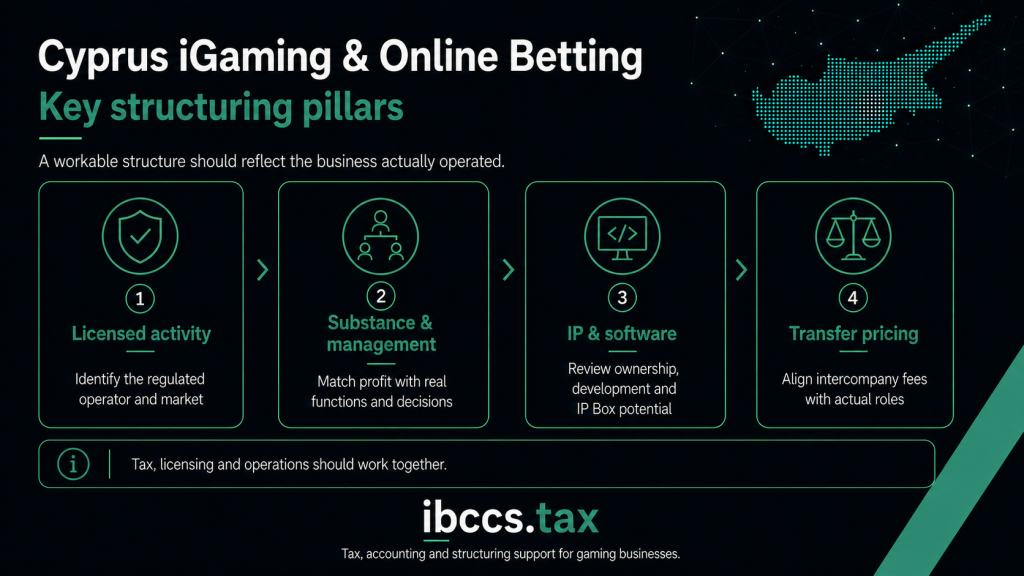
An iGaming or online betting structure should be designed around the lawful business that actually operates, not around a preferred tax outcome. The starting point is to identify the regulated activity, the licence or licences under which it is carried on, contractual counterparties, technology and IP ownership, development functions, management, marketing, payment flows and commercial risks.
Once those elements are mapped, the group can assess which entity should earn each category of revenue and whether intercompany royalties, platform fees, development charges, management fees or other payments are commercially supportable and arm’s length. Regulatory permission and tax allocation are related in practice, but they are not the same analysis.
A Cyprus company may form part of that structure where there is a genuine and legally permissible role for Cyprus. Under the current Cyprus framework, a Cyprus tax-resident company is generally subject to 15% corporate income tax on taxable income, while qualifying software profits may potentially benefit from the Cyprus IP Box deduction where the relevant conditions and nexus requirements are satisfied. Neither result should be considered in isolation from licensing, substance, transfer pricing, VAT, accounting and the wider international group position.
Why iGaming Tax Structuring Is Different
An ordinary service company may have a relatively direct relationship between employees, customers and revenue. An iGaming group can be much more fragmented.
A licensed betting or gaming operator may hold the regulatory licence and customer relationship. A second company may own the platform, another may employ developers, and management or marketing may sit elsewhere. Payment processors can also settle funds through accounts that do not sit with the entity performing the underlying economic function.
This creates a central tax question: does the legal and tax structure reflect the actual operating model?
A group can have well-drafted agreements but still create tax exposure if the conduct of the business is inconsistent with those agreements. Equally, genuine functions performed in Cyprus should be identified and appropriately reflected in the group’s profit allocation.
For international gaming groups, effective international tax structuring should therefore combine corporate tax, transfer pricing, IP, VAT, governance and implementation rather than treating each topic as an isolated exercise.
Start With the Actual iGaming Business Model
The term “iGaming company” covers very different activities. Before considering tax rates or entity locations, the group should define what each company actually does.
| Business model | Main tax and structuring questions |
| B2C online betting operator | Where is the betting activity licensed? Which entity contracts with players? Who assumes player, regulatory and payment risk? |
| Foreign-licensed gaming operator | Where is the regulated activity legally licensed? Which functions are intended to be carried on in Cyprus, and has specialist gaming counsel confirmed that those functions are permissible? |
| B2B platform provider | Who owns the platform? How are licence or SaaS fees earned? Where is development performed? |
| Game developer | Who owns the code and related IP? Are development services provided to another group company? |
| Aggregator or content platform | Which entity contracts with studios and operators? How are platform, distribution and integration margins allocated? |
| Affiliate or marketing business | Which lawfully licensed operator or B2B business is being supported? Who performs the acquisition activity, and how are affiliate or marketing returns earned and priced? |
| IP owner or licensing entity | Is the entity the genuine owner and economic exploiter of the IP? What development and management functions support the royalty income? |
| Shared service or management company | What services are actually performed and how should the service fee be priced? |
The same group may contain several of these models. The analysis should therefore be performed by function and revenue stream, not simply by legal entity name.
Where Cyprus May Fit in an International iGaming Group
Cyprus does not need to be the jurisdiction of every player-facing licence to have a legitimate role in a wider gaming group. Depending on the operating model, a Cyprus company may be relevant for licensed online betting, B2B software development, qualifying technology or IP, holding, management, shared services or other corporate functions. Where a Cyprus entity supports a foreign-licensed gaming business, the regulatory permissibility of the specific Cyprus functions should be confirmed before contracts, personnel or operations are implemented.
The starting point should be functional rather than tax-driven. A group should first determine what can lawfully and genuinely happen in Cyprus and then decide whether the legal entity, contracts, staffing and profit allocation reflect that role. A structure is easier to defend when the tax result follows the commercial organisation rather than requiring artificial activity after the structure has already been designed.
| Possible Cyprus role | What should be present in practice | Main review point |
| B2B software or platform company | Product, development, engineering management, customer contracts or technical support appropriate to the role | Revenue allocation, development costs, IP ownership and transfer pricing |
| IP or technology company | Clear legal rights, development evidence, governance and a genuine ability to exploit the technology | IP Box eligibility, nexus, royalties and substance |
| Management or shared-services company | Real personnel, decision-making, finance, operational or administrative functions | Service pricing, management location and cost allocation |
| Holding or investment company | Documented ownership purpose, governance and oversight of subsidiaries or investments | Participation income, substance, financing and future exit |
For larger groups, several Cyprus entities are not automatically better than one. Additional companies should be introduced only where there is a clear legal or operational reason for separating functions. Each entity creates its own accounting, corporate, transfer pricing and governance obligations, so complexity should have a commercial purpose.
Licence Structure and Tax Structure Are Not the Same Thing
A gaming licence determines whether a regulated activity may legally be carried out in a particular market. It does not, by itself, determine where every profit within an international group should be taxed.
The licensed operator may earn the player-facing return because it holds the customer contract and assumes regulatory and commercial risks. At the same time, a software company that genuinely develops and owns valuable technology may be entitled to a separate return. A marketing company may earn an arm’s-length service or commission return. A management company may earn remuneration for real decision-making and support functions.
The structure becomes vulnerable when the licence, contracts, people, technology and financial flows point in different directions without a supportable commercial explanation.
Cyprus Betting Licensing: What Class B Covers
The Republic of Cyprus has a defined betting licensing framework. Class A licensing applies to land-based betting and Class B licensing applies to online betting. The National Betting Authority regulates these activities. This framework does not create a general Cyprus online gaming or casino licence: online casino, poker, betting exchanges, spread betting and certain other online gambling activities are not permitted under the local betting regime. The land-based casino sector is regulated separately and should not be confused with online betting licensing.
A Class B application is therefore a specific regulatory project, not a standard company-registration exercise. The licensing framework includes corporate eligibility, financial and guarantee requirements, governance, AML/compliance, technical and operating obligations. Those requirements should be confirmed and managed by specialist gaming counsel or a licensing adviser, while the Cyprus tax, company, accounting and substance elements are coordinated alongside the application.
Licensed bookmakers also have betting-specific taxes, contributions and reporting obligations in addition to ordinary corporate tax and accounting requirements. A group entering or expanding in a regulated market should therefore obtain jurisdiction-specific regulatory advice first, then coordinate the tax, corporate and accounting structure with the licensing model rather than designing the two separately.
Looking for a Cyprus Betting or International Gaming Licence?
Searches for terms such as “Cyprus gambling licence”, “e-gaming licence Cyprus” or “online betting licence Cyprus” can be misleading because there is no single licence covering every gaming activity. For a business offering online betting in Cyprus, the relevant local route is the Class B bookmaker licence. For online casino, poker or other gaming models that are not licensable under the Cyprus online betting framework, the appropriate licensing jurisdiction must be assessed separately based on the activity, target markets and applicable regulation.
IBCCS TAX can assess whether Cyprus should form part of the wider structure and support the company registration in Cyprus, tax planning, accounting, VAT, payroll, transfer pricing, IP and substance work connected with the project. We do not position tax advice as a substitute for gaming-law advice.
Where specialist licensing support is required, we can coordinate with an external regulatory partner on matters such as licensing-jurisdiction selection, application strategy and documentation, AML/compliance requirements and engagement with the relevant gaming regulator. The regulatory partner leads the licence process; IBCCS TAX keeps the tax, corporate and accounting implementation aligned with the approved operating model. Discuss Your Gaming Structure & Licensing Requirements

Corporate Tax Structure: Which Entity Earns Which Revenue?
A well-designed structure starts by identifying revenue and the functions that generate it.
Typical revenue streams may include licensed betting revenue, other lawfully licensed player-facing revenue, B2B platform fees, software licence fees, game-content royalties, integration fees, affiliate commissions, marketing fees, development services and management services.
The entity receiving cash is not automatically the entity that should retain the underlying profit. Payment processors may settle on behalf of one company, while another entity performs the economically significant function. Accounting and intercompany settlements should reconcile these differences transparently.
A useful review asks:
- Which entity signs the player, operator, studio or affiliate contract?
- Which company bears chargebacks, regulatory exposure and customer claims?
- Which entity owns and maintains the technology?
- Where are product, risk, treasury and commercial decisions made?
- Which entity employs or contracts with developers and key management?
- Which company funds development and assumes development risk?
- What related-party payments are required to compensate other group entities?
The result should be commercially coherent before tax optimisation is considered.
Cyprus Corporate Tax Residency, Management and Substance
A Cyprus company is generally taxed in Cyprus where it is tax resident. Management and control remains central to the analysis, and the location of directors, major decisions and substantive contracting can be relevant. Cyprus also applies an incorporation-based corporate residence rule to Cyprus-incorporated companies, subject to the effect of applicable double tax treaties.
For an iGaming structure, tax residence should be supported by real governance rather than a paper board process. The board should understand the business, exercise genuine authority and make decisions consistent with the responsibilities allocated to the Cyprus entity.
Substance is broader than the number of directors. Depending on the company’s role, relevant factors may include:
- appropriately qualified directors and decision-makers;
- Cyprus office and operational infrastructure;
- local or Cyprus-based personnel where the function requires them;
- control over bank accounts and treasury decisions;
- ownership and management of contractual relationships;
- management of development, licensing or service arrangements;
- maintenance of accounting and corporate records;
- evidence that significant decisions are taken where the structure says they are taken.
A company should not be given a high-value return merely because it is incorporated in Cyprus. The return needs to be consistent with its functions, assets and risks.
IBCCS TAX provides tax planning services in Cyprus for international businesses assessing corporate residence, substance and cross-border operating models.
IP Ownership and Licensing in an iGaming Group
Technology can be one of the most valuable assets in an iGaming business. Proprietary assets may include platform code, game engines, backend systems, risk engines, wallet architecture, fraud-prevention technology, data tools, integrations and other software.
The legal owner of software should be identifiable through employment agreements, contractor agreements, IP assignment clauses, acquisition documents and development records. Where several group companies contribute to development, legal ownership alone does not resolve the tax position.
The analysis should ask who performs and controls development, who funds it, who bears failure risk, who decides the product roadmap and who is entitled to exploit the completed software.
Licensing agreements should reflect those facts. A royalty paid to an IP company with little involvement in the development, protection or exploitation of the IP may attract scrutiny, particularly where the royalty removes a significant share of the operator’s profit.
Gaming Software and the Cyprus IP Box
Qualifying copyrighted software can potentially fall within the Cyprus IP Box framework. For an eligible Cyprus tax-resident company, the regime can provide an 80% deduction on qualifying IP profits calculated under the nexus approach. With the current 15% corporate tax rate, fully qualifying profit may therefore produce an effective Cyprus corporate tax rate of approximately 3%.
The important word is qualifying.
The fact that a company is a gaming or technology business does not mean all of its revenue qualifies. Player revenue, marketing returns, brand value, customer lists, trademarks and general service income should not be automatically treated as qualifying software profit.
A gaming technology company should identify the qualifying software asset, the income attributable to that asset, qualifying expenditure, acquisition costs, related-party development costs and the appropriate nexus fraction.
Our dedicated guide to the Cyprus IP Box for SaaS and software companies explains the software eligibility, nexus, development and outsourcing analysis in greater detail.
When a Tax Ruling May Be Relevant
A Cyprus tax ruling may be considered where the facts are material and the company wants additional certainty around the proposed treatment. This may be particularly relevant where SaaS or licence income includes several components, where development is split across countries or where the group is implementing a new IP ownership model.
IBCCS TAX assists with Cyprus IP Box eligibility and tax ruling applications, including the practical documentation needed to support the position after a ruling is obtained.
Development Teams, Outsourcing and the Nexus Requirement
Gaming businesses often use distributed development teams. Employees may sit in Cyprus while specialist studios or contractors operate elsewhere. Another group company may also provide engineering services.
For IP Box purposes, these arrangements can materially affect the nexus calculation. In-house development and qualifying outsourced development are not treated in the same way as IP acquisition costs or development outsourced to related parties.
From a broader transfer pricing perspective, the group should also determine whether a development company is a routine service provider or performs higher-value functions that justify a different return.
The contractual model should correspond with reality. If a Cyprus company is said to own and control the product but all product decisions, engineering leadership and development risk sit elsewhere, the structure should be reviewed before significant IP income is allocated to Cyprus.
Transfer Pricing Between Gaming Group Companies
Transfer pricing is central to iGaming structures because related entities frequently exchange high-value services and rights. Common controlled transactions include:
- software and platform licence fees;
- game content royalties;
- development and engineering services;
- marketing and player-acquisition services;
- affiliate management;
- platform support and integration;
- management and administrative services;
- financing and treasury arrangements;
- data, risk or compliance support.
Each transaction should be priced according to the functions performed, assets used and risks assumed by the parties. A percentage royalty or service fee should not be selected solely because it produces a desired tax result.
The group should also maintain appropriate agreements, invoices, allocation methodologies and transfer pricing documentation. Cyprus documentation obligations depend on the nature and value of controlled transactions, while the arm’s-length principle remains relevant even where a transaction falls below a particular local documentation threshold.
Further information is available in our guide to transfer pricing in Cyprus and international structures.
VAT and Indirect Taxation for iGaming Businesses
VAT analysis in the gaming sector is fact-specific. The treatment can depend on whether the transaction is a regulated betting or gaming service, software licence, B2B platform service, marketing service, electronically supplied service or another category.
A structure should therefore review each material revenue and cost flow separately. Relevant questions include:
- Is the customer a business or consumer?
- Where is the customer established or resident?
- Is the supplier acting as principal, agent or intermediary?
- Does the transaction fall within a gaming-specific exemption or other local rule?
- Is a B2B reverse-charge mechanism relevant?
- Are there VAT registration or reporting obligations in another jurisdiction?
- How should intercompany software, marketing and management services be treated?
A group should not assume that because its player-facing activity receives a particular VAT treatment, all technology and intercompany transactions receive the same treatment.
IBCCS TAX provides VAT administration and compliance support in Cyprus for businesses with local and cross-border transactions.
Payment Flows, Merchant Relationships and Intercompany Settlements
Payment processing is operationally critical in iGaming and can make a group structure appear more complicated than the legal contracts suggest.
Processors, acquiring banks, wallets or alternative payment providers may settle funds to particular entities for regulatory, commercial or risk reasons. Those arrangements should be reconciled with the underlying customer contracts and accounting treatment. The tax review should establish:
- Which entity legally earns the revenue.
- Which entity receives the settlement.
- Whether the receiving entity holds funds for another group company.
- Which fees and chargebacks are deducted by the processor.
- How intercompany balances are cleared.
- Whether transfer pricing or financing consequences arise from persistent balances.
Unexplained cash movements between related companies can create difficulties during audit, banking reviews and transaction due diligence. A clean structure should allow a third party to understand why funds move where they do.
Marketing, Affiliates and Player Acquisition
Lawfully licensed betting and gaming businesses may spend heavily on affiliates, media buying, sponsorships, bonuses and other acquisition activity. The entity bearing those costs should be consistent with the commercial model and with the regulatory permissions applicable in the market being targeted.
Where one group company performs marketing for an operator, the transfer pricing method should reflect the functions and risks involved. A routine service provider may be remunerated differently from an entity that controls a significant marketing strategy, bears acquisition risk or owns valuable marketing intangibles.
Affiliate payments also require reliable documentation. Contracts, traffic reports, commission calculations, invoices and payment records should align. In cross-border arrangements, VAT and withholding-tax issues should be considered where relevant.
Management Functions and Where Decisions Are Actually Made
An iGaming group may centralise product, finance, treasury, compliance, risk, HR or strategic management in one jurisdiction while holding licences elsewhere. This can be commercially efficient, but it can also affect tax residence, permanent establishment and profit allocation.
For example, a foreign operator whose key commercial decisions are regularly taken by executives in Cyprus may need to consider whether the Cyprus activity goes beyond a support function. Similarly, an executive based in Cyprus who habitually negotiates or concludes important contracts for a foreign entity can create a different risk profile from an employee performing limited back-office work.
The location of management should therefore be part of the structure design, not an afterthought following relocation of senior staff.
International Expansion: Tax Follows the Operating Footprint
Entering a new betting or gaming market is first a regulatory question and then also a tax and operating question. Once the activity and licensing route are confirmed, the new footprint may create local corporate tax, permanent establishment, payroll, VAT, withholding-tax and transfer pricing obligations. A group planning international expansion should review, before launch:
- the required regulatory entity;
- the local customer contract;
- employees and dependent agents;
- local office or server infrastructure where relevant;
- marketing activity;
- payment and banking requirements;
- intercompany services and royalties;
- withholding taxes and treaty access;
- local VAT or gaming-specific indirect taxes;
- how profits will be repatriated.
The objective is not to force every country into one template. It is to maintain a coherent global model while adapting to jurisdiction-specific requirements.
Accounting Should Support the Tax Structure
A tax structure is only sustainable if the accounting records reflect it correctly. Gaming groups may have large transaction volumes, multiple currencies, processor settlements, player liabilities, bonuses, chargebacks, platform fees, affiliate commissions and intercompany balances. Revenue recognition and gross-versus-net presentation should be consistent with the contractual role of each entity.
The accounting function should be able to reconcile processor statements to bank receipts, revenue, gaming liabilities, fees and intercompany settlements. Related-party charges should be invoiced consistently with the transfer pricing policy, and supporting schedules should be available for year-end tax calculations.
IBCCS TAX provides accounting services in Cyprus for local and international companies requiring coordinated tax and financial reporting.
Planning Before a Restructure or Exit
Tax structuring should be reviewed well before a funding round, sale or strategic acquisition. Potential investors and acquirers typically examine:
- ownership of software and other IP;
- validity of developer and contractor assignments;
- licensing arrangements;
- regulatory structure;
- historic tax residence and substance;
- transfer pricing;
- VAT and indirect tax compliance;
- revenue recognition;
- related-party balances;
- ownership of customer and supplier contracts.
Moving IP or changing the operator structure immediately before a sale can create tax, valuation, regulatory and due diligence complications. A structure designed earlier around genuine business functions usually provides greater flexibility when an exit opportunity arises.
Signs Your iGaming Structure May Need a Review
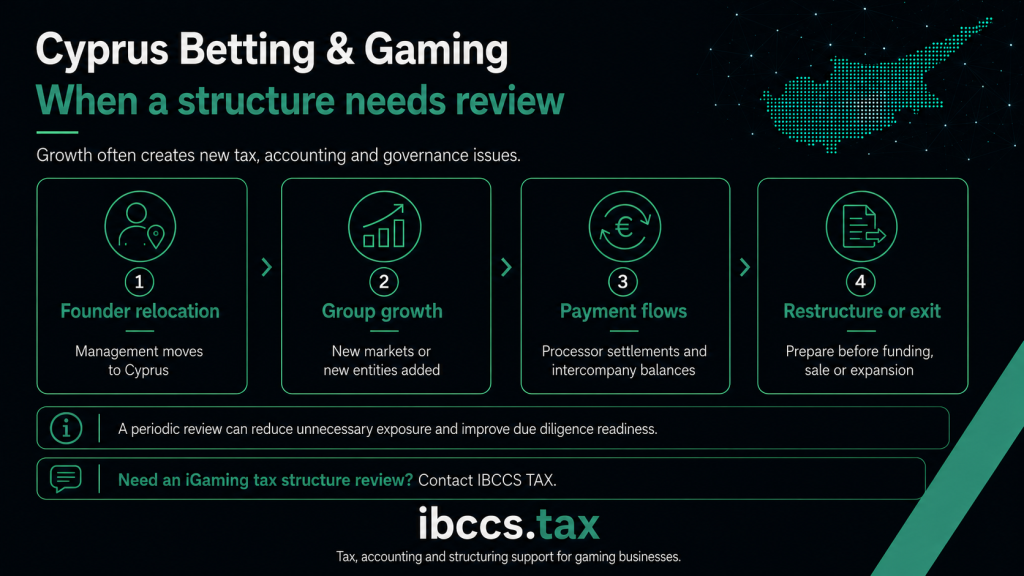
An iGaming structure often evolves faster than the legal chart. A group may start with one operating company and later add developers, new licences, affiliates, payment providers and regional teams without revisiting how profit and responsibility are allocated. That is usually the point at which a structure review becomes commercially useful.
- Key management has moved to a different country but the tax residence position has not been reviewed.
- The entity receiving most of the revenue has relatively few people or functions compared with other group companies.
- Software ownership is documented in one company, while development decisions and costs sit elsewhere.
- Intercompany royalties or service fees were introduced historically and have not been revisited as the business model changed.
- Payment processors settle funds to accounts that do not match the contractual revenue model, creating recurring reconciliation issues.
- New regulated markets have been entered without reviewing local tax, payroll, VAT or permanent establishment exposure.
- Marketing, affiliate or acquisition functions have become significant but are still treated as minor support services for transfer pricing purposes.
- The group is preparing for external investment, financing or a sale and expects tax, IP and corporate due diligence.
These indicators do not mean that the existing structure is necessarily incorrect. They mean that the structure may no longer describe the business with sufficient accuracy. A periodic review is particularly valuable after a major product launch, acquisition, founder relocation, licensing change, financing round or entry into a new market.
Practical iGaming Structuring Scenarios
Scenario 1 – B2B Platform Developed in Cyprus
A Cyprus company employs product and engineering staff and develops a proprietary B2B gaming platform licensed to unrelated operators in several jurisdictions.
The company should review software ownership, development records, customer agreements, transfer pricing for any related-party development and whether qualifying software profits can fall within the Cyprus IP Box. Its Cyprus management and operational functions should support the profit retained locally.
Scenario 2 – Foreign-Licensed Operator With Cyprus Management
An operator is lawfully licensed outside Cyprus, while founders and senior executives relocate to Cyprus and plan to perform strategic, treasury and commercial functions from the island.
Specialist gaming counsel should first confirm whether the proposed Cyprus-based functions are permissible within the operator’s licensing model. The tax review can then assess whether the foreign operator may become Cyprus tax resident or create a Cyprus permanent establishment, whether remuneration and payroll need to change and whether a revised group structure would better reflect the new management footprint.
Scenario 3 – Cyprus IP Company With Overseas Developers
A Cyprus company legally owns gaming software, but most engineering is performed by related companies abroad.
The group should not assume that all royalty or software profit qualifies for the IP Box. Nexus, development control, transfer pricing and the economic contribution of the foreign developers need to be analysed together.
Scenario 4 – Licensed Operator, Platform and Marketing Companies in Different Countries
A lawfully licensed player-facing operator pays a platform fee to one related entity and marketing fees to another. Processor settlements are received centrally and redistributed within the group.
The structure requires a clear functional analysis, arm’s-length pricing, documented settlement mechanics and consistent VAT and accounting treatment. The group should be able to explain why each entity earns its return.
Common iGaming Tax Structuring Mistakes
Starting With the Lowest Tax Rate
Selecting jurisdictions before mapping functions can produce entities with profit but no operational basis for earning it.
Treating a Licence as Proof of Tax Residence
A regulatory licence does not establish where the company is managed or where all business profits belong.
Assuming All Technology Revenue Qualifies for IP Box
The Cyprus IP Box applies to qualifying IP profits under the nexus approach. It is not a general reduced rate for gaming businesses.
Paying Royalties Without a Functional Analysis
The IP owner’s legal title, development activity, control of risk and economic contribution should support the royalty arrangement.
Letting Payment Flows Drive the Tax Treatment
A bank or processor settlement can be operationally convenient but does not replace the underlying contractual and accounting analysis.
Ignoring Senior Management Relocation
Moving founders or key executives can change corporate tax residence, permanent establishment and payroll exposure even where the legal entities remain unchanged.
Leaving Transfer Pricing Until Year-End
Intercompany pricing should be designed when the structure is implemented and reflected consistently throughout the year.
iGaming Tax Structure Review Checklist
Before implementing or reviewing an international iGaming structure, management should be able to answer the following questions:
- Which entity holds each gaming or betting licence, in which jurisdiction and for which activity?
- Which entity contracts with players, operators, studios, suppliers and affiliates?
- Where are the group’s key commercial and strategic decisions made?
- Which companies employ management, developers and marketing teams?
- Who owns the platform, games and other proprietary software?
- Where was the IP developed and who funded the development?
- Which entity assumes regulatory, player, payment and product risks?
- What revenue should each company earn based on its functions?
- Are intercompany royalties and service charges arm’s length and documented?
- Has the VAT treatment of each material transaction been reviewed?
- Do processor settlements reconcile with contracts and accounting records?
- Could any entity be tax resident or have a permanent establishment in another country?
- Does the Cyprus substance correspond with the profit allocated to Cyprus?
- Is any software potentially eligible for the Cyprus IP Box?
- Are tax ruling opportunities relevant to a material Cyprus position?
- Would the structure withstand investor, bank, regulator and buyer due diligence?
- Have the functions intended to be carried on from Cyprus been reviewed for gaming-regulatory permissibility?
What a Commercially Useful iGaming Tax Review Should Produce
A useful tax review should not end with a diagram showing where companies are incorporated. Management should be able to understand how the proposed structure changes the way the group operates and what must be implemented for the position to remain supportable. A practical review should normally produce:
- a clear functional map showing which entity performs each material activity and assumes each significant risk;
- an explanation of which revenue streams belong to which entity and why;
- a list of intercompany agreements, transfer pricing policies and accounting processes that need to be introduced or updated;
- an assessment of where management, development and IP functions should be evidenced in practice;
- a VAT and payment-flow map for the most material transaction chains;
- a list of regulatory issues that should be referred to specialist gaming counsel in Cyprus or other relevant markets;
- an implementation sequence that management, finance and legal teams can actually follow.
This keeps the analysis focused on business decisions rather than theoretical tax optimisation. It also creates a structure that can be maintained by the finance team and explained consistently to auditors, banks, investors and tax authorities.
How IBCCS TAX Supports iGaming, Betting and Gaming Technology Businesses
IBCCS TAX assists licensed betting businesses, gaming technology companies and international groups with the tax and implementation issues surrounding cross-border operating structures. Our work can include:
- group and corporate tax structure reviews;
- Cyprus tax residency and management analysis;
- international tax structuring;
- Cyprus company formation and corporate administration;
- IP ownership and Cyprus IP Box eligibility reviews;
- tax ruling applications;
- transfer pricing analysis and documentation;
- VAT review and administration;
- accounting and tax compliance;
- coordination of remuneration, payroll and management functions;
- review of cross-border intercompany agreements from a tax perspective;
- restructuring and pre-transaction tax planning.
- tax, accounting and corporate implementation around a Cyprus Class B or international gaming-licensing project;
- coordination with specialist external gaming-licensing and regulatory partners where a licence application or gaming-law opinion is required.
IBCCS TAX does not position itself as the decision-maker on whether a gaming activity is legally permitted or whether a specific licence is available. Where gaming-law or licence-application advice is required, we coordinate the tax and corporate work with appropriately qualified regulatory counsel or a specialist licensing partner. Our role is to ensure that the Cyprus and international tax, accounting, corporate and implementation elements remain aligned with the legally approved operating model.
Is Your iGaming or Betting Structure Designed for the Business You Actually Operate?
The key question is not simply, “How much tax do we pay?” It is whether the group’s legal entities, licensing model, people, IP, contracts, payment flows and profit allocation accurately reflect the lawful business being operated.
A commercially coherent structure can improve tax certainty, reduce unnecessary exposure and make accounting, banking, regulatory reviews and future transactions easier to manage. Tax efficiency should be the result of a well-designed operating model, not a substitute for one.
IBCCS TAX can review an existing or proposed iGaming, online betting or gaming-technology structure and assess the Cyprus tax, corporate, IP, transfer pricing, VAT, accounting and international structuring considerations. Where a licence or gaming-law opinion is required, we can coordinate with specialist regulatory partners. Request an iGaming & Betting Tax Structure Review.
Frequently Asked Questions About Cyprus Tax Structuring for iGaming & Betting Companies
1. Can an online gaming company use a Cyprus company?
Potentially, yes, but the permitted role depends on the activity. Cyprus can be relevant for licensed online betting and for legitimate B2B technology, IP, holding, management or other corporate functions. A Cyprus entity should not be assumed to be able to conduct or support a regulated gaming activity without confirming the regulatory position for the specific functions involved.
2. Can I obtain an e-gaming or gambling licence in Cyprus?
Cyprus does not issue one broad e-gaming or gambling licence covering all online gaming activities. The National Betting Authority issues betting licences, including Class B for online betting. Online casino and certain other online gambling activities are not licensed under the local online betting framework. Where another gaming licence is required, the appropriate jurisdiction and licence type should be determined by specialist gaming counsel based on the activity and target markets.
3. Can IBCCS TAX help with a betting or gaming licence application?
IBCCS TAX can support the Cyprus and international tax, company, accounting, VAT, transfer pricing, IP and substance elements around a licensing project. Where specialist regulatory assistance is required, we can coordinate the matter with an external gaming-licensing partner, while keeping the tax and corporate implementation aligned with the approved licence structure.
4. Can a Cyprus company operate an online casino in Cyprus?
No. The Republic’s online betting framework does not provide an online casino licence. Class B licensing covers online betting, while online casino and certain other online gambling activities are prohibited locally. Where an international group is licensed for gaming elsewhere, any functions proposed to be carried on from Cyprus should be reviewed separately with specialist gaming counsel.
5. What corporate tax rate applies to a Cyprus iGaming company?
A Cyprus tax-resident company is currently subject to the standard 15% corporate income tax rate on taxable income, subject to available exemptions and deductions. Licensed betting activity can also carry sector-specific taxes, contributions and regulatory reporting obligations, which should be considered separately from ordinary corporate tax.
6. Can gaming software qualify for the Cyprus IP Box?
Potentially. Qualifying copyrighted software can fall within the IP Box, but eligibility depends on the asset, ownership, qualifying income, development expenditure, nexus fraction and supporting documentation. The 3% potential effective rate is not an automatic rate for all gaming revenue.
7. Can an iGaming group place its IP in Cyprus and charge royalties?
It may be possible, but legal ownership alone is not enough. The group should assess who develops, controls, funds and exploits the IP and whether the royalty is arm’s length. Substance and transfer pricing should support the arrangement.
8. Does a gaming licence determine where the company pays tax?
No. Licensing and tax residence are separate analyses. Tax residence may depend on incorporation rules, management and control, applicable treaties and the actual location of business functions.
9. Are transfer pricing rules relevant to gaming groups?
Yes. Related-party royalties, development services, platform fees, marketing services, management charges and financing arrangements should all be priced on an arm’s-length basis.
10. Does Cyprus VAT apply to all iGaming revenue?
No single answer applies to every gaming transaction. The treatment depends on the service, customer, jurisdiction, regulatory framework and whether the transaction is B2B or B2C. Software and intercompany services can also follow a different VAT treatment from player-facing activity.
11. Can relocating founders to Cyprus affect a foreign gaming company?
Yes. If founders or senior executives manage a foreign company from Cyprus, corporate tax residence, permanent establishment, payroll and transfer pricing questions may arise. The structure should be reviewed before or alongside the relocation.
12. When should an iGaming tax structure be reviewed?
Ideally before licensing a new market, relocating management, moving IP, establishing development teams, changing processor arrangements, raising investment or entering a sale process. Early review usually provides more options than correcting an inconsistent structure after implementation.
Cyprus Tax Calendar 2027: Key Tax Deadlines for Individuals and Companies
Cyprus tax compliance does not revolve around one annual deadline.
Read More
Tax on Dividends in Cyprus: SDC, GHS, Non-Dom and Company Distributions
Dividend taxation in Cyprus changed materially from 1 January 2026.
Read More
Payroll in Cyprus: PAYE, Social Insurance, GHS and Employer Obligations
Payroll in Cyprus is more than transferring a net salary
Read MoreDisclaimer: This article is for general information only and does not constitute tax, legal, gaming-regulatory or financial advice. Licensing availability and regulatory permissions should be confirmed with appropriately qualified gaming counsel in the relevant jurisdiction, based on the specific activity and target market.