
Dividend taxation in Cyprus changed materially from 1 January 2026. The reform reduced Special Defence Contribution on actual dividends linked to profits earned from 2026 to 5% for individuals who fall within the SDC net, while retaining transitional treatment for distributions from older profits. At the same time, the long-standing Non-Dom regime remains relevant and GHS continues to be a separate consideration.
The result is that “what is the Cyprus dividend tax rate?” does not have one universal answer. The correct treatment depends on who receives the dividend, whether the recipient is Cyprus tax resident, whether they are domiciled or Non-Dom for SDC purposes, the period in which the distributing company earned the profits, and whether the dividend is paid by a Cyprus or foreign company.
For the wider system, see Tax in Cyprus. Company-level tax is covered separately in Cyprus Corporate Tax in 2026.

- Dividends received by an individual are generally not subject to Cyprus personal income tax.
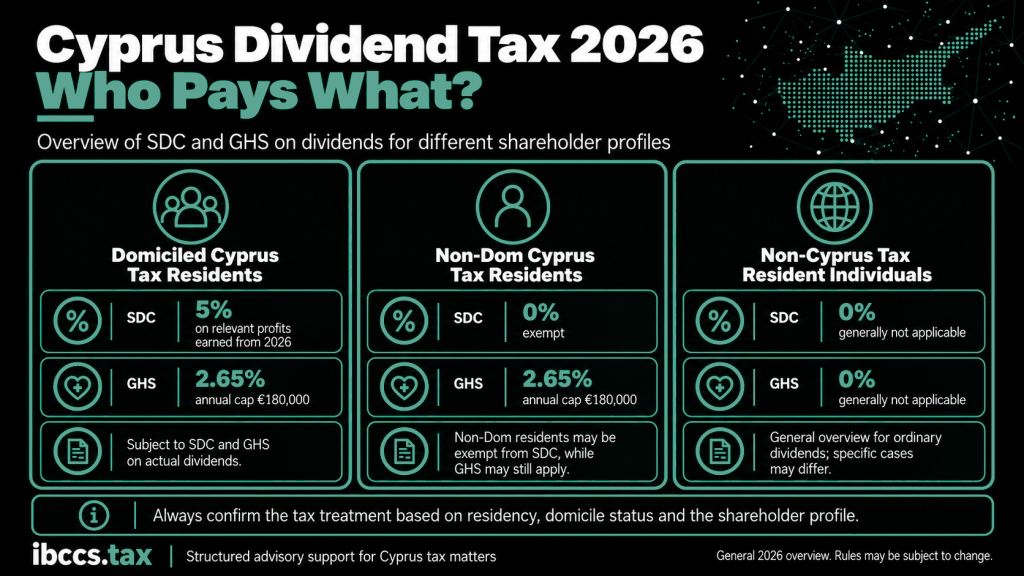
- Cyprus tax-resident and domiciled individuals can be subject to SDC on dividends.
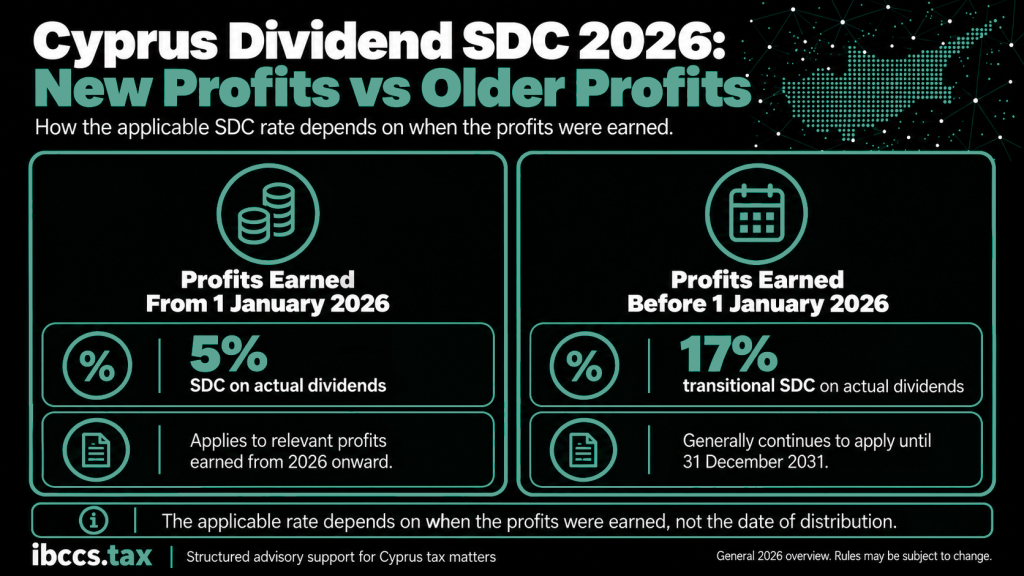
- For actual dividends connected with profits earned from 1 January 2026, the SDC rate is 5% where the individual is within the SDC net.
- Transitional rules can preserve the historical 17% SDC rate for dividends paid from profits earned up to 31 December 2025, including qualifying distributions made on or before 31 December 2031.
- A qualifying Cyprus tax-resident Non-Dom individual is generally exempt from SDC on dividends, but GHS may still apply.
- GHS on dividend income is generally 2.65% for a Cyprus tax-resident natural person, subject to the €180,000 aggregate annual GHS contribution base.
- Non-Cyprus tax residents are generally outside Cyprus SDC and GHS on ordinary dividend income, subject to specific rules and the individual’s actual status.
- Deemed Dividend Distribution was abolished for profits earned from 2026 onwards, but transitional DDD rules remain relevant to 2024 and 2025 profits.
- Cyprus generally does not levy ordinary withholding tax on dividends paid to non-residents, but targeted defensive withholding rules can apply to specified corporate recipients in EU non-cooperative or low-tax jurisdictions.
- Salary and dividends are taxed differently and should not be substituted mechanically without considering company law, payroll, Social Insurance, GHS and the shareholder’s full tax position.
Cyprus Dividend Tax 2026 at a Glance
| Recipient | Personal income tax | SDC | GHS |
| Cyprus tax-resident + domiciled individual | Generally exempt | 5% for relevant 2026+ profits; transitional 17% can apply to older profits | Generally 2.65% subject to annual GHS cap |
| Cyprus tax-resident Non-Dom individual | Generally exempt | Generally exempt | Generally 2.65% subject to annual GHS cap |
| Non-Cyprus tax-resident individual | Generally not subject to Cyprus PIT on ordinary dividend receipt | Generally outside Cyprus SDC | Generally no GHS on dividends for non-residents |
| Cyprus company receiving qualifying dividend | Potential corporate income tax exemption | Separate corporate SDC / anti-avoidance analysis may be required | Not an individual GHS contribution |
The profit year matters
For dividends paid by a Cyprus company, it is not enough to look only at the payment date. Transitional SDC rules can depend on whether the underlying distributable profit arose before or from 1 January 2026.
Are Dividends Subject to Personal Income Tax in Cyprus?
Dividend income received by an individual is generally exempt from Cyprus personal income tax. This is different from salary, self-employment income or rental income, which can fall within the progressive personal income tax system.
The exemption from personal income tax does not mean the dividend is automatically tax-free. SDC and GHS follow separate rules, and the source country can also impose tax where the dividend is paid by a foreign company. Foreign tax credits and double tax treaties may therefore become relevant.
The 5% SDC Rate and the Transitional 17% Rule
The 2026 reform reduced SDC on actual dividends for Cyprus tax-resident and domiciled individuals from 17% to 5% for dividends linked to profits earned from 1 January 2026. This materially changes the ongoing cost of distributing new profits to shareholders who are within the SDC regime.
However, retained earnings from earlier years cannot simply be treated as 2026 profits. Dividends paid from profits earned up to 31 December 2025 can remain subject to 17% SDC where the transitional provisions apply. The transitional period extends to distributions received on or before 31 December 2031 for the relevant older profits.
Companies with material pre-2026 retained earnings should therefore maintain clear records of distributable reserves by profit year. Dividend resolutions, accounting records and SDC withholding should all reflect the source of the profits being distributed.
Cyprus Non-Dom and Dividend Income
A qualifying Cyprus tax-resident individual who is non-domiciled for SDC purposes is generally exempt from SDC on dividend income. This exemption can apply to dividends from Cyprus companies and foreign companies, subject to the individual’s status and the detailed law.
The exemption is from SDC, not from every Cyprus charge. GHS can still apply to dividend income, and foreign withholding tax can apply where a dividend is paid from another jurisdiction.
The tax residency conditions are explained in Cyprus tax residency 2026, while internationally mobile investors can also review Cyprus Tax for Expats.
When Does Non-Dom Status End?
An individual can be deemed domiciled in Cyprus once they have been Cyprus tax resident for at least 17 out of the preceding 20 tax years. From 2026, an eligible person without a Cyprus domicile of origin can elect for an alternative SDC method that may extend the exemption for two additional five-year periods, subject to a €250,000 payment for each period and the statutory application process.
GHS on Dividends
GHS is separate from SDC. Dividend income of a Cyprus tax-resident natural person is generally subject to GHS at 2.65%, including where the individual is Non-Dom and therefore exempt from SDC. The total annual income base subject to GHS for a natural person is capped at €180,000 across the relevant categories of income.
Where income comes from several sources, the cap and ordering rules should be reviewed carefully so that GHS is not overpaid or underpaid. Foreign dividend income can also require self-assessment where no Cyprus payer is withholding at source.
Dividends Paid by a Cyprus Company to Cyprus Resident Individuals
A Cyprus company distributing dividends to a Cyprus tax-resident individual should determine whether the shareholder is domiciled or Non-Dom for SDC purposes, which profit years are being distributed and whether GHS withholding applies. The company’s board and accounting records should also demonstrate that sufficient distributable reserves exist.
IBCCS TAX provides support with the declaration of withheld SDC and GHS contributions from dividends and the underlying shareholder classification.
Dividends Paid to Non-Resident Shareholders
Cyprus generally does not impose ordinary withholding tax on dividends paid to non-Cyprus tax residents. This is one of the established features of the Cyprus holding-company framework. The position should nevertheless be checked where the recipient is a company located in a jurisdiction subject to Cyprus defensive tax measures.
Cyprus applies targeted withholding provisions to specified payments to corporate recipients in EU non-cooperative jurisdictions and, from 2026, to certain dividend payments to related companies in low-tax jurisdictions. Treaty provisions and the exact statutory conditions can alter the result, so international distributions should be reviewed before payment.
Foreign Dividends Received by a Cyprus Resident Individual
Foreign dividends are generally outside Cyprus personal income tax, but SDC and GHS can remain relevant depending on the recipient’s tax residency and domicile. The source country may withhold tax before the dividend is paid, making double tax treaty provisions and foreign tax credits important to the final cash outcome.
Investors should retain dividend vouchers, source-country tax statements and evidence of foreign withholding so that any available credit can be supported.
Dividends Received by a Cyprus Company
Qualifying dividend income received by a Cyprus company can be exempt from corporate income tax. Separate SDC and anti-avoidance conditions can become relevant for certain passive or low-tax foreign income, and international holding structures should also review participation, substance, transfer pricing and source-country withholding.
The company-level framework is covered in Cyprus Corporate Tax in 2026.
Deemed Dividend Distribution After the 2026 Reform
Deemed Dividend Distribution was abolished for profits earned from 1 January 2026 onwards. A Cyprus company can therefore retain 2026 and later profits without the old automatic deemed-distribution mechanism applying to those profits.
Transitional rules remain relevant for 2024 and 2025 profits. In broad terms, 70% of qualifying profits can still be deemed distributed two years after the end of the relevant year where the statutory shareholder conditions are satisfied: 2024 profits can be relevant at 31 December 2026 and 2025 profits at 31 December 2027.
Salary vs Dividends for Owner-Managers
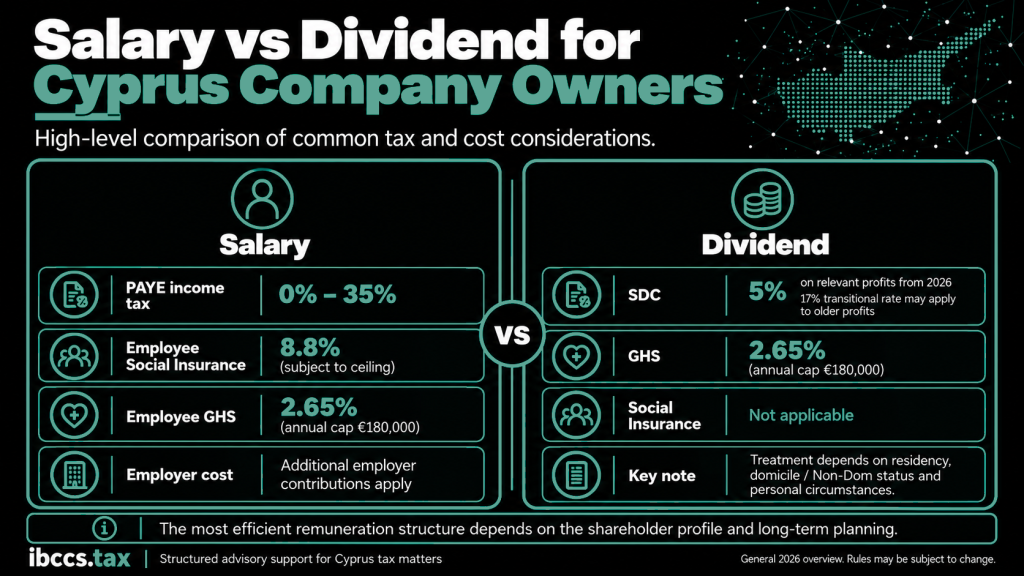
Salary and dividends are not interchangeable. Salary is remuneration for employment or services and can create PAYE, Social Insurance and GHS obligations. A dividend is a distribution of company profit and is not a deductible business expense of the company.
A shareholder-director should therefore avoid setting an arbitrary low salary and extracting every remaining amount as dividends without reviewing the commercial role, payroll position, company distributable reserves, SDC, GHS and wider personal tax profile.
For the employment side, see Payroll in Cyprus.
How a Cyprus Company Should Document a Dividend Distribution
- Confirm sufficient distributable reserves and the relevant profit years.
- Prepare the appropriate board / shareholder resolutions under company law and the company’s constitutional documents.
- Identify each shareholder and their tax-residency and SDC domicile status.
- Calculate SDC and GHS withholding where applicable.
- Prepare the relevant declarations and arrange payment by the statutory deadlines.
- Post the dividend and withholding entries correctly in the accounting records.
- Retain supporting documentation for the company, shareholder and tax files.
Common Dividend Tax Mistakes
- Assuming every dividend is taxed at 5% SDC after 2026 without identifying the profit year.
- Treating Non-Dom as an exemption from GHS.
- Ignoring foreign withholding tax on dividends received from overseas companies.
- Paying dividends without sufficient distributable reserves.
- Failing to distinguish a shareholder loan, salary or director fee from a dividend.
- Using the same treatment for resident and non-resident shareholders.
- Overlooking defensive withholding rules for specified corporate recipients in low-tax or non-cooperative jurisdictions.
How IBCCS TAX Can Help
IBCCS TAX can review the company and shareholder position before a dividend is declared, identify the relevant profit pool, assess SDC and GHS, prepare the required withholding declarations and coordinate the distribution with the wider corporate and personal tax position.
This can be combined with tax planning services in Cyprus, accounting services in Cyprus and our service for withheld SDC and GHS contributions from dividends.

Frequently Asked Questions – Tax on Dividends in Cyprus
1. What is the dividend tax rate in Cyprus in 2026?
There is no single universal rate. Dividends are generally outside personal income tax. A Cyprus tax-resident and domiciled individual can be subject to 5% SDC on dividends linked to profits earned from 2026, while transitional 17% treatment can apply to older profits. GHS can also apply.
2. Do Cyprus Non-Doms pay tax on dividends?
Qualifying Non-Dom individuals are generally exempt from SDC on dividends, but GHS at 2.65% can still apply to a Cyprus tax-resident natural person, subject to the annual GHS cap.
3. Are foreign dividends taxable in Cyprus?
Foreign dividends are generally outside personal income tax. SDC depends on the recipient’s domicile status, GHS can apply, and source-country withholding and treaty relief should be reviewed.
4. Does Cyprus withhold tax on dividends paid to non-residents?
Cyprus generally does not impose ordinary dividend withholding tax on non-residents, but targeted defensive rules can apply to specified corporate recipients in EU non-cooperative or low-tax jurisdictions.
5. What happened to Deemed Dividend Distribution?
DDD was abolished for profits earned from 2026 onwards. Transitional rules remain relevant to 2024 and 2025 profits.
6. Is a dividend better than salary in Cyprus?
Not automatically. Salary and dividends have different corporate, PAYE, Social Insurance, GHS and SDC consequences. The appropriate mix depends on the owner’s role, company profits and wider tax profile.


Cyprus Non-Dom After 17 Years: Deemed Domicile and the Alternative SDC Method
Cyprus Non-Dom is often described as a 17-year tax benefit,
Read More
Cyprus Non-Dom Eligibility: Domicile of Origin, Domicile of Choice and the 17/20 Rule
Cyprus Non-Dom eligibility is often described too simply. A person
Read More
IBCCS TAX to Attend Plan ₿ Forum 2026 in Lugano, Switzerland
IBCCS TAX will be attending Plan ₿ Forum 2026 in
Read MoreImportant Note: This article provides general information on Cyprus tax and compliance rules. The correct treatment depends on the taxpayer, the nature and source of the income or transaction, tax residency and domicile, available exemptions, applicable double tax treaties and the facts of the case. It should not be treated as a substitute for transaction-specific tax or legal advice.