

Cyprus corporate tax changed materially from 1 January 2026. The standard corporate income tax rate increased from 12.5% to 15%, the tax loss carry-forward period was extended, the company tax-residency rules were broadened and the filing timetable for the 2026 tax year changed. At the same time, several established features of the Cyprus tax system remain important, including exemptions for qualifying dividend income and gains from the disposal of qualifying titles, the Notional Interest Deduction and the Cyprus IP Box regime.
For a business, the headline 15% rate is only the starting point. Corporate income tax is charged on taxable profit rather than turnover, and taxable profit is not always the same as the accounting profit shown in the financial statements. The final position depends on the nature of the company’s income, deductible and non-deductible expenditure, available tax losses, financing, related-party transactions, foreign operations and any incentives or exemptions that apply.
This guide explains how Cyprus corporate tax works for the 2026 tax year and how it interacts with the wider compliance cycle. For a summary of the wider changes introduced from 1 January 2026, see Cyprus Tax Reform 2026. Businesses establishing a new Cyprus entity can also refer to our Cyprus Company Formation 2026 guide.

- The standard Cyprus corporate income tax rate is 15% for tax years beginning on or after 1 January 2026.
- Cyprus corporate tax is charged on taxable profit, not on turnover or cash received. Accounting profit is adjusted for tax-exempt income, non-deductible expenditure, capital allowances, tax losses and other tax rules.
- A Cyprus-incorporated company is generally treated as Cyprus tax resident from 2026 unless an applicable double tax treaty provides otherwise; the management and control test also remains relevant.
- Qualifying dividend income and gains from the disposal of qualifying corporate titles can be exempt from corporate income tax, subject to the applicable conditions and anti-avoidance rules.
- Tax losses can generally be carried forward for seven years from the end of the tax year in which the loss arises. Group relief may also be available subject to the relevant ownership and other conditions.
- The Notional Interest Deduction can reduce taxable profit on qualifying new equity, subject to an 80% cap on the taxable profit generated by the financed activities.
- The Cyprus IP Box regime provides an 80% deduction on qualifying IP profits under the nexus approach, which can result in an effective corporate tax rate as low as approximately 3% at the 15% headline rate.
- Provisional corporate tax for 2026 is payable in two equal instalments on 31 July and 31 December 2026. The company should review its expected taxable profit rather than simply repeat the previous year’s payment.
- For the 2026 tax year, the corporate income tax return and final balancing tax payment are due by 31 January 2028.
- Related-party transactions must follow the arm’s-length principle. The 2026 Local File thresholds increased, but transactions below the documentation thresholds are not exempt from the arm’s-length requirement.
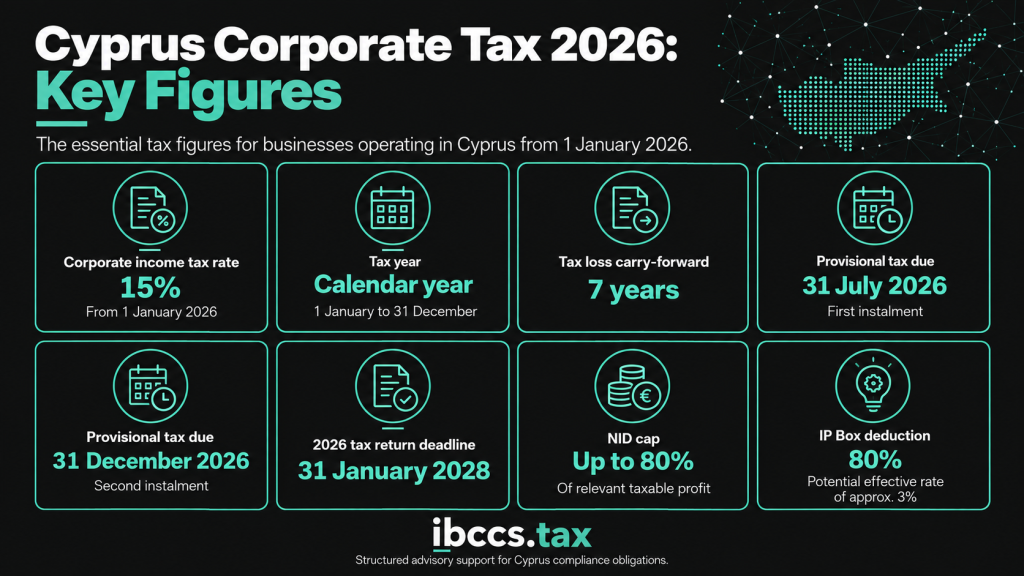
Cyprus Corporate Tax 2026: Key Figures at a Glance
| Item | 2026 position | Practical point |
| Standard corporate income tax rate | 15% | Applies to taxable corporate profits, not gross revenue. |
| Tax year | Calendar year | 1 January to 31 December. |
| Tax loss carry-forward | 7 years | Subject to the applicable utilisation rules. |
| Provisional tax – first instalment | 31 July 2026 | Based on expected full-year taxable profit. |
| Provisional tax – second instalment | 31 December 2026 | Estimate can be reviewed before year-end. |
| 2026 corporate tax return deadline | 31 January 2028 | New deadline for tax years from 2026 onwards. |
| 2026 final balancing payment | 31 January 2028 | Aligned with the tax return deadline. |
| NID cap | Up to 80% of relevant taxable profit | Applies to qualifying new equity and financed activities. |
| IP Box deduction | 80% of qualifying profits | Potential effective rate of approximately 3%, subject to nexus and other conditions. |
How Corporate Tax Works in Cyprus
Cyprus corporate income tax is imposed on the taxable income of companies and other corporate taxpayers within the scope of the Income Tax Law. A Cyprus tax-resident company is generally taxed on income arising in Cyprus and abroad, while a non-Cyprus tax-resident company can be taxed on profits attributable to a permanent establishment in Cyprus and on certain other Cyprus-source income.
The tax system works on a self-assessment basis. A company maintains accounting records, prepares financial statements, determines its taxable profit through a tax computation, pays provisional tax during the year and submits the annual corporate income tax return electronically. Taxable profit can differ substantially from accounting profit because tax law may exempt some income, deny or restrict some expenses and provide separate deductions or incentives.
For companies that need ongoing accounting support, accounting services in Cyprus and accurate bookkeeping are the practical foundation for calculating tax correctly and preparing the year-end tax position.
Who Pays Corporate Tax in Cyprus?
Cyprus tax-resident companies
A company that is tax resident in Cyprus is generally subject to Cyprus corporate income tax on its worldwide taxable income, subject to exemptions, foreign tax credits and specific rules for particular categories of income. Management and control in Cyprus remains a core tax-residence test and should be supported in practice by the way key decisions are taken and the company is actually managed.
From 2026, the tax-residence definition also provides that a company incorporated under Cyprus company law is generally treated as Cyprus tax resident unless an applicable double tax treaty provides otherwise. Companies that have transferred their registered office or legal seat to Cyprus are also treated as incorporated in Cyprus for this purpose.
Tax residence is not only a registration question
Where a company has connections to more than one jurisdiction, tax residency, treaty tie-breakers, management and control, substance and permanent-establishment exposure should be reviewed together. A certificate of incorporation alone should not be treated as a complete international tax analysis.
Non-Cyprus tax-resident companies and permanent establishments
A company that is not tax resident in Cyprus can still have a Cyprus corporate tax liability where it carries on business through a permanent establishment in Cyprus or derives certain income that falls within the Cyprus taxing provisions. The existence of a permanent establishment depends on the facts, including the company’s physical presence, activities, personnel and authority exercised in Cyprus.
International businesses should therefore review Cyprus corporate tax exposure before opening an office, relocating key functions, appointing personnel or carrying out sustained commercial activity in Cyprus. The analysis should also consider the relevant double tax treaty where one applies.
Cyprus Corporate Tax Rate in 2026: 15%
The standard Cyprus corporate income tax rate is 15% from 1 January 2026. The previous 12.5% rate applies to earlier tax years, but companies calculating 2026 provisional tax and final corporate tax must use the 15% rate unless a specific special mode of taxation applies.
The increase in the headline rate does not mean that every euro recorded in a company’s accounts is taxed at 15%. The rate applies to taxable profit after the relevant tax adjustments. A business with exempt dividend income, qualifying gains on titles, available tax losses, NID or IP Box income can have an effective tax burden different from 15%, while a business with non-deductible expenditure can have taxable profit that is higher than its accounting profit.
The corporate rate increase formed part of the wider Cyprus Tax Reform 2026, which also changed tax loss utilisation, interest taxation for companies, filing deadlines, transfer pricing thresholds and other aspects of the corporate tax framework.
Taxable Profit vs Accounting Profit: What Is Actually Taxed?
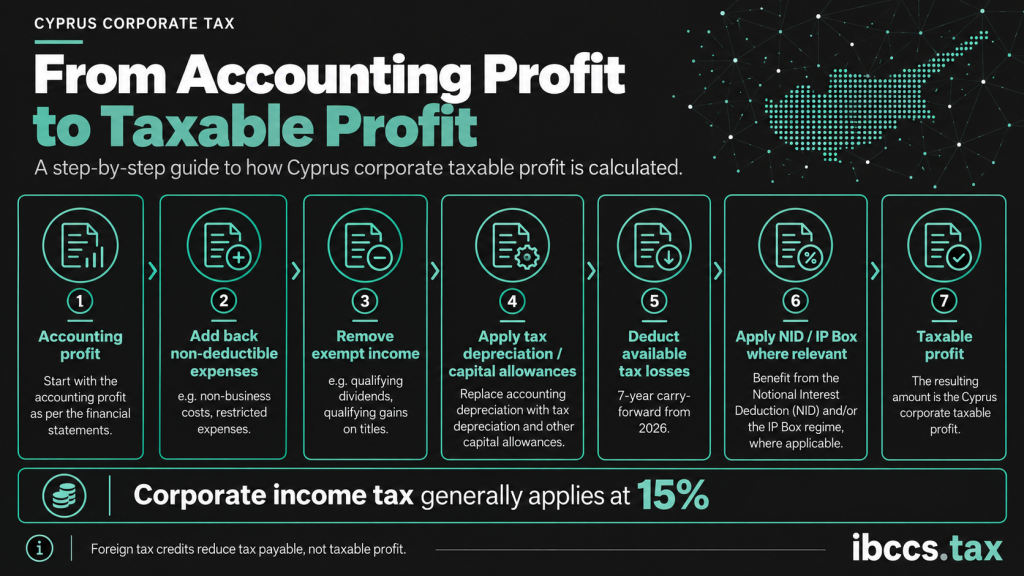
Corporate tax is not calculated by applying 15% to the company’s turnover. It is also not necessarily calculated by applying 15% directly to the accounting profit shown in the financial statements. The starting point is normally the company’s accounting result, which is then adjusted under Cyprus tax rules to arrive at taxable profit.
Common adjustments include adding back expenses that are not deductible for tax purposes, replacing accounting depreciation with the tax capital allowances permitted by law, removing exempt income, applying tax losses, calculating the Notional Interest Deduction and applying any special tax regime that is relevant to the business.
| Illustrative tax computation | EUR | Tax treatment |
| Accounting profit before tax | 180,000 | Starting point |
| Add back non-deductible expenditure | +10,000 | Increases taxable profit |
| Deduct available tax losses | -30,000 | Subject to utilisation rules |
| Deduct qualifying NID | -20,000 | Illustrative only; actual NID depends on the facts |
| Illustrative taxable profit | 140,000 | Amount subject to standard CIT |
| Corporate income tax at 15% | 21,000 | Before foreign tax credits or other applicable adjustments |
Illustration only
The example is designed to show the difference between accounting and taxable profit. It does not represent a universal tax computation, and the availability of losses, NID or other adjustments must be verified for the particular company and tax year.
What Corporate Income Is Taxable in Cyprus?
The tax treatment depends on the nature of the income rather than the label used in the accounts. For most trading and professional businesses, ordinary operating profit is taxed at the standard 15% rate after allowable deductions. Other income streams may be exempt, subject to special rules or taxed outside the corporate income tax framework.
Trading and service income
Profits from ordinary trading, consulting, professional services, technology, e-commerce and other commercial activities are generally subject to corporate income tax at 15% after deductible business expenses and other relevant adjustments. The same principle applies whether the customers are in Cyprus or abroad, although VAT, permanent establishment and foreign tax issues may also need to be considered.
Interest income from 2026
From 1 January 2026, interest income earned by companies is generally subject to corporate income tax at 15% and is no longer subject to Special Defence Contribution as passive interest. This simplifies the previous distinction between active and passive interest for ordinary companies, although the deductibility of financing expenses and related-party financing still requires separate analysis.
Rental income
Corporate rental income is subject to corporate income tax after allowable expenses. From 2026, rental income is no longer subject to SDC for companies, so the corporate income tax treatment becomes the central direct-tax charge. Businesses should also note that from 1 July 2026 rent relating to immovable property in Cyprus must be paid and received through recognised electronic payment methods.
Royalty and intellectual property income
Royalty income is generally subject to corporate income tax after allowable expenses. Where the company develops or exploits qualifying intellectual property, the Cyprus IP Box regime may materially reduce the taxable amount if the statutory conditions and nexus requirements are met.
Crypto-asset gains
From 2026, qualifying gains from cryptocurrency transactions are subject to a special flat income tax rate of 8%. The regime has specific rules, including limitations on the utilisation of crypto losses, and does not apply to crypto acquired through mining. Businesses with material digital-asset activity should therefore separate the crypto position from the ordinary 15% corporate tax computation.
Key Cyprus Corporate Tax Exemptions
One reason the headline rate does not tell the full story is that Cyprus corporate tax law contains important exemptions for specific categories of income and gains. These exemptions can be highly relevant to holding companies, investment structures and international groups, but they must be applied only where the legal conditions are satisfied.
Qualifying dividend income
Dividend income received by a Cyprus company is generally exempt from corporate income tax. Foreign dividends can also benefit from the participation exemption, although SDC can apply where the statutory exemption conditions are not satisfied. Anti-avoidance rules and transitional rules affecting dividends connected with pre-2026 profits should be reviewed separately where relevant.
Companies used primarily to hold participations should also review our guide to the Cyprus Holding Company, which explains how dividend income, disposals, outbound payments, substance and shareholder considerations interact in a holding structure.
Gains from the disposal of qualifying titles
Profits from the disposal of qualifying corporate titles are generally exempt from corporate income tax. The definition can include shares, bonds, debentures and certain other securities and financial instruments. This exemption is one of the important features of Cyprus for investment and holding activity.
The exemption should not be confused with the separate Cyprus Capital Gains Tax regime. Gains connected with Cyprus immovable property, including certain disposals of shares in companies that derive value from Cyprus immovable property, may fall within Capital Gains Tax rather than the ordinary corporate income tax rules.
Foreign permanent establishment profits
Profits of a foreign permanent establishment of a Cyprus tax-resident company can generally be exempt from Cyprus corporate income tax, subject to anti-avoidance conditions. From 2026, the exemption is not available where the foreign permanent establishment is situated in a jurisdiction included on the EU list of non-cooperative jurisdictions.
A company may also elect, on an irrevocable basis, for foreign permanent establishment profits to be taxed in Cyprus. Where foreign income is taxed in Cyprus, foreign tax credits can be relevant in reducing double taxation.
Business Expenses: What Is Deductible for Cyprus Corporate Tax?
The general principle is that expenditure incurred wholly and exclusively for the generation of taxable income is deductible, subject to the specific provisions and restrictions of Cyprus tax law. Expenses should be supported by appropriate invoices, receipts, contracts and other documentation that demonstrate the business purpose and the amount claimed.
For an operating company, deductible costs commonly include employee costs, employer social contributions, rent for business premises, professional fees, software and subscriptions, marketing costs, utilities, business travel and other expenditure connected with generating taxable business income. The precise treatment depends on the nature of the expense and any specific statutory rules.
Interest and financing costs
Interest incurred for generating taxable income can generally be deductible, but several restrictions may apply. These include rules where borrowing finances assets that generate exempt income, the ATAD interest limitation rule and special defensive provisions for payments connected with certain low-tax or non-cooperative jurisdictions.
For taxpayers within the interest limitation rule, exceeding borrowing costs can be restricted by reference to 30% of taxable EBITDA, subject to the available EUR 3 million safe harbour and the detailed group rules. Financing arrangements with related parties must also comply with transfer pricing and the arm’s-length principle.
Entertainment expenses
From 2026, the maximum deductible amount for business entertainment expenses increased to EUR 30,000. The deduction remains limited to the lower of 1% of the business’s gross income or EUR 30,000. Businesses should retain supporting documentation and distinguish genuine business entertainment from private or shareholder expenditure.
Research and development expenditure
The enhanced 120% deduction for qualifying research and development expenditure on intangible assets has been extended to 2030. This can be relevant to technology, software and innovation-driven businesses that carry out qualifying R&D activities in Cyprus and maintain appropriate documentation of the expenditure and development activity.
Expenses that may be non-deductible or restricted
Examples of items that can be non-deductible or subject to restrictions include:
- fines and penalties;
- company formation and certain capital expenditure that is not deductible as an ordinary revenue expense;
- accounting depreciation, which is generally replaced by tax capital allowances where applicable;
- expenses connected with tax-exempt income to the extent restricted by the tax rules;
- private, shareholder or non-business expenditure;
- certain ex-gratia employment payments under the 2026 rules; and
- rent or other expenditure where a specific statutory condition for deductibility is not met.
From 1 July 2026, payments of rent relating to immovable property in Cyprus must be made through bank transfer, debit or credit card, or another recognised electronic payment method. This applies to both natural and legal persons and should be reflected in the company’s payment controls and documentation.
Tax Losses in Cyprus: Seven-Year Carry-Forward From 2026
The 2026 tax reform extended the general tax loss carry-forward period from five to seven years. A tax loss can therefore generally be carried forward and set against taxable profits arising during the following seven years, subject to the applicable restrictions. Cyprus does not generally provide a carryback of ordinary corporate tax losses.
The extended period is particularly relevant to start-ups, investment-stage businesses, technology companies and businesses with multi-year development cycles. A company should maintain a clear tax-loss schedule and review utilisation annually, because older losses can expire if they are not used within the permitted period.
Group Relief for Cyprus Companies
Group relief can allow tax losses to be surrendered between eligible group companies, subject to the statutory conditions. The Cyprus group relationship generally requires a direct or indirect 75% voting-share relationship, and the rules can also accommodate certain EU or treaty-country intermediate companies.
From 2026, a company is required to use its own brought-forward losses against its taxable income before surrendering losses through group relief. Groups should therefore model the order of loss utilisation before year-end rather than treating group relief as a purely administrative filing exercise.
Notional Interest Deduction: Tax Relief for Qualifying New Equity
The Notional Interest Deduction, commonly referred to as NID, can provide a tax deduction to Cyprus tax-resident companies and Cyprus permanent establishments of foreign companies on qualifying new equity introduced on or after 1 January 2015. It is intended to reduce the tax distinction between equity financing and debt financing.
The NID is calculated by multiplying qualifying new equity by a reference interest rate. The reference rate is based on the 10-year government bond yield of the country in which the new equity is employed, measured at 31 December of the preceding tax year, plus a 5% premium. For 2026, the relevant bond yields are those at 31 December 2025.
The NID cannot exceed 80% of the taxable profit generated by the activities financed by the new equity, calculated before the NID. Any deduction restricted by this 80% cap is not carried forward. A company can elect to claim all, part or none of the available NID for a tax year.
Why NID matters
NID can reduce the effective tax burden of a company funded with qualifying equity, but the benefit depends on how and where the equity is used. Equity movements, related-party funding, restructurings and anti-avoidance provisions should be reviewed before a deduction is assumed.
Cyprus IP Box: Potential Effective Corporate Tax Rate of About 3%
Cyprus operates an IP Box regime based on the OECD modified nexus approach. For qualifying intellectual property and qualifying profits, the regime provides an 80% deduction. With the standard corporate tax rate at 15%, the effective rate on qualifying IP profits can therefore be as low as approximately 3%, subject to the nexus calculation and the facts of the business.
The regime is especially relevant to software businesses and other innovation-led companies that develop qualifying IP and can demonstrate the required link between qualifying expenditure and the income generated by the asset. It should not be assumed that every intangible asset, brand, trademark or acquired IP automatically qualifies.
IBCCS TAX assists with eligibility analysis, structuring and implementation through our Cyprus IP Box regime and tax ruling support. For material or technically sensitive arrangements, a tax ruling can provide additional certainty before the intended treatment is implemented.
Foreign Tax Credits, Double Tax Treaties and International Income
A Cyprus tax-resident company can earn income in multiple jurisdictions. Where foreign-source income is taxable in Cyprus and has already suffered foreign tax, Cyprus can generally provide relief through foreign tax credits, subject to the relevant limitations. In many cases, a credit can be available even where Cyprus does not have a double tax treaty with the source country.
Double tax treaties remain important for allocating taxing rights, determining permanent-establishment exposure, reducing source-country withholding taxes and resolving residence issues. Treaty benefits should not be treated as automatic: beneficial ownership, substance, anti-abuse provisions and the commercial reality of the structure can all be relevant.
International groups and founders planning cross-border structures should consider the corporate tax position together with tax planning services in Cyprus and, where relevant, a broader international tax optimisation strategy.
Withholding Tax on Payments From Cyprus Companies
Cyprus generally does not impose withholding tax on dividends, interest or royalties paid to non-residents, subject to important exceptions. Royalties for rights used in Cyprus can be subject to Cyprus withholding tax, and defensive measures apply to certain payments involving companies in jurisdictions on the EU list of non-cooperative jurisdictions and, from 2026, certain related companies in low-tax jurisdictions.
Because these defensive measures depend on the recipient, ownership relationship, jurisdiction and type of payment, international groups should review dividend, interest and royalty flows before payment rather than relying only on the general no-withholding-tax principle.
Transfer Pricing and Related-Party Transactions in Cyprus
Transactions between related parties must be priced on an arm’s-length basis. The Cyprus transfer pricing rules cover domestic and cross-border controlled transactions and can require annual documentation, a Local File or Master File and a Summary Information Table depending on the circumstances.
From 2026, the Local File exemption thresholds increased to EUR 10 million for financial transactions, EUR 5 million for transactions involving the sale or purchase of goods and EUR 2.5 million for categories including services, IP/royalties and other controlled transactions. These are documentation thresholds: transactions below them must still comply with the arm’s-length principle.
Companies with related-party financing, service charges, IP licences, management fees or intercompany trading should review our Transfer Pricing rules in Cyprus and ensure that the pricing and documentation remain consistent with the company’s tax return and financial statements.
Pillar Two and the 15% Global Minimum Tax for Large Groups
The 15% Cyprus corporate tax rate should not be confused with the separate Pillar Two global minimum tax framework. Cyprus has implemented the EU rules for multinational enterprise groups and large-scale domestic groups that meet the relevant consolidated revenue threshold, generally EUR 750 million under the Pillar Two framework.
For groups within scope, the effective tax rate is assessed under specialised GloBE rules rather than by simply comparing the local statutory rate with 15%. Large groups with Cyprus constituent entities should therefore treat Pillar Two as a separate compliance and modelling exercise.
Corporate Tax and Capital Gains Tax Are Not the Same
Ordinary corporate income tax and Cyprus Capital Gains Tax operate as separate regimes. Gains from the disposal of qualifying titles can be exempt from corporate income tax, but Cyprus Capital Gains Tax can apply to disposals of Cyprus immovable property and to certain disposals of shares in companies that directly or indirectly derive value from Cyprus immovable property.
The 2026 reform reduced the relevant property-rich threshold for certain indirect share disposals from 50% to 20%. A company planning the disposal of property or shares in a property-holding structure should therefore identify the applicable tax regime before assuming that the exemption for titles applies.
Cyprus Corporate Tax Filing and Payment Deadlines for 2026
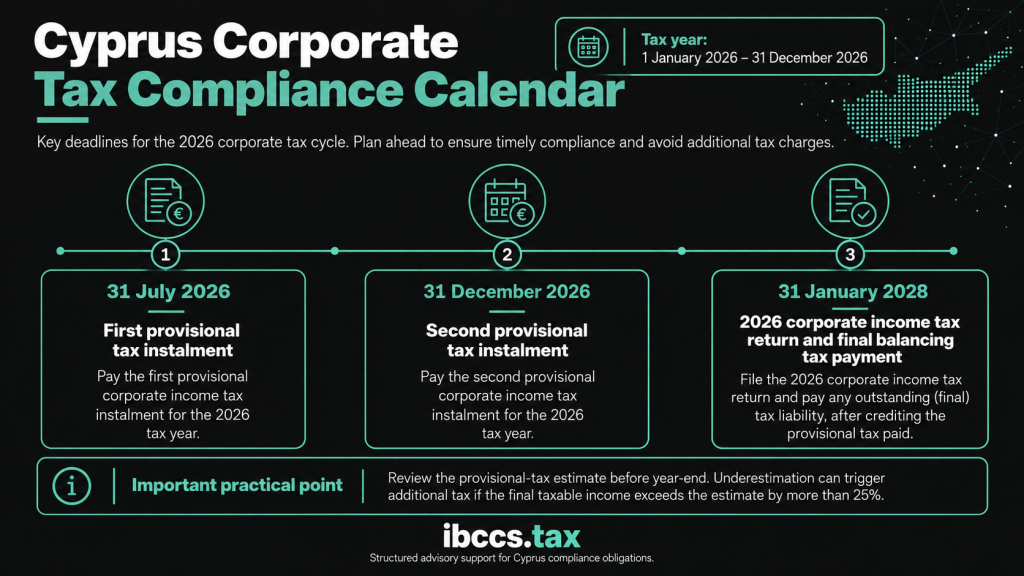
The corporate tax compliance timetable changed for the 2026 tax year. Companies still pay provisional tax during the current year, but the deadline for the annual return and final balancing payment has moved to 31 January of the second year following the tax year.
| Obligation | Deadline for 2026 | What the company should do |
| First provisional tax instalment | 31 July 2026 | Estimate full-year taxable profit and pay the first equal instalment. |
| Second provisional tax instalment | 31 December 2026 | Reassess the estimate and revise it if the expected taxable profit has changed. |
| 2026 corporate income tax return | 31 January 2028 | Submit the annual return electronically based on the final tax computation and financial information. |
| Final balancing tax payment | 31 January 2028 | Settle the final liability after deducting provisional tax and available credits. |
For the mechanics of the two current-year instalments, the 75% rule and the risks of using an outdated estimate, see our detailed guide to Cyprus Provisional Tax 2026.
The 75% Provisional Tax Rule
If the provisional taxable income declared for the year is less than 75% of the final taxable income, an additional 10% tax can apply to the difference. This makes the December review important: a company that has grown faster than expected during the second half of the year should not simply pay the second instalment based on the July forecast without revisiting the underlying taxable profit.
Record Retention and Tax Audit Readiness
The 2026 reforms also strengthened the tax administration framework. Tax records and supporting documentation generally need to be retained for six years by reference to the relevant return submission or revised return submission, with additional considerations where an audit or enquiry is in progress.
In practice, companies should maintain a complete tax file containing the annual tax computation, financial statements, supporting schedules, contracts, invoices, transfer pricing material, evidence supporting exemptions and deductions, and reconciliations between accounting records and the tax return.
Financial Statements and Accounting Records: Why They Matter for Corporate Tax
A reliable corporate tax computation depends on reliable accounting records. Revenue, expenses, fixed assets, financing, related-party balances and tax-sensitive transactions should be recorded consistently during the year rather than reconstructed only when the tax return becomes due.
IBCCS TAX provides bookkeeping services in Cyprus, preparation of financial statements and wider accounting services for Cyprus and international businesses. Keeping the accounting and tax processes connected makes it easier to identify provisional tax changes, missing documents and tax adjustments before deadlines are reached.
Common Cyprus Corporate Tax Mistakes
Most corporate tax errors are not caused by the 15% calculation itself. They arise because the wrong amount is treated as taxable, exemptions are applied without support, deductions are claimed without evidence or compliance requirements are reviewed too late.
- Applying 15% to turnover or accounting profit without preparing a proper tax computation.
- Using the old 12.5% corporate tax rate for the 2026 tax year or provisional tax estimate.
- Assuming every dividend or share disposal is automatically tax-exempt without checking the statutory conditions and anti-avoidance rules.
- Failing to distinguish ordinary corporate tax from Capital Gains Tax on Cyprus immovable property or property-rich structures.
- Claiming expenses without sufficient invoices, contracts or evidence of a business purpose.
- Ignoring interest limitation, related-party financing or transfer pricing rules when deducting finance costs.
- Failing to track tax-loss expiry dates or the order in which own losses and group relief should be used.
- Treating NID or IP Box as automatic deductions without reviewing qualifying equity, nexus, income streams and documentation.
- Repeating the previous year’s provisional tax amount instead of reassessing current-year taxable profit.
- Leaving transfer pricing, foreign tax credits or treaty analysis until after the year-end accounts have been finalised.
Cyprus Corporate Tax 2026 Checklist
| Question | Why it matters |
| Is the company Cyprus tax resident? | Determines the scope of income subject to Cyprus tax and can affect treaty analysis. |
| Has the 15% rate been used for 2026? | The previous 12.5% rate no longer applies to the 2026 tax year. |
| Is taxable profit reconciled to accounting profit? | Tax adjustments determine the actual tax base. |
| Are exempt income and gains identified correctly? | Dividends, titles and foreign PE profits can require separate analysis. |
| Are expenses supported and deductible? | Unsupported or restricted expenses can increase taxable profit. |
| Are tax losses tracked by year? | Losses now have a seven-year carry-forward period. |
| Could NID or IP Box apply? | Eligible companies may reduce taxable profit materially. |
| Are related-party transactions arm’s length? | Transfer pricing applies even below Local File documentation thresholds. |
| Has provisional tax been reviewed? | The July and December payments should reflect realistic expected taxable profit. |
| Are the 2026 return and final payment scheduled for 31 January 2028? | The deadline changed for tax years from 2026 onwards. |
How IBCCS TAX Can Help With Cyprus Corporate Tax
IBCCS TAX supports Cyprus companies, international groups, founders and investors with corporate tax from the initial structure through to annual compliance. The objective is to combine tax efficiency with accurate accounting, appropriate substance and a position that can be supported if reviewed by the Cyprus Tax Department.
Our support can include:
- corporate tax residency and scope-of-taxation reviews;
- annual corporate tax computations and tax return support;
- provisional tax calculations and revisions;
- review of deductible and non-deductible expenditure;
- tax loss and group relief analysis;
- Notional Interest Deduction calculations;
- Cyprus IP Box eligibility, structuring and tax ruling support;
- tax treatment of dividends, interest, royalties and foreign income;
- foreign tax credit and double tax treaty analysis;
- transfer pricing and related-party transaction support;
- bookkeeping, financial statements and wider accounting compliance; and
- international tax structuring and implementation for businesses operating across jurisdictions.
Our Cyprus team combines tax planning, accounting services and practical support across the wider IBCCS TAX Cyprus service platform, allowing a company’s tax position to be reviewed together with its accounting, corporate and operational requirements.
Cyprus Corporate Tax in 2026: Final Considerations
The 15% corporate tax rate is the most visible change for 2026, but it should not be considered in isolation. A company’s actual tax burden depends on how taxable profit is calculated, which income is exempt, which expenses are deductible, whether losses or NID are available, whether the IP Box applies and how cross-border and related-party transactions are structured.
The compliance timetable has also changed. Companies should manage corporate tax as an annual process rather than a single year-end filing: maintain current accounting records, review provisional tax in July and December, document significant transactions as they occur and prepare for the 31 January 2028 filing and final payment deadline for the 2026 tax year.
For businesses with international operations, the strongest corporate tax position is one that is commercially grounded, supported by substance and documentation, and coordinated with accounting, VAT, transfer pricing and shareholder-level planning.

Frequently Asked Questions About Cyprus Corporate Tax
1. What is the corporate tax rate in Cyprus in 2026?
The standard Cyprus corporate income tax rate is 15% from 1 January 2026. The previous 12.5% rate applies to earlier tax years. The 15% rate is applied to taxable profit after the relevant tax adjustments, not to gross turnover.
2. Is Cyprus corporate tax charged on revenue or profit?
Corporate income tax is charged on taxable profit, not revenue. Accounting profit is adjusted for tax-exempt income, non-deductible expenses, capital allowances, tax losses, NID and other applicable tax rules to determine the taxable amount.
3. When is a Cyprus company tax resident?
A company is tax resident in Cyprus where its management and control is exercised in Cyprus. From 2026, a company incorporated under Cyprus company law is also generally treated as Cyprus tax resident unless an applicable double tax treaty provides otherwise.
4. Are dividends received by a Cyprus company taxable?
Dividend income is generally exempt from Cyprus corporate income tax. However, Special Defence Contribution, participation-exemption conditions, anti-avoidance provisions and transitional rules can still be relevant depending on the source and underlying profits.
5. Are gains from selling shares taxable in Cyprus?
Profits from the disposal of qualifying corporate titles are generally exempt from corporate income tax. Separate Capital Gains Tax rules can apply where the transaction involves Cyprus immovable property or certain property-rich companies.
6. How long can a Cyprus company carry forward tax losses?
From 2026, ordinary tax losses can generally be carried forward for seven years from the end of the tax year in which the loss arises, subject to the applicable rules. Cyprus generally does not allow ordinary corporate tax losses to be carried back.
7. What is the Notional Interest Deduction in Cyprus?
NID is a tax deduction available on qualifying new equity introduced into a Cyprus tax-resident company or Cyprus permanent establishment. It is calculated using the relevant 10-year government bond yield plus 5% and is subject to an 80% cap on the taxable profit generated by the financed activities.
8. What is the Cyprus IP Box corporate tax rate?
The IP Box provides an 80% deduction on qualifying IP profits under the nexus approach. At the 15% corporate income tax rate, the effective rate on qualifying profits can be as low as approximately 3%, subject to eligibility and the detailed calculation.
9. When is provisional corporate tax due in Cyprus for 2026?
The 2026 provisional corporate tax is payable in two equal instalments, due on 31 July 2026 and 31 December 2026. The estimate should be based on expected taxable profit for the full year and should be reviewed before the second instalment.
10. When is the 2026 Cyprus corporate tax return due?
For the 2026 tax year, the corporate income tax return is due by 31 January 2028. The final balancing corporate tax payment is also due by 31 January 2028.
11. Does every Cyprus company pay 15% corporate tax?
No. The 15% rate is the standard rate on taxable profit, but some income can be exempt and certain incentives or deductions can reduce the taxable amount. A company with no taxable profit will not simply pay 15% of its revenue.
12. Do transfer pricing rules apply to small related-party transactions?
The arm’s-length principle applies to controlled transactions even if the company is below the thresholds that trigger a Cyprus Local File. The documentation burden can differ by size, but the pricing itself must still be supportable.


Cyprus Corporate Tax in 2026: Rate, Taxable Profits, Exemptions and Filing Requirements
Cyprus corporate tax changed materially from 1 January 2026. The
Read More
Cyprus Companies at Risk of Strike-Off: 31 December 2026 Deadline for Overdue HE32 Annual Returns
Cyprus companies with overdue Annual Returns (HE32) and corresponding Financial
Read More
Cyprus VAT for International Services: B2B, B2C and Reverse Charge Explained
International services are one of the areas where Cyprus VAT
Read MoreImportant Note This article provides general information on the Cyprus corporate tax framework as reviewed in October 2026. The tax treatment of a company depends on its activities, tax residence, income, expenses, ownership, financing, related-party transactions, foreign operations and applicable treaty or anti-avoidance rules. Transaction-specific professional advice should be obtained before applying an exemption, deduction, incentive or cross-border tax position.