

The United Arab Emirates has developed into an established international business centre connecting the Middle East with Europe, Asia and Africa. Entrepreneurs, international groups and investors use the country for local operations, regional headquarters, global trade, professional services, technology, manufacturing, investment and holding structures.
The UAE can offer meaningful commercial advantages, including broad international connectivity, full foreign ownership for many activities, modern infrastructure, flexible company formation options and a competitive tax environment. These benefits are strongest where the selected Emirate, licence, legal form and operating model match the company’s actual customers, activities and growth plans.
Starting a business in the UAE should therefore not be treated as a decision based only on a low tax rate, a fast incorporation package or the possibility of obtaining a residence visa. The company must also be able to operate, bank, hire, invoice customers and comply with the relevant licensing and tax framework.
This guide explains why businesses choose the UAE, which types of companies can benefit most and what should be reviewed before proceeding. Businesses already ready to begin the formation process can use our detailed guide on how to set up a business in the UAE.

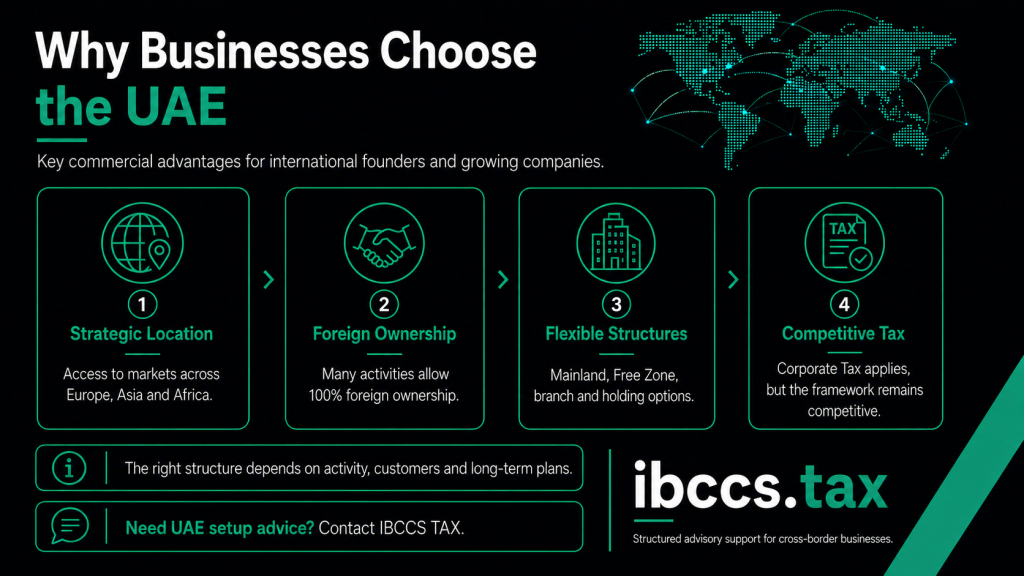
- The UAE provides access to regional and international markets through established aviation, port and logistics infrastructure.
- Many mainland and Free Zone activities allow 100% foreign ownership, subject to the relevant activity and regulatory approvals.
- Businesses can choose between mainland, Free Zone, branch, holding and other specialised structures.
- The standard UAE Corporate Tax regime applies 0% to taxable income up to AED 375,000 and 9% to the portion above that amount.
- Qualifying Free Zone Persons may access a 0% rate on Qualifying Income, but the regime is conditional and requires compliance.
- The UAE does not levy personal income tax on employment income, although individuals conducting business can fall within Corporate Tax rules.
- An extensive treaty and investment-agreement network can support cross-border operations, but treaty benefits are not automatic.
- The country offers long-term residence routes for eligible investors, entrepreneurs and professionals.
- Digital government services and one-stop licensing systems can make formation and administration more efficient.
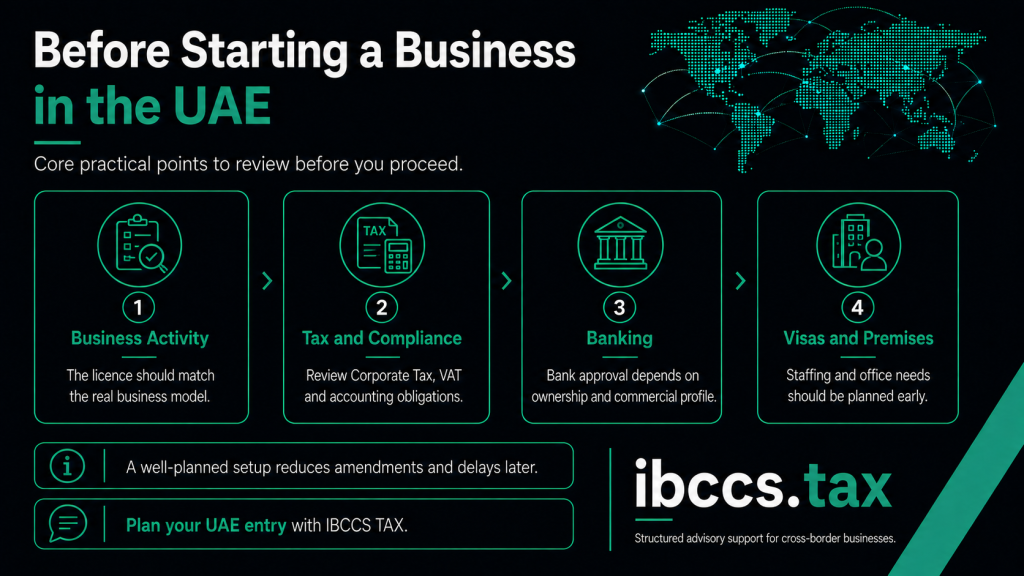
- The most suitable UAE structure depends on market access, activity, premises, visas, banking, tax and substance rather than the lowest setup cost.
Why Is the UAE Attractive for International Business?
The UAE combines several commercial advantages within one jurisdiction. It provides access to a large regional market while also supporting businesses that trade or provide services internationally. Companies can select from multiple Emirates and licensing environments, each offering different operational, sector and infrastructure options.
The country has also continued to modernise company, investment and tax rules. Full foreign ownership is available for many mainland activities, Free Zones provide specialist business ecosystems, and digital government platforms have streamlined a growing number of registration and administrative procedures.
These factors do not make the UAE the correct location for every company. The business should still establish whether it has a genuine commercial reason to operate from the country and whether the expected revenue can support the premises, staffing, banking and compliance required by the selected structure.
1. Strategic Location and International Connectivity
The UAE is positioned between major markets in Europe, Asia and Africa, making it a practical base for companies serving more than one region. Its time zone can also support communication with clients and teams across several continents during the same business day.
International airports, seaports, logistics corridors and warehousing facilities support passenger movement, trade and regional distribution. This is particularly relevant for businesses involved in logistics, commodities, e-commerce, manufacturing, professional services and regional management.
Geographic location alone does not create a successful regional hub. Contracts, employees, decision-making, customs arrangements and customer access should also support the UAE company’s stated role.
2. A Diversified and Internationally Oriented Economy
The UAE has developed substantial non-oil activity across trade, logistics, manufacturing, finance, technology, tourism, real estate, professional services and renewable energy. This creates opportunities for both customer-facing companies and businesses supporting wider commercial ecosystems.
Different Emirates have developed distinct sector strengths. A company should therefore compare the location of customers, suppliers, regulators, infrastructure and talent rather than assuming that every activity should automatically be established in Dubai.
The presence of international groups, regional headquarters, investors and professional advisers can also support partnerships and commercial expansion. Market-entry research remains important because competition can be strong and customer expectations vary between sectors.
3. Full Foreign Ownership for Many Activities
Foreign investors can own 100% of many UAE mainland companies, subject to the selected activity and any strategic or regulated-sector restrictions. Free Zone companies are also generally available with full foreign ownership.
This allows international founders to maintain ownership and control without introducing a shareholder solely to meet a nationality requirement. The constitutional documents should still define management, voting rights, ownership transfers and profit distributions clearly.
Full ownership should not be confused with unrestricted activity. A company may still require external approvals, specialised licences, local premises or specific governance arrangements depending on the sector.
4. Flexible Company Formation Options
The UAE offers several ways to establish a commercial presence. A business may operate through a mainland LLC, a Free Zone company, a branch of an existing entity, a holding company, an SPV or another specialised structure.
These options allow the setup to be aligned with the customer base, permitted activities, shareholders, premises, employees and investment plans. A local retail business, an international consultancy and a regional holding company should not use the same structure simply because one package is cheaper or faster.
A detailed comparison is provided in our guide to the types of companies in the UAE.
5. Mainland Access and Specialist Free Zone Ecosystems
A mainland company can generally conduct its licensed activities directly in the UAE market, subject to sector and location requirements. This can be valuable for companies serving local customers, maintaining customer-facing premises, bidding for work or employing larger operational teams.
Free Zones can provide integrated licensing, workspace, visa support and sector-specific infrastructure. They may be appropriate for international services, trade, logistics, technology, media, manufacturing and other business models where the selected zone supports the actual activity.
The two routes should be compared commercially rather than through generic claims. Our guides to mainland company formation in the UAE and UAE Free Zone benefits explain the differences in more detail.
6. Competitive but Compliance-Based Tax Environment
The UAE remains a competitive tax jurisdiction, but it should no longer be described as universally tax-free. UAE companies are generally within the federal Corporate Tax regime, and VAT applies to taxable supplies and imports under the ordinary rules.
Under the standard Corporate Tax regime, taxable income up to AED 375,000 is subject to 0%, while the portion above that amount is generally subject to 9%. The threshold applies to taxable income rather than turnover, revenue or the amount held in the bank account.
A Qualifying Free Zone Person can apply 0% to Qualifying Income where all statutory conditions are met. Free Zone status alone does not guarantee the preferential rate, and non-qualifying income can be taxed under the standard rules.
The tax environment can be attractive where the company is properly structured and maintains accurate accounting, filing and transfer pricing records. Further details are available in our guide to UAE Corporate Tax.
7. No Personal Income Tax on Employment Income
The UAE does not levy personal income tax on an individual’s salary or ordinary employment income. This can support the recruitment and retention of internationally mobile founders, managers and employees.
The absence of personal income tax does not mean that every amount received by an individual is outside the UAE tax framework. A natural person conducting a business or business activity can become subject to Corporate Tax where the relevant conditions are met, while VAT can apply separately.
A person relocating from another country should also review whether tax residence has genuinely changed and whether income remains taxable in the previous or another jurisdiction. Our guide to UAE personal income tax and tax residency explains the distinction.
8. International Tax Treaty and Investment Network
The UAE has developed an extensive network of Double Taxation Agreements and investment treaties. These agreements can support international trade, investment and profit repatriation by reducing double taxation and providing legal protections in qualifying cases.
Treaty access is not automatic merely because a company has a UAE incorporation certificate. The entity may need to demonstrate tax residence, beneficial ownership, effective management, commercial substance and compliance with anti-abuse provisions.
Cross-border businesses should review the applicable treaty together with withholding taxes, permanent establishment, transfer pricing and the tax position of the other country. IBCCS TAX provides international taxation services in the UAE for companies operating across jurisdictions.
9. Modern Infrastructure and Digital Government Services
The UAE provides modern telecommunications, transport, office, industrial and logistics infrastructure. Businesses can choose between serviced offices, conventional commercial premises, warehouses, industrial facilities and sector-specific environments.
Many registration, licensing, tax and immigration procedures are supported through digital portals. Some formation routes can be completed efficiently where the activity and documents are straightforward, while regulated sectors and corporate shareholders can require a longer process.
Digital access improves efficiency but does not remove the need for accurate documentation or professional review. Incorrect activities, ownership details or tax registrations can still lead to delays and amendments.
10. Access to International Talent and Residence Options
The UAE’s international workforce allows companies to recruit people with experience across many markets and industries. English is widely used in business, while the wider multilingual environment can support regional and international operations.
Licensed businesses can generally sponsor residence visas for qualifying shareholders and employees, subject to the selected structure, premises and immigration approval. Eligible investors, entrepreneurs and professionals may also consider long-term residence routes such as the Golden Visa or Green Visa.
Residence eligibility should be assessed separately from company ownership. The business licence, visa status, personal tax residence and family relocation should be coordinated rather than treated as one automatic result.
IBCCS TAX provides UAE immigration assistance and practical relocation assistance in the UAE for business owners, employees and families.
11. A Business Environment Designed for Growth
The UAE can support businesses at different stages, from founder-led companies and regional subsidiaries to investment structures and multinational headquarters. Companies can expand activities, premises, staff and ownership through the appropriate licensing and corporate procedures.
The market also provides access to professional services, financing, investors and established commercial communities. These advantages are most valuable where the business has a clear growth strategy and adequate resources for implementation.
The existence of a supportive environment does not replace product-market fit. A company still needs credible pricing, customer acquisition, contracts, operational capacity and financial control.
12. Quality of Life as a Business Consideration
Safety, international travel connections, schools, healthcare, housing and a diverse social environment can make the UAE attractive to founders and senior employees relocating with their families. These factors can support retention and continuity in regional management roles.
Quality of life is also linked to cost. Housing, schooling, insurance and lifestyle expenses can be significant, particularly in the largest business centres. Companies relocating staff should include these factors in compensation and workforce planning.
A successful business relocation should therefore coordinate commercial setup with the practical needs of the owners, employees and their families.
Which UAE Business Structure Should You Choose?
| Structure | Typical use | Main advantage | Key consideration |
| Mainland company | Direct UAE operations and local customers | Broad market access within the licence | Premises, activity and local approvals |
| Free Zone company | International, specialist or zone-based activity | Integrated setup and sector ecosystem | Mainland access and conditional tax treatment |
| Branch | Extension of an existing foreign or UAE company | Continuity with the parent company | Parent remains responsible for branch liabilities |
| Holding company | Ownership of subsidiaries and strategic assets | Centralised governance and investment structure | Tax, substance, banking and asset transfers |
| SPV or international vehicle | Specific investment, asset or cross-border structure | Narrow and ring-fenced purpose | Limited operating and visa functionality |
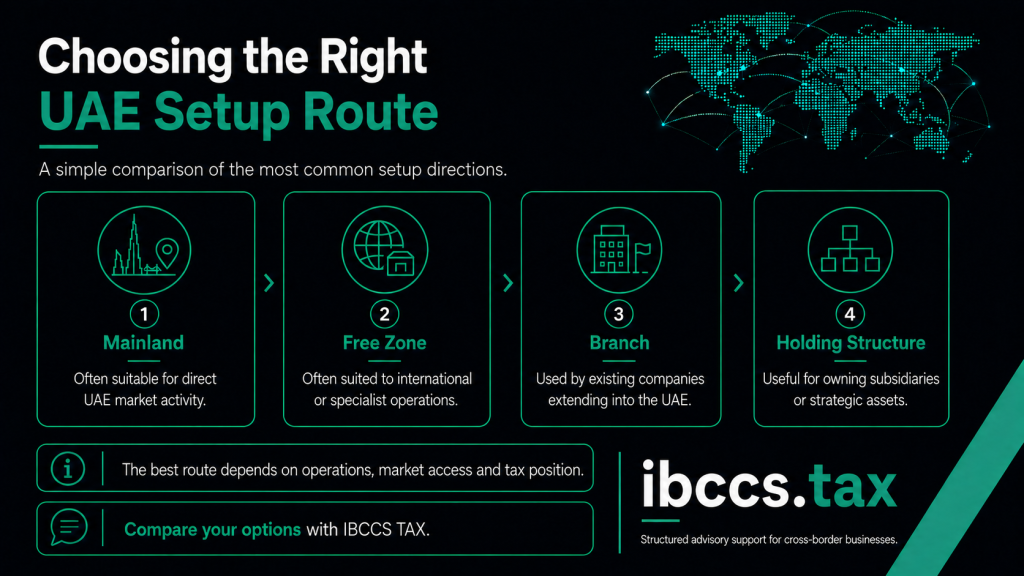
The best UAE business structure depends on what the company will actually do, where its customers are located and whether it requires employees, premises, visas or local market access. A structure designed for international ownership should not be used as a substitute for an operating licence.
Businesses considering an ownership or investment vehicle can also review our guide to UAE holding company setup.
Business Sectors With Strong UAE Potential
The UAE supports a wide range of industries, but the commercial opportunity and regulatory requirements differ substantially by sector. Businesses should validate customer demand, competition, licences and capital requirements before entering the market.
Technology and Digital Services
Technology companies can access regional customers, international talent, specialist Free Zones and innovation-focused ecosystems. Software, cybersecurity, fintech, artificial intelligence, digital media and e-commerce are areas of continuing commercial interest.
Regulated financial, payment, data and telecommunications activities require specialist analysis. A general technology licence may not cover every product or service offered by the company.
Trade, Logistics and E-Commerce
The UAE’s ports, airports, warehousing and customs infrastructure make it suitable for regional distribution, re-export and international trading. The business should select a jurisdiction that supports the relevant products, storage, customs and customer markets.
E-commerce businesses must also review consumer protection, product approvals, VAT, fulfilment and whether the selected licence permits direct sales into the intended market.
Manufacturing and Advanced Industry
Industrial zones, logistics access and government focus on advanced manufacturing can support production, assembly and processing businesses. The setup may require land, utilities, environmental approvals, customs arrangements and a larger workforce.
The project should be evaluated as an operating investment rather than a standard company-registration exercise. Facility, supply-chain and financing decisions normally need to be made before licensing is completed.
Financial and Professional Services
The UAE is home to established financial centres and a large market for accounting, legal, consulting, corporate, technology and advisory services. International companies can use the country to serve regional clients and manage cross-border projects.
Financial services and certain professional activities can be regulated. The licence, professional qualifications, ownership and customer-facing arrangements should be confirmed before marketing or contracting begins.
Tourism, Hospitality and Consumer Markets
Tourism, hospitality, retail, food and beverage, entertainment and related services can benefit from resident and visitor demand. These sectors usually involve premises, inspections, employee planning and multiple local approvals.
Commercial success depends heavily on location, customer acquisition and operating margins. High market visibility should not be confused with low entry cost or simple compliance.
Real Estate and Construction-Related Activity
Real estate development, brokerage, property management, construction and technical services can provide opportunities but are subject to activity-specific licensing and regulatory rules. The correct licence depends on whether the company is investing, developing, advising, managing or providing contracting services.
Property ownership through a company also requires a separate review of land-registry eligibility, financing, VAT, Corporate Tax and the intended exit.
What Are the Main Challenges of Doing Business in the UAE?
The UAE offers a supportive business environment, but companies should plan for practical and regulatory challenges. The following issues are common reasons why a setup that looks attractive at incorporation can become inefficient later.
Choosing Between Multiple Authorities and Jurisdictions
The UAE contains several Emirates, mainland licensing authorities, Free Zones and specialist regulators. Activity descriptions and operating rights can differ between them.
The company should compare the whole operating model rather than select an authority based only on the licence price or promotional package.
Understanding the Real Cost of Operations
The total cost can include the licence, premises, visas, immigration registrations, regulatory approvals, insurance, accounting, tax, audit, banking and annual renewal. These costs vary according to the activity and scale of the business.
A low first-year setup price may not include the facilities, compliance or amendments required when the company begins operating.
Corporate Bank Account Approval
Banks conduct independent due diligence and review ownership, source of funds, business activity, customers, suppliers and expected transactions. Incorporation does not guarantee an account.
The licence, business plan, contracts and commercial substance should present a consistent and credible profile. Companies with complex ownership or high-risk markets should plan for additional review.
Tax, Accounting and Transfer Pricing Compliance
Corporate Tax, VAT and accounting obligations should be addressed from the beginning. Related Party transactions must be priced on an arm’s length basis, and businesses should retain sufficient records to support tax returns and exemptions.
Companies that postpone bookkeeping until the first filing deadline can face incomplete records, incorrect VAT treatment and difficulties supporting deductible expenses.
Mainland Market Access for Free Zone Companies
A Free Zone company does not automatically have unrestricted access to every mainland activity. Additional permits, branches, distributors or other arrangements can be required depending on the business model.
The route to customers should be confirmed before the company signs contracts, hires staff or commits to a facility.
Recruitment, Employment and Visa Administration
Hiring requires appropriate work permits, employment documentation, payroll processes and compliance with the applicable labour framework. Visa capacity can depend on premises, licence and authority approval.
Companies should also consider health insurance, employee benefits, Emiratisation requirements where applicable and the cost of relocating international staff.
Market Competition and Commercial Execution
The UAE attracts businesses from many countries, which creates commercial opportunities but also strong competition. A company must understand customer behaviour, pricing, sales cycles and sector-specific relationships.
A UAE licence cannot compensate for an underdeveloped product, weak market entry plan or insufficient working capital.
Who Can Benefit Most From Starting a Business in the UAE?
International Service Companies
Consulting, technology and professional service businesses working with regional or international customers can use the UAE as a commercial and management base. The structure should match where services are performed, where decisions are made and who the customers are.
Trading and Distribution Businesses
Companies importing, storing, distributing or re-exporting goods can benefit from logistics infrastructure and access to regional markets. Customs, product approvals, warehouse requirements and mainland sales should be mapped in advance.
Regional Headquarters and International Groups
International groups can establish a UAE subsidiary or branch to coordinate regional management, sales, treasury or support functions. Substance, transfer pricing, employment and decision-making should reflect the role assigned to the entity.
Entrepreneurs Relocating With Their Business
Founders who plan to live and manage their business from the UAE can coordinate company formation with residence, personal tax planning and family relocation. The move should be genuine and supported by practical management and living arrangements.
Investors and Holding Structures
Investors can use appropriately designed UAE companies or SPVs to hold subsidiaries, projects and strategic assets. The structure should consider Corporate Tax exemptions, treaty access, banking, governance and the tax implications in the countries where the investments are located.
When May the UAE Not Be the Best Business Location?
The UAE may be less suitable where a company has no genuine commercial connection to the country, all management and employees remain elsewhere, and the main objective is only to obtain a low-tax registration. Such a structure can create banking, substance and foreign tax-residence risks.
Another jurisdiction may be more practical where the business needs direct access to a particular regulated market, public funding, local labour pool or legal framework that the UAE does not provide. Companies should also consider whether expected revenue justifies the recurring cost of a properly maintained UAE operation.
The decision should compare the UAE with the locations of customers, founders, management, employees and intellectual property. International structuring can involve more than one jurisdiction where each entity has a clear commercial role.
How to Decide Whether to Start a Business in the UAE
1. Identify the Commercial Reason
Define whether the UAE company will serve local customers, manage regional operations, trade internationally, employ staff, hold investments or support relocation. The purpose should be specific enough to guide the licence and structure.
2. Confirm the Business Activities
List the exact products and services the company will provide. Activity codes affect ownership, approvals, premises, customer access and tax treatment.
3. Map the Customer and Supplier Locations
Establish where customers and suppliers are located and how contracts, goods and payments will move. This is central to choosing between mainland and Free Zone.
4. Compare the Emirates and Licensing Authorities
Review where the business will operate, which authority supports the activity and whether specialist infrastructure or regulatory approval is required.
5. Assess Tax and Cross-Border Consequences
Review Corporate Tax, VAT, transfer pricing, withholding taxes, permanent establishment, shareholder tax and personal tax residence before implementation.
6. Plan Premises, Employees and Visas
Decide what physical facility and workforce the business needs. Do not select a licence package that cannot support the planned operations.
7. Test the Banking Profile
Consider the source of funds, countries, customers, expected transactions and required banking services. The setup should be credible to financial institutions.
8. Prepare a Multi-Year Budget
Include annual licence, premises, visas, accounting, audit, tax, insurance, payroll and regulatory costs rather than only the incorporation fee.
9. Confirm Governance and Ownership
Document shareholder rights, management authority, financing and future investor arrangements. This is particularly important for joint ventures and group companies.
10. Build Ongoing Compliance Into the Setup
Implement accounting, tax, corporate and employment processes when the company begins operating. Compliance should not be postponed until renewal or filing deadlines.
Practical Examples
International Consultancy Serving Regional Clients
A consulting business has customers across the Gulf and plans to relocate its founder and hire a small team. A UAE company can provide a regional operating base, but the correct mainland or Free Zone route depends on where services are provided and where customers are located.
The founder should coordinate licensing, Corporate Tax, VAT, residence and banking rather than assuming that a consultancy licence automatically produces a tax-free result.
E-Commerce and Distribution Company
A company wants to import products, store them in the UAE and sell across regional markets. The UAE can provide logistics and re-export advantages, but the company must review product approvals, customs, warehousing, mainland sales and VAT.
The chosen Free Zone or mainland location should follow the supply chain and customer model rather than the lowest incorporation price.
Technology Company Establishing a Regional Headquarters
A technology group wants a UAE office for regional sales, partnerships and management. The company may benefit from international talent and connectivity, but the licence, staff and transfer pricing should reflect the functions performed in the UAE.
A nominal headquarters without decision-makers or employees may not support the intended banking, tax or treaty position.
Entrepreneur Relocating an Online Business
A founder plans to move to Dubai and operate an online service company from the UAE. The setup can combine company ownership, residence and personal tax planning where the relocation and management are genuine.
The founder must still assess tax obligations in the previous country, customer VAT, Corporate Tax and whether the selected licence covers the actual services.
International Group Using a UAE Holding Company
A group wants a UAE parent to own regional subsidiaries and receive dividends. A holding structure can centralise ownership and governance, but Participation Exemption, treaty access, substance and banking should be tested before shares are transferred.
The company should be selected as part of the wider group structure rather than as an isolated incorporation.
Common Misconceptions About Starting a Business in the UAE
The UAE Is Completely Tax-Free
UAE companies are generally subject to Corporate Tax and may need VAT registration. Specific exemptions and Free Zone treatment apply only where the statutory conditions are satisfied.
Every Business Needs a UAE National Shareholder
Many mainland activities allow 100% foreign ownership, while Free Zone companies are generally available with full foreign ownership. Restrictions can still apply to strategic and regulated sectors.
A Free Zone Company Can Trade Everywhere Without Restrictions
Free Zone companies may require additional permissions or structures for certain mainland activities. The route to customers depends on the activity and Emirate.
Company Formation Guarantees a Residence Visa
Visa eligibility depends on the licence, facility, immigration rules and individual application. Some specialised vehicles are not designed to sponsor visas.
A Trade Licence Guarantees a Corporate Bank Account
Banks complete independent due diligence and can request evidence of business activity, source of funds and commercial substance.
The Cheapest Setup Is the Best Setup
A low-cost package may not support the required activities, staff, premises or banking. The total multi-year operating cost is more relevant than the first-year price.
No Personal Income Tax Means No Tax Planning Is Required
An individual may remain taxable in another country or become subject to UAE Corporate Tax on business activity. Tax residence and company management should be reviewed together.
The Same Structure Works for Every Business
A local trading company, international consultancy, regional headquarters and holding vehicle have different licensing, tax and operational requirements.
How IBCCS TAX Can Assist
The advantages of doing business in the UAE depend on selecting and implementing a structure that supports the company’s actual commercial activity. Formation, tax, accounting, banking, immigration and corporate administration should be coordinated from the beginning. At IBCCS TAX, we assist clients with:
- UAE market-entry and structure reviews;
- mainland, Free Zone, branch and holding company comparisons;
- selection of the appropriate Emirate, authority and business activities;
- UAE company formation and licensing;
- ownership, governance and group structuring;
- Corporate Tax and VAT analysis and registration;
- Free Zone Corporate Tax reviews;
- accounting, payroll, audit and tax returns;
- transfer pricing and intercompany arrangements;
- corporate bank-account coordination;
- investor, employee and family visas;
- relocation and practical onboarding;
- corporate management and annual compliance;
- international tax and treaty analysis.
Our UAE company formation services provide coordinated support from the initial structure review through licensing and implementation. Businesses already operating in the country can use our UAE accounting and tax services and corporate management services.
Considering Starting a Business in the UAE?
The UAE can provide a strong platform for local operations, international trade, regional expansion and business relocation. The opportunity should be assessed together with the activity, customer market, tax position, banking, employees and recurring compliance. Contact IBCCS TAX to discuss whether the UAE is the right location for your business and how the structure should be implemented.

Frequently Asked Questions About Starting a Business in the UAE
1. Why should I start a business in the UAE?
The UAE offers international connectivity, full foreign ownership for many activities, flexible company structures, modern infrastructure, residence options and a competitive tax environment. The value of these benefits depends on the business model and selected setup.
2. Is the UAE a good place for foreign entrepreneurs?
It can be a strong location for foreign entrepreneurs who have a clear commercial reason to operate from the country. Foreign ownership is available for many activities, and company formation can often be coordinated efficiently.
3. Can a foreigner own 100% of a UAE company?
Full foreign ownership is available for many mainland activities and is generally available in Free Zones. Strategic and regulated activities can be subject to additional conditions.
4. Is it better to establish a mainland or Free Zone company?
Mainland is often suitable for broad direct UAE operations, while a Free Zone may suit international or specialist activities. The choice depends on customers, activities, premises, visas and tax treatment.
5. Is the UAE tax-free for companies?
No. UAE companies are generally within the Corporate Tax regime, and VAT can apply. A Qualifying Free Zone Person may access 0% on Qualifying Income where all conditions are met.
6. What is the UAE Corporate Tax rate?
Under the standard regime, taxable income up to AED 375,000 is subject to 0%, while the portion above AED 375,000 is generally subject to 9%. Special rules apply to certain entities and large multinational groups.
7. Does the UAE have personal income tax?
The UAE does not levy personal income tax on salary or ordinary employment income. Individuals conducting business can fall within Corporate Tax rules, and foreign tax obligations may still apply.
8. Can a UAE company sponsor residence visas?
Many operating mainland and Free Zone companies can sponsor qualifying shareholder and employee visas, subject to their licence, premises and immigration approval. Not every specialised vehicle provides visa eligibility.
9. Can I establish a UAE company remotely?
Many formation steps can be coordinated remotely, depending on the authority, activity, shareholder documents and verification requirements. Banking, immigration or regulated activities may require additional procedures.
10. How much does it cost to start a business in the UAE?
The cost depends on the Emirate, licensing authority, activities, legal form, premises, visas and external approvals. A realistic budget should also include annual accounting, tax, payroll and renewal costs.
11. How long does UAE company formation take?
A straightforward company can often be licensed efficiently once the documents and approvals are ready. Regulated activities, corporate shareholders, premises and legalisation can extend the process.
12. Can a UAE company open a corporate bank account?
A UAE company can apply for an account, but approval is subject to the bank’s due-diligence assessment. Incorporation does not guarantee banking.
13. Which business sectors are attractive in the UAE?
Opportunities exist across technology, logistics, trade, manufacturing, finance, professional services, tourism, hospitality and real estate-related activity. Each sector has different commercial and regulatory requirements.
14. Does a UAE company need accounting records?
Yes. Companies should maintain accurate financial records and supporting documents for Corporate Tax, VAT, management and regulatory purposes. Audit requirements depend on the entity and circumstances.
15. Can I relocate to the UAE with my business?
Business owners can combine company formation with residence and family relocation where the relevant visa requirements are satisfied. Personal tax residence and practical relocation should be reviewed separately.
16. What is the main risk when starting a business in the UAE?
A common risk is choosing a low-cost structure that does not support the actual activity, customers, staff, premises, banking or tax position. The setup should be designed around operations and long-term plans.




Cezary Zieniuk to Join Free IMC Webinar on the New Geography of Global Mobility
On 23 September 2026, Cezary Zieniuk, Founder of IBCCS TAX
Read More
UAE Business License Guide: Types, Requirements, Costs and Renewal
A UAE business license is the formal authorization that allows
Read More
Why Start a Business in the UAE? Strategic Advantages and Practical Considerations
The United Arab Emirates has developed into an established international
Read MoreDisclaimer: This article provides general information and does not constitute legal, tax, investment or immigration advice. UAE business requirements depend on the Emirate, licensing authority, activity, legal form, ownership, premises, income and applicable legislation. Professional advice should be obtained before establishing, relocating or restructuring a business in the UAE.