

UAE Free Zones form an important part of the country’s business environment, offering dedicated locations for international trade, professional services, technology, logistics, manufacturing, financial activity and other commercial sectors. For many entrepreneurs and international groups, a Free Zone can provide a practical combination of foreign ownership, integrated company services, workspace solutions and access to an established business ecosystem.
These advantages do not make every Free Zone suitable for every business. The commercial value of a UAE Free Zone company depends on its licensed activities, customer location, staffing requirements, premises, banking profile, Corporate Tax position and ability to operate outside the selected zone.
A business should therefore assess the benefits together with the operational and compliance limitations before incorporation. A wider comparison of available structures is provided in our guide to the types of companies in the UAE, while businesses ready to review a specific setup can explore our UAE company formation services.

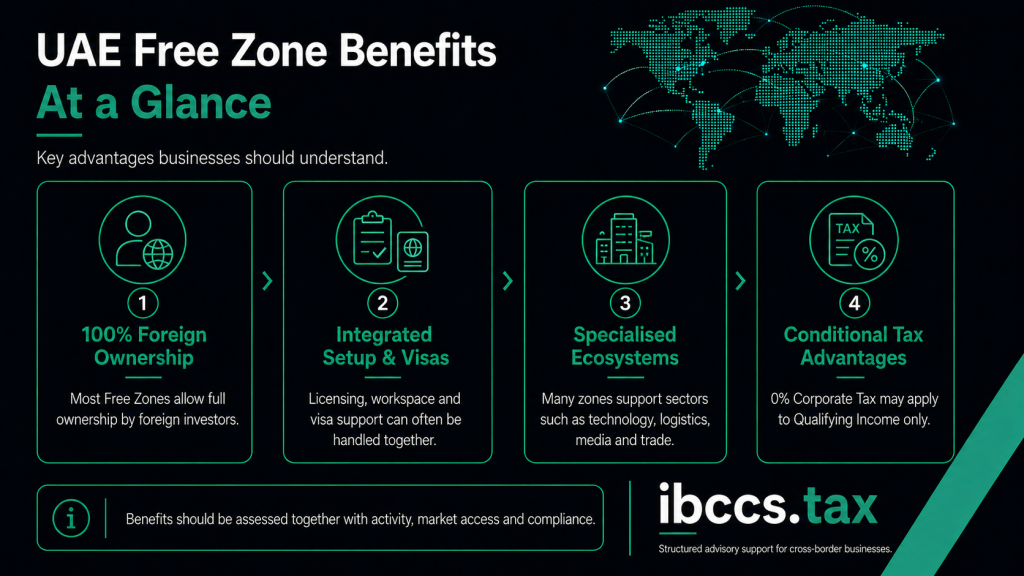
- UAE Free Zones generally allow 100% foreign ownership, subject to the selected authority’s approval and compliance requirements.
- Many zones integrate licensing, office, visa and administrative services within one business environment.
- Sector-focused Free Zones can provide specialised infrastructure, relevant commercial networks and industry-specific facilities.
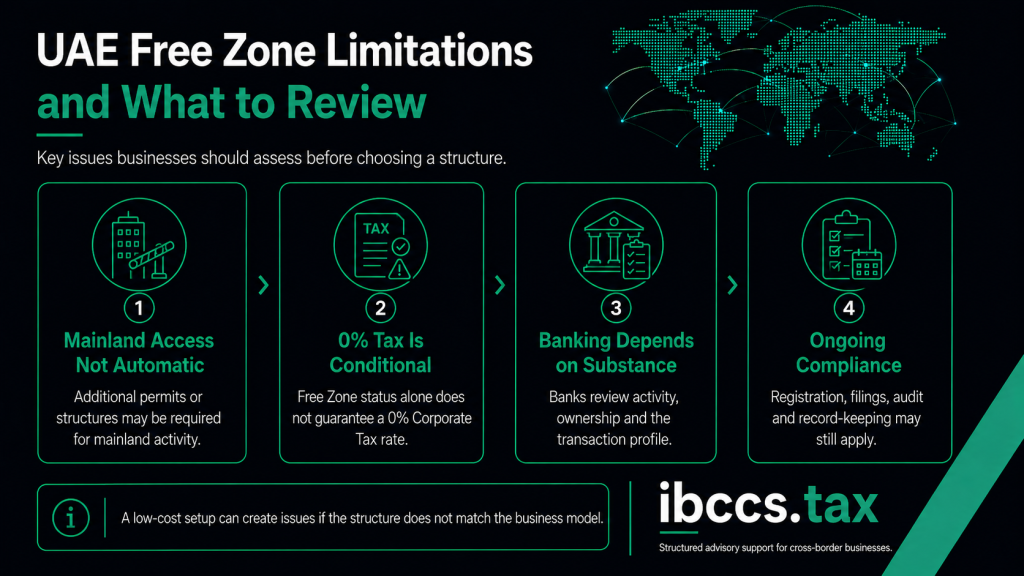
- A Free Zone licence does not automatically provide unrestricted access to customers and activities throughout the UAE mainland.
- Free Zone companies remain within the UAE Corporate Tax regime, and the 0% rate is conditional.
- Qualifying Free Zone Person status requires adequate substance, Qualifying Income, transfer pricing compliance and audited financial statements.
- VAT and customs benefits depend on the transaction, movement of goods and whether a particular area qualifies as a Designated Zone.
- Visa capacity, workspace requirements, banking suitability and annual renewal costs differ between Free Zones.
- The most appropriate zone should be selected according to the operating model rather than the lowest advertised incorporation price.
What Is a UAE Free Zone?
A UAE Free Zone is a designated business area administered by its own licensing authority and operating rules, together with the applicable federal and local legislation. Each zone determines the legal forms, licensed activities, facilities and administrative services available to companies registered within it.
Some Free Zones accommodate a broad range of commercial and professional activities, while others focus on specific sectors such as commodities, logistics, technology, media, healthcare, manufacturing or financial services. Two Free Zone companies can therefore have materially different operating permissions, infrastructure, visa arrangements and compliance requirements.
An operating Free Zone company should not be confused with a traditional offshore or international company. A Free Zone entity generally holds a business licence and can conduct approved commercial activity, whereas a traditional offshore company is usually used for holding, investment or cross-border structuring. The distinction is explained further in our guide to offshore and onshore companies in the UAE.
What Are the Main Benefits of UAE Free Zones?
Full Foreign Ownership and Corporate Control
One of the best-known UAE Free Zone benefits is the ability of foreign investors to own the full share capital of the company. The shareholders can usually be individuals, corporate entities or a combination of both, subject to the selected zone’s regulations, due-diligence procedures and activity approvals.
Full ownership allows international founders to control management, voting rights and economic participation without introducing a shareholder solely to satisfy a nationality requirement. This advantage is no longer unique to Free Zones because many mainland activities also allow full foreign ownership, but Free Zones can still provide an attractive combination of ownership, licensing support and specialised infrastructure.
Integrated Licensing and Administrative Services
Many UAE Free Zones operate as integrated business hubs. Company registration, trade-name approval, licence issuance, workspace arrangements, establishment services and visa applications can often be coordinated through one authority or digital platform.
This structure can reduce the number of separate processes involved in incorporation and ongoing administration, particularly for international shareholders. Corporate ownership, regulated activities, immigration procedures and bank-account opening can still require additional documentation and review, so the setup should be planned as a complete implementation process rather than a licence-only exercise.
Specialised Business Ecosystems and Infrastructure
A sector-focused Free Zone can provide infrastructure, commercial networks and administrative expertise designed around a particular industry. Technology companies may benefit from proximity to investors and innovation programmes, while logistics, commodities and manufacturing businesses may require warehouses, customs support and access to ports or airports.
The value of a specialised ecosystem depends on how actively the company will use it. A recognised location can support credibility and commercial access, but the licensed activities, practical facilities, banking profile and tax position remain more important than the zone’s marketing profile.
Flexible Offices, Warehouses and Operational Facilities
UAE Free Zones can offer workspace ranging from shared desks and serviced offices to private offices, warehouses, industrial units and specialist facilities. This flexibility can allow a business to begin with an appropriate footprint and expand as its staffing and operational requirements develop.
The selected facility can affect the licence, visa allocation, customs registrations and activities the company is permitted to perform. A consultant may require only an approved shared workspace, while a trading, manufacturing or logistics company may need dedicated premises that support its supply chain and regulatory obligations.
Visa and Workforce Support
A licensed Free Zone company can generally sponsor residence visas for shareholders, managers and employees, subject to the selected package, premises and immigration approval. Many zones coordinate establishment services and visa administration alongside the incorporation process, which can simplify implementation for international founders.
Visa eligibility is not unlimited, and the available quota can depend on the office, activity and rules of the selected authority. Businesses planning to relocate shareholders or employ a team should review immigration requirements before choosing a setup. IBCCS TAX provides UAE immigration assistance for investors, employees and dependent family members.
International Trade and Logistics Connectivity
Free Zones located near airports, ports and logistics corridors can provide an effective base for international trade, storage, processing and re-export activities. Certain zones offer customs-controlled facilities, bonded storage and procedures designed to support the efficient movement of goods.
These advantages are particularly relevant where products are imported for storage or re-export rather than immediate release into the UAE mainland. Customs treatment is not a universal exemption, and goods entering the mainland can become subject to declarations, duties and VAT even where they were previously held in a Free Zone.
Potential UAE Corporate Tax Advantages
A Qualifying Free Zone Person may benefit from a 0% UAE Corporate Tax rate on Qualifying Income. This can create a meaningful advantage where the company’s activities, customers, income streams and operational substance satisfy the current Free Zone Corporate Tax rules.
The preferential rate is not a general exemption for all Free Zone companies. Income that does not qualify can be subject to the standard 9% rate, while profits attributable to a mainland or foreign Permanent Establishment can fall outside the 0% regime. The tax analysis should therefore be completed before contracts and operating arrangements are implemented.
Flexible Corporate and Group Structures
A Free Zone company can operate as a trading entity, service company, regional headquarters, operating subsidiary or another permitted corporate vehicle. International groups may use the structure to separate UAE operations from activities in other countries, introduce local management or establish a dedicated company for a particular business line.
The structure can also provide a clear ownership and governance framework for founders and investors. These outcomes depend on the selected legal form, constitutional documents, management arrangements and tax treatment, so the company should be designed around its commercial role within the wider group.
UAE Free Zone Corporate Tax Benefits Are Conditional
Free Zone companies remain within the UAE Corporate Tax framework. A Free Zone Person must assess its registration, accounting and annual return obligations even where it expects its Qualifying Income to benefit from the 0% rate.
The distinction between a 0% tax rate and an exemption from compliance is important. A company can have no Corporate Tax payable on qualifying income while still being required to register, prepare financial information, maintain documentation and file its annual Corporate Tax Return.
Qualifying Free Zone Person Requirements
To benefit from the preferential regime, a company must meet the requirements for Qualifying Free Zone Person status. These requirements include maintaining adequate substance, deriving Qualifying Income, complying with the arm’s length principle, meeting the applicable transfer pricing obligations and preparing audited financial statements.
The company must also remain within the permitted limits for non-qualifying revenue and must not elect to enter the standard Corporate Tax regime. The assessment is based on the actual employees, assets, expenditure, activities, counterparties and contracts rather than the wording of the trade licence alone.
Qualifying and Non-Qualifying Income
A 0% rate can apply to Qualifying Income, while non-qualifying taxable income is generally subject to the standard 9% rate. Specific treatment can also apply to immovable property, intellectual property, Permanent Establishments and transactions involving Free Zone and Non-Free Zone Persons.
International customers do not automatically produce Qualifying Income, and a transaction between two Free Zone companies is not necessarily eligible solely because both parties are located in a zone. The underlying activity, counterparty and statutory conditions must be reviewed together.
Registration, Filing and Record-Keeping
A Free Zone company subject to Corporate Tax must register and obtain a Corporate Tax Registration Number within the applicable timeframe. The Corporate Tax Return and any resulting payment are generally due within nine months from the end of the relevant Tax Period.
Taxable Persons must also retain sufficient accounting records and supporting documents for at least seven years. Further information about the standard rates, Free Zone rules and filing obligations is available in our detailed guide to UAE Corporate Tax.
VAT and Customs Benefits Depend on the Transaction
A Free Zone company is not automatically exempt from UAE VAT. The standard VAT framework generally applies, and mandatory registration is required where taxable supplies and imports exceed the applicable threshold.
Certain areas are treated as Designated Zones for limited VAT purposes, primarily in relation to qualifying transactions involving goods. Services generally remain subject to the normal rules, and goods used, consumed or released into the mainland can create VAT and customs obligations.
The company should map the movement of goods, contractual supply chain and customer location before relying on any customs or VAT advantage. Businesses requiring ongoing registration, bookkeeping and return support can use our UAE accounting and tax services.
Mainland Market Access Is Not Automatic
Free Zone companies can generally conduct approved activities within the selected zone and internationally. Direct activity on the UAE mainland may require an additional permit, branch, distributor, mainland subsidiary or another authorised arrangement, depending on the activity and the relevant Emirate.
The requirements for selling goods can differ from those applying to consultancy, professional or digital services. The company should confirm its route to mainland customers before entering contracts or issuing invoices, as correcting the structure after operations have begun can involve new licences, contract transfers and tax analysis.
A detailed incorporation and operating review is available in our guide to Dubai Free Zone company formation.
UAE Free Zone vs Mainland Company
| Factor | Free Zone company | Mainland company |
| Foreign ownership | Generally 100% | 100% available for many activities, subject to restrictions |
| Licensing authority | Individual Free Zone authority | Competent mainland economic authority |
| Typical market focus | International, specialised or zone-based operations | Broad UAE and international operations |
| Mainland activity | May require an additional permit or structure | Available within the approved licence |
| Facilities | Shared workspace, office, warehouse or specialist facility | Premises according to licence and activity |
| Visas | Based on zone, facility and package | Based on setup, premises and immigration approval |
| Corporate Tax | Conditional 0% on Qualifying Income; standard rules otherwise | Standard Corporate Tax regime |
| Best suited to | International, sector-focused and zone-based businesses | Businesses requiring extensive direct UAE operations |
The correct choice is not determined solely by ownership or the headline Corporate Tax rate. Customer location, operating permissions, facilities, staff, banking and long-term expansion should be assessed together.
Which Businesses Can Benefit Most From a UAE Free Zone?
International Service Businesses
Consultants, technology companies and professional service providers working mainly with international customers can benefit from integrated setup, visa options and flexible workspace. A well-matched licence can provide an efficient UAE operating base without the wider premises requirements of some mainland structures.
The company’s Corporate Tax position must still be reviewed because professional and advisory income does not automatically qualify for the 0% rate. The customer profile, activity and substance should be aligned from the beginning.
Trading and Re-Export Companies
Businesses importing goods for storage, processing or re-export can benefit from zones connected to ports, airports and customs facilities. The selected Free Zone should support the relevant products, warehouse requirements, customs procedures and expected volume of activity.
Sales into the mainland require a separate review of customs, VAT and licensing. The supply chain should identify which entity imports the goods, where title passes and how products are released into the UAE market.
Technology and Digital Businesses
Technology-focused Free Zones can provide communities, facilities and licence categories designed for software, digital products, e-commerce and innovation-led companies. This environment can support access to staff, commercial partners and investors.
Founders should also consider intellectual-property ownership, governance, banking and future funding requirements. A low-cost licence can become restrictive if the company later needs additional shareholders, offices or regulated activities.
Regional Headquarters and Group Companies
International groups can use a Free Zone company as a regional headquarters, management entity or service company. The structure can centralise selected functions and provide a dedicated UAE base for staff and decision-making.
The actual location of employees, management and activities must support the intended role. Transfer pricing and substance are particularly important where the company provides services to Related Parties or earns income from other members of the group.
Manufacturing and Logistics Operations
Industrial and logistics-oriented zones can provide factories, warehouses, customs facilities and transport connectivity. These structures are suitable where the company requires physical operations rather than a licence and shared workspace alone.
The setup normally requires detailed planning involving facilities, environmental approvals, customs, staffing and supply-chain contracts. The operating model should be confirmed before the company commits to premises or equipment.
When May a Free Zone Not Be the Best Option?
A Free Zone may be less suitable where the company’s principal activity requires extensive direct operations across the UAE mainland. Retail outlets, restaurants, clinics, construction activities and other location-specific businesses may require mainland licences and activity approvals.
A mainland company can also be more practical where most customers are located in the UAE and the company does not require a specialist Free Zone ecosystem. Since full foreign ownership is available for many mainland activities, ownership alone should not determine the structure.
The Free Zone route should also be reconsidered where the available package cannot support the required employees, premises or banking profile. Restructuring later can involve new licences, contract transfers, tax work and additional bank-account applications.
How to Evaluate UAE Free Zone Benefits for Your Business
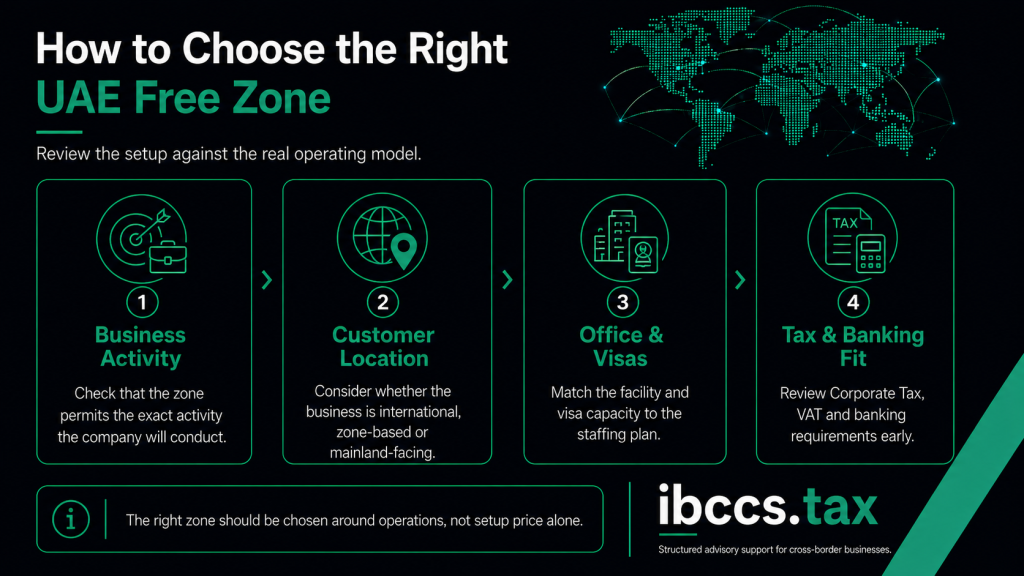
Confirm the Licensed Activities
The selected zone must permit the exact activities the company intends to conduct. The licence should correspond to the website, contracts, invoices, staffing model and expected bank transactions.
A broad or loosely matched activity description can create difficulties with banks, customers and regulators. The operating model should be translated into the correct licence before incorporation.
Identify the Customer Base
The company should establish whether it will serve international customers, businesses inside the selected zone, mainland companies or consumers. This affects market access, VAT, Corporate Tax and the licensing structure.
A company focused on international services may require a different solution from a business selling goods directly throughout the UAE. Customer location should be treated as a core structuring factor rather than an issue to solve after launch.
Review Facilities and Visa Capacity
The business should decide whether it needs a shared desk, private office, warehouse or specialised facility. The premises should support the actual activity, staffing plan and operational requirements.
Visa requirements should be planned alongside the workspace because the available quota can depend on the selected package. A setup designed for one shareholder may need to be expanded before several employees can be sponsored.
Assess Corporate Tax, VAT and Customs
Expected income streams should be classified before relying on the Free Zone Corporate Tax regime. VAT and customs treatment should also be reviewed where the business supplies goods or services in the UAE.
Tax planning should follow the commercial activity rather than drive the company into an unsuitable licence or location. The structure should remain defensible when the contracts, employees, assets and payment flows are reviewed together.
Consider Banking and Commercial Substance
The selected structure should be consistent with the expected customers, suppliers, countries, transaction volumes and source of funds. Banks assess the commercial purpose and operating profile rather than the incorporation certificate alone.
The company should be capable of demonstrating genuine business activity that corresponds to its licence and banking application. Premises, staff, management and contracts should support the scale and nature of the expected transactions.
Compare Recurring Costs
The initial incorporation price is only one part of the cost. The company should also consider annual licence and facility renewal, visas, accounting, audit, tax filings, insurance and regulatory approvals.
A discounted first-year package can become expensive or restrictive when the business expands. The comparison should cover at least the expected first two or three years of operations rather than the registration fee alone.
Practical Examples
International Consultancy Company
A consultancy provides services to customers in Europe and Asia and requires a UAE company, residence visas and a corporate bank account. A Free Zone can provide an efficient operating platform where the selected activity and facility match the company’s business.
The founders should not assume that all consultancy income qualifies for 0% Corporate Tax. The customer profile, actual services, management and substance must be reviewed before the tax treatment is confirmed.
Logistics and Re-Export Business
A company imports products, stores them near a UAE port and re-exports them to regional markets. A logistics-focused Free Zone may provide suitable warehouse and customs infrastructure.
Goods released into the mainland require separate customs and VAT treatment. The company should map the importer-of-record position, title to the goods and customer contracts before commencing trade.
Technology Startup
A technology company requires office space, employee visas, intellectual-property ownership and the ability to introduce investors. A sector-focused Free Zone can provide a relevant ecosystem and a practical initial structure.
The founders should still review share rights, governance, banking and future funding. The setup should be capable of supporting investment and expansion rather than only the immediate incorporation.
Business Serving Mainly UAE Customers
A professional services company expects most clients to be located on the mainland and requires frequent on-site work. A Free Zone structure may still be possible, but additional permissions or a mainland company could be more commercially practical.
The route to customers should be established before contracts are signed. The company should compare the operational flexibility and recurring compliance costs of both options rather than focusing only on setup price.
Common Misconceptions About UAE Free Zones
Every Free Zone Company Pays 0% Corporate Tax
The 0% rate applies only to Qualifying Income of a Qualifying Free Zone Person that satisfies all applicable conditions. Free Zone companies remain within the Corporate Tax framework and must assess registration, filing and accounting obligations.
Free Zone Companies Are Exempt From VAT
Free Zone status does not create a general VAT exemption. Special Designated Zone treatment is limited and mainly relevant to qualifying transactions involving goods.
A Free Zone Company Cannot Work With Mainland Clients
Mainland activity can be possible through permits, branches, distributors or other approved arrangements. The correct solution depends on the activity, customer and Emirate.
Mainland Companies Require a UAE Majority Shareholder
Full foreign ownership is available for many mainland activities. Certain strategic and regulated sectors can remain subject to additional requirements.
The Cheapest Free Zone Is Always the Best
A low-cost package may not support the necessary activities, visas, premises, banking or growth plans. Recurring costs and operational restrictions are usually more important than the initial promotional price.
Incorporation Guarantees a Bank Account
Banks conduct independent due diligence and review the business model, shareholders, source of funds and expected transactions. Company registration does not guarantee approval.
How IBCCS TAX Can Assist
Selecting a UAE Free Zone requires coordination between licensing, taxation, accounting, banking, immigration and the company’s wider commercial objectives. The structure should be workable at incorporation and remain suitable as the business develops. At IBCCS TAX, we assist clients with:
- comparing UAE Free Zones and mainland alternatives;
- selecting the appropriate legal form and licensed activities;
- incorporating Free Zone companies and branches;
- structuring corporate ownership and governance;
- assessing Qualifying Free Zone Person status;
- Corporate Tax and VAT registration;
- bookkeeping, financial statements and audit coordination;
- transfer pricing and related-party transaction support;
- investor and employee visas;
- corporate bank-account coordination;
- mainland permits and additional operating structures;
- annual corporate, accounting and tax compliance.
Our UAE company formation services provide coordinated support from the initial structure review through registration and ongoing administration. Existing businesses can also use our UAE accounting and tax services and corporate management services.
Considering a UAE Free Zone Company?
The benefits of a UAE Free Zone depend on how closely the selected zone, licence, facility and tax position match the company’s actual operations. A properly structured setup can support international growth, while an unsuitable package can create restrictions involving customers, banking, staff and compliance. Contact IBCCS TAX to discuss the appropriate UAE business structure with our team.

Frequently Asked Questions About UAE Free Zone Benefits
1. What are the main benefits of a UAE Free Zone company?
The principal benefits can include full foreign ownership, integrated registration and visa services, flexible facilities, specialised infrastructure and potential access to the 0% Corporate Tax regime for Qualifying Income. The practical value depends on the selected zone and the company’s operating model.
2. Does every UAE Free Zone allow 100% foreign ownership?
UAE Free Zone companies are generally available with full foreign ownership, subject to the authority’s regulations, activity approvals and due-diligence requirements. The ownership structure must still be disclosed to the relevant authorities and service providers.
3. Are UAE Free Zone companies tax-free?
No. Free Zone companies are within the Corporate Tax framework. A Qualifying Free Zone Person may apply 0% to Qualifying Income, while other taxable income can be subject to 9%.
4. Does a Free Zone company need Corporate Tax registration?
A Free Zone Person subject to Corporate Tax must register and comply with the applicable return-filing requirements. This includes companies expecting their Qualifying Income to benefit from the 0% rate.
5. Are Free Zone companies exempt from VAT?
No. VAT generally applies in Free Zones, while certain Designated Zones receive limited special treatment for qualifying transactions involving goods. Services generally remain subject to the normal VAT rules.
6. Can a Free Zone company sell to mainland customers?
It can be possible, but an additional permit, distributor, branch or mainland entity may be required depending on the activity and Emirate. The operating route should be confirmed before business begins.
7. Can a Free Zone company sponsor residence visas?
A licensed company can generally sponsor shareholder and employee visas, subject to its facility, package and immigration approval. The available quota differs between zones and setups.
8. Is a Free Zone company the same as an offshore company?
No. A Free Zone company is generally a licensed operating entity, while a traditional offshore company is usually used for holding, investment or cross-border structuring.
9. Does a Free Zone company need an office?
The company normally requires an approved workspace or facility. This can range from a flexi-desk to a private office, warehouse or industrial unit, depending on the activity and zone.
10. Which UAE Free Zone is best?
There is no universally best Free Zone. The correct choice depends on the activity, customer base, facilities, visa requirements, tax position, banking profile and long-term plans.
11. Can a Free Zone company open a UAE bank account?
It can apply for a corporate bank account, but approval is subject to the bank’s due-diligence assessment. Incorporation alone does not guarantee an account.
12. Are audited financial statements required?
A Qualifying Free Zone Person must prepare audited financial statements for Corporate Tax purposes. Additional audit requirements can also arise under the regulations of the selected zone or the company’s circumstances.



UAE Business License Guide: Types, Requirements, Costs and Renewal
A UAE business license is the formal authorization that allows
Read More
Why Start a Business in the UAE? Strategic Advantages and Practical Considerations
The United Arab Emirates has developed into an established international
Read More
UAE Holding Company Setup: Structures, Tax, Asset Protection and Key Considerations
A UAE holding company can provide a structured way to
Read MoreDisclaimer: This article provides general information and does not constitute legal, tax or investment advice. The benefits and requirements of a UAE Free Zone depend on the selected authority, licence, activity, facility, income, ownership and applicable legislation. Professional advice should be obtained before establishing, acquiring or restructuring a UAE Free Zone company.