

The distinction between an offshore and onshore company is an important consideration for entrepreneurs, investors and international groups establishing a structure in the United Arab Emirates.
The terms are widely used, but they can oversimplify the UAE company formation framework. An onshore company generally refers to a mainland operating business licensed to conduct approved activities in the UAE. An offshore company usually refers to an international corporate vehicle established through a specialised registry for holding, investment or cross-border structuring purposes.
A Free Zone operating company represents a third category. It is incorporated and licensed in the UAE, can employ staff and conduct approved business activities, and should not automatically be classified as an offshore company.
The appropriate structure therefore depends on what the entity will do, where it will operate, whether it needs staff and visas, what assets it will hold and how it will earn income. For a broader review of the available legal structures, see our guide to the types of companies in the UAE.

- An onshore company generally refers to a mainland business licensed for active UAE operations.
- A traditional offshore company is usually established for holding, investment or international structuring rather than ordinary UAE trading.
- A Free Zone operating company is not the same as a traditional offshore company.
- Mainland companies can often be fully foreign-owned, although regulated and strategic activities may remain subject to additional conditions.
- A UAE offshore company should not be assumed to be exempt from Corporate Tax.
- Offshore ownership is not anonymous because beneficial ownership, AML and KYC requirements apply.
- A traditional offshore company does not ordinarily provide the same employee visa, office and operating framework as a mainland company.
- Specialised registry products can combine an international holding structure with an operating Free Zone subsidiary or licensed activity.
- Market access, banking, tax, governance and commercial substance should be assessed before incorporation.
- • The lowest-cost or fastest setup is not necessarily the most appropriate long-term structure.
What Does “Onshore Company” Mean in the UAE?
“Onshore company” is a commercial term commonly used to describe a business established on the UAE mainland.
A mainland company is licensed by the competent economic authority in the relevant Emirate. It is designed to conduct approved commercial, professional or industrial activities in the UAE and can also carry out international business, subject to its licence and any sector-specific approvals. Onshore does not describe one legal form. A mainland business may be established as:
- a Limited Liability Company;
- a single-owner LLC;
- a partnership;
- a Private Joint Stock Company;
- a Public Joint Stock Company;
- a sole establishment;
- a civil or professional company;
- a branch of an existing UAE or foreign company.
The Limited Liability Company is the most common option for many operating businesses because it combines separate legal personality, limited shareholder liability and access to a broad range of commercial activities.
Many mainland activities permit full foreign ownership. Certain activities with strategic impact and regulated sectors can nevertheless require additional approvals, ownership conditions or other restrictions.
What Is an Offshore Company in the UAE?
The term “offshore company” is generally used for an International Business Company or another corporate vehicle registered through a specialised UAE international corporate registry. A traditional offshore company is normally established for purposes such as:
- holding shares in subsidiaries;
- owning investments or intellectual property;
- structuring joint ventures;
- international financing;
- holding particular assets;
- succession and private-wealth planning;
- cross-border contractual arrangements;
- separating ownership from operational activities.
RAK International Corporate Centre is one example of a UAE international corporate registry. It registers and administers structures including companies limited by shares, holding companies, Restricted Purposes Companies and Segregated Portfolio Companies. Its focus includes private wealth, investment vehicles, holding structures and international business.
A traditional offshore company is not normally intended to operate like a standard mainland company. It generally does not provide the same commercial licence, employee framework, physical office or direct market-access model.
However, the term “offshore” covers different registry products. Some newer structures can provide a route to licensed UAE operations or residence visas. The rights of the company must therefore be verified against the current rules of the selected registry rather than inferred from the word “offshore”.
Is a Free Zone Company an Offshore Company?
A Free Zone operating company is not ordinarily the same as a traditional offshore or International Business Company. A Free Zone company generally has:
- a licence covering specified business activities;
- a registered or leased facility within the relevant Free Zone;
- potential eligibility for investor and employee visas;
- authority to enter commercial contracts;
- accounting and Corporate Tax obligations;
- the ability to operate within the scope of its licence.
Free Zone companies are usually fully foreign-owned, although access to customers and activities outside the Free Zone can require additional permissions or operating arrangements. The exact position depends on the Free Zone, the licensed activities and the commercial model.
An offshore company, by comparison, is generally designed as a holding, investment or international structuring vehicle rather than a standard licensed operating entity.
Specialised products can blur this distinction. Certain international registry structures can operate within the UAE where they hold the required trade licence, while combined structures may pair an international holding company with a Free Zone operating subsidiary. These should be assessed as specific products rather than assumed features of every offshore company.
Offshore vs Onshore Company in the UAE: Main Differences
| Factor | Onshore or mainland company | Traditional offshore or international company |
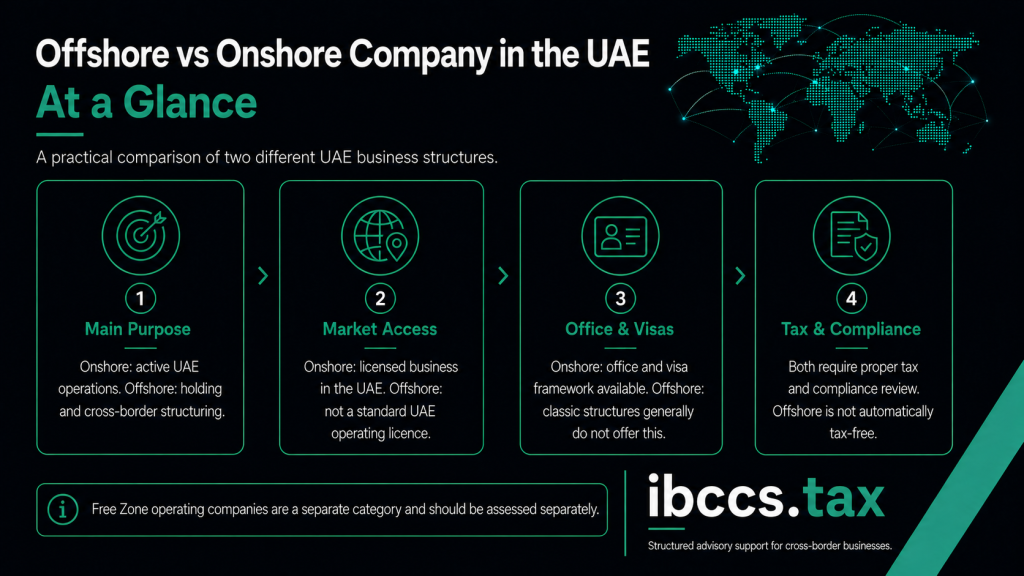
| Main purpose | Active UAE and international business operations | Holding, investment and cross-border structuring |
| Registration | Licensed by the relevant mainland economic authority | Registered through a specialised international corporate registry |
| Operating licence | Yes, for approved activities | Generally not a standard mainland operating licence |
| Direct UAE market activity | Available within the scope of the licence and approvals | Generally limited without an additional operating structure |
| Separate legal personality | Yes for an incorporated company such as an LLC | Generally yes |
| Foreign ownership | Often 100%, subject to activity and approvals | Generally 100% |
| Employees | Can employ staff subject to labour and immigration requirements | Traditional structures generally do not employ an operating workforce |
| Investor and employee visas | Available subject to the company setup | Normally unavailable through a classic international company alone |
| Physical premises | Required according to the licence and activity | Usually based on a registered-agent address |
| Corporate Tax | Standard Corporate Tax regime generally applies | Corporate Tax status and filing must be assessed; no automatic exemption |
| VAT | Can apply where taxable supplies meet the relevant conditions | Depends on whether the company makes taxable supplies within the VAT framework |
| Beneficial ownership | UBO and AML requirements apply | UBO and AML requirements also apply |
| Banking | Operating account based on the business model and due diligence | Banking depends heavily on purpose, substance, assets and transaction profile |
| Best suited to | Trading, services, employment and UAE operations | Holding assets, investments and specialised international structures |
Market Access and Permitted Activities
An onshore company is generally selected where a business needs to provide goods or services directly within the UAE. The company can contract with customers, employ staff, lease premises and conduct the activities listed on its licence. It may also carry out international business, provided that the activity remains within the authorised scope and any regulatory approvals are obtained.
This does not mean that every mainland licence provides unlimited access to every sector. Financial services, healthcare, education, real estate, legal services, transport and other regulated activities can require additional authorisation.
A traditional offshore company is not ordinarily designed to conduct day-to-day commercial operations in the UAE. It may hold ownership interests, enter permitted international arrangements or own particular assets, but an operating subsidiary, branch, Free Zone entity or another licensed structure may be required where the group intends to trade actively in the UAE.
Ownership and Legal Liability
Both onshore and offshore incorporated companies can provide separate legal personality and limit shareholder liability. For an onshore LLC, shareholder liability is generally limited to the shareholder’s participation in the company. Exceptions can arise through personal guarantees, fraud, unlawful conduct or other circumstances in which corporate protection does not apply.
A company limited by shares registered through an international corporate registry can similarly limit shareholder liability to the capital invested or committed. Limited liability does not create absolute asset protection. The structure must be properly established, managed and documented, and personal and business transactions should remain separate.
Office, Employees and UAE Residence Visas
An onshore operating company normally requires premises consistent with its activity and licensing conditions. The premises may range from an office suitable for a consultancy business to a retail unit, clinic, restaurant, workshop or industrial facility. The company can sponsor investor and employee residence visas subject to its licence, establishment file, premises and immigration approvals.
A traditional offshore company normally uses the address of its registered agent and does not provide the same standard employee or visa framework. This distinction is important for owners who want to relocate to the UAE. A holding company may be commercially suitable for asset ownership but may not by itself provide the immigration and operational structure needed for the shareholder and their employees.
Some specialised products can combine an international company with a Free Zone operating subsidiary or provide visa eligibility. These options should be assessed as specific structures rather than treated as standard features of every UAE offshore company.
UAE Corporate Tax: Offshore Does Not Mean Tax-Free
One of the most important corrections to older offshore company guidance is that a UAE offshore company is not automatically outside the Corporate Tax regime.
UAE Corporate Tax generally applies to juridical persons incorporated, established or otherwise recognised in the UAE, as well as to foreign juridical persons effectively managed and controlled from the UAE. A company registered through a UAE international corporate registry must therefore assess its Corporate Tax status, registration deadline, filing requirements and taxable income.
Under the standard Corporate Tax regime:
- taxable income up to AED 375,000 is subject to 0%;
- the portion of taxable income exceeding AED 375,000 is subject to 9%.
These rates apply to taxable income rather than turnover or the value of assets owned by the company.
An offshore holding company may have little or no taxable income where it only receives income that qualifies for an exemption. For example, dividends or gains derived from qualifying shareholdings may benefit from the Participation Exemption where the statutory conditions are met.
This is not the same as a blanket exemption for offshore companies. The company must establish the nature of its income, satisfy the relevant exemption conditions and complete any required registration and reporting.
An onshore company is also subject to the Corporate Tax framework. Its taxable income is calculated from the accounting result after applying the relevant tax adjustments, exemptions, deductions and reliefs.
Further details are available in our guide to UAE Corporate Tax.
VAT Treatment
VAT is separate from Corporate Tax and is not determined solely by whether the company is described as onshore or offshore. A UAE-resident business must generally register for VAT where the value of its taxable supplies and imports exceeds AED 375,000 over the relevant period or is expected to exceed the threshold within the prescribed timeframe.
A mainland operating business selling taxable goods or services in the UAE will commonly need to assess VAT registration. An offshore company holding investments without making taxable supplies may have a different VAT position. Where it undertakes transactions, provides services or receives income connected with taxable activity, a separate VAT analysis is required.
Privacy, Beneficial Ownership and Compliance
A UAE offshore company should not be marketed or understood as an anonymous company.
UAE companies are subject to beneficial ownership, anti-money laundering and know-your-client requirements. Relevant authorities, registries, registered agents, banks and professional service providers may require information about the individuals who ultimately own or control the company.
Beneficial ownership information may not necessarily be publicly displayed in the same way as basic company information, but it must be available to the appropriate registry, professional providers and competent authorities. The structure can provide legitimate confidentiality and separation of business affairs, but it should not be used or promoted as a means of concealing ownership.
Banking Considerations
Neither offshore nor onshore company formation guarantees the opening of a corporate bank account. Banks assess the company’s ownership, activities, source of funds, customers, suppliers, expected transaction volumes, countries involved and connection with the UAE.
An onshore operating company with premises, employees, customers and documented business activity may be easier to explain commercially. It will still need to satisfy the bank’s due-diligence and risk requirements.
An offshore holding company can also obtain banking services, but the bank may require detailed evidence of:
- the assets or subsidiaries being held;
- the source of funds;
- the purpose of the structure;
- anticipated dividends, investments or transactions;
- the shareholders’ business background;
- commercial substance and governance;
- the relationship between the company and the selected banking jurisdiction.
The company should therefore be formed around a genuine commercial or investment purpose rather than created first with the assumption that banking will follow automatically.
UAE Tax Residency and Double Taxation Agreements
The incorporation of a company in the UAE does not automatically guarantee access to every UAE Double Taxation Agreement.
Treaty access can depend on whether the company qualifies as a UAE tax resident under the relevant agreement, whether it is the beneficial owner of the income and whether it satisfies any substance, purpose or anti-abuse provisions.
A UAE Tax Residency Certificate may support a treaty claim, but the certificate does not override the wording of the relevant agreement or create treaty eligibility where the underlying requirements are not met.
An offshore holding company intended to receive cross-border dividends, interest, royalties or capital gains should therefore be reviewed before transactions begin.
IBCCS TAX provides international taxation services in the UAE for clients requiring tax residency, treaty and cross-border structuring support.
When Is an Onshore Company Usually More Appropriate?
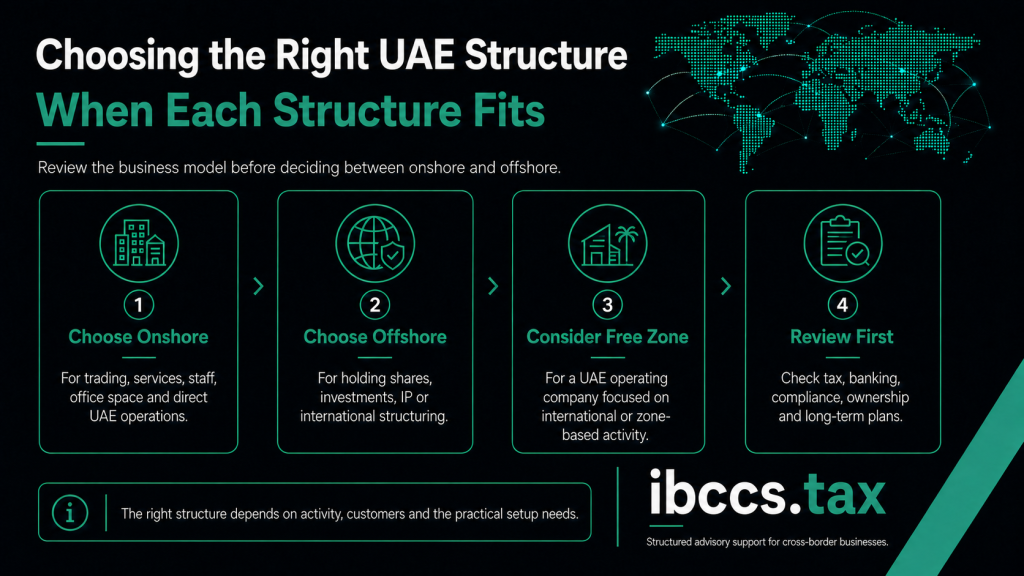
An onshore or mainland company is generally more suitable where the business intends to operate actively in the UAE. This may include situations where the company will:
- provide services directly to UAE clients;
- sell goods in the local market;
- maintain an office, retail unit or operating facility;
- employ a local team;
- obtain investor and employee visas;
- enter UAE commercial contracts;
- build a substantial operational presence;
- work in a regulated sector requiring mainland approval.
The precise legal form should still be selected according to liability, ownership and governance. An onshore company may be established as an LLC, branch or another permitted structure.
When Is an Offshore Company Usually More Appropriate?
A traditional offshore or international company can be appropriate where the entity is intended primarily as a holding or structuring vehicle rather than an operating business. Potential situations include:
- holding shares in one or more subsidiaries;
- owning an international investment portfolio;
- holding intellectual property;
- structuring a joint venture;
- separating a project or asset from an operating company;
- facilitating succession or private-wealth planning;
- establishing an international financing structure;
- holding assets that do not require a UAE operating licence.
The structure should have a clear purpose and should be reviewed under Corporate Tax, beneficial ownership, banking, reporting and foreign-country tax rules. An offshore company is generally not the correct solution where the owner expects to hire staff, rent commercial premises and trade actively with UAE customers without an additional operating entity.
When May a Free Zone Company Be a Better Option?
A Free Zone company may provide a middle route between a mainland operating business and a traditional offshore holding company. It can be suitable where the business requires a UAE operating licence and visas but serves mainly international customers or operates within a specialised industry ecosystem. Examples can include:
- international consultancy;
- software and technology;
- e-commerce;
- media and creative services;
- logistics and commodities;
- regional headquarters;
- professional services;
- manufacturing within a specialised zone.
The selected Free Zone should be assessed individually. Activity restrictions, mainland access, facilities, visa allocation, Corporate Tax and banking requirements differ between zones.
The choice should be based on the business model rather than the general assumption that every Free Zone offers the same benefits.
Can an Offshore Holding Company Own an Onshore Operating Company?
Yes. A group structure can combine an offshore or international holding company with an onshore or Free Zone operating subsidiary. In this model:
- the holding company owns shares, intellectual property or strategic assets;
- the operating company signs customer contracts, employs staff and conducts licensed activities;
- legal and financial risk can be separated between ownership and operations;
- investors or family members can hold interests through the holding level;
- the group can create a clearer governance and succession framework.
The structure must have a commercial purpose and should not be implemented solely to create an assumed tax advantage.
Corporate Tax, Participation Exemption, transfer pricing, accounting, beneficial ownership, banking and tax residency should be reviewed together. More information is available in our guide to international business structuring.
Practical Examples
Consultancy Business Serving UAE Clients
A consultant intends to establish an office in Dubai, employ staff and provide services directly to UAE customers.
A mainland LLC or suitable Free Zone operating company is generally more appropriate than a traditional offshore company. The final decision should reflect customer location, licensed activity, visa requirements and the rules governing mainland service delivery.
International Family Holding Investments
A family wants to hold shares in companies located in several countries and does not intend to carry out active UAE operations through the holding entity.
An international holding company or SPV may be suitable, subject to tax residency, treaty, succession, banking and Corporate Tax analysis.
Foreign Trading Group Entering the UAE
An international trading group intends to import products, maintain a warehouse and supply customers across the UAE.
A mainland operating company or a Free Zone entity supported by the correct customs and distribution arrangements would generally be required. A traditional offshore company alone would not provide the necessary operational framework.
Technology Founder With International Customers
A technology founder works primarily with customers outside the UAE but wants a UAE residence visa, an operating company and the ability to hire staff.
A Free Zone operating company may be more practical than either a mainland company or a traditional international company, depending on the activity, customer base and chosen zone.
Group Separating Assets From Operations
A business group wants intellectual property and investments to be held separately from its UAE commercial operations.
A holding company may own the relevant assets and shares, while an onshore or Free Zone subsidiary conducts the operating activity. The agreements, transfer pricing and governance between the entities must reflect the commercial reality.
Common Misconceptions About Offshore and Onshore Companies
“Offshore companies do not pay UAE Corporate Tax”
This is not a reliable assumption. UAE-incorporated juridical persons generally fall within the Corporate Tax framework. The final liability depends on taxable income, available exemptions and the company’s circumstances.
“Offshore companies provide complete anonymity”
UAE beneficial ownership, AML and KYC procedures require the identification of the individuals who ultimately own or control the company.
“Offshore companies can operate freely in the UAE”
A traditional international company generally does not provide the same operating licence as a mainland or Free Zone company. An additional operating structure or specialised product may be required.
“Onshore companies must have a UAE national shareholder”
Many mainland activities now permit full foreign ownership. Regulated and strategic activities can nevertheless remain subject to additional requirements.
“Every Free Zone company is offshore”
A Free Zone operating company is generally a licensed UAE business capable of conducting approved activities. It is not the same as a traditional offshore holding or international company.
“Offshore formation guarantees asset protection”
Limited liability and asset separation depend on correct legal structuring, management, documentation and compliance. Incorporation alone does not protect assets in every circumstance.
“An offshore company guarantees a bank account”
Bank-account approval depends on due diligence, activity, source of funds, commercial purpose and the bank’s risk assessment.
How IBCCS TAX Can Assist
Selecting between an offshore, onshore and Free Zone structure requires more than comparing incorporation packages. At IBCCS TAX, we assist clients with:
- assessment of offshore, mainland and Free Zone options;
- UAE company formation;
- holding-company and SPV structuring;
- mainland LLC and branch registration;
- Free Zone selection and licensing;
- international ownership and group structures;
- Corporate Tax and VAT analysis;
- Tax Residency Certificate and treaty reviews;
- beneficial ownership and corporate compliance;
- accounting and financial reporting;
- banking coordination;
- investor and employee visa support;
- restructuring of existing UAE entities.
Our UAE company formation services provide coordinated support from the initial structuring analysis through incorporation, tax registration, banking and ongoing administration.
Choosing Between an Offshore and Onshore Company?
The correct structure depends on whether the entity will operate, employ staff, hold investments, serve UAE customers or form part of a wider international group. Contact IBCCS TAX to discuss an appropriate UAE company structure with our team.

Frequently Asked Questions About Offshore vs Onshore Companies in the UAE
1. What is the main difference between an offshore and onshore company in the UAE?
An onshore company is generally established for active operations in the UAE, while a traditional offshore company is normally used for holding, investment or international structuring.
2. Is an onshore company the same as a mainland company?
In common UAE business terminology, onshore company usually refers to a mainland company. “Onshore” is not itself one specific legal form.
3. Is a Free Zone company an offshore company?
Not ordinarily. A Free Zone company is generally a licensed UAE operating entity, while a traditional offshore company is primarily an international corporate or holding vehicle.
4. Can an offshore company do business in the UAE?
A traditional offshore company generally does not have a standard UAE operating licence. An operating subsidiary, branch, Free Zone company or specialised registry product may be required.
5. Does a UAE offshore company pay Corporate Tax?
It can fall within UAE Corporate Tax. The company must assess its registration, filing and taxable-income position rather than assume that offshore status creates an exemption.
6. Can an offshore company obtain a UAE residence visa?
A classic international company generally does not provide standard visa eligibility. Certain specialised structures or products can combine a holding company with an operating or visa-eligible entity.
7. Can an offshore company open a bank account?
It can apply for banking services, but approval depends on the company’s purpose, ownership, source of funds, expected transactions and the bank’s due-diligence requirements.
8. Is the owner of a UAE offshore company anonymous?
No. Beneficial owners must be identified under the applicable registry, AML and KYC procedures, even where the information is not displayed publicly.
9. Can a foreign investor own 100% of an onshore company?
Full foreign ownership is available for many mainland activities. Certain regulated or strategic activities can require additional approvals or ownership conditions.
10. Which is cheaper: an offshore or onshore company?
A traditional offshore company can have lower initial operating requirements, but price should not determine the choice. An unsuitable structure can create additional banking, licensing, tax and restructuring costs.
11. Can an offshore company own a mainland company?
Yes. An offshore or international holding company can own shares in a mainland or Free Zone operating subsidiary, subject to the relevant legal, regulatory, tax and banking requirements.
12. Which structure is best for an active UAE business?
A mainland or appropriate Free Zone operating company will generally be more suitable than a traditional offshore company where the business will serve customers, hire staff and maintain operations in the UAE.




Cezary Zieniuk to Join Free IMC Webinar on the New Geography of Global Mobility
On 23 September 2026, Cezary Zieniuk, Founder of IBCCS TAX
Read More
UAE Business License Guide: Types, Requirements, Costs and Renewal
A UAE business license is the formal authorization that allows
Read More
Why Start a Business in the UAE? Strategic Advantages and Practical Considerations
The United Arab Emirates has developed into an established international
Read MoreDisclaimer: This article provides general information and does not constitute legal, tax or investment advice. The treatment of a UAE company depends on its registry, legal form, licensed activities, income, ownership, management and wider international circumstances. Professional advice should be obtained before establishing, acquiring or restructuring an offshore, mainland or Free Zone company.