

Dubai Free Zone company formation is an established route for entrepreneurs, investors and international businesses seeking a presence in the United Arab Emirates. A well-selected Free Zone can provide full foreign ownership, an integrated licensing and immigration process, access to specialised facilities and a practical base for serving regional or international markets.
The term “Free Zone company” does not describe one standard setup. Each Dubai Free Zone applies its own regulations, permitted activities, legal forms, workspace requirements, visa framework and renewal procedures, which means that two licences with similar names can create very different commercial outcomes.
The structure should therefore be selected around the company’s actual operations, customers, staffing plans and tax position rather than the lowest advertised setup price. Businesses comparing wider options can also review our guide to the types of companies in the UAE and our practical overview of how to set up a business in the UAE.

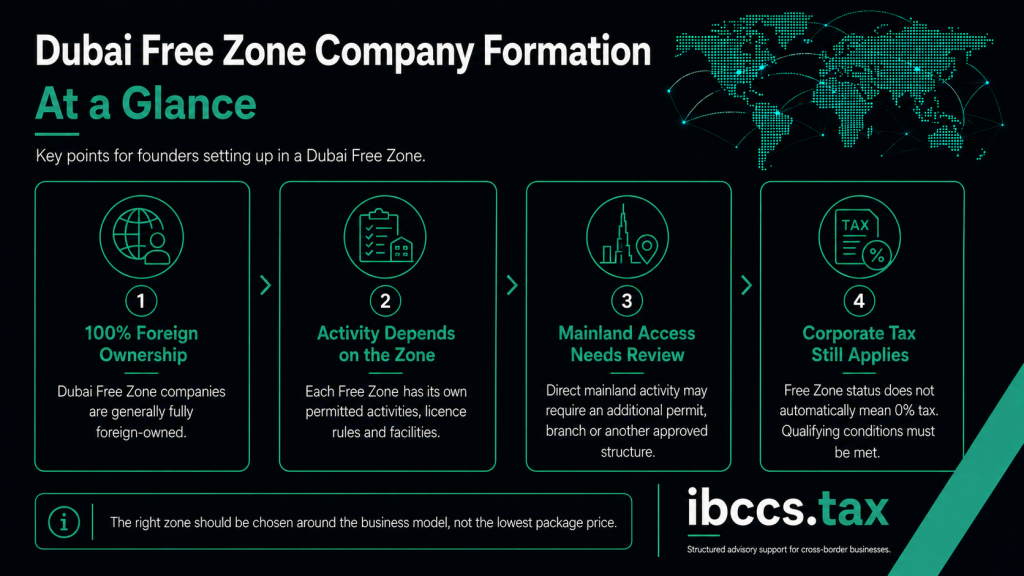
- Dubai Free Zone companies generally permit 100% foreign ownership, subject to the selected authority’s approval and compliance procedures.
- The correct Free Zone depends on the licensed activity, customer location, workspace, visas, banking profile and long-term operating model.
- A Free Zone licence does not create automatic or unrestricted authority to conduct business throughout mainland Dubai.
- Dubai now provides formal licensing and permit routes for eligible Free Zone establishments to conduct approved activities outside their zones, but separate approval remains necessary.
- A Free Zone company does not automatically qualify for 0% UAE Corporate Tax; preferential treatment is conditional on Qualifying Free Zone Person and Qualifying Income requirements.
- The total cost includes more than incorporation and licence fees, with facilities, visas, approvals, accounting, tax and renewal costs also requiring review.
- Free Zone terminology such as FZE, FZCO, FZC and FZ-LLC is not applied uniformly across every authority.
- Bank-account opening is a separate due-diligence process and should be considered before the company is incorporated.
- An operating Free Zone company is not the same as a traditional offshore or international holding company.
- Ongoing compliance can include bookkeeping, Corporate Tax returns, VAT, audit, transfer pricing, UBO records, payroll and licence renewals.
What Is a Dubai Free Zone Company?
A Dubai Free Zone company is an entity incorporated and licensed by a specific Free Zone authority within the Emirate of Dubai. It is authorised to conduct the activities listed on its licence and operates under the regulations of the selected zone together with applicable UAE federal legislation.
Free Zones are designed as specialised business environments. Some focus on sectors such as commodities, logistics, aviation, media, technology, financial services, healthcare or manufacturing, while others provide a wider range of commercial and professional licences for international entrepreneurs and SMEs.
The company can generally be owned entirely by foreign individuals or corporate shareholders. Depending on the licence, workspace and immigration package, it may also sponsor residence visas for shareholders, directors and employees, making it an operating UAE business rather than a passive offshore vehicle.
Is Free Zone Company Formation in Dubai Right for Your Business?
Dubai Free Zone company formation can work well where the business serves international clients, operates within a specialised industry ecosystem or requires a UAE licence and residence-visa framework without broad direct activity across the mainland. It can also be suitable for consultancies, technology businesses, e-commerce companies, international trading operations, regional headquarters and professional service providers.
The suitability of a Free Zone depends on the facts rather than the general advantages associated with the model. The selected authority must permit the intended activities and provide an appropriate combination of facilities, visas, customs access, banking suitability and commercial permissions.
When a Free Zone Setup May Work Well
A Free Zone setup may be commercially efficient where most customers are located outside the UAE or where the company’s activity is closely aligned with the zone’s infrastructure and industry focus. It can also provide a practical route for founders who require a UAE operating company, a residence visa and a corporate account while keeping the initial organisation relatively streamlined.
The structure becomes particularly relevant where the company can operate within the scope of its Free Zone licence without creating a complicated mainland distribution or delivery model. The activity, contracts and invoicing arrangements should nevertheless be reviewed before incorporation so that the licence reflects how the business will actually earn revenue.
When a Mainland Company May Be More Suitable
A mainland structure may be more suitable where the business needs broad direct access to customers throughout the UAE, regularly enters local government or regulated contracts, or requires premises and approvals available through the mainland licensing framework. It may also be preferable where the company’s principal commercial activity will take place outside a Free Zone and additional permits would add unnecessary complexity.
A Free Zone, mainland and offshore structure should be compared on the basis of the intended operating model rather than treated as interchangeable packages. Our detailed comparison of offshore and onshore companies in the UAE explains how these models differ in market access, employment, tax and commercial purpose.
Main Benefits of a Dubai Free Zone Company
Full Foreign Ownership
Dubai Free Zone companies are generally available with full foreign ownership. Shareholders may be individuals, corporate entities or a combination of both, subject to the regulations and due-diligence procedures of the selected authority.
Full ownership does not remove transparency and compliance obligations. The Free Zone, bank and relevant professional advisers will normally require information about shareholders, directors, authorised signatories and Ultimate Beneficial Owners, together with supporting identity and source-of-funds documents.
Integrated Setup and Administration
Many Free Zones provide a centralised route for incorporation, licence issuance, workspace, immigration processing and administrative services. This can reduce the number of separate authorities involved in the initial setup and make routine amendments or renewals easier to coordinate.
A substantial part of the application may be completed remotely, although the extent of remote processing depends on the legal form, shareholder structure, activity and immigration requirements. Physical presence can still be required for medical examinations, Emirates ID registration, banking and other post-incorporation steps.
Specialised Business Environment
A sector-focused Free Zone may provide infrastructure, commercial networks and administrative knowledge tailored to a particular industry. These features can be valuable for logistics, commodities, media, technology, aviation, healthcare, manufacturing and other businesses requiring sector-specific facilities or approvals.
The reputation of a zone should not replace a detailed legal and commercial assessment. Permitted activities, workspace, market access, tax treatment and ongoing costs are generally more important than branding when determining whether the structure will support the company’s actual operations.
Flexible Workspace and Visa Options
Free Zones may offer flexi-desks, shared workspaces, serviced offices, private offices, warehouses and industrial facilities. This allows a company to select a facility that reflects its stage of development rather than committing immediately to a large commercial lease.
The workspace can affect visa eligibility, activity permissions, customs registrations and operational substance. A package suitable for one consultant may not support a business planning to employ a team, store goods or receive clients regularly, so the facility should be selected together with the licence and staffing plan.
Important Limitations to Review Before Incorporation
Mainland Activity Requires a Compliant Route
A Free Zone licence does not automatically authorise unrestricted business activity throughout mainland Dubai. The correct route depends on the activity, the location in which it will be performed and the requirements of the Free Zone and the Dubai Department of Economy and Tourism.
Dubai has introduced a formal framework under which eligible Free Zone establishments can apply for licences or permits to conduct approved activities outside their Free Zone. This development provides greater flexibility, but access remains conditional and should be arranged before the company begins mainland operations, signs local contracts or issues invoices for activities requiring additional authorisation.
Corporate Tax Treatment Is Conditional
A Free Zone company is within the UAE Corporate Tax framework and should not be described as automatically tax-free. A Qualifying Free Zone Person can benefit from a 0% rate on Qualifying Income only where all statutory requirements are satisfied, while other taxable income can be subject to 9%.
The company’s activities, customers, counterparties, facilities and income streams should be reviewed before relying on the Free Zone regime. Marketing statements made at the incorporation stage are not a substitute for an annual Corporate Tax analysis supported by accounting records and appropriate documentation.
Banking and Commercial Substance Matter
Company registration does not guarantee the opening of a corporate bank account. Banks assess the ownership structure, business model, source of funds, customer and supplier locations, anticipated transactions and the company’s connection with the UAE.
A licence or workspace that appears inconsistent with the proposed business can create additional due-diligence questions. The banking profile should therefore be considered before the Free Zone and licence are selected, particularly where the company expects high transaction volumes, international payments or activity in a regulated sector.
Common Dubai Free Zone Legal Forms
Free Zone terminology is not standardised across all Dubai authorities. The meaning of a suffix should be confirmed by reviewing the relevant regulations and constitutional documents rather than assuming that the same designation creates an identical legal structure in every zone.
Free Zone Establishment (FZE)
FZE is commonly used by some Free Zones for an incorporated entity with a single shareholder. The shareholder may be an individual or a corporate entity, subject to the authority’s rules and the documentary requirements for the proposed ownership structure.
The designation is not universal and some authorities now use different terminology for single-owner companies. The legal personality, share capital, management and transfer rules should therefore be confirmed from the company documents rather than inferred from the abbreviation alone.
Free Zone Company (FZCO or FZC)
FZCO or FZC is commonly used for a Free Zone company with one or more shareholders, depending on the relevant authority. It generally provides separate legal personality and limited shareholder liability, subject to the regulations and exceptions applicable to the entity.
The number of permitted shareholders and the governance rules can differ between Free Zones. Companies expecting new investors should review share-transfer procedures, management rights and constitutional documents before incorporation rather than treating the setup as a standard licence package.
Free Zone Limited Liability Company
Some authorities use FZ-LLC, LLC-FZ or similar terminology for an incorporated Free Zone entity. The structure generally separates the company from its owners and limits shareholder liability to the agreed participation or share capital, subject to applicable law and personal guarantees.
Although the name resembles a mainland LLC, the company remains governed by the rules of its Free Zone. Its market access, permitted activities, facilities and amendment procedures will therefore depend on the selected authority.
Branch of an Existing Company
A UAE or foreign company may establish a branch within a Dubai Free Zone where the relevant authority permits the parent company’s activities. A branch is an extension of the parent rather than a separately owned subsidiary, so the parent remains responsible for its obligations.
The branch structure can preserve the parent company’s name and commercial continuity, but it does not provide the same legal separation as a subsidiary. Corporate documents, board approvals and foreign-issued records may also require legalisation or attestation before the branch can be registered.
Types of Dubai Free Zone Licences
Licence categories vary between Free Zones, and the exact wording of the approved activities is important. A company should select activities that correspond to the services or goods described in its contracts, website, invoices and bank-account application.
Commercial and Trading Licences
A commercial or trading licence permits the company to trade specified goods or categories of products. The business may also require customs registration, warehouse facilities, product approvals or a compliant mainland distribution route depending on where the goods are imported, stored and sold.
A general trading licence can provide broader coverage than a licence limited to a specific product category, but it can involve different costs and due-diligence requirements. The scope should be selected around the genuine supply chain rather than the widest available wording.
Professional and Service Licences
Professional and service licences cover activities such as consultancy, technology, marketing, management support and other specialist services. The chosen wording should accurately reflect the company’s expertise and the services it will deliver to clients.
Certain professional activities require qualifications, experience or external approval. Combining unrelated services under one licence may also be restricted, which makes it important to map the actual revenue streams before the application is submitted.
E-Commerce Licences
An e-commerce licence can support online sales, digital platforms and internet-based commercial activity. The company must still review what is being sold, where customers are located, how payments are processed and whether goods will be imported or stored in the UAE.
An e-commerce designation does not replace the need for the underlying trading or service permissions. VAT, consumer rules, customs, delivery arrangements and payment-provider requirements may also apply depending on the business model.
Industrial and Manufacturing Licences
Industrial and manufacturing businesses generally require facilities, technical approvals and operational infrastructure beyond a flexi-desk package. The selected Free Zone should support the relevant production, storage, environmental and logistics requirements.
The company may also need approvals for equipment, safety, customs, product standards or regulated materials. These requirements should be mapped before a lease is signed because the facility is often central to the licence approval.
Regulated and Specialised Activities
Activities in financial services, healthcare, education, aviation, food, commodities and other regulated sectors can require additional authorisation from a competent authority. The Free Zone application may remain conditional until the external approval has been obtained.
Regulated businesses should allow additional time for documentation, policies, capital and management approvals. A preliminary regulatory assessment can prevent a company from selecting a zone or facility that cannot support the intended licence.
How to Choose the Right Free Zone in Dubai
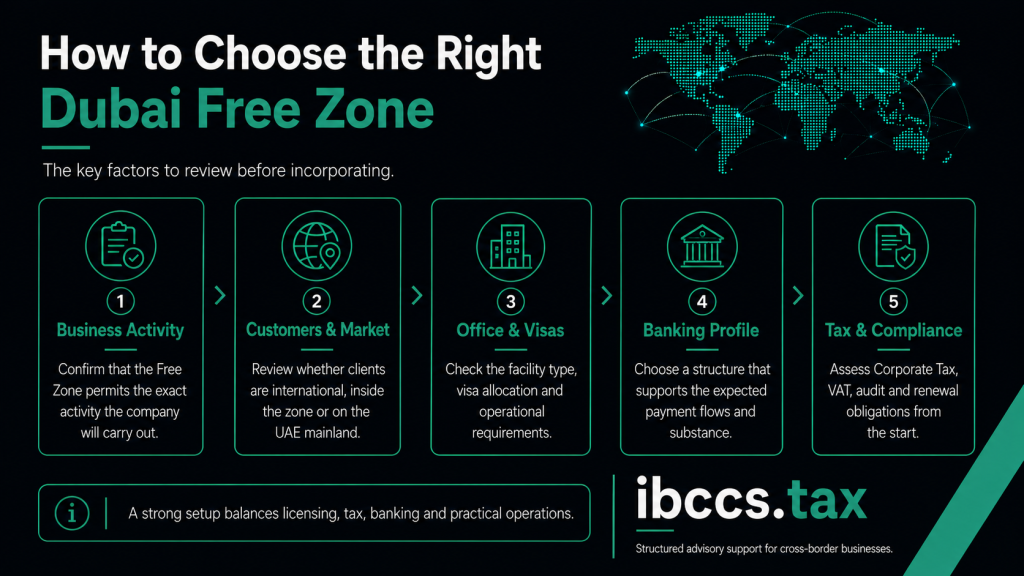
There is no single best Free Zone in Dubai for every business. The correct choice results from matching the authority, licence, facility and compliance framework to the company’s operating model and expected development.
Confirm the Permitted Business Activities
The first step is to confirm that the intended activities are available and can be combined under the selected licence. The wording should be sufficiently accurate to cover the company’s actual services or products without introducing unrelated activities that complicate compliance or banking.
A mismatch between the licence and the real business can create difficulties with banks, customers, payment providers, tax authorities and regulators. The activity review should therefore be completed before the company name or package is selected.
Identify Customer and Market Location
The company should determine whether its customers will be outside the UAE, within a Free Zone or on the mainland. It should also establish where contracts will be signed, where services will be delivered and where goods will be imported, stored or distributed.
A business serving mainly international customers may have different requirements from a company delivering projects throughout Dubai. The route for mainland activity should be designed at the setup stage so that additional licences or entities do not become an unexpected requirement later.
Assess Facilities and Operational Requirements
The business should decide whether it needs a flexi-desk, private office, warehouse, showroom, workshop or industrial facility. The required premises can narrow the available Free Zones and materially affect the setup and renewal cost.
Facility requirements should be assessed together with customer meetings, staff numbers, storage, customs and operational substance. A minimal package can be appropriate for a small consultancy but unsuitable for a growing team or a business with physical goods.
Plan Visas and Employment
Visa eligibility and quotas should be reviewed before the package is purchased. The number and type of visas can depend on the Free Zone, workspace, licence and immigration approval rather than one uniform Dubai-wide rule.
The company should consider shareholders, managers, employees and dependent family members as part of one implementation plan. Visa costs also extend beyond the licence and can include establishment-card processing, entry permits, medical examinations, Emirates ID, insurance and status changes.
Review the Banking Profile
The Free Zone and licence should support the commercial explanation presented to the bank. Shareholders should be ready to explain the company’s products or services, source of funds, customers, suppliers, transaction countries and expected account activity.
Where a company has corporate shareholders or a complex international group, the bank may require ownership charts, financial statements and commercial agreements. Structuring these elements clearly before incorporation can reduce delays after the licence is issued.
Evaluate Corporate Tax and Compliance
The company should assess whether it expects to meet the Qualifying Free Zone Person conditions and whether its income is likely to be Qualifying Income. This review should consider the activity, counterparties, location of operations, permanent establishments, intellectual property, real estate and transactions with natural persons.
The analysis also needs to cover accounting, audit, transfer pricing, VAT and record-keeping. A Free Zone should not be chosen solely because a promotional package refers to tax benefits without explaining the conditions that apply to the company’s specific revenue streams.
Dubai Free Zone Company Formation Process
1. Define the Business Model
The process should begin with a clear description of the proposed activities, customers, ownership, employees, facilities and expected transactions. This information determines which Free Zones and licence categories are realistically suitable.
A structured review at this stage can also identify mainland activity, regulated approvals, customs requirements and tax issues before incorporation. It reduces the risk of selecting a company package that must be amended immediately after setup.
2. Compare Suitable Free Zones
The relevant authorities should be compared by activity, facility, visas, banking suitability, mainland access, tax position and recurring cost. The first-year licence price is only one factor and should not outweigh the practical restrictions of the setup.
The comparison should include renewal costs and the cost of adding employees, activities or workspace. A structure that is inexpensive for the first year can become inefficient where the company expands or requires permissions that were not included in the original package.
3. Choose the Legal Form
The shareholders must decide whether to establish an incorporated Free Zone company or register a branch of an existing entity. The ownership, liability, governance and document requirements differ materially between these options.
An incorporated subsidiary can provide separation from the shareholder or parent company, while a branch preserves direct legal continuity. The decision should be aligned with commercial contracts, group reporting, liability and future investment plans.
4. Select and Reserve the Trade Name
The proposed name must comply with the naming rules of the selected authority and should not conflict with an existing registration. Restrictions can apply to protected words, government references, regulated terms and wording that implies an activity not included in the licence.
The name should also be considered from a banking, branding and group-structure perspective. Where a corporate shareholder or parent is involved, evidence of the right to use the group name may be required.
5. Prepare the Application and KYC Documents
The Free Zone will review the shareholders, directors, Ultimate Beneficial Owners and proposed business activities. Individual and corporate applicants are expected to provide identity, address, ownership and commercial-background information.
Additional documents can be required for corporate shareholders, regulated activities, complex ownership or higher-risk international profiles. Preparing a complete ownership chart and clear business explanation can help avoid repeated information requests.
6. Obtain Initial and External Approvals
Some applications can proceed directly to registration, while others require preliminary or external approval. Qualifications, professional experience, a business plan, regulatory consent or technical information may be requested depending on the activity.
The approval sequence should be confirmed before substantial facility or incorporation costs are committed. A regulated application can take longer than a standard consultancy or trading setup and may require specific directors, policies or capital.
7. Select the Workspace or Facility
The company selects the approved flexi-desk, office, warehouse or industrial facility required for the licence. The lease or service agreement is usually connected with the company registration and can affect visa capacity and operational permissions.
The facility should reflect the real business rather than the minimum available option. Banks, regulators and tax authorities can consider whether the company has an appropriate operational presence for the activity and income reported.
8. Sign the Constitutional Documents
The shareholders sign the Memorandum and Articles of Association, resolutions, declarations and other incorporation documents required by the authority. The documents establish ownership, management powers, share capital and the rules governing the company.
Foreign corporate documents may require notarisation, legalisation or attestation. This should be planned early because obtaining and processing documents from another country can affect the incorporation timeframe.
9. Pay the Registration, Licence and Facility Fees
Once the application and documents have been approved, the registration, licence and facility charges are paid. The authority then issues the incorporation certificate, licence and constitutional documents for the new entity.
The fee schedule should be reviewed for both the initial term and future renewals. Promotional pricing can exclude immigration, facility upgrades, activity additions and other costs that become necessary once the company begins operating.
10. Complete Post-Incorporation Registrations
After the licence is issued, the company may need an establishment card, immigration file, shareholder or employee visas, Corporate Tax registration, VAT registration and customs registration. These are separate implementation stages and should be coordinated with the intended start of operations.
Corporate bank-account opening also begins after incorporation and remains subject to independent due diligence. The company should prepare its business explanation, ownership documents, source-of-funds evidence and expected transaction profile before approaching the bank.
Documents Required for Dubai Free Zone Company Formation
Document requirements depend on the selected authority, business activity, shareholder type and legal form. The Free Zone may request additional evidence where the ownership structure, activity or international profile requires enhanced due diligence.
Documents for Individual Shareholders
An individual shareholder will commonly provide a passport copy, proof of residential address, photograph and completed application or KYC forms. A UAE visa and Emirates ID may also be required where the applicant is already resident in the country.
The authority may request information about professional background, source of funds and the proposed business. A business plan is not required for every setup, but it can be requested for specialised, regulated, industrial or commercially complex activities.
Documents for Corporate Shareholders
A corporate shareholder will normally provide its certificate of incorporation, constitutional documents, corporate extract or certificate of incumbency, board resolution and ownership chart. Documents identifying the directors, authorised signatories and Ultimate Beneficial Owners will also be required.
Foreign documents may need notarisation, legalisation or attestation depending on their country of issue and the Free Zone’s procedures. The document process should be confirmed at the beginning to avoid delays after the application has been approved in principle.
How Much Does Dubai Free Zone Company Formation Cost?
There is no single price for setting up a Free Zone company in Dubai because the total depends on the authority, licence, legal form, activities, workspace, visas and approvals. A reliable quotation should separate the incorporation cost from immigration, facility, tax and ongoing compliance expenses.
| Cost component | What affects it |
| Company registration | Free Zone, legal form, shareholder structure and incorporation package |
| Business licence | Activity category, number of activities and regulated approvals |
| Workspace or facility | Flexi-desk, office, warehouse, workshop or industrial space |
| Immigration and visas | Establishment card, quota, shareholder and employee applications |
| Corporate documents | Individual or corporate shareholders, legalisation and attestation |
| External approvals | Regulated, professional, industrial or specialised activities |
| Accounting and tax | Bookkeeping, Corporate Tax, VAT, transfer pricing and financial statements |
| Audit | Free Zone rules, Qualifying Free Zone Person status and other requirements |
| Annual renewal | Licence, facility, immigration services and amendments |
Promotional packages may exclude establishment cards, visa processing, medical examinations, Emirates ID, insurance, document attestation, external approvals and accounting. The first-year cost should therefore be compared with the expected recurring cost and the price of expanding the setup later.
How Long Does Dubai Free Zone Company Formation Take?
A straightforward company can often be incorporated relatively quickly once the activity, structure and documentation have been approved. The licence timeline should nevertheless be distinguished from visa processing, tax registrations and bank-account opening, which proceed through separate systems.
Corporate shareholders, regulated activities, complex ownership, foreign document legalisation and specialised premises can extend the process. A realistic implementation plan should account for all stages required before the company can employ staff, receive payments and begin full commercial operations.
Can a Dubai Free Zone Company Operate on the Mainland?
A Dubai Free Zone company can conduct the activities permitted by its licence within the relevant framework and can trade internationally. Conducting approved activities outside the Free Zone within mainland Dubai may require an additional licence, permit, branch, distributor or another authorised arrangement.
Dubai’s current framework allows eligible Free Zone establishments to apply for formal permission to conduct specified activities outside their zones. The process is not automatic, and the company must comply with the relevant licensing, premises, record-keeping and inspection requirements before relying on mainland access.
The correct route differs between goods, professional services, e-commerce, regulated activity and project-based work. The company should determine how it will contract, invoice, deliver and employ staff before mainland business begins.
UAE Corporate Tax for Dubai Free Zone Companies
Dubai Free Zone companies fall within the UAE Corporate Tax regime. A Free Zone company that is within scope generally must register, maintain appropriate accounting records and submit an annual Corporate Tax Return even where it expects some or all of its income to qualify for the 0% rate.
A Qualifying Free Zone Person may apply 0% Corporate Tax to Qualifying Income and 9% to taxable income that does not qualify. The rules should be reviewed together with our detailed guide to UAE Corporate Tax, particularly where the company has mainland customers, intellectual property, real estate, financial activity or transactions with related parties.
Qualifying Free Zone Person Requirements
To maintain Qualifying Free Zone Person status, the company must satisfy the conditions in the Corporate Tax framework. These include maintaining adequate substance in the UAE, deriving Qualifying Income, complying with transfer pricing, preparing audited financial statements and remaining within the permitted level of non-qualifying revenue.
The company must also avoid electing into the standard Corporate Tax regime if it intends to retain preferential Free Zone status. The conditions apply continuously, which means that a company’s position should be reviewed each Tax Period rather than assumed from the location of incorporation.
Qualifying and Non-Qualifying Income
The tax result depends on the source and nature of the company’s income, the status of its counterparties and the activity performed. Income from Qualifying Activities can receive different treatment from income connected with Excluded Activities, natural persons, permanent establishments or other non-qualifying sources.
A licence category and a Corporate Tax classification are not the same. The company should map each material revenue stream and retain contracts, invoices and operational evidence supporting the treatment applied in its return.
Small Business Relief
A Qualifying Free Zone Person cannot elect for Small Business Relief. A company considering whether to remain under the Free Zone regime or elect into the standard Corporate Tax system should compare the consequences before making an election or filing its return.
The analysis can affect taxable income, losses, deductions and future compliance. It should be based on the company’s current and expected business rather than a single-year view of revenue. IBCCS TAX provides international taxation services in the UAE for Free Zone businesses requiring Corporate Tax classification, structuring, treaty and cross-border support.
VAT and Customs Treatment
Free Zone status does not create a general exemption from VAT. A business must assess VAT registration based on the value and nature of its taxable supplies and imports, with mandatory registration generally arising when the applicable threshold is exceeded.
Only specified areas are treated as Designated Zones for VAT purposes, and the special rules are limited. They mainly concern qualifying goods and movements under defined conditions, while services generally remain subject to the normal UAE VAT framework.
Customs treatment depends on the Free Zone, the movement of goods and their final destination. Goods entering the mainland can trigger customs procedures, duty and import VAT even where they were previously stored or processed in a Free Zone.
Visas and Employment
A Dubai Free Zone company can generally sponsor shareholder, manager and employee residence visas, subject to the licence, workspace, immigration file and approval. The available quota depends on the setup and should be confirmed before the company commits to hiring or relocation plans.
Visa implementation can include establishment-card registration, entry permits, status changes, medical examinations, Emirates ID, insurance and residence processing. Employment rules may also differ in certain specialised jurisdictions, which means that offer letters, contracts and payroll should be prepared under the correct framework. Our team can coordinate company formation with immigration assistance in the UAE for shareholders, employees and dependent family members, allowing the commercial and relocation timelines to be planned together.
Corporate Bank Account Opening
Free Zone incorporation and bank-account opening are separate processes. The bank will review the company’s shareholders, Ultimate Beneficial Owners, activity, source of funds, customer and supplier countries, expected turnover and anticipated transaction flows.
The bank may request contracts, a business plan, group documents, financial information or evidence of commercial substance. A clear relationship between the licence, workspace and proposed business can make the application easier to understand, although every account remains subject to the bank’s independent risk assessment.
Ongoing Compliance for a Dubai Free Zone Company
Company formation is the beginning of the compliance process rather than the final step. A Dubai Free Zone company must maintain its licence and facility while also meeting the accounting, tax, immigration and corporate requirements arising from its activities.
Ongoing obligations can include annual licence renewal, bookkeeping, financial statements, Corporate Tax registration and returns, VAT, Ultimate Beneficial Owner records, transfer pricing, payroll, immigration files, customs registrations and amendments to shareholders or directors. Qualifying Free Zone Persons must also maintain audited financial statements and evidence supporting the treatment of their income. IBCCS TAX provides accounting and tax services in the UAE for businesses requiring bookkeeping, Corporate Tax, VAT, financial reporting and ongoing compliance support after incorporation.
Practical Dubai Free Zone Company Formation Examples
International Consultancy Business
A consultant serves clients in Europe and Asia and requires a UAE company, residence visa and corporate account. A Dubai Free Zone company may be suitable where the selected authority permits the consultancy activities and provides an appropriate workspace and immigration package.
The Corporate Tax position still requires analysis because professional-service income does not automatically qualify for the 0% rate. The company should also confirm whether it expects to serve mainland clients and whether an additional permit or operating arrangement will be required.
E-Commerce Business
An entrepreneur plans to sell products through an online platform to customers in and outside the UAE. The company must review its e-commerce and trading activities, import arrangements, storage, payment providers, delivery model and VAT position.
A low-cost service licence would not be an appropriate substitute for the permissions required by a product-based business. The Free Zone should be selected around the supply chain and customer journey rather than the online nature of the sales channel alone.
International Trading and Logistics Company
A trading company imports goods and expects to store them before re-exporting or selling them into the UAE. The selected zone should support the necessary logistics, warehouse and customs arrangements, while the company distinguishes clearly between international trade and mainland sales.
The importer-of-record position, customs registration, product approvals and distribution route should be confirmed before incorporation. These issues can affect the licence, facility, VAT and Corporate Tax treatment of the business.
Technology Startup
A technology startup requires visas, office space, intellectual property ownership and the ability to introduce investors. The founders should compare the company regulations, share structure, permitted activities, tax treatment and investor expectations of the shortlisted Free Zones.
The lowest-cost setup may not provide the governance or facilities needed for future funding. Intellectual property, employment, share transfers and group structuring should be considered before the company documents are signed.
Foreign Company Establishing a Branch
An international company wants a Dubai presence without creating a separately owned subsidiary. A Free Zone branch may be suitable where the authority permits the parent’s activities and the parent is prepared to remain responsible for the branch.
The parent’s corporate documents, board approvals and ownership records may require attestation. The group should also consider banking, accounting, Corporate Tax and whether a subsidiary would provide better liability separation for the UAE operation.
Common Dubai Free Zone Company Formation Mistakes
Choosing a Free Zone Only by Price
The lowest initial price may not support the required activities, visas, facilities, banking profile or mainland access. Correcting the structure later can involve amendments, additional licences, new premises or a complete transfer to another entity.
The decision should be based on the full first-year and renewal cost together with commercial suitability. A more appropriate setup can be less expensive over time even where the initial package is not the cheapest.
Assuming Every Free Zone Offers the Same Benefits
Free Zones operate under different regulations and focus on different industries. Their licences, legal forms, facilities, visa processes and amendment rules are not interchangeable.
A structure designed for one consultant may not work for trading, logistics or a regulated activity. The selected authority should be assessed against the company’s exact operating requirements rather than a generic list of Free Zone advantages.
Assuming 0% Corporate Tax Applies Automatically
The 0% rate applies only where a Qualifying Free Zone Person earns Qualifying Income and satisfies all relevant conditions. Incorporation in a Free Zone is not sufficient on its own.
The company must also register, file returns and maintain evidence supporting its treatment. Failing to review the tax position can create exposure that is significantly larger than the cost saved through a low-price incorporation package.
Selecting the Wrong Business Activity
The licence should correspond to the company’s actual services, products and revenue model. A mismatch can cause problems with customers, banks, payment processors, customs, tax authorities and regulators.
Activities should be selected carefully rather than added only because they are available in the package. Related activities can support commercial flexibility, but unrelated wording can complicate the business explanation and compliance profile.
Ignoring Mainland Access
A company planning to serve customers throughout Dubai should determine the compliant mainland route before operations begin. Additional permits or licences can affect the setup cost, premises, tax and timing.
Addressing the issue only after contracts have been signed can require changes to the invoicing and delivery structure. The market-access plan should therefore form part of the original company design.
Underestimating Banking Requirements
A Free Zone licence does not guarantee a bank account. The company needs a credible commercial purpose, transparent ownership, clear source of funds and a transaction profile that matches the licensed activity.
Banking should be planned while the jurisdiction, facility and licence are being selected. This is especially important for international trading, investment, payment services and businesses involving higher-risk countries or sectors.
Ignoring Annual Compliance and Renewal Costs
The annual cost can include licence and facility renewal, accounting, audit, tax returns, visas, insurance, customs and corporate amendments. A promotional first-year fee does not represent the full cost of maintaining a compliant company.
A realistic budget should cover both routine obligations and expected growth. The company may require additional office space, employee visas or activities sooner than anticipated, so future changes should be included in the setup comparison.
How IBCCS TAX Can Assist With Dubai Free Zone Company Formation
Dubai Free Zone company formation requires coordination between licensing, legal structure, taxation, immigration, banking and ongoing compliance. A setup should support the business after incorporation rather than simply result in the fastest possible licence.
- Comparing suitable Dubai Free Zones and company structures
- Selecting permitted business activities and the appropriate licence
- Choosing between an incorporated company and a branch
- Preparing shareholder, UBO and corporate documentation
- Coordinating workspace, establishment-card and immigration procedures
- Supporting shareholder and employee visa applications
- Assisting with corporate bank-account preparation and coordination
- Registering for Corporate Tax and VAT where required
- Reviewing Qualifying Free Zone Person and Qualifying Income conditions
- Providing bookkeeping, financial statements and audit coordination
- Managing annual corporate, tax and regulatory compliance
- Restructuring an existing Free Zone company where the original setup no longer fits the business
These services are delivered as a coordinated process rather than separate administrative tasks. Our UAE company formation services support clients from the initial structure review through registration, banking, immigration, tax and ongoing administration.
Planning to Establish a Dubai Free Zone Company?
The appropriate Free Zone depends on the company’s activities, customers, ownership, visa requirements, facilities, tax profile and long-term commercial plans. A structured review before incorporation can prevent costly amendments and ensure that the licence supports the intended business model. Contact IBCCS TAX to discuss a Dubai Free Zone company setup with our UAE team and coordinate the legal, tax, banking and immigration requirements from the outset.

Frequently Asked Questions About Dubai Free Zone Company Formation
1. Can a foreigner own 100% of a Dubai Free Zone company?
Yes. Dubai Free Zone companies generally permit full foreign ownership, subject to the regulations, activity approvals and due-diligence procedures of the selected authority. Ownership must still be disclosed to the Free Zone, bank and relevant authorities.
2. Which is the best Free Zone in Dubai?
There is no single best Free Zone for every business. The correct choice depends on the permitted activities, customers, facilities, visas, mainland access, banking profile, tax position and long-term operating plan.
3. Can a Dubai Free Zone company trade on the mainland?
A company may need an additional licence, permit, branch, distributor or another approved arrangement to conduct specified activities outside its Free Zone. Dubai provides a formal mechanism for eligible Free Zone establishments, but approval is not automatic and depends on the activity and relevant conditions.
4. Does a Dubai Free Zone company pay Corporate Tax?
Free Zone companies are within the UAE Corporate Tax regime. A Qualifying Free Zone Person may apply 0% to Qualifying Income, while non-qualifying taxable income can be subject to 9%.
5. Does every Free Zone company need Corporate Tax registration?
A Free Zone company within scope of Corporate Tax generally must register and submit annual returns, even where it expects Qualifying Income to be taxed at 0%. Specific exemptions or special circumstances should be assessed separately.
6. Is a Dubai Free Zone company exempt from VAT?
No. Free Zone status does not create a general VAT exemption, and registration depends on the company’s taxable supplies and imports. Special Designated Zone rules are limited and do not apply to every Free Zone or every transaction.
7. What is the difference between an FZE and an FZCO?
The terminology varies between Free Zones. FZE is often used for a single-shareholder entity, while FZCO may be used for one or more shareholders, but the regulations and constitutional documents of the selected authority determine the actual structure.
8. Can I obtain a UAE residence visa through a Free Zone company?
A Free Zone company can generally sponsor shareholder and employee visas, subject to its licence, workspace, visa quota and immigration approval. The package should be selected with the expected number of visas and future staffing needs in mind.
9. Do I need an office in a Dubai Free Zone?
The company requires an approved facility or registered workspace, which may be a flexi-desk, serviced office, private office, warehouse or industrial unit. The appropriate option depends on the activity, visas and operational requirements.
10. How much does a Dubai Free Zone company cost?
The cost depends on the Free Zone, licence, activities, facility, visas, approvals and renewal requirements. A tailored quotation should include both incorporation expenses and the ongoing cost of maintaining the company.
11. How long does Dubai Free Zone company formation take?
A straightforward application can often be processed quickly once the documentation and approvals are complete. Corporate shareholders, regulated activities, legalised documents, visas and bank-account opening can extend the overall implementation timeline.
12. Can a Dubai Free Zone company open a UAE bank account?
Yes, it can apply for a corporate bank account, but approval is subject to the bank’s due-diligence review. The company should provide a clear business model, ownership structure, source of funds and expected transaction profile.
13. Does a Free Zone company need audited financial statements?
Audit requirements depend on the Free Zone, activity and tax status. A Qualifying Free Zone Person must prepare and maintain audited financial statements under the current Corporate Tax framework.
14. Is a Free Zone company the same as an offshore company?
No. A Free Zone company is generally a licensed UAE operating entity that can conduct approved business and sponsor visas, while a traditional offshore or international company is mainly used for holding, investment or cross-border structuring.



UAE Business License Guide: Types, Requirements, Costs and Renewal
A UAE business license is the formal authorization that allows
Read More
Why Start a Business in the UAE? Strategic Advantages and Practical Considerations
The United Arab Emirates has developed into an established international
Read More
UAE Holding Company Setup: Structures, Tax, Asset Protection and Key Considerations
A UAE holding company can provide a structured way to
Read MoreDisclaimer: This article provides general information and does not constitute legal, tax or investment advice. Dubai Free Zone requirements vary according to the selected authority, business activity, legal form, ownership, facility and applicable legislation, and the appropriate treatment depends on the circumstances of the company. Professional advice should be obtained before establishing, acquiring or restructuring a Free Zone company or relying on a particular tax, licensing or mainland-access position.