

The cost of setting up a company in Cyprus cannot be reduced to a single incorporation fee. A realistic budget should cover the legal formation of the company, its initial tax and operational setup, and the recurring obligations required to keep it properly administered and compliant.
The final cost depends on the ownership structure, business activity, expected transaction volume, VAT and payroll requirements, banking needs, governance arrangements and the level of economic substance required. For this reason, two companies incorporated under the same legal form may have materially different first-year and annual cost profiles.
IBCCS TAX supports local and international clients with company formation in Cyprus, tax planning, accounting, corporate administration and post-incorporation compliance. This guide explains the full cost framework so that founders can assess the complete scope before proceeding, even where a fixed public price would not accurately reflect the proposed structure.

- The incorporation fee is only one part of the total budget. A Cyprus company also requires corporate administration, accounting, financial reporting and statutory filings.
- First-year costs are normally higher than recurring annual costs. The first year may include tax registration, VAT or VIES registration, banking support, payroll setup and additional document preparation.
- The business model drives the cost. A simple consulting company, an e-commerce business and an operational company with employees and premises do not require the same level of support.
- Banking and substance should be assessed before incorporation. They can materially affect the structure, documentation and ongoing operating requirements.
- The most useful comparison is the total first-year scope. A formation quotation should show what is included, what is optional and which costs will continue each year.
Quick Answer: How Much Does It Cost to Set Up a Cyprus Company?
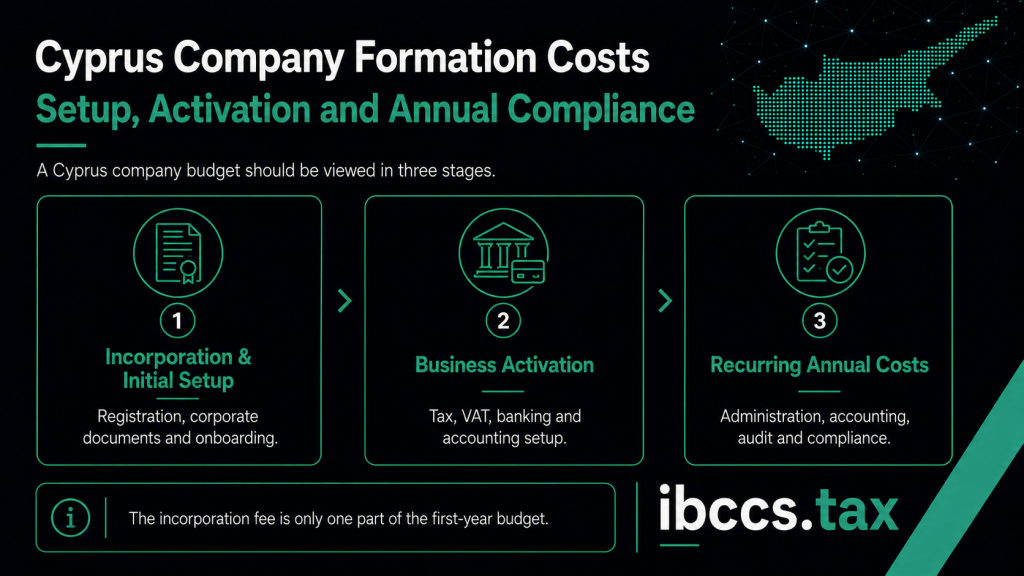
There is no single standard cost that applies to every Cyprus company. The correct answer depends on whether the question refers only to legal incorporation, the complete first-year setup or the annual cost of maintaining the company.
A straightforward company with one individual shareholder, a limited number of transactions and no employees will usually have a lower cost profile than a company with corporate shareholders, cross-border trading, VAT, payroll, local management, regulated activity or a broader substance requirement. The most accurate approach is therefore to prepare an itemised scope based on the actual business model.
| Cost layer | When it arises | Typical components | Main cost drivers |
| Legal incorporation | At formation | Name approval, incorporation documents, Registrar filings, corporate certificates and initial KYC | Ownership structure, number of parties, corporate shareholders, translations and document certification |
| Business activation | After incorporation | Tax registration, VAT or VIES where applicable, accounting setup, bank or EMI onboarding and payroll registration | Business activity, countries involved, expected flows, employees and banking risk profile |
| Ongoing compliance | Recurring | Registered office, secretary, bookkeeping, financial statements, audit, tax filings, annual return and corporate administration | Transaction volume, VAT, payroll, currencies, group transactions and complexity |
| Governance and substance | Structure-dependent | Cyprus-based decision-making, directors, office, employees, records and operational support | Tax residency objectives, business functions, treaty position, banking expectations and operational footprint |
The Main Components of Cyprus Company Formation Cost
1. Incorporation and Legal Setup
The initial formation cost covers the legal work required to establish the entity. The process normally includes company name approval, preparation of the memorandum and articles of association, appointment of the shareholder, director and secretary, confirmation of the registered office, submission of the incorporation application and issue of the corporate certificates.
The scope becomes more detailed where the company has several shareholders, a corporate shareholder, a trust or holding structure, different classes of shares, bespoke articles or sector-specific approvals. Foreign documents may also require certification, apostille, translation or additional verification. Our step-by-step guide to registering a company in Cyprus explains the incorporation process and the decisions that should be made before filing.
2. KYC, UBO and Source-of-Funds Review
Company formation involves due diligence on the proposed shareholders, directors, beneficial owners and, where relevant, the wider ownership chain. The information required normally includes identity and address documents, professional or business background, a clear description of the intended activity, expected countries of operation and evidence supporting the source of funds and source of wealth.
A simple ownership structure can usually be reviewed more efficiently than a structure involving several entities, nominees, trusts, private investment vehicles or parties from multiple jurisdictions. Complex or incomplete ownership information may require additional review and documentation before incorporation can proceed.
3. Registered Office and Company Secretary
A Cyprus company requires a registered office in Cyprus and a company secretary. These are not merely formation details; they are continuing elements of the company’s corporate administration. The registered office is the formal address for statutory records and official correspondence, while the secretary supports the company’s corporate records and filings.
The cost depends on whether the company requires only standard registered office and secretarial support or a broader corporate administration service covering resolutions, changes to directors or shareholders, certified documents, powers of attorney and ongoing liaison with the Registrar. IBCCS TAX provides corporate services in Cyprus alongside the formation process.
4. Tax Registration, VAT and VIES
After incorporation, the company must be integrated into the relevant tax and reporting framework. Tax registration is a separate post-incorporation step. VAT registration is not automatically required for every company, but it may become mandatory or commercially appropriate depending on turnover, the nature of supplies, the location of customers and the company’s cross-border activity.
Companies trading with businesses in other EU Member States may also need VIES-related registration and reporting. E-commerce, digital services, import and export activity, marketplace sales and cross-border consulting can each create different VAT requirements. IBCCS TAX assists clients with VAT registration and de-registration in Cyprus and ongoing VAT administration.
5. Accounting, Financial Statements and Audit
Accounting should be organised from the first transaction rather than addressed only at the end of the financial year. A Cyprus company generally needs proper books and records, annual financial statements, tax reporting and statutory audit support under the applicable framework. The amount of work depends heavily on the quality, volume and complexity of the records.
The main cost drivers include the number of sales and purchase invoices, bank accounts, currencies, payment processors, employees, loans, related-party transactions, fixed assets, investments and VAT returns. A dormant or low-activity company will not require the same accounting scope as an operational business with frequent transactions. More information is available on our accounting services in Cyprus page.
6. Bank or EMI Account Support
The incorporation of a company does not automatically guarantee the opening of a bank or electronic money institution account. Financial institutions conduct their own risk assessment and may request a business plan, contracts, invoices, ownership documents, tax information, source-of-funds evidence and a detailed explanation of expected payments.
The time and work involved depend on the business sector, countries of operation, currencies, expected turnover, payment flows, customer profile and the proposed signatories. A company with a clear commercial purpose and a well-prepared compliance file is generally in a stronger position than one that begins the banking process without adequate documentation. Our Cyprus company bank account support is coordinated as a separate onboarding process.
7. Payroll and Social Insurance
A company that employs staff or pays remuneration through payroll may need employer registration, payroll setup, social insurance administration and recurring submissions. The scope depends on the number of employees, remuneration structure, benefits, commencement dates and whether directors or internationally mobile employees are involved.
Where payroll is expected, it should be included in the first-year budget rather than treated as an afterthought. IBCCS TAX supports clients with company registration for social insurance in Cyprus and ongoing payroll-related compliance.
8. Tax Residency, Governance and Economic Substance
Legal incorporation and tax residency are related but distinct matters. The company’s governance, place of effective decision-making, board composition, records and actual conduct should be aligned with the intended Cyprus tax position and the wider cross-border structure.
Some companies require a relatively limited local footprint, while others need Cyprus-based directors, regular board meetings, dedicated premises, employees, local operating expenditure or other evidence of genuine business activity. Substance should reflect what the company actually does; it should not be assembled as a generic checklist. Our guide to Cyprus economic substance requirements explains the practical factors that should be assessed.
Where the company forms part of an international structure, the review may also need to consider the owner’s personal tax residence, permanent establishment exposure, transfer pricing, withholding taxes and the application of double tax treaties. These matters are normally addressed through a wider tax planning review in Cyprus rather than through incorporation alone.
One-Off, First-Year and Recurring Annual Costs
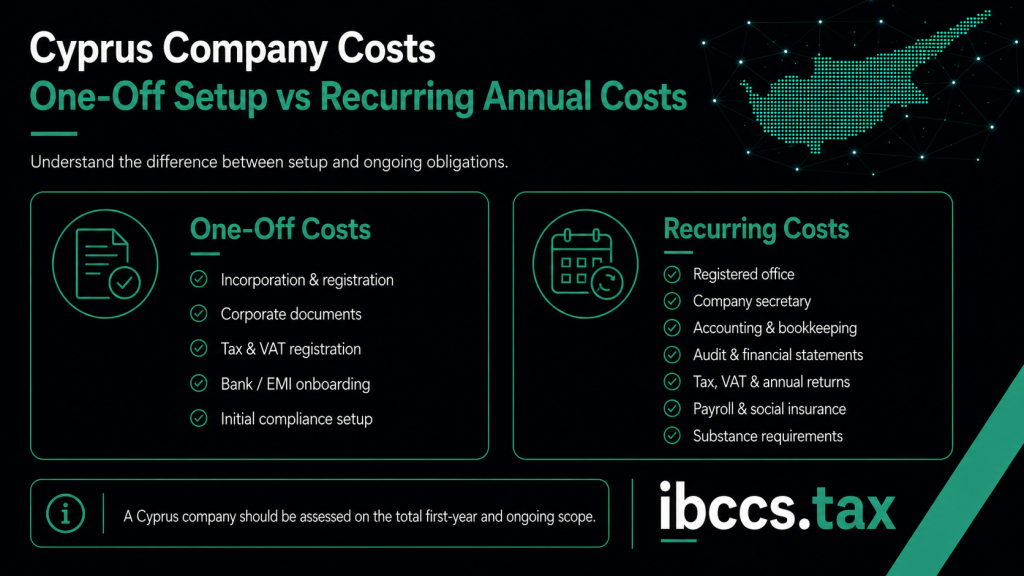
A useful cost estimate should separate the formation stage from the first year of operation and from the costs that continue in later years. This distinction prevents the initial incorporation figure from being mistaken for the complete cost of establishing and maintaining the company.
| Cost category | One-off | First year | Recurring annually |
| Name approval and incorporation filings | Yes | Included at setup | No, unless a later corporate change is required |
| KYC and ownership review | Initial review | May continue if documents or structure change | Periodic updates and event-driven reviews |
| Registered office | No | Yes | Yes |
| Company secretary and corporate administration | Initial appointments | Yes | Yes |
| Tax registration | Usually initial | Yes | Only updates or additional registrations |
| VAT and VIES | Initial registration where applicable | Registration and filings | Ongoing returns and reporting |
| Accounting setup | Yes | Yes | Bookkeeping and reporting continue |
| Financial statements and audit | No | Provision should be made from the first year | Yes, subject to the applicable requirements |
| Bank or EMI onboarding | Initial applications | Often relevant | Possible account maintenance and periodic compliance reviews |
| Payroll and social insurance | Initial setup | Where applicable | Ongoing where employees or payroll remain |
| Substance and local operations | Initial implementation | Where required | Ongoing while the structure operates |
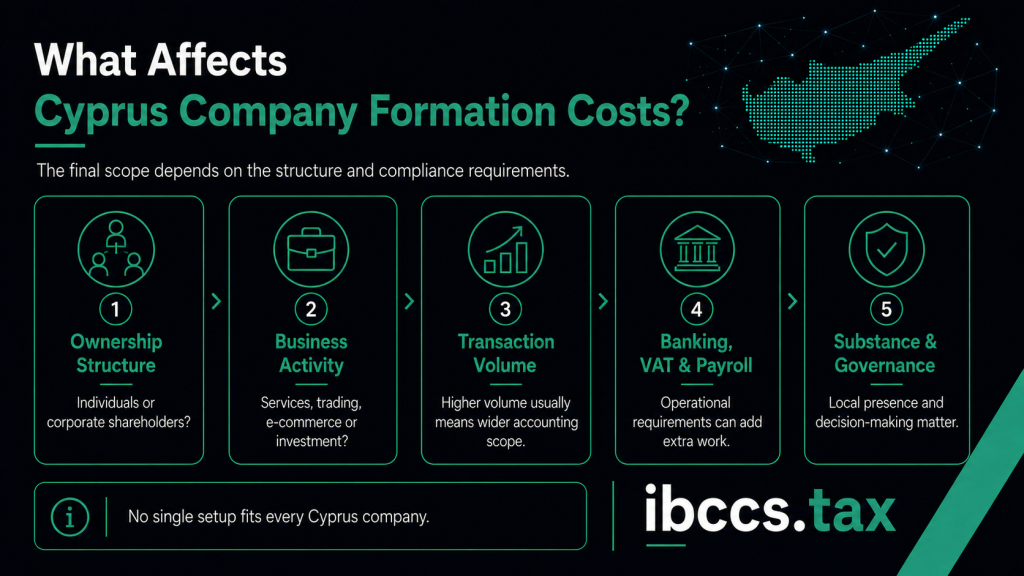
What Determines the Final Cost of a Cyprus Company?
Ownership and Control Structure
A company owned directly by one individual is generally more straightforward to establish and administer than a company owned by several individuals, another company, a trust or a multi-layered group. Corporate shareholders usually require additional constitutional documents, corporate approvals, ownership charts and evidence identifying the ultimate beneficial owners.
Business Activity and Regulatory Profile
The activity determines the legal, tax, VAT, banking and compliance work required. Consulting and professional services may be comparatively straightforward, while e-commerce, financial services, gaming, crypto-related activity, import and export, investment activity or regulated services may require additional analysis, licensing checks or enhanced banking documentation.
The legal form should also match the intended activity and risk profile. Our guide to the types of companies in Cyprus explains the main structures available and when a private limited company is commonly used.
Transaction Volume and Accounting Complexity
Accounting cost is driven by work volume rather than the company’s registered capital or the number of months since incorporation. Frequent transactions, several bank or payment accounts, multiple currencies, inventory, intercompany balances, loans and incomplete supporting documents increase the bookkeeping and reconciliation work required.
VAT and Cross-Border Transactions
A company supplying services or goods across borders may require a more detailed VAT analysis than a purely local or passive company. The place-of-supply rules, customer status, EU reporting and the use of marketplaces or fulfilment providers can all affect the registration and reporting scope.
Banking Risk and Payment Infrastructure
The banking profile is influenced by the industry, transaction countries, expected values, customer and supplier base, source of funds and the commercial connection to Cyprus. Where a business requires several currencies, merchant acquiring, payment gateways or more than one financial institution, the onboarding work may be broader.
Directors, Management and Tax Residency
A foreign owner may be able to participate directly in the management of the company, but the appropriate director and governance arrangement should be reviewed in light of the company’s intended tax residency and the owner’s country of residence. A Cyprus-resident director should have a genuine role and sufficient information and authority to make decisions; the appointment should not be treated as a purely administrative formality.
Economic Substance and Local Presence
A holding company, software business, consultancy and trading operation will not necessarily require the same people, premises, expenditure or operational functions. The cost increases where the proposed model requires dedicated office space, local employees, senior management, specialised service providers or a wider Cyprus operating platform.
Timing and Document Readiness
A well-prepared file can be processed more efficiently than an urgent application submitted with incomplete ownership information, expired documents or unclear business activities. Additional certifications, translations, legal opinions or expedited filings may affect the initial scope.
Three Typical Cyprus Company Cost Profiles
The following profiles do not represent fixed packages or prices. They show how the cost structure changes as the business becomes more operational and compliance-intensive.
Profile 1: Owner-Managed Consulting or Professional Services Company
This profile may involve one individual shareholder, a small number of international clients, limited monthly transactions, no employees and a straightforward service activity. The core cost areas are incorporation, registered office, secretary, accounting, financial statements, audit and tax compliance. VAT and banking requirements depend on the client base and transaction model.
Cost profile: lower structural complexity, provided that the ownership, management and cross-border tax position are straightforward.
Profile 2: SaaS, E-Commerce or International Trading Company
This profile may involve customers in several countries, recurring payments, payment processors, VAT or VIES reporting, contractors, software or intellectual property, and a higher number of transactions. The company may require more detailed accounting, banking documentation, VAT analysis and operational agreements.
Cost profile: moderate to higher operational complexity, depending on transaction volume, payment channels, countries and the treatment of IP, inventory or cross-border services.
Profile 3: Operational Cyprus Company With Local Substance
This profile may involve Cyprus-based management, office space, employees, payroll, local expenditure and day-to-day business activity. The formation cost may not be substantially different from a simpler company, but the implementation and annual operating scope will be broader because the company requires real infrastructure and recurring local administration.
Cost profile: higher recurring operational scope, reflecting the people, premises, governance and compliance required by the actual business.
| Profile | Accounting and compliance | Banking and VAT | Governance and substance |
| Owner-managed consulting | Usually lower transaction volume and a straightforward reporting profile | Depends on client location and payment model | Requires a clear management and tax residency position |
| SaaS, e-commerce or trading | More transactions, currencies, processors and cross-border records | Often more significant due to VAT, VIES, gateways and multi-country flows | May require stronger operational documentation and IP or supply-chain governance |
| Operational Cyprus company | Broader bookkeeping, payroll and local reporting | Aligned with day-to-day Cyprus operations | Local management, premises, employees and evidence of genuine activity may be central |
What May Not Be Included in a Basic Formation Scope?
A formation scope should be reviewed line by line. The term “company formation” may refer only to legal incorporation, while a business owner may expect it to include tax activation, accounting, banking and all first-year compliance. These are separate workstreams and should be identified before engagement.
- tax planning or cross-border structuring advice;
- VAT, VIES or other specialised registrations;
- bank or EMI application support;
- accounting setup, bookkeeping, financial statements and audit;
- payroll, employer registration and social insurance administration;
- resident director, office, employees or wider substance arrangements;
- certified copies, apostilles, translations and courier services;
- licensing, regulatory advice or sector-specific approvals;
- changes to the structure after incorporation.
The objective is not to include every possible service in every formation. It is to ensure that the quotation reflects the services the company will actually need during its first year.
Why the Incorporation Fee Is Not the Full Cost
A company may be legally incorporated but still not be ready to trade. It may need tax registration, a bank or EMI account, VAT analysis, an accounting process, contracts, invoicing procedures, payroll or operational substance before it can function as intended.
The more useful financial question is therefore not only “What is the incorporation fee?” but “What will be required to establish, activate and maintain this company properly during the first twelve months?” This broader assessment supports better budgeting and reduces the likelihood of unexpected compliance work after the company has already been formed.
Can a Cyprus Company Be Registered Remotely, and Does That Affect the Cost?
Cyprus company formation can often be coordinated remotely, subject to satisfactory KYC, due diligence and execution of the required documents. Physical travel to Cyprus is not necessarily required for the incorporation itself.
Remote onboarding can, however, require certified identity and address documents, apostilles, translations, courier delivery or verification through an accepted professional. The exact requirements depend on the parties and jurisdictions involved. Banking institutions may also apply their own identification or meeting requirements independently of the incorporation process.
How to Obtain an Accurate Cyprus Company Formation Quotation
An accurate quotation should be based on a short pre-incorporation assessment rather than only the requested company name. The following information allows the legal, tax, accounting and operational scope to be identified from the outset:
- Business activity: what the company will sell, provide, hold or manage.
- Ownership: shareholders, beneficial owners and any corporate or trust involvement.
- Management: proposed directors, their countries of residence and where decisions will be made.
- Markets: countries of customers, suppliers, employees and contractors.
- Financial profile: expected turnover, number of transactions, currencies and payment methods.
- VAT position: types of supplies and whether customers are businesses or consumers.
- Banking needs: bank, EMI, payment gateways and expected payment flows.
- People and premises: employees, payroll, office and substance requirements.
- Wider structure: personal tax residence, existing companies, IP, investments and cross-border arrangements.
For entrepreneurs with activities or assets in several countries, the company should be assessed as part of the wider structure. Our international tax planning checklist for entrepreneurs outlines the main issues that should be reviewed together before implementation.
How IBCCS TAX Supports Cyprus Company Formation
At IBCCS TAX, company formation is coordinated with the services required to make the company operational and maintain it correctly. Depending on the case, our support may include:
- pre-incorporation review of the proposed activity and ownership structure;
- company name approval and preparation of incorporation documents;
- KYC, beneficial ownership and source-of-funds onboarding;
- registered office, secretary and ongoing corporate administration;
- tax, VAT and VIES registration where applicable;
- accounting setup, bookkeeping, financial statements, audit coordination and tax compliance;
- bank or EMI onboarding support and preparation of the business profile;
- payroll and social insurance registration;
- tax residency, governance and substance planning;
- ongoing international tax and corporate structuring support.
Clients who are ready to proceed can review our Cyprus company registration services or contact our team for an itemised first-year scope tailored to the proposed business. Share the proposed activity, ownership, expected transaction volume, VAT, payroll, banking and substance requirements. Our team will define the formation and first-year compliance scope for your Cyprus company. Contact IBCCS TAX
The cost of a Cyprus company should be assessed in the context of the company’s actual purpose. A structure that is inexpensive to incorporate but not aligned with the owner’s tax residence, banking needs, compliance obligations or operational reality may require significant corrective work later. A properly prepared first-year scope gives the founder a clearer understanding of what is required to establish the entity, begin trading and maintain it on an ongoing basis. IBCCS TAX combines company formation, tax planning, accounting, corporate administration, VAT, payroll, banking coordination and substance support so that the structure can be implemented as one coherent process.

Frequently Asked Questions: Cyprus Company Formation Cost
1. How much does it cost to set up a company in Cyprus?
There is no single cost that applies to every company. The final scope depends on the legal structure, ownership, business activity, KYC requirements, accounting volume, VAT, payroll, banking, governance and economic substance. A reliable estimate should separate legal incorporation from first-year activation and recurring annual compliance.
2. Can IBCCS TAX provide a fixed company formation fee?
A defined fee can be provided once the proposed activity and ownership structure have been reviewed. Where the case is straightforward, the formation scope can be relatively standard. Where it involves corporate shareholders, international structuring, regulated activity, complex banking or substance, the quotation should reflect the additional work required.
3. What costs are mandatory for a Cyprus company?
The company normally requires incorporation, a registered office, a secretary, corporate records, accounting, annual financial and tax compliance, and statutory filings. Tax, VAT, payroll, banking and substance requirements depend on the company’s activity and operating model.
4. Are accounting and audit included in the incorporation cost?
They should not be assumed to be included unless the quotation states this expressly. Incorporation is a legal setup process, while accounting, financial statements, audit and tax compliance are ongoing services. They should be included in the first-year budget from the outset.
5. Is VAT registration mandatory for every Cyprus company?
No. VAT registration depends on the nature and value of the supplies, customer location, business model and applicable registration rules. A company may also require VIES or other VAT-related reporting where it carries out relevant cross-border EU transactions.
6. Can a non-resident register a Cyprus company remotely?
In many cases, yes. The incorporation process can often be coordinated remotely, provided that the required KYC, due diligence, signatures and certified documents are completed. Banks and other institutions may apply separate onboarding requirements.
7. Is a Cyprus bank account included with company formation?
A bank or EMI account is a separate application and is subject to the financial institution’s approval. The company formation provider can prepare and coordinate the application, but no incorporation automatically guarantees account approval.
8. Does a Cyprus company need a Cyprus-resident director?
A Cyprus private company must have at least one director, but the director’s residence and role should be considered together with tax residency, management and control, banking and substance. A local director may be appropriate in some structures, but the arrangement must reflect genuine decision-making rather than a nominal appointment.
9. Does a company with a corporate shareholder cost more to establish?
It can require a broader onboarding scope because the corporate shareholder’s constitutional documents, good-standing evidence, ownership chain, board approvals and ultimate beneficial owners need to be verified. The exact effect depends on the jurisdictions and complexity of the structure.
10. What is the best way to compare Cyprus company formation quotations?
Compare the total first-year scope rather than only the incorporation line. Confirm whether the quotation includes registered office, secretary, tax registration, VAT, accounting, financial statements, audit, annual filings, banking support, payroll and any governance or substance requirements.
Cyprus UBO Register 2026: Annual Confirmation Deadline, Requirements & Penalties
The Cyprus Department of Registrar of Companies and Intellectual Property
Read More
Cezary Zieniuk to Join Free IMC Webinar on the New Geography of Global Mobility
On 23 September 2026, Cezary Zieniuk, Founder of IBCCS TAX
Read More
Cyprus Extends 2025 Annual PAYE Return Deadline to 30 November 2026
The Cyprus Tax Department has announced a further extension to
Read MoreDisclaimer: This article is provided for general informational purposes and does not constitute legal, tax or accounting advice. The applicable requirements and scope should be assessed based on the facts of each case and the rules in force at the relevant time.