

Cyprus continues to attract entrepreneurs, executives, investors, retirees and internationally mobile families looking for an EU base with a competitive tax framework. However, becoming resident in Cyprus does not automatically mean that all foreign income becomes exempt from tax.
The outcome depends on several connected factors, including your Cyprus tax residency, the nature and source of your income, whether you qualify for Non-Dom status, your position in other countries and any companies or investment structures you own.
For an employee receiving one salary, the analysis may be relatively straightforward. For a founder managing a foreign company, an investor receiving dividends from several jurisdictions or a family holding international assets, the position can be significantly more complex.
This guide explains the main Cyprus tax considerations for expats and internationally mobile individuals in 2026. It also highlights where tax residency, foreign income, Non-Dom status, company ownership and annual filing obligations need to be reviewed together rather than in isolation.

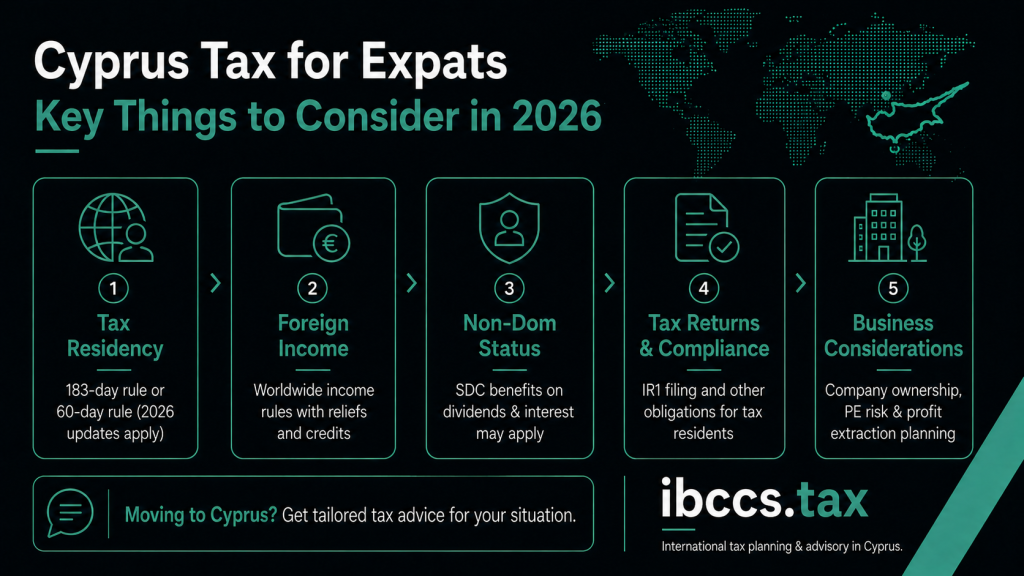
- Cyprus tax residency can generally be established under either the 183-day rule or the 60-day rule.
- From 2026, the previous 60-day rule condition requiring an individual not to be tax resident in another country has been removed.
- Cyprus tax residents are generally assessed under Cyprus rules on worldwide income.
- The tax treatment depends on whether the income is salary, business income, dividends, interest, rent, pension income or capital gains.
- Non-Dom status is mainly relevant to Special Defence Contribution on dividends and passive interest.
- Non-Dom status does not create a blanket exemption for all foreign income.
- GHS/GESY contributions may continue to apply even where an individual qualifies as Non-Dom.
- Moving to Cyprus while managing a foreign company can create corporate tax residency or permanent establishment considerations.
- Double tax treaties and foreign tax credits may reduce double taxation, but their application requires a fact-specific review.
- Filing obligations should be considered even where an individual expects little or no Cyprus tax to be payable.
Quick Answer: How Are Expats Taxed in Cyprus?
An individual who becomes Cyprus tax resident is generally subject to Cyprus tax rules on worldwide income, although the final treatment depends on the type of income, available exemptions, foreign tax credits and any applicable double tax treaty.
Qualifying Cyprus tax residents who are non-domiciled in Cyprus for Special Defence Contribution purposes may generally benefit from an exemption from SDC on dividend and passive interest income. This does not mean that every form of foreign income becomes tax-free, as personal income tax, GHS/GESY contributions, source-country taxes and reporting requirements may still apply.
Individuals who are not Cyprus tax residents are generally taxed in Cyprus only on income arising from relevant Cyprus sources, subject to the applicable rules.
Cyprus Tax for Expats: Who Is This Guide For?
This guide is particularly relevant for individuals who are:
- moving to Cyprus for employment or business;
- receiving income from more than one country;
- shareholders or directors of foreign companies;
- entrepreneurs managing an international business;
- receiving foreign dividends, interest or rental income;
- relocating with an investment portfolio;
- considering Cyprus Non-Dom status;
- receiving a foreign pension;
- maintaining homes or substantial connections in several countries;
- planning a long-term personal or family relocation to Cyprus.
Where a move involves international income, companies or significant assets, tax planning should usually take place before the change of residence or before major payments and transactions are completed.
Cyprus Tax Residency: The Starting Point
The first step in assessing Cyprus tax for expats is establishing whether the individual is tax resident in Cyprus for the relevant calendar year. Tax residency is different from citizenship, immigration residence and the right to live in Cyprus. A person may hold a Cyprus residence permit without becoming Cyprus tax resident. Equally, an individual may become Cyprus tax resident without being a Cyprus citizen.
Cyprus provides two main routes to individual tax residency: the 183-day rule and the 60-day rule.
The Cyprus 183-Day Rule
Under the standard test, an individual is generally considered Cyprus tax resident when they spend more than 183 days in Cyprus during the relevant calendar year. This route is primarily based on physical presence and is often the more straightforward option for individuals who live in Cyprus for most of the year. Accurate day-count records should still be maintained. Travel dates, accommodation records and other supporting documentation may be relevant when applying for a Tax Residency Certificate or demonstrating the position to banks, tax authorities and other institutions.
The Cyprus 60-Day Rule in 2026
The 60-day rule provides an alternative route for individuals who maintain a substantial connection with Cyprus but do not spend more than 183 days on the island. For tax years beginning from 1 January 2026, an individual no longer needs to prove that they are not tax resident in any other country to qualify under the Cyprus 60-day rule. The remaining conditions continue to apply. In general, the individual must:
- spend at least 60 days in Cyprus during the relevant tax year;
- not spend more than 183 days in any other single country during that year;
- carry on a business in Cyprus, be employed in Cyprus or hold an office in a Cyprus tax-resident company;
- maintain the relevant business, employment or office connection during the year; and
- maintain a permanent home in Cyprus, whether owned or rented.
The 2026 amendment creates more flexibility, but it can also increase the possibility of an individual qualifying as tax resident in more than one country under domestic legislation. Where two countries claim the same individual as tax resident, the position may need to be determined under an applicable double tax treaty. Factors such as the location of a permanent home, centre of vital interests, habitual residence and nationality may become relevant.
A full explanation is available in our guide to the Cyprus 60-day and 183-day tax residency rules. Individuals planning a move can also explore our practical service for changing tax residency to Cyprus.
Tax Residency Is Not the Same as Immigration Residency
One of the most common mistakes made by new residents is assuming that an immigration permit automatically determines their tax position.
Immigration residence regulates the legal right to live in Cyprus. Tax residency determines how an individual is treated under Cyprus tax legislation and potentially under an applicable double tax treaty.
The two systems may interact, but they are not interchangeable. An individual may have a Yellow Slip, Pink Slip or permanent residence permit and still need to assess separately whether the Cyprus 60-day or 183-day tax residency test has been met.
Similarly, obtaining Cyprus tax residency does not automatically cancel tax residency in the previous country. Exit rules, domestic residence tests, temporary non-residence provisions and treaty tie-breaker rules may still need to be considered.
Does Cyprus Tax Foreign Income?
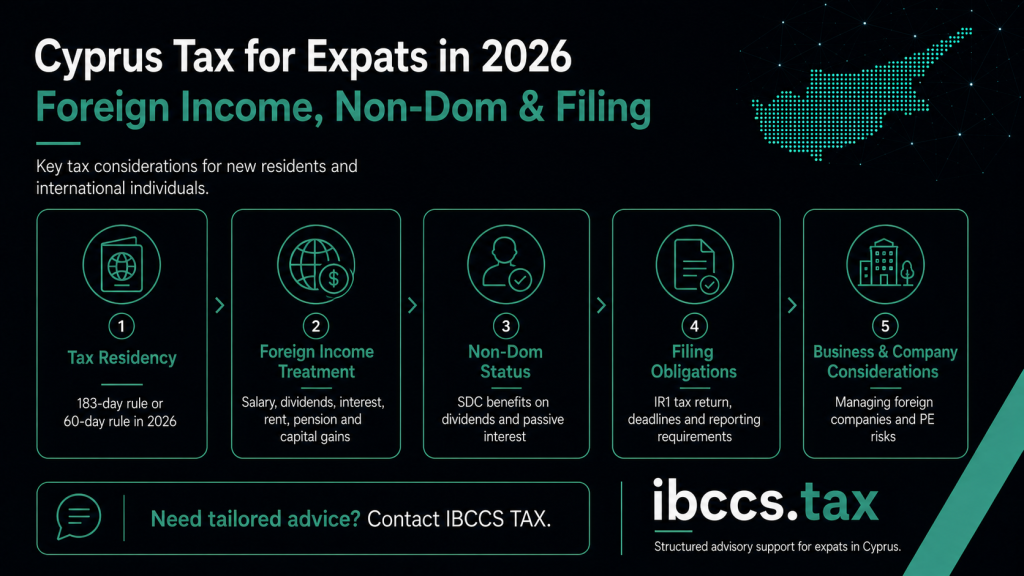
Cyprus tax residents are generally subject to Cyprus tax rules on their worldwide income. This means that foreign income should not be ignored simply because it is paid by a non-Cyprus company or received into a bank account outside Cyprus. The actual tax treatment depends on the legal classification of the income. Salary, business profits, dividends, interest, rent, pension income and capital gains can be treated differently.
The country where the income arises may also impose tax. In that situation, an applicable double tax treaty or foreign tax credit mechanism may help reduce double taxation.
How Common Types of Foreign Income May Be Treated
| Type of income | Main Cyprus tax considerations |
| Foreign employment income | Personal income tax, place where work is performed, available employment exemptions, payroll and treaty position |
| Self-employment or consulting income | Personal income tax, business deductions, VAT, social insurance, GHS/GESY and permanent establishment considerations |
| Foreign dividends | Generally not subject to personal income tax, but SDC, Non-Dom status and GHS/GESY may be relevant |
| Foreign interest | Classification as passive or business-related interest, SDC, Non-Dom status and GHS/GESY |
| Foreign rental income | Personal income tax, permitted deductions, GHS/GESY, source-country tax and foreign tax credit |
| Foreign pension income | Standard personal income tax treatment or an available alternative treatment, subject to the individual circumstances and treaty position |
| Gains on investments | Nature of the asset, whether it qualifies as a security, location of immovable property and source-country taxation |
| Foreign business profits | Personal or corporate tax treatment, location of activity, permanent establishment and company residency |
| Trust or foundation distributions | Legal classification of the payment, underlying income, residency, control and reporting position |
This classification exercise is particularly important for people with several income sources. Describing all payments simply as “foreign income” is rarely sufficient to determine the correct Cyprus tax treatment.
Foreign Employment Income
An individual who works from Cyprus for a foreign employer may become taxable in Cyprus on employment income, particularly where the work is physically performed in Cyprus. The identity and location of the employer are not the only relevant factors. The place where duties are exercised, payroll arrangements, tax residency, social insurance coverage and any applicable treaty should also be reviewed.
Certain employment income exemptions may be available to qualifying individuals commencing employment in Cyprus. Eligibility depends on specific conditions, including previous employment history, residence history, remuneration and the timing of the move. The exemption should be assessed before payroll is implemented. Correct treatment from the beginning is generally preferable to attempting to correct salary reporting after the end of the tax year.
Foreign Dividends and Cyprus Non-Dom Status
Dividend income is one of the main reasons entrepreneurs, shareholders and investors consider Cyprus tax residency. Dividend income received by an individual is generally not subject to Cyprus personal income tax. However, Special Defence Contribution and GHS/GESY may still need to be considered.
A Cyprus tax-resident individual who is also domiciled in Cyprus for SDC purposes may be subject to SDC on dividend income under the applicable rules. A qualifying Cyprus tax resident who is non-domiciled in Cyprus is generally exempt from SDC on dividends.
GHS/GESY contributions may still apply even where the individual is exempt from SDC. The Non-Dom position should therefore not be assessed by looking only at the headline SDC exemption.
The ownership structure also matters. Dividends may be received directly, through a holding company, from a Cyprus company or from a foreign company. The company’s tax residency, substance, underlying profits and the shareholder’s wider position can all affect the analysis.
Foreign Interest Income
Passive interest income received by a qualifying Cyprus Non-Dom individual is generally exempt from SDC. Interest may nevertheless be subject to GHS/GESY contributions, and the legal classification of the income should be reviewed. Interest arising as part of an ordinary business activity may not necessarily follow the same treatment as passive interest earned on savings or investments.
For investors with substantial cash, bond or lending portfolios, the analysis should include the source of the income, the entity paying it, any withholding tax and the availability of a foreign tax credit.
Foreign Rental Income
A Cyprus tax resident receiving rent from property outside Cyprus should generally consider the income for Cyprus tax and reporting purposes. Foreign rental income may be subject to personal income tax after applying the relevant deductions and allowances. Tax may also be payable in the country where the property is located, with relief potentially available in Cyprus through a double tax treaty or foreign tax credit.
From 1 January 2026, rental income is no longer subject to SDC under the current Cyprus framework. GHS/GESY and personal income tax considerations may still remain relevant. The legal ownership of the property should also be considered. Property held personally, jointly, through a company or through another structure may produce different reporting and tax consequences.
Foreign Pension Income
Foreign pension income can be particularly relevant for individuals retiring to Cyprus. Depending on the type of pension, the individual’s tax residency and the applicable double tax treaty, foreign pension income may be taxed under the standard Cyprus personal income tax brackets or under an available alternative method.
Government service pensions can be subject to different treaty rules from private pensions. A pension should therefore not be classified solely by the country from which it is paid. The appropriate treatment should be reviewed using the pension documentation, the relevant treaty and the individual’s wider income position.
Capital Gains and Investment Portfolios
Cyprus does not apply the same tax treatment to every investment gain. Gains arising from the disposal of qualifying securities may generally fall outside Cyprus personal income tax and Cyprus capital gains tax. However, the definition of a qualifying security, the nature of the instrument and the individual’s activities should be reviewed.
Cyprus capital gains tax is particularly relevant to disposals involving immovable property situated in Cyprus and, in certain circumstances, shares deriving value from Cyprus immovable property. Foreign property and other foreign assets may also be taxed in the country where the asset is located. The Cyprus reporting and foreign tax credit position should be assessed separately. Investors carrying out frequent or organised transactions should also consider whether their activities could be characterised as investment activity or as trading.
Cyprus Non-Dom Status: What It Covers
Cyprus Non-Dom status is a tax classification relevant to Special Defence Contribution. It is not an immigration permit and does not replace the need to establish Cyprus tax residency. Qualifying Cyprus tax residents who are non-domiciled in Cyprus for SDC purposes are generally exempt from SDC on:
- dividend income; and
- passive interest income.
The exemption can be relevant whether the income arises in Cyprus or abroad, subject to the applicable legislation and anti-abuse provisions. The regime is particularly relevant for entrepreneurs receiving dividends, investors holding income-producing assets and internationally mobile individuals with substantial passive income.
IBCCS TAX assists with Cyprus Non-Dom eligibility, implementation and ongoing compliance.
What Cyprus Non-Dom Status Does Not Cover
Non-Dom status does not mean that every category of income becomes exempt from Cyprus tax. Depending on the circumstances, the individual may still need to consider:
- personal income tax on salary;
- tax on self-employment or business income;
- personal income tax on rental income;
- GHS/GESY contributions;
- social insurance;
- VAT obligations;
- capital gains tax;
- foreign-source taxation;
- double tax treaty provisions;
- annual tax return obligations;
- reporting of foreign income and assets where required.
The correct analysis should therefore review the complete personal and business position rather than treating Non-Dom as a standalone product. The standard Non-Dom framework is also commonly relevant until deemed domicile may apply under the long-term 17-out-of-20-year test. Individuals planning to remain in Cyprus for many years should consider the long-term position early rather than waiting until the initial Non-Dom period is close to ending.
Planning to Relocate With Foreign Income?
IBCCS TAX can review how Cyprus tax residency, Non-Dom status, foreign income, GHS/GESY and reporting obligations apply to your circumstances. Request a Cyprus Tax and Residency Review

Cyprus Personal Income Tax Rates in 2026
Cyprus applies progressive personal income tax rates. From 2026, the first €22,000 of chargeable annual income falls within the 0% band, with higher marginal rates applying to income above the relevant thresholds.
Moving into a higher tax bracket does not mean that the entire income is taxed at the higher rate. Each rate applies only to the part of chargeable income within the relevant bracket. The final chargeable income can differ from gross income because deductions, exemptions and allowances may apply. Employment income exemptions, pension treatment and the legal classification of income can materially affect the calculation.
Our detailed guide to Cyprus personal income tax rates in 2026 includes the current brackets and practical calculation examples.
Moving to Cyprus While Owning a Foreign Company
For entrepreneurs and company owners, personal tax residency is only one part of the analysis. Moving to Cyprus does not automatically make every foreign company owned by the individual a Cyprus company. However, the way the business is managed after the move can create important corporate tax questions. The review should consider:
- where strategic and commercial decisions are made;
- where directors are located;
- where board meetings take place;
- who signs contracts and approves payments;
- where employees and contractors perform their work;
- where the company’s office and operational resources are located;
- whether the owner performs income-generating activities from Cyprus;
- whether the foreign company could create a permanent establishment in Cyprus;
- whether the company could be considered managed and controlled from Cyprus;
- how salary, director remuneration and dividends are paid to the owner.
A founder who moves to Cyprus but continues making all strategic decisions for a foreign company from their Cyprus home may create a different risk profile from a passive shareholder who does not participate in management. The company’s place of incorporation is therefore not always decisive. Corporate tax residency, permanent establishment and treaty considerations can depend on how the business operates in practice.
Should You Keep the Foreign Company or Establish a Cyprus Company?
There is no universal answer. The appropriate structure depends on the business model, customers, employees, intellectual property, markets, ownership, future investment plans and existing tax position. Possible approaches may include:
- retaining the foreign company with appropriate governance and substance;
- establishing a Cyprus operating company;
- creating a Cyprus holding or investment structure;
- separating operating and intellectual property activities;
- reviewing a branch or permanent establishment position;
- redomiciling an existing company where legally and commercially appropriate;
- restructuring the group before the founder changes tax residency.
The decision should be based on commercial reality rather than the corporate tax rate alone.
IBCCS TAX provides international tax planning and structuring for entrepreneurs, investors and private clients operating across several jurisdictions. Where a Cyprus entity forms part of the recommended structure, our team can also assist with company formation in Cyprus.
Our international tax planning checklist for entrepreneurs provides further guidance on the issues to assess before implementing a cross-border structure.
Do You Own or Manage a Foreign Company?
Personal relocation can affect both your individual tax position and the tax residency or permanent establishment exposure of your business. Speak to a Cyprus Tax Consultant
Double Tax Treaties and Foreign Tax Credits
A Cyprus tax resident may receive income that has already been taxed in another country. This does not necessarily mean that the same income will be taxed twice without relief. Cyprus has an extensive network of double tax treaties. Depending on the treaty and the type of income, taxing rights may be allocated to Cyprus, the source country or both countries with a credit mechanism.
A foreign tax credit may generally be available against the Cyprus tax attributable to the same income, subject to the applicable limitations and supporting documentation. Treaty relief is not always automatic. The taxpayer may need to demonstrate:
- tax residency;
- beneficial ownership;
- the nature and source of the income;
- the foreign tax paid;
- entitlement under the treaty;
- consistency between foreign and Cyprus tax filings.
Tax Residency Certificates, foreign tax assessments, withholding tax certificates and payment records should be retained. Where an individual is treated as tax resident by two countries, the treaty residence position may need to be assessed before determining how income should be reported.
Can You Be Tax Resident in Cyprus and Another Country?
It is possible for two countries to treat the same individual as tax resident under their domestic rules. The 2026 change to the Cyprus 60-day rule makes this issue more relevant because an individual is no longer automatically excluded from the Cyprus 60-day route simply because another country also considers them tax resident.
Where a double tax treaty applies, the individual’s treaty residence may be determined using tie-breaker factors. These can include:
- availability of a permanent home;
- location of the centre of vital interests;
- habitual residence;
- nationality;
- agreement between the relevant tax authorities.
The centre of vital interests can involve both personal and economic connections. The location of immediate family, main home, business management, investments and regular activities may all be relevant. A Cyprus Tax Residency Certificate is important evidence, but it may not by itself resolve a competing residence claim in another jurisdiction.
Do Expats Need to File a Cyprus Tax Return?
Cyprus tax residents should review their annual filing obligations even where they expect no tax to be payable. The filing position can depend on the relevant tax year, age, gross income, income type and administrative implementation of the applicable legislation. A return can become more complex when an individual has:
- foreign salary or consulting income;
- several employers or income sources;
- dividends or interest;
- foreign rental property;
- a foreign pension;
- company directorships;
- self-employment;
- foreign tax credits;
- Non-Dom status;
- income taxed in another jurisdiction.
For the 2025 tax year, the current deadline for submitting the Cyprus Individual Income Tax Return and paying the resulting liability is 31 October 2026. Our guide to the 2025 Cyprus Personal Income Tax Return explains the current filing deadline and practical issues involving foreign income.
IBCCS TAX also provides personal income tax return preparation and filing in Cyprus, including support for internationally mobile individuals and taxpayers with cross-border income.
Tax Considerations for Different Expat Profiles
Employees and Senior Executives
Employees should review Cyprus personal income tax, payroll, social insurance, GHS/GESY and any available expatriate employment exemptions.
Senior executives may also hold directorships, shares or options. The treatment of salary, benefits, dividends and share-based remuneration should be coordinated rather than reviewed separately.
Where an individual continues working for a foreign employer from Cyprus, the employer may also need to consider payroll registration and permanent establishment exposure.
Entrepreneurs and Company Owners
Entrepreneurs should consider personal tax residency together with the location and operation of their companies. The analysis may include salary, dividends, company tax residency, permanent establishment, management and control, intellectual property, transfer pricing, VAT, substance and the future sale of the business. Tax planning is generally more effective before the move, before a restructuring or before substantial profits are distributed.
Investors and High-Net-Worth Individuals
Investors and HNWIs may hold portfolios, real estate, private companies, trusts, foundations or family investment structures across several jurisdictions. Their Cyprus position may involve:
- Non-Dom eligibility;
- dividends and passive interest;
- GHS/GESY;
- foreign rental income;
- investment gains;
- treaty access;
- family members with different tax residences;
- wealth succession;
- long-term deemed domicile planning;
- banking and tax reporting.
A review should normally cover the full structure and expected cash flows rather than only the individual’s annual income.
Retirees
Retirees should assess the treatment of foreign pensions, investment income, rental income and capital withdrawals. The relevant double tax treaty may determine whether a pension can be taxed in Cyprus, in the paying country or under specific rules for government service pensions. Long-term estate and succession considerations may also be relevant where property, accounts and family members are located in different countries.
Common Cyprus Tax Mistakes Made by Expats
Assuming a Residence Permit Determines Tax Residency
Immigration residence and tax residency are separate. Holding a permit does not automatically establish or prevent Cyprus tax residency.
Treating Non-Dom as a Full Exemption From Tax
Non-Dom mainly affects SDC on dividends and passive interest. Salary, business income, rent, GHS/GESY and filing obligations may still apply.
Ignoring the Previous Country’s Residence and Exit Rules
Becoming tax resident in Cyprus does not automatically terminate tax residence elsewhere. Domestic exit rules and treaty provisions should be checked.
Managing a Foreign Company From Cyprus Without a Review
Regularly directing a foreign business from Cyprus can create corporate tax residency or permanent establishment considerations.
Assuming Foreign Bank Accounts Make Income Foreign and Non-Taxable
The location of a bank account does not generally determine the tax treatment. The nature, source and beneficial ownership of the income are more important.
Claiming Treaty Relief Without Supporting Documents
Tax Residency Certificates, foreign tax payment records and withholding certificates may be needed to support treaty relief or a foreign tax credit.
Reviewing the Position Only After the Tax Year Ends
Many opportunities and risks depend on actions taken during the year. Day counts, employment arrangements, company governance and distributions should be planned in advance.
Cyprus Tax Planning Checklist Before Relocation
Before changing residence, an internationally mobile individual should consider the following steps:
- Identify all current and expected income sources.
- List companies, partnerships, trusts, foundations and other entities in which you have an interest.
- Review the domestic residence rules of the country you are leaving.
- Determine whether the Cyprus 183-day or 60-day rule is appropriate.
- Review the possibility of dual tax residency.
- Assess Cyprus Non-Dom eligibility and long-term deemed domicile exposure.
- Analyse salary, dividends, interest, rent, pension and investment gains separately.
- Review GHS/GESY, social insurance and payroll obligations.
- Assess the management and control of any foreign companies.
- Consider permanent establishment exposure for foreign businesses.
- Review double tax treaties and foreign tax credit documentation.
- Plan major dividends, disposals or restructurings before they occur.
- Prepare the documentation needed for tax residency and Non-Dom confirmation.
- Establish an annual Cyprus filing and compliance process.
A structured review before relocation is generally more effective than attempting to reorganise the position after residence has already changed or income has already been received.
How IBCCS TAX Can Help
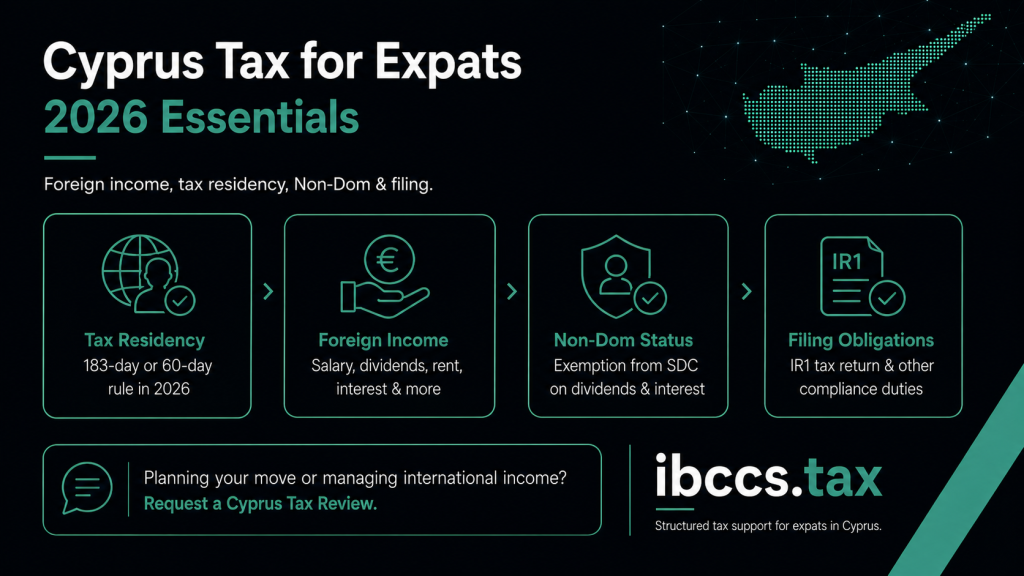
IBCCS TAX supports entrepreneurs, investors, executives, private clients and internationally mobile families with Cyprus and cross-border tax matters. Our services may include:
- Cyprus tax residency eligibility and planning;
- analysis of the 60-day and 183-day rules;
- Non-Dom assessment and implementation;
- foreign income classification;
- personal income tax planning;
- GHS/GESY review;
- double tax treaty analysis;
- foreign tax credit support;
- company tax residency and permanent establishment review;
- international corporate structuring;
- Cyprus company formation;
- personal tax registration and IR1 filing;
- ongoing tax, accounting and compliance support.
Through our offices in Cyprus, Georgia, the UAE and Uzbekistan, together with broader international experience, we can coordinate matters involving more than one jurisdiction. Our objective is to create a position that is compliant, properly documented and practical for the client’s business, investment and personal circumstances.
Plan Your Cyprus Tax Position Before You Move
Cyprus can offer an attractive tax and business environment for internationally mobile individuals. The result, however, depends on how tax residency, Non-Dom status, foreign income, company ownership and reporting obligations work together. A well-planned move should consider both the Cyprus position and the rules of every other relevant country. This is particularly important for entrepreneurs, investors and private clients whose income, companies or assets extend across several jurisdictions.
IBCCS TAX can assess your circumstances, identify the relevant Cyprus and international tax considerations and support the practical implementation of your tax residency, company structure and ongoing compliance. Book a Cross-Border Tax Consultation
Frequently Asked Questions About Cyprus Tax for Expats
1. Does Cyprus tax worldwide income?
Cyprus tax residents are generally subject to Cyprus tax rules on worldwide income. The final treatment depends on the type of income, available exemptions, foreign tax credits and any applicable double tax treaty. Individuals who are not Cyprus tax resident are generally taxed only on relevant Cyprus-source income.
2. Does Cyprus tax foreign dividends?
Foreign dividends received by an individual are generally not subject to Cyprus personal income tax. Special Defence Contribution and GHS/GESY should still be reviewed. Qualifying Cyprus Non-Dom individuals are generally exempt from SDC on dividend income, although GHS/GESY may continue to apply.
3. Does Cyprus tax foreign interest?
The treatment depends on whether the interest is passive or earned as part of an ordinary business activity. Qualifying Non-Dom individuals are generally exempt from SDC on passive interest, but GHS/GESY and foreign withholding tax may still be relevant.
4. Is foreign rental income taxable in Cyprus?
A Cyprus tax resident should generally consider foreign rental income for Cyprus personal income tax and reporting purposes. Permitted deductions, source-country tax, foreign tax credits and GHS/GESY may affect the final outcome. Rental income is no longer subject to SDC under the rules applying from 2026.
5. Do Cyprus Non-Doms pay tax on foreign income?
Non-Dom status does not exempt every form of foreign income. It primarily provides an exemption from SDC on dividend and passive interest income. Salary, business profits, rental income, GHS/GESY and other tax obligations may still apply.
6. Can I keep my foreign company after moving to Cyprus?
It may be possible to retain a foreign company, but the way the company is managed after the move should be reviewed. Managing and directing the company from Cyprus can create corporate tax residency, permanent establishment, payroll or other compliance considerations.
7. Can I be tax resident in Cyprus and another country?
Yes. Two countries can treat the same individual as tax resident under their domestic laws. Where a double tax treaty applies, tie-breaker rules may be used to determine the individual’s treaty residence.
8. Is Cyprus tax residency the same as Cyprus immigration residency?
No. Tax residency and immigration residency are separate legal concepts. A residence permit does not automatically make a person Cyprus tax resident, and Cyprus tax residency does not by itself provide an immigration right to live in Cyprus.
9. Do expats need to submit an IR1 tax return?
The filing position depends on the relevant tax year, income, age and applicable administrative rules. Individuals with foreign income, several income sources, company involvement or foreign tax credits should review the obligation carefully rather than assume that no return is required.
10. When should I obtain Cyprus tax advice?
Advice is particularly important before relocating, receiving a substantial dividend, selling a business or investment, changing a company structure or beginning to manage a foreign company from Cyprus. Early planning allows the personal, corporate and compliance position to be aligned before transactions take place.
Managing a Foreign Company from Cyprus: Tax Residency, Management and Control & Permanent Establishment
Moving to Cyprus does not automatically move a foreign company
Read More
Private Client Accounting in Cyprus: Foreign Income, Investments & Tax Reporting
Private client accounting is not simply a personal tax return
Read More
Moving to Cyprus from Germany: Residency, Tax, Non-Dom & Business Relocation
Cyprus is increasingly considered by German entrepreneurs, company owners, professionals,
Read MoreDisclaimer: This article is for general information only and does not constitute tax, legal or financial advice. Professional advice should be obtained based on your specific circumstances.