

Cyprus remains a popular destination for British entrepreneurs, professionals, retirees, investors and families looking for a European base with a warm climate, an international business environment and a well-established tax and legal framework. Since Brexit, however, moving from the UK to Cyprus requires more planning than simply renting a property and registering locally.
For most new British arrivals, immigration status, the right to work and Cyprus tax residency are three separate questions. A residence permit may allow you to live in Cyprus without giving you the right to work. A work-based permit may depend on the employer and role. Cyprus tax residency, in turn, depends on separate day-count and connection tests rather than the type of residence card you hold.
The most effective relocation plan therefore starts by identifying what you want to do in Cyprus: retire, work remotely, take local employment, move an existing business, establish a Cyprus company, invest for permanent residence or relocate as a family. Once the immigration route is clear, the Cyprus tax position – including the 183-day or 60-day rule and potential Non-Dom status – can be structured around the way you will actually live and work.
IBCCS TAX supports British and other international clients with Cyprus relocation and immigration, tax residency, Non-Dom, company formation, accounting and ongoing compliance. This guide focuses on the Cyprus side of the move and highlights when separate UK advice may still be required.

- New British arrivals are generally treated as third-country nationals for Cyprus immigration purposes unless protected by the Withdrawal Agreement or another specific status.
- A visitor residence permit allows residence but does not permit employment or economic activity in Cyprus.
- The Digital Nomad route can be relevant to qualifying British remote workers serving an employer or clients located abroad.
- Local employment requires an appropriate residence and employment route; owning a Cyprus company does not by itself create a personal right to work.
- Cyprus permanent residency by investment is available to qualifying non-EU investors under the current framework, with a minimum qualifying investment of EUR 300,000, but it is not a general employment permit.
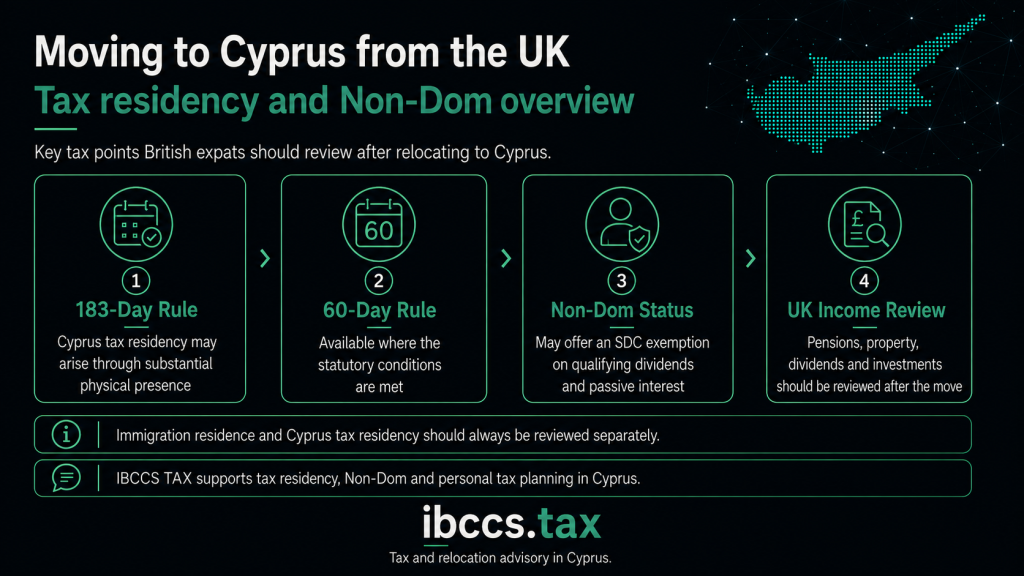
- Cyprus immigration residence and Cyprus tax residence are separate. A person can hold a residence permit without becoming Cyprus tax resident, and tax residency depends on the applicable 183-day or 60-day rules.
- Qualifying Cyprus tax residents who are non-domiciled for SDC purposes may generally benefit from an exemption from SDC on dividends and passive interest.
- UK income does not disappear from the tax analysis after relocation. The Cyprus treatment should be reviewed, while UK-specific residence, filing or source-country questions should be confirmed with a UK adviser where needed.
- Business owners should review both their personal relocation and the tax residence or permanent establishment exposure of any company they continue to manage from Cyprus.
Quick Answer: Can British Citizens Move to Cyprus After Brexit?
Yes. British citizens can move to Cyprus, but new arrivals who are not protected by rights under the UK-EU Withdrawal Agreement are generally treated as third-country nationals for immigration purposes. This means that living in Cyprus beyond a short visit requires an appropriate residence route, and working in Cyprus requires a status that permits the intended employment or economic activity.
The right route depends on the individual. A retiree or financially independent person may consider temporary visitor residence. A professional working remotely for a foreign employer or foreign clients may consider the Digital Nomad route. A person taking local employment needs an appropriate residence and employment permit. Business owners may combine company formation with a work-residence strategy, while qualifying investors may consider permanent residency by investment.
Separately, a British citizen who spends sufficient time in Cyprus and meets the relevant conditions may become Cyprus tax resident under the 183-day or 60-day rule. Qualifying tax residents may also benefit from Cyprus Non-Dom status, particularly where they receive dividends or passive interest. Immigration status and tax status should be planned together, but they should never be treated as the same thing.
Who Is This Guide For?
This guide is intended for British citizens who are considering a move to Cyprus or have recently arrived and want to understand the main decisions before committing to a residence, employment or tax structure. It is deliberately written from the Cyprus perspective rather than as a detailed guide to UK tax law.
It is particularly relevant to professionals working remotely, consultants, founders and company shareholders, retirees with UK pensions, investors and HNWIs, families considering a long-term move, and British residents who want to understand whether Cyprus permanent residency by investment may fit their plans. The appropriate route will depend on whether the priority is lifestyle, employment, business, investment, tax planning or a combination of these objectives.
Moving to Cyprus After Brexit: Start With Your Immigration Status
Before Brexit, a British citizen could rely on EU free-movement rights when relocating to Cyprus. That is no longer the general position for a new arrival. A British passport remains useful for travel, but it does not by itself provide an unlimited right to live or work in Cyprus.
The first question should therefore be practical: what legal basis will allow you and any accompanying family members to reside in Cyprus for the period you intend to stay? Only after that route is identified should the tax and business structure be finalised.
If You Already Lived in Cyprus Before the End of the Brexit Transition Period
British nationals and qualifying family members who established residence in Cyprus under EU free-movement rules before the relevant Brexit transition deadline may have rights under the Withdrawal Agreement and a specific residence-document regime. Their position is different from that of a British citizen moving to Cyprus for the first time today.
If you believe you are protected by the Withdrawal Agreement, the existing status and documents should be reviewed before applying under a new third-country residence category. This article focuses primarily on new British arrivals who need to choose a current Cyprus residence route.
New UK Arrivals Are Generally Third-Country Nationals
For a new British arrival, the Cyprus immigration system should be approached in the same structured way as for other non-EU nationals. Different permits are designed for different purposes. A visitor permit, a remote-work route, a local employment permit and permanent residency by investment do not give the same rights.
This distinction matters because choosing the easiest residence route is not always the right solution. A permit that works for a retiree living on foreign income may be unsuitable for a founder who intends to work daily in a Cyprus business.
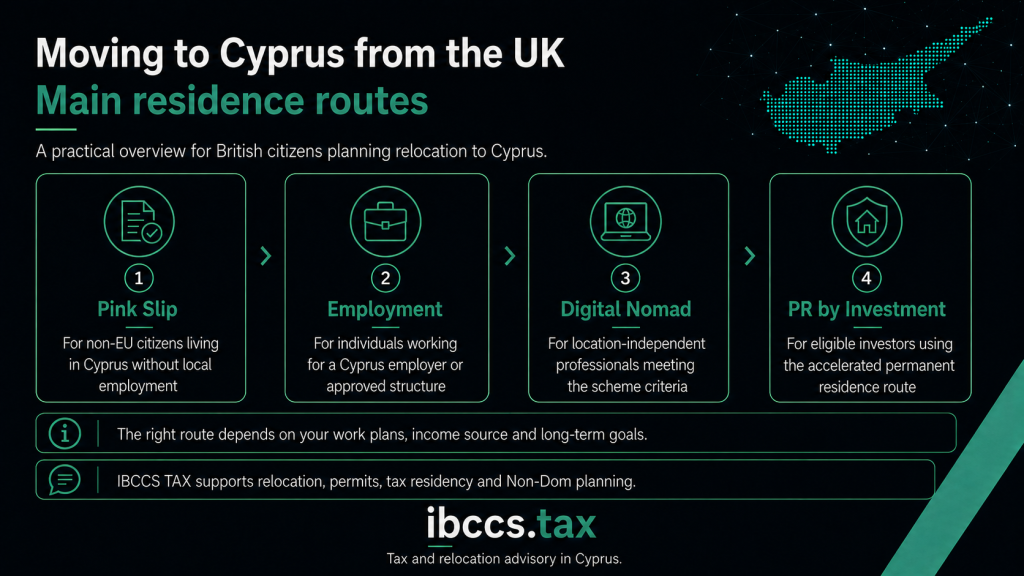
Which Cyprus Residence Route May Fit a British Citizen?
There is no single “British expat permit”. The appropriate route depends on the purpose of residence and whether the applicant will work or carry on economic activity in Cyprus.
| Residence route | Typical use | Work / economic activity |
| Withdrawal Agreement status | Eligible UK nationals and family members with protected pre-Brexit residence rights | Depends on the protected status and applicable rights |
| Temporary visitor residence / Pink Slip | Retirees, financially independent individuals and other third-country nationals residing without local economic activity | No local employment or business activity under the visitor permit |
| Digital Nomad residence | Remote employees or self-employed professionals working for companies or clients abroad | Remote work for foreign employer or foreign clients within the scheme; not a substitute for local employment permission |
| Residence and employment permit | British national employed in Cyprus under an eligible employment category | Yes, subject to the permit and employer / role conditions |
| Permanent residency by investment | Qualifying investors and families seeking long-term Cyprus residence | Not a general employment permit; work rights need separate review |
| Family-based route | Spouses or qualifying family members of Cypriot, EU or other qualifying residents | Depends on the family category and status granted |
Temporary Residence as a Visitor: The Cyprus Pink Slip
A temporary visitor residence permit, commonly referred to as a Pink Slip, can be relevant to British citizens who want to live in Cyprus without taking local employment or carrying on business activity in the Republic. It is often considered by retirees, people living from foreign income or savings, and family members whose circumstances fit the visitor framework.
The key limitation is important: visitor status is not a work permit. A British citizen should not select a visitor permit and then assume they can take a Cyprus job, operate a local business or simply treat the permit as a general entrepreneurial residence route.
IBCCS TAX assists third-country nationals with the Cyprus Temporary Residence Permit / Pink Slip, including document preparation and practical application support.
Cyprus Digital Nomad Visa for British Remote Workers
The Cyprus Digital Nomad scheme is designed for non-EU and non-EEA nationals who can work independently of location using telecommunications technology. It can be relevant to British employees working for an employer established abroad and to self-employed professionals providing remote services to clients located outside Cyprus.
Under the current scheme, the applicant must demonstrate stable and sufficient net monthly income of at least EUR 3,500, with additional requirements where family members are included. The first permit is temporary and the route is intended for remote foreign work rather than ordinary employment with a Cyprus employer.
For a British consultant or technology professional, the Digital Nomad route can solve the immigration question, but it does not answer the tax question. Spending substantial time in Cyprus may create Cyprus tax residency, and a self-employed professional may also need to review Cyprus tax registration, Social Insurance, VAT or business-structure issues depending on the facts.
Local Employment and Companies of Foreign Interests
A British citizen who wants to work for a Cyprus employer needs an immigration status that permits local employment. One relevant framework for international businesses is the regime for eligible Companies of Foreign Interests, under which qualifying companies can employ third-country nationals subject to the applicable employer, employee and permit criteria.
This can be particularly relevant where an international business is relocating activities to Cyprus and the British founder, executive or specialist will be employed by the Cyprus entity. The company itself must satisfy the relevant registration and eligibility requirements, and the individual requires the appropriate residence and employment permit.
Where a new Cyprus company is part of the plan, IBCCS TAX provides end-to-end support for company registration in Cyprus, tax structuring, accounting and corporate compliance. Immigration planning should be coordinated with the incorporation rather than addressed after the company has already started operating.
Cyprus Permanent Residency by Investment
For British investors and families seeking a more permanent residence solution, Cyprus offers an investment-based permanent residence route under the current Regulation 6(2) framework. The minimum qualifying investment is EUR 300,000, excluding VAT where applicable, and the programme also includes financial, source-of-funds, due diligence and family eligibility requirements.
Qualifying investments can currently include certain new residential property, commercial real estate, share capital in an eligible Cyprus company and units in qualifying Cyprus investment funds. The correct investment route should be reviewed before funds are committed, particularly where property, a business investment or long-term family residence is involved.
Permanent residency by investment should not be confused with tax residency or a general work permit. An investor can hold Cyprus permanent residence without becoming Cyprus tax resident if the tax-residence conditions are not met. Similarly, the permit does not generally provide unrestricted local employment rights, so any plan to work or operate a business personally should be reviewed separately.
Our detailed guide explains the current Cyprus Permanent Residency by Investment framework, investment categories and ongoing considerations.
Family and Other Residence Routes
Family circumstances can create separate residence options. A British citizen who is married to a Cypriot or EU national, or who is joining a family member with another qualifying status, may need to use a family-based route rather than a visitor or investment permit.
Because the immigration status of spouses and children can affect work rights, schooling, healthcare and long-term residence planning, family applications should be considered as one relocation project rather than as separate forms submitted after the main applicant has moved.
Planning a Move From the UK to Cyprus?
The most useful first step is to identify the correct immigration route, expected work or business activity and intended Cyprus tax position before committing to a structure. IBCCS TAX can coordinate the Cyprus-side relocation, tax and compliance review. Request a Cyprus Relocation & Tax Review.

Can a British Citizen Work in Cyprus?
Yes, but the right to work depends on the residence and employment category. A British citizen should not assume that the right to live in Cyprus automatically includes a right to take local employment or operate a business.
A visitor residence permit does not allow employment. The Digital Nomad route is designed for remote work for an employer or clients located abroad. Local employment requires the appropriate employment-residence framework. A founder who owns shares in a Cyprus company must still ensure that their personal immigration status permits the role they actually perform in Cyprus.
This distinction is especially important for entrepreneurs. Incorporating a Cyprus company can be commercially useful, but company ownership and personal work permission are separate legal questions. The immigration plan should therefore be aligned with the company structure, salary, directorship and day-to-day responsibilities.
Working Remotely for a UK or Foreign Employer From Cyprus
Remote work can appear simple because the employer remains abroad and salary continues to be paid into the same bank account. In practice, the employee should consider where the duties are physically performed, whether Cyprus payroll or Social Insurance obligations arise, and whether the employer creates a taxable or employment presence in Cyprus.
For the employer, the risk depends on the role performed in Cyprus. A senior employee who negotiates or concludes contracts, manages a business line or effectively runs the company from Cyprus can create different considerations from an employee working remotely in a limited support role.
The immigration and employment framework should therefore be agreed with the employer before the move. A residence permit should not be selected on the assumption that the employer relationship can simply continue unchanged.
Starting or Moving a Business to Cyprus
British entrepreneurs may decide to establish a Cyprus company, continue operating an existing UK or international company, or use a combination of entities. The correct option depends on customers, employees, management, IP, banking, investment plans and the location from which the business will actually be run.
A Cyprus company can provide a clear local operating platform where the founder genuinely relocates management and activity to Cyprus. It can also support local payroll, office arrangements, contracting and ongoing accounting. The standard Cyprus corporate income tax rate is 15% under the current framework, but the headline rate should not be the only reason for choosing the structure.
Continuing to use a foreign company after the founder moves can also be possible, but management and control, permanent establishment and payroll exposure should be reviewed. A company incorporated in the UK does not necessarily remain a purely UK tax matter if its strategic management and operational activity are transferred to Cyprus.
For founders and shareholders, our guide to moving to Cyprus as a business owner explains the interaction between personal relocation, tax residency, Non-Dom and company structure in more detail.
Immigration Residence and Cyprus Tax Residence Are Different
One of the most common relocation mistakes is assuming that a residence permit determines tax residency. It does not. Immigration law answers whether a person is legally entitled to live and, where applicable, work in Cyprus. Tax law answers where the individual is treated as tax resident and how income is taxed and reported.
A British investor may hold permanent residence but spend relatively little time in Cyprus and remain non-resident for Cyprus tax purposes. Another British citizen may hold a temporary permit and spend enough time in Cyprus to become tax resident. The two analyses should be coordinated but completed separately.
This distinction is particularly important for permanent residency by investment. The residence permit can provide a long-term immigration base, but Cyprus tax benefits such as Non-Dom status require a separate tax-residency analysis.
Cyprus Tax Residency for British Citizens: 183-Day and 60-Day Rules
Cyprus generally provides two main routes to individual tax residency. The correct route depends on how much time the person spends in Cyprus and the nature of their personal or economic connections with the country.
The 183-Day Rule
An individual who spends more than 183 days in Cyprus during a calendar year is generally considered Cyprus tax resident for that year. This is often the most straightforward route for British families or retirees who relocate fully and make Cyprus their main home.
Accurate travel records should still be maintained, especially where the person frequently returns to the UK, travels for business or maintains homes in more than one country.
The 60-Day Rule
The 60-day rule can be relevant to internationally mobile entrepreneurs, directors and professionals who maintain a genuine connection with Cyprus without spending more than 183 days on the island. The conditions include at least 60 days of presence in Cyprus, not spending more than 183 days in any other single country, maintaining a permanent home in Cyprus and having the required business, employment or office connection in Cyprus.
From 2026, Cyprus removed the former condition that an individual using the 60-day rule must not be tax resident in any other country. This makes Cyprus domestic qualification more flexible, but it also makes it even more important to identify whether another country – including the UK – still regards the person as tax resident under its own rules.
IBCCS TAX assists clients with changing tax residency to Cyprus, including eligibility under the 183-day or 60-day route, documentation and practical implementation.
What About UK Tax Residence?
Moving to Cyprus does not by itself determine when UK tax residence ends. A British citizen with material UK connections, a UK home, continuing workdays, property, a company or significant transactions should confirm the UK position separately where it is relevant.
IBCCS TAX focuses on the Cyprus tax and relocation position. Where a matter turns on the UK Statutory Residence Test, a formal HMRC position or another UK-specific rule, we recommend confirming the UK side with an appropriately qualified UK adviser and coordinating the outcome with the Cyprus plan.
Cyprus Non-Dom Status for British Expats
For many British entrepreneurs, shareholders and investors, Non-Dom status is one of the most important Cyprus tax considerations after tax residency has been established. It is a Cyprus tax classification for Special Defence Contribution purposes, not an immigration status.
A qualifying Cyprus tax resident who is non-domiciled for SDC purposes may generally be exempt from SDC on dividend income and passive interest. This can be particularly relevant to a British shareholder receiving dividends from an international company or an investor holding cash and investment portfolios outside Cyprus.
The exemption does not mean that all income becomes tax-free. Salary, self-employment income, business profits, rental income, GHS contributions and other tax or reporting obligations need to be reviewed separately. The source country may also retain taxing rights over specific income.
IBCCS TAX provides Cyprus Non-Dom eligibility and implementation support for internationally mobile individuals, including coordination with tax residency and annual compliance.
What Non-Dom Does Not Do
Non-Dom should be treated as one part of a wider Cyprus tax position rather than as a blanket exemption. A British client should still understand how their salary, pension, rent, business income and investments are classified and whether Cyprus or another country has taxing rights.
- It does not create Cyprus tax residency by itself.
- It does not provide an immigration or work permit.
- It does not exempt employment or self-employment income from ordinary Cyprus tax rules.
- It does not remove GHS obligations where they apply.
- It does not eliminate tax or reporting obligations in the UK or another source country.
Cyprus Tax for UK Expats: What Happens to Common UK Income?
Once a British citizen becomes Cyprus tax resident, UK-linked income should be reviewed by category. The aim is not to provide a detailed UK tax manual, but to understand how the income fits into the Cyprus return, whether a Cyprus exemption or special treatment may apply, and whether foreign tax credits or treaty coordination are required.
The table below summarises the main Cyprus-side questions. UK-specific filing, residence and source-country obligations should be confirmed separately where material.
| Income / asset | Main Cyprus-side considerations | UK-side point to confirm where relevant |
| Salary or employment income | Cyprus personal income tax, where duties are performed, payroll, Social Insurance and available exemptions | UK residence, UK workdays and any continuing PAYE obligations |
| UK company dividends | Generally exempt from Cyprus personal income tax; Non-Dom / SDC and GHS should be reviewed | Any UK-specific shareholder or departure-year issues |
| Bank interest | Non-Dom / SDC and GHS considerations; include relevant records in Cyprus reporting | Any withholding or UK reporting issue |
| UK rental property | Cyprus reporting, allowable treatment, GHS and potential foreign tax credit | UK property tax and landlord filing requirements |
| UK pension | Cyprus pension treatment and any available special option; treaty coordination | Pension type and UK treatment, especially government-service pensions |
| Shares, funds and ISA investments | Underlying income and asset classification under Cyprus rules; investment gains require asset-specific analysis | UK wrapper or return-to-UK consequences where relevant |
| Business or consulting income | Cyprus personal or company tax, VAT, Social Insurance and business structure | Whether the UK business or company remains taxable or resident in the UK |
UK Company Dividends
Dividends received by an individual Cyprus tax resident are generally exempt from Cyprus personal income tax. For a qualifying Cyprus Non-Dom, SDC on dividends is generally not payable, although GHS can remain relevant within the applicable contribution framework.
The Cyprus result should be reviewed alongside the company structure and the individual’s wider position. Where the person is also the main director or decision-maker of the UK company, the move can affect the company itself, not only the treatment of the dividend.
UK Rental Property
Many British residents keep a UK home or investment property after moving to Cyprus. Rental income should be included in the Cyprus analysis once the owner becomes Cyprus tax resident, while tax paid in the UK may potentially be relevant to foreign tax credit relief, subject to the applicable conditions.
A practical annual file should retain rental statements, ownership information, foreign tax documents and evidence of tax paid. The UK property remains connected with the UK, so the UK filing and property-tax position should be handled or confirmed separately.
UK Pensions
Pension income can be an important part of the relocation decision for British retirees. Cyprus provides a specific tax framework for qualifying foreign pension income, including an optional special method that may be attractive in some circumstances, but the correct treatment depends on the pension type and the individual’s overall income profile.
Private pensions and government-service pensions should not be assumed to follow the same cross-border treatment. Before changing withholding instructions or relying on treaty relief, the pension should be identified correctly and the UK side confirmed where necessary.
UK Investments and ISAs
A UK ISA can remain a useful UK tax wrapper, but moving to Cyprus means the Cyprus treatment of the underlying income and assets should be considered independently. An account label does not automatically determine the Cyprus tax treatment.
For example, dividends, passive interest and investment disposals can each follow different Cyprus rules. Investors with material portfolios should keep broker statements showing income, realised transactions, withholding tax and account ownership rather than relying only on a year-end portfolio value.
For larger or more complex portfolios, our guide to Cyprus tax planning for HNWIs explains the interaction between foreign income, investments, companies and private-client structures.
Coordinate Immigration and Tax Before the Move
A residence permit, work structure and tax plan should support the same real-life arrangement. If you intend to work, run a company, receive dividends or invest for permanent residence, the most efficient time to review the position is before the move is implemented. Discuss Your Cyprus Relocation Plan
British Business Owners and Company Directors Moving to Cyprus
For a British founder or company owner, personal relocation and business relocation should be considered together. A person may become Cyprus tax resident and Non-Dom while retaining shares in a UK or international company, but the company has its own tax residence, management and compliance questions.
If the founder continues making strategic decisions, negotiating important contracts, directing employees and controlling banking from Cyprus, the company may create Cyprus management-and-control or permanent establishment exposure. Board paperwork in the UK will not necessarily resolve a position that does not match how the company is actually run.
In some cases, continuing with the foreign company remains appropriate. In others, establishing a Cyprus operating company, subsidiary or group structure may better reflect the new reality. The decision should be driven by the business model, people, customers, IP and management rather than by a single tax rate.
IBCCS TAX can coordinate Cyprus company formation, tax planning, governance, payroll and accounting for entrepreneurs who are moving both their personal and business base to Cyprus.
A Practical UK-to-Cyprus Relocation Roadmap
A well-planned move is easier when the main decisions are taken in the right order. The following sequence is a practical framework rather than a substitute for individual advice.
- Define the purpose of the move. Decide whether Cyprus will be a retirement base, remote-work location, employment destination, business headquarters, investment residence or permanent family home.
- Select the correct immigration route. Confirm whether the applicant will rely on Withdrawal Agreement rights, visitor residence, Digital Nomad status, a work-residence permit, permanent residency by investment or a family route.
- Confirm the right to work. If you will work from Cyprus, identify whether the permit covers local employment, remote foreign work or the role you intend to perform in your own company.
- Plan the business structure. Decide whether to retain a foreign company, establish a Cyprus company, employ staff locally or reorganise management before the relocation takes effect.
- Model Cyprus tax residency. Estimate Cyprus days and determine whether the 183-day or 60-day route is realistic and supportable.
- Review Non-Dom eligibility and expected income. Identify salary, dividends, interest, pension, rent, business income and investments rather than treating everything as one category of foreign income.
- Put registrations and records in place. Depending on the circumstances, this can include Cyprus tax registration, payroll or Social Insurance, company accounting, residence documentation, banking updates and an annual travel record.
- Maintain annual compliance. A good relocation structure should remain easy to evidence through tax returns, company records, residence renewals, bank documentation and source-of-funds information.
Practical Relocation Scenarios
Scenario 1 – British Retiree With a UK Pension and Property
A retired couple wants to live in Cyprus for most of the year, receive UK pension income and keep their former UK home as a rental property. The main Cyprus review should start with the appropriate residence permit, the 183-day tax-residence position, pension treatment, rental-income reporting and whether Non-Dom status is relevant to any investment income. UK property and pension-specific obligations should be confirmed separately where required.
Scenario 2 – Remote Consultant Working for International Clients
A British consultant works online for clients in the UK, EU and United States and wants to base themselves in Limassol. The first question is whether the Digital Nomad route or another residence status fits the planned activity. The tax review should then consider the 60-day or 183-day rule, whether the person operates as self-employed or through a company, VAT, Social Insurance and the treatment of business expenses.
Scenario 3 – Founder With a UK Company
A founder moves to Cyprus with their family but continues to own and manage a UK trading company. The personal position may involve Cyprus tax residency and Non-Dom, while the business review should consider where management and control is now exercised, whether a Cyprus company or subsidiary would better reflect the operations and how salary and dividends should be documented.
Scenario 4 – Investor Seeking Permanent Residence
A British investor wants a long-term Cyprus residence base for the family but does not intend to work locally. Permanent residency by investment may be relevant if the current investment, income and due-diligence criteria are satisfied. The investor should separately decide whether they intend to become Cyprus tax resident; holding the permit alone does not create tax residency or Non-Dom status.
Common Mistakes When Moving From the UK to Cyprus
Choosing a Visitor Permit and Then Working in Cyprus
Visitor residence is designed for residence without local economic activity. The work plan should be confirmed before the permit is selected.
Assuming a Cyprus Company Gives the Owner a Work Permit
Company ownership and immigration permission are separate. The founder should ensure the residence and work route permits the role they actually perform.
Treating Permanent Residence as Tax Residence
Cyprus permanent residency by investment is an immigration status. Cyprus tax residency depends on separate statutory rules and day counts.
Applying for Non-Dom Before Understanding Tax Residency
Non-Dom is relevant to Cyprus tax residents. The tax-residence route and expected income should be mapped first.
Focusing Only on the Cyprus Headline Tax Rate
A British founder or investor can have continuing UK income, property, companies and reporting obligations. A move should be assessed as a cross-border transition even where the advisory work is led from Cyprus.
Leaving Accounting Until the First Tax Return
Foreign income, investment statements, tax paid abroad and company transactions are easier to report when the supporting records are collected during the year. Waiting until the filing deadline increases the risk of missing or inconsistent information.
Cyprus Relocation Checklist for British Citizens
- Confirm whether any Withdrawal Agreement rights apply to you or your family.
- Choose the Cyprus residence route that matches your real purpose: visitor, remote work, employment, investment or family residence.
- Confirm whether the permit allows the work or business activity you intend to perform.
- Review accommodation and property requirements for the chosen permit.
- If considering permanent residency by investment, review the investment category, source of funds and financial criteria before committing.
- Estimate your Cyprus days and whether the 183-day or 60-day tax-residency route fits your plans.
- Review Cyprus Non-Dom eligibility if you expect dividend or passive interest income.
- Map UK and international income by category: salary, dividends, rent, pension, interest, investments and business income.
- If you own a foreign company, review where it will be managed after the move.
- Arrange Cyprus tax registration, payroll, Social Insurance, company accounting and personal filing support as required.
- Keep travel records, residence documents, bank statements and evidence of foreign taxes paid.
- Obtain UK-specific tax advice where the move involves material UK residence, property, pension, company, trust or transaction issues.
How IBCCS TAX Supports British Clients Moving to Cyprus
IBCCS TAX supports international individuals and families who want Cyprus to function as a genuine residence, business or investment base. Our role is to coordinate the Cyprus-side legal, tax and practical implementation so that immigration status, tax residency and business arrangements are consistent with the client’s real circumstances.
Depending on the profile, support may include residence-permit applications, permanent residency by investment, tax residency planning, Non-Dom assessment, company formation, payroll, accounting, personal tax registration and ongoing compliance. Where a question requires formal UK-specific advice, we can coordinate the Cyprus position with information or advice provided by the client’s UK adviser rather than presenting Cyprus advice as a substitute for UK expertise.
- Cyprus relocation and residence-permit support
- Temporary residence / Pink Slip applications
- Cyprus permanent residency by investment planning
- Cyprus tax residency under the 183-day or 60-day rule
- Cyprus Non-Dom eligibility and implementation
- Cyprus company formation and business structuring
- Accounting and ongoing Cyprus compliance
- Personal IR1 tax return preparation
Plan Your Move to Cyprus Around the Life You Intend to Live
For a British citizen, a successful move to Cyprus is not simply a tax decision and it is not simply an immigration application. The residence permit, work rights, home, business structure, tax residency and long-term family plans should support the same real-life arrangement.
A retiree living from pensions and investments may require a very different structure from a remote consultant, a founder moving a company or an investor seeking permanent residence. The objective is not to use the most complicated route, but to choose a compliant structure that remains practical after the move has been completed.
IBCCS TAX can assess your proposed Cyprus residence route, tax residency and Non-Dom position and coordinate the practical implementation through our Cyprus team. For business owners and investors, we can also integrate company formation, accounting and ongoing compliance into the relocation plan. Request a Cyprus Relocation & Tax Review.
Frequently Asked Questions About Moving to Cyprus From the UK
1. Can British citizens move to Cyprus after Brexit?
Yes. British citizens can relocate to Cyprus, but new arrivals who are not protected by Withdrawal Agreement rights generally need an appropriate third-country residence route for long-term residence. The correct route depends on whether the person will visit, retire, work remotely, take local employment, invest or join family.
2. Do British citizens need a Yellow Slip in Cyprus?
The Yellow Slip is the familiar registration route for EU/EEA citizens. New British arrivals after Brexit do not generally use the ordinary EU free-movement registration route. UK nationals protected by the Withdrawal Agreement have a separate status and residence-document framework.
3. Can a British citizen get a Cyprus Pink Slip?
Potentially, yes. A temporary visitor residence permit can be relevant to qualifying third-country nationals who want to reside in Cyprus without local employment or business activity. The applicant must meet the applicable immigration and documentation requirements.
4. Can a UK citizen work in Cyprus?
Yes, where the individual holds a residence and employment status that permits the intended work. A visitor permit does not allow employment. Remote workers may consider the Digital Nomad route where eligible, while local employment requires the appropriate work-residence framework.
5. Can I work remotely from Cyprus for a UK company?
Potentially. Immigration, tax, payroll and employer-presence issues should be reviewed together. The Digital Nomad route may be relevant to qualifying remote workers serving an employer abroad, but the employee and employer should still assess Cyprus tax, Social Insurance and permanent establishment considerations.
6. Can I open a Cyprus company and move to Cyprus?
A British citizen can establish a Cyprus company, but incorporation does not automatically provide personal residence or work rights. The company structure and the founder’s immigration route should be planned together.
7. Can British citizens get Cyprus permanent residency by investment?
Potentially, yes. Under the current Regulation 6(2) framework, qualifying non-EU nationals can apply through an eligible investment of at least EUR 300,000, subject to financial, due-diligence and other programme requirements.
8. Does Cyprus permanent residency make me Cyprus tax resident?
No. Permanent residence is an immigration status. Cyprus tax residency is determined separately, generally under the 183-day or 60-day rules.
9. Can a British citizen qualify for Cyprus Non-Dom status?
Potentially, yes. The individual must first be Cyprus tax resident and then satisfy the Cyprus domicile conditions for SDC purposes. Non-Dom can be particularly relevant to qualifying dividend and passive interest income.
10. What happens to my UK pension after moving to Cyprus?
The Cyprus treatment depends on the pension type and the individual’s wider income position. Cyprus has a specific framework for foreign pension income, while UK-side treatment and treaty application may need separate confirmation, particularly for government-service pensions.
11. What happens if I keep a UK property?
A Cyprus tax resident should include the UK property income in the Cyprus analysis, while UK property income can remain subject to UK rules. Evidence of foreign tax paid may be relevant to Cyprus foreign tax credit relief.
12. Can I keep my UK company after moving to Cyprus?
Potentially, but the company should be reviewed separately from the shareholder. If the business is effectively managed from Cyprus, corporate tax residence, permanent establishment, payroll or restructuring issues may arise.
13. Do I need a UK tax adviser as well as a Cyprus adviser?
Not in every case. For a straightforward move, the Cyprus side may be the main focus. UK advice becomes more important where residence status is uncertain or the person retains material UK property, pensions, companies, trusts or plans a significant transaction. IBCCS TAX can coordinate the Cyprus position with the client’s UK adviser where required.
14. Can IBCCS TAX handle both relocation and tax in Cyprus?
Yes. IBCCS TAX supports clients with Cyprus relocation and immigration, tax residency, Non-Dom, company formation, accounting and ongoing tax compliance. This integrated approach can reduce gaps between the residence permit, work structure and tax position.

IBCCS TAX to Attend Plan ₿ Forum 2026 in Lugano, Switzerland
IBCCS TAX will be attending Plan ₿ Forum 2026 in
Read More
Cyprus Non-Dom Status: Tax Benefits, Eligibility, Rules and How It Works
Cyprus Non-Dom status is one of the most important elements
Read More
Cyprus Tax Calendar 2027: Key Tax Deadlines for Individuals and Companies
Cyprus tax compliance does not revolve around one annual deadline.
Read MoreDisclaimer: This article is for general information only and does not constitute tax, legal, immigration or financial advice. Immigration and tax rules can change, and professional advice should be obtained based on your specific circumstances. Where a matter depends on UK-specific law or HMRC treatment, separate UK advice may be required.