


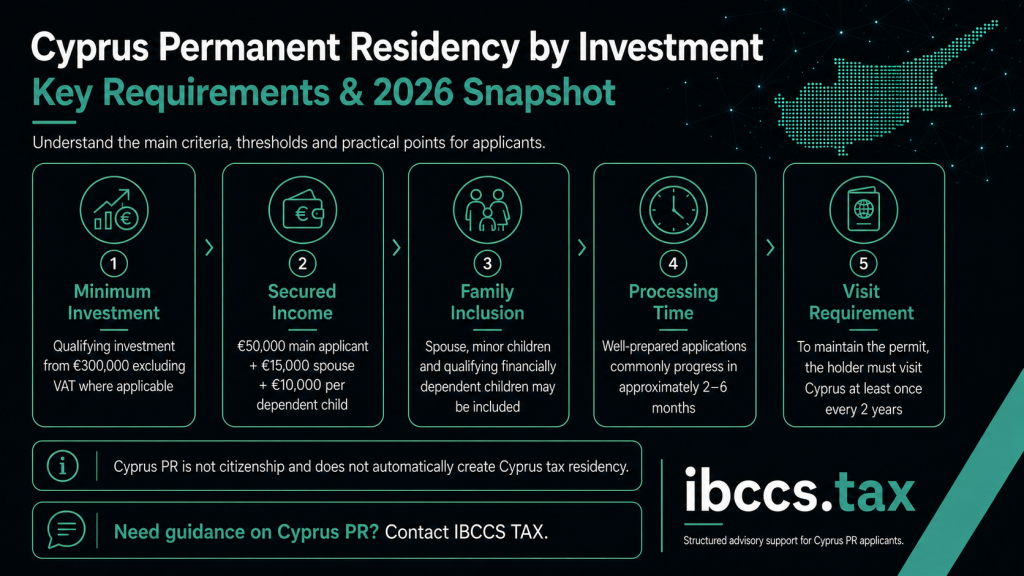
- Minimum Investment: Applicants must make a qualifying investment of at least €300,000, excluding VAT where applicable.
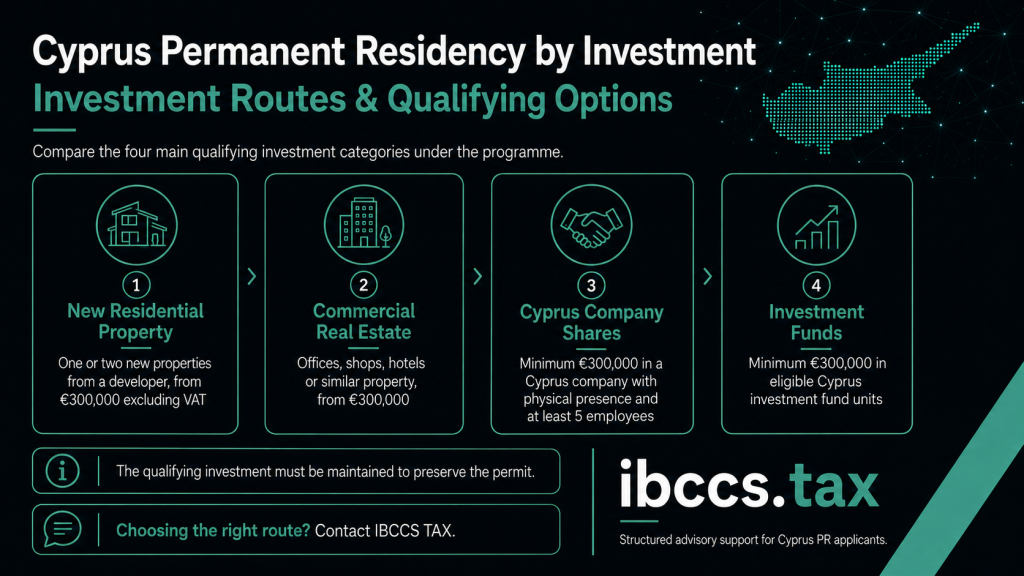
- Four Investment Routes: Eligible options include new residential property, commercial real estate, shares in a Cyprus company, or units in eligible Cyprus investment funds.
- Income Requirement: The main applicant must prove secured annual income of at least €50,000, increased by €15,000 for a spouse and €10,000 for each dependent child.
- Family Inclusion: The permit may cover the main applicant, spouse, minor children and qualifying financially dependent children up to the age of 25.
- Processing Time: Applications are commonly examined within approximately 2–6 months, depending on file completeness, authority review and supporting documentation.
- Permanent Residence: The permit grants long-term residence rights in Cyprus and does not require full-time relocation.
- Minimum Visit Requirement: To maintain the permit, the holder must visit Cyprus at least once every two years.
- No General Employment Rights: Holders cannot take up ordinary employment in Cyprus, but certain shareholder or director arrangements may be possible depending on the investment structure.
- Tax Planning Is Separate: Cyprus permanent residency does not automatically create Cyprus tax residency. Tax residency, Non-Dom status and corporate structuring should be assessed separately.
- Not Citizenship by Investment: Cyprus PR by investment is a residency route, not a passport programme. Citizenship may only be considered through separate naturalisation rules, subject to residence and other legal conditions.
Cyprus continues to stand out as one of the most attractive European destinations for non-EU investors, families, entrepreneurs and internationally mobile individuals seeking long-term residence, stability and a strong base within the European Union.
In 2026, the Cyprus Permanent Residency by Investment Programme, commonly referred to as the Cyprus Golden Visa or the Regulation 6(2) Immigration Permit, remains a structured route for eligible non-EU nationals to obtain permanent residence through a qualifying investment in Cyprus.
The programme is particularly relevant for investors who want a secure EU residence base without an obligation to relocate full-time. It can also form part of a wider international tax, relocation, asset protection or family mobility strategy, provided the immigration, tax and compliance aspects are properly aligned.
At IBCCS TAX, we assist clients not only with the residency application itself, but also with the wider considerations that often matter most: investment structuring, Cyprus tax residency, Non-Dom planning, company formation, banking, relocation and long-term compliance.
Cyprus Permanent Residency by Investment in 2026: Quick Answer
Cyprus permanent residency by investment allows eligible non-EU nationals to obtain long-term residence in Cyprus by making a qualifying investment of at least €300,000. The route is commonly called the Cyprus Golden Visa, although technically it is a permanent residence permit under Regulation 6(2), not a citizenship by investment programme.
Applicants must satisfy both investment and financial criteria. In 2026, this includes secured annual income of at least €50,000 for the main applicant, increased by €15,000 for a spouse and €10,000 for each dependent child. The permit may include qualifying family members and does not require the applicant to live in Cyprus full-time, provided the investment and compliance requirements continue to be met.
Cyprus PR by Investment 2026 Programme Snapshot
| Requirement | 2026 Position |
| Programme type | Permanent residency by investment |
| Common name | Cyprus Golden Visa |
| Legal basis | Regulation 6(2) of the Aliens and Immigration Regulations |
| Eligible applicants | Non-EU nationals who meet the investment, income and due diligence criteria |
| Minimum investment | €300,000, excluding VAT where applicable |
| Main investment options | New residential property, commercial real estate, Cyprus company shares, Cyprus investment fund units |
| Main applicant income | Minimum secured annual income of €50,000 |
| Additional income | €15,000 for spouse and €10,000 for each dependent child |
| Family inclusion | Spouse, minor children and qualifying financially dependent children |
| Processing time | Commonly around 2–6 months, depending on the file and authority review |
| Minimum stay | No full-time stay requirement |
| Visit requirement | At least once every two years |
| Employment rights | No general employment in Cyprus under this permit |
| Tax residency | Not automatic; assessed separately |
| Schengen access | Cyprus is an EU Member State but not yet a full Schengen Area member |
| Citizenship | Not automatic; possible only through separate naturalisation rules if conditions are met |
Why Choose the Cyprus Golden Visa (Residency by Investment)?
Cyprus offers a combination of EU membership, Mediterranean lifestyle, legal certainty, business infrastructure and favourable conditions for internationally mobile families. For investors seeking more than a simple property purchase, Cyprus can provide a long-term base for residence, business planning, education, wealth structuring and relocation.
The Cyprus Permanent Residency by Investment Programme stands out because it combines flexibility with a clear investment threshold. Unlike some residence routes that require substantial physical presence, Cyprus PR by investment allows successful applicants to maintain their permit with only limited visits to Cyprus, while preserving the option to relocate later if personal, family or business circumstances change.
Key advantages include:
- EU Location: Cyprus is a full Member State of the European Union, providing a stable legal and regulatory environment.
- Permanent Residence Status: The permit gives the right to reside in Cyprus on a long-term basis.
- No Full-Time Relocation Requirement: Applicants do not need to move to Cyprus permanently to maintain the permit.
- Family-Oriented Structure: The programme may include the spouse and eligible dependent children.
- Lifestyle and Education: Cyprus offers international schools, private healthcare, strong connectivity and a high quality of life.
- Strategic Business Base: Cyprus remains a recognised jurisdiction for international business, holding structures, IP planning and regional operations.
- Tax Planning Potential: For those who relocate properly, Cyprus tax residency and Non-Dom status in Cyprus may provide significant planning opportunities.
Cyprus, the EU and Schengen: What Investors Should Understand
Cyprus is a full Member State of the European Union, which is one of the reasons its permanent residency framework is attractive to international investors. However, Cyprus permanent residency should not be confused with Schengen residence rights or EU citizenship. As of 2026, Cyprus is not yet a full member of the Schengen Area. This means that a Cyprus permanent residence permit does not automatically provide visa-free access to Schengen countries for nationals who would otherwise require a Schengen visa.
Cyprus continues to progress through the Schengen integration process, but investors should avoid making decisions based on future assumptions until formal accession is completed and border controls are officially removed. For this reason, the Cyprus Permanent Residency by Investment Programme should be assessed primarily as a secure Cyprus residence solution with potential long-term European advantages, rather than as an immediate Schengen mobility product.
Cyprus Residency by Investment Pathways: The €300,000 Requirement
To qualify for Cyprus permanent residency by investment, the applicant must make a qualifying investment of at least €300,000. The investment must fall within one of the eligible categories and the source and transfer of funds must be properly documented.
As an advisory firm, IBCCS TAX does not act as a real estate agent. Instead, we collaborate closely with a network of trusted and reputable developers across Cyprus, providing you with impartial guidance to find the investment that best suits your goals. Our long-standing experience on the island ensures you have access to the best projects.
1. New Residential Property:
The applicant may purchase one or two new residential properties, such as houses or apartments, directly from a land development company. The total purchase value must be at least €300,000, excluding VAT where applicable.
This is the most common route for families and private investors who want a residential base in Cyprus. A reduced VAT rate may be available for qualifying primary residences, but this must be reviewed carefully before signing the purchase agreement.
Key condition: For the residential property route, the applicant’s secured annual income should generally derive from sources outside Cyprus.
2. Commercial Real Estate:
The applicant may invest in other types of immovable property, such as offices, shops, hotels or similar developments. Unlike the residential property route, resale properties may be accepted in this category.
This option may be relevant for investors who prefer a commercial asset, business premises or income-generating property rather than a residential unit.
Key condition: The income criteria and source of funds must still be properly documented, and the applicant must also provide proof of accommodation in Cyprus if the investment is not a residence.
3. Shares in a Cyprus Company:
The applicant may invest at least €300,000 in the share capital of a company registered and operating in Cyprus. The company must have a physical presence in Cyprus and employ at least five people.
This route may be relevant for entrepreneurs or investors who want to connect their residency planning with a genuine business presence in Cyprus.
Key condition: The company structure, business substance, employment requirements and tax position should be reviewed carefully before proceeding.
4. Units in Cyprus Investment Funds:
The applicant may invest at least €300,000 in units of eligible Cyprus investment funds, such as Alternative Investment Funds or other qualifying collective investment structures.
This option may be suitable for investors who prefer a regulated investment product rather than direct property ownership.
Key condition: The fund must meet the applicable eligibility criteria and the investment must be properly documented.
Important Note on Selling or Replacing the Investment
The qualifying investment must be maintained in order to preserve the residency permit. If the applicant sells the investment without immediately replacing it with another qualifying investment of equal or greater value, the permanent residency permit may be cancelled.
Cyprus PR Investment Options Compared
| Investment Option | Suitable For | Key Notes |
| New residential property | Families, lifestyle investors, future relocation planning | Must be new property purchased from a developer; VAT treatment should be reviewed |
| Commercial real estate | Investors seeking offices, shops, hotels or similar assets | Resale property may be accepted in this category |
| Cyprus company shares | Entrepreneurs and investors with business substance in Cyprus | Company must operate in Cyprus, have physical presence and employ at least five people |
| Cyprus investment funds | Investors seeking a financial investment route | Fund eligibility and Cyprus investment exposure must be reviewed carefully |
Cyprus Permanent Residency by Investment Eligibility: Financial and Personal Requirements
Beyond the qualifying investment, applicants must meet financial, personal and due diligence requirements. These criteria are essential. A strong application is not based only on the purchase of an eligible asset, but also on the quality and completeness of the supporting documentation.
Secure Annual Income
The main applicant must demonstrate secured annual income of at least €50,000. This amount increases by €15,000 for a spouse and €10,000 for each dependent child included in the application.
The spouse’s income may also be taken into account when calculating the total income requirement, provided it is properly documented.
Acceptable income may include, depending on the applicant’s circumstances:
- salary income;
- dividends;
- pensions;
- rental income;
- interest income;
- business income;
- other stable and lawful income sources.
For the new residential property route, the income should generally come from sources outside Cyprus. For other qualifying investment categories, the position should be reviewed based on the structure and facts of the case.
Clean Criminal Record
The main applicant and adult family members must provide clean criminal record certificates. These are usually required from the country of origin and the country of residence, where different.
Health Insurance
The applicant and family members must have valid health insurance covering medical care in Cyprus, unless they are beneficiaries of the Cyprus General Healthcare System.
Non-Employment Declaration
The applicant and spouse must confirm that they do not intend to take up ordinary employment in Cyprus. However, the permit may allow certain income in connection with the qualifying investment, such as dividend income or remuneration as a director in the company in which the applicant has invested, subject to proper review.
Proof of Accommodation
If the qualifying investment is not residential property, the applicant must provide proof of accommodation in Cyprus. This may include a rental agreement or other appropriate evidence.
Income, Source of Funds and Due Diligence Requirements
Income and source-of-funds documentation are central to the Cyprus PR by investment application. In practice, incomplete financial evidence is one of the most common reasons for delays, additional questions or complications.
Applicants should be ready to demonstrate:
- how the qualifying investment funds were generated;
- that the funds came from lawful sources;
- how the funds were transferred to Cyprus;
- that the payment was made in accordance with the programme criteria;
- that the applicant has sufficient annual income to support the family members included in the application.
Depending on the case, supporting documentation may include tax returns, accountant certificates, bank statements, salary confirmations, dividend declarations, rental agreements, company documents, sale agreements, investment portfolio statements or pension confirmations.
At IBCCS TAX, we recommend reviewing the source-of-funds and income position before committing to a specific investment. This helps identify documentation gaps early and reduces the risk of issues during the application review.
Documents Required for Cyprus Permanent Residency by Investment
The exact document list depends on the applicant’s profile, family structure, country of residence and investment route. However, most applications will require the following categories of documents:
- valid passport copies for the main applicant and family members;
- birth certificates for children;
- marriage certificate, where applicable;
- clean criminal record certificates for adult applicants;
- proof of the qualifying investment;
- sale agreement, title deed, share certificate or fund documentation, depending on the investment route;
- official payment receipts and bank transfer evidence;
- proof that the investment funds were transferred from abroad, where required;
- tax returns or accountant certificates proving secured annual income;
- bank statements or financial confirmations;
- health insurance certificates;
- proof of accommodation in Cyprus, if required;
- declarations confirming non-employment in Cyprus;
- student certificates for dependent adult children, where applicable;
- translations, certifications, apostilles or legalisations, depending on the country of issue.
A properly prepared document file is essential. Even where the investment is eligible, weak documentation can delay the process or create avoidable authority queries.
Read more about other Citizenship & Residency by Investment Programs
Our Streamlined Application Process & Services for Cyprus Residency by Investment
Applying for Cyprus permanent residency by investment requires more than selecting a property or investment product. The process involves eligibility review, financial documentation, due diligence, coordination with professional parties, application preparation and post-approval compliance. At IBCCS TAX, we provide end-to-end support throughout the process.
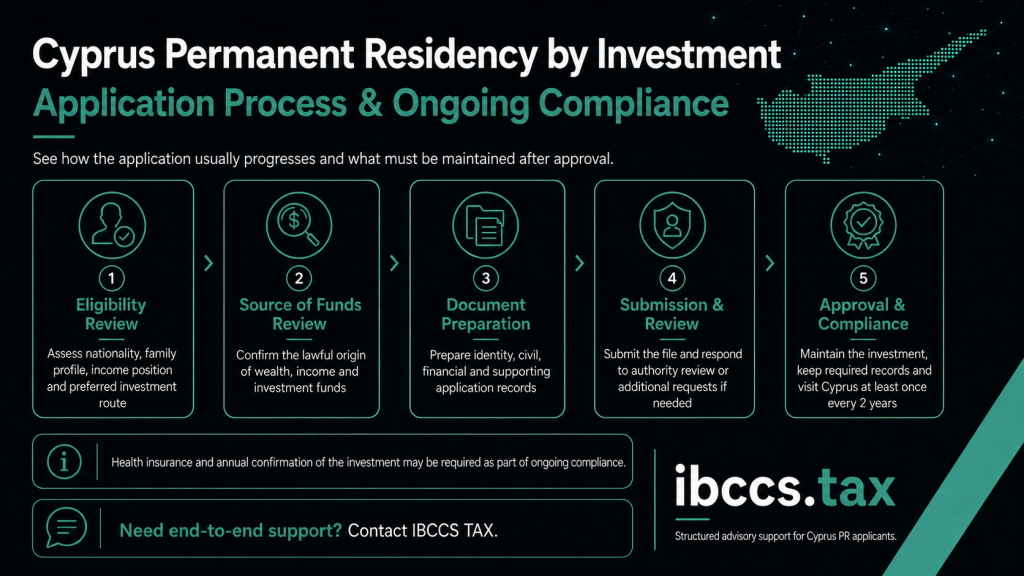
Step 1: Initial Consultation and Eligibility Review
We review your personal circumstances, nationality, family structure, source of income, tax position and investment objectives. This allows us to confirm whether the Cyprus PR by investment route is suitable and which investment category may be most appropriate.
Step 2: Investment Route Assessment
We help you assess the available investment options from a compliance, tax and practical perspective. Where real estate is involved, we coordinate with trusted developers and professional parties while maintaining an advisory role.
Step 3: Source of Funds and Income Review
Before the application is prepared, we review the available financial evidence and identify whether additional documentation is required. This is a critical stage, especially for entrepreneurs, company owners, investors or applicants with multi-jurisdictional income.
Step 4: Document Preparation
We assist with preparing the application file, including forms, declarations, supporting documents, translations, certifications and coordination with the relevant professional parties.
Step 5: Application Submission and Monitoring
Once the file is complete, the application is submitted to the competent authorities. We monitor progress, assist with additional requests and coordinate communication throughout the review period.
Step 6: Approval, Biometrics and Residence Cards
Following approval, applicants must complete the required steps for registration, biometrics and issuance of residence cards. We assist with the post-approval process and practical arrangements in Cyprus.
Step 7: Post-Approval Support
After the permit is issued, we can assist with tax registration, Non-Dom review, bank account opening, relocation, company formation, accounting, payroll, bookkeeping and ongoing compliance.
Cyprus PR Application Timeline
The Cyprus PR by investment application is commonly examined within approximately 2–6 months, although timing depends on the quality of the file, the completeness of documents, due diligence checks and authority workload. A typical process may look as follows:
| Stage | Indicative Timing |
| Initial review and strategy | 1–2 weeks |
| Investment selection and structuring | Varies by investment route |
| Document collection and preparation | 2–6 weeks |
| Application submission | Once the file is complete |
| Authority review | Commonly around 2–6 months |
| Approval and biometrics | After authority decision |
| Residence card issuance | Following completion of final formalities |
Applicants should avoid planning around the shortest possible timeline. A complete and well-documented file is usually more important than speed at the beginning of the process.
Ongoing Obligations After Approval
Cyprus permanent residency by investment is a long-term status, but it is not entirely passive. Investors must continue to meet the relevant conditions after approval.
Key ongoing obligations include:
- maintaining the qualifying investment in Cyprus;
- maintaining valid health insurance in Cyprus, where required;
- providing annual confirmation that the investment is still held;
- providing clean criminal record certificates every three years for adult applicants, where required;
- visiting Cyprus at least once every two years;
- ensuring that any sale or replacement of the qualifying investment is handled correctly;
- avoiding activities that are inconsistent with the permit conditions, including ordinary employment in Cyprus.
Failure to comply with the ongoing requirements may put the permit at risk. Investors should therefore treat post-approval compliance as part of the overall residency strategy, not as an afterthought.
Maximising Your Benefits: Cyprus Tax Advantages
Cyprus permanent residency and Cyprus tax residency are separate concepts. Obtaining a Cyprus PR permit does not automatically make the applicant a Cyprus tax resident. This distinction is important. Some applicants want Cyprus PR mainly as a residence and family security option, while others want to relocate, become Cyprus tax resident, obtain Non-Dom status, establish a Cyprus company or restructure international income.
Where properly planned, Cyprus may offer a highly attractive tax environment, including:
- Non-Domicile Status: Qualifying Cyprus tax residents who are non-domiciled in Cyprus may benefit from an exemption from Special Defence Contribution on dividend and passive interest income for a defined period.
- Corporate Tax: From 2026, the standard Cyprus corporate tax rate is 15%, while Cyprus remains competitive for properly structured international business.
- Employment Income Exemptions: Certain individuals taking up employment in Cyprus may qualify for employment income exemptions, subject to conditions.
- International Business Structuring: Cyprus remains a recognised jurisdiction for holding companies, IP structures, management companies and cross-border operations.
- No Inheritance Tax: Cyprus does not impose inheritance tax, which may be relevant for estate and succession planning.
The right tax outcome depends on facts: physical presence, source of income, domicile position, company structure, place of effective management, family circumstances and the applicant’s broader international footprint.
At IBCCS TAX, we assess immigration and tax planning in Cyprus together, so that the residency application supports the client’s wider objectives rather than creating unintended tax consequences.
Cyprus Permanent Residency vs Cyprus Tax Residency
Cyprus permanent residency gives the right to reside in Cyprus. Cyprus tax residency determines whether an individual is taxable in Cyprus on their worldwide income under Cyprus tax rules.
These are not the same.
An individual may hold Cyprus permanent residency without becoming Cyprus tax resident if they do not meet the applicable tax residency criteria. Conversely, an individual may become Cyprus tax resident through physical presence and other relevant conditions, regardless of whether they hold a specific investment-based PR permit.
This is why international investors should review the immigration and tax position together before relocating, spending significant time in Cyprus, becoming a director of a Cyprus company or transferring income-producing assets.
Cyprus Permanent Residency vs Citizenship
Cyprus permanent residency by investment is not citizenship. It does not provide a Cypriot passport, EU citizenship or automatic voting rights. However, permanent residency may support a future naturalisation strategy if the applicant genuinely resides in Cyprus and satisfies the separate legal requirements for citizenship at the relevant time.
Naturalisation is subject to separate conditions, which may include legal residence, physical presence, Greek language knowledge, knowledge of Cyprus’ socio-political reality, good character, proper accommodation and stable financial means.
Investors should therefore avoid viewing Cyprus PR as a direct or automatic route to citizenship. It is better understood as a long-term residence status that may, in appropriate cases, form part of a wider relocation and naturalisation plan.
Your Trusted Partner for Cyprus Residency by Investment
Choosing the right advisor is one of the most important decisions in the Cyprus PR by investment process. The application involves immigration law, investment due diligence, tax planning, banking, documentation, family structuring and post-approval compliance.
IBCCS TAX provides integrated support for individuals, families, entrepreneurs and investors considering Cyprus as a long-term residence, business or relocation base. Our support may include:
- eligibility assessment for Cyprus permanent residency by investment;
- investment route review and coordination;
- source-of-funds and income documentation review;
- document preparation and application support;
- coordination with developers, lawyers, banks and other professionals;
- tax residency and Non-Dom assessment;
- Cyprus company formation and structuring;
- accounting, bookkeeping and tax compliance;
- relocation assistance and post-approval support.
We combine immigration support with tax and business advisory, helping clients make informed decisions before, during and after the residency process.
Ready to explore Cyprus permanent residency by investment? Contact IBCCS TAX for a confidential consultation and tailored assessment of your options. Explore more about Cyprus Residency by Investment.

Cyprus Permanent Residency by Investment Frequently Asked Questions (FAQ)
1. What is Cyprus permanent residency by investment?
Cyprus permanent residency by investment is a residence route for eligible non-EU nationals who make a qualifying investment in Cyprus and meet the applicable income, due diligence and documentation requirements. It is commonly referred to as the Cyprus Golden Visa.
2. What is the minimum investment for Cyprus PR in 2026?
The minimum qualifying investment is €300,000, excluding VAT where applicable. The investment must fall within one of the eligible categories, such as new residential property, commercial real estate, Cyprus company shares or qualifying Cyprus investment funds.
3. Is the Cyprus Golden Visa the same as Cyprus permanent residency?
In practice, the term Cyprus Golden Visa is commonly used to describe the Cyprus permanent residency by investment route under Regulation 6(2). It is a residency programme, not a citizenship by investment programme.
4. Can I get Cyprus PR by buying property?
Yes, provided the property investment meets the programme criteria. The most common route is the purchase of new residential property from a developer with a minimum value of €300,000, excluding VAT where applicable.
5. Can I buy resale property for Cyprus permanent residency?
Resale residential property does not usually qualify under the new residential property route. However, resale property may be relevant under the commercial real estate category, such as offices, shops, hotels or similar developments, subject to the applicable criteria.
6. What income do I need for Cyprus permanent residency by investment?
The main applicant must prove secured annual income of at least €50,000. This increases by €15,000 for a spouse and €10,000 for each dependent child included in the application.
7. Can my spouse’s income be included?
Yes, the spouse’s income may be taken into account when calculating the total secured annual income requirement, provided it is properly documented.
8. Can I include my family members?
Yes. The application may include the spouse, minor children and qualifying financially dependent children up to the age of 25, subject to conditions.
9. Can parents or parents-in-law be included?
Under the current criteria, parents and parents-in-law are not generally included as dependants under the main applicant’s Cyprus PR by investment application.
10. Do I need to live in Cyprus full-time?
No. Cyprus permanent residency by investment does not require full-time relocation. However, the holder must visit Cyprus at least once every two years to maintain the permit.
11. Does Cyprus PR allow me to work in Cyprus?
The permit does not allow ordinary employment in Cyprus. However, depending on the investment route and structure, the applicant may be able to receive dividends or act as a paid director in the company in which they have invested. This should be reviewed before proceeding.
12. Does Cyprus permanent residency make me a Cyprus tax resident?
No. Cyprus permanent residency and Cyprus tax residency are separate. Tax residency depends on separate rules, including physical presence and other relevant criteria. Applicants should obtain tax advice if they plan to relocate or spend significant time in Cyprus.
13. Does Cyprus PR give access to Schengen?
No automatic Schengen access is granted solely because of Cyprus permanent residency. Cyprus is an EU Member State but is not yet a full member of the Schengen Area. Schengen visa requirements depend on the applicant’s nationality and the rules in force at the time of travel.
14. Can Cyprus PR lead to citizenship?
Cyprus PR may support a future naturalisation strategy only if the applicant actually resides in Cyprus and satisfies the separate citizenship requirements. Citizenship is not automatic and is not granted simply because an investment was made.
15. What happens if I sell my investment?
If you sell the qualifying investment, you must immediately replace it with another qualifying investment of equal or greater value. Otherwise, the permanent residency permit may be at risk of cancellation.
16. What documents are required for Cyprus PR by investment?
Documents usually include passports, civil status documents, criminal record certificates, proof of investment, payment receipts, evidence of funds transferred to Cyprus, proof of secured income, health insurance, accommodation evidence and supporting documents for dependants.
17. How long does the Cyprus PR application take?
The application is commonly examined within approximately 2–6 months, depending on the completeness of the file, due diligence, authority review and any additional requests.
18. How can IBCCS TAX assist?
IBCCS TAX assists with eligibility assessment, investment route review, document preparation, source-of-funds review, application coordination, tax residency planning, Non-Dom assessment, company structuring, banking, relocation and post-approval compliance.
Cyprus Corporate Tax in 2026: Rate, Taxable Profits, Exemptions and Filing Requirements
Cyprus corporate tax changed materially from 1 January 2026. The
Read More
Cyprus Companies at Risk of Strike-Off: 31 December 2026 Deadline for Overdue HE32 Annual Returns
Cyprus companies with overdue Annual Returns (HE32) and corresponding Financial
Read More
Cyprus VAT for International Services: B2B, B2C and Reverse Charge Explained
International services are one of the areas where Cyprus VAT
Read More