

Moving from Italy to Cyprus is a decision about more than lifestyle or headline tax rates. For Italian entrepreneurs, professionals, shareholders and investors, the important questions are when Italian tax residence ends, how Cyprus tax residency is established, which income streams may be taxed differently and what happens to existing companies and assets after the move.
Cyprus offers EU free-movement rights for Italian citizens, a defined tax-residency framework, a Non-Dom regime for qualifying individuals and an established international business environment. But a Cyprus address, a Yellow Slip or a newly incorporated company does not by itself cancel Italian tax obligations.
Recent discussion of Italy’s proposed 2027 exit tax has added urgency for some investors. The proposal is not yet law, and its final terms may change. The broader planning principle is nevertheless evergreen: the tax consequences of leaving a country matter just as much as the taxes paid after arrival.
This guide explains the Cyprus side of the relocation and highlights the Italian issues that should be assessed with qualified Italian tax advisers. At IBCCS TAX, we coordinate relocation services in Cyprus with tax-residency, Non-Dom, business structuring and ongoing compliance support.

- Italian citizens can generally live and work in Cyprus under EU free-movement rules, subject to registration requirements for longer stays.
- Cyprus immigration registration and tax residency are distinct; a Yellow Slip does not automatically change tax residence.
- Cyprus individual tax residency generally follows the 183-day rule or, where all criteria are satisfied, the 60-day rule.
- Qualifying Cyprus tax residents who are non-domiciled for SDC purposes may generally receive dividends and passive interest without Cyprus Special Defence Contribution; GHS and source-country taxation can still apply.
- Cyprus has a 15% standard corporate income tax rate from 2026, while its personal income tax bands begin at 0% up to €22,000 of taxable income.
- A qualifying employee may benefit from a 50% exemption on employment income for up to 17 years where the statutory conditions are met.
- Italy’s proposed 2027 exit tax focuses on certain unrealised financial gains; the €800,000 threshold relates to in-scope assets, not necessarily total wealth.
- Italian tax residence, company holdings, investments, property and a potential exit-tax exposure should be reviewed before irreversible relocation or disposal decisions.
Quick Answer: Can Italian Citizens Move to Cyprus?
Yes. Italy and Cyprus are both EU member states. An Italian citizen can generally enter Cyprus with a valid passport or national identity card and work or become self-employed without a separate work permit. A stay exceeding three months normally triggers the EU registration process, commonly called the Yellow Slip or MEU1, with an application generally required within four months of entry.
Tax residency is a separate question. Cyprus generally determines an individual’s tax residence using the 183-day or 60-day rule. Italy may continue to regard that person as resident under its own domestic rules, and the Italy–Cyprus double tax treaty may need to be considered where both countries claim residence. Cyprus tax residency planning should therefore begin before the relocation is implemented.
Who Should Consider Moving from Italy to Cyprus?
Cyprus may be particularly relevant to an Italian founder who can genuinely relocate business management, an investor receiving dividends or passive interest, a consultant serving international clients, a senior executive taking Cyprus employment or a family seeking a long-term EU base. It may also suit financially independent people whose income comes from a diversified international portfolio.
The right structure is determined by actual circumstances. A family retaining a home and business in Milan, a shareholder preparing to sell a company and a remote professional moving permanently to Limassol have different Italian departure risks and different Cyprus compliance needs. A realistic review should analyse residence, income sources, existing assets, family location and the practical business model after the move.
Residency in Cyprus for Italian Citizens: Yellow Slip and EU Rights
Italian citizens can generally rely on EU free movement. When moving for more than three months, they normally apply for the MEU1 Registration Certificate, supported by documents appropriate to their circumstances. An employee may use employment documentation; a self-employed person relies on the relevant activity and registrations; financially self-sufficient residents normally need to demonstrate adequate resources and comprehensive healthcare cover.
The MEU1 application is generally submitted within four months of entry. Spouses and children may follow the applicable EU family-member rules, while non-EU family members may require a different document and procedure. IBCCS TAX can assist with the Cyprus Yellow Slip application, residence evidence and coordination with the intended employment or business structure.
Important distinction: the Yellow Slip confirms registration of EU residence. It is not a Cyprus Tax Residency Certificate, Non-Dom confirmation or an automatic release from Italian taxation.
How to Become a Cyprus Tax Resident after Leaving Italy
The 183-Day Rule
An individual who is physically present in Cyprus for more than 183 days in the calendar tax year is generally considered Cyprus tax resident. For a person making Cyprus their principal home and spending most of the year here, this is usually the clearest domestic route. Travel records, accommodation, family arrangements and the intended employment or business activity should still be documented.
The 60-Day Rule
The 60-day rule can be relevant to internationally mobile founders, directors and professionals. Broadly, the individual must spend at least 60 days in Cyprus during the tax year, not spend more than 183 days in any other single country, maintain a permanent home in Cyprus that is owned or rented, and carry on business, be employed or hold a qualifying office in Cyprus during the relevant year. The business, employment or office connection must remain in place under the applicable conditions.
From 1 January 2026, the previous requirement that the individual must not be tax resident in any other state was removed from the Cyprus 60-day framework. This change makes Cyprus qualification more flexible under domestic law; it does not automatically terminate Italian tax residency or prevent dual residence.
Does Italian Tax Residency End Automatically?
No. Italy applies its own domestic residence rules, and residence may depend on a combination of factual and legal connections such as physical presence, personal and family ties and the applicable registration position. Simply moving into a Cyprus apartment, obtaining MEU1 or appointing oneself as a Cyprus company director is not enough to establish that Italy has lost taxing rights.
The Italy–Cyprus double tax treaty contains residence tie-breaker rules relevant where a person is resident under both domestic systems. Factors such as a permanent home and the centre of vital interests can become important. An Italian tax adviser should confirm the departure year and any continuing Italian obligations, while IBCCS TAX supports the Cyprus tax-residency position, records and implementation.
Italy vs Cyprus Taxes: What Changes after Relocation?
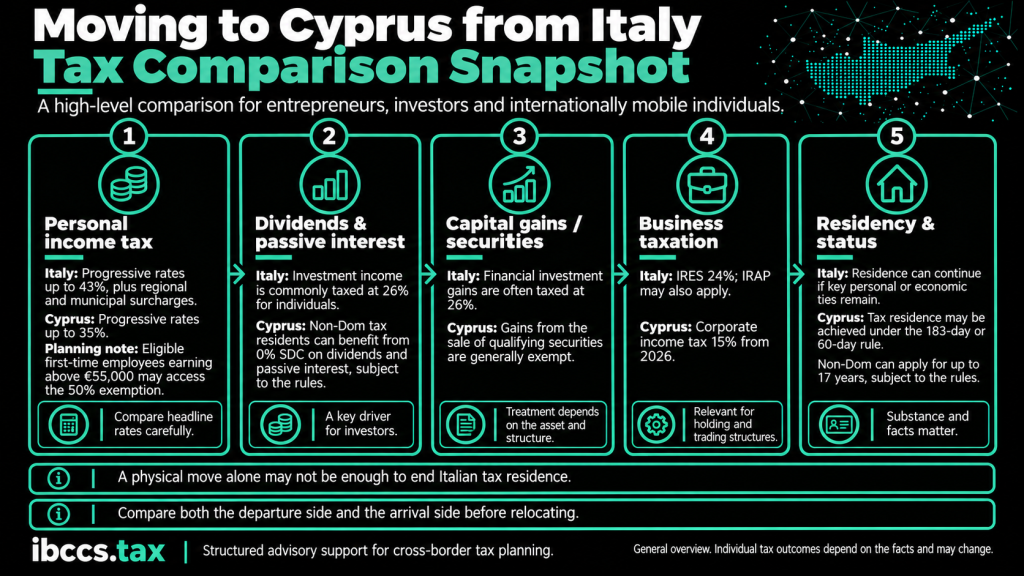
Comparing only the highest personal tax rate can be misleading. Employees, portfolio investors, company shareholders and self-employed professionals may experience very different outcomes. The following overview reflects the broadly applicable 2026 framework, not a personalised calculation.
| Tax issue | Italy – general 2026 position | Cyprus – 2026 position |
| Personal income tax | National IRPEF: 23%, 33%, 43%; regional and municipal taxes may apply | 0% to €22,000 taxable income; rising bands up to 35% over €72,000 |
| Portfolio dividends | Ordinarily 26% on many personally held investment dividends, subject to exceptions | Qualifying Cyprus Non-Dom: generally 0% SDC; GHS may apply |
| Qualifying security disposals | Many financial capital gains generally subject to 26%, with exceptions | Profits on disposal of qualifying securities generally exempt from income tax; exceptions and classifications matter |
| Standard corporate tax | IRES generally 24%, with IRAP and specific rules potentially relevant | 15% corporate income tax on taxable profits |
| Employment incentive | Italian-specific incentives depend on individual eligibility | Potential 50% exemption on qualifying employment income for up to 17 years |
| Departure issue | Review continuing Italian taxation and potential exit tax | Cyprus tax residency does not extinguish Italian departure tax liabilities |
Tax treatment depends on source, treaty provisions, qualifications, entity substance, social contributions and individual circumstances. These are not interchangeable effective tax rates.
Illustrative Tax Comparison: €100,000 of Annual Income
The figures below use the 2026 national personal income tax bands and assume €100,000 is the relevant annual income/taxable base before the stated Cyprus employment exemption. They are deliberately income-tax-only examples, not take-home pay estimates. No Italian regional or municipal taxes, tax credits, deductions, social insurance or GHS contributions have been included.
| Illustrative situation | Indicative national personal income tax |
| Italian resident: €100,000 subject to standard national IRPEF | €35,200 |
| Cyprus resident: €100,000 taxable income, without employment exemption | €23,300 |
| Cyprus resident employee: €100,000 qualifying salary with 50% exemption | €6,900 |
The 50% Cyprus employment exemption is not automatic. In broad terms, the relevant regime can apply to qualifying new employment where annual remuneration exceeds €55,000 and the employee meets the statutory prior non-residence and other conditions. The exemption can last up to 17 years, subject to those conditions. An entrepreneur paying themselves salary cannot assume eligibility merely by setting up a Cyprus company.
For a dividend-focused investor, the comparison is different. A simple illustration of €100,000 in qualifying dividend receipts might produce €26,000 of Italian dividend tax under the ordinary 26% treatment, whereas a qualifying Cyprus Non-Dom individual may owe no Cyprus SDC on that dividend but could have €2,650 GHS on that income, assuming the income is within the annual contribution base. Foreign withholding taxes, dividend classifications, Italian-source taxation and any existing Italian liability can materially change the outcome. This is an illustration of different regimes, not a guaranteed saving.
The right financial model should calculate tax by income type, country of source, the actual residence date and corporate structure, then add social contributions, GHS and ongoing compliance costs. For clients with multiple entities or investments, international tax planning should precede any headline savings estimate.
Cyprus Non-Dom Status for Italian Entrepreneurs and Investors
Cyprus Non-Dom status can be a particularly significant consideration for an Italian resident receiving dividends or passive interest. It is a tax concept relevant to the Special Defence Contribution (SDC), not an immigration programme or a general exemption from all taxes. An individual must first be Cyprus tax resident and then qualify as non-domiciled under the applicable rules.
A qualifying Cyprus Non-Dom tax resident generally does not pay Cyprus SDC on dividends or passive interest. Under the standard framework, an individual who has been Cyprus tax resident for at least 17 of the previous 20 years is deemed domiciled for SDC purposes, with additional rules and an alternative method potentially relevant in particular circumstances.
Non-Dom does not exempt employment income, active self-employment or every type of capital gain. Cyprus General Healthcare System (GHS/GESY) contributions may apply even where SDC does not. For dividend, interest and certain other income earners the normal GHS contribution rate is 2.65%, subject to the overall annual contribution-income ceiling of €180,000 per individual. Source-country taxes may also remain relevant.
Our Non-Dom services in Cyprus cover the eligibility assessment, supporting documentation and coordination with tax residency and the client’s broader investment structure.
What Happens to Italian Income and Assets after Moving?
Italian Company Shares and Dividends
An Italian shareholder may continue to receive dividends after becoming Cyprus tax resident, but the Italian company’s withholding obligations, treaty entitlement, beneficial ownership and the shareholder’s original tax residence need to be established. Cyprus Non-Dom treatment should not be confused with an exemption from Italian source-country tax. A prospective share sale also requires a separate analysis, particularly in light of Italian departure and capital-gains rules.
Italian Real Estate
Keeping a flat, house or rental property in Italy is possible, but Italian-source property income, ownership taxes and gains on sale may remain subject to Italian law. Retaining an Italian home may also affect residence analysis depending on the surrounding facts. Cyprus-side disclosure and treaty relief should be reviewed when relevant.
Investment Portfolios and Securities
Cyprus generally exempts profits from the disposal of qualifying securities from income tax, but the exact asset classification is critical. Shares, bonds, fund interests, derivatives, crypto-assets and property-rich companies should not automatically be treated identically. Cyprus has a specific 8% tax regime for qualifying crypto gains from 2026, subject to exceptions, including mining-related assets; it should not be represented as a blanket securities exemption.
Pensions and Foreign Income
Qualifying foreign pension income may benefit from a Cyprus alternative method of taxation: 5% on pension income exceeding €5,000 annually, subject to the relevant legal and treaty rules. The nature of the pension matters, and government-service pensions may require a different treaty analysis. A retired client should compare this option with the ordinary progressive tax bands before making an election.
Italy’s Proposed 2027 Exit Tax: Why Departure Planning Matters
Status at 3 November 2026: proposal only, not enacted law. Article 17 of Italy’s draft 2027 budget would extend an exit-tax mechanism to certain private individuals transferring tax residence abroad. As drafted, it would generally target unrealised gains on specified financial assets and rights where their aggregate value is at least €800,000, the taxpayer was Italian tax resident for at least six of the preceding ten tax periods and the transfer removes Italy’s right to tax the relevant gains.
The generally discussed rate is 26% on relevant unrealised gains, not 26% of the entire portfolio value. Other assets and categories can be treated differently, and the in-scope asset definitions matter. The proposal indicates an intended start for tax-residence transfers effective from 1 January 2027, but its scope, technical operation and final wording remain subject to parliamentary review.
The draft also contemplates payment within 180 days and conditional payment deferral for qualifying moves, including moves to EU member states. The reported EU deferral mechanism would require a 50% advance payment and suitable guarantee, with a limited deferral period and further conditions. Therefore, moving from Italy to Cyprus would not, by itself, eliminate a liability under the proposal if it becomes law.
For someone already considering relocation, the practical response is not to rush a paper move. It is to model whether Italian tax residence could genuinely cease in the intended year, identify in-scope assets and accrued gains, review liquidity and seek Italian advice before any major transfers or disposals. A physical departure late in a calendar year may not be enough under Italian annual residence rules.
Moving an Italian Business or Managing an Italian Company from Cyprus
An Italian entrepreneur can relocate personally without necessarily relocating the Italian company. That distinction is central to a defensible structure. If an Italian SRL retains its employees, customers, contracts and real operations in Italy, the company may continue to require Italian corporate, tax, payroll and accounting compliance even after the shareholder moves.
Where a founder or managing director starts making strategic decisions from Cyprus, the company may need a separate assessment of effective management, corporate residence, permanent establishment, governance and possible Italian or Cyprus reporting obligations. A Cyprus company should reflect genuine business substance and commercial operations, not merely an address or nominal board appointments.
When establishing a new Cyprus operating or holding entity is commercially appropriate, Cyprus corporate income tax is generally 15% from 2026. Profit extraction, director remuneration, dividends, Social Insurance, GHS, cross-border transfer pricing and foreign-source rules still need to be assessed. Our company formation in Cyprus and corporate services team can coordinate these requirements. Founders may also find our guide to moving to Cyprus as a business owner useful.
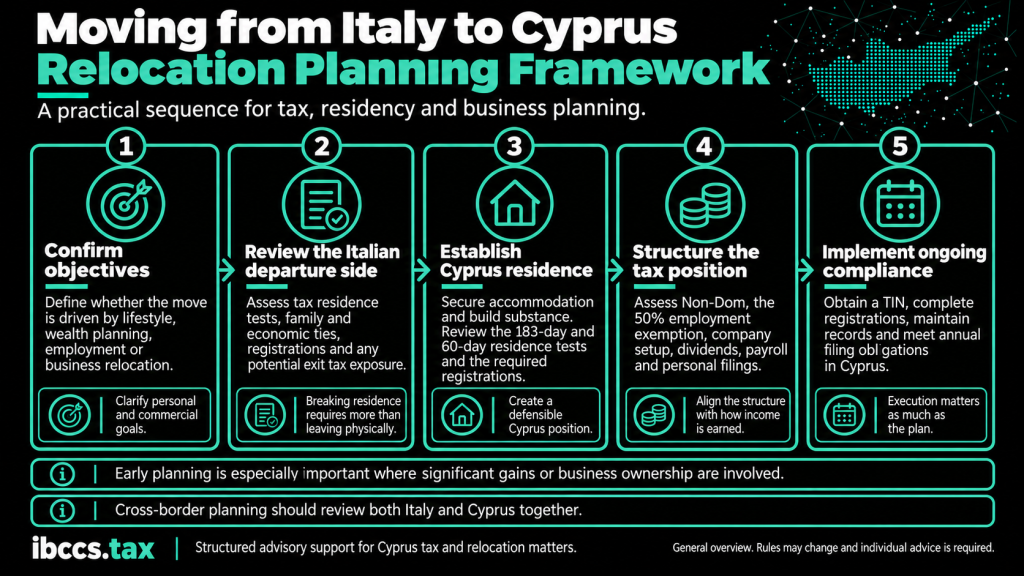
Relocating from Italy to Cyprus: A Practical Roadmap
- Define the relocation date, family arrangements, future home and the number of days expected in both countries.
- Ask an Italian adviser to assess Italian tax residency, the departure year, company holdings, existing liabilities and any prospective exit-tax exposure.
- Inventory assets and income: employment, dividends, securities, crypto, Italian property, pensions, trusts and business interests.
- Select the correct Cyprus residence basis and plan EU MEU1 / Yellow Slip registration for the relevant family members.
- Choose a defendable Cyprus tax-residence route (183-day or 60-day) and preserve documents that substantiate it.
- Determine Non-Dom eligibility, income classification, foreign withholding and expected GHS treatment.
- Review whether the existing Italian business should remain in Italy, change its governance or develop genuine operations through a Cyprus company.
- Complete Cyprus tax registration, Social Insurance, payroll, VAT/VIES or accounting arrangements as required; monitor annual compliance and future law changes.
Practical Relocation Scenarios
1. Italian Founder with an SRL and a Planned Share Sale
A founder intends to move to Cyprus and sell part of an Italian shareholding next year. The departure date, ownership percentage, valuation, tax residence, potential Italian exit taxation and post-move company governance should be reviewed before the sale process advances. Cyprus treatment cannot be evaluated in isolation from Italian taxing rights.
2. Portfolio Investor Living on Dividends
An Italian investor receives dividends and interest from international investments and intends to live in Cyprus most of the year. Cyprus tax residency and Non-Dom may be relevant, but the analysis must identify each source-country withholding tax, whether Italian residence genuinely ceases and whether GHS contributions apply. An investor with substantial unrealised gains also needs Italian departure-tax advice.
3. Senior Executive Taking a Cyprus Role
An Italian professional accepts employment with a genuinely Cyprus-based business at a salary above €55,000. Their potential Cyprus 50% employment exemption should be checked alongside payroll, Social Insurance and GHS. Italy’s treatment of the departure year and any ongoing Italian workdays must also be reviewed.
4. Family Retaining Property in Italy
A family moves to Limassol while retaining a rental apartment in Rome. The EU residence and Cyprus tax arrangements may be straightforward, but Italian property taxation and personal ties remain relevant. A coherent record of where the family genuinely lives, works and studies is important.
Common Mistakes to Avoid
- Assuming a Yellow Slip or a Cyprus tax number proves Italian tax residence has ended.
- Treating Cyprus Non-Dom as an exemption from all taxation or from foreign withholding.
- Quoting a guaranteed tax saving without analysing income types and social contributions.
- Believing the proposed €800,000 exit-tax threshold means a tax on all worldwide assets.
- Waiting until after a share sale, asset transfer or year-end to assess the departure position.
- Running an Italian business from Cyprus without analysing management, substance and permanent-establishment exposure.
How IBCCS TAX Supports Clients Relocating from Italy
IBCCS TAX advises internationally mobile individuals, families, founders and investors who want to establish a sustainable base in Cyprus. Our Cyprus team integrates residence registration, tax-residency analysis, Non-Dom eligibility, company formation, corporate governance, accounting and continuing tax compliance. We focus on structures that reflect the client’s actual commercial activity and residence, not purely formal changes.
For issues governed by Italian law — including the Italian departure year, domestic residence rules, source-country liabilities, Italian company taxation and any future exit-tax rules — we recommend review by appropriately qualified Italian advisers. We can coordinate the Cyprus analysis and implementation with their conclusions, helping align both sides of the relocation.
Considering a move from Italy to Cyprus? Arrange an initial review of your proposed residence, income, investment and business structure before making material tax or corporate decisions. Contact IBCCS TAX to discuss your relocation.

Frequently Asked Questions: Moving to Cyprus from Italy
1. Can an Italian citizen live and work in Cyprus?
Generally yes, under EU free-movement rules. For longer stays, the relevant Cyprus EU residence registration (MEU1 / Yellow Slip) should be completed within the applicable period.
2. Do Italians need a visa to move to Cyprus?
Italian citizens generally do not need a visa or separate work permit under ordinary EU free-movement arrangements, but residence registration and activity-specific compliance remain relevant.
3. Is the Cyprus Yellow Slip the same as tax residency?
No. The Yellow Slip relates to lawful EU residence; tax residency follows separate legal tests and supporting evidence.
4. Can I qualify for Cyprus tax residency after 60 days?
Potentially, but only if all conditions of the Cyprus 60-day rule are met. Sixty days of presence alone is insufficient.
5. Did the Cyprus 60-day rule change in 2026?
Yes. Cyprus removed the former condition that the individual must not be tax resident in another state. Other statutory conditions remain, and dual-residence or treaty issues may still arise.
6. Can I become a Cyprus Non-Dom if I am Italian?
Potentially yes, if you become Cyprus tax resident and meet the non-domicile conditions for SDC purposes. Nationality itself is not the determining criterion.
7. Are dividends tax-free in Cyprus for Italian investors?
Qualifying Cyprus Non-Dom residents may be exempt from Cyprus SDC on dividends, but GHS contributions and source-country withholding or other taxes may still apply.
8. Is Cyprus income tax lower than in Italy?
Cyprus has a maximum ordinary personal income tax rate of 35% in 2026, compared with 43% national IRPEF in Italy, but the effective burden depends on income, deductions, municipal/regional taxes, contributions and eligibility for exemptions.
9. What is the Cyprus corporate tax rate in 2026?
The standard Cyprus corporate income tax rate is 15% on taxable profits from 1 January 2026, subject to the relevant corporate rules and exceptions.
10. Does Italy impose an exit tax when someone moves to Cyprus?
Certain Italian exit-tax rules already exist for business situations. As at 3 November 2026, a separate 2027 proposal concerning specified unrealised financial gains of certain departing individuals is under parliamentary consideration, not yet enacted.
11. Would Italy’s proposed 26% exit tax apply to everyone leaving?
No. The draft contains several cumulative conditions, including at least €800,000 in specified assets, a six-of-ten-year residence condition and the loss of Italian taxing rights. The 26% figure generally concerns qualifying gains, not the full portfolio value.
12. Can I avoid Italy’s proposed exit tax by moving to Cyprus?
No automatic exemption follows from a move to Cyprus. The outcome depends on the final Italian legislation, your actual tax-residence status, relevant assets and any conditional deferral provisions. Obtain Italian advice.
13. Can I keep my Italian SRL after moving to Cyprus?
Yes in principle, but continuing Italian company compliance and cross-border questions involving effective management, permanent establishment and the shareholder’s tax position must be reviewed.
14. Can IBCCS TAX handle my Cyprus relocation and tax setup?
Yes. IBCCS TAX can coordinate the Cyprus residence, tax, Non-Dom, company, accounting and compliance work and liaise with appropriately qualified Italian advisers where Italian law is involved.



Professional Tax in Cyprus: Municipal Fees, Who Pays, Deadlines and Exemptions
Professional Tax in Cyprus refers to municipal business charges, rather
Read More
Moving to Cyprus from Italy: Tax Benefits, Residency, Non-Dom & Business Relocation
Moving from Italy to Cyprus is a decision about more
Read More
Cyprus Non-Dom After 17 Years: Deemed Domicile and the Alternative SDC Method
Cyprus Non-Dom is often described as a 17-year tax benefit,
Read MoreImportant: This article is general information, based on the position reviewed on 3 November 2026. The Italian 2027 exit-tax measure discussed above is a draft and may be amended, withdrawn or enacted differently. Any decision should be based on up-to-date advice addressing the individual facts, applicable tax treaties and legislation.