

Georgia introduced a substantially more regulated labour migration framework in 2026. Foreign nationals who previously relied only on visa-free entry, a company registration, an employment contract or an Individual Entrepreneur registration may now need a separate right to work before carrying out paid employment or entrepreneurial activity in Georgia.
The term most people search for is a work permit in Georgia. Under the current legislation, the formal concept is the right to work. It is issued through the State Employment Support Agency and is separate from a D1 immigration visa or a Georgian residence permit. For many foreign employees and self-employed professionals, legal work now depends on coordinating these elements correctly rather than treating immigration status and employment status as the same thing.
IBCCS TAX Georgia provides legal and immigration support in Georgia for foreign employees, self-employed professionals, founders and Georgian employers hiring international staff. This guide explains the current framework in force in September 2026, including who needs the right to work, how the application process works, the Worknet labour-market procedure, self-employed applications, employer quotas, exemptions, residence requirements and penalties.

- Since 1 March 2026, many foreign nationals who work for Georgian employers or carry out self-employed labour or entrepreneurial activity in Georgia must obtain the right to work unless a statutory exemption applies.
- For an employee, the Georgian employer applies for the right to work. For a self-employed foreigner, the applicant applies directly through the labour migration system.
- The right to work is not the same as a D1 visa or a work residence permit. Depending on the person’s location and existing residence status, an additional immigration or residence step may be required after approval.
- A standard employee application usually involves a 10-working-day local labour-market procedure through Worknet before the right-to-work application, although defined exceptions apply.
- The right to work for an employee is tied to a specific Georgian employer and position. For self-employed applicants, it is linked to a specific profession and field of labour or entrepreneurial activity.
- Standard applications cost GEL 200 and are reviewed within up to 30 calendar days after the complete application is filed. Expedited review within 10 working days costs GEL 400.
- Self-employed applicants must apply personally, attend a mandatory video interview and present the original passport used for the application.
- Some employers must obtain an annual quota for foreign workers and meet turnover requirements. Certain activities are also subject to sector-specific annual quotas.
- Working without the required right to work can result in a GEL 2,000 fine for the foreign worker or self-employed person and, for an employee, a separate GEL 2,000 fine for the employer for each worker.
- Foreign nationals who had active registration in the labour migration database on 1 March 2026 are subject to a specific transitional rule requiring the right to work and the appropriate residence permit by 1 January 2027.
What Changed in Georgia’s Labour Migration Rules in 2026?
Before 2026, many foreign nationals were able to work or conduct business in Georgia without a separate work-authorisation process. Company registration in Georgia, visa-free presence or an employment relationship often formed the practical basis on which foreigners worked in the country. The 2026 framework changed that approach by making the right to work a central compliance requirement for many foreign employees and self-employed foreigners without permanent residence.
The system entered into force on 1 March 2026 and was amended several times during the year. Later changes expanded exemptions, introduced the short-term professional activity route, added employer quota and turnover rules, tightened self-employed application procedures and clarified how changes to employment arrangements should be handled.
For a detailed breakdown of the July 2026 amendments, see our separate update on Georgia’s new labour migration and work permit rules. This article focuses on the full current framework rather than one legislative update.
What Is the Right to Work in Georgia?
The right to work is the formal authorisation that allows a qualifying foreign national to carry out paid labour or entrepreneurial activity under Georgia’s labour migration framework. It is issued through the State Employment Support Agency under the Ministry of Internally Displaced Persons from the Occupied Territories, Labour, Health and Social Affairs of Georgia.
For employees, the right is linked to a specific local employer and a specific position. For self-employed foreigners, it identifies the relevant profession and labour or entrepreneurial activity. The authorisation cannot simply be transferred to another employer or used for a materially different business activity.
This is why a work permit should be reviewed before the work arrangement changes. Moving to another employer, changing the actual position or changing the self-employed activity can require a new or updated right to work. Changes only to the level of a position, salary or working schedule do not by themselves trigger a new application under the current rules where the underlying position remains the same.
Who Needs a Work Permit or Right to Work in Georgia?
The rules generally apply to foreign nationals who do not hold permanent residence in Georgia and who receive financial benefit from employment, labour activity or entrepreneurial activity connected with Georgia.
Foreign Employees of Georgian Employers
A foreign national employed by a local Georgian employer generally needs the right to work unless an exemption applies. The employer is the applicant for the work authorisation and the permit is issued for employment with that specific employer in the approved position.
The rules can also cover a remote employment relationship with a Georgian employer. The key exception is where the foreign national performs the work fully remotely and the work does not require the person’s entry into Georgia. In that situation, the activity can fall outside the labour migration regime.
Self-Employed Foreigners, Individual Entrepreneurs and Contractors
The framework also covers self-employed foreigners who carry out paid labour or entrepreneurial activity in Georgia. This can include independent contractors, consultants, service providers, traders and Individual Entrepreneurs where the activity is carried out for financial benefit.
Registration as an Individual Entrepreneur or obtaining Small Business Status does not itself replace the right-to-work analysis. Business registration, tax status and labour migration status are separate legal questions.
If you are considering an Individual Entrepreneur or company structure, our guide to company formation in Georgia explains the main business setup options. The work-authorisation position should be reviewed alongside the structure rather than after the business has already started operating.
Foreign Company Owners and Directors
Being a shareholder or director does not create one universal answer. Current law provides an exemption for foreign nationals carrying out managerial or governing activities in Category I, Category II or Category III enterprises, as well as public interest entities, and for persons serving on an audit committee.
A manager of a smaller Category IV enterprise may fall within the self-employed work-authorisation procedure. Foreign founders should therefore review both the company category and the person’s actual role rather than assuming that company ownership automatically creates a work-permit exemption.
Who Is Exempt from the Right-to-Work Requirement?
The 2026 framework contains several important exemptions. Whether an exemption applies depends on the person’s status and the nature of the activity, so it should be assessed before an application is filed.
| Exempt category or activity | General position |
| Permanent residence holders | The labour migration right-to-work regime is aimed at foreigners without permanent residence. |
| Valid investment residence permit holders | Expressly excluded from the relevant labour migration requirements. |
| Certain special residence permit holders | An exemption applies where the special permit was issued on the written initiative of a member of the Government. |
| Refugees, asylum seekers and persons with specified protection status | Covered by statutory exceptions. |
| Diplomatic, consular and qualifying international-organisation personnel | Covered by statutory exceptions. |
| Accredited foreign journalists | Covered by the statutory exemption. |
| Short-term professional activity | May be carried out without the general right to work if the activity and registration requirements are satisfied. |
| Fully remote work for a Georgian employer that does not require entry into Georgia | Outside the general right-to-work requirement. |
| Services for a non-resident connected with that non-resident’s activities outside Georgia | Generally exempt, subject to the special position for an entrepreneur natural person who needs residence status in Georgia. |
| Certain managers of Category I-III enterprises and public interest entities | Managerial or governing activity can fall within the statutory exemption. |
| Activity for a public institution or state-participated enterprise | Covered by a statutory exemption. |
The exemption analysis should be completed before paying an application fee. Under the July 2026 rules, where an application is submitted for a person to whom the labour migration law does not apply, the Agency may leave the application unreviewed, and the service fee is not refundable.
Remote Workers and Digital Professionals
Remote work needs to be classified carefully because the result depends on who the client or employer is and where the activity is connected.
A foreign national working fully remotely for a Georgian employer can be exempt where the work does not require entry into Georgia. Separately, a foreigner providing labour or services to a non-resident person can be exempt where the services relate to that non-resident’s activities outside Georgia.
This does not mean that every digital nomad living in Georgia is automatically outside the work-permit regime. The person’s client base, Georgian business registration, residence objective and actual place of activity should all be reviewed. The 2026 amendments also created a route that can allow certain self-employed entrepreneur natural persons serving non-residents to obtain the right to work where it is needed for their Georgian residence position.
Work Permit, D1 Visa and Work Residence Permit: What Is the Difference?
One of the most common sources of confusion is treating the right to work, the D1 visa and the work residence permit as interchangeable. They are separate elements of the legal-status framework.
| Document / status | Purpose | Key point |
| Right to work | Authorises the approved employment or self-employed activity under the labour migration framework. | Issued through the State Employment Support Agency. |
| D1 immigration visa | Immigration basis connected with labour activity for a person applying from outside Georgia. | Where required, the person applies after obtaining the right to work. |
| Work residence permit | Residence status for a person who has obtained the right to work and satisfies the separate residence criteria. | Separate income and turnover requirements apply. |
| IT residence permit | Special residence route for qualifying IT employees, IT small-business entrepreneurs and certain international-company managers. | Separate experience and income conditions apply for relevant applicants. |
What Happens After the Right to Work Is Approved?
If the foreign national is outside Georgia, the person generally has 30 calendar days after obtaining the right to work to apply for a D1 immigration visa. If the person is already in Georgia, the person generally has 10 calendar days to apply for a work residence permit or, where applicable, an IT residence permit.
These additional steps are not required where the person already holds a Georgian residence permit of a type recognised by the legislation, or where the work is carried out completely remotely and does not require entry into Georgia.
Work Residence Permit Requirements
A work residence permit has its own eligibility criteria. In addition to holding the right to work, the applicant must provide evidence of labour or entrepreneurial activity in Georgia and satisfy the applicable income and turnover conditions.
The legislation requires monthly income or remuneration from the Georgian labour or entrepreneurial activity of at least five times the average consumer’s subsistence minimum. The annual turnover of the employing enterprise or the applicant’s enterprise must generally be at least GEL 50,000 per foreign applicant. For education and medical institutions, the relevant turnover threshold is GEL 35,000 per foreign applicant.
Because the subsistence-minimum figure changes over time, the required monthly income should be checked at the date of application rather than relying on a historical fixed GEL amount.
How to Get a Work Permit in Georgia as a Foreign Employee
For a foreign employee, the process is driven by the Georgian employer. The employee does not simply submit an individual work-permit request without the employer’s participation.
Step 1: Prepare the Employment Agreement
The employer and foreign employee should have a written fixed-term employment agreement containing the information required by Georgian labour migration law. The agreement must be in Georgian and in the worker’s native language or another language the worker understands.
The contract should correctly identify the employer, employee, position, workplace, term and the principal rights and duties of both parties. The position used in the work-permit application should match the real work performed.
Step 2: Complete the Worknet Labour-Market Procedure
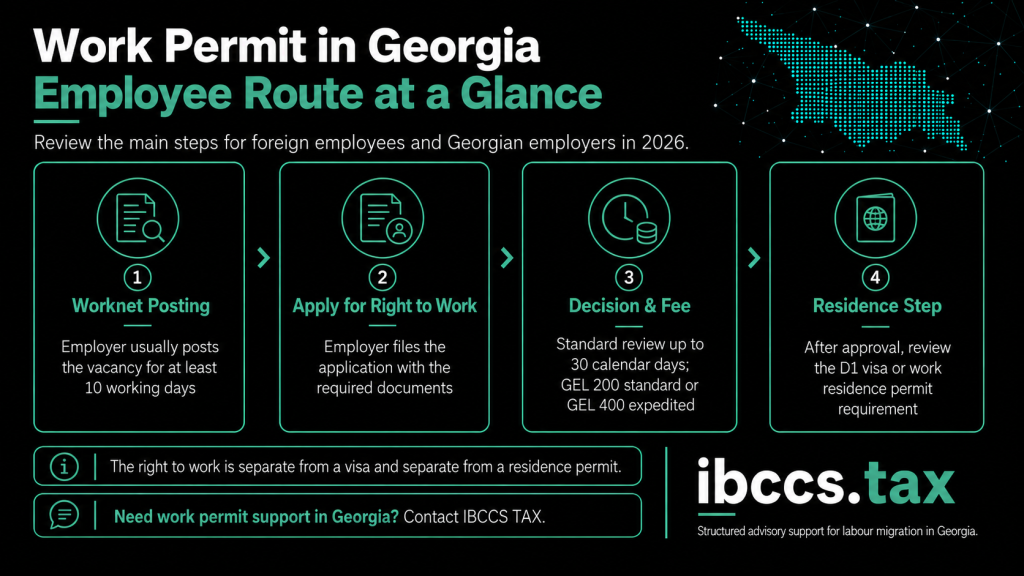
As a general rule, the employer must publish the vacancy in the Worknet labour-market information system at least 10 working days before applying for the foreign employee’s right to work.
During that period, the State Employment Support Agency can search for local candidates who satisfy the vacancy requirements. If the Agency does not identify a suitable local candidate within the 10-working-day period, the employer can proceed with the right-to-work application.
Where the Agency proposes a candidate and the employer decides not to hire that person, the employer must notify the Agency electronically and justify the refusal within three working days after the selection process. The Agency then reviews the employer’s reasoning before confirming whether the work-permit procedure may continue.
When Is the Worknet Labour-Market Test Not Required?
The Worknet test does not apply in several defined cases. The exemption concerns the labour-market testing stage; it should not automatically be interpreted as an exemption from the right to work itself.
- A company holding International Company Status under the Georgian Tax Code.
- A company holding Innovative Startup Status under the Law on Innovations.
- Certain international experts in the higher-education authorisation and programme-accreditation expert pool.
- A position with gross monthly remuneration above GEL 15,000 where relevant higher education in the required specialisation is objectively necessary for the work.
The high-salary exception should not be treated as completely automatic. Where the Agency considers that the personal performance of the specific foreign national is not sufficiently necessary, it can in defined circumstances require the ordinary labour-market procedure after coordination with the relevant state authorities.
Step 3: Submit the Right-to-Work Application
After the applicable Worknet procedure or exemption has been addressed, the employer submits the application through the special labour migration system. The application includes employer data, employee passport and residence information, the proposed position and qualification requirements, the employee’s education and experience, the employment agreement and supporting employer documentation.
The foreign passport should have at least six months of validity remaining at the time the application is submitted under the current procedural rules.
Step 4: Receive the Decision
The standard review period is up to 30 calendar days from submission of the complete application and required documents. An expedited administrative procedure is available with a decision no later than the tenth working day.
The current service fee is GEL 200 for the standard application and GEL 400 for expedited review. For an employed foreign national, the fee is paid by the local employer.
Employer Quotas for Foreign Workers
Large or foreign-worker-intensive employers have an additional quota requirement. Where a local employer plans to employ more than five foreign citizens during a calendar year, or the number of foreign citizens exceeds 5% of the employer’s total workforce, the employer can be required to agree an annual foreign-worker quota with the Agency before submitting individual right-to-work applications. Where 5% of the workforce would amount to fewer than five persons, the five-person threshold is used.
The employer must seek approval of the annual quota through the labour migration system at least 10 working days before applying for the relevant work authorisations. The approved quota then determines the number of foreign-worker applications that the employer can submit during the calendar year, although a justified request for an increase can be made.
Employer Turnover Requirements
The quota and application framework is also connected with employer turnover. As a general rule, the employer must demonstrate annual turnover of at least GEL 50,000 for each foreign national seeking the right to work. Education and medical institutions use a lower threshold of GEL 35,000 per foreign applicant.
The July 2026 rules contain relief for a newly established or newly registered employer that has been operating for no more than three months and employs no more than three foreigners. In that situation, the employer is not required to provide the ordinary annual-turnover certificate. Non-VAT-registered employers can use alternative competent evidence of turnover under the applicable procedure.
Sector-Specific Annual Quotas
Georgia can also restrict particular professions or economic activities through annual sector quotas. These quotas are separate from the employer-specific annual quota described above.
Under the current Annex No. 3 to the work-authorisation rules, the annual quota is zero for courier services, passenger transportation and tourist-guide services. The annual quota for mountain, alpine and ski guide services is 200. The specified quota restrictions do not apply to the defined Worknet-exempt cases.
Foreign nationals and employers in affected sectors should check the current annex before making commercial commitments, because quota rules can directly affect whether a right to work can be issued.
How Self-Employed Foreigners Apply for the Right to Work
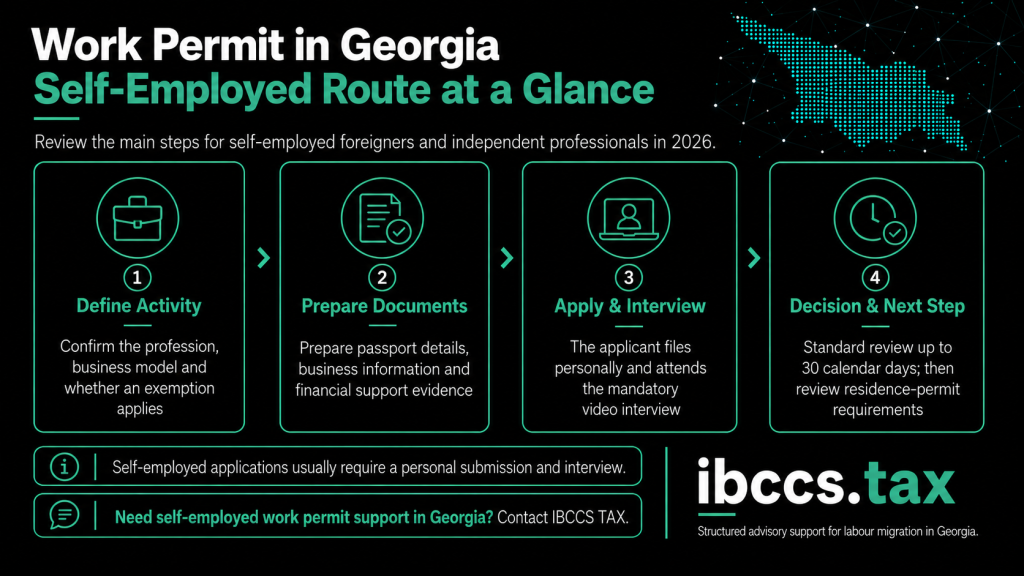
The procedure for self-employed foreigners is different from the employer-sponsored route. A self-employed applicant applies directly to the State Employment Support Agency through the labour migration portal.
Following the July 2026 amendments, the self-employed applicant must submit the application personally rather than through an authorised representative. The Agency can request additional information or correction of deficiencies during the review.
Documents and Information for a Self-Employed Application
The application requires personal and passport information, details of education, profession, qualifications, business or labour experience and the intended activity in Georgia.
Where the applicant is already connected with a Georgian company or is registered as an entrepreneur natural person, the application can require the company or entrepreneur identification details and turnover evidence. The general annual-turnover threshold is GEL 50,000 per foreign applicant, or GEL 35,000 for an education or medical institution. A business or entrepreneur registered for no more than three months is currently exempt from providing the ordinary annual-turnover certificate.
Where the applicant intends to start a new entrepreneurial activity, the procedure requires a detailed business plan containing information on the planned investment, expected annual turnover, resources required to start the activity and supporting financial evidence.
Mandatory Video Interview for Self-Employed Applicants
A self-employed applicant must attend a video interview with the Agency after submitting the required information. The interview is conducted in Georgian or English, and an interpreter can attend where needed.
The applicant must have the original foreign passport used for the application available during the interview. Failure to attend the interview, confirm the electronic application or present the original passport can result in refusal.
Self-Employed Work Permit Fees and Timing
The same general service periods apply to a self-employed application: up to 30 calendar days for standard review and no later than the tenth working day under the expedited procedure. The fees are GEL 200 and GEL 400 respectively, and in the self-employed case the applicant pays the fee directly.
Short-Term Professional Activity: When a Full Work Permit May Not Be Needed
The 2026 amendments introduced a separate short-term professional activity route. A foreign national can carry out qualifying professional activity in Georgia without the ordinary right to work and the relevant residence permit where the activity forms part of a temporary visit, does not constitute long-term employment in the local labour market and relates to a specific short-term project, event or service.
The activity may not exceed a total of four months in the calendar year and cannot exceed the person’s lawful period of stay in Georgia. Before the activity begins, the Georgian employer or service organiser must register the foreign national through the labour migration system and submit the required information. Registration for this category is free.
The short-term route cannot be used merely by describing ordinary long-term employment as a project. It also does not apply where the worker is not properly registered, is not legally staying in Georgia or carries out an activity subject to the sector quota list.
IT Professionals: Longer Work Authorisation and Residence Options
Georgia provides a more favourable validity period for qualifying foreign nationals working in information technology. A right to work issued to an employed or self-employed IT professional can be valid for up to three years and can be extended for periods of up to three years.
There is also a specific IT residence permit. For relevant IT employees and Individual Entrepreneurs with Small Business Status, the residence rules include at least two years of IT labour or economic activity experience and annual IT remuneration of at least USD 25,000 equivalent in GEL. Certain managers and representatives of qualifying international companies can also fall within the IT residence framework.
The IT work-authorisation and residence rules are related but separate. A person should verify both the work-permit eligibility and the residence-permit criteria before assuming that qualification for one automatically guarantees the other.
Can International Students Work in Georgia?
A study residence permit does not create a blanket exemption from the right-to-work rules. If a foreign student takes paid employment with a Georgian employer, the ordinary labour migration analysis still applies unless another statutory exemption covers the activity.
However, a person who already holds a valid Georgian residence permit is not required to apply for a separate work residence permit merely because the right to work is obtained. This distinction is important: an existing study residence permit can affect the immigration step after work authorisation, but it does not automatically eliminate the work-authorisation requirement itself.
Can You Work in Georgia on Visa-Free or Tourist Status?
Lawful entry or visa-free stay does not by itself give a foreign national the right to carry out paid activity. A foreigner who is legally staying in Georgia can generally apply for the right to work, but if the activity requires work authorisation, the work should not begin simply because the person is lawfully present in the country.
After the right to work is issued, a person already in Georgia who does not hold another Georgian residence permit generally has 10 calendar days to apply for the relevant work residence permit or IT residence permit.
How Long Is a Georgian Work Permit Valid?
For a standard foreign employee or self-employed foreigner, the first right to work is generally issued for a period from six months to one year. During the first five years, an extension can generally be granted for up to one year each time.
After the right to work has been extended continuously for five years, subsequent extensions can be granted for periods from one to five years. IT-sector rights to work follow the separate up-to-three-year validity and renewal framework.
An extension application should be submitted at least 30 calendar days before the existing right to work expires. The employer handles the extension for an employee, while the self-employed foreigner applies directly.
What Happens If the Employer or Activity Changes?
The employee’s right to work is specific to the approved employer and position. A change of employer or a substantive change in position can therefore require a new right to work. A self-employed person who changes the approved field of labour or entrepreneurial activity also needs the corresponding updated authorisation.
The July 2026 amendments clarified that where an employment contract changes only the position level, salary or work schedule, without changing the underlying approved position, a new right-to-work application and contract-change report are not required on that basis alone.
Where an employment agreement terminates early or is changed in a way that must be reported, the employer has a specific obligation to update the labour migration system. Early termination must generally be reported within five calendar days.
Why Can a Work Permit Application Be Refused?
A right-to-work application can be refused where the required information or documentation is incomplete and the deficiency is not corrected properly within the permitted period. Refusal can also arise where employer quota requirements are not satisfied, a sector quota has already been exhausted, the person’s qualifications or proposed work do not correspond to labour-market requirements, or expulsion proceedings are pending.
For self-employed applicants, failure to attend the mandatory video interview, confirm the application or show the original passport can also result in refusal.
A refusal can be appealed to court within one month, but the appeal does not itself create a right to work and does not automatically postpone an obligation to leave Georgia or suspend an expulsion process.
Penalties for Working Without the Right to Work
The 2026 framework introduced specific administrative penalties for unauthorised work. A foreign employee carrying out paid activity without the required right to work can be fined GEL 2,000. The Georgian employer or service organiser can also be fined GEL 2,000 for each foreign worker employed without the required authorisation.
A self-employed foreigner carrying out activity without the required right to work can likewise be fined GEL 2,000. A repeated offence can result in a GEL 4,000 fine, and a further offence after the repeat sanction can result in a GEL 12,000 fine.
Separate penalties apply for other breaches, including failure by an employer to report required employment-agreement changes and changing the employer or approved activity without renewing the right to work.
The Labour Migration Portal in Georgia
Applications, employer quota procedures and many related notifications are handled through Georgia’s special labour migration electronic system at labourmigration.moh.gov.ge. Worknet is a separate system used for the local labour-market vacancy procedure that normally precedes an employer-sponsored application.
The distinction is practical: Worknet is used to test the local labour market, while the labour migration portal is used for the formal right-to-work process, self-employed applications, quota procedures and other labour migration registrations.
Transitional Rule Until 1 January 2027
There is an important transitional rule for labour immigrants who were already registered in the Ministry’s unified labour migration database and had active registration status on 1 March 2026. Those persons must obtain the right to work and the appropriate residence permit no later than 1 January 2027.
This is not a general grace period for every foreign national who was in Georgia before March 2026. The rule is tied to the specified active database registration status. Anyone relying on the transition should confirm that the historical registration actually qualifies.
Common Work Permit Mistakes in Georgia
The most common compliance problems arise when foreign nationals and employers assume that one legal status automatically covers another. The following issues should be checked before work begins:
- Assuming visa-free entry or tourist status automatically gives permission to work.
- Registering an Individual Entrepreneur and assuming business registration replaces the right to work.
- Treating a Georgian residence permit as an automatic work-permit exemption where the person still falls within the labour migration rules.
- Skipping the Worknet process without confirming that a specific labour-market-test exemption applies.
- Using the GEL 15,000 salary exception without also meeting the relevant higher-education condition.
- Hiring several foreign workers without reviewing the employer’s annual quota and turnover requirements.
- Submitting a self-employed application through a representative despite the requirement for personal submission.
- Preparing a self-employed application without a credible business plan, turnover evidence or financial support documentation.
- Changing employer, position or business activity without checking whether the existing authorisation still covers the new arrangement.
- Treating a short-term project as automatically exempt without completing the required registration.
- Missing the 10-day or 30-day post-approval immigration and residence steps.
- Relying on the 1 January 2027 transition without having the required active registration status on 1 March 2026.
Work Permit and Labour Migration Support from IBCCS TAX Georgia
The 2026 framework means that work authorisation should be reviewed together with employment documentation, company structure and residence status. A foreign employee can have a valid employment contract but still lack the required work authorisation. A self-employed professional can have a registered business and tax number but still need to address labour migration requirements.
IBCCS TAX Georgia supports both foreign nationals and Georgian employers with the practical implementation of the current rules. Depending on the case, our support can include:
- Assessment of whether the right to work is required or a statutory exemption applies.
- Review of employee, self-employed, remote-work and founder/director status.
- Preparation and review of employment agreements and supporting immigration documentation.
- Worknet vacancy and labour-market procedure support.
- Right-to-work applications through the labour migration system.
- Employer annual quota and turnover-documentation review.
- Self-employed application preparation, business-plan review and video-interview preparation.
- Assessment of work residence permit or IT residence permit eligibility after work-authorisation approval.
- Review of changes to employer, position, contract or entrepreneurial activity.
- Renewals, reporting obligations and support with existing or historical labour migration registrations.
For wider relocation planning, foreign professionals and families can also review our expat services in Georgia. Employers should coordinate the immigration analysis with their broader legal requirements for Georgian companies so that employment contracts, corporate records and work-authorisation procedures remain aligned.
Review the Work and Residence Route Before Activity Begins
Georgia remains accessible to international professionals and entrepreneurs, but the 2026 labour migration framework has made the legal sequence more important. The correct route depends on whether the person is an employee or self-employed, who receives the services, whether an exemption applies, where the person is physically located, the employer’s size and turnover, and the residence status the person intends to use.
The safest approach is to determine the work-authorisation position before employment or paid activity starts, prepare the supporting documents around the actual commercial arrangement and then coordinate the right to work with the D1 visa or residence-permit requirements where necessary.
IBCCS TAX Georgia can review the complete position and coordinate the work permit, employment and residence process. Contact IBCCS TAX to discuss a foreign employee, self-employed application, employer quota, short-term professional activity or wider relocation to Georgia.

FAQ: Work Permit in Georgia for Foreigners
1. Do foreigners need a work permit in Georgia in 2026?
Many foreign nationals without permanent residence now need the formal right to work if they are employed by a Georgian employer or carry out self-employed labour or entrepreneurial activity in Georgia. Defined statutory exemptions apply, so the correct answer depends on the activity, employer or client, residence status and working arrangement.
2. What is the right to work in Georgia?
The right to work is the formal labour migration authorisation issued through the State Employment Support Agency. For an employee it is tied to a specific Georgian employer and position; for a self-employed foreigner it is linked to a specific profession and field of activity.
3. How do I apply for a work permit in Georgia?
A foreign employee applies through the Georgian employer, generally after the applicable Worknet labour-market procedure. A self-employed foreigner applies directly through the labour migration portal and must attend a mandatory video interview.
4. What is the labour migration portal in Georgia?
The special electronic system at labourmigration.moh.gov.ge is used for right-to-work applications, self-employed applications, employer quota procedures and related labour migration registrations. Worknet is the separate portal used for the local labour-market vacancy procedure.
5. How long does it take to get a Georgia work permit?
The standard procedure takes up to 30 calendar days after a complete application is filed. Expedited administrative review is available with a decision no later than the tenth working day.
6. How much does a work permit in Georgia cost?
The current service fee is GEL 200 for the standard procedure and GEL 400 for expedited review. An extension under the standard procedure costs GEL 200. The employer pays for an employed foreign worker, while a self-employed applicant pays directly.
7. What is the difference between a work permit and a D1 visa in Georgia?
The right to work authorises the labour or entrepreneurial activity. A D1 visa is an immigration document. A person outside Georgia who obtains the right to work generally has 30 calendar days to apply for a D1 visa unless another rule applies.
8. Do I need a work residence permit after getting the right to work?
If you are already in Georgia and do not hold another qualifying Georgian residence permit, you generally have 10 calendar days after obtaining the right to work to apply for a work residence permit or, where applicable, an IT residence permit.
9. Can I work in Georgia on visa-free status?
Visa-free entry allows lawful presence but does not automatically authorise paid work. If your activity falls within the right-to-work regime, the required work authorisation must be obtained even if you entered Georgia visa-free.
10. Can international students work in Georgia?
A study residence permit does not automatically exempt a student from the right-to-work rules. Paid employment with a Georgian employer should be reviewed under the labour migration framework. However, a person who already holds a Georgian residence permit is generally not required to apply for a separate work residence permit after obtaining the right to work.
11. Do freelancers need a work permit in Georgia?
A freelancer or independent contractor carrying out paid activity in Georgia can fall within the self-employed foreigner rules. An exemption may apply where the person provides services to a non-resident and the services are connected with the non-resident’s activities outside Georgia, but the residence objective and business structure can change the analysis.
12. Does a Georgian Individual Entrepreneur need a work permit?
For a foreign national without permanent residence, registration as an Individual Entrepreneur does not automatically replace the right-to-work requirement. The labour migration position should be assessed separately from business and tax registration.
13. Do company directors need a work permit in Georgia?
It depends on the company category and the person’s role. Managers of Category I-III enterprises and public interest entities can fall within a statutory exemption, while a manager of a Category IV enterprise may need to use the self-employed procedure.
14. Is there a labour-market test before hiring a foreign employee?
Usually yes. The employer generally posts the vacancy on Worknet for at least 10 working days before applying. Defined exceptions include International Company Status, Innovative Startup Status and certain highly paid roles requiring relevant higher education.
15. What is the GEL 15,000 work permit exemption?
It is an exemption from the ordinary Worknet labour-market testing procedure where the position pays more than GEL 15,000 gross per month and relevant higher education is objectively required for the role. It is not a general exemption from the right-to-work system itself.
16. Can a Georgian employer hire many foreign employees?
Yes, but an employer planning to employ more than five foreign citizens or exceeding the applicable 5% workforce threshold can be required to obtain an annual quota. Turnover requirements also apply, generally GEL 50,000 per foreign applicant or GEL 35,000 for education and medical institutions.
17. How long is a Georgia work permit valid?
A standard first right to work is generally valid for six months to one year. During the first five years, extensions can generally be granted for up to one year at a time. Qualifying IT rights to work can be issued and renewed for periods of up to three years.
18. Can I change employer after getting a work permit?
The right to work is employer-specific for an employee. Changing the employer generally requires a new right to work. A material change in the approved position can also require a new authorisation.
19. What is short-term professional activity in Georgia?
It is a separate route for qualifying temporary professional projects, events or services that do not constitute long-term local employment. The activity can last up to four months in a calendar year, subject to lawful stay and prior registration through the labour migration system.
20. What is the fine for working without a work permit in Georgia?
The foreign worker or self-employed person can be fined GEL 2,000 for working without the required right to work. In the employee case, the employer can also be fined GEL 2,000 for each unauthorised foreign worker. Repeated violations can lead to higher penalties.
21. Who has until 1 January 2027 to comply?
The transition applies to labour immigrants who were registered in the Ministry’s labour migration database and had active registration status on 1 March 2026. It is not a general deadline for every foreign national who was living or working in Georgia before March 2026.
22. Can IBCCS TAX help with a work permit in Georgia?
Yes. IBCCS TAX Georgia can assess whether the right to work is required, prepare employee or self-employed applications, support Worknet and employer quota procedures, review residence-permit requirements and coordinate the wider legal and immigration process.





Work Permit in Georgia for Foreigners: Right to Work, Employers, Self-Employed and Residence Rules
Georgia introduced a substantially more regulated labour migration framework in
Read More
Cezary Zieniuk to Join Free IMC Webinar on the New Geography of Global Mobility
On 23 September 2026, Cezary Zieniuk, Founder of IBCCS TAX
Read More
Property Tax in Georgia in 2026: Rates, Income Thresholds, Filing and Rules for Foreign Owners
Property tax in Georgia is an annual obligation that can
Read MoreDisclaimer: This article is for general information only and does not constitute tax, legal or financial advice. Professional advice should be obtained based on your specific circumstances.