

Value Added Tax (VAT) is one of the most important ongoing tax obligations for businesses operating in Georgia. The standard rate is 18%, but the practical VAT position depends on much more than the headline rate. A company needs to know when registration becomes mandatory, which transactions count toward the threshold, whether a supply is taxable in Georgia, what input VAT can be deducted, how cross-border services are treated and how monthly returns and invoices should be managed.
For foreign-owned Georgian companies, the analysis can become more complex. A Georgian LLC may sell services to customers abroad, buy software or professional services from non-residents, import goods, work with related companies in other jurisdictions or combine taxable and exempt activities. Each of those facts can affect the VAT result even where the company has a relatively simple corporate structure.
At IBCCS TAX, our teams in Tbilisi and Batumi support businesses with taxation services in Georgia, including VAT registration, transaction review, monthly compliance, VAT deductions, reverse-charge analysis and communication with the Revenue Service. This guide explains how the Georgian VAT system works in 2026 and what businesses should review before a registration or filing issue becomes a tax risk.

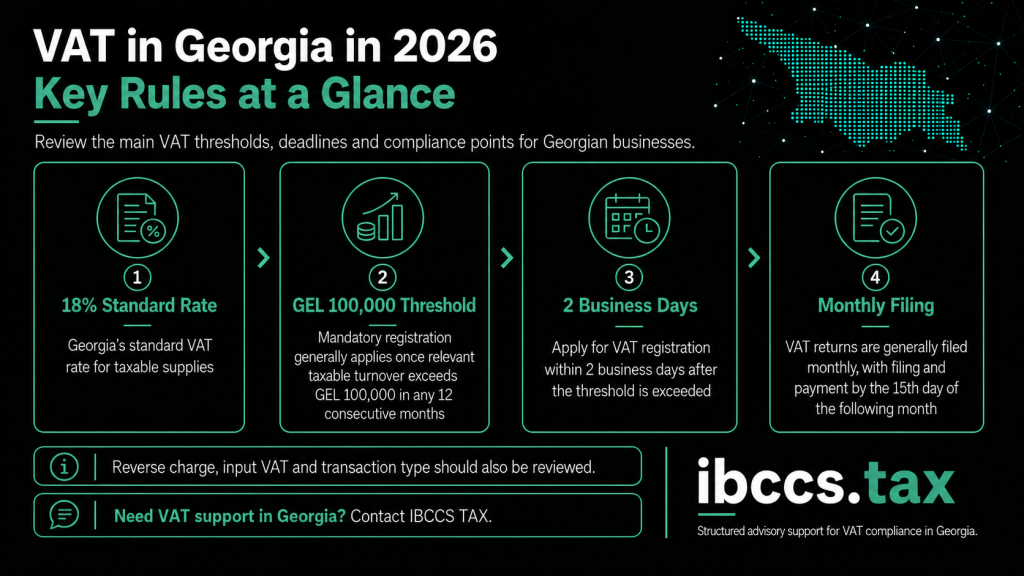
- The standard VAT rate in Georgia is 18%.
- Mandatory VAT registration generally arises when VAT-taxable supplies exceed GEL 100,000 during any 12 consecutive calendar months. This is a rolling 12-month test, not a calendar-year threshold.
- A person that exceeds the mandatory threshold should apply for VAT registration no later than two business days after the threshold is exceeded. VAT liability arises from the transaction that causes the threshold to be exceeded, including that transaction.
- Voluntary VAT registration is available before the mandatory threshold is reached and may be useful where the business has material input VAT or works mainly with VAT-registered customers.
- VAT is reported monthly. A registered VAT taxpayer generally files the VAT return and pays the tax no later than the 15th day of the following month.
- Input VAT may generally be deductible where purchases are used for taxable activities and the company holds the required supporting documents. Mixed taxable and exempt activities can require proportional deduction.
- Cross-border services require a place-of-supply review. Services purchased from a non-resident may create reverse-charge VAT in Georgia, while many B2B services supplied to foreign taxable customers may fall outside the Georgian place of supply under the general rule, subject to exceptions.
- Georgia distinguishes VAT exemptions with the right of deduction from exemptions without the right of deduction. The difference is important for pricing and recoverability of input VAT.
- The Revenue Service has announced a new process for timely confirmation or rejection of VAT invoices from 1 October 2026. As at September 2026, the detailed access-restriction mechanism has been publicly announced by the Revenue Service, but we have not identified a published legal act incorporating all of those specific procedural details. Businesses should prepare operationally and continue monitoring final formal guidance.
- IBCCS TAX Georgia can coordinate VAT registration, monthly returns, invoice review, input VAT analysis, reverse-charge treatment and VAT clean-up as part of an ongoing tax and accounting engagement.
Why VAT Matters for Georgian Companies
VAT often becomes relevant earlier than founders expect because the registration threshold is relatively low compared with the turnover of an operating company in Georgia. A business that monitors only annual revenue can miss the point at which the rolling 12-month threshold is exceeded. Once the obligation arises, the issue is no longer only registration: the company must also determine which supplies should bear VAT, whether historical transactions need correction and how VAT should be reflected in invoices and accounting records.
For established companies, VAT is an ongoing control process. Sales invoices, purchase invoices, imports, non-resident services, credits, adjustments and the accounting ledger should be aligned before the monthly return is submitted. Weak VAT controls can create cash-flow costs where deductible VAT is missed, or tax exposure where output VAT is under-reported.
VAT should therefore be coordinated with the company’s wider accounting services in Georgia. Monthly bookkeeping makes threshold monitoring, invoice reconciliation and VAT return preparation materially easier because the VAT position is reviewed as transactions occur rather than reconstructed after the deadline.
What Is VAT in Georgia?
VAT is an indirect tax applied to taxable supplies of goods and services and to certain imports and cross-border transactions. A VAT-registered business generally charges output VAT on taxable Georgian supplies and may deduct eligible input VAT incurred on purchases used for taxable activities. The net balance is reported to the Revenue Service for each monthly tax period.
The commercial result depends on the customer and transaction type. A B2B business may often pass VAT through to a VAT-registered customer that can itself claim a deduction, while a B2C business may need to absorb VAT into its final price or increase the consumer price. For that reason, VAT registration is both a tax-compliance question and a pricing and cash-flow question.
Who Must Register for VAT in Georgia?
A taxable person generally becomes subject to mandatory VAT registration when the total amount of VAT-taxable supplies of goods or services exceeds GEL 100,000 during any 12 consecutive calendar months. The rule can apply to companies and individual entrepreneurs, and the legal form of the business does not by itself remove the VAT obligation.
The threshold test should not be treated as a simple gross-revenue test. Georgian VAT legislation excludes certain transactions from the registration calculation, including specified exempt transactions and exports of goods. A business with a mixture of Georgian taxable sales, exports, exempt supplies and foreign services should therefore classify the transactions before deciding whether the GEL 100,000 threshold has been crossed.
How the GEL 100,000 VAT Threshold Works
The most important practical point is that the GEL 100,000 threshold is measured over any 12 consecutive calendar months. It does not reset automatically on 1 January. The company should therefore monitor the relevant VAT-taxable turnover every month using a rolling calculation.
Example: Why the Threshold Is Not a Calendar-Year Test
Assume a company has GEL 58,000 of relevant VAT-taxable supplies from July to December 2025 and a further GEL 47,000 from January to June 2026. The combined amount for the 12 consecutive months from July 2025 to June 2026 is GEL 105,000. The company may therefore cross the VAT threshold during 2026 even though neither the 2025 calendar-year figure nor the first six months of 2026, viewed separately, exceeds GEL 100,000.
Once the threshold is exceeded, the application for VAT registration should generally be made no later than two business days. Importantly, the VAT liability arises from the taxable transaction that causes the threshold to be exceeded, including that transaction. A company should not assume that VAT starts only after the Revenue Service formally completes the registration.
What Happens If VAT Registration Is Late?
Late registration can create exposure because the underlying VAT liability is tied to the point at which the statutory threshold was exceeded, not simply to the date on which the company eventually submits the registration application. The Revenue Service can therefore review the historical period from the effective VAT obligation, together with the related declarations, tax payable, interest and any applicable sanctions.
The safest approach is preventive threshold monitoring. Businesses that are approaching GEL 100,000 should review the composition of their turnover before the threshold is crossed, particularly where they issue long-term contracts, receive advance payments or have a mixture of domestic and international transactions.
VAT threshold approaching? IBCCS TAX Georgia can review the rolling 12-month turnover, confirm whether registration is required and coordinate the VAT registration process before the company starts filing monthly returns.

Voluntary VAT Registration in Georgia
A business does not need to wait until it exceeds GEL 100,000. Georgian law allows voluntary VAT registration, in which case the person is generally treated as a VAT taxpayer from the date of application, subject to the compulsory-registration rules if the mandatory threshold has already been reached.
Voluntary registration can be commercially useful where the company expects significant VAT-bearing costs, imports equipment or inventory, works mainly with VAT-registered B2B customers, or wants its VAT treatment in place before scaling. In those cases, the ability to claim eligible input VAT can improve the economics of the business.
It is not automatically the right choice for every company. A business selling mainly to private consumers or VAT-exempt customers may find that VAT registration increases its effective price or reduces margin, while also creating monthly filing and invoice-management obligations. The decision should be modelled using expected revenue, customer type, input costs and transaction geography rather than made only for reputational reasons.
How to Register for VAT in Georgia
VAT registration is handled through the Georgian tax administration. Before applying, the Georgian company should establish whether the registration is mandatory or voluntary, identify the effective date, confirm the turnover calculation and make sure its accounting records can support the first VAT period.
For a mandatory registration, the application deadline is generally two business days after the threshold is exceeded. For a voluntary registration, the timing should be coordinated with invoicing and purchase activity so that the company understands from which date it will operate as a VAT taxpayer.
After registration, the company should immediately align its invoice process, sales accounting, purchase-document collection and monthly close. VAT registration without an operational accounting process often creates problems in the first return because sales may be invoiced incorrectly or input VAT documents may not be captured in time.
VAT Rate in Georgia: 18%
The standard VAT rate in Georgia is 18%. Where a transaction is subject to Georgian VAT, the company should determine whether the agreed commercial price is VAT-exclusive or VAT-inclusive. That distinction matters because the tax can either be added to the contractual price or extracted from a gross amount already agreed with the customer.
For example, if a taxable price is GEL 10,000 excluding VAT, the VAT is GEL 1,800 and the gross invoice is GEL 11,800. If GEL 11,800 is already a VAT-inclusive amount, the VAT component is calculated from the gross amount rather than by simply adding another 18%.
VAT Exemptions in Georgia: With and Without the Right of Deduction
Georgia distinguishes between transactions that are VAT exempt with the right of deduction and transactions that are VAT exempt without the right of deduction. The terminology is important because both categories may result in no output VAT being charged on the transaction, but the treatment of input VAT can be very different.
| VAT treatment | Output VAT | Input VAT consequence |
| Taxable at 18% | VAT generally charged | Eligible input VAT may generally be deductible |
| Exempt with right of deduction | No output VAT charged under the exemption | Related input VAT may generally remain deductible |
| Exempt without right of deduction | No output VAT charged under the exemption | Related input VAT is generally not deductible |
Exports of goods are a common example of a transaction that is VAT exempt with the right of deduction, provided the statutory conditions and evidence are met. Financial services and certain medical, educational and other activities may fall within exemptions without the right of deduction. The exact legal category should be checked rather than relying on the commercial label used for the transaction.
VAT on Imports and Exports
Import VAT is a separate obligation from the domestic registration threshold. A person importing goods can be liable for VAT on import even where the person is not otherwise required to register as a VAT taxpayer. The customs value, applicable import rules and supporting customs documentation should therefore be reviewed as part of the transaction.
Exports of goods from Georgia are generally VAT exempt with the right of deduction where the statutory export conditions are met. This allows the supplier to make the qualifying export without charging Georgian output VAT while preserving the right to deduct eligible input VAT connected with the exported goods. Customs declarations and transport evidence are important because the VAT treatment depends on the legal export being properly documented.
Trading businesses using customs warehouses or re-export structures should review VAT together with the customs model. Our guide to Special Trading Company Status in Georgia explains why special corporate or trading status does not remove the need for a separate VAT and customs analysis.
Input VAT and VAT Deductions
A VAT-registered taxable person may generally deduct VAT paid or payable on purchases used for VAT-taxable activities, subject to the conditions and documentary requirements in the Tax Code. Deduction can also be available for VAT paid on imports and VAT assessed under the reverse-charge mechanism where the statutory conditions are satisfied.
The deduction is not automatic merely because a supplier charged VAT. The company should hold the appropriate tax invoice, import declaration or other permitted deduction document and should be able to demonstrate the business connection between the cost and its taxable activity. Invoices that do not meet the required rules, private or representation expenses and other restricted items may not support a deduction.
Mixed Taxable and Exempt Activities
Where the same purchases support both transactions giving a right of deduction and transactions that do not, the company may need to apply proportional VAT deduction rules. This is particularly relevant for businesses combining taxable commercial operations with financial, educational, medical or other exempt activities.
A clean chart of accounts and accurate cost allocation make this analysis easier. If the accounting system cannot identify which costs support which activity, the company may struggle to justify the VAT deduction taken in the monthly return.
Reverse Charge VAT in Georgia
Reverse-charge VAT is especially relevant to Georgian businesses purchasing services from non-resident suppliers. Under the Georgian Tax Code, services supplied in Georgia to a Georgian tax agent by a taxable person that is not established or normally resident in Georgia, and does not have a participating fixed establishment in Georgia, can be subject to VAT under the reverse-charge mechanism.
In practical terms, a Georgian business purchasing foreign consulting, software, marketing, professional or other services should not assume that the absence of Georgian VAT on the supplier’s invoice means there is no Georgian VAT consequence. The first question is where the service is treated as supplied under Georgia’s place-of-supply rules. If the place of supply is Georgia and the reverse-charge conditions are met, the Georgian recipient may need to calculate and report VAT.
For a VAT-registered business using the service for taxable activities, reverse-charge VAT can often be deductible in the same VAT framework, subject to proper declaration and eligibility. A non-VAT-registered recipient can still have a reverse-charge payment obligation without becoming generally VAT-registered solely because of that transaction. This is one reason cross-border supplier costs should be reviewed separately from the GEL 100,000 registration threshold.
VAT for Foreign-Owned Georgian LLCs and International Service Companies
Foreign-owned Georgian LLCs frequently have customers and suppliers in several countries. VAT should therefore be analysed transaction by transaction rather than by asking only where the company is incorporated.
Services Sold to Foreign Business Customers
Under the general B2B place-of-supply rule, where the recipient is a taxable person, the place of supply is generally where the recipient is established, or the relevant fixed establishment if the service is supplied to that establishment. As a result, many ordinary B2B services supplied by a Georgian company to a foreign taxable customer may be treated as supplied outside Georgia rather than as a Georgian 18% VAT transaction.
There are important exceptions, including rules for services connected with immovable property, events, transport and other specified activities. The company should therefore classify the service before invoicing. A foreign customer address on the contract is not, by itself, enough to establish the correct VAT treatment.
Services Purchased from Foreign Suppliers
Where a Georgian company buys services from a non-resident supplier, the general B2B rule can place the service in Georgia because the recipient is established in Georgia. This can create reverse-charge VAT for services such as consulting, legal, accounting, advertising, software and digital tools, depending on the facts and the applicable exceptions.
This is a common issue for technology and online businesses that use foreign SaaS platforms, cloud services, advertising providers and independent consultants. The accounting team should identify recurring non-resident suppliers during the monthly close rather than waiting for a tax audit to discover the reverse-charge exposure.
Related-Party and Group Transactions
Charges between a Georgian company and a foreign parent, subsidiary or related service company should be reviewed for both VAT and broader tax purposes. Management fees, IP licences, development services, cost recharges and shared-service arrangements can create different VAT outcomes depending on the nature of the service and where it is used.
Where the Georgian company is part of a wider international structure, VAT analysis should be coordinated with international tax structuring so that invoicing, transfer-pricing documentation, corporate tax and VAT do not contradict one another.
VAT and Georgia’s 1% Small Business Regime
The VAT rules should not be confused with Georgia’s Small Business Status regime for qualifying Individual Entrepreneurs. The 1% turnover-tax regime and VAT are separate systems with separate thresholds and compliance obligations. An entrepreneur using Small Business Status can still become required to register for VAT if the VAT registration conditions are met.
This distinction is important for freelancers and consultants whose turnover is growing. Our guide to the Georgia 1% tax regime and Small Business Status explains the income-tax regime, while VAT registration should be monitored independently using the VAT rules.
VAT Returns and Monthly Filing Deadlines
The VAT accounting period in Georgia is a calendar month. A VAT-registered taxpayer generally submits the VAT declaration and pays the VAT due no later than the 15th day of the month following the reporting period.
| VAT area | Main rule | Practical control |
| Registration threshold | GEL 100,000 of relevant VAT-taxable supplies in any 12 consecutive months | Monitor rolling turnover monthly |
| Standard rate | 18% | Confirm whether contract price is VAT-inclusive or VAT-exclusive |
| Tax period | Calendar month | Close sales and purchase ledgers monthly |
| Return and payment | Generally by the 15th day of the following month | Reconcile invoices and ledger before filing |
| Input VAT | Deduction subject to taxable use and valid evidence | Check invoice/document eligibility |
| Reverse charge | Can apply to qualifying non-resident services | Review foreign suppliers every month |
A monthly VAT return should be based on reconciled accounting records. The company should compare sales, purchase invoices, bank transactions, import documents, reverse-charge items, credit notes and prior-period adjustments before submission. Filing from an incomplete invoice register can result in both underpaid output VAT and missed deductions.
Companies that want the VAT process integrated with bookkeeping can review our detailed guide to accounting in Georgia for Georgian LLCs, which explains how monthly accounting and tax compliance should work together.
VAT Invoices in Georgia
Tax invoices are a central part of the Georgian VAT system. A VAT-registered taxable person generally issues a tax invoice when supplying goods or services to another taxable person, subject to the specific rules and exceptions. Tax invoices can be issued in written or electronic form, and the Ministry of Finance determines the forms, details and procedures for issuing, recording and using them.
For the recipient, a valid tax invoice is also an important deduction document. The company should therefore review not only invoices it issues but also invoices it receives. Supplier identity, transaction period, taxable amount, VAT amount and the underlying commercial transaction should reconcile with the accounting records.
Announced VAT Invoice Confirmation Changes from 1 October 2026
The Georgian Revenue Service has announced a new administrative mechanism intended to strengthen the timely confirmation or rejection of VAT invoices from 1 October 2026. Under the announcement, taxpayers will be expected to take action on invoices received for confirmation in the Revenue Service electronic portal rather than leaving them pending.
The announced process states that, if a taxpayer still has an invoice awaiting confirmation on the 5th day of the following month, the primary user and sub-users may temporarily lose access to Revenue Service electronic services other than the invoice modules. Access is expected to be restored immediately after the pending invoice is confirmed or rejected.
The practical message for businesses is clear: invoice confirmation should become part of the monthly VAT close. A company should assign responsibility for reviewing incoming electronic VAT invoices, checking them against contracts and accounting records, and confirming or rejecting them before the next month’s administrative cut-off.
Status of the October 2026 Change as at September 2026
The Revenue Service has publicly announced the 1 October 2026 implementation date and the intended portal-access mechanism. However, as at the date of this article in September 2026, we have not identified a published legal act in the Georgian legislative database incorporating all of the specific procedural details described in the announcement. The existing VAT legislation already regulates electronic tax invoices and their use, but the newly announced monthly access-restriction process should still be monitored for final formal implementation guidance.
Businesses should therefore prepare for the announced process operationally while continuing to follow Revenue Service updates. IBCCS TAX Georgia will apply the final procedure in monthly VAT compliance once the formal implementation details are confirmed.
Common VAT Mistakes for Georgian Companies
VAT errors are often caused by process failures rather than by the 18% calculation itself. The following issues are particularly common in companies with growing turnover or cross-border activity:
- Monitoring turnover by calendar year instead of using the rolling 12-month registration test.
- Treating all revenue as identical for the threshold without separating taxable supplies, exports, exempt transactions and supplies whose place is outside Georgia.
- Applying for VAT registration after the threshold has already been exceeded and assuming liability begins only from the registration certificate date.
- Charging 18% VAT automatically on foreign-customer invoices without checking the place-of-supply rules.
- Failing to account for reverse-charge VAT on services purchased from non-resident suppliers.
- Claiming input VAT without the required tax invoice, import declaration or other valid deduction document.
- Claiming full input VAT where costs support both taxable and exempt activities without considering proportional deduction.
- Failing to reconcile VAT invoices with the accounting ledger and bank records before the monthly return.
- Ignoring credit notes, corrections, cancelled transactions or prior-period adjustments.
- Leaving incoming electronic VAT invoices pending without a clear confirmation or rejection process as the announced October 2026 procedure approaches.
A VAT review is most effective before the filing deadline. Once a return has been submitted, corrections can still be possible, but the company may need amended declarations, accounting adjustments and supporting explanations. Regular monthly control is usually more efficient than reconstructing several periods after an issue is identified.
VAT Deregistration in Georgia
VAT registration does not necessarily continue indefinitely. A person may generally apply to cancel VAT registration if the amount of relevant taxable transactions during the preceding 12 calendar months does not exceed GEL 100,000 and at least one year has passed since the person was last registered, subject to the statutory conditions and Revenue Service procedure.
Deregistration should be planned rather than treated as a simple administrative cancellation. The company should review outstanding VAT balances, assets, inventory, open invoices and any adjustment consequences before applying. A business that expects turnover to rise again should also consider whether deregistration followed by a new registration would create unnecessary administrative work.
When a Georgian Company Should Request a VAT Review
A VAT review is particularly useful when the company is approaching the GEL 100,000 threshold, begins importing or exporting goods, starts selling services internationally, purchases significant services from foreign suppliers, changes its business model, introduces a new product line or moves from primarily B2C to B2B customers.
A review is also appropriate before a financing round, due diligence process or accounting-provider change where historical VAT treatment needs to be validated. Investors and buyers often focus on recurring tax compliance because errors can create liabilities that survive a change in ownership.
VAT Registration and Compliance Services in Georgia from IBCCS TAX
IBCCS TAX Georgia provides VAT support as part of a wider tax and accounting engagement for Georgian and foreign-owned businesses. Our objective is not only to submit the monthly declaration but to make sure the VAT treatment follows the company’s actual transactions, contracts and accounting records.
- Review of the GEL 100,000 rolling 12-month threshold and mandatory-registration date.
- Assessment of voluntary VAT registration and its commercial impact.
- Preparation and coordination of VAT registration with the Revenue Service.
- Review of local, export, import and cross-border service transactions.
- Place-of-supply and reverse-charge VAT analysis for non-resident services.
- Monthly VAT return preparation and filing.
- Review and reconciliation of sales and purchase VAT invoices.
- Input VAT eligibility and supporting-document review.
- Proportional deduction analysis for mixed taxable and exempt activities.
- VAT treatment of imports, exports and customs-related transactions.
- Review of electronic VAT invoices and operational support for the announced October 2026 confirmation process.
- VAT clean-up, amended reporting and reconciliation of historical accounting discrepancies.
- Support during Revenue Service queries, tax audits and tax disputes.
Businesses that require broader tax support can review our taxation services in Georgia. Where VAT compliance is part of the monthly bookkeeping process, our accounting services in Georgia can coordinate invoice processing, reconciliations, payroll, tax filings and year-end reporting within one workflow.
Review VAT Before the Threshold Becomes a Problem
VAT is easiest to manage when the company understands its position before a registration deadline, international transaction or filing issue arises. The core rules are straightforward at a high level – an 18% standard rate, a GEL 100,000 rolling registration threshold and monthly reporting – but the correct result depends on transaction classification, place of supply, exemptions, deductions and documentation.
For foreign-owned and internationally active Georgian businesses, VAT should be built into contracts, invoicing and accounting from the beginning. A company that monitors turnover, reviews foreign transactions, reconciles invoices and maintains valid deduction documents is much less likely to face avoidable cash-flow costs or retrospective corrections.
IBCCS TAX Georgia can review your VAT position before registration, take over monthly VAT compliance or assess historical periods where the treatment is uncertain. Contact IBCCS TAX to discuss VAT registration, monthly filing, reverse charge, input VAT or a wider tax and accounting engagement for your Georgian business.
FAQ: VAT in Georgia
1. What is the VAT rate in Georgia?
The standard VAT rate in Georgia is 18%. Whether a particular transaction is subject to 18% VAT depends on the nature of the supply, the place of supply and whether a statutory exemption applies.
2. What is the VAT registration threshold in Georgia?
Mandatory VAT registration generally arises when the total amount of relevant VAT-taxable supplies exceeds GEL 100,000 during any 12 consecutive calendar months.
3. Is the GEL 100,000 VAT threshold calculated by calendar year?
No. The threshold is a rolling 12-month test. A business should recalculate the relevant VAT-taxable turnover each month rather than starting from zero on 1 January.
4. How quickly must a company register after exceeding the VAT threshold?
A taxable person that becomes subject to mandatory registration should generally apply to the tax authority no later than two business days after the threshold is exceeded.
5. From which transaction does VAT liability start after the threshold is exceeded?
VAT liability generally arises from the taxable transaction that causes the total relevant turnover to exceed GEL 100,000, including that transaction. The company should not wait for a later formal registration date before analysing the liability.
6. Can a business register for VAT voluntarily in Georgia?
Yes. Voluntary VAT registration is available before the mandatory threshold is reached. Whether it is commercially beneficial depends on customer type, pricing, input costs and the expected VAT profile of the business.
7. When are VAT returns due in Georgia?
The VAT tax period is a calendar month. A VAT-registered taxpayer generally files the VAT return and pays the VAT due no later than the 15th day of the following month.
8. Can a Georgian company deduct input VAT?
A VAT-registered taxable person may generally deduct eligible VAT on purchases used for taxable activities, subject to the statutory conditions and valid supporting documents. Restrictions and proportional deduction can apply.
9. What is reverse-charge VAT in Georgia?
Reverse charge can apply when a Georgian tax agent receives qualifying services in Georgia from a non-resident supplier that is not established in Georgia and has no participating fixed establishment. The Georgian recipient may need to calculate and report the VAT.
10. Does a Georgian company charge VAT to foreign clients?
Not automatically. For many B2B services, the general place-of-supply rule points to the country where the taxable business customer is established, which can place the service outside Georgia. Specific exceptions apply, so the service should be classified before invoicing.
11. Are exports subject to Georgian VAT?
Qualifying exports of goods are generally VAT exempt with the right of deduction, provided the statutory conditions and export documentation are satisfied.
12. Can an Individual Entrepreneur with 1% Small Business Status also be VAT registered?
Yes. Small Business Status and VAT are separate tax regimes. An entrepreneur using the 1% regime can still become subject to VAT registration when the VAT rules and threshold are met.
13. What is changing with VAT invoice confirmation from 1 October 2026?
The Revenue Service has announced that taxpayers should timely confirm or reject VAT invoices received for confirmation. The announced mechanism indicates temporary restrictions on electronic portal access where invoices remain pending after the relevant monthly cut-off. As at September 2026, businesses should prepare for the announced process while continuing to monitor final formal implementation guidance.
14. Can a company cancel its VAT registration?
In general, a person may apply for cancellation where relevant taxable turnover for the last 12 months does not exceed GEL 100,000 and at least one year has passed since the last VAT registration, subject to the statutory procedure and other applicable conditions.
15. Can IBCCS TAX handle VAT registration and monthly VAT compliance?
Yes. IBCCS TAX Georgia can review the VAT registration position, coordinate registration, prepare monthly returns, review invoices and deductions, analyse reverse-charge and cross-border transactions, and support VAT clean-up or Revenue Service matters.






IBCCS TAX to Attend Plan ₿ Forum 2026 in Lugano, Switzerland
IBCCS TAX will be attending Plan ₿ Forum 2026 in
Read More
Georgia iGaming License in 2026: Online Casino, Slots & Sports Betting for International Operators
Georgia introduced a dedicated licensing framework in 2026 for the
Read More
Work Permit in Georgia for Foreigners: Right to Work, Employers, Self-Employed and Residence Rules
Georgia introduced a substantially more regulated labour migration framework in
Read MoreDisclaimer: This article is for general information only and does not constitute tax, legal or financial advice. Professional advice should be obtained based on your specific circumstances.