

A UAE holding company can provide a structured way to own subsidiaries, investments, intellectual property and other strategic assets. It may be used by international groups, entrepreneurs and families that want to separate ownership from day-to-day operations, centralise governance or create a platform for acquisitions and regional expansion.
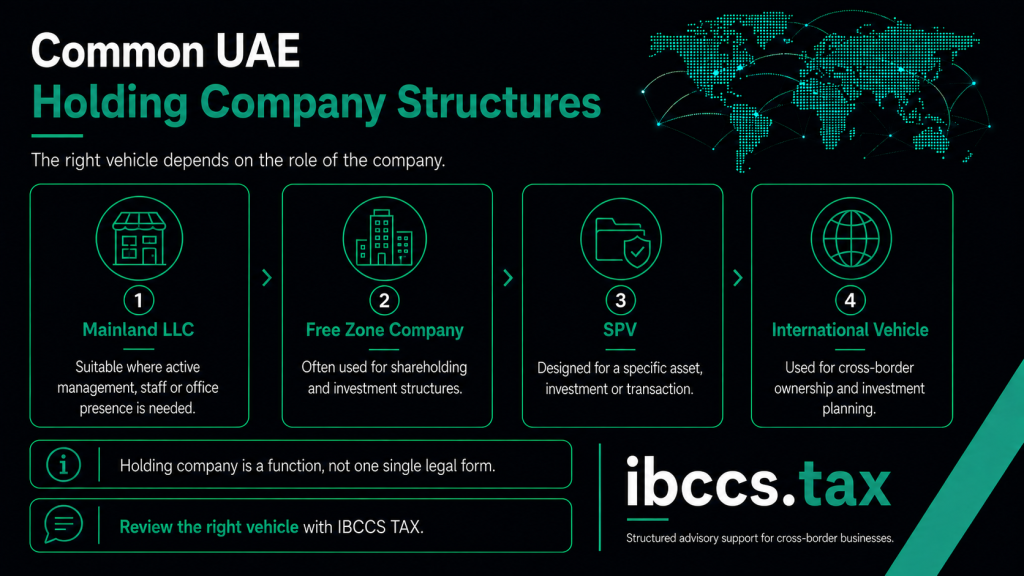
The term holding company does not describe one universal UAE legal form. The entity may be established as a mainland company, a Free Zone company, a Special Purpose Vehicle or an international corporate vehicle, depending on the assets, activities, shareholders and commercial objectives.
The correct structure should therefore be selected only after reviewing the ownership chain, expected income, financing, management, tax residence, banking and succession arrangements. A company formed solely because it is marketed as a low-tax or asset-protection solution may not provide the intended legal, tax or operational result.
Businesses comparing the broader UAE framework can review our guide to the types of companies in the UAE. More complex cross-border arrangements should also be considered alongside international business structuring and the tax position of the ultimate shareholders.

- A holding company describes the purpose of an entity rather than one specific UAE legal form.
- The company may be established through a mainland, Free Zone, SPV or international corporate structure.
- A holding company can centralise ownership and governance, but limited liability and asset separation are not absolute protections.
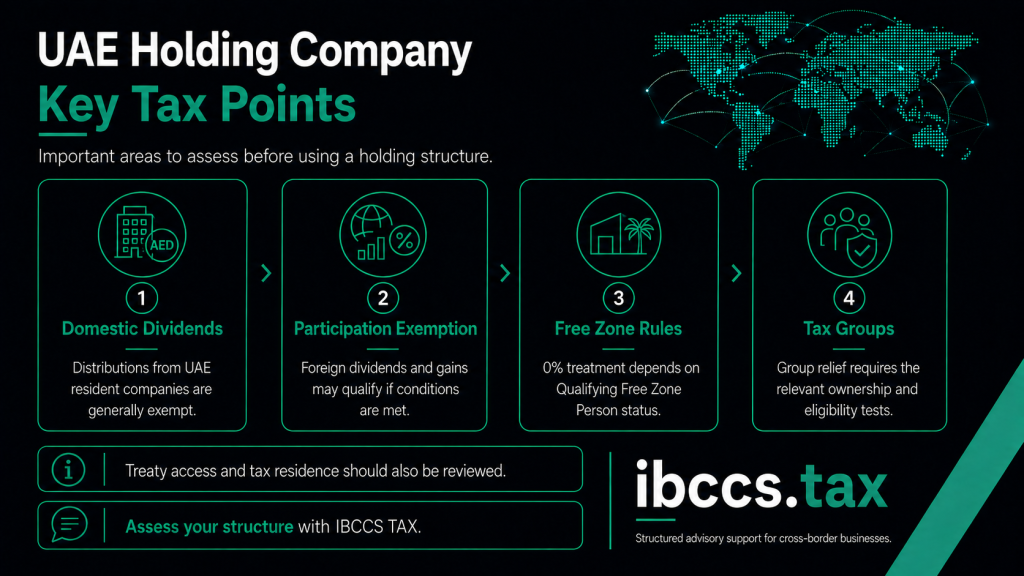
- UAE Corporate Tax applies to holding companies, although domestic dividends and qualifying participation income can be exempt.
- Foreign dividends and capital gains do not automatically qualify for exemption; the Participation Exemption conditions must be satisfied.
- A Free Zone holding company can access the 0% regime only where it qualifies as a Qualifying Free Zone Person and derives Qualifying Income.
- Tax losses of subsidiaries are not automatically consolidated at holding-company level.
- A UAE Tax Group generally requires at least 95% ownership and cannot include a Qualifying Free Zone Person.
- Treaty access and a Tax Residency Certificate depend on tax residence, management, documentation and the relevant treaty.
- A passive holding company, a management holding company and an SPV can have materially different licensing, VAT and compliance positions.
- The company must maintain accounting records, beneficial ownership information and appropriate corporate governance.
What Is a Holding Company in the UAE?
A holding company is an entity established primarily to own shares or other ownership interests in subsidiaries and investments. It may also hold intellectual property, financing instruments, real estate interests or other assets where these activities are permitted by its constitutional documents and licence.
A pure holding company generally limits its role to ownership and investment. A management or mixed holding company may also provide strategic, administrative, treasury or other services to subsidiaries, but these additional activities can change the licensing, VAT, transfer pricing and Corporate Tax position.
Descriptions such as parent company, intermediate holding company and ultimate holding company indicate the entity’s position within a group. They are not separate legal forms and do not by themselves determine the company’s tax treatment or regulatory obligations.
Holding Company Is a Function, Not a Legal Form
A UAE holding company must be incorporated using a legal form available through the selected registration authority. The same commercial objective can therefore be implemented through different structures, each with its own governance, operating rights, substance and cost profile.
The legal form should be selected according to what the entity will own, whether it will provide services, whether it needs employees or visas, and how investors may enter or exit. The company should not be described as a holding vehicle until its permitted activities and constitutional documents support that role.
Common UAE Holding Company Structures
Mainland Limited Liability Company
A mainland LLC can be used as a holding company where the relevant activity is available and approved by the competent authority. It may be suitable where the group wants a conventional operating and governance framework, access to premises and employees, or the ability to combine holding functions with permitted management activities.
A mainland structure is generally subject to the standard UAE Corporate Tax regime. It can also be relevant where the holding company will maintain an active office, employ management personnel or interact regularly with UAE operating subsidiaries.
Free Zone Holding Company
A Free Zone company may be licensed to hold shares, investments or other permitted assets. The available activities, share classes, facilities and governance rules differ between Free Zones, so the selected authority should be reviewed against the proposed asset and ownership structure.
Holding shares and other securities for investment purposes can be a Qualifying Activity under the Free Zone Corporate Tax regime where the relevant conditions are met. The shares or securities must be held for investment purposes, and the company must also satisfy the wider Qualifying Free Zone Person requirements.
Special Purpose Vehicle
A Special Purpose Vehicle is formed for a narrow and defined purpose, such as holding one investment, project, asset, financing arrangement or joint venture interest. It is generally designed to isolate a particular transaction from wider operating activities.
An SPV should not be treated as a broad operating company unless its regulations and permitted activities clearly allow this. Its constitutional documents, bank account and contracts should remain consistent with the limited purpose for which it was created.
International or Offshore Corporate Vehicle
A company registered through a UAE international corporate registry can be used for shareholding, investment and cross-border structuring. These entities are generally not standard operating companies and may not provide the same premises, employee or visa framework as a mainland or operational Free Zone company.
The rights of the vehicle depend on the specific registry and product. The general term offshore should not be used as a substitute for reviewing the entity’s legal capacity, Corporate Tax position, banking eligibility and permitted UAE activities.
Holding Company vs SPV vs Operating Company
| Factor | Holding company | SPV | Operating company |
| Primary role | Own subsidiaries or strategic assets | Hold a specific asset or transaction | Conduct active business |
| Typical income | Dividends, gains, interest or management fees | Income linked to the specific asset or project | Trading or service revenue |
| Employees | Possible where management activity requires them | Usually limited | Common |
| Commercial activity | Limited or group-focused | Restricted to stated purpose | Broad within the licence |
| Governance | Group and investment oversight | Transaction-specific | Operational management |
| Best suited to | Groups, investors and family ownership structures | Projects, joint ventures and ring-fenced investments | Customer-facing operations |
The labels should reflect the actual role of the entity. A company that invoices subsidiaries for management, treasury or administrative services is no longer purely passive and must account for those functions in its licence, VAT, transfer pricing and substance analysis.
Why Establish a Holding Company in the UAE?
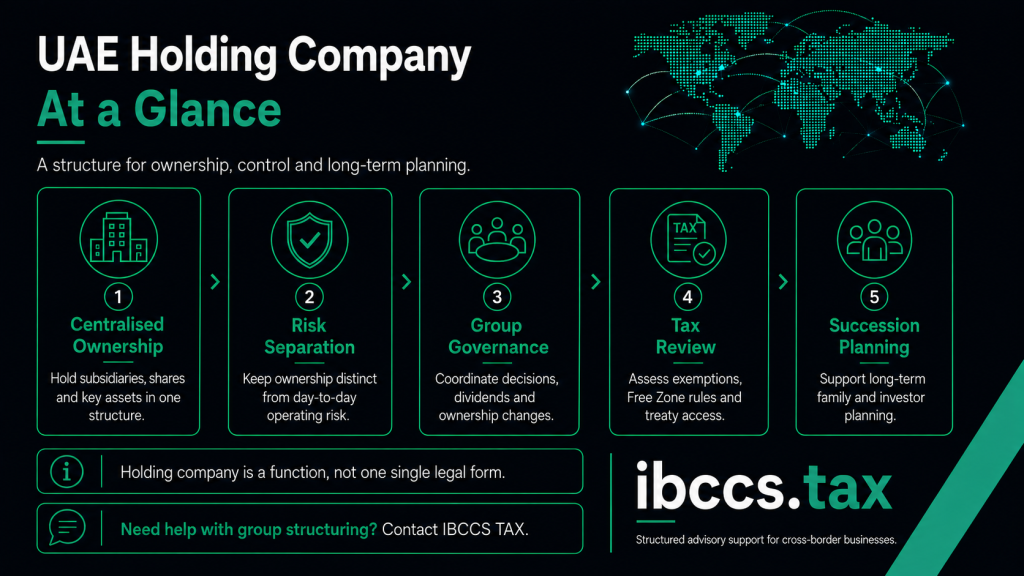
Centralised Ownership and Governance
A holding company can place several subsidiaries or investments under one ownership platform. This can simplify shareholder governance, group reporting, acquisition decisions and the introduction of new investors at the parent level.
Centralisation does not mean that subsidiary boards and managers can ignore their own legal duties. Each entity should maintain appropriate records, approvals and decision-making processes, particularly where directors act for several group companies.
Separation of Assets From Operating Risk
Holding shares, intellectual property or strategic assets outside an operating company can reduce direct exposure to the operating company’s commercial liabilities. This can support risk management where separate entities maintain distinct contracts, accounts and decision-making.
The protection is not absolute. Personal guarantees, cross-guarantees, unlawful distributions, fraudulent conduct, commingled funds or poorly documented intercompany arrangements can undermine the intended separation.
Acquisitions and Investment Management
A holding company can provide a consistent acquisition vehicle for investments in the UAE and other countries. It can also make it easier to sell or introduce investors into a subsidiary without transferring the group’s entire operating structure.
Acquisition financing, interest deductions, legal title, regulatory approvals and foreign tax implications should be reviewed before the investment is completed. The company should not be inserted into a transaction after signing without considering tax and legal consequences.
Group Financing and Cash Management
A holding company may receive dividends, provide shareholder funding or coordinate treasury arrangements within a group. This can support capital allocation, but loans, guarantees and service charges between Related Parties must be commercially documented and priced on an arm’s length basis.
Interest deductibility can be restricted under the UAE Corporate Tax rules, and acquisition debt requires additional analysis. The financing should have a clear commercial purpose, appropriate terms and evidence of repayment capacity.
Succession and Continuity
A holding company can simplify succession by consolidating ownership of several assets beneath one corporate interest. This can reduce the number of separate transfers required when ownership changes and provide a framework for voting and economic rights.
The company alone does not solve succession. The shares in the holding company remain part of the owner’s estate unless they are coordinated with wills, foundations, trusts, shareholder arrangements or other succession tools.
UAE Corporate Tax for Holding Companies
A UAE holding company is generally within the Corporate Tax regime and must assess registration, accounting and annual return requirements. Under the standard regime, taxable income up to AED 375,000 is subject to 0%, while the portion exceeding AED 375,000 is generally subject to 9%.
A holding company can have little or no taxable income where its receipts qualify as exempt income. This result depends on the nature of each dividend, gain, interest payment and service fee rather than the company being labelled a holding entity.
Dividends From UAE Companies
Dividends and other profit distributions received from a UAE Resident juridical person are generally exempt from Corporate Tax. The exemption can make a UAE holding company suitable for owning local subsidiaries, but the holding company must still complete its wider registration and reporting obligations.
Intercompany transactions outside the dividend relationship remain subject to the ordinary rules. Management charges, loans, guarantees and asset transfers should be supported by agreements and transfer pricing analysis.
Foreign Dividends and the Participation Exemption
Foreign dividends and gains relating to ownership interests can qualify for the Participation Exemption where the statutory conditions are met. These conditions include ownership, holding-period, entitlement, subject-to-tax and asset tests.
The ownership condition may be met through a qualifying percentage interest or the prescribed acquisition-cost threshold. The exemption should be confirmed for each participation because a small shareholding, low-tax subsidiary or asset-heavy investment vehicle may require additional analysis.
Capital Gains on the Disposal of Subsidiaries
A gain on the sale of shares can be exempt where the relevant Participation Exemption conditions are satisfied. If the conditions are not met, the gain can form part of taxable income even though it arises within a holding structure.
The treatment of acquisition costs, impairments, prior group relief and transactions with Related Parties should be reviewed before a disposal. The legal sale documentation and accounting treatment should remain consistent with the tax position.
Free Zone Holding Company Tax Treatment
A Qualifying Free Zone Person can apply a 0% Corporate Tax rate to Qualifying Income. Holding shares and other securities for investment purposes is a Qualifying Activity where the instruments are held for the required investment period and the wider conditions are satisfied.
A Free Zone licence does not create automatic 0% treatment. The company must maintain adequate substance, comply with transfer pricing, prepare audited financial statements and remain within the applicable limits for non-qualifying revenue.
Tax Groups and Group Relief
A UAE parent and eligible subsidiaries may apply to form a Corporate Tax Group where the parent has at least 95% of the relevant ownership, voting, profit and net-asset rights and the other statutory conditions are satisfied. The group is then treated as one Taxable Person for Corporate Tax purposes.
A Qualifying Free Zone Person cannot join a Tax Group. Groups that do not satisfy the Tax Group conditions may still consider Qualifying Group Relief or Tax Loss transfers where the separate requirements are met, but losses are not automatically consolidated merely because one company owns another.
Domestic Minimum Top-up Tax for Large Groups
UAE entities belonging to very large multinational groups can also fall within the Domestic Minimum Top-up Tax regime. This is a separate Pillar Two assessment and does not generally apply to ordinary private holding companies or owner-managed groups.
A group meeting the relevant global revenue threshold should assess the effective tax position at group level rather than relying only on the standard UAE rates or a Free Zone status.
Further information about rates, exemptions, Free Zone treatment and filing is available in our guide to UAE Corporate Tax and through our UAE international taxation services.
VAT Treatment of a UAE Holding Company
The passive holding of shares and receipt of dividends generally do not by themselves represent taxable supplies for UAE VAT purposes. A company that only holds investments can therefore have a different VAT position from an operating or management holding company.
Where the holding company provides management, administrative, financing or other services for consideration, those activities can create taxable supplies and VAT registration obligations. The ability to recover input VAT can also depend on whether costs relate to taxable business activity or passive investment holdings.
The company should distinguish shareholder oversight from services provided to subsidiaries. Intercompany invoices should reflect genuine functions and should not be issued solely to create input VAT recovery or move profit within the group.
Tax Residency and Double Taxation Agreements
Incorporating a company in the UAE does not automatically secure every treaty benefit. The company must satisfy the residence definition in the relevant Double Taxation Agreement and may need to demonstrate effective management, beneficial ownership and genuine commercial substance.
A UAE Tax Residency Certificate can support a treaty application, but it does not override the treaty wording or anti-abuse provisions. A juridical person applying for a certificate must also meet the relevant establishment and documentary requirements.
Board meetings, management decisions, banking, records and key personnel should therefore be aligned with the intended UAE residence position. A company managed entirely from another country can create foreign tax residence or permanent establishment risks.
Economic Substance and Operational Presence
The separate UAE Economic Substance reporting regime no longer applies to financial years ending after 31 December 2022. This does not mean that substance is irrelevant to a holding company.
Substance remains important for Free Zone Corporate Tax treatment, transfer pricing, banking, treaty access and demonstrating where the company is managed. The required level depends on whether the company is a passive investment vehicle or provides active management, financing or headquarters services.
A passive company may require a lighter operational footprint, while an active holding company should be capable of demonstrating the people, premises, expenditure and decision-making appropriate to its functions.
Step-by-Step UAE Holding Company Setup
Step 1: Define the Purpose of the Holding Structure
The process should begin with a clear list of assets, subsidiaries and transactions the company will hold. The shareholders should identify whether the company will remain passive or provide management, treasury, financing or intellectual-property services.
This distinction affects the licence, legal form, tax analysis, staffing and banking profile. A vague objective such as asset protection or tax efficiency is not enough to select the structure.
Step 2: Map the Ownership and Group Structure
The shareholders should prepare a diagram showing the ultimate owners, holding entities, operating subsidiaries and material investments. The structure should also identify voting rights, economic rights, financing and any future investors.
The ownership chain is relevant to beneficial ownership reporting, Corporate Tax groups, Participation Exemption, banking and succession planning.
Step 3: Choose the UAE Jurisdiction and Legal Form
The founders should compare a mainland company, Free Zone company, SPV and international corporate vehicle. The choice should reflect the company’s activities, assets, employees, premises, visas, tax position and expected transactions.
The selected legal form must support the intended governance and ownership rights. A low-cost vehicle may be unsuitable where the group expects external investment, active management or treaty claims.
Step 4: Confirm the Holding and Management Activities
The company should obtain the appropriate holding, investment or management activity under the selected authority. Additional activities may be required where the company will provide services, finance subsidiaries or hold particular regulated assets.
The constitutional documents and licence should be consistent with the actual functions. A passive holding licence should not be used for broad operational or advisory activity.
Step 5: Model the Tax and Cash Flows
The group should classify expected dividends, capital gains, interest, royalties, management fees and asset transfers. The analysis should consider Corporate Tax exemptions, Free Zone conditions, VAT, transfer pricing, interest deductions and foreign taxes.
The structure should be tested under realistic scenarios, including a subsidiary sale, refinancing, loss-making company and distribution to the ultimate shareholders.
Step 6: Prepare Governance and Shareholder Documents
The company should establish clear rules for board authority, reserved matters, dividend policy, related-party transactions and changes in ownership. Where there are several owners, a shareholders’ agreement may be required alongside the constitutional documents.
Directors acting across several group companies should document decisions separately and manage conflicts of interest.
Step 7: Incorporate the Holding Company
The application normally includes shareholder and beneficial ownership information, proposed activities, trade name, constitutional documents and due-diligence records. Corporate shareholders can require additional resolutions, certificates and legalised documents.
The holding company can be incorporated before or after the operating subsidiaries. There is no universal requirement to create every subsidiary first.
Step 8: Establish Banking and Funding Arrangements
The bank will review the purpose of the holding structure, source of funds, subsidiaries, expected dividends, acquisitions and countries involved. A holding company without a clear asset or transaction profile can face additional due-diligence questions.
Capital contributions, shareholder loans and acquisition finance should be documented from the beginning. Personal and corporate funds should remain separate.
Step 9: Transfer or Acquire the Assets and Subsidiaries
Existing shares and assets must be transferred using legally valid agreements and approvals. The parties should review valuation, consent, financing, taxes and any restrictions contained in existing shareholder or lender documents.
A transfer should not be treated as a simple administrative step. It can create tax, accounting, stamp, regulatory or foreign legal consequences in the country where the asset or subsidiary is located.
Step 10: Register for Tax and Implement Accounting
The holding company should complete Corporate Tax registration within the applicable timeframe and assess VAT separately. Accounting systems must distinguish dividends, gains, loans, management fees and costs attributable to different investments.
Records should support the Participation Exemption, Free Zone status, transfer pricing and any group relief claimed by the company.
Step 11: Maintain Ongoing Corporate Governance
The company should hold and document board and shareholder decisions, maintain beneficial ownership records and renew its licence and registered office. Intercompany balances, dividends and service charges should be reviewed regularly.
The governance should also remain consistent with the company’s intended tax residence and the commercial role assigned to it within the group.
Documents Commonly Required
The required documents depend on the selected jurisdiction, legal form, shareholders and assets. Individual owners normally provide identity, address and source-of-funds information, while corporate shareholders require a broader corporate document package.
Individual Shareholders
- passport copy and personal details;
- proof of residential address;
- UAE visa and Emirates ID, where applicable;
- professional and source-of-funds information;
- proposed ownership and management details;
- Ultimate Beneficial Owner declarations.
Corporate Shareholders
- certificate of incorporation or registration extract;
- constitutional documents;
- certificate of incumbency or equivalent current extract;
- board or shareholder resolution approving the holding company;
- group ownership chart and Ultimate Beneficial Owner information;
- authorised-signatory documents and powers of attorney;
- legalisation, attestation and translation where required.
The authority or bank may also request information about the subsidiaries, investments, expected transactions and commercial purpose of the structure. These materials should be prepared consistently across the incorporation, banking and tax processes.
How Much Does a UAE Holding Company Cost?
There is no single cost for establishing a UAE holding company. The total depends on the jurisdiction, legal form, licence, registered office, share structure, documents, banking requirements and whether the company requires active management or employees.
| Cost component | What affects it |
| Incorporation and registration | Jurisdiction and legal form |
| Holding or management licence | Permitted activities and authority |
| Registered office or premises | Passive or active operating model |
| Corporate documents | Individual or corporate shareholders |
| Legalisation and translation | Country of issue and authority requirements |
| Banking and due diligence | Assets, countries and transaction profile |
| Accounting and audit | Tax status, Free Zone conditions and company size |
| Tax and transfer pricing | Income, financing and Related Party transactions |
| Annual renewal | Licence, office, corporate administration and filings |
The setup cost should be considered alongside the cost of transferring shares, obtaining valuations, restructuring financing and maintaining the company. A low annual licence fee can be outweighed by an unsuitable tax, banking or governance result.
Banking for a UAE Holding Company
A UAE holding company can apply for a corporate bank account, but approval depends on the bank’s assessment of the ownership, assets, source of funds, subsidiaries and expected transactions. Incorporation does not guarantee an account.
The application can require subsidiary financial statements, investment agreements, sale documents, dividend evidence, group charts and explanations of the commercial purpose. The company should be prepared to show why the UAE is an appropriate location for its ownership and management functions.
A passive holding company may have fewer transactions than an operating business, but the value and complexity of those transactions can lead to enhanced due diligence. The banking strategy should be considered before the entity is incorporated or assets are transferred.
Asset Protection and Liability Considerations
A holding structure can separate investments and strategic assets from the risks of operating subsidiaries. Limited liability can also restrict shareholder exposure to the amount invested, subject to the law, contractual guarantees and the conduct of the parties.
Asset protection is not automatic. The companies should maintain separate accounts, contracts, records and decision-making, while intercompany transfers should have a genuine commercial basis. Assets transferred after a claim or insolvency risk has arisen can be challenged.
The holding company should also avoid guaranteeing every operating liability unless this is commercially necessary. Cross-guarantees can reconnect risks that the structure was intended to separate.
Succession and Family Ownership
A UAE holding company can bring several investments under one ownership interest and create a clearer framework for voting, income distribution and succession. This can be useful where family members will own different economic or management rights.
The shares in the holding company still need an appropriate succession plan. Wills, foundations, trusts, family governance documents and buy-sell arrangements may be required depending on the owners, assets and jurisdictions involved.
The structure should also consider incapacity, disputes, divorce, creditor risk and the treatment of minority family members. Corporate documents alone should not be expected to resolve every private-wealth issue.
Ongoing Compliance for UAE Holding Companies
A holding company must maintain its licence, registered office, accounting records, corporate registers and Ultimate Beneficial Owner information. It should also document share acquisitions, disposals, dividends, financing and services provided to subsidiaries.
Corporate Tax returns are generally required even where the company receives only exempt income or has no tax payable. The company should also assess audit, transfer pricing, VAT, Country-by-Country Reporting and Domestic Minimum Top-up Tax where relevant to the group.
IBCCS TAX provides UAE accounting and tax services and corporate management services for holding companies and international groups requiring ongoing compliance support.
Practical UAE Holding Company Examples
Founder Owning Several Operating Companies
An entrepreneur owns trading and service companies in several countries and wants to centralise ownership through a UAE parent. The holding company can provide one governance platform and receive dividends from the subsidiaries.
The structure should review the Participation Exemption, treaty access, management location and foreign tax implications before the shares are transferred.
International Group Establishing a Regional Holding Company
A foreign group plans acquisitions across the Middle East and wants a UAE company to hold regional subsidiaries. The company may also provide treasury or management support to the group.
The licence, staff, transfer pricing, banking and Corporate Tax position should reflect the active regional role rather than treating the company as a passive shell.
Family Holding Investment Assets
A family wants to consolidate shares and long-term investments under one UAE vehicle. A holding company can simplify ownership and create formal voting and distribution rules.
The shareholders should coordinate the company with succession documents and determine whether a foundation, trust or other private-wealth structure is also required.
Holding Company Owning Intellectual Property
A group wants the UAE holding company to own trademarks or software and license them to operating subsidiaries. This creates an active intellectual-property and Related Party arrangement rather than a simple shareholding structure.
The company should review the licence, valuation, development functions, transfer pricing, VAT and the specific Corporate Tax treatment of intellectual-property income.
Real Estate Investment Structure
An investor plans to own several properties and wants to separate each asset from wider commercial risk. A holding company may own dedicated property companies rather than holding every property directly.
The structure should consider financing, land-registry rules, transaction costs, rental activity, VAT and the intended exit before the properties are acquired.
Common UAE Holding Company Setup Mistakes
Treating Holding Company as One Standard Legal Form
The legal vehicle can be a mainland company, Free Zone company, SPV or international company. The correct choice depends on the actual assets, activities and governance requirements.
Assuming Every Dividend and Capital Gain Is Tax-Free
Domestic dividends are generally exempt, but foreign dividends and gains must satisfy the Participation Exemption conditions. The tax position should be tested before income is received or a subsidiary is sold.
Expecting Automatic Asset Protection
Limited liability and separation depend on proper contracts, records, governance and financial discipline. Guarantees, fraud or commingled transactions can undermine the structure.
Ignoring the Difference Between Passive and Active Holding
A company providing management, financing or administrative services has a different licence, VAT, substance and transfer pricing profile from a company that only owns shares.
Using a Free Zone Solely for a 0% Tax Rate
The Free Zone regime is conditional and applies only to Qualifying Income of a Qualifying Free Zone Person. A structure should not be selected before reviewing the activity and counterparties.
Assuming Subsidiary Losses Automatically Reduce Holding Company Income
Losses are not automatically pooled. A Tax Group or loss transfer requires specific ownership and eligibility conditions.
Relying on Incorporation Alone for Treaty Benefits
Treaty access depends on residence, beneficial ownership, management and the relevant agreement. A certificate does not override the treaty or anti-abuse provisions.
Transferring Assets Without Tax and Legal Review
Moving shares, intellectual property or property into a holding company can create taxes, consents, valuation issues and lender restrictions in other jurisdictions.
Ignoring Banking Until After Incorporation
Banks assess the commercial purpose and assets of the structure. The jurisdiction and legal form should be selected with the expected banking profile in mind.
How IBCCS TAX Can Assist
A UAE holding company should be designed around the commercial purpose, tax position and governance of the wider group. The incorporation itself is only one part of establishing a structure that works in practice. At IBCCS TAX, we assist clients with:
- reviewing mainland, Free Zone, SPV and international corporate options;
- designing ownership and group structures;
- UAE holding company incorporation;
- holding and management activity licensing;
- Corporate Tax and Participation Exemption analysis;
- Free Zone Corporate Tax reviews;
- Tax Group and group-relief assessments;
- international tax residency and treaty analysis;
- share transfers, acquisitions and group reorganisations;
- transfer pricing and intercompany agreements;
- corporate banking coordination;
- accounting, financial statements and tax returns;
- corporate governance and ongoing administration;
- succession and family ownership coordination.
Our UAE company formation services cover incorporation and implementation, while our global company formation and corporate services support clients whose structures extend beyond the UAE.
Planning a UAE Holding Company Structure?
The appropriate holding structure depends on the assets, subsidiaries, income streams, investors and countries involved. Reviewing these factors before incorporation can prevent avoidable transfers, tax exposure and banking difficulties later. Contact IBCCS TAX to discuss UAE holding company setup and international structuring with our team.

Frequently Asked Questions About UAE Holding Companies
1. What is a UAE holding company?
A UAE holding company is an entity used primarily to own subsidiaries, shares, investments or other strategic assets. Holding company describes its function rather than one specific legal form.
2. Which legal form is best for a UAE holding company?
The appropriate form may be a mainland LLC, Free Zone company, SPV or international corporate vehicle. The choice depends on the assets, activities, employees, tax position, banking and governance.
3. Can a UAE holding company conduct business?
It can conduct the activities permitted by its licence and constitutional documents. A passive holding company and a management holding company have different operating, VAT, transfer pricing and substance requirements.
4. Does a UAE holding company pay Corporate Tax?
A holding company is generally within the Corporate Tax regime. Domestic dividends and qualifying participation income can be exempt, while other income can be subject to the standard rates.
5. Are foreign dividends tax-free in a UAE holding company?
Foreign dividends can qualify for the Participation Exemption where the ownership, holding-period, subject-to-tax and other conditions are satisfied. The exemption is not automatic.
6. Are capital gains on shares exempt from UAE Corporate Tax?
A gain can be exempt where the Participation Exemption conditions are met. If the conditions are not satisfied, the gain can form part of taxable income.
7. Can a Free Zone holding company pay 0% Corporate Tax?
A Qualifying Free Zone Person can apply 0% to Qualifying Income. Holding shares and securities for investment purposes can be a Qualifying Activity, but all Free Zone conditions must be satisfied.
8. Can a UAE holding company form a Tax Group with subsidiaries?
It may apply to form a Tax Group where the parent holds at least 95% of the required ownership, voting, profit and net-asset rights and the other conditions are met. A Qualifying Free Zone Person cannot join a Tax Group.
9. Does a holding company provide asset protection?
A properly maintained structure can separate assets from operating risks, but protection is not absolute. Guarantees, unlawful conduct, insolvency and poor corporate separation can affect the result.
10. Can a holding company own property in the UAE?
This depends on the property location, entity type, ownership rules and registration requirements. The structure should be confirmed before the property is acquired.
11. Can a UAE holding company sponsor residence visas?
Visa eligibility depends on the selected jurisdiction, licence and facility. Some holding or SPV structures are not designed to sponsor employees or investors.
12. Does a UAE holding company need a bank account?
A bank account is commonly required for funding, acquisitions, dividends and expenses, although the exact need depends on the structure. Approval remains subject to bank due diligence.
13. Does a UAE holding company need audited financial statements?
Audit requirements depend on the jurisdiction, revenue, tax status and whether the company is a Qualifying Free Zone Person. Separate group, lender or shareholder requirements can also apply.
14. Are UAE Economic Substance Reports still required?
The standalone Economic Substance reporting regime no longer applies to financial years ending after 31 December 2022. Substance remains relevant for Free Zone tax treatment, transfer pricing, banking and treaty access.
15. How much does a UAE holding company cost?
The cost depends on the legal form, jurisdiction, licence, office, shareholders, banking, tax and administration. The cost of transferring and maintaining the underlying assets should also be included.




Cezary Zieniuk to Join Free IMC Webinar on the New Geography of Global Mobility
On 23 September 2026, Cezary Zieniuk, Founder of IBCCS TAX
Read More
UAE Business License Guide: Types, Requirements, Costs and Renewal
A UAE business license is the formal authorization that allows
Read More
Why Start a Business in the UAE? Strategic Advantages and Practical Considerations
The United Arab Emirates has developed into an established international
Read MoreDisclaimer: This article provides general information and does not constitute legal, tax or investment advice. The treatment of a UAE holding company depends on its jurisdiction, legal form, activities, assets, ownership, management and the laws of all countries involved. Professional advice should be obtained before establishing a holding company, transferring assets or implementing a group restructuring.