
Cyprus is frequently considered by internationally mobile entrepreneurs, investors, company shareholders and private clients looking for an established EU jurisdiction from which to manage their personal, business and investment affairs.
The Cyprus tax framework can provide meaningful planning opportunities, particularly for qualifying individuals receiving dividends, passive interest or income from international investments. However, an effective strategy involves much more than establishing tax residency or applying for Non-Dom status.
A High-Net-Worth Individual may own companies in several countries, receive income from different asset classes, hold foreign property, participate in trusts or foundations and have family members living in different jurisdictions. A personal relocation can also affect the management and tax position of companies controlled by that individual.
Cyprus tax planning for HNWIs should therefore bring together personal tax residency, domicile, foreign income, corporate ownership, investment structures, family arrangements and ongoing tax compliance. Each component should be reviewed as part of one coordinated position rather than as a separate transaction.

- HNWI is not a separate legal tax status in Cyprus. The individual is taxed according to residence, domicile, income type, ownership and applicable exemptions.
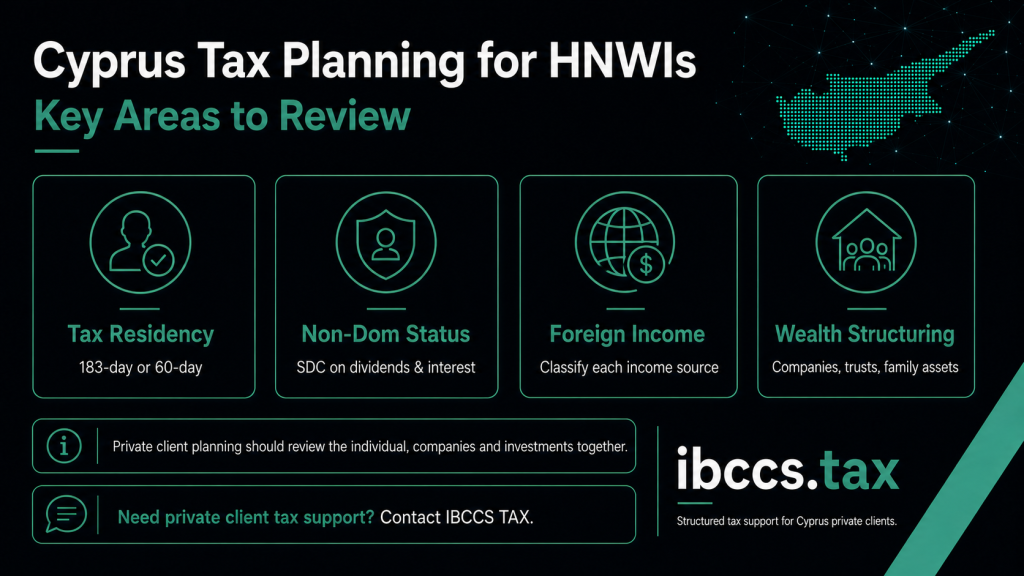
- Cyprus tax residency may generally be established under the 183-day rule or the 60-day rule.
- Qualifying Cyprus Non-Doms may generally be exempt from SDC on dividends and passive interest income.
- Non-Dom status does not create a blanket exemption for salary, business profits, rental income or all investment gains.
- Foreign income should be classified by type rather than treated as one general category.
- GHS contributions and personal tax return obligations may remain relevant even when no SDC is payable.
- Ownership or active management of foreign companies can create corporate tax consequences in Cyprus.
- International holding, investment, trust or foundation structures should have a clear legal, commercial and family purpose.
- Family members may have different residence, domicile and reporting positions even where the assets are managed together.
- Major dividends, company sales, restructurings and relocations should be reviewed before they take place.
- Tax planning and ongoing accounting compliance should be coordinated rather than handled by separate advisers without a common strategy.
- Source-of-wealth, source-of-funds and ownership documentation should be organised as part of the implementation process.
Quick Answer: How Are HNWIs Taxed in Cyprus?
A high-net-worth individual who becomes Cyprus tax resident is generally considered under Cyprus tax rules in relation to worldwide income. The final treatment depends on the type of income, available exemptions, Non-Dom status, foreign tax credits and any applicable double tax treaty.
Qualifying Cyprus tax residents who are non-domiciled in Cyprus for Special Defence Contribution purposes may generally benefit from an exemption from SDC on dividend and passive interest income. Salary, business income, rental income, GHS contributions, certain capital gains and annual reporting obligations must be considered separately.
The ownership and management of foreign companies also require attention. Where an individual manages an international company from Cyprus, the move can create corporate tax residency, permanent establishment, payroll or transfer pricing considerations for the business.
For this reason, HNWI tax planning should normally assess both the individual and any associated companies, investment entities and family structures.
Cyprus Tax Planning for HNWIs. Who Is This Guide For?
This guide is intended for private clients whose personal tax affairs are connected with significant international income, assets, companies or family structures. It may be particularly relevant to:
- founders and shareholders of international companies;
- individuals receiving substantial foreign dividends or interest;
- investors holding listed securities, private equity or alternative investments;
- families owning property in several jurisdictions;
- individuals considering relocation to Cyprus;
- beneficiaries, settlors or controllers of trusts and foundations;
- family business owners planning succession or a future exit;
- private clients maintaining homes or tax connections in several countries;
- individuals with family offices or external investment managers;
- executives receiving complex remuneration, bonuses, shares or carried interests;
- families requiring coordinated personal and corporate tax reporting.
The level of wealth alone does not determine whether specialist planning is required. Complexity, cross-border exposure, ownership and the timing of transactions are usually more important than a specific financial threshold.
What Does HNWI Mean for Cyprus Tax Planning?
The term high-net-worth individual is widely used by banks, investment firms and professional advisers, but it does not create a separate category under Cyprus tax law. Cyprus does not apply one tax regime exclusively to individuals above a particular wealth threshold. Instead, the tax position is determined by factors such as:
- whether the person is Cyprus tax resident;
- whether the person is domiciled or non-domiciled for SDC purposes;
- the nature and source of each income stream;
- ownership and management of companies;
- location and classification of investments;
- involvement in trusts, foundations or partnerships;
- applicable double tax treaties;
- foreign tax already paid;
- family and personal connections with other jurisdictions.
An HNWI may therefore have a simple Cyprus tax position where most assets are passive and properly structured. Another individual with lower net wealth may require a more complex analysis because they actively manage companies, hold properties in several countries or receive income through multiple entities.
The purpose of private client tax planning is not to apply a standard HNWI package. It is to understand how the complete personal, corporate and family position operates across the relevant jurisdictions.
Why HNWI Tax Planning Requires an Integrated Approach
Private clients rarely receive income from only one source. A typical international profile may include salary, directors’ fees, dividends, interest, rental income, investment gains, pension income and distributions from family structures. The same individual may also control operating companies, holding companies, investment vehicles and property-owning entities. Decisions made at the personal level can therefore affect the tax, management and reporting position of associated companies.
For example, relocating to Cyprus may change the individual’s personal tax residence while also raising questions about where a foreign company is managed. A major dividend may be treated differently from salary, while the sale of company shares may require analysis in both Cyprus and the jurisdiction from which the individual moved.
A coordinated review should identify:
- how the individual will establish Cyprus tax residency;
- whether Cyprus Non-Dom status is available;
- how each category of foreign income is treated;
- whether companies or structures are affected by the move;
- which treaties and foreign tax credits may apply;
- what documentation and annual filings will be required;
- how future distributions, disposals and succession events should be planned.
IBCCS TAX provides tax consulting and tax planning services in Cyprus for private clients, investors, business owners and internationally mobile individuals.
Cyprus Tax Residency for HNWIs
The first step in any Cyprus private client tax plan is determining whether and when the individual becomes Cyprus tax resident. Tax residency is separate from citizenship, immigration residence and the right to remain in Cyprus. Holding a Cyprus residence permit does not automatically establish tax residency, and becoming Cyprus tax resident does not by itself provide an immigration right.
Cyprus provides two principal routes to individual tax residency: the 183-day rule and the 60-day rule.
The Cyprus 183-Day Rule
An individual who spends more than 183 days in Cyprus during a calendar year is generally considered Cyprus tax resident for that year. This route may be suitable where Cyprus becomes the individual’s principal home and the person intends to spend most of the year on the island. The analysis is largely based on physical presence, but accurate travel records should still be maintained.
Private clients who travel frequently should retain clear records of arrival and departure dates, accommodation and other supporting evidence. This may be relevant when obtaining a Tax Residency Certificate, opening or maintaining financial accounts and responding to enquiries from tax authorities in other jurisdictions.
The Cyprus 60-Day Rule
The 60-day rule can provide an alternative route for internationally mobile individuals who maintain a substantial connection with Cyprus but do not spend more than 183 days on the island. Under the current framework, the individual generally needs to:
- spend at least 60 days in Cyprus during the relevant calendar year;
- avoid spending more than 183 days in any other single country;
- carry on a business in Cyprus, be employed in Cyprus or hold an office in a Cyprus tax-resident company;
- maintain the relevant business, employment or office connection during the year; and
- maintain a permanent home in Cyprus that is owned or rented.
The present rules no longer include the former condition requiring the person not to be tax resident in any other country. This provides additional flexibility but also makes dual tax residency analysis more important.
Our detailed guide explains the Cyprus 60-day and 183-day tax residency rules. IBCCS TAX also assists with the practical process of changing tax residency to Cyprus.
Dual Tax Residency and Treaty Residence
An individual can meet the domestic tax residency rules of Cyprus and another country during the same year. Where a double tax treaty applies, the person’s treaty residence may need to be determined using the relevant tie-breaker provisions. These can examine the availability of a permanent home, the centre of vital interests, habitual residence, nationality and, where necessary, agreement between the tax authorities.
For an HNWI, the centre of vital interests can be particularly complex. Relevant factors may include:
- the location of the spouse and dependent children;
- homes available to the family;
- business management and directorships;
- investment and banking relationships;
- social and economic connections;
- habitual travel patterns;
- involvement in charitable, professional or family activities.
A Cyprus Tax Residency Certificate is important evidence but may not, by itself, resolve a competing residence claim elsewhere.
Cyprus Non-Dom Status for HNWIs
Cyprus Non-Dom status can be a central component of tax planning for internationally mobile investors and shareholders. It is a classification used for Special Defence Contribution purposes. It is not an immigration permit, a substitute for tax residency or a general exemption from taxation.
A qualifying Cyprus tax resident who is non-domiciled in Cyprus may generally benefit from an exemption from SDC on:
- dividend income; and
- passive interest income.
The exemption may be relevant to income arising in Cyprus or abroad, subject to the applicable legislation and the individual’s circumstances.
This can be particularly significant for individuals receiving distributions from operating companies, family holding structures or investment portfolios. However, the complete treatment should also consider GHS contributions, source-country withholding taxes, treaty relief and the legal classification of the payment.
IBCCS TAX assists with Cyprus Non-Dom eligibility, documentation and implementation.
What Non-Dom Status Does Not Cover
Non-Dom status should not be described as a general tax-free regime. It does not automatically exempt:
- employment income;
- directors’ fees;
- self-employment or consulting income;
- business profits;
- rental income;
- every type of investment gain;
- Cyprus capital gains tax in applicable cases;
- social insurance;
- GHS contributions;
- foreign-source taxation;
- personal tax return obligations.
Where income is received through a company, the company’s corporate tax position must also be considered separately from the personal treatment of the shareholder. A strategy based only on the Non-Dom exemption may therefore overlook other liabilities, reporting requirements or corporate exposures.
Long-Term Deemed Domicile Planning
Non-Dom status should also be considered as part of a long-term plan. An individual who remains Cyprus tax resident for a substantial period can eventually be treated as domiciled in Cyprus for SDC purposes under the deemed domicile rules. The standard analysis considers whether the person has been Cyprus tax resident for at least 17 of the previous 20 tax years.
Private clients intending to remain in Cyprus long term should not wait until the end of the initial Non-Dom period before considering the future position. Long-term planning may involve reviewing:
- the expected period of Cyprus residence;
- future dividend and interest income;
- ownership of family companies;
- anticipated business exits;
- intergenerational transfers;
- the residence of family members;
- alternative personal or corporate arrangements.
This does not necessarily mean that an immediate restructuring is required. It means that the long-term implications should be understood before decisions become difficult or expensive to change.
How Cyprus Treats Foreign Income
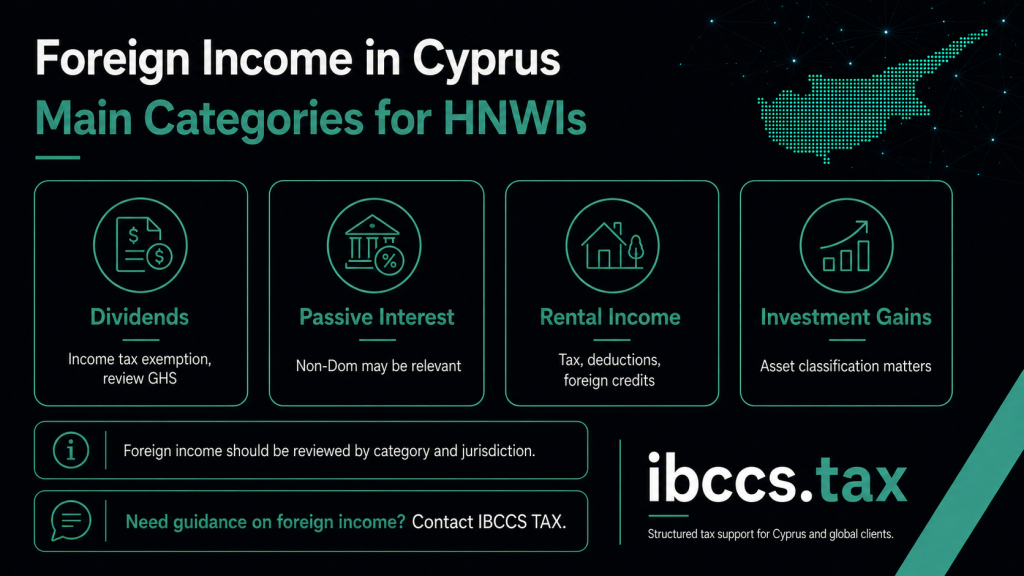
Cyprus tax residents are generally considered under Cyprus tax rules in relation to worldwide income. However, different categories of foreign income can receive very different treatment. The phrase “foreign income” is therefore not sufficiently precise for tax planning. The legal and economic nature of the payment must be identified.
| Type of income | Main Cyprus considerations |
| Foreign salary and bonuses | Personal income tax, place where duties are performed, employment exemptions, payroll and treaty position |
| Directors’ fees | Source rules, treaty treatment, company jurisdiction and the individual’s actual duties |
| Dividends | Personal income tax exemption, SDC, Non-Dom status, GHS and source-country withholding |
| Passive interest | SDC, Non-Dom status, GHS, withholding tax and beneficial ownership |
| Business or consulting income | Personal income tax, deductions, VAT, social insurance and permanent establishment |
| Foreign rental income | Personal income tax, permitted deductions, GHS, foreign tax and available credits |
| Foreign pensions | Standard personal tax rates or an available alternative treatment, subject to treaty provisions |
| Investment gains | Nature of the asset, classification as a security, trading activity and property-related rules |
| Trust or foundation distributions | Nature of the distribution, underlying income, control, residence and reporting |
| Company sale proceeds | Asset classification, source-country rules, previous residence and transaction timing |
The same amount can produce a different Cyprus outcome depending on whether it represents a dividend, salary, capital repayment, loan, trust distribution or disposal proceeds.
Foreign Dividends
Foreign dividends received by an individual are generally not subject to Cyprus personal income tax. SDC and GHS should still be considered. A qualifying Cyprus Non-Dom individual may generally be exempt from SDC on dividend income. GHS contributions may nevertheless remain applicable within the relevant framework and limits.
The source country may also impose withholding tax. Relief may depend on a double tax treaty, local filing procedure, beneficial ownership and the documentation available to support the individual’s Cyprus residence. Where dividends are received from a company controlled by the individual, the analysis should also consider the company’s residence, management, substance and underlying profits.
Foreign Interest
Passive interest received by a qualifying Cyprus Non-Dom individual may generally benefit from the SDC exemption. The classification of interest is important. Passive return on deposits or investments may be treated differently from interest arising in the ordinary course of a financing or lending business.
The review should also consider source-country withholding tax, GHS, related-party arrangements and the legal ownership of the underlying account or instrument.
Foreign Rental Income
A Cyprus tax resident receiving rental income from property outside Cyprus should normally consider the income for Cyprus tax and reporting purposes. The property’s location may give the source country a primary right to tax the rent. Cyprus may then provide relief through an applicable treaty or foreign tax credit, subject to the relevant limitations and supporting evidence.
The analysis should also consider ownership costs, permitted deductions, financing, GHS and whether the property is owned personally, jointly or through a company.
Foreign Pensions
Foreign pension income may follow the standard personal income tax rules or an available alternative treatment, depending on the type of pension and the individual’s circumstances. The applicable double tax treaty is particularly important. Private pensions and government service pensions may be allocated differently between Cyprus and the paying country.
Pension planning should be based on the pension documentation and treaty rather than only on the location of the paying institution.
Request a Private Client Tax Review
International income should be reviewed by category and jurisdiction before tax residency changes or substantial payments are made. Discuss Your Cyprus Tax Position With IBCCS TAX

Investment Portfolios and Capital Gains
HNWI investment portfolios may include listed shares, bonds, funds, private equity, structured products, digital assets and direct investments in privately held companies.
Cyprus generally provides favourable treatment for gains from the disposal of qualifying securities. However, the classification of an asset should be confirmed rather than assumed. The review should consider:
- whether the asset falls within the applicable definition of a security;
- whether the activity is investment or trading in nature;
- whether the gain relates directly or indirectly to Cyprus immovable property;
- whether another country retains taxing rights;
- whether the asset is held personally or through an entity;
- whether the individual has recently changed tax residence;
- whether previous-country temporary non-residence or exit rules apply.
Cyprus capital gains tax is particularly relevant to disposals of immovable property situated in Cyprus and, in applicable cases, shares deriving value from Cyprus immovable property. Foreign property and investments may remain taxable in the jurisdiction where they are located or under the laws of the individual’s previous country. The absence of a general Cyprus wealth tax does not remove income, reporting, property or source-country obligations connected with the investment portfolio.
International Companies Owned by HNWIs
Many private clients are also founders, shareholders or directors of international businesses. Becoming Cyprus tax resident does not automatically make every foreign company owned by the person a Cyprus tax-resident company. However, the individual’s role after relocation can materially affect the corporate position. The review should identify:
- where the company’s strategic decisions are made;
- where directors and senior management are located;
- where material contracts are negotiated and approved;
- where banking and financing decisions are taken;
- where the owner performs daily management functions;
- where employees, premises and operational assets are located;
- whether the company has adequate substance in its registered jurisdiction;
- whether Cyprus corporate tax residency could arise;
- whether the company could create a permanent establishment in Cyprus.
For business owners, personal tax planning and corporate tax planning should normally be carried out together.
Our guide to moving to Cyprus as a business owner explains how personal residency, foreign company ownership, remuneration and company structure interact.
Management and Control
A foreign company may become exposed to Cyprus corporate taxation where its real management and control is exercised from Cyprus. Formal registration abroad does not, by itself, determine the final tax position. The analysis may examine whether directors genuinely exercise authority, where substantive board decisions are taken and where the company is commercially directed.
A structure in which foreign directors simply approve decisions already made by the shareholder in Cyprus may be difficult to reconcile with the stated management position. Governance should therefore reflect the real conduct of the company rather than being designed only as documentary evidence.
Salary, Directors’ Fees and Dividends
An owner may receive salary, directors’ fees, dividends, benefits or loan repayments from associated companies. Each payment follows a different legal and tax treatment. Salary may involve progressive personal income tax, payroll, social insurance and GHS. Dividends may be exempt from personal income tax, while SDC, Non-Dom status and GHS require separate consideration.
Directors’ fees can also raise source and treaty questions depending on the company’s jurisdiction. The remuneration strategy should be commercially supportable, properly documented and coordinated with the company’s distributable profits, payroll obligations and the individual’s personal cash-flow needs.
Cyprus Holding and Investment Companies
A Cyprus holding company may form part of an international ownership or investment structure where it has a genuine commercial role. Potential purposes can include:
- holding shares in operating subsidiaries;
- consolidating ownership;
- receiving qualifying dividends;
- supporting acquisitions or future disposals;
- centralising investment governance;
- organising financing or capital contributions;
- facilitating succession or family ownership arrangements.
A holding company should not be inserted into a structure solely because Cyprus has favourable holding-company features. The source jurisdictions, beneficial ownership, management, substance, transfer pricing and future exit strategy must also be reviewed.
Further information is available in our guide to using a Cyprus holding company.
Wealth Structuring for International Private Clients
Wealth structuring involves organising the legal ownership, management and transfer of family and investment assets. It is not limited to reducing immediate tax. An appropriate structure may also need to address:
- governance and decision-making;
- separation of family and business assets;
- continuity following incapacity or death;
- family succession;
- protection of minority or dependent family members;
- centralised investment administration;
- banking and reporting;
- ownership transparency;
- dispute prevention;
- long-term flexibility.
Possible structures may include companies, partnerships, trusts, foundations, investment vehicles or direct personal ownership. No structure is universally suitable. The analysis should consider the laws of every relevant jurisdiction, including where the settlor, founder, beneficiaries, protectors, directors, trustees and assets are located.
Tax treatment may depend on control, beneficial ownership, the nature of the underlying income and the timing and character of distributions. A structure that is effective for succession purposes may still create tax or reporting obligations for individual family members.
IBCCS TAX provides international tax planning and structuring services for entrepreneurs, investors, private clients and international groups.
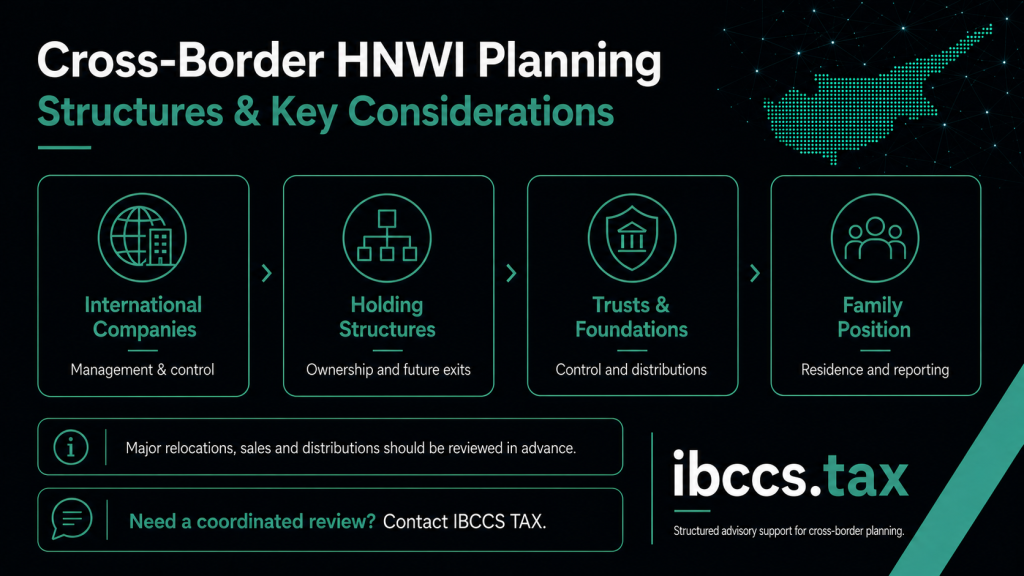
Trusts, Foundations and Family Structures
Trusts and foundations can form part of family wealth and succession arrangements, but their treatment should never be assumed from the legal name of the structure alone. The tax review should establish:
- who created and funded the structure;
- who controls or influences decisions;
- who can benefit;
- where the trustees, council members or administrators are located;
- what assets and income are held;
- whether distributions represent income, capital or another category;
- which reporting regimes apply;
- how the structure is treated in each relevant country.
The individual’s relocation to Cyprus may change the tax or reporting analysis even where the trust or foundation remains legally established elsewhere. Similarly, the residence of beneficiaries can produce different outcomes within the same family. A distribution suitable for one beneficiary may create an unexpected liability or disclosure obligation for another. Tax, legal and succession advice should therefore be coordinated before significant contributions, distributions or changes of control take place.
Family Members in Different Jurisdictions
HNWI families frequently have members living, studying or working in different countries. Spouses may not always share the same tax residency. Adult children may become independently resident in another jurisdiction, while younger children and the principal family home can influence treaty residence and centre-of-vital-interests analysis.
Family members may also hold different shares, beneficiary rights or management responsibilities within the same structure. Planning should therefore consider each person separately, including:
- tax residency and domicile;
- citizenship and immigration status;
- ownership of family companies;
- beneficiary interests;
- receipt of dividends, gifts or distributions;
- future inheritance or succession;
- local reporting obligations;
- marital property or family law considerations.
A family structure cannot be evaluated solely through the position of its principal wealth creator.
Cyprus Real Estate and Foreign Property
Real estate can create separate tax, legal and reporting considerations from financial investments. An HNWI moving to Cyprus may acquire a principal residence, investment property or development asset on the island while retaining property abroad. The Cyprus analysis may involve:
- purchase and ownership costs;
- VAT and transfer fees;
- rental income;
- financing;
- capital gains tax;
- ownership through a company or personally;
- succession;
- private use of company-owned property;
- source-of-funds documentation.
Foreign real estate may remain taxable in the country where it is situated. Rental income and disposal gains may also need to be reported in Cyprus once the individual becomes Cyprus tax resident, with treaty relief or foreign tax credits considered where available. Property should therefore be reviewed by jurisdiction and purpose rather than treated as part of one undifferentiated investment portfolio.
No General Wealth, Inheritance or Gift Tax Does Not Mean No Planning
Under the current Cyprus framework, there is no general net wealth tax, inheritance tax or gift tax. This can be relevant to internationally mobile families, but it does not mean that every lifetime transfer, succession event or asset disposal is free from tax or cost.
Other jurisdictions may impose:
- inheritance or estate tax;
- gift tax;
- capital gains tax;
- exit tax;
- transfer duties;
- property transfer fees;
- reporting obligations;
- taxes based on the residence or domicile of the donor, deceased person or recipient.
Cyprus property, foreign property, company shares and trust interests may also require legal and succession planning even where Cyprus itself does not impose a general inheritance tax. The absence of one tax should not be treated as a substitute for coordinated estate, family and cross-border tax planning.
Tax Reporting and Private Client Accounting
HNWI tax planning does not end when the structure is designed. The individual may require annual coordination of foreign income, tax returns, GHS obligations, SDC declarations, foreign tax credits and supporting documentation. Associated companies may have their own accounting, tax, payroll and corporate filing requirements. A private client compliance process may need to bring together:
- salary and directors’ fees;
- dividends and interest;
- foreign rental income;
- pension income;
- realised investment gains;
- trust or foundation distributions;
- foreign tax withheld or paid;
- related-party transactions;
- personal expenses paid by companies;
- shareholder and director loan accounts;
- changes in residence or ownership.
The accounting records of associated companies should also be consistent with the individual’s personal filings. Dividends, loans, benefits and expense reimbursements should not be treated differently by the company and the shareholder.
IBCCS TAX provides personal income tax return preparation in Cyprus as well as broader accounting services in Cyprus for companies and international structures.
Source of Wealth, Source of Funds and Banking Documentation
Private client planning should also consider the evidence required by banks, investment platforms, regulated advisers and professional service providers. A technically appropriate structure may be difficult to implement if ownership, income and transaction history cannot be documented clearly. Depending on the circumstances, the client may need to provide:
- company financial statements;
- dividend resolutions and payment records;
- sale agreements;
- investment statements;
- tax returns and tax residence certificates;
- inheritance or gift documentation;
- trust or foundation documents;
- property sale records;
- loan agreements;
- bank statements;
- corporate ownership charts.
Source of wealth explains how the individual accumulated their overall wealth. Source of funds explains the origin of money used for a particular transaction. Preparing this information before a major relocation, acquisition, distribution or bank application can reduce delays and avoid inconsistencies between tax, legal and banking records.
Planning Before a Business Sale or Major Distribution
The timing of a business sale, dividend or restructuring can materially affect the tax outcome. A client considering relocation to Cyprus should not assume that becoming Cyprus tax resident immediately determines the treatment of a transaction. The previous jurisdiction may apply exit rules, temporary non-residence provisions, anti-avoidance legislation or continued taxation of locally connected assets.
Before Selling a Business
Pre-sale planning may need to consider:
- the expected transaction structure;
- share sale versus asset sale;
- location and classification of the company;
- previous-country capital gains and exit rules;
- management and control before completion;
- the date on which Cyprus residence begins;
- earn-outs, deferred consideration and rollover arrangements;
- family or trust ownership;
- treaty treatment;
- post-sale investment of proceeds.
Relocating shortly before a sale does not automatically remove the taxing rights of the previous country. Planning should begin before binding negotiations, restructuring or contractual rights have been established.
Before Receiving a Major Dividend
A substantial dividend should be reviewed in relation to:
- the individual’s residence on the payment date;
- Non-Dom eligibility;
- source-country withholding tax;
- GHS;
- company distributable reserves;
- the period in which the underlying profits arose;
- previous-country rules;
- beneficial ownership;
- banking and source-of-funds documentation.
The decision should be documented through the relevant company procedures and aligned with both personal and corporate reporting.
Before Contributing Assets to a Structure
Transferring shares, investments, property or cash to a company, trust or foundation can be a taxable event even where the transfer is intended as part of long-term family planning. Before implementation, the parties should assess valuation, capital gains, stamp or transfer costs, beneficial ownership, reporting and any restrictions imposed by existing agreements or financial institutions.
Practical HNWI Cyprus Tax Planning Scenarios
Scenario 1 – Founder Relocating Before a Future Exit
A founder intends to move to Cyprus while continuing to manage an international company and expects a potential sale within several years. The review should combine personal tax residency, Non-Dom status, management and control, remuneration, shareholder structure and the tax rules of the country being left. The future sale should be considered early enough to avoid implementing artificial or commercially disruptive changes immediately before the transaction.
Scenario 2 – Investor With a Global Portfolio
An investor becomes Cyprus tax resident while holding listed securities, bonds, funds, foreign bank deposits and property in several jurisdictions. The analysis should classify dividends, passive interest, rental income and realised gains separately. It should also consider Non-Dom status, GHS, source-country withholding, foreign tax credits and whether the frequency of transactions could affect their character.
Scenario 3 – Family With Companies and Trust Interests
A family relocates to Cyprus while retaining companies, a foreign trust and adult children resident in other countries. Each family member’s residence and beneficiary position should be reviewed independently. The structure’s control, income, distributions and reporting obligations may produce different consequences for the parents and children.
Scenario 4 – Business Owner Receiving Salary and Dividends
A shareholder-director controls several companies and plans to receive both salary and dividends after becoming Cyprus tax resident. The appropriate balance should be reviewed in relation to the individual’s duties, payroll, social insurance, GHS, Non-Dom status, company profits and the jurisdictions in which the companies operate.
Scenario 5 – Private Client Holding International Property
An individual owns residential and investment property in Cyprus and abroad. The planning should consider rental income, financing, property management, foreign tax, capital gains, personal use, succession and whether any property is held through a company or family structure.
Common HNWI Tax Planning Mistakes
Treating Non-Dom as a Complete Tax Exemption
Non-Dom primarily affects SDC on dividends and passive interest. Other income, contributions, reporting requirements and corporate liabilities remain separate.
Focusing Only on Cyprus
The country being left, source countries and jurisdictions of companies and assets may continue to impose tax or reporting obligations.
Relocating Before Reviewing Controlled Companies
A shareholder’s move can change where companies are managed and create corporate tax residency or permanent establishment exposure.
Restructuring Immediately Before a Major Transaction
Late changes may lack commercial substance, trigger tax in another country or create additional due diligence questions during a sale or banking process.
Using a Structure Without a Defined Purpose
A holding company, trust or foundation should address genuine ownership, governance, investment or succession objectives. Complexity alone does not create an effective tax plan.
Failing to Coordinate Personal and Company Records
Dividends, loans, expenses and benefits should be treated consistently in company accounts, board documentation and personal tax filings.
Ignoring Family Members’ Separate Positions
Spouses, adult children and beneficiaries may have different residence, domicile, ownership and reporting obligations.
Delaying Compliance Until the Filing Deadline
Foreign income, investment transactions and distributions can be difficult to reconstruct after the year has ended. Records should be maintained as events occur.
HNWI Cyprus Tax Planning Checklist
Before implementing a Cyprus private client tax plan, the following questions should be answered:
- When and how will Cyprus tax residency be established?
- Will another country continue to claim the individual as tax resident?
- Is Cyprus Non-Dom status available?
- How long does the individual expect to remain resident in Cyprus?
- What income will be received from salary, dividends, interest, rent, pensions and investments?
- Which foreign taxes and withholding taxes may apply?
- What companies does the individual own, direct or manage?
- Could any foreign company become managed and controlled from Cyprus?
- Are trusts, foundations, partnerships or family investment entities involved?
- Where are the trustees, directors, beneficiaries and assets located?
- Are family members resident in different countries?
- Are any major dividends, sales, gifts or restructurings planned?
- What Cyprus and foreign tax returns will be required?
- How will foreign tax credits be documented?
- Are source-of-wealth and source-of-funds records complete?
- Do company accounts and personal tax reporting follow the same treatment?
- Does the structure remain appropriate if the family stays in Cyprus long term?
- Who will coordinate tax advisory, accounting, legal and corporate implementation?
Where several of these questions remain unresolved, planning should normally take place before residence changes, distributions or transfers are completed.
Tax Advisor or Accountant in Cyprus: What Does an HNWI Need?
HNWI clients commonly require both strategic tax advice and ongoing accounting support.
A tax adviser may focus on residence, domicile, treaties, foreign income, company ownership, transaction timing and the design of an appropriate structure. An accountant may prepare returns, maintain records, calculate liabilities and coordinate ongoing reporting. For a private client with international affairs, these functions should not operate independently. An adviser may recommend a distribution or structure, but the strategy must be reflected correctly in:
- company accounts;
- board resolutions;
- payroll;
- tax returns;
- foreign tax credit records;
- banking documentation;
- annual compliance.
The best model is therefore usually a coordinated service in which planning, implementation and reporting follow one consistent analysis.
How IBCCS TAX Can Help HNWIs and Private Clients
IBCCS TAX supports high-net-worth individuals, entrepreneurs, investors and internationally mobile families with Cyprus and cross-border tax matters. Our work may include:
- Cyprus tax residency planning;
- analysis of the 183-day and 60-day rules;
- Non-Dom assessment and implementation;
- review of foreign income and investment portfolios;
- double tax treaty analysis;
- foreign tax credit support;
- salary, directors’ fees and dividend planning;
- company tax residency and management review;
- permanent establishment analysis;
- Cyprus holding and investment structures;
- international corporate structuring;
- review of trusts, foundations and family arrangements;
- planning before business sales and major distributions;
- personal tax registration and returns;
- GHS and SDC compliance;
- accounting and tax compliance for associated companies;
- source-of-wealth and source-of-funds coordination;
- practical implementation across relevant jurisdictions.
Our Cyprus office combines local tax, accounting, legal and corporate support with experience in international structures. This allows the personal position of the private client to be coordinated with companies, investments and ongoing compliance.
Coordinate Your Personal, Investment and Corporate Position
Cyprus tax planning for HNWIs should not focus on one exemption or one entity. The individual’s tax residency, Non-Dom status, foreign income, investment portfolio, international companies, family structures and annual compliance should form one coherent and properly documented position. The most effective planning is implemented before residence changes, distributions, disposals or restructurings take place. It should also remain practical enough to be maintained through reliable accounting, governance and reporting.
IBCCS TAX can review your personal and corporate circumstances, identify the relevant Cyprus and international tax considerations and support the implementation and ongoing compliance of an appropriate private client structure. Request a Private Client Tax Review.
Frequently Asked Questions About Cyprus Tax Planning for HNWIs
1. Is HNWI a Separate Tax Status in Cyprus?
No. Cyprus tax law does not apply a separate general regime solely because an individual exceeds a particular wealth threshold. The person’s position depends on tax residency, domicile, income, investments, company ownership and the rules applying to each asset and transaction.
2. Why Is Cyprus Considered by High-Net-Worth Individuals?
Cyprus combines EU membership with tax residency options, a Non-Dom framework, an extensive treaty network, limited capital gains taxation and no general net wealth or inheritance tax. The actual benefits depend on the individual’s income, assets, previous residence and international structure.
3. Does Cyprus Tax Worldwide Income?
Cyprus tax residents are generally considered under Cyprus tax rules in relation to worldwide income. The final treatment depends on the type of income, available exemptions, foreign tax credits and applicable double tax treaties.
4. Are Foreign Dividends Taxable in Cyprus?
Foreign dividends received by an individual are generally exempt from Cyprus personal income tax. SDC, Non-Dom status, GHS and source-country withholding tax should still be reviewed.
5. Are Foreign Investment Gains Taxable in Cyprus?
The treatment depends on the nature of the asset and transaction. Gains from the disposal of qualifying securities may generally benefit from an exemption, while gains connected with Cyprus immovable property can fall within Cyprus capital gains tax.
6. Does Cyprus Impose a Wealth Tax?
Cyprus does not currently impose a general net wealth tax. Income, property, capital gains, GHS and reporting obligations may nevertheless apply to assets held by the individual.
7. Does Cyprus Have Inheritance Tax?
Cyprus does not currently impose a general inheritance tax. Foreign jurisdictions, property transfer rules, succession law and the residence or domicile of family members may still create tax or legal consequences.
8. Does Non-Dom Mean All Foreign Income Is Tax-Free?
No. Non-Dom status mainly affects SDC on dividend and passive interest income. Salary, business income, rent, GHS, applicable capital gains and annual reporting obligations must be assessed separately.
9. Can an HNWI Retain Foreign Companies After Moving to Cyprus?
Potentially, but the companies’ management and operation should be reviewed. Where the individual directs a foreign company from Cyprus, corporate tax residency or permanent establishment exposure may arise.
10. Can Spouses Have Different Tax Residency Positions?
Yes. Each spouse’s tax residence is determined separately based on their own facts and applicable rules. Family location and shared homes may still be relevant when determining treaty residence and centre of vital interests.
11. Do HNWIs Need to File a Cyprus Personal Tax Return?
The filing position depends on the applicable rules, income and individual circumstances. Private clients with foreign income, companies, investment gains or foreign tax credits should review their obligations rather than assume that no return is required because little Cyprus tax is payable.
12. When Should HNWI Tax Planning Begin?
Planning should ideally begin before moving to Cyprus, receiving a substantial distribution, selling a business, transferring assets or changing an international ownership structure. Earlier analysis provides more time to coordinate the Cyprus position with the laws of other relevant jurisdictions.
Cyprus UBO Register 2026: Annual Confirmation Deadline, Requirements & Penalties
The Cyprus Department of Registrar of Companies and Intellectual Property
Read More
Cezary Zieniuk to Join Free IMC Webinar on the New Geography of Global Mobility
On 23 September 2026, Cezary Zieniuk, Founder of IBCCS TAX
Read More
Cyprus Extends 2025 Annual PAYE Return Deadline to 30 November 2026
The Cyprus Tax Department has announced a further extension to
Read MoreDisclaimer: This article is for general information only and does not constitute tax, legal or financial advice. Professional advice should be obtained based on your specific circumstances.