

Last updated: July 2026
The United Arab Emirates does not currently impose federal personal income tax on individuals. This remains one of the factors attracting internationally mobile professionals, entrepreneurs, investors and families to the country.
However, describing the UAE simply as “tax-free” can be misleading. An individual may not pay UAE personal income tax on their salary but could still have Corporate Tax, VAT, registration, reporting or foreign tax obligations depending on their activities and wider circumstances.
Anyone moving to Dubai, Abu Dhabi or another Emirate should therefore review their personal residence, income sources, business activities and connections with other countries as part of a coordinated international tax planning and structuring exercise.

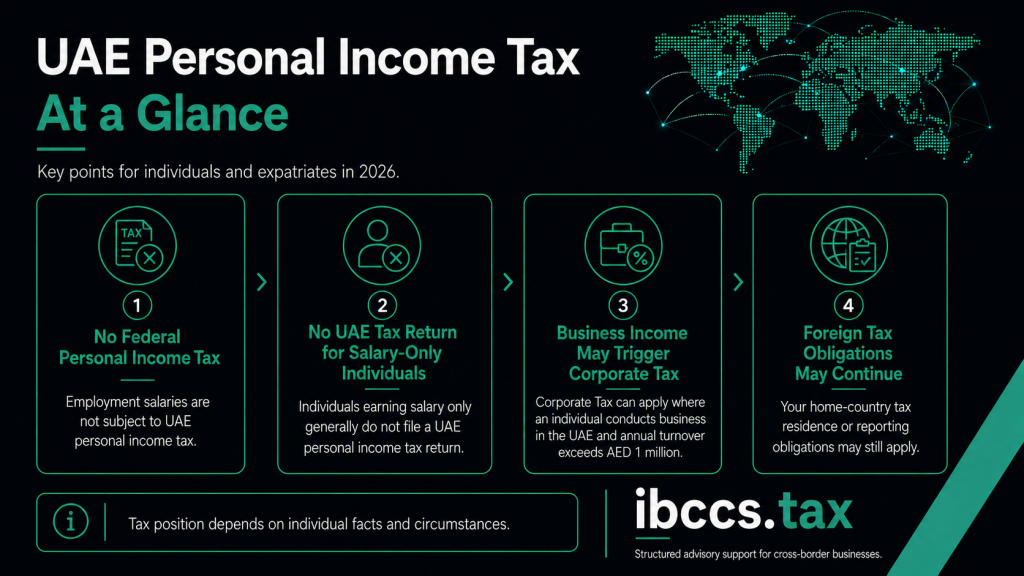
- The UAE does not currently levy federal personal income tax on individuals.
- Employment salaries are not subject to UAE personal income tax.
- Wages, personal investment income and real estate investment income are not treated as business or business activities for UAE Corporate Tax purposes.
- An individual conducting business in the UAE may fall within Corporate Tax where annual business turnover exceeds AED 1 million.
- UAE tax residency may arise under the 183-day test, the 90-day test or the primary residence and centre of interests test.
- A UAE residence visa does not automatically establish or terminate tax residency.
- An individual may continue to have tax or reporting obligations in another country after moving to the UAE.
Is There Personal Income Tax in the UAE?
The UAE does not currently impose federal personal income tax on individuals. An employee receiving a salary for work performed in the UAE is therefore not subject to UAE personal income tax on that employment income. The same federal position applies across all Emirates. There is no separate Dubai income tax or Abu Dhabi personal income tax imposed on an employee’s salary.
An individual receiving employment income only would not generally be required to file a federal UAE personal income tax return solely in relation to that salary. This differs from jurisdictions where employees must submit annual personal tax returns even when tax has already been deducted through payroll.
The absence of personal income tax should not be interpreted as an exemption from every form of taxation or compliance. Business activities conducted personally, income earned through a company, VAT obligations and continuing tax exposure in other countries must be assessed separately.
How Different Types of Individual Income Are Treated in the UAE
The UAE Corporate Tax framework distinguishes between income earned by an individual in a personal capacity and income arising from a business or business activity.
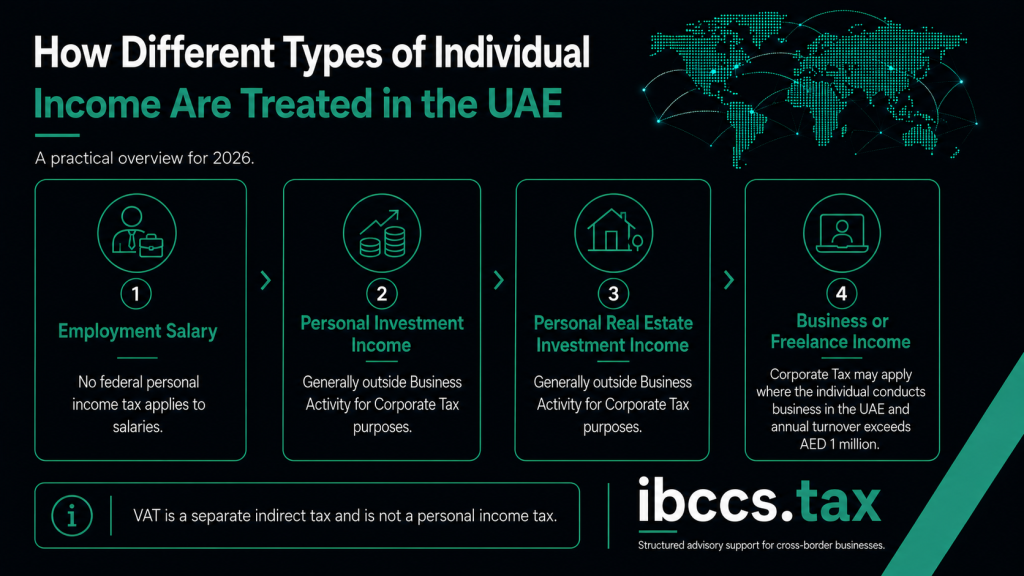
Wages, personal investment income and real estate investment income are not considered business or business activities for Corporate Tax purposes. This means that these income streams are treated differently from revenue generated through consultancy, freelance, professional or commercial activities conducted by an individual.
| Type of income | General UAE treatment | Important qualification |
| Employment salary | No federal personal income tax | Foreign tax or reporting obligations may still apply |
| Personal investment income | Not considered a business or business activity for Corporate Tax purposes | The investment must be held and managed in a personal capacity |
| Real estate investment income | Not considered a business or business activity for Corporate Tax purposes | The structure, licensing and manner in which the activity is conducted must be reviewed |
| Freelance or consultancy income | May fall within UAE Corporate Tax | The AED 1 million annual business turnover threshold is relevant |
| Income earned through a company | Considered separately at company level | The company may have Corporate Tax, VAT, accounting and filing obligations |
The classification depends on the underlying facts and the manner in which the activity is conducted. Personal investing is different from operating an investment business, while privately holding a property may be treated differently from carrying out a licensed commercial real estate activity.
When Does UAE Corporate Tax Apply to an Individual?
UAE Corporate Tax is not limited to incorporated companies. A natural person, meaning an individual, can also fall within the Corporate Tax regime where both of the following conditions are met:
- the individual conducts a business or business activity in the UAE; and
- total turnover derived from that business or business activity exceeds AED 1 million during the calendar year.
The AED 1 million threshold relates to business turnover. It is not based on the individual’s salary, personal savings, investment portfolio or taxable profit.
Wages, personal investment income and real estate investment income are excluded when determining whether income arises from a relevant business or business activity. An individual who does not conduct business in the UAE, or whose relevant annual business turnover does not exceed AED 1 million, is not required to register for Corporate Tax on that basis.
Where an individual falls within Corporate Tax, the standard rate structure generally provides:
- 0% on taxable income up to AED 375,000;
- 9% on taxable income exceeding AED 375,000.
The AED 1 million and AED 375,000 thresholds perform different functions. The AED 1 million threshold determines whether the individual’s business activities bring them within the Corporate Tax regime, while AED 375,000 is the taxable-income threshold above which the standard 9% rate applies.
Do Freelancers and Consultants Pay Tax in the UAE?
Freelancers, consultants, sole proprietors and other self-employed individuals should not assume that the absence of personal income tax means their business profits are automatically outside the UAE tax system.
Where an individual personally conducts consultancy, professional, commercial or other business activities in the UAE and annual turnover exceeds AED 1 million, Corporate Tax registration and filing may be required.
This can apply whether the activity is conducted through a sole establishment, professional licence or another arrangement under which the individual personally carries on the business. The applicable treatment depends on the legal and commercial substance of the activity rather than the description used by the individual.
A resident natural person whose annual business turnover exceeds AED 1 million must generally apply for Corporate Tax registration by 31 March of the following calendar year. The Corporate Tax Return and any resulting tax liability are generally due within nine months from the end of the relevant tax period.
Corporate Tax should be assessed separately from VAT. A person can be required to register for one tax without being required to register for the other because the thresholds, tax bases and applicable rules are different.
IBCCS TAX provides accounting and tax services in the UAE for businesses and individuals requiring support with Corporate Tax registration, bookkeeping, tax calculations and ongoing compliance.
Does the UAE Tax Foreign Income?
The UAE does not impose federal personal income tax merely because an individual receives foreign salary, investment income or other personal income while living in the UAE.
The treatment nevertheless depends on the nature of the income. Foreign income connected with a business or business activity conducted by an individual may need to be considered under the Corporate Tax framework rather than treated as ordinary personal income.
A separate question is whether another country retains the right to tax the income. This may arise because of:
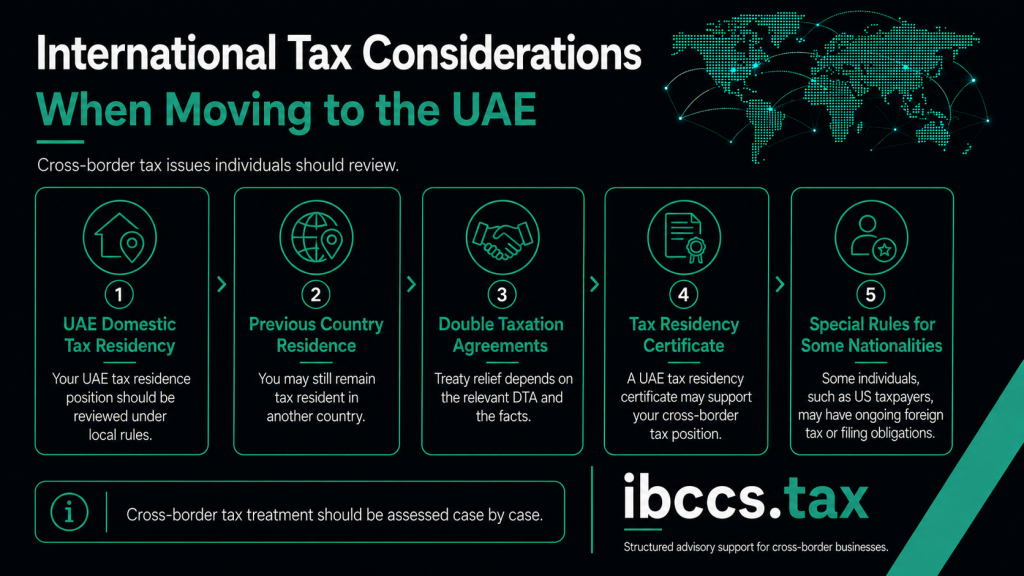
- continuing tax residence in a previous country;
- income sourced in another jurisdiction;
- ownership of foreign property or investments;
- employment, directorships or business activities abroad;
- nationality-based tax and filing rules;
- the provisions of an applicable Double Taxation Agreement.
Moving to the UAE does not automatically end these obligations. Each income stream should be reviewed together with the individual’s tax residence position and the rules of the jurisdictions involved.
UAE Tax Residency Rules for Individuals
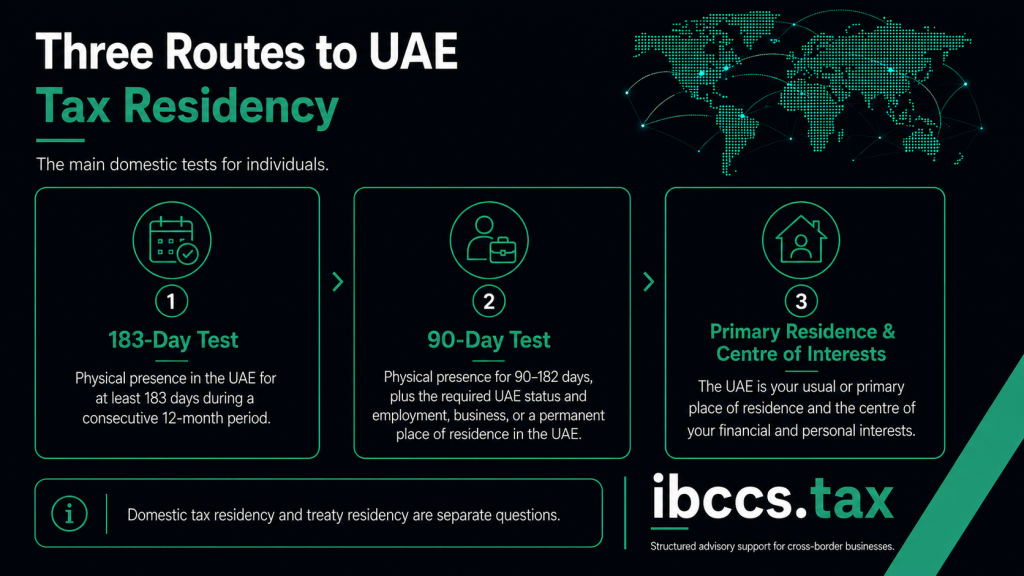
UAE domestic rules provide three principal routes under which a natural person may be considered a UAE tax resident.
The 183-Day Test
An individual may be considered a UAE tax resident if physically present in the UAE for at least 183 days during a relevant consecutive 12-month period.
This test is based on actual physical presence rather than simply holding a UAE residence visa. Travel records and other evidence may be required to demonstrate that the applicable day-count threshold has been satisfied.
The 90-Day Test
An individual may also qualify after being physically present in the UAE for at least 90 days during a relevant consecutive 12-month period.
To qualify under this route, the individual must be a UAE national, hold a valid UAE residence permit or be a national of a Gulf Cooperation Council member state. They must also have either a permanent place of residence in the UAE or carry out employment or business in the UAE.
A permanent place of residence does not necessarily need to be owned by the individual. It must, however, be continuously available to them rather than being accommodation used only for a temporary visit.
The Primary Residence and Centre of Interests Test
An individual may be considered a UAE tax resident where their usual or primary place of residence and centre of financial and personal interests are in the UAE.
This requires a broader assessment of the individual’s actual circumstances. Relevant factors may include where they normally live, where their family is based, where they work or conduct business, and where their main personal, professional, banking and economic relationships are located.
No single document or connection necessarily determines the outcome. The individual’s residence, activities and financial and personal relationships must be considered together.
UAE Residence Visa vs Tax Residency
A UAE residence visa and UAE tax residency are related concepts, but they are not the same.
A residence visa gives an individual immigration permission to live in the UAE. It may also be relevant when applying the 90-day tax residency test, but the visa alone does not automatically establish that the individual is tax resident in the UAE.
Likewise, obtaining a UAE residence visa does not automatically terminate tax residency in another country. A previous jurisdiction may continue to treat an individual as resident based on day-count rules, an available home, family connections, employment, business activities or other domestic criteria.
An individual can also be regarded as resident in more than one country under the respective domestic rules. Where a Double Taxation Agreement applies, the agreement may need to be reviewed to determine the individual’s residence for treaty purposes.
Individuals planning their move can combine their tax analysis with practical relocation assistance in the UAE, including support with immigration, accommodation, banking and other implementation matters.
What Is a UAE Tax Residency Certificate?
A UAE Tax Residency Certificate is an official certificate documenting that an individual or legal person meets the relevant UAE tax residency requirements for a specified period.
The certificate may be required for:
- domestic tax residency purposes;
- applying the provisions of a Double Taxation Agreement;
- supporting a position before a foreign tax authority;
- satisfying a bank or financial institution;
- documenting an individual’s cross-border tax position.
A Tax Residency Certificate provides evidence of UAE tax residence. It does not independently create tax residency where the underlying conditions have not been met.
Where the certificate will be used to claim treaty benefits, the definition of residence and documentary requirements under the relevant Double Taxation Agreement must also be reviewed. Domestic UAE tax residence and treaty residence are connected but separate questions.
IBCCS TAX provides international taxation services in the UAE for clients requiring tax residency analysis, treaty guidance and coordinated cross-border support.
Can You Remain Tax Resident in Another Country?
Becoming tax resident in the UAE does not necessarily mean that an individual immediately stops being tax resident elsewhere.
A previous country may continue to classify the individual as resident because of:
- the number of days spent there;
- an available permanent home;
- the location of a spouse or dependent family;
- employment or directorship responsibilities;
- business management and decision-making;
- economic, social or personal connections;
- country-specific departure or residence rules.
Where an individual is resident in both the UAE and another treaty country, an applicable Double Taxation Agreement may contain tie-breaker provisions. These may consider factors such as permanent home, centre of vital interests, habitual abode and nationality, although the wording of the relevant treaty must always be checked.
Treaty protection is not necessarily automatic. The individual may need to demonstrate eligibility, obtain a UAE Tax Residency Certificate and complete procedural requirements in the other jurisdiction.
Entrepreneurs and company owners should also consider how their personal move may affect entities that they manage or control. Further practical considerations are covered in our guide to international tax planning for entrepreneurs.
Do Individuals Need to File a UAE Tax Return?
The filing position depends on the source and nature of the individual’s income.
| Individual’s position | General UAE filing position |
| Employee receiving salary only | No federal personal income tax return solely in relation to the salary |
| Individual receiving personal investment income | No Corporate Tax registration based solely on that income |
| Individual receiving real estate investment income | No Corporate Tax registration based solely on that income |
| Individual conducting business with turnover not exceeding AED 1 million | Generally outside mandatory Corporate Tax registration on that basis |
| Individual conducting business with turnover exceeding AED 1 million | Corporate Tax registration and return may be required |
| Individual making taxable supplies above the VAT threshold | Separate VAT registration and returns may be required |
The absence of a personal income tax return does not mean that no other UAE filings are required. Corporate Tax and VAT obligations arise under separate rules and must be assessed independently.
Other UAE Taxes and Charges Individuals Should Know
Value Added Tax
The UAE applies a standard VAT rate of 5% to most taxable supplies of goods and services. VAT is an indirect consumption tax and is not a tax on an individual’s salary or personal income.
A business must generally register for VAT where taxable supplies and imports exceed AED 375,000. Voluntary registration may be available where taxable supplies, imports or taxable expenses exceed AED 187,500, subject to the applicable conditions.
Excise Tax
Excise Tax applies to specified categories of goods. It is a product-specific indirect tax rather than a tax on personal income, and it should be considered separately from the individual’s salary or residence position.
Local and Transaction-Based Charges
Individuals may also encounter municipality fees, property-related charges, tourism fees, customs duties and other transaction-based costs.
The application of these charges can depend on the Emirate, type of transaction, nature of the asset and service involved. They should be reviewed separately from the federal personal income tax position.
Practical Examples
Employee Working in Dubai
An employee relocates to Dubai and receives a monthly salary from a UAE employer. The salary is not subject to federal UAE personal income tax, and the employee would not generally file a UAE personal income tax return solely because of that employment income.
The employee should still review whether they have ended tax residence in their previous country and whether foreign investments, property or other income remain taxable there.
Independent Consultant With AED 1.2 Million Turnover
A consultant personally conducts business in the UAE and generates annual turnover of AED 1.2 million. Because business turnover exceeds AED 1 million, the consultant may need to register for Corporate Tax, maintain appropriate records and file a Corporate Tax Return.
Any resulting Corporate Tax is calculated by reference to taxable income after the applicable adjustments rather than by applying the tax rate to the full AED 1.2 million turnover.
Individual Owning a UAE Rental Property
An individual owns a residential property personally and receives rental income. The income may fall within real estate investment income where the activity is conducted in a personal investment capacity.
The position should be reconsidered where the activity is conducted through a commercial licence, forms part of a wider property business or is structured in a manner that changes the nature of the income.
Founder Moving to the UAE
A founder moves to the UAE but continues to own and manage companies registered in other jurisdictions. Their salary or personal investment income may not be subject to UAE personal income tax, but the move can affect the tax residence, management and control or permanent establishment position of the companies.
Personal relocation, company structuring and actual decision-making should therefore be reviewed together. Entrepreneurs planning a UAE entity can also read our guide on how to set up a business in the UAE.
Common UAE Personal Income Tax Misconceptions
“The UAE has no taxes”
The UAE does not levy federal personal income tax, but it operates Corporate Tax, VAT, Excise Tax and other charges. Each tax has its own scope, thresholds and compliance requirements.
“A UAE residence visa automatically makes me tax resident”
A residence visa may be relevant to the 90-day test, but additional conditions must be satisfied. Other routes to UAE tax residency also exist.
“I must spend at least 183 days in the UAE”
The 183-day test is only one route to domestic UAE tax residency. An individual may also qualify under the 90-day test or the primary residence and centre of interests test.
“Freelance income is tax-free because it is personal income”
Freelance and consultancy income may arise from a business or business activity. Corporate Tax can apply where annual business turnover exceeds AED 1 million.
“A Double Taxation Agreement applies automatically”
Treaty access depends on the wording of the relevant agreement, the individual’s residence position, the type of income and the applicable procedural requirements.
How IBCCS TAX Can Assist
The UAE offers an attractive environment for internationally mobile individuals and entrepreneurs, but personal residence and business tax implications should be reviewed before a relocation or structure is implemented.
At IBCCS TAX, we assist clients with:
- UAE personal and business tax exposure reviews;
- domestic and treaty tax residency analysis;
- Tax Residency Certificate support;
- Corporate Tax registration and compliance for natural persons;
- accounting, bookkeeping, VAT and Corporate Tax services;
- cross-border ownership and company structuring;
- UAE company formation and ongoing corporate support;
- coordination between relocation, personal tax and business planning.
Clients planning to establish a business can access our UAE company formation services. Individuals and families moving to the country can also combine their tax planning with our UAE relocation assistance.
Planning to Move, Work or Conduct Business in the UAE?
Understanding the 0% personal income tax position is only the starting point. Business activities, tax residence, foreign income and connections with other jurisdictions should be reviewed together before important decisions are implemented.
Contact IBCCS TAX to discuss your UAE and international tax position with our team.

Frequently Asked Questions About UAE Personal Income Tax
1. Does the UAE have personal income tax in 2026?
No. The UAE does not currently levy federal personal income tax on individuals, and employment salaries are not subject to UAE personal income tax.
2. Do expatriates pay tax on their salary in Dubai?
Dubai does not impose a separate personal income tax on employment salaries. An expatriate may nevertheless have tax obligations in another jurisdiction depending on residence, nationality and income-source rules.
3. Do employees need to file a UAE personal income tax return?
An individual receiving only employment salary would not generally file a federal UAE personal income tax return solely in relation to that salary. Separate Corporate Tax or VAT obligations can arise where the individual also conducts business.
4. Do freelancers pay tax in the UAE?
A freelancer or consultant may become subject to UAE Corporate Tax where they conduct a business or business activity in the UAE and annual business turnover exceeds AED 1 million.
5. Is the AED 1 million threshold based on turnover or profit?
The AED 1 million threshold is based on turnover generated from business or business activities during the calendar year. It is not based on taxable profit.
6. Is spending 183 days in the UAE the only way to become tax resident?
No. UAE domestic rules also include a 90-day test with additional conditions and a test based on the individual’s usual or primary residence and centre of financial and personal interests.
7. Does a UAE residence visa make me a UAE tax resident?
Not automatically. A residence visa can be relevant to the 90-day test, but the other legal requirements must also be satisfied.
8. Does the UAE tax foreign income?
The UAE does not levy federal personal income tax merely because an individual receives foreign personal income. Foreign business income and continuing obligations in other jurisdictions must be assessed separately.
9. Can I be tax resident in both the UAE and another country?
Yes. An individual can satisfy the domestic tax residence rules of more than one country. An applicable Double Taxation Agreement may then be required to determine residence for treaty purposes.
10. What is a UAE Tax Residency Certificate?
A UAE Tax Residency Certificate is an official document confirming that the applicant meets the relevant UAE tax residency requirements for a specified period.




Cezary Zieniuk to Join Free IMC Webinar on the New Geography of Global Mobility
On 23 September 2026, Cezary Zieniuk, Founder of IBCCS TAX
Read More
UAE Business License Guide: Types, Requirements, Costs and Renewal
A UAE business license is the formal authorization that allows
Read More
Why Start a Business in the UAE? Strategic Advantages and Practical Considerations
The United Arab Emirates has developed into an established international
Read MoreDisclaimer: This article provides general information and does not constitute tax, legal or investment advice. UAE and international tax treatment depends on the individual facts, applicable legislation and relevant Double Taxation Agreements. Professional advice should be obtained before implementing a relocation, business or investment structure.