

Georgia has become an increasingly attractive jurisdiction for entrepreneurs, technology companies, consultants, investors and international business groups looking for a practical and tax-efficient base of operations. Its appeal is not limited to one factor. Georgia combines a relatively simple business environment, strategic location between Europe and Asia, streamlined company registration, competitive operating costs and several tax incentive regimes that may be relevant for specific types of activity.
However, Georgia should not be viewed only through the lens of low headline tax rates. The real value of the jurisdiction depends on choosing the right structure, applying the correct tax regime, meeting the applicable conditions and maintaining proper compliance after the business is established. This is especially important for international businesses. A regime that works well for an IT company exporting software services may not be suitable for a trading business, a holding structure, a freelancer, a manufacturing project or a company with employees and local operations in Georgia.
In this guide, we explain the main Georgia tax incentives available to international businesses, including Virtual Zone status, International Company Status, Free Industrial Zones and the 1% Small Business regime. We also look at how to decide which option may fit your company and why professional tax advice should come before registration, not after.
Why Georgia is Considered a Tax-efficient Jurisdiction for Business
Georgia is often discussed as a business-friendly jurisdiction because it offers a combination of relatively simple administration, flexible legal structures and several tax regimes that can be attractive when used correctly. For foreign entrepreneurs and international companies, Georgia may be considered for:
- IT and software development companies;
- international service providers;
- trading businesses;
- logistics and export-oriented activities;
- holding or investment-related structures;
- individual entrepreneurs and freelancers;
- regional operations between Europe, the Caucasus, Central Asia and the Middle East.
Georgia also offers a practical environment for setting up and operating a company. In many cases, the process of business registration in Georgia can be completed efficiently, provided that the legal form, ownership structure, tax position and ongoing compliance requirements are considered from the beginning.
The key point is that Georgia’s tax advantages are not automatic in every case. Different regimes apply to different business models. Some are designed for IT companies, others for Free Industrial Zone activity, and others for individual entrepreneurs rather than companies. A tax-efficient Georgian structure should therefore be based on the actual commercial activity, not only on the desire to access the lowest possible tax rate.
Main Tax Incentive Regimes in Georgia Country
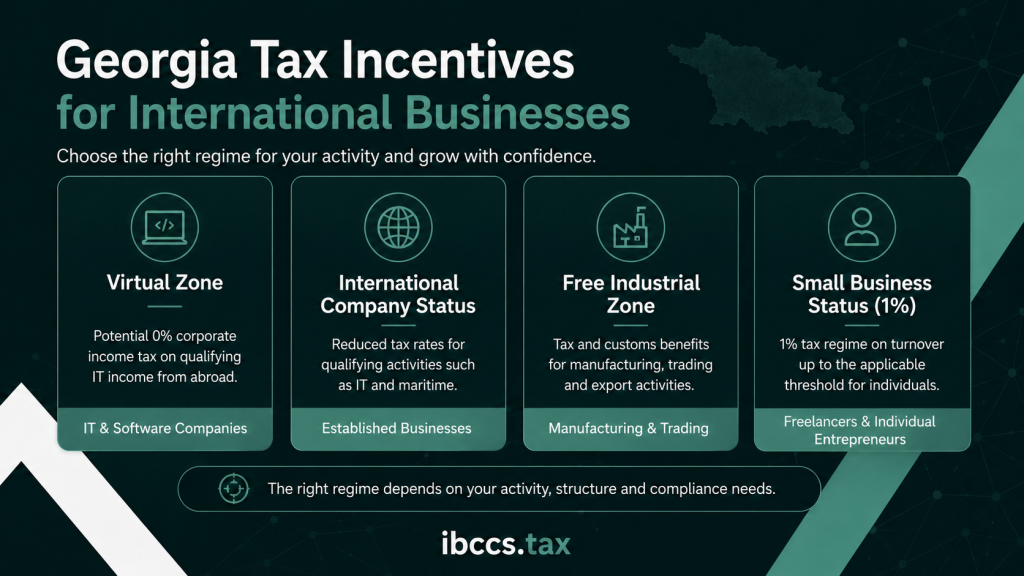
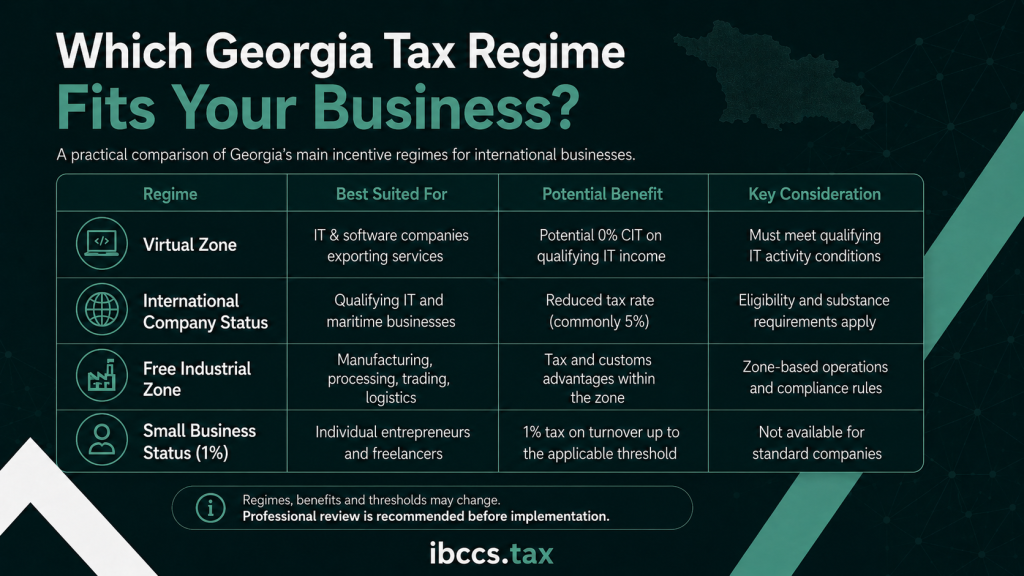
Georgia offers several regimes that may be relevant for international businesses and entrepreneurs. The most commonly discussed include:
| Regime | Best suited for | Potential benefit | Key point to review |
|---|---|---|---|
| Virtual Zone status | IT and software companies exporting qualifying services or products | Favourable treatment for qualifying foreign-source IT income | The activity must qualify and proper documentation is important |
| International Company Status | Qualifying IT and maritime-related companies | Reduced tax rates for eligible activities | Not every company or activity qualifies |
| Free Industrial Zone | Manufacturing, processing, trading or export-oriented activity within a zone framework | Favourable tax and customs treatment in a zone-based structure | The business must fit the operational model of a Free Industrial Zone |
| Small Business Status | Individual entrepreneurs and freelancers | 1% turnover-based regime up to the relevant threshold | It is not a corporate tax regime for standard companies |
Each of these options can be useful in the right context. Each can also be misunderstood if assessed only from a headline tax perspective. For example, the 1% tax regime is often discussed internationally, but it generally refers to qualifying individual entrepreneurs under Small Business Status, not to standard Georgian companies. Similarly, Virtual Zone status may be very attractive for IT companies, but it does not apply to all digital businesses or all types of foreign income.
The role of proper tax advisory in Georgia is to determine whether the business activity, ownership structure, revenue model and operational setup support the intended regime.
Virtual Zone Status in Georgia: for IT and Software Export Businesses
Virtual Zone status is one of Georgia’s best-known tax incentive regimes, particularly among IT companies and software businesses. In general terms, Virtual Zone status is designed for Georgian legal entities involved in qualifying information technology activities. It is often considered by businesses that develop software, IT systems or digital products and provide those services or products to clients outside Georgia.
The main attraction is the potential favourable tax treatment of qualifying income derived from IT activity provided to foreign clients. This can make Georgia an interesting option for software development companies, SaaS-related businesses, IT outsourcing providers and certain digital product companies.
However, Virtual Zone status should not be treated as a simple “tax-free company” label. The company’s activity must be assessed carefully. Important questions include:
- Is the company genuinely engaged in qualifying IT activity?
- Are the clients located outside Georgia?
- Where is the product or service created?
- Does the company have adequate documentation to support its position?
- Is the income clearly connected to qualifying IT services or products?
- Are there any local Georgian clients or mixed activities?
- How will salaries, subcontractors, dividends and expenses be treated?
- Is the company maintaining proper accounting records and tax compliance?
A common mistake is to focus only on obtaining the status and not enough on maintaining it. The practical operation of the company matters. If the company’s activities change, if revenue streams become mixed, or if documentation is weak, the tax position may require further review. For IT businesses considering Georgia, Virtual Zone status can be highly attractive, but it should be planned together with accounting, corporate structure and ongoing compliance.
International Company Status in Georgia: Reduced Tax Regime for Qualifying Activities
International Company Status is another important preferential regime in Georgia. It is generally associated with qualifying activities in areas such as IT and certain maritime-related services. For eligible companies, it may provide reduced tax rates compared with the general regime.
This status may be relevant for more established companies that have a qualifying activity, operational substance and a clearer business structure. It may also be considered where the company expects to have employees, a more formal operating setup or a longer-term Georgian presence. The key issue is eligibility. International Company Status is not suitable for every business and should not be selected only because the headline tax rates appear attractive.
Before considering this regime, a company should review:
- whether its activity falls within the qualifying categories;
- whether its income can be linked to qualifying activities;
- whether it has or can develop appropriate operational substance;
- whether payroll and employment tax implications are properly understood;
- how dividends, profit distributions and reinvested profits may be treated;
- whether the regime fits the company’s long-term business model.
For many businesses, the comparison between Virtual Zone status and International Company Status is especially important. Both may be relevant to IT companies, but they are not identical. The better option depends on the company’s activity, operational model, clients, staff, substance, revenue profile and future plans.
This is where careful taxation services in Georgia can add significant value. The decision should be made before the company is structured and before revenue flows are already in place.
Free Industrial Zones in Georgia: When a Zone-based Structure May Work
Georgia’s Free Industrial Zones may be relevant for businesses involved in manufacturing, processing, trading, logistics, export-oriented operations or other activities that can fit within a zone-based framework. A Free Industrial Zone structure can offer tax and customs advantages, but it is not a universal solution. The business must be suitable for the operational requirements of the zone. The company must also understand the practical implications of working within a specific zone environment.
Free Industrial Zones may be considered where a business needs:
- import and export operations;
- warehousing or logistics support;
- manufacturing or processing activity;
- access to regional trade routes;
- a defined operational base for goods-related activity.
However, not every trading or international business needs a Free Industrial Zone. For example, a consulting company, software company or professional services provider may find that another Georgian structure is more appropriate. Before choosing a Free Industrial Zone, companies should assess:
- whether the planned activity is suitable for the zone;
- whether the logistics and operational setup are commercially practical;
- whether local suppliers, customers or Georgian market transactions are involved;
- how customs, tax and reporting obligations will work;
- whether the expected benefits justify the operational requirements.
A Free Industrial Zone can be effective when it matches the business model. It can be inefficient when selected only for perceived tax advantages without a clear operational reason.
Small Business Status in Georgia and the 1% Tax Regime: Useful, but not a Company Regime
The 1% tax regime in Georgia is one of the most widely discussed features of the Georgian tax system. It is often attractive to freelancers, consultants, individual service providers and small entrepreneurs. However, it is important to understand what it is and what it is not.
The 1% regime is generally connected with Small Business Status for qualifying individual entrepreneurs. It is not the same as corporate tax for a Georgian LLC or other standard company. This distinction is crucial for foreign entrepreneurs comparing Georgia with other jurisdictions. Small Business Status may be relevant for individuals who:
- operate as individual entrepreneurs;
- provide qualifying services;
- remain within the applicable turnover threshold;
- do not carry out restricted activities;
- prefer a simplified tax regime;
- do not require a corporate structure for commercial, banking or legal reasons.
However, it may not be suitable where the business:
- needs a company rather than an individual entrepreneur registration;
- has investors or multiple shareholders;
- needs limited liability protection;
- operates through a group structure;
- requires corporate contracts with larger clients;
- has activities excluded from the regime;
- expects to exceed the relevant threshold;
- requires a more formal international business setup.
This is why the 1% regime should not be presented as “1% corporate tax in Georgia”. It is a specific simplified regime, mainly relevant for qualifying individual entrepreneurs. For some clients, Small Business Status may be the most efficient and practical solution. For others, a Georgian company, Virtual Zone structure, International Company Status or another arrangement may be more appropriate.
Georgia’s General Corporate Tax System: Why Distributions Matter
In addition to special regimes, companies considering Georgia should understand the general corporate tax environment.
Georgia’s corporate tax system is often described as a distribution-based model. In simplified terms, corporate income tax is generally connected with profit distributions and certain deemed distributions, rather than being applied in the same way as a traditional annual profit tax system.
This can be attractive for companies that reinvest profits, but it also requires proper understanding of what may constitute a taxable distribution or deemed distribution. For example, certain non-business expenses, benefits, undocumented payments or transactions not properly connected with the company’s activity may create tax implications.
This is why accounting and tax compliance are important even where a company appears to benefit from a favourable regime. A low-tax structure is only effective when the company’s records, transactions and distributions are properly managed.
For a more detailed explanation, see our guide to Georgia corporate tax.
How to Choose the Right Georgia Tax Regime
There is no single “best” Georgian tax regime for every international business. The right choice depends on the facts. Before selecting a structure, the following questions should be reviewed.
What does the business actually do?
An IT company, trading company, consulting business, holding structure, individual freelancer and manufacturing business may all require different tax treatment.
Who are the clients?
Foreign clients, Georgian clients, EU clients, non-EU clients, related parties and individual consumers may all create different tax and VAT considerations.
Where is the work performed?
For certain regimes, the location of activity, team, management, development work or operational substance may be relevant.
Is the business a company or an individual activity?
Small Business Status may be attractive for individual entrepreneurs, but it is not the same as a Georgian company structure.
Does the company need employees?
Payroll, employment tax and pension obligations may affect the overall tax and compliance position.
Will profits be reinvested or distributed?
Georgia’s tax system may treat reinvested profits differently from distributed profits, depending on the structure and regime.
Is there a cross-border structure?
If the Georgian entity is part of a wider group, issues such as transfer pricing, withholding tax, treaty access, substance, management and intercompany transactions may need review.
Is the business model likely to change?
A regime that fits the company today may need to be reviewed if the company adds new services, hires employees, starts local activity or expands into new markets.
The most important point is that tax planning should match commercial reality. A structure should not be built around a tax incentive if the business does not genuinely fit the conditions of that incentive.
Why Professional Tax Advice Matters Before Registration
Many entrepreneurs start with the question: “How quickly can I register a company in Georgia?” A better first question is: “What structure should I register, and which tax regime fits my business?”
Registration is only one part of the process. The more important decisions often come before registration, including:
- whether to operate as an individual entrepreneur or a company;
- whether a Georgian LLC is appropriate;
- whether Virtual Zone status may apply;
- whether International Company Status should be considered;
- whether a Free Industrial Zone structure is commercially suitable;
- how ownership should be structured;
- how revenue flows will be documented;
- how accounting records will be maintained;
- whether VAT, payroll or withholding tax issues may arise;
- how profits will be distributed or reinvested.
A company can usually be registered quickly, but correcting the wrong structure later can be more complicated.
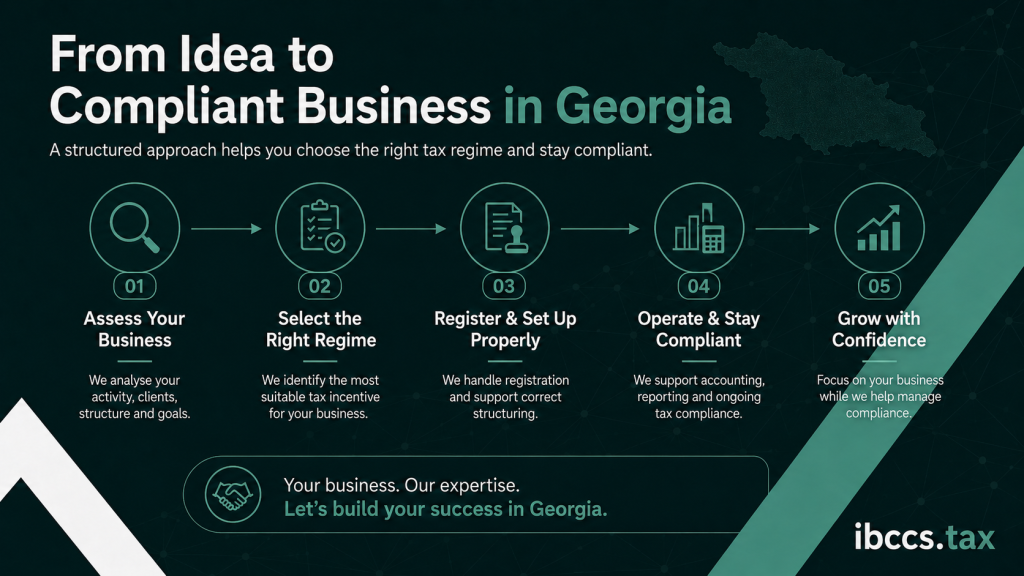
At IBCCS TAX, we help clients assess the structure before implementation. Our Georgia team supports local and international clients with business registration in Georgia, tax advisory, accounting, compliance and wider business support.
Accounting and Compliance in Georgia Should not be an Afterthought
Georgia’s tax incentives can be attractive, but they do not remove the need for proper accounting and compliance. A company should maintain accurate financial records, document its income and expenses, prepare filings where required, monitor tax obligations and ensure that the selected regime continues to match its activity.
This is especially important for companies using special regimes. The company should be able to demonstrate what it does, where its clients are located, how its revenue is generated and why the regime applies. Professional accounting services in Georgia can help businesses maintain accurate records, prepare reports, support tax filings and keep management informed.
For international businesses, accounting also supports wider strategic decisions. Reliable financial records help with banking, investor communication, management reporting, audit support and future restructuring. A tax incentive is only as strong as the compliance framework behind it.
Georgia for International Businesses: Opportunities and Limitations
Georgia can be a highly effective jurisdiction when the structure matches the client’s commercial, personal and long-term objectives. It may be especially relevant for:
- IT companies exporting services or software;
- entrepreneurs seeking a practical regional base;
- individual consultants and freelancers;
- businesses looking at Georgia as part of a wider international structure;
- trading and logistics businesses with regional operations;
- investors considering Georgia alongside Cyprus, UAE or other jurisdictions.
However, Georgia is not the right solution for every business. A company should also consider:
- where the owners and directors are tax resident;
- where management and control are exercised;
- where clients and suppliers are located;
- whether the company needs substance in Georgia;
- whether banking and payment processing are practical;
- whether the business requires VAT registration;
- whether the structure creates tax issues in another jurisdiction;
- whether the chosen tax regime will remain appropriate as the company grows.
For broader context, see our article on doing business in Georgia.
Comparing Georgia Tax Regimes: Practical Overview
| Business profile | Possible regime to consider | Key caution |
|---|---|---|
| Software development company serving foreign clients | Virtual Zone status | Must qualify as IT activity and maintain supporting documentation |
| Established IT company with staff and operational substance | International Company Status | Eligibility and activity requirements must be reviewed |
| Individual freelancer or consultant | Small Business Status | Generally applies to individual entrepreneurs, not companies |
| Trading, logistics or export-oriented activity | Free Industrial Zone | Must fit the zone-based operational model |
| General company with reinvested profits | Standard corporate tax system | Distributions and deemed distributions must be monitored |
| Cross-border group structure | Tailored Georgian structure | Requires review of international tax, substance and compliance |
This table is only a high-level guide. The right answer depends on the actual facts of the business.
How IBCCS TAX Can Assist
IBCCS TAX supports businesses and individuals across Georgia, Cyprus, UAE, Uzbekistan and other jurisdictions, helping clients choose structures that are practical, compliant and aligned with their commercial objectives.
In Georgia, our team assists with:
- tax advisory and structuring;
- selection of the appropriate tax regime;
- company and individual entrepreneur registration;
- Virtual Zone and other status-related considerations;
- accounting and bookkeeping;
- tax compliance and reporting;
- payroll and employment tax matters;
- corporate and legal support;
- cross-border structuring;
- coordination with other jurisdictions.
For clients operating internationally, we can also coordinate Georgian matters with wider corporate, tax and residency planning. This is particularly relevant where Georgia is being considered together with Cyprus, UAE or other jurisdictions. Our approach is practical: we look at the business model first, then the tax regime. The objective is not only to access a beneficial regime, but to build a structure that can be maintained properly over time.
Build the Structure Before Choosing the Tax Incentive
Georgia offers several attractive tax incentives, but the best result comes from choosing the regime that fits the business, not the regime with the most attractive headline rate.
Virtual Zone status may be effective for qualifying IT companies. International Company Status may be relevant for certain established businesses. Free Industrial Zones may work for suitable trading, manufacturing or export activity. Small Business Status may be highly efficient for qualifying individual entrepreneurs.
Each option has its own purpose, conditions and limitations. Before registering a business in Georgia or applying for a preferential tax regime, it is important to review the company’s activity, clients, ownership, revenue model, operational substance, compliance capacity and international tax position. With the right planning, Georgia can be a strong platform for international business. With the wrong structure, the same tax incentives can create misunderstanding, compliance issues or missed opportunities.
IBCCS TAX can help you assess the available options and build a Georgian structure that is commercially practical, tax-aware and compliant.
Need Advice on Georgia Tax Incentives?
If you are considering Georgia for your company, IT business, trading activity or individual entrepreneur setup, our team can help you evaluate the available regimes and choose the right structure. Contact IBCCS TAX to discuss tax advisory, accounting, compliance and business registration support in Georgia.






FAQ – Georgia Tax Incentives
1. What are the main tax incentives in Georgia for international businesses?
The main Georgia tax incentives often considered by international businesses include Virtual Zone status for qualifying IT companies, International Company Status for eligible activities, Free Industrial Zones for suitable zone-based operations and Small Business Status for qualifying individual entrepreneurs.
2. What is Virtual Zone status in Georgia?
Virtual Zone status is a special regime for Georgian legal entities engaged in qualifying information technology activities. It is commonly considered by IT and software companies that provide qualifying services or products to foreign clients.
3. Is Virtual Zone status available for all online businesses?
No. Virtual Zone status is not automatically available for every online or digital business. The company’s activity must qualify, and the income should be properly connected with eligible IT services or products.
4. What is International Company Status in Georgia?
International Company Status is a preferential tax regime available to companies carrying out qualifying activities, commonly associated with IT and certain maritime-related services. Eligibility should be reviewed before applying.
5. What is a Free Industrial Zone in Georgia?
A Free Industrial Zone is a special zone-based framework that may offer favourable tax and customs treatment for suitable activities, such as manufacturing, processing, trading or export-oriented operations.
6. Does Georgia have a 1% corporate tax?
No. The commonly discussed 1% tax regime generally relates to qualifying individual entrepreneurs under Small Business Status. It should not be confused with corporate tax for Georgian companies.
7. Is Small Business Status suitable for foreign freelancers?
It may be suitable for certain foreign freelancers or individual entrepreneurs, depending on their activity, turnover, registration position and eligibility. However, it is not always the best option where a corporate structure is required.
8. Which Georgia tax regime is best for IT companies?
IT companies often consider Virtual Zone status or International Company Status. The better option depends on the company’s activity, clients, team, substance, revenue model and long-term plans.
9. Can a foreigner register a company in Georgia?
Yes. Foreign investors and entrepreneurs can generally register a business in Georgia. However, the legal form, tax regime, accounting obligations and compliance framework should be reviewed before registration.
10. Do Georgia tax incentives remove compliance obligations?
No. Even where a company benefits from a preferential tax regime, it still needs proper accounting, documentation, tax review and ongoing compliance.
11. Should I choose Georgia, Cyprus or UAE for my company?
The answer depends on your business model, management location, clients, banking needs, tax residency, substance, ownership structure and long-term objectives. In many cases, a comparative review is recommended before choosing the jurisdiction.
12. Can IBCCS TAX help with Georgia tax advisory and business registration?
Yes. IBCCS TAX assists with tax advisory, business registration, accounting, compliance and structuring in Georgia, including support for international clients considering Georgia as part of a wider business or tax planning strategy.

Cezary Zieniuk to Join Free IMC Webinar on the New Geography of Global Mobility
On 23 September 2026, Cezary Zieniuk, Founder of IBCCS TAX
Read More
Property Tax in Georgia in 2026: Rates, Income Thresholds, Filing and Rules for Foreign Owners
Property tax in Georgia is an annual obligation that can
Read More
Accounting Entries in Georgia: Bookkeeping Examples for Georgian LLCs
Accurate bookkeeping starts with recording each business transaction in the
Read More