

Georgia offers two important preferential regimes for qualifying technology businesses: Virtual Zone Person Status and International Company Status. Both can reduce Georgian tax, but they are designed for different operating models and apply different conditions to activity, experience, employment, substance and ongoing compliance.
The comparison is often reduced to a headline of 0% versus 5% profit tax. That is incomplete. A Virtual Zone company must connect its exemption to information technology developed in Georgia and supplied outside Georgia, while an International Company must carry out listed permitted activities in Georgia, demonstrate an eligible experience route and maintain adequate qualified people and operating costs.
At IBCCS TAX, we assist software businesses, technology groups and international founders with company registration in Georgia, eligibility reviews, tax modelling, status applications and ongoing accounting. This guide compares the two regimes and explains which questions should be answered before selecting a structure.

- Virtual Zone Person Status is generally aimed at a Georgian legal entity producing software or qualifying IT in Georgia and supplying it outside Georgia.
- International Company Status applies a broader reduced-tax package to listed IT and maritime activities carried out in Georgia, but the eligibility and substance requirements are more formal.
- Qualifying Virtual Zone profit distributions can be exempt from corporate profit tax, while an International Company is generally subject to 5% profit tax under Georgia’s distributed-profit system.
- International Company employment income can qualify for a 5% rate, while employees of a Virtual Zone company generally remain subject to the ordinary Georgian employment income rules.
- Dividends paid by an International Company are not taxed at source in Georgia under the special rules; a Virtual Zone shareholder should separately review the ordinary dividend withholding position.
- International Company Status generally requires at least two years of relevant experience through the applicant or a qualifying related or represented enterprise.
- Neither regime removes the need for VAT analysis, payroll, accounting, documentation or review of the shareholder’s foreign tax position.
Why the Regimes Should Be Compared Before Company Setup
The status should follow the real operating model. A company that selects Virtual Zone treatment but performs most development outside Georgia may struggle to support the exemption. An International Company that cannot demonstrate experience, employees or operating expenditure in Georgia may not satisfy the conditions for the status.
The decision also affects hiring, pricing and profit extraction. Salary tax can make International Company Status more attractive for a larger Georgian team, while the simpler Virtual Zone route may suit a focused software export business with a leaner local operation. The shareholder’s dividend and foreign tax position can change the comparison again.
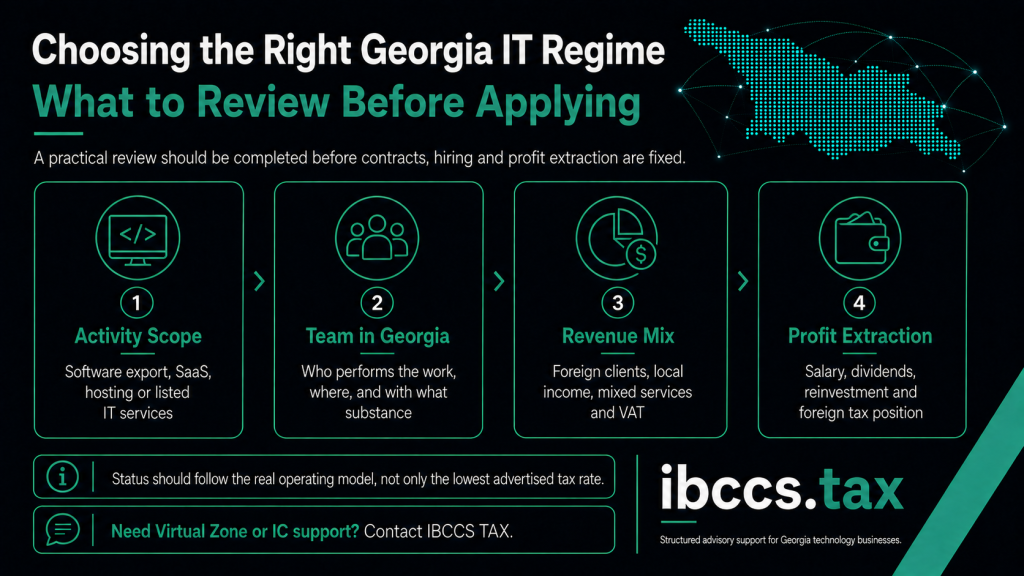
A practical review should therefore be completed before employment agreements, customer contracts and group service arrangements are fixed. Restructuring an established workflow after the company has begun trading is usually more difficult than designing the correct model at the beginning.
What Is Virtual Zone Person Status in Georgia?
A Virtual Zone Person is a Georgian legal person engaged in information technology activity and holding the relevant status. The legal definition of IT focuses on the study, support, development, design, production and introduction of computer information systems that result in software products.
The regime is connected to IT produced in Georgia and supplied outside Georgia. Qualifying profit or profit distributions derived from that activity can benefit from a profit tax exemption, and the Information Technology Zones law also provides special treatment for qualifying supplies outside Georgia.
Virtual Zone Status does not convert every digital or consulting service into exempt IT income. The company should be able to identify the software product or qualifying IT output, show where it was developed and connect customer revenue with the Georgian development activity.
What Is International Company Status in Georgia?
International Company Status is a preferential regime available to a Georgian enterprise carrying out activities listed by the Government of Georgia. The permitted list includes a wide range of software publishing, programming, computer consulting, technology management, digital product, hosting, software maintenance and related IT services, as well as defined maritime activities.
For an IT business, the regime generally provides a 5% corporate profit tax rate, a 5% employment income rate for qualifying employees, no Georgian withholding tax on dividends and an exemption from property tax, except land, for property intended or used for permitted activity.
The broader benefit package comes with more formal entry and operating conditions. The company must satisfy an experience route, carry out the permitted activity in Georgia and maintain adequate qualified human resources and operating costs for its basic income-generating activity.
Virtual Zone vs International Company: Main Differences
The following comparison summarises the main decision points. The correct treatment still depends on the company’s contracts, development process, employees, revenue mix and shareholder profile.
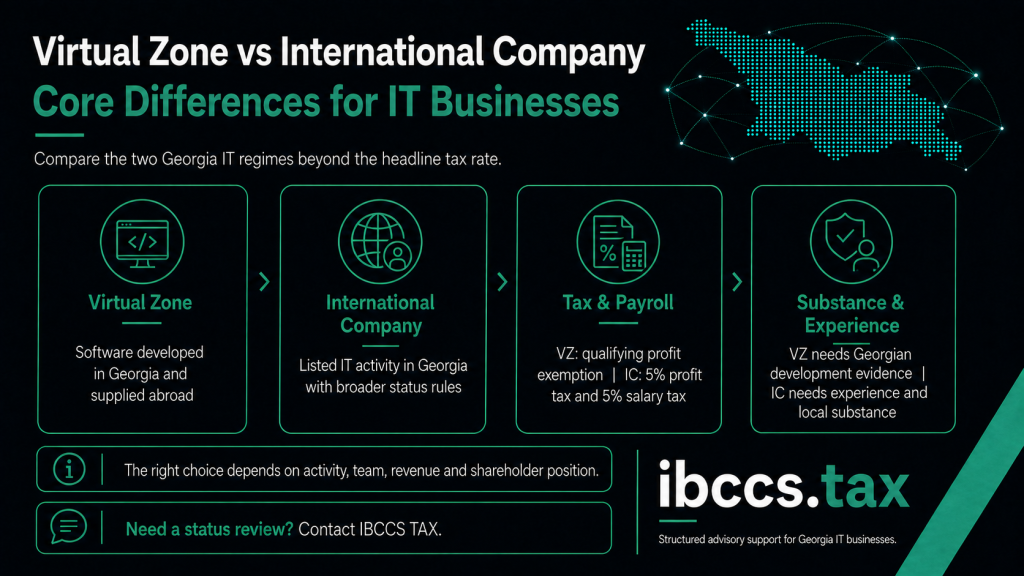
| Area | Virtual Zone Person | International Company |
| Core purpose | Qualifying IT or software developed in Georgia and supplied outside Georgia. | Listed IT or maritime activities carried out in Georgia. |
| Profit tax | Qualifying exported IT profit distributions may be exempt. | Generally 5% under the distributed-profit model. |
| Experience test | No separate statutory two-year experience route for the status. | Generally at least two years through the applicant or a qualifying related or represented enterprise. |
| Substance | Development in Georgia must be evidenced; no fixed employee count is stated. | Basic income-generating activity, qualified human resources and appropriate operating costs in Georgia are expressly required. |
| Employment income | Ordinary Georgian employment income treatment generally applies. | Qualifying employment income is generally taxed at 5%. |
| Dividends | Ordinary Georgian dividend withholding should be reviewed separately. | No Georgian tax at source under the special International Company rule. |
| Other revenue | Local and non-qualifying income requires separate tax and expense allocation. | Non-permitted revenue is limited to 2% of permitted activity revenue, excluding VAT. |
| Application | Streamlined status process, with a statutory 10-working-day decision period. | More detailed Revenue Service and Government review. |
| Typical fit | Focused software export business with demonstrable Georgian development. | Established IT group or substantive Georgian technology operation with employees. |
Eligibility and Permitted IT Activities
A business should not assume that being described as a technology company is enough. The legal tests focus on what the company actually produces or provides, where the activity takes place and whether the resulting revenue falls within the qualifying scope.
Virtual Zone: Software Product and Georgian Development
The Virtual Zone definition is built around information technology activity that results in software products. Activities can include development, design, production, implementation and support, but the company should be able to demonstrate a technological output rather than relying only on broad labels such as consulting, marketing or digital services.
The production activity must take place in Georgia. Evidence may include employment or contractor agreements, source-code repositories, project records, task assignments, technical documentation, workspace arrangements and records showing how the Georgian team contributed to the product supplied to foreign customers.
International Company: Listed Permitted Activities
International Company Status uses a detailed permitted list. For IT businesses, it includes software publishing, computer programming, computer technology consulting, computer management, other IT and computer services, production or delivery of digital products, website development, web hosting, remote software and hardware maintenance, system administration and defined forms of online software delivery.
The list should be matched with the customer contract and invoice description. A company may use commercial terminology different from the official activity codes, but it still needs to explain how the work falls within a permitted category.
IT Consulting, Support and Mixed Digital Services
Consulting can qualify only where it genuinely concerns computer technology or another permitted IT activity. General management consulting, business development, recruitment, advertising and non-technical project coordination should not automatically be included because the client operates in the technology sector.
Mixed service packages should be separated where possible. Contracts and accounting records should distinguish software development, hosting or technical support from non-qualifying commercial services so that revenue and costs can be analysed accurately.
Experience Requirements and Application Routes
The two regimes differ materially at the application stage. Virtual Zone Status focuses on the company’s IT activity and uses a relatively streamlined administrative procedure. International Company Status requires a more substantial eligibility file and a Government decision.
Virtual Zone Application
The Information Technology Zones law provides that status should be granted no later than 10 working days after the application, followed by an electronic certificate. The application should identify the company and describe the IT activity for which status is requested.
Although the procedure is comparatively accessible, the company should prepare its evidence before trading. A certificate confirms status, but it does not by itself prove that every future invoice relates to IT developed in Georgia and supplied outside Georgia.
International Company Experience Test
International Company Status generally requires at least two years of experience in the permitted activity. The experience may be held by the Georgian applicant itself, by a non-resident enterprise represented in Georgia or by a qualifying partner enterprise that owns more than 50% of the applicant, subject to the detailed rules.
The application should include documents showing the history and nature of the activity. These may include corporate records, customer contracts, invoices, financial statements, project evidence, ownership documents and explanations of how the experienced foreign or related enterprise connects with the Georgian applicant.
Substance and IT Activity in Georgia
Substance is central to both regimes, but it appears differently in the rules. Virtual Zone treatment requires the IT to be produced in Georgia. International Company Status expressly requires basic income-generating activity in Georgia, adequate qualified human resources and appropriate operating expenditure.
Where Development Work Is Performed
The company should be able to identify which functions are performed in Georgia. This can include architecture, coding, testing, deployment, technical support, system administration or product management where those activities form part of the qualifying service.
Using a Georgian company only as an invoicing vehicle while all meaningful development occurs abroad creates a weak position. Customer contracts alone do not establish local production; operational records should support the role of the Georgian business.
Employees, Contractors and Qualified Human Resources
Neither regime should be reduced to a fixed minimum headcount. The number and profile of people should be credible for the activity, revenue and project volume. A small specialist product may require a lean team, while a large development contract may require several engineers and support functions.
Employment normally creates the clearest evidence, especially for International Company Status and its 5% salary tax benefit. Contractors may also contribute to the operating model, but their location, independence, deliverables and documentation need to be reviewed rather than assumed to provide equivalent substance.
Operating Costs, Workspace and Technical Infrastructure
International Company rules expressly refer to appropriate operating costs. The company should have expenditures consistent with its activity, such as salaries, workspace, equipment, cloud services, development tools, professional support and other costs needed to deliver customer projects.
A traditional office is not automatically required for every software business, but the operational arrangement should be credible. Remote or hybrid teams should still have documented access to systems, equipment and management processes in Georgia.
Profit Tax Comparison
The Virtual Zone exemption can be more attractive at headline level because qualifying exported IT profit distributions may be exempt from Georgian corporate profit tax. The company must nevertheless separate qualifying activity from local or non-IT income and support that the software or IT was developed in Georgia.
An International Company generally pays profit tax at 5% under Georgia’s distributed-profit model. The reduced rate applies when a taxable distribution or other taxable event occurs, rather than as a conventional annual tax on retained accounting profit. Certain qualifying Georgian salary and research expenses can also reduce the distributed-profit amount subject to tax under the detailed rules.
For context on taxable distributions and deemed distributions, see our guide to Georgia corporate tax. The comparison should model expected reinvestment, salaries, dividends and non-business payments rather than only annual accounting profit.
Salary and Employment Tax
Employment cost is one of the strongest reasons an established IT business may prefer International Company Status. Income earned from employment with an International Company is generally taxed at 5%, provided the employee reporting and other requirements for the benefit are met.
A Virtual Zone company does not receive a comparable special salary tax rate. Employment income generally remains subject to the ordinary Georgian rules, commonly including 20% income tax, with pension obligations considered separately where applicable.
The comparison should use the planned gross salary and total team size. A lower company profit tax rate may be less important than payroll cost for a business employing a substantial Georgian development team.
Dividend Tax Treatment
A dividend paid by an International Company is not taxed at source in Georgia and is not included in the recipient’s Georgian gross income under the special rules. This can be a material advantage for shareholders extracting profits from the company.
Virtual Zone Status exempts qualifying company profit but does not provide the same express dividend withholding exemption. The ordinary Georgian treatment of dividends to natural persons or non-resident enterprises should therefore be reviewed when modelling the full effective rate.
In both cases, the shareholder’s country of residence may tax dividends or apply controlled foreign company rules. Georgian treatment is only one part of an international founder’s final tax position.
VAT Under Virtual Zone and International Company Status in Georgia
Neither status removes the need for transaction-by-transaction VAT analysis. The Information Technology Zones law provides special treatment for IT produced by a Virtual Zone Person and supplied outside Georgia, but the company still needs to establish that the supply falls within the qualifying scope.
An International Company applies the ordinary VAT framework. The result depends on the customer, service type and place-of-supply rules. Foreign B2B customers often produce a different outcome from local customers or consumer services, but foreign invoicing is not automatically VAT-free in every case.
Both companies should monitor the GEL 100,000 mandatory registration threshold for VAT-taxable transactions during any continuous 12-calendar-month period and maintain records supporting zero-rated, exempt or outside-scope treatment where claimed.
Other Income and Mixed Activities
Mixed activity is a major difference between the regimes. A Virtual Zone company can earn local or non-qualifying income, but that income does not automatically benefit from the exemption. Revenue and related expenses need to be allocated so that qualifying exported IT can be distinguished from other activity.
An International Company is designed to earn income from permitted activities. Current rules allow non-permitted revenue only within a narrow annual tolerance: excluding VAT, it must not exceed 2% of revenue from permitted activities. Exceeding the limit can create a serious status risk.
A business with substantial marketing, recruitment, management consulting, hardware trading or other non-IT revenue may need a separate company or a standard Georgian LLC rather than trying to fit all income into one preferential status.
Application Process and Timing
Virtual Zone Status can usually be addressed after the Georgian legal entity is registered and the proposed IT activity is defined. International Company Status requires a fuller application to the Revenue Service, which reviews the submission and passes a compliant application through the Ministry of Finance for a Government decision.
| Stage | Virtual Zone Person | International Company |
| Company setup | Register a Georgian legal entity and define the IT activity. | Register a Georgian enterprise with a structure capable of satisfying the experience and operating requirements. |
| Application | Submit the prescribed status application to the designated authority. | Apply to the Revenue Service with registration data, addresses, activities, service location and supporting evidence. |
| Initial review | Status decision is provided within the statutory 10-working-day period. | Revenue Service verifies compliance, may request corrections or additional information and forwards a compliant file. |
| Decision | Electronic status certificate is issued after approval. | The Government of Georgia grants status by ordinance; status applies from the beginning of the month granted. |
| Ongoing focus | Evidence that qualifying IT is produced in Georgia and supplied outside Georgia. | Continued permitted activity, experience basis, qualified people, operating costs and revenue-mix limits. |
Ongoing Accounting and Evidence
Preferential tax status should be reflected in the accounting structure. Customer revenue should be tagged by activity, market and contract, while employee and contractor costs should identify who performed the development and where the work was carried out.
A Virtual Zone company should maintain evidence connecting exported revenue with software or IT developed in Georgia. An International Company should maintain evidence of permitted activity, employees, operating expenditure and the 2% non-permitted revenue limit. Both should retain contracts, invoices, technical records, payroll data and bank documentation.
IBCCS TAX provides accounting services in Georgia that can be aligned with status-specific reporting, VAT, payroll and annual financial statements. The procedures should be established before the first reporting period rather than reconstructed during a tax review.
Which Status May Fit Different IT Business Models?
The choice depends on the company’s maturity, team and revenue rather than a universal ranking. The following scenarios illustrate how the analysis may differ, but each business still requires an eligibility review.
Early-Stage Software Export Company
A founder establishing a small Georgian development team to build software for foreign B2B customers may consider Virtual Zone Status where the software output and Georgian development can be documented. The absence of a formal two-year experience test can make it more accessible at an earlier stage.
The founder should still model salary tax and dividend withholding. If the team grows quickly, the International Company employment benefit may become more significant than the Virtual Zone profit tax exemption.
Established International Technology Group
An existing software group with more than two years of qualifying history and plans to employ a substantive Georgian team may be a stronger candidate for International Company Status. The foreign parent or related enterprise may provide an experience route, subject to the ownership and representation conditions.
The 5% salary tax, 5% profit tax and dividend exemption can create a coherent package where the Georgian company performs genuine development and service delivery rather than acting only as a billing entity.
SaaS and Digital Product Business
A SaaS company can potentially fit either regime depending on how the product is developed, licensed and supported. Virtual Zone analysis focuses on software produced in Georgia and supplied abroad, while International Company analysis considers whether the activities fall within software publishing, digital products, hosting, support or related permitted categories.
Subscription terms, intellectual property ownership, customer location, cloud infrastructure and support services should be reviewed together because they affect both eligibility and VAT.
IT Consulting and Outsourcing Company
A software development outsourcing company with clear technical deliverables may fit either regime. A business providing mainly general advisory, staffing or project coordination without producing software or carrying out listed technical activity has a weaker position.
Contracts should describe the actual technical work and deliverables, not only the number of hours supplied. The location and role of the Georgian team should also be documented.
Digital Agency with Mixed Services
A digital agency combining web development with branding, advertising, content, lead generation and general consulting may have too much mixed income for International Company Status and only part of its activity may qualify for Virtual Zone treatment.
Separating qualifying development into a dedicated company can sometimes create a clearer structure, but related-party pricing, management and commercial substance should be reviewed before a group is divided solely for tax purposes.
Common Mistakes When Choosing a Georgia IT Tax Regime
A common mistake is selecting Virtual Zone Status because it is described as 0% tax without documenting what software is produced in Georgia. Status alone does not establish that every invoice qualifies for the exemption.
Another mistake is applying for International Company Status without a credible two-year experience route or a realistic Georgian operating plan. A presentation stating that employees will be hired later may not replace evidence of the required activity and resources.
Founders also overlook payroll, dividends and VAT. A company-level rate can appear attractive while the total cost is driven by salaries, shareholder tax or the VAT treatment of customer contracts.
Mixed activities are frequently underestimated. International Company non-permitted revenue has a narrow tolerance, while Virtual Zone non-qualifying revenue requires separate taxation and cost allocation. Accounting systems should reflect these differences from the beginning.
When Neither Preferential Status May Be Appropriate
A standard Georgian LLC may be preferable where the business has substantial local customers, mixed commercial services, limited Georgian technical activity or no credible experience route for International Company Status. Georgia’s ordinary distributed-profit model can still be commercially attractive without a special status.
A company should also avoid applying where the intended structure depends on nominal employees or documents that do not reflect actual operations. The tax benefit should support a real Georgian business rather than create a mismatch between legal form and substance.
Our broader guide to Georgia tax incentives for international businesses compares Virtual Zone and International Company Status with other Georgian regimes and standard company taxation.
Virtual Zone and International Company Support from IBCCS TAX
IBCCS TAX assists technology companies, software founders and international groups with the full decision and implementation process. We review the service descriptions, customer contracts, development workflow, experience history, employees, operating costs and expected revenue mix before recommending a status.
Our support may include Georgian company registration, eligibility memoranda, preparation and coordination of the status application, tax modelling, employment and payroll setup, VAT review, accounting procedures and ongoing compliance. We can also help an existing company assess whether its current records support the status already held.
Where founders or parent companies are based abroad, the local regime can be coordinated with international tax structuring covering dividends, management and control, related-party agreements and the shareholder’s foreign tax obligations.
Choose the Operating Model Before the Tax Status
Virtual Zone and International Company Status can both be effective for a technology business with genuine Georgian activity. The strongest choice is the one that matches how the company develops software, employs people, contracts with customers and distributes profit.
A focused review before setup can identify whether the activity is permitted, whether the experience route is available, what substance is needed and how payroll, dividends and VAT affect the total cost. This provides a more reliable basis for investment than choosing a company solely from the lowest advertised tax rate.
Contact IBCCS TAX to compare Virtual Zone Person and International Company Status for your IT business in Georgia.






FAQ: Virtual Zone vs International Company Status in Georgia
1. What is the main difference between Virtual Zone and International Company Status?
Virtual Zone Status focuses on IT or software produced in Georgia and supplied outside Georgia, with a potential profit tax exemption. International Company Status applies a 5% profit tax and broader employment and dividend benefits but has more formal experience and substance requirements.
2. Does a Virtual Zone company pay 0% corporate tax?
Qualifying profit distributions from IT developed by the Virtual Zone Person in Georgia and supplied outside Georgia can be exempt. Local income, non-IT activity and transactions outside the exemption need separate tax analysis.
3. What is the corporate profit tax rate for an International Company?
The special corporate profit tax rate is generally 5% under Georgia’s distributed-profit model. Taxable distributions and deemed distributions are calculated under the International Company rules.
4. Does International Company Status require two years of experience?
Generally yes. The experience can be demonstrated by the Georgian applicant or through a qualifying non-resident represented enterprise or partner enterprise, subject to the detailed ownership and activity conditions.
5. Does Virtual Zone Status require employees in Georgia?
The law does not set a fixed minimum employee number, but the qualifying IT must be produced in Georgia. The company should maintain credible evidence of the people and activity performing the development locally.
6. What salary tax applies under the two regimes?
Qualifying employment income paid by an International Company is generally taxed at 5%. Employees of a Virtual Zone company generally remain subject to the ordinary Georgian employment income rules.
7. Are dividends exempt under both regimes?
International Company dividends are not taxed at source in Georgia under the special rule. Virtual Zone Status does not provide the same express dividend withholding exemption, so the ordinary treatment should be reviewed.
8. Can an IT consulting company obtain either status?
It may qualify where the services are genuine computer technology consulting, programming or another permitted technical activity. General business, management or marketing consulting does not qualify simply because the customer is a technology company.
9. Can a Virtual Zone company have Georgian customers?
It can have Georgian or other non-qualifying income, but the profit tax exemption is connected to qualifying IT supplied outside Georgia. Local income and related expenses should be accounted for separately.
10. How much non-permitted income can an International Company earn?
The current rules allow non-permitted revenue, excluding VAT, only up to 2% of revenue from permitted activities during the calendar year. Exceeding the threshold can create a status revocation risk.
11. Does either status remove VAT obligations?
No. VAT treatment depends on the customer, service and place-of-supply rules. Each company should monitor registration thresholds and maintain documents supporting the treatment used.
12. Which status is better for a software company?
Virtual Zone Status may suit a focused software export company with demonstrable Georgian development. International Company Status may suit an established business with an eligible experience route and a larger Georgian team. The total tax and operating model should be compared.
13. Can a startup without two years of history obtain International Company Status?
A startup may still have a route where a qualifying represented or partner enterprise has the required experience. The ownership and relationship conditions need to be reviewed carefully.
14. Can IBCCS TAX assist with the application and ongoing compliance?
Yes. IBCCS TAX can review eligibility, register the Georgian company, coordinate the application, establish accounting and payroll procedures and support the company with ongoing status compliance.
Georgia iGaming License in 2026: Online Casino, Slots & Sports Betting for International Operators
Georgia introduced a dedicated licensing framework in 2026 for the
Read More
Work Permit in Georgia for Foreigners: Right to Work, Employers, Self-Employed and Residence Rules
Georgia introduced a substantially more regulated labour migration framework in
Read More
Cezary Zieniuk to Join Free IMC Webinar on the New Geography of Global Mobility
On 23 September 2026, Cezary Zieniuk, Founder of IBCCS TAX
Read MoreDisclaimer: This article is for general information only and does not constitute tax, legal or financial advice. Professional advice should be obtained based on your specific circumstances.