
The Antigua and Barbuda Citizenship by Investment Programme provides qualifying international investors and families with a structured route to second citizenship. Established in 2013, the programme is designed for applicants who make an approved economic contribution or investment and successfully complete the required legal, financial and due diligence procedures.
The current minimum qualifying level begins at US$230,000. A properly prepared application may generally progress within several months, with practical timelines commonly around six months or longer depending on due diligence and application readiness. The total client journey can be longer where documents must be obtained from several countries, complex wealth structures need to be explained or additional due diligence is required.
For internationally mobile entrepreneurs, investors and families, Antigua and Barbuda citizenship may support a broad range of qualifying contribution, real estate, university and business investment routes, together with a family-oriented application framework. Its value should nevertheless be assessed within a wider plan that considers tax residency, company ownership, banking, source of wealth, succession, family needs and long-term mobility objectives.
At IBCCS TAX, we provide Citizenship & Residency by Investment advisory as part of a broader range of international tax, corporate, legal and relocation services. Our approach is to assess whether the programme is not only available, but also suitable within the client’s wider personal and business strategy.
What Is the Antigua and Barbuda Citizenship by Investment Programme?
The Antigua and Barbuda Citizenship by Investment Programme enables eligible individuals and qualifying family members to obtain citizenship after completing an approved economic contribution or investment and satisfying the applicable eligibility, documentation and due diligence requirements.
The programme has operated since 2013. Applicants must normally be at least 18 years old, have a clean and verifiable background, demonstrate sufficient financial capacity and provide evidence that the funds used for the application were obtained lawfully.
Applications are generally submitted through an authorised agent or approved professional channel. The formal assessment reviews identity, personal history, business activity, financial background, source of wealth, source of funds and any relevant compliance or reputational matters.
Citizenship is granted only after the applicant has passed the required assessment and completed the qualifying economic commitment. Applicants should not treat eligibility as automatic or rely on guaranteed approval or processing dates.
Why Consider Antigua and Barbuda Citizenship by Investment?
The programme may appeal to internationally mobile individuals who want a structured route to second citizenship without completing a conventional multi-year naturalisation process. Its principal strategic feature is a broad range of qualifying contribution, real estate, university and business investment routes, together with a family-oriented application framework.
Second citizenship may support personal contingency planning, family security, international flexibility and access diversification. For entrepreneurs and investors operating across several countries, it may form part of a wider plan involving residence, tax, business ownership, banking and succession.
The programme should nevertheless be assessed against the applicant’s actual objectives. Citizenship is not the same as immigration residence, tax residency, banking access or corporate substance. A second passport does not automatically change where an individual lives, where they are taxed or where their company is effectively managed.
Key Benefits of Antigua and Barbuda Citizenship for Investors and Families
Potential benefits include a direct pathway to full citizenship, the ability to include qualifying family members, dual citizenship where permitted, and citizens acquiring nationality through the programme are generally required to spend at least five days in antigua and barbuda during the first five years after citizenship is granted.
The five-day presence requirement should be incorporated into the client’s planning from the outset. Although limited, it is a genuine programme condition and should not be confused with tax residency.
The practical benefit depends on the applicant’s existing passports, countries of residence, travel patterns, family needs and commercial position. Programme marketing should not replace an individual legal and strategic assessment.
How Long Does Antigua and Barbuda Citizenship by Investment Take?
A properly prepared application may generally progress within several months, with practical timelines commonly around six months or longer depending on due diligence and application readiness. This period normally covers the formal review after submission rather than the preparation of supporting records beforehand.
The overall process may take longer where documents must be obtained from multiple countries, legalised or translated, or where the applicant has several nationalities, complex corporate interests, litigation, regulatory exposure or non-traditional sources of wealth.
Application readiness is therefore important. Consistent personal records, a clear source-of-wealth narrative and traceable investment funds can reduce avoidable delays. Processing periods should always be treated as indicative rather than guaranteed.
Antigua and Barbuda Citizenship Investment Options and Minimum Costs
The programme offers the following principal qualifying routes. The appropriate option depends on the applicant’s family composition, preferred asset type, liquidity requirements, tolerance for commercial risk and long-term objectives.
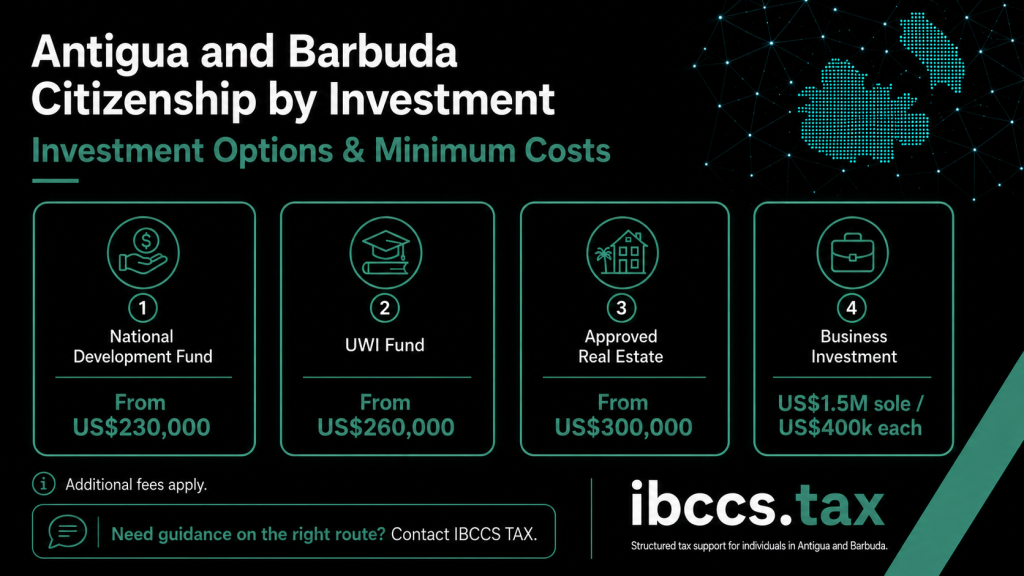
| Investment option | Minimum qualifying amount | Key characteristics |
| National Development Fund Contribution | US$230,000 | Non-refundable contribution; processing, due diligence and passport fees apply separately. |
| University of the West Indies Fund | US$260,000 | Family-focused route, generally structured for larger families and inclusive of specified processing fees. |
| Approved Real Estate Investment | US$300,000 | Investment in an approved real estate project, generally subject to a minimum five-year holding period. |
| Business Investment | US$1,500,000 sole / US$400,000 each in qualifying joint investment | Direct investment in an eligible business, subject to the applicable total investment thresholds. |
The headline investment is not necessarily the total cost. Due diligence, application, government, passport and professional fees may apply, together with legal and transaction costs for property, business or financial investment routes.
National Development Fund Contribution
The minimum qualifying amount is US$230,000. Non-refundable contribution; processing, due diligence and passport fees apply separately.
As a non-refundable route, the payment should be viewed as the cost of qualifying under the programme rather than as an asset expected to be recovered. Family pricing and additional government charges should be calculated before proceeding.
University of the West Indies Fund
The minimum qualifying amount is US$260,000. Family-focused route, generally structured for larger families and inclusive of specified processing fees.
As a non-refundable route, the payment should be viewed as the cost of qualifying under the programme rather than as an asset expected to be recovered. Family pricing and additional government charges should be calculated before proceeding.
Approved Real Estate Investment
The minimum qualifying amount is US$300,000. Investment in an approved real estate project, generally subject to a minimum five-year holding period.
Applicants should assess title, valuation, contractual restrictions, holding periods, management charges, potential income and resale conditions. Programme eligibility does not guarantee investment performance, capital appreciation or a liquid exit.
Business Investment
The minimum qualifying amount is US$1,500,000 sole / US$400,000 each in qualifying joint investment. Direct investment in an eligible business, subject to the applicable total investment thresholds.
The commercial, legal and regulatory terms of the route should be reviewed independently before funds are committed.
Total Antigua and Barbuda Citizenship Costs and Fees
Government processing, due diligence, passport and professional fees apply. Real estate and business routes also involve legal, transaction, operational and ownership costs.
Applicants should request a complete cost calculation before proceeding. It should distinguish the qualifying investment, non-refundable government charges, due diligence, professional fees, document costs, passport expenses and any property, banking or transaction costs.
Family applications should be costed using the age and dependency status of each person. A headline amount advertised for a single applicant may not reflect the total financial commitment for a spouse, children, parents or other dependants.
Antigua and Barbuda Citizenship Requirements
- be at least 18 years old
- select and complete a qualifying investment route
- provide complete and accurate application documents
- demonstrate lawful source of funds and source of wealth
- pass background, security and due diligence checks
- complete any required interview or biometric procedure
- pay the applicable government and professional fees
Potential issues should be identified before substantial costs are incurred. Criminal or regulatory matters, previous visa refusals, sanctions exposure, bankruptcy, adverse media, litigation and inconsistencies in corporate or financial records may require additional analysis or may affect eligibility.
Documents Required for a Antigua and Barbuda Citizenship Application
- passports and national identification documents
- birth and marriage certificates
- proof of residential address
- police clearance certificates
- medical documentation
- employment, professional or business records
- bank statements and financial evidence
- source-of-funds and source-of-wealth documentation
- dependency evidence for family members
- company ownership, income and tax records where applicable
Documents may need certification, apostille or legalisation and translation. Applicants with companies in several jurisdictions may need financial statements, registers, contracts, dividend resolutions, sale agreements and tax filings to explain the accumulation and movement of funds.
Antigua and Barbuda Citizenship Application Process
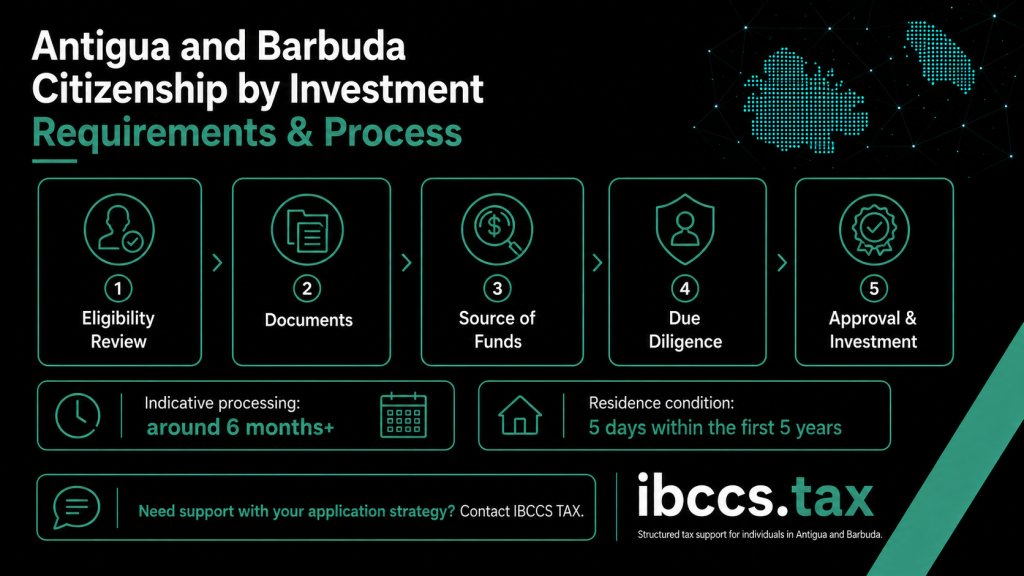
1. Initial eligibility and strategy review
The applicant’s nationality, residence history, family composition, professional background, source of wealth and objectives are reviewed. The available investment routes and likely documentation requirements are compared.
2. Appointment of the authorised application channel
The formal application is prepared and filed through the appropriate authorised agent or approved professional route. Tax, corporate and relocation advisers may support the wider planning.
3. Preparation of documents
Application forms and supporting records are collected, certified and checked for consistency. The source-of-wealth and source-of-funds narrative is prepared.
4. Submission, due diligence and interview
The application undergoes identity verification, background screening, financial due diligence and any required interview or biometric process.
5. Approval and completion of the investment
Following approval in principle, the applicant completes the prescribed contribution or investment and pays outstanding charges.
6. Citizenship and passport documentation
After the investment has been verified, the citizenship documentation and passport process are completed in accordance with current procedures.
Source of Funds, Source of Wealth and Due Diligence
Due diligence is a central part of citizenship by investment and should not be treated as an administrative formality. Applicants must present a clear and verifiable financial profile that is consistent with their professional history, tax records, banking activity and declared assets.
Source of wealth explains how the applicant accumulated their total financial position over time. Source of funds identifies the origin and movement of the specific money used for the qualifying investment. These are related but separate evidential requirements.
Entrepreneurs may need company registers, financial statements, contracts, invoices, dividend resolutions and evidence of genuine operations. Investors may rely on portfolio statements, property sale records, inheritance documents or investment redemption evidence.
Where wealth includes crypto assets, applicants should be prepared to document wallet ownership, transaction history, exchange accounts, acquisition cost, tax reporting and conversion into the funds used for the application.
Antigua and Barbuda Citizenship for Families and Dependants
The programme can accommodate a spouse, qualifying children and dependent parents or grandparents, subject to current age, education and dependency criteria.
Every person included in the application must satisfy the applicable background and documentation requirements. Additional contribution, due diligence and passport charges may apply according to age and family composition.
Family planning should take place before filing. Adding dependants after citizenship is granted may involve separate rules, additional charges or a different application route. Education, healthcare, residence rights, inheritance and tax consequences should also be reviewed separately.
Is There a Residence Requirement for Antigua and Barbuda Citizenship?
Citizens acquiring nationality through the programme are generally required to spend at least five days in Antigua and Barbuda during the first five years after citizenship is granted.
The programme residence condition, if any, should not be confused with tax residence. An applicant may obtain citizenship while continuing to live and remain tax resident in another jurisdiction.
Antigua and Barbuda Citizenship and Tax Residency
Antigua and Barbuda citizenship is not the same as tax residency. Citizenship provides nationality and the right to hold a passport, while tax residency determines where an individual may be liable for tax.
Citizenship does not by itself establish tax residence in Antigua and Barbuda. Tax treatment depends on physical presence, residence status, income source, business activity and the rules of other jurisdictions in which the applicant remains connected.
An individual may remain tax resident where they spend sufficient time, maintain a permanent home, have their centre of vital interests, live with immediate family, carry on employment or business activity, manage companies or retain substantial economic ties.
For example, an individual considering Cyprus would still need to satisfy the relevant Cyprus Tax Residency conditions. Holding a second citizenship does not replace the Cyprus 60-day or 183-day tests.
Tax Considerations for Antigua and Barbuda Citizens
The tax consequences of citizenship depend primarily on where the individual is tax resident, where income arises and how assets and businesses are structured. Citizenship alone rarely determines the complete international tax position.
A person who obtains citizenship but continues to reside and operate in another country may remain fully taxable there. A company owned by the new citizen may also remain tax resident where it is incorporated, effectively managed or commercially active.
Applicants with international companies or investments should coordinate citizenship planning with International Tax & Structuring. The review may include personal and corporate tax residency, management and control, controlled foreign company rules, exit tax, source-based taxation, substance, reporting and succession.
Is Antigua and Barbuda Citizenship Suitable for Entrepreneurs?
The programme may be relevant to entrepreneurs seeking personal flexibility, family security and a long-term second citizenship solution. The five-day presence requirement should be incorporated into the client’s planning from the outset. Although limited, it is a genuine programme condition and should not be confused with tax residency.
Citizenship does not independently resolve corporate tax residency, permanent establishment, banking, management and control or economic substance. Founders should assess where decisions are made, where directors and staff are located, where contracts are negotiated and where commercial operations take place.
For international business owners, the strongest approach is to coordinate second citizenship with International Business Structuring, banking, tax residency and compliance planning.
Common Misconceptions About Antigua and Barbuda Citizenship by Investment
Approval is guaranteed within the advertised timeframe
No approval or completion date should be treated as guaranteed. Due diligence, document quality and case complexity can affect timing.
The minimum investment is the full cost
The headline amount does not include all government, due diligence, passport, professional or transaction costs.
Citizenship automatically changes tax residency
Citizenship and tax residency are separate. The applicant may remain taxable where they live, work, manage a business or maintain personal and economic ties.
No programme residence requirement means no tax residence anywhere
The absence of a citizenship residence condition does not remove tax residence in other countries.
The application is a simple document filing
Background verification, financial due diligence, source-of-wealth analysis and interviews may require substantial preparation.
Antigua and Barbuda Citizenship as Part of a Wider International Plan
Antigua and Barbuda Citizenship by Investment may provide a structured route to second citizenship for suitable investors and families. Its value should be assessed not only by the headline cost or processing period, but by how it supports personal mobility, family security, business planning and long-term resilience.
For some clients, second citizenship is the principal objective. For others, it complements a separate residence route, a change of tax residence, company restructuring, banking diversification or succession planning.
An investor seeking a European residence base may also consider Cyprus Permanent Residency by Investment, while the citizenship programme remains one component of a broader international mobility strategy.
The appropriate approach depends on nationality, family structure, source of wealth, tax position, business interests and long-term priorities. A coordinated review helps determine not only whether the programme is accessible, but whether it is strategically appropriate.
How IBCCS TAX Can Assist with Antigua and Barbuda Citizenship by Investment
IBCCS TAX advises international entrepreneurs, investors, private clients and families on citizenship and residency planning as part of a wider cross-border strategy.
- initial eligibility and objectives assessment
- comparison of the available investment routes
- coordination through the appropriate authorised application channel
- preparation and review of source-of-funds and source-of-wealth documentation
- family and dependant planning
- coordination with personal tax residency
- international company and ownership-structure review
- banking and compliance considerations
- coordination with wider relocation and investment objectives
Our approach is designed to avoid fragmented decision-making. Citizenship, tax residency, business structure, banking and family mobility are often closely connected, and decisions in one area may have consequences in another.
A Strategic Approach to Antigua and Barbuda Citizenship
Antigua and Barbuda offers a defined citizenship by investment pathway with a current minimum qualifying level beginning at US$230,000. For suitable investors, the programme may provide an additional citizenship, family inclusion and greater long-term mobility flexibility.
The long-term value should not be assessed solely by processing speed, passport access or the headline contribution. A robust decision should consider due diligence, tax residency, company structure, banking, family objectives, investment risk and the applicant’s existing international connections.
Transparent wealth documentation, traceable investment funds and consistent personal and corporate records are fundamental to a well-prepared application. When these issues are coordinated from the beginning, citizenship can become a meaningful component of a sustainable international strategy rather than an isolated administrative transaction.
Start Your Antigua and Barbuda Citizenship Assessment
The most appropriate route will depend on your family composition, financial profile, source of wealth, preferred investment type, tax residency and wider international objectives. Careful preparation can reduce compliance risks, avoid unnecessary delays and ensure that the citizenship decision supports your long-term plans.
Contact IBCCS TAX to discuss your eligibility for Antigua and Barbuda Citizenship by Investment and how the programme may fit within your wider mobility, tax and international structuring strategy. Explore your options: learn more about Antigua and Barbuda Citizenship by Investment

Frequently Asked Questions – Antigua and Barbuda Citizenship by Investment
1. What is the minimum investment for Antigua and Barbuda citizenship?
The minimum qualifying level currently begins at US$230,000. The full cost depends on the selected route, family composition, due diligence and other government or professional fees.
2. How long does Antigua and Barbuda Citizenship by Investment take?
A well-prepared application may generally progress within several months, with practical timelines commonly around six months or longer depending on due diligence and application readiness. This is indicative rather than guaranteed, and document preparation takes place before formal submission.
3. Can I submit the application directly?
Applications must generally be filed through an authorised agent or approved professional channel. IBCCS TAX can coordinate the wider advisory process and the appropriate application pathway.
4. Can family members be included?
The programme can accommodate a spouse, qualifying children and dependent parents or grandparents, subject to current age, education and dependency criteria.
5. Is there a residence requirement?
Citizens acquiring nationality through the programme are generally required to spend at least five days in Antigua and Barbuda during the first five years after citizenship is granted.
6. Is Antigua and Barbuda citizenship the same as tax residency?
No. Citizenship grants nationality, while tax residency determines where an individual may be taxed. A person can hold this citizenship and remain tax resident in another country.
7. When is the qualifying investment completed?
In many programmes, the final contribution or investment is completed after approval in principle. The precise sequence depends on the selected route and current procedures.
8. Why are source of funds and source of wealth important?
They demonstrate how the applicant accumulated their overall wealth and where the specific investment money originated. Both must be supported by consistent, verifiable documentation.
9. Is there a residence requirement?
Yes. A person obtaining citizenship through the programme is generally required to spend at least five days in Antigua and Barbuda during the first five years after citizenship is granted.
10. Which option may be suitable for a larger family?
The University of the West Indies Fund can be relevant for larger family applications, but the full cost and eligibility conditions should be compared with the National Development Fund and other routes.
Property Tax in Georgia in 2026: Rates, Income Thresholds, Filing and Rules for Foreign Owners
Property tax in Georgia is an annual obligation that can
Read More
Accounting Entries in Georgia: Bookkeeping Examples for Georgian LLCs
Accurate bookkeeping starts with recording each business transaction in the
Read More
Cyprus Extends 2025 Annual PAYE Return Deadline to 30 November 2026
The Cyprus Tax Department has announced a further extension to
Read More