

Choosing the right tax consultant in Cyprus is an important decision for companies, entrepreneurs, investors and private individuals who need more than basic administrative support. Cyprus offers a highly attractive business and tax environment, but making the most of it requires proper planning, practical implementation and ongoing compliance.
For many clients, the key question is not only whether Cyprus is suitable, but how their tax position should be structured in practice. This may involve corporate tax, personal tax, tax residency, VAT, payroll, substance, international ownership, dividends, intellectual property, or cross-border income.
At IBCCS TAX, we support clients through tax planning services in Cyprus, combining local knowledge with international advisory experience. The right tax consultant should not only explain the rules, but also help you apply them in a way that is commercially practical, compliant and sustainable.
What Does a Tax Consultant in Cyprus Actually Do?
A tax consultant in Cyprus provides professional advice on how tax rules apply to your personal, corporate or international situation. This is different from basic bookkeeping or administrative filing. A tax consultant should help you understand your exposure, identify planning opportunities, avoid unnecessary risks and structure your affairs correctly from the beginning.
Typical areas of support may include:
- corporate tax advisory for Cyprus companies;
- personal tax planning for individuals and relocating professionals;
- Cyprus tax residency planning;
- Non-Dom and relocation-related tax considerations;
- VAT registration, VAT compliance and cross-border VAT matters;
- dividend, interest, royalty and capital gains planning;
- IP Box and intellectual property structuring;
- tax-efficient company formation and restructuring;
- international tax planning for businesses operating across several jurisdictions;
- ongoing compliance and communication with tax authorities.
For example, a client planning to register a company in Cyprus may need much more than incorporation documents. The company’s management, tax residency, accounting setup, VAT position, shareholder structure, substance and future profit distribution should all be considered at the beginning. This is why tax advice is often most valuable before the structure is implemented.
Tax Consultant, Accountant or Lawyer: Who Do You Need?
One common mistake is assuming that every professional involved in company administration provides the same type of support. In practice, the roles are different.
An accountant usually assists with bookkeeping, preparation of financial records, VAT returns, payroll, annual accounts and other recurring compliance obligations. A lawyer may assist with legal documents, corporate law, contracts, disputes and formal legal opinions. A tax consultant focuses on the tax consequences of decisions, transactions, structures and personal or corporate arrangements.
In many cases, the most effective solution requires cooperation between these areas. For example, a Cyprus company may need tax planning before incorporation, legal support during registration, accounting support after incorporation and ongoing corporate services to keep the company compliant.
IBCCS TAX provides integrated support across accounting services in Cyprus, company registration in Cyprus, corporate services and tax advisory. This allows clients to move from planning to implementation without losing continuity between advice and practical execution.
When Should You Speak to a Cyprus Tax Advisor?
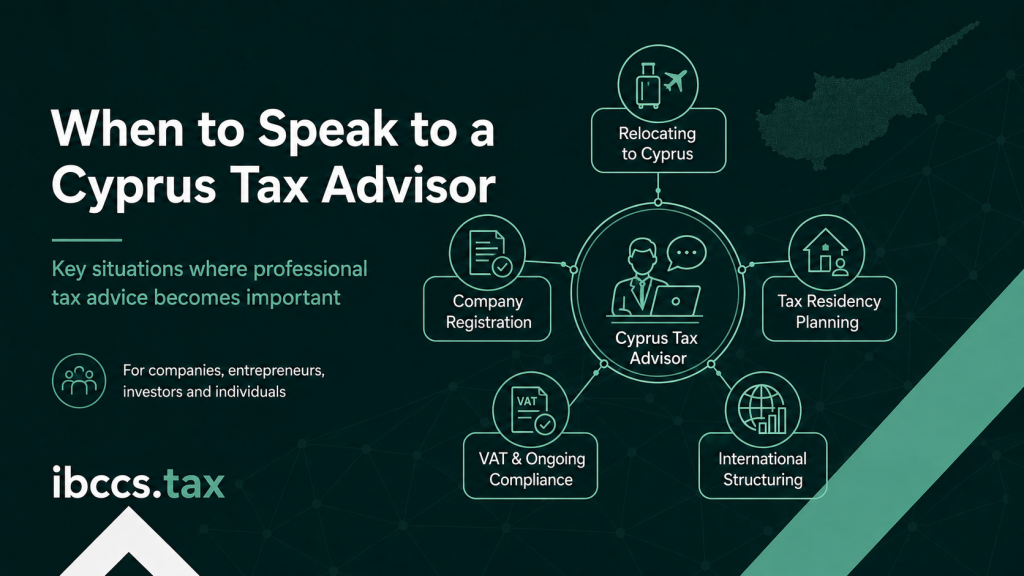
The best time to speak to a tax advisor is usually before making a major decision, not after the structure is already in place. Tax advice is especially important when the facts involve more than one jurisdiction or when personal and corporate tax issues overlap. You should consider speaking to a Cyprus tax consultant if you are:
- planning to relocate to Cyprus;
- considering Cyprus tax residency;
- registering a Cyprus company;
- moving business operations, management or employees to Cyprus;
- receiving dividends, royalties, consulting income or director fees;
- planning to use Cyprus as a holding, trading or IP structure;
- hiring employees or contractors in Cyprus;
- unsure whether VAT registration is required;
- operating through companies in more than one country;
- concerned about substance, management and control, or tax authority scrutiny;
- behind on filings, VAT, tax returns or corporate obligations.
For individuals, Cyprus tax residency can be a powerful planning tool when structured correctly. However, the position should be reviewed based on day count, permanent home, employment or business activity, source of income, previous tax residence and potential dual residency exposure. IBCCS TAX assists clients with change of tax residency to Cyprus and related planning.
For companies, early tax advice can help avoid structural problems that may become difficult or expensive to fix later. This is especially relevant for foreign-owned Cyprus companies, holding companies, service companies, IP structures and businesses with international shareholders or management.
Why International Tax Experience Matters
Cyprus is often used by international entrepreneurs, investors, consultants and business owners because it combines an EU legal environment with a competitive tax framework and access to a wide treaty network. However, international tax planning is rarely about Cyprus alone.
A business owner relocating to Cyprus may still have companies, clients, assets, family members or reporting obligations in another country. A Cyprus company may trade internationally, receive income from abroad, employ remote staff, hold shares in foreign subsidiaries or distribute profits to non-resident shareholders. This is where international tax experience becomes important. A local-only view may not be enough if the client’s real situation crosses borders.
A tax consultant in Cyprus should be able to consider:
- whether Cyprus tax residency creates exposure in another country;
- whether a foreign company may be affected by management and control issues;
- how dividends, interest, royalties or service fees may be treated internationally;
- whether VAT rules apply to cross-border services;
- whether substance and documentation support the intended tax position;
- whether double tax treaty analysis may be required;
- whether personal relocation and corporate structuring should be coordinated.
At IBCCS TAX, we work with clients who often need advice not only in Cyprus, but also in relation to wider international structures. This is particularly relevant for founders, consultants, digital businesses, holding companies, family-owned groups and investors with assets or income in more than one jurisdiction.
Key Questions to Ask Before Choosing a Tax Consultant in Cyprus
Before appointing a tax consultant, it is useful to ask a few practical questions.
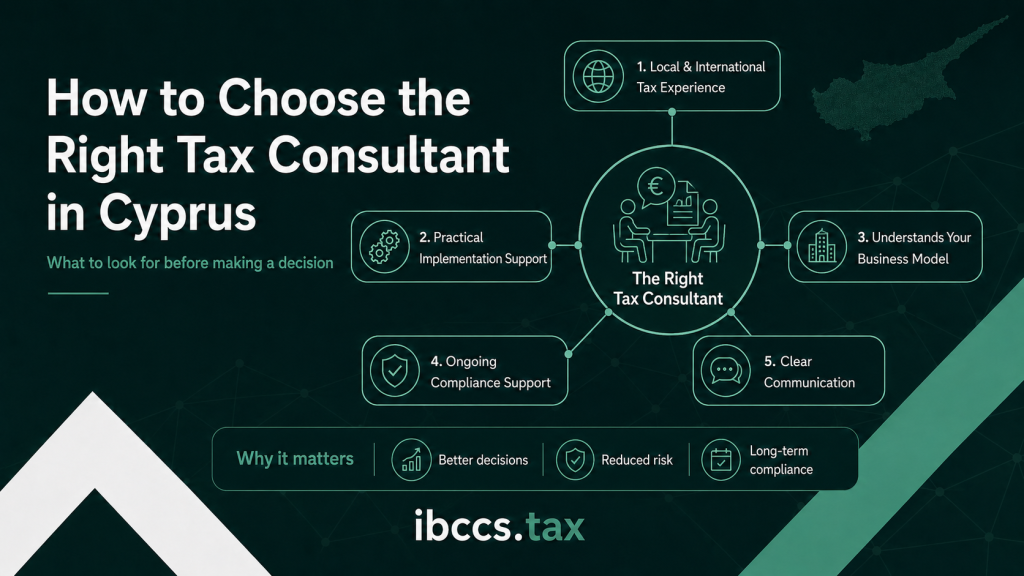
Do they understand both local and international tax issues?
If your case involves only a simple local filing, a local compliance provider may be enough. But if you are relocating, operating internationally, using a Cyprus company, receiving income from abroad or planning a cross-border structure, you need advice that looks beyond Cyprus alone.
Can they support implementation, not only advice?
A tax memo may be useful, but many clients also need practical implementation: company registration, tax registration, VAT registration, accounting setup, payroll, corporate administration, documentation and ongoing compliance.
Do they understand your business model?
Tax advice should be based on facts. A consultant should ask about your income, clients, contracts, shareholders, management, operations, employees, jurisdictions and future plans. Generic advice is rarely enough for serious tax planning.
Can they assist with ongoing compliance?
Tax planning must be maintained. A structure that looks efficient on paper can fail if accounting, VAT, filings, payroll, substance and documentation are not handled properly.
Do they communicate clearly?
Tax is technical, but advice should still be understandable. You should know what is recommended, why it matters, what the risks are and what steps need to be taken next.
Common Mistakes When Looking for Tax Advice in Cyprus
One of the most common mistakes is choosing support based only on price. Low-cost advice may be attractive at the beginning, but incomplete planning can create compliance issues, unexpected tax exposure or restructuring costs later.
Another mistake is treating tax planning as a one-off exercise. In reality, tax positions need to be supported by documents, accounting records, board decisions, contracts, tax filings and practical substance.
Clients also sometimes separate tax advice from implementation. For example, they may receive advice from one provider, register the company elsewhere, handle accounting with another team and later discover that the structure was not implemented as intended.
Other frequent mistakes include:
- relying on outdated information found online;
- assuming that incorporation automatically creates tax residency;
- ignoring VAT implications;
- overlooking payroll and social insurance obligations;
- failing to review management and control;
- not documenting board decisions and commercial substance;
- leaving tax residency planning until the end of the year;
- assuming that Non-Dom, IP Box or other regimes apply automatically.
A professional tax consultant should help prevent these issues by reviewing the full picture before decisions are made.
How IBCCS TAX Supports Clients in Cyprus
IBCCS TAX supports companies, entrepreneurs, investors and private individuals with practical tax advisory, implementation and ongoing compliance in Cyprus. Our work is designed for clients who need clear guidance and coordinated support rather than isolated advice.
Our Cyprus services include tax planning, accounting services, VAT administration, company registration, corporate services, tax residency planning and international structuring. We assist clients at different stages: before relocation, before company formation, during restructuring, when applying for tax residency, when setting up VAT and accounting, or when reviewing an existing structure that may need improvement.
The objective is not only to identify tax opportunities, but to build solutions that can be implemented, documented and maintained properly.
Need a Tax Consultant in Cyprus?
If you are planning to relocate, register a company, restructure your business, review your tax residency or improve ongoing compliance, professional tax advice can help you make better decisions from the beginning. IBCCS TAX provides tax consulting and tax planning services in Cyprus for companies, entrepreneurs, investors and private clients with local and international needs. Contact us to discuss your situation and identify the right next steps.

Frequently Asked Questions – Tax Consultant in Cyprus
1. Do I need a tax consultant or an accountant in Cyprus?
It depends on the nature of your needs. An accountant usually assists with bookkeeping, VAT, payroll and recurring compliance. A tax consultant provides advice on tax exposure, planning, structuring, residency, international tax matters and risk management. In many cases, both are needed.
2. When should I contact a tax advisor in Cyprus?
You should contact a tax advisor before making important decisions such as relocating, registering a company, taking dividends, hiring employees, moving management to Cyprus, applying for tax residency or restructuring an international business.
3. Can a Cyprus tax consultant help with tax residency?
Yes. A Cyprus tax consultant can help assess whether you may qualify under the applicable tax residency rules, review your wider international exposure and support the practical steps required to document and maintain your position.
4. Can tax advice help before registering a Cyprus company?
Yes. Tax advice before company formation can help determine whether a Cyprus company is suitable, how it should be structured, whether VAT may apply, what substance is needed and how ongoing compliance should be handled.
5. Why is international tax experience important?
Many Cyprus tax matters involve more than one country. International tax experience is important where a client has foreign income, foreign shareholders, overseas companies, cross-border services, relocation plans or possible tax obligations in another jurisdiction.
Managing a Foreign Company from Cyprus: Tax Residency, Management and Control & Permanent Establishment
Moving to Cyprus does not automatically move a foreign company
Read More
Private Client Accounting in Cyprus: Foreign Income, Investments & Tax Reporting
Private client accounting is not simply a personal tax return
Read More
Moving to Cyprus from Germany: Residency, Tax, Non-Dom & Business Relocation
Cyprus is increasingly considered by German entrepreneurs, company owners, professionals,
Read More