

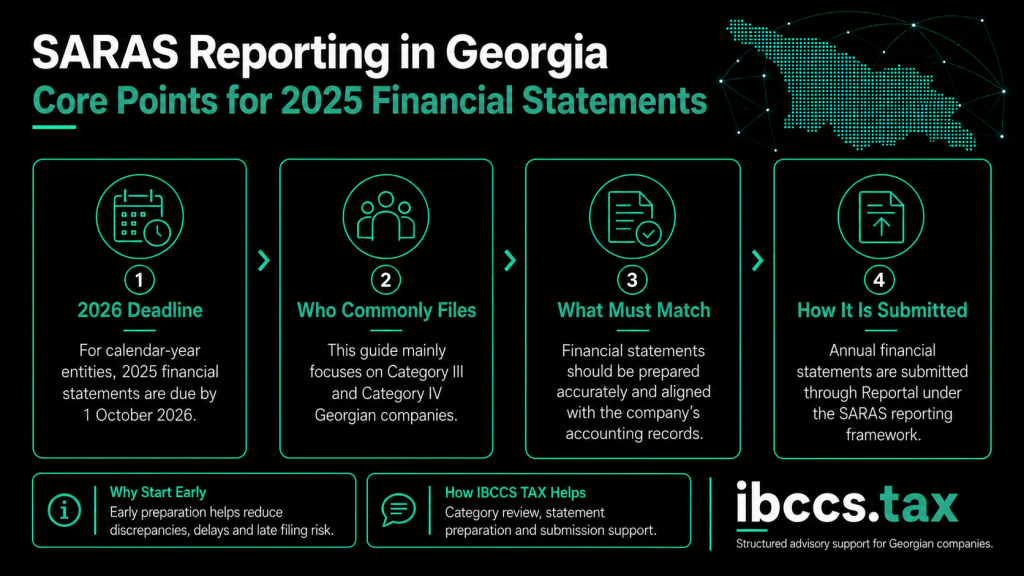
For Georgian companies with a calendar-year reporting period, the annual financial reporting deadline is approaching. Financial statements for the 2025 reporting period should be submitted to Georgia’s Service for Accounting, Reporting and Auditing Supervision, commonly known as SARAS, immediately once they are available and no later than 1 October 2026.
The filing is more than a portal upload. A company first needs to confirm its reporting category, apply the correct financial reporting standard, close and reconcile the accounting records, prepare the financial statements and supporting disclosures, and make sure the submitted figures are consistent with the underlying books. For foreign-owned companies, this often also means resolving shareholder balances, foreign-currency transactions, related-party items and historical accounting issues before the statements are finalised.
At IBCCS TAX, our teams in Tbilisi and Batumi provide accounting services in Georgia, including preparation of annual financial statements and SARAS reporting support. This guide explains the 2026 filing deadline, Category III and Category IV criteria, applicable reporting standards, the Reportal submission process and the practical issues companies should address before filing.

SARAS Reporting Deadline for 2025 Financial Statements
For companies whose financial year follows the calendar year, the key date for the 2025 reporting period is 1 October 2026. Georgian reporting rules require annual financial statements to be filed immediately once they are available, but no later than 1 October of the year following the reporting period. Reportal has already opened the reporting process for 2025 statements, so companies do not need to wait until the final weeks of September to begin preparing their filing.
Where a company’s financial reporting period does not coincide with the calendar year, the deadline is generally calculated differently. The financial statements should be reported immediately when available and no later than nine months after the end of the relevant reporting period. Companies using a non-calendar financial year should therefore work from their own reporting date rather than automatically applying the 1 October deadline.
The practical deadline for the accounting team is usually earlier than the statutory filing date. Before submission, the books need to be closed, material balances reconciled, the company’s reporting category confirmed and the statements reviewed. Starting this work early creates time to resolve discrepancies without turning the final submission into a last-minute correction exercise.
What Is SARAS in Georgia?
SARAS is the Service for Accounting, Reporting and Auditing Supervision in Georgia. It supervises the country’s financial reporting and auditing framework and sets or administers reporting requirements for different categories of entities under the Law of Georgia on Accounting, Reporting and Auditing.
For operating companies, SARAS becomes particularly visible at year-end because the financial statements submitted under the reporting framework are published through Georgia’s reporting infrastructure. This means annual reporting has a broader purpose than satisfying an internal accounting requirement. Banks, investors, counterparties and other users may rely on published financial information when assessing the company.
What Is Reportal?
Reportal is the official reporting portal used for annual financial statement submission and publication. Companies register on the reporting website, determine the applicable size category and submit the required annual report through the system. The portal also contains the Annual Statements Register, where published reports can be searched and reviewed.
The terms SARAS reporting and Reportal filing are often used interchangeably in business discussions, but it is useful to distinguish them. SARAS is the supervisory authority and reporting framework, while Reportal is the digital platform through which the annual reporting process is carried out.
Which Georgian Companies Must Submit Financial Statements?
Georgia’s reporting framework classifies entities by size and status. Public Interest Entities and larger Category I and Category II enterprises have more extensive reporting and audit obligations, while many privately owned Georgian SMEs fall into Category III or Category IV. The company’s category should be determined from the applicable criteria at the end of the reporting period rather than assumed from its legal form or from the category used in a previous year.
Category I and Category II Companies in Georgia
Category I enterprises are the largest non-PIE companies in Georgia. A company generally falls into Category I where it meets at least two of the following three criteria: total assets exceeding GEL 50 million, annual revenue exceeding GEL 100 million, or more than 250 employees. Category I companies prepare financial statements under IFRS and are subject to mandatory annual audit and management reporting requirements.
Category II covers larger businesses below the Category I thresholds that do not qualify as Category III or IV. These companies also have more extensive reporting requirements, including annual audit and management reporting. This guide focuses primarily on Category III and Category IV companies, which represent the main SARAS reporting segment supported by IBCCS TAX Georgia for outsourced financial statement preparation and submission.
For most owner-managed and foreign-owned SMEs, the first practical question is whether the business falls within Category IV or Category III. Those categories determine which reporting standard applies and are the main focus of the SARAS preparation and submission support provided by IBCCS TAX Georgia.
Category III and Category IV Companies in Georgia
The classification test uses three indicators: total assets, revenue and average number of employees during the reporting period. A company generally needs to meet at least two of the relevant three criteria for the category, with Category III applying where the entity does not qualify as Category IV and falls within the Category III thresholds.
| Area | Category III Enterprise | Category IV Enterprise |
| Total assets | Does not exceed GEL 10 million | Does not exceed GEL 1 million |
| Revenue | Does not exceed GEL 20 million | Does not exceed GEL 2 million |
| Average employees | Does not exceed 50 | Does not exceed 10 |
| Classification logic | Not Category IV and meets at least 2 of the 3 Category III criteria | Meets at least 2 of the 3 Category IV criteria |
| Primary reporting standard | IFRS for SMEs; IFRS may also be applied | Financial Reporting Standard for Category IV Entities; a higher standard may be applied |
| Statutory audit | Generally not required unless another Georgian law requires it | Generally not required unless another Georgian law requires it |
| Calendar-year filing deadline for 2025 | 1 October 2026 | 1 October 2026 |
A growing Georgian company should not assume that it remains in the same category indefinitely. Revenue, assets and headcount can change quickly, and moving into a higher category can alter the reporting standard, management reporting requirements and audit obligations. Category determination should therefore be part of the annual close process.
Category III vs Category IV SARAS Reporting: What Changes?
Category III Financial Statements
A Category III enterprise generally prepares its financial statements under IFRS for SMEs. The company may apply full IFRS instead, and a higher standard can also be required where separate legislation regulating the business activity demands it. The important point is that the accounting policies, year-end adjustments and presentation should be consistent with the reporting standard used for the statements.
Category III enterprises are generally not required to obtain a statutory audit of their annual financial statements unless another Georgian law creates an audit requirement. This does not reduce the responsibility to prepare accurate statements. The absence of a mandatory audit means the company itself, together with its accounting provider, needs a robust closing and review process before filing.
Category IV Financial Statements
Category IV is the smallest enterprise category and uses the Financial Reporting Standard for Category IV Entities approved by SARAS. The standard is designed for smaller businesses, but the reporting obligation remains formal. The company should still prepare annual financial statements based on complete accounting records and retain the supporting information behind the figures reported.
Category IV enterprises may apply a higher reporting standard, such as IFRS for SMEs or IFRS, where appropriate. As with Category III, a statutory audit is generally not required unless another Georgian law provides otherwise. A smaller company should therefore avoid equating simplified reporting with no reporting responsibility.
Does a Category III or Category IV Company Need an Audit?
For most Category III and Category IV enterprises, SARAS does not require an annual financial statement audit simply because the company falls into those categories. An audit can still be required by other legislation, by the company’s sector, by a lender or investor, or by a contractual arrangement. The audit question should therefore be checked separately from the size-category test.
Even where an audit is not mandatory, year-end review remains important. Financial statements should reconcile with the company’s accounting ledgers, bank balances, payroll, asset records and supporting documents. If the books contain unresolved differences, filing an unaudited statement does not remove the underlying accounting risk.
What Should Be Prepared Before SARAS Submission?
The quality of the SARAS filing depends on the quality of the year-end accounting close. A Georgian company that has maintained monthly records consistently may need only closing adjustments and statement preparation. A company that delivered documents irregularly or changed accounting providers during the year may need a broader reconciliation before the financial statements can be prepared reliably.
Confirm the Company Category and Reporting Standard
The first step is to confirm the company’s size category using the applicable year-end indicators. Once the category is established, the accounting team can identify the correct reporting standard and determine the format and disclosures required for the financial statements. This avoids preparing a statement package under a standard that does not match the company’s reporting obligations.
Close and Reconcile the Accounting Records
Bank accounts, receivables, payables, payroll balances, shareholder accounts, taxes, fixed assets and other material ledger balances should be reconciled before the statements are finalised. Unexplained differences should be investigated rather than carried forward simply to meet the deadline, because those balances can affect both the financial position and future accounting periods.
Foreign-owned Georgian companies often need additional work around foreign-currency accounts, shareholder loans, intercompany balances and international payment providers. Our broader guide to accounting in Georgia explains how monthly bookkeeping, bank reconciliation and annual reporting connect for Georgian LLCs and foreign-owned companies.
Prepare the Financial Statements and Disclosures
The statement package should be prepared in line with the standard applicable to the company. Depending on the category and reporting framework, this may include the statement of financial position, performance information, comparative figures and relevant notes or appendices. The objective is not to produce the longest report, but to prepare a complete and internally consistent set of statements for the entity’s actual reporting requirements.
Management should review the final figures before submission and understand any material year-end adjustments. If the financial statements show balances or transactions that management cannot explain, the issue should be resolved before the report is filed and published.
Complete the Reportal Filing and Retain Submission Evidence
Once the statements are finalised and approved, the filing is completed through Reportal. The company should ensure that the correct reporting period, category and statement package are used, and that the submission is successfully completed rather than left in draft or publication process status.
The final submission evidence should be retained with the year-end accounting file. This creates a clear record for management, future accountants, banks, investors and any later review of the reporting period.
SARAS Reporting Is Not the Same as Tax Filing in Georgia
A common misconception is that a company has completed its annual obligations because its tax declarations were filed with the Revenue Service. Tax compliance and SARAS financial reporting are separate processes. Tax returns are prepared under Georgian tax rules, while annual financial statements are prepared under the applicable financial reporting standard and submitted through the SARAS reporting framework.
The two systems should nevertheless be consistent. Revenue, payroll, taxes, fixed assets and other material items recorded in the accounting system should support both the company’s tax position and its financial statements. Differences may be legitimate because tax and financial reporting rules do not always produce identical results, but they should be understood and documented rather than discovered after filing.
Where the year-end close identifies tax-sensitive discrepancies, the accounting review can be coordinated with our taxation services in Georgia. This is particularly relevant for shareholder transactions, related-party payments, VAT issues and previous-period corrections that cannot be resolved through presentation changes alone.
Common Issues Identified Before SARAS Filing
Many SARAS projects begin as a straightforward request to prepare annual financial statements and then reveal accounting issues that need to be corrected before submission. These problems are not unusual, especially for companies that have grown quickly, changed accountants, managed documents remotely or completed transactions with shareholders and related entities during the year.
- Unreconciled bank accounts or payment-provider balances that do not match the accounting ledger.
- Shareholder loans, advances or withdrawals recorded without clear agreements or classification.
- Fixed assets that were purchased but not added correctly to the asset register or depreciated consistently.
- Foreign-currency balances where exchange-rate differences or settlement dates have not been recorded correctly.
- Payroll, contractor or withholding records that do not reconcile with the underlying agreements and payments.
- VAT or other tax declarations that differ from the accounting records without a documented explanation.
- Missing supplier invoices, contracts or evidence supporting expenses and year-end accruals.
- Related-party and intercompany transactions that were booked but not supported by clear legal or commercial documentation.
- Opening balances carried from earlier years without reconciliation or with unresolved differences from previous accounting providers.
The correct response depends on the issue. Some differences can be resolved through ordinary year-end adjustments, while others may require missing documents, amended accounting records or a separate tax review. The earlier the review starts, the more time the company has to correct the underlying records before the statutory deadline.
What Happens If the SARAS Reporting Deadline Is Missed?
Late reporting can lead to enforcement action by SARAS. The official SARAS FAQ states that the Service may apply a written warning and/or a monetary fine where the reporting deadline is breached. For the categories most relevant to Georgian SMEs, the listed fine is GEL 1,000 for a Category III enterprise and GEL 500 for a Category IV enterprise.
The financial amount is not the only reason to avoid late filing. A missing or delayed report can create unnecessary questions during banking reviews, investor due diligence, financing applications or a change of accounting provider. Because annual statements are part of Georgia’s public reporting infrastructure, timely and accurate filing also supports the company’s broader compliance profile.
SARAS Reporting Services in Georgia from IBCCS TAX
IBCCS TAX Georgia provides end-to-end support for Category III and Category IV companies preparing their annual financial statements. The objective is to manage the entire reporting process, not simply upload a document at the end. We start with the accounting records and reporting category so that the final submission reflects the company’s actual financial position and the standard applicable to it.
Our teams in Tbilisi and Batumi can support companies that already maintain regular monthly accounting with IBCCS TAX, as well as businesses that need a standalone year-end reporting project or a review of previous accounting before the statements are prepared. Where records are incomplete, the scope can include accounting clean-up and reconciliation before the reporting package is finalised.
- Determination of the company’s SARAS category and confirmation of the applicable reporting standard.
- Review of accounting records and identification of discrepancies or balances requiring clarification.
- Year-end reconciliation of material accounts and coordination of closing adjustments.
- Professional preparation of the annual financial statements and relevant notes or appendices where required.
- Consistency review between the financial statements, underlying accounting records and material tax information.
- Preparation of the filing package and upload through Reportal.
- Coordination of final submission and support throughout the reporting process.
- Accounting clean-up or review of previous periods where historical records need correction before reporting.
Companies that need full ongoing support can review our accounting services in Georgia, covering monthly bookkeeping, payroll, tax-compliant reporting, accounting for previous periods and preparation of annual financial statements. A regular accounting process usually makes the SARAS close faster because the year-end work builds on records that have already been reconciled during the year.
When Should a Company Start Preparing Its 2025 SARAS Filing?
For a straightforward Category III or Category IV company with complete records, the reporting project may be relatively efficient. Where there are multiple bank accounts, foreign currencies, shareholder transactions, inventory, fixed assets, employee balances or prior-period inconsistencies, more preparation time is needed. September should therefore be treated as a filing month, not as the first month in which the 2025 accounts are reviewed.
Starting early also gives management time to answer questions about unusual transactions and locate missing documents. It is much easier to correct an unexplained shareholder payment, supplier balance or fixed-asset entry before the final statements are approved than after the report has been submitted and published.
Prepare the Financial Statements Before the Deadline, Not at the Deadline
SARAS reporting is an annual compliance requirement, but it also provides a useful quality check on the company’s accounting. A well-prepared year-end process confirms that the financial statements reflect the underlying records, that material balances are understood and that the company can present reliable information to banks, investors and other stakeholders.
For 2025 calendar-year financial statements, the statutory filing date is 1 October 2026. Companies that have not yet confirmed their category or prepared the annual statements should begin the process now so that any accounting discrepancies can be resolved before submission.
IBCCS TAX Georgia can prepare and submit 2025 financial statements for Category III and Category IV companies and support the full process from category determination through Reportal filing. Contact IBCCS TAX to discuss SARAS reporting, annual financial statements or accounting clean-up for your Georgian company.

FAQ: SARAS Reporting and Financial Statements in Georgia
1. What is SARAS in Georgia?
SARAS is Georgia’s Service for Accounting, Reporting and Auditing Supervision. It oversees the financial reporting and auditing framework and administers reporting requirements for entities classified under the Law of Georgia on Accounting, Reporting and Auditing.
2. What is the SARAS reporting deadline for 2025 financial statements?
For an entity with a calendar-year reporting period, the 2025 financial statements should be reported immediately when available and no later than 1 October 2026. Where the reporting period does not coincide with the calendar year, the deadline is generally no later than nine months after the end of the reporting period.
3. What is Reportal Georgia?
Reportal is the official financial reporting portal used to determine the reporting category, submit annual statements and publish reports within Georgia’s reporting system. SARAS is the supervisory authority, while Reportal is the digital filing platform.
4. Who must submit financial statements to SARAS?
Georgia’s reporting framework applies to entities according to their size category and status. Public Interest Entities and Category I to IV enterprises have reporting requirements, although the applicable standard, audit requirement and report package differ by category. Many privately owned SMEs fall into Category III or Category IV.
5. What is a Category IV company in Georgia?
A Category IV enterprise generally meets at least two of three criteria at the end of the reporting period: total assets do not exceed GEL 1 million, revenue does not exceed GEL 2 million and the average number of employees does not exceed 10. The category should be confirmed using the applicable rules for the reporting period.
6. What is a Category III company in Georgia?
A Category III enterprise is an entity that is not Category IV and meets at least two of three criteria: total assets do not exceed GEL 10 million, revenue does not exceed GEL 20 million and the average number of employees does not exceed 50.
7. Which accounting standard applies to Category III companies?
Category III enterprises generally prepare financial statements under IFRS for SMEs and may apply full IFRS. A higher standard can also apply where separate legislation regulating the company’s activity requires it.
8. Which accounting standard applies to Category IV companies?
Category IV enterprises generally use the Financial Reporting Standard for Category IV Entities approved by SARAS. They may apply a higher reporting standard, including IFRS for SMEs or IFRS, where appropriate.
9. Does a Category III company need an audit?
A Category III enterprise is generally not required by the SARAS category rules to obtain an audit of its financial statements unless another Georgian law requires one. Sector rules, financing arrangements or investor requirements can still create a separate audit need.
10. Does a Category IV company need an audit?
A Category IV enterprise is generally not required to have its financial statements audited unless another Georgian law requires an audit. The company must still prepare and submit compliant annual financial statements.
11. Is SARAS reporting the same as filing tax returns in Georgia?
No. SARAS financial reporting and tax filing with the Revenue Service are separate compliance processes. The accounting records should support both, and material differences should be understood, but filed tax declarations do not replace the annual SARAS financial statements.
12. What happens if a company files late?
SARAS may apply a written warning and/or a monetary fine for a missed reporting deadline. The official FAQ lists a GEL 1,000 fine for a Category III enterprise and GEL 500 for a Category IV enterprise, subject to the applicable enforcement process.
13. Can financial statements be prepared if the accounting records are incomplete?
They can be prepared only after the available accounting information has been reviewed and the material gaps have been addressed. In practice, a company with incomplete records may need an accounting clean-up, bank reconciliation, missing documents or corrections to earlier bookkeeping before reliable financial statements can be finalised.
14. Can IBCCS TAX prepare and submit SARAS financial statements?
Yes. IBCCS TAX Georgia can determine the reporting category, review and reconcile the accounting records, prepare annual financial statements and relevant disclosures, and coordinate filing through Reportal for Category III and Category IV companies.





IBCCS TAX to Attend Plan ₿ Forum 2026 in Lugano, Switzerland
IBCCS TAX will be attending Plan ₿ Forum 2026 in
Read More
Georgia iGaming License in 2026: Online Casino, Slots & Sports Betting for International Operators
Georgia introduced a dedicated licensing framework in 2026 for the
Read More
Work Permit in Georgia for Foreigners: Right to Work, Employers, Self-Employed and Residence Rules
Georgia introduced a substantially more regulated labour migration framework in
Read MoreDisclaimer: This article is for general information only and does not constitute tax, legal or financial advice. Professional advice should be obtained based on your specific circumstances.