

Registering a company in Georgia is only the beginning of the operating cycle. Once a Georgian LLC starts signing contracts, issuing invoices, receiving payments or paying suppliers, it needs an accounting process that records those transactions correctly and supports the company’s tax, financial reporting and banking obligations.
This is especially important for foreign-owned companies. International founders may manage the business from another country, receive income in several currencies and work with clients, contractors or related companies across different jurisdictions, which makes timely bookkeeping and clear supporting documentation essential.
At IBCCS TAX, we provide accounting services in Georgia through our teams in Tbilisi and Batumi. This guide explains how accounting in Georgia works for Georgian LLCs and foreign-owned companies, what should be organised after incorporation and when routine bookkeeping needs to be supported by wider tax or cross-border advice.

- A Georgian LLC should establish its accounting process before regular trading begins, not after the first filing deadline.
- Monthly bookkeeping should cover invoices, bank movements, expenses, shareholder funding, payroll and other transactions relevant to the company.
- Georgia’s 15% corporate profit tax is generally connected with distributions and certain deemed distributions, making payment classification and supporting documentation especially important.
- The standard VAT rate is 18%, while mandatory registration may arise when VAT-taxable transactions exceed GEL 100,000 during any continuous 12-calendar-month period.
- Foreign-owned companies often need additional coordination for multi-currency payments, related-party dealings, group reporting and management from outside Georgia.
- Annual financial reporting and possible audit requirements depend on the company’s SARAS category and applicable accounting standard.
- IBCCS TAX provides monthly bookkeeping, payroll, tax filings, accounting clean-up, financial statements and coordinated tax support through its teams in Tbilisi and Batumi.
Why Accounting Matters After Registering an LLC in Georgia
A Georgian LLC can often be registered quickly, but registration does not create an operational accounting system. The company still needs access to the Revenue Service portal, a process for collecting documents, a clear approach to bank and card transactions, and someone responsible for reviewing whether tax declarations or other reports are required.
Accounting also protects the commercial side of the business. Reliable records help founders understand cash flow, answer bank compliance questions, prepare for investor or lender reviews and distinguish company funds from personal money, which becomes increasingly important as transaction volume grows.
For founders still planning their structure, accounting should be considered together with LLC registration in Georgia and the wider business registration process. Setting up the document flow at incorporation is usually easier than reconstructing several months of activity later.
Does Every Georgian LLC Need Accounting?
A Georgian LLC is a separate legal entity and should maintain records that accurately reflect its financial activity. This remains relevant even when the company has only a small number of transactions, has not become profitable or is still preparing to launch its services.
The amount of work varies significantly between companies. A low-activity consulting LLC may have a relatively simple monthly process, while an e-commerce, trading or employment-based business may require VAT monitoring, payroll, inventory records, customs documentation and more detailed reconciliations.
The practical question is therefore not whether the company needs accounting, but what level of accounting support fits its activity. The correct scope should reflect transaction volume, employee numbers, currencies, tax registrations, payment providers and the complexity of the ownership and operating model.
When Should a New Georgian Company Appoint an Accountant?
The best time to appoint an accountant is before the company begins regular operations. This allows the founder and accounting provider to agree how invoices will be issued, which documents must be retained, how expenses will be approved and when information must be delivered each month.
Waiting until the first tax deadline often creates avoidable problems. Bank entries may be unclear, supplier invoices may be missing, shareholder payments may have no supporting agreement and transactions that required an earlier VAT or withholding review may already have been completed.
A pre-trading accounting setup is particularly useful where the company expects foreign clients, multiple bank accounts, card payments, online payment processors, employees or transactions with shareholders and related entities. It creates a consistent process before the volume of activity makes corrections more difficult.
What Does Accounting in Georgia Include?
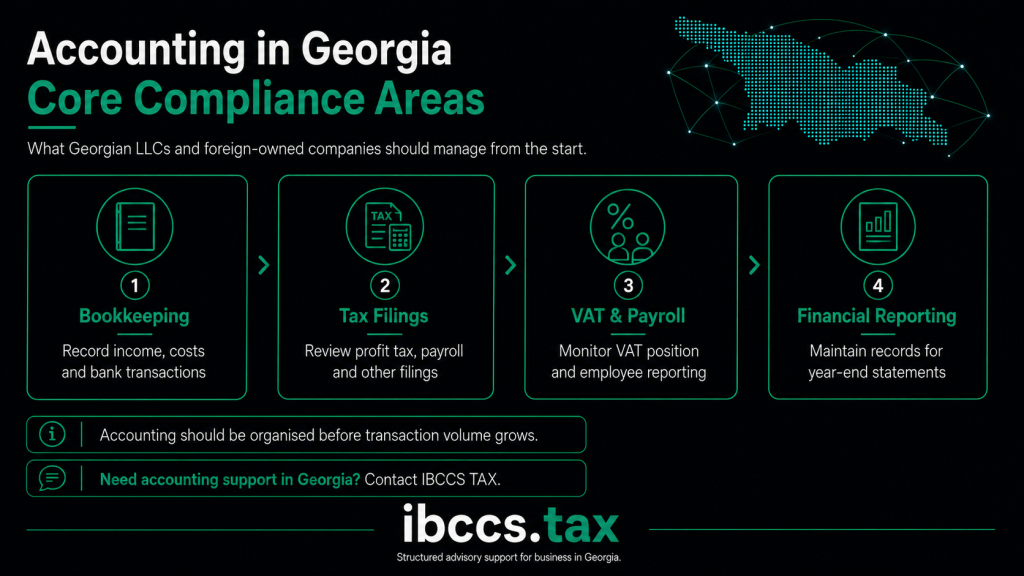
Accounting in Georgia involves more than entering invoices into software. It is a continuous process of recording transactions, checking supporting evidence, reconciling financial accounts, identifying tax-sensitive payments and preparing information for filings, annual financial statements and management decisions.
The precise scope depends on the company, but most active Georgian LLCs need a combination of monthly bookkeeping, tax compliance, bank reconciliation and document review. Foreign-owned companies may also need coordination between the Georgian records and reporting required by shareholders, group companies or advisers in other jurisdictions.
Monthly Bookkeeping and Transaction Recording
Monthly bookkeeping records the company’s sales, purchases, operating costs, bank movements, cash transactions and other financial events in the correct accounting period. Regular processing makes it easier to identify missing documents and unusual transactions while the founder still remembers the commercial background.
A good monthly close does not simply total income and expenses. It should also identify payments that may represent shareholder funding, loans, dividends, employee benefits, non-business expenditure or transactions requiring separate tax treatment.
Bank Reconciliation and Payment Classification
Bank reconciliation compares the accounting records with the company’s bank statements and explains every movement. It helps detect duplicated entries, unpaid invoices, unidentified receipts, bank charges and transfers between accounts that could otherwise distort the company’s financial position.
Classification matters because two payments of the same amount may have completely different consequences. A supplier invoice, shareholder loan repayment and personal expense paid with a company card are not interchangeable, even though each appears as a debit on the bank statement.
Invoices and Supporting Documentation
An invoice is important, but it may not be the only document needed to support a transaction. Depending on the activity, the company may also need a contract, statement of work, delivery confirmation, service acceptance evidence, customs document, board or shareholder decision, or proof explaining the business purpose of an expense.
Complete records are useful beyond tax compliance. Banks, auditors, investors and potential buyers may all ask how a payment relates to the company’s activity, so a clear document trail improves both compliance and commercial credibility.
Shareholder Funding, Loans and Distributions
Foreign founders frequently transfer funds to a new Georgian company before it generates revenue. Those transfers should be documented and classified as capital, a shareholder loan or another appropriate form of funding rather than left as unexplained receipts.
The same principle applies when money moves back to a shareholder. A reimbursement, loan repayment, dividend and personal withdrawal have different accounting and tax consequences, and the company should not use one generic description for all of them.
Foreign Currency and Payment Providers
Many Georgian companies invoice in EUR, USD, GBP or other currencies. The accounting records need to reflect the applicable exchange-rate treatment and explain differences created by conversion rates, bank charges and currency movements between the invoice and settlement dates.
Online payment processors can create an additional layer of complexity because the amount received into the bank may be lower than the customer invoice after fees, refunds or withheld reserves. The accountant therefore needs full payment-provider statements rather than only the final net bank receipt.
What Documents Should Be Provided to a Georgian Accountant?
The accountant should receive enough information to understand the commercial purpose and legal basis of each transaction. A payment reference or screenshot may help, but it rarely replaces the underlying agreement, invoice or corporate document.
Companies should agree a regular document calendar and a secure method of sharing records. The following table summarises the information commonly required, although the exact list should be adapted to the business model.
| Accounting area | Typical records | Why they matter |
| Sales and income | Contracts, invoices, acceptance or delivery evidence, payment records | Supports revenue recognition, VAT analysis and client reconciliation |
| Operating expenses | Supplier invoices, contracts, receipts and evidence of business purpose | Helps classify expenses and identify possible corporate profit tax consequences |
| Banking and payments | Full bank statements, payment references, card records and payment-provider reports | Allows reconciliation and explains how gross invoices connect with net settlements |
| Shareholder funding | Loan agreements, capital decisions, repayment schedules and shareholder resolutions | Distinguishes funding from income, expenses or profit distributions |
| Employees and contractors | Employment or service agreements, payroll information, benefits and work records where relevant | Supports payroll, withholding, pension and worker-classification analysis |
| Assets and inventory | Purchase documents, customs records, asset registers and stock records | Supports valuation, depreciation, cost tracking and transaction evidence |
| Cross-border dealings | Intercompany agreements, management-fee support, transfer-pricing information and foreign invoices | Helps assess withholding, related-party and international tax implications |
Monthly Accounting and Tax Compliance in Georgia
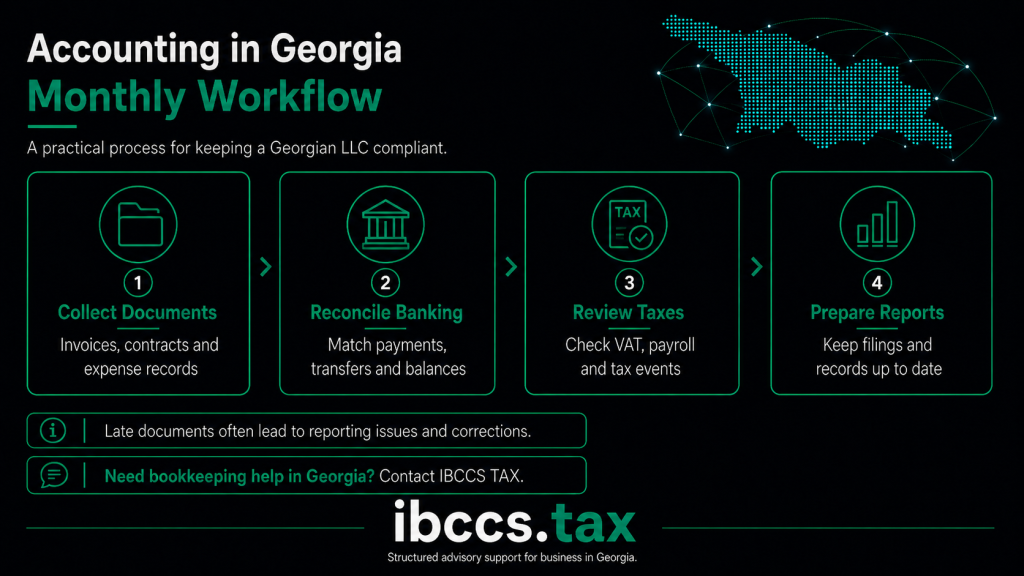
Many Georgian tax obligations are reviewed on a monthly basis, but there is no single identical filing package for every LLC. The returns and payments required depend on what the company has done during the period, whether it has employees, whether it is VAT registered and whether any distribution or tax-sensitive payment has occurred.
This is why monthly accounting should be completed before filing decisions are made. A company may have no corporate profit tax payment in one month but still have payroll, VAT or withholding obligations, while another company may have few transactions but one payment that requires detailed analysis.
Corporate Profit Tax Events
Georgia’s corporate profit tax system is generally linked to distributed profits and certain transactions treated as deemed distributions. Monthly accounting should therefore identify payments to shareholders, non-business expenses, undocumented costs and other transactions that may fall within the taxable base.
The label used in a bank transfer does not determine the result. The underlying documents, recipient, purpose and legal relationship need to support the accounting treatment, particularly where funds move between the company, its owners and related entities.
VAT Declarations and Monitoring
A VAT-registered company needs accurate sales and purchase records for the relevant reporting period. The accounting process should confirm the VAT treatment of each transaction, the availability of supporting documents and whether input VAT can be recognised.
Companies that are not yet registered should still monitor turnover and transaction types. Waiting until year-end can be too late because the mandatory threshold is measured over a rolling period rather than only by reference to the calendar year.
Payroll and Employee Reporting
A company with employees needs payroll information before salaries and benefits are processed. Employment terms, gross remuneration, leave, bonuses, benefits and payment dates should be communicated in time for the applicable calculations and declarations.
Changes should also be reported promptly. New hires, terminations, salary adjustments and one-off benefits can alter the monthly payroll position, so the accounting provider should not learn about them only after the bank payment has been made.
Withholding Tax and Payments to Non-Residents
Payments to foreign service providers, lenders, licensors or other non-residents may require a Georgian withholding tax review. The analysis can depend on the type of payment, the recipient, the place where services are performed and whether an applicable double tax treaty changes the domestic treatment.
These issues are easier to review before the contract is signed and the invoice is paid. Where the transaction is material or recurring, routine bookkeeping may need to be supported by taxation services in Georgia or wider international tax advice.
Georgia Corporate Profit Tax and Accounting Records
The standard corporate profit tax rate in Georgia is generally 15%. Unlike a conventional annual profit-tax system, Georgia’s model normally focuses on distributed profits and specified transactions that are treated as distributions, while profits retained and used for business purposes are generally not taxed immediately.
This model can support reinvestment, but it also makes accurate transaction classification central to compliance. Personal expenses, undocumented payments, certain benefits, shareholder transactions and transfers lacking a clear business purpose may create consequences even where the company has not formally declared a dividend.
Accounting should therefore connect each material payment with the relevant contract, invoice, corporate decision or other evidence. Our guide to Georgia corporate tax explains the wider system, while companies with financing, management-fee or group arrangements may also need an international tax structuring review.
VAT Registration and Accounting in Georgia
The standard Georgian VAT rate is 18%. Mandatory registration may arise when VAT-taxable transactions exceed GEL 100,000 during any continuous 12-calendar-month period, so the company should monitor qualifying turnover on an ongoing basis rather than checking only its annual revenue.
The threshold is not the only issue. VAT treatment can depend on whether the transaction concerns goods or services, where the customer is established, where the service is considered supplied and whether the activity is taxable, exempt or outside the Georgian VAT scope.
Foreign clients do not automatically make every invoice VAT-free. International service companies should review their contracts and customer status, while import VAT, reverse-charge rules and input VAT documentation may also affect the position. Once registration is required or chosen voluntarily, invoice content and monthly record-keeping should be aligned with VAT reporting from the start.
Payroll Accounting for Employees, Directors and Contractors
Payroll accounting begins with the legal relationship, not the bank transfer. The company needs clear agreements and accurate remuneration information so that salary tax, pension obligations where applicable, benefits and other reporting items can be calculated correctly.
Directors can require particular attention where they perform operational work, receive remuneration, live outside Georgia or hold another relationship with the company. The accounting treatment should match the legal arrangement and the actual services provided rather than relying on an informal understanding between the founder and the company.
Contractor payments should also be reviewed carefully. Describing a person as an independent contractor does not by itself determine the outcome if the working relationship resembles employment, and cross-border contractors may raise additional withholding or permanent establishment questions.
Annual Financial Statements and SARAS Reporting
Georgia’s financial reporting framework classifies entities by reference to factors such as total assets, revenue and average employee numbers. The company’s category determines the accounting standard, the scope of financial statements, whether a management report is required and whether the financial statements must be audited.
Many smaller Georgian LLCs fall within the Category IV framework, while larger entities may apply IFRS for SMEs or full IFRS. The category should be confirmed each year rather than assumed permanently, because growth in revenue, assets or employment can move the company into a different reporting category.
For calendar-year entities, financial statements are generally submitted to SARAS no later than 1 October of the following year, subject to the applicable category and reporting rules. Preparing annual statements is much easier when monthly records have already been reconciled, because year-end work can then focus on closing adjustments and disclosures rather than reconstructing the entire period.
Accounting for Foreign-Owned Georgian Companies
Foreign ownership does not change the need for Georgian accounting, but it often changes how information must be collected and explained. The founder may be abroad, contracts may be signed electronically, client payments may arrive through non-Georgian platforms and group reporting may use a different currency or accounting timetable.
A reliable process should connect the local records with the company’s wider business structure. The Georgian accountant needs timely information, while the founder needs reports that are understandable and can be used for management, banking and foreign compliance purposes.
Cross-Border Management and Document Flow
Remote management makes discipline especially important. The company should define who approves expenses, who issues invoices, how signed contracts are stored and who provides monthly bank and payment-provider records to the accountant.
Without an agreed process, the accountant may receive incomplete information after deadlines have passed. A simple monthly checklist and one responsible contact person can prevent many of the problems commonly seen in foreign-owned LLCs.
Related-Party Transactions and Transfer Pricing
Transactions with shareholders, directors and group companies should be supported by appropriate agreements and commercial reasoning. Management fees, intercompany services, loans, intellectual property charges and cost allocations may require more than routine bookkeeping, especially when the counterparty is outside Georgia.
The company should be able to explain what was provided, why the amount is commercially justified and how the payment connects with its activity. Material or recurring related-party transactions should be reviewed before implementation rather than documented only after a tax or bank query.
Group Reporting and Foreign Tax Requirements
A foreign shareholder may need Georgian financial information for consolidation, management accounts, CFC analysis or a tax return in another country. The reporting package should therefore be agreed in advance if local statutory statements alone will not provide the required level of detail.
The Georgian accounting records do not automatically resolve the shareholder’s foreign tax position. Where the company is managed from another jurisdiction or forms part of an international structure, local bookkeeping should be coordinated with broader tax residency and management-and-control considerations.
Accounting for Inactive or Low-Activity Georgian LLCs
A company that has not yet issued sales invoices may still have accounting activity. Registration expenses, legal address fees, bank charges, professional costs, shareholder funding and software subscriptions all need to be recorded and supported.
The same applies when a company temporarily stops trading. VAT registration, employment relationships, outstanding receivables, supplier balances and annual financial reporting may continue to require attention, so inactivity should be assessed rather than assumed.
Where the company is no longer required, continued low activity can create unnecessary compliance costs and risk. In that situation, the owners should review whether to maintain, restructure or formally liquidate the entity instead of leaving it unmanaged.
Changing Accountant in Georgia
A Georgian company can change its accounting provider, but the handover should be structured carefully. The new accountant normally needs access to the Revenue Service portal, the accounting database, previously filed returns, financial statements, fixed-asset records, payroll information, contracts and reconciled opening balances.
The outgoing provider should also explain unresolved items, missing documents and any positions that require follow-up. A handover based only on exported transaction lists may leave the new accountant without the context needed to understand shareholder balances, prior VAT treatment or outstanding tax issues.
Before changing provider, the company should clarify the effective handover date and responsibility for each open filing period. This avoids gaps where both providers assume the other party will complete a declaration or year-end report.
Correcting Previous Accounting Periods
Previous-period accounting problems are common where a company started operating before appointing an accountant, changed providers without a proper handover or delivered incomplete records. Typical issues include unreconciled bank entries, missing supplier invoices, undocumented shareholder payments and returns that do not match the underlying transactions.
An accounting clean-up normally begins with collecting records, reconciling accounts and comparing the accounting database with returns already submitted. The next step is to identify whether corrections, additional documents or a separate tax review are required before regular monthly processing can continue.
Voluntary correction is usually easier than discovering the same issues during a tax audit, banking review, investor due diligence or company sale. The time and cost involved depend on the number of periods, transaction volume, quality of records and complexity of the tax exposure.
Common Accounting Mistakes Made by Foreign Founders
One common mistake is treating the company bank account as an extension of the founder’s personal account. Personal purchases, cash withdrawals and transfers to shareholders should not be mixed with ordinary business expenses without clear documentation and an appropriate legal basis.
Another mistake is sending documents only when a filing deadline approaches. Monthly accounting works best when information is provided consistently, because missing invoices and unclear bank entries can be resolved while the relevant people still remember the transaction.
Foreign founders also sometimes focus on invoices but overlook contracts, service acceptance evidence, shareholder decisions and payment-provider statements. These documents may be essential for supporting the business purpose, VAT treatment and source of funds.
A further risk is assuming that every payment to a foreign supplier is tax-neutral or that every foreign customer invoice falls outside Georgian VAT. Cross-border transactions need to be reviewed according to their substance, not only the country shown on the invoice.
What to Expect from an Accounting Provider in Georgia
An accounting provider should explain what information is required, when it must be delivered and which responsibilities remain with the company. The engagement should distinguish routine bookkeeping and filings from tax advice, legal review, audit work and special projects such as clean-up or management reporting.
The founder should also understand how questions are handled. A useful provider does not only process documents, but flags missing evidence, unusual transactions, approaching VAT thresholds and payments that need additional review before the company commits to them.
For a foreign-owned company, communication is part of the service. The accounting provider should be able to explain Georgian requirements clearly and coordinate with the company’s management or external advisers where local records form part of a wider international structure.
Accounting Services in Georgia from IBCCS TAX
IBCCS TAX supports Georgian LLCs, foreign-owned companies and international groups with ongoing bookkeeping, payroll, tax filings, financial statements and accounting reviews. Our teams in Tbilisi and Batumi can coordinate the monthly accounting process with company registration, tax advisory, legal support and cross-border structuring.
Our support can include monthly transaction processing, bank and payment-provider reconciliation, VAT and payroll reporting, annual financial statements, management reporting, accounting for previous periods and organised handovers when a company changes accountant. The scope is adapted to the activity and complexity of the business rather than applying the same checklist to every company.
Businesses that need routine compliance can review our accounting services in Georgia. Where the issue extends beyond bookkeeping, IBCCS TAX can also provide taxation services in Georgia and coordinated advice across Georgia, Cyprus, the UAE, Uzbekistan and other international markets.
Build Accounting into Your Georgian Company Setup
Georgia can provide an efficient environment for operating a company, but the quality of the structure depends on what happens after registration. Accurate accounting helps the LLC understand its tax position, maintain credible banking records and provide reliable information to founders, shareholders and business partners.
The strongest approach is to organise accounting before transaction volume becomes difficult to reconstruct. A clear monthly process gives management better visibility while keeping the company prepared for tax filings, VAT, payroll, annual financial reporting and future growth.
If you are registering a new company, reviewing an existing accounting process or correcting previous periods, contact IBCCS TAX to discuss practical accounting support in Tbilisi, Batumi or remotely.






FAQ: Accounting for Georgian LLCs and Foreign-Owned Companies
1. Does a Georgian LLC need an accountant?
A Georgian LLC needs a reliable accounting process that records its transactions and supports its tax and financial reporting obligations. The scope may be relatively simple for a low-activity company, but the records and applicable filings still need to be reviewed regularly.
2. When should a new Georgian company start accounting?
The accounting process should ideally be organised before regular trading begins. This allows the company to establish invoicing, document storage, bank reconciliation and monthly reporting procedures before the first filing deadlines arise.
3. Are Georgian tax declarations filed monthly?
Several important obligations are assessed or reported monthly, including VAT, payroll and corporate profit tax events under the distribution model. The exact returns required depend on the company’s transactions, employees and registrations during the relevant period.
4. What documents should be sent to a Georgian accountant?
The accountant normally needs contracts, sales and supplier invoices, bank statements, payment explanations, expense documents, payroll information and documents relating to shareholders, loans or funding. Additional records may be required for inventory, customs, payment providers or related-party transactions.
5. What is the VAT rate in Georgia?
The standard VAT rate is 18%. The correct treatment depends on the type of goods or services, the customer, place-of-supply rules and whether the transaction is taxable, exempt or outside the Georgian VAT scope.
6. When does mandatory VAT registration arise in Georgia?
Mandatory registration may arise when VAT-taxable transactions exceed GEL 100,000 during any continuous 12-calendar-month period. Because this is a rolling threshold, turnover should be monitored throughout the year rather than checked only at year-end.
7. What is the corporate profit tax rate for a Georgian LLC?
The standard corporate profit tax rate is generally 15%, with taxation normally linked to distributed profits and certain deemed distributions. Accurate accounting is needed to identify which payments or transactions fall within the taxable base.
8. Does an inactive Georgian company still need accounting?
An inactive or low-activity company may still have bank charges, professional costs, shareholder funding and annual reporting considerations. Its actual obligations should be assessed rather than assuming that no accounting is required because it has not issued sales invoices.
9. Are Georgian companies required to prepare annual financial statements?
Georgian entities are subject to the accounting and financial reporting framework supervised by SARAS. The applicable standard, reporting package and possible audit requirement depend on the company’s size category and other legal factors.
10. Can accounting services in Georgia be provided remotely?
Much of the monthly process can be coordinated remotely when documents and bank information are shared securely and on time. Local support remains valuable for Georgian-language records, tax portal administration and communication with authorities where required.
11. Can a company change its accountant in Georgia?
Yes, but the handover should include portal access, accounting data, prior returns, financial statements, reconciliations and explanations of unresolved matters. The company should also confirm which provider is responsible for each open filing period.
12. Can IBCCS TAX correct accounting for previous periods?
IBCCS TAX can review available records and assist with accounting clean-up where previous periods are incomplete or unreconciled. The required work depends on the transaction volume, documents available, returns already filed and any tax issues identified.
13. Why use IBCCS TAX for accounting in Georgia?
IBCCS TAX combines local bookkeeping and tax compliance with company registration, legal coordination and international tax advisory. This integrated approach is particularly useful for foreign-owned companies that need their Georgian records to work within a broader cross-border structure.
Property Tax in Georgia in 2026: Rates, Income Thresholds, Filing and Rules for Foreign Owners
Property tax in Georgia is an annual obligation that can
Read More
Accounting Entries in Georgia: Bookkeeping Examples for Georgian LLCs
Accurate bookkeeping starts with recording each business transaction in the
Read More
VAT in Georgia in 2026: Registration, Rates, Returns, Invoices and New Rules
Value Added Tax (VAT) is one of the most important
Read MoreDisclaimer: This article is for general information only and does not constitute tax, legal or financial advice. Professional advice should be obtained based on your specific circumstances.