

Last updated: July 2026
UAE Corporate Tax is now a central part of the compliance framework for companies operating in the United Arab Emirates. Businesses that previously focused mainly on licensing, bookkeeping and VAT must also determine their Corporate Tax status, calculate taxable income and file an annual return.
The standard UAE Corporate Tax rates remain competitive, but the final tax position involves considerably more than applying 9% to the company’s accounting profit. The result can depend on the legal form, tax residence, Free Zone status, income profile, group structure, related-party transactions, available reliefs and quality of the accounting records.
Companies establishing or maintaining operations in Dubai, Abu Dhabi or another Emirate should therefore integrate Corporate Tax into their wider UAE accounting and tax compliance framework from the beginning.

- UAE Corporate Tax applies to financial years beginning on or after 1 June 2023.
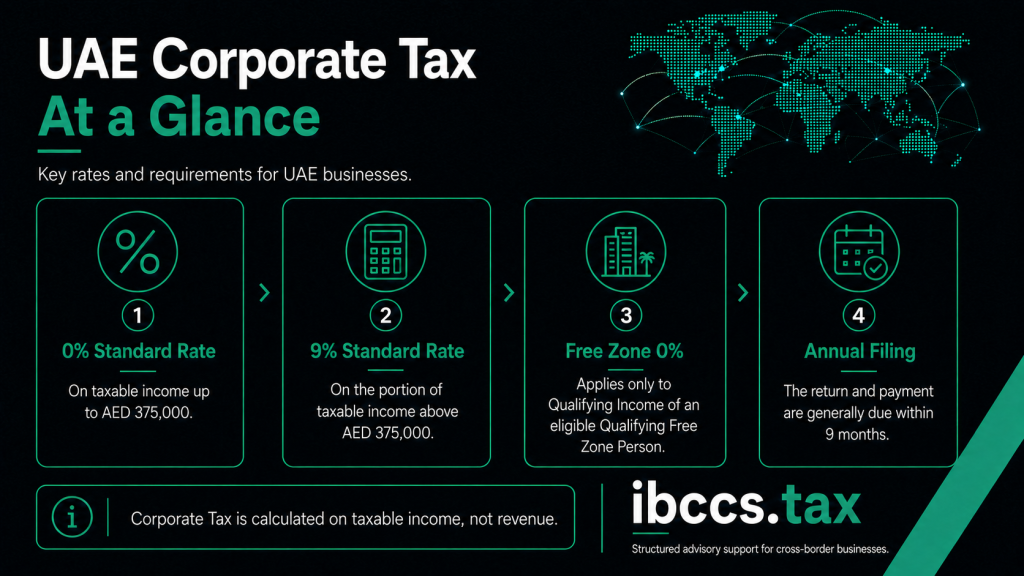
- The standard rate is 0% on taxable income up to AED 375,000 and 9% on the portion exceeding AED 375,000.
- The rates apply to taxable income, not directly to revenue or gross sales.
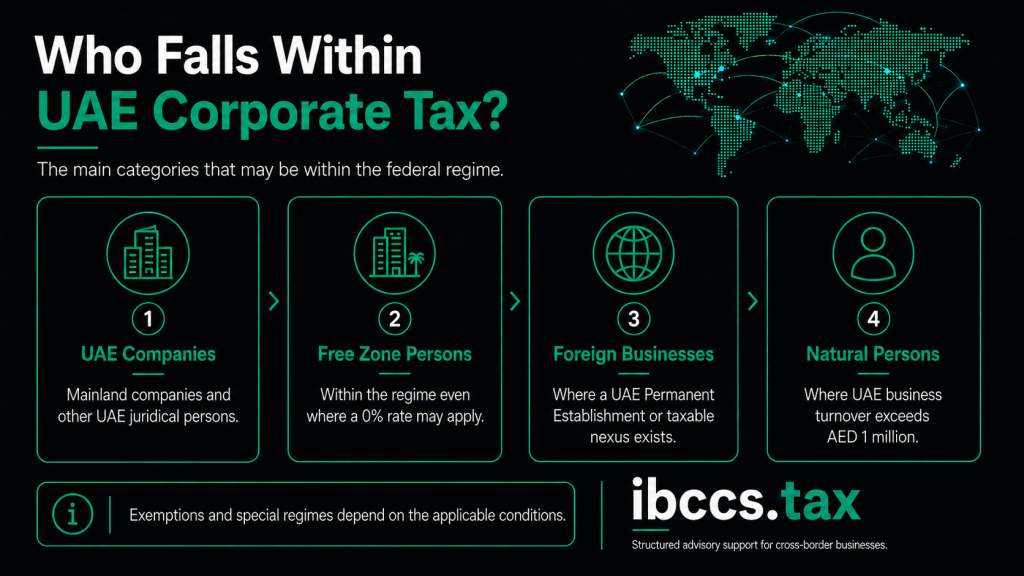
- UAE companies, Free Zone Persons and certain foreign businesses can fall within Corporate Tax.
- A Free Zone licence does not automatically provide a 0% Corporate Tax rate.
- Eligible Resident Persons may elect for Small Business Relief where the relevant conditions are met.
- Corporate Tax registration is separate from VAT registration.
- Corporate Tax Returns and payments are generally due within nine months from the end of the Tax Period.
- Related-party transactions must comply with the arm’s length principle.
- Taxable Persons must retain adequate records and supporting documents for at least seven years.
What Is UAE Corporate Tax?
UAE Corporate Tax is a federal direct tax imposed on the taxable income of corporations and other businesses. It applies throughout all seven Emirates and is separate from VAT, customs duties, Excise Tax and applicable Emirate-level taxes.
The regime operates principally on an annual self-assessment basis. A Taxable Person determines its taxable income, submits a Corporate Tax Return and pays the resulting liability to the Federal Tax Authority.
Corporate Tax applies to financial years beginning on or after 1 June 2023. A company using a calendar financial year therefore became subject to the regime from the financial year beginning on 1 January 2024.
Who Is Subject to UAE Corporate Tax?
Corporate Tax can apply to several categories of businesses and Taxable Persons.
UAE Companies and Other Juridical Persons
Companies and other juridical persons incorporated, established or otherwise recognised in the UAE are generally treated as UAE Resident Persons for Corporate Tax purposes.
This includes mainland companies and entities established in UAE Free Zones. The owners’ nationality or country of residence does not generally change the company’s status under the UAE Corporate Tax regime.
Foreign Companies Managed and Controlled From the UAE
A foreign company may be treated as a UAE Resident Person where it is effectively managed and controlled in the UAE.
The place of incorporation is not therefore the only relevant consideration. The location where key strategic and commercial decisions are made can affect the company’s Corporate Tax residence.
Non-Resident Businesses
A foreign juridical person may fall within UAE Corporate Tax where it has a Permanent Establishment or another taxable nexus in the UAE.
The assessment can involve the existence of an office, branch, fixed place of business, dependent agent or another sufficiently substantial business presence in the country.
Natural Persons Conducting Business
An individual can fall within Corporate Tax where they conduct a Business or Business Activity in the UAE and annual turnover from those activities exceeds AED 1 million.
Wages, Personal Investment Income and Real Estate Investment Income are not treated as Business or Business Activities for this purpose. More information is available in our guide to UAE personal income tax and tax residency.
Who May Be Exempt From UAE Corporate Tax?
Certain persons can be exempt from Corporate Tax automatically or subject to notification, listing, application and continuing conditions.
The main categories include:
- Government Entities;
- specified Government Controlled Entities;
- qualifying Extractive Businesses;
- qualifying Non-Extractive Natural Resource Businesses;
- Qualifying Public Benefit Entities;
- qualifying public or private pension and social security funds;
- Qualifying Investment Funds;
- certain UAE subsidiaries wholly owned and controlled by specified Exempt Persons.
An exemption should not be assumed solely from an entity’s activity, ownership, public-benefit purpose or regulatory status. The applicable conditions, registration requirements and continuing obligations must be reviewed before relying on exempt treatment.
What Are the UAE Corporate Tax Rates?
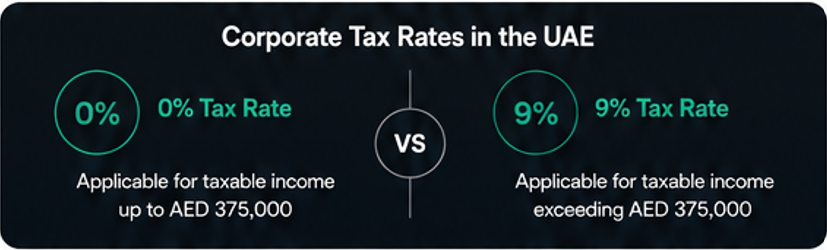
For a Taxable Person subject to the standard regime, the rates are:
| Portion of taxable income | Corporate Tax rate |
| Up to AED 375,000 | 0% |
| Exceeding AED 375,000 | 9% |
The 9% rate applies only to the portion of taxable income above AED 375,000. It is not applied retrospectively to the first AED 375,000 once the threshold has been exceeded.
Example: Taxable Income of AED 600,000
A company has taxable income of AED 600,000.
- AED 375,000 at 0%: AED 0;
- remaining AED 225,000 at 9%: AED 20,250.
The resulting Corporate Tax liability before available credits or other adjustments is AED 20,250.
The calculation is based on taxable income rather than turnover. A company with substantial revenue but low taxable profit may therefore have a lower liability than a smaller business operating with a higher profit margin.
How Is UAE Taxable Income Calculated?
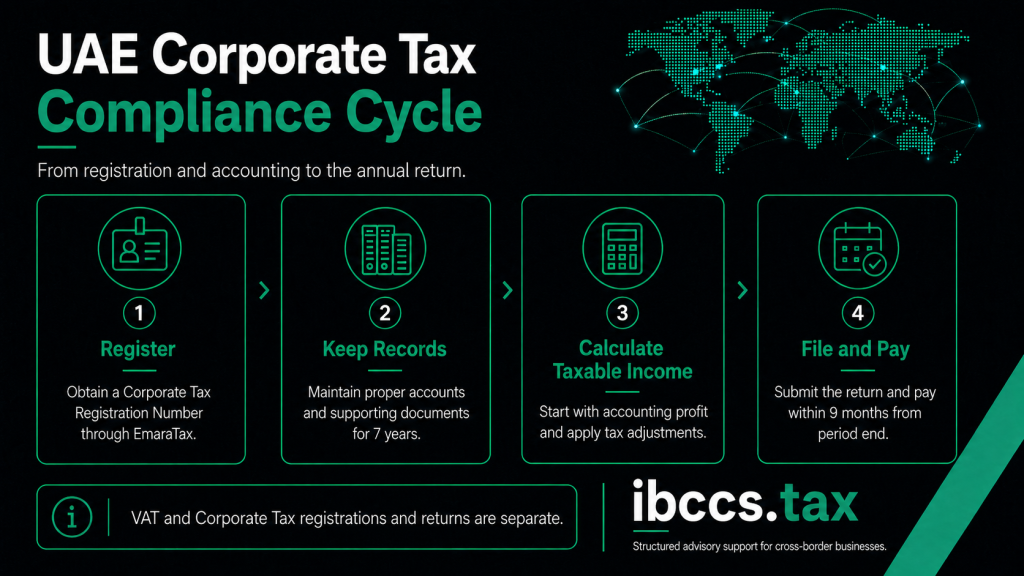
The starting point is generally the company’s accounting net profit or loss before tax, as reported in financial statements prepared using the applicable accounting standards.
The accounting result is then adjusted under the Corporate Tax rules. Adjustments may relate to:
- exempt income;
- expenditure that is not deductible or is only partly deductible;
- depreciation, amortisation and fair-value treatment;
- transactions with Related Parties and Connected Persons;
- available Tax Losses;
- foreign tax credits;
- transitional adjustments;
- elections and reliefs available under the Corporate Tax Law.
Corporate Tax should not therefore be calculated simply by multiplying the accounting profit, turnover or bank receipts by 9%. The financial statements provide the starting point, but specific tax adjustments determine the final taxable income.
What Business Expenses Are Deductible?
Legitimate business expenditure incurred to derive taxable income is generally deductible, although timing rules and specific restrictions can apply.
Capital expenditure is ordinarily recognised through depreciation or amortisation over the useful economic life of the relevant asset or benefit. Costs with both business and personal elements must be apportioned, and only the business-related portion may be deductible.
Expenses that may be restricted or non-deductible include:
- personal or non-business expenditure;
- fines and penalties;
- bribes and illicit payments;
- dividends and profit distributions;
- Corporate Tax itself;
- recoverable input VAT;
- certain interest expenditure;
- payments to Related Parties or Connected Persons that do not meet the arm’s length standard.
Accurate bookkeeping and complete supporting documentation are important because the deductibility of expenditure depends on both its business purpose and the evidence retained by the Taxable Person.
Are Dividends and Capital Gains Taxable?
Dividends and other profit distributions received from a UAE Resident juridical person are generally exempt from Corporate Tax.
Foreign dividends and gains on the disposal of ownership interests may qualify for the Participation Exemption where the relevant ownership, holding-period, subject-to-tax and other conditions are met.
There is no general rule that every capital gain earned by a UAE company is tax-free. A gain that does not qualify for a statutory exemption or relief can form part of taxable income.
International holding and investment structures should be reviewed before acquisitions, dividend distributions or disposals are implemented. IBCCS TAX supports clients with international taxation in the UAE and wider international business structuring.
How Does UAE Corporate Tax Apply to Free Zone Companies?
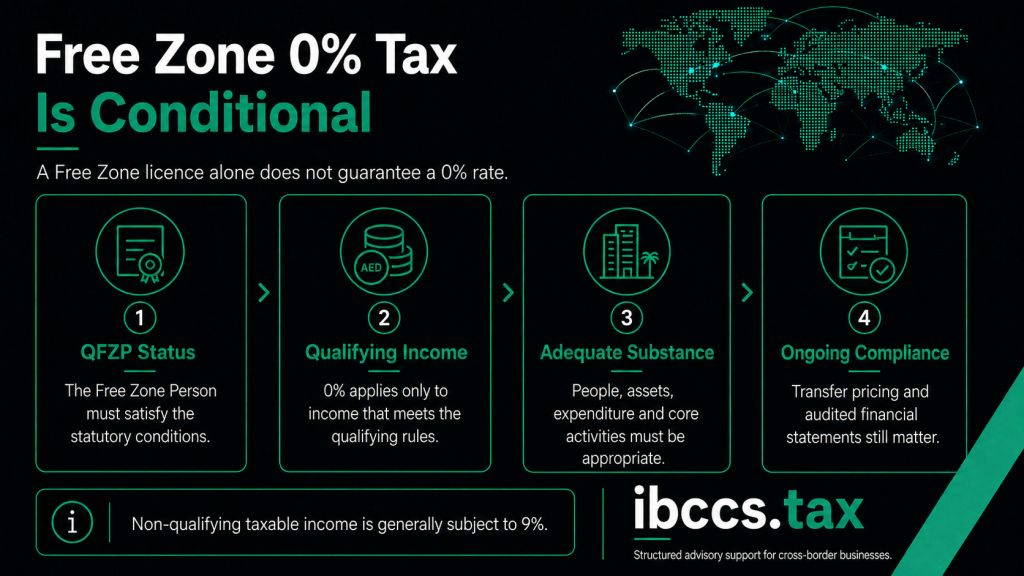
A Free Zone Person is within the scope of UAE Corporate Tax and generally must register and submit a Corporate Tax Return.
A company does not automatically receive a 0% rate simply because it holds a Free Zone licence. A Qualifying Free Zone Person may benefit from:
- 0% Corporate Tax on Qualifying Income;
- 9% Corporate Tax on taxable income that is not Qualifying Income.
Maintaining Qualifying Free Zone Person status involves conditions including:
- maintaining adequate substance in a Free Zone;
- deriving Qualifying Income;
- complying with the arm’s length principle;
- satisfying applicable transfer pricing requirements;
- preparing and maintaining audited financial statements;
- complying with the applicable de minimis limits;
- not electing to be subject to the standard Corporate Tax regime.
Income attributable to a mainland or foreign Permanent Establishment and income from other non-qualifying sources can be subject to the 9% rate. The treatment depends on the company’s activities, customers, contracts, operational substance, assets and locations.
What Is Small Business Relief?
Small Business Relief can reduce the Corporate Tax and compliance burden for eligible Resident Persons.
A qualifying person may elect to be treated as having no taxable income for a Tax Period where:
- revenue does not exceed AED 3 million in the current Tax Period;
- revenue did not exceed AED 3 million in any previous relevant Tax Period.
Under the current rules, the relief applies to qualifying Tax Periods beginning on or after 1 June 2023 and ending on or before 31 December 2026.
Small Business Relief is not available to:
- Qualifying Free Zone Persons;
- members of specified MNE Groups with consolidated group revenue exceeding AED 3.15 billion.
The relief is an election and is different from the standard 0% rate on the first AED 375,000 of taxable income. A business electing for the relief still needs to consider registration, return filing, the treatment of Tax Losses and the effect on other available deductions and reliefs.
Does a Business With No Profit Need to Register and File?
A company can have no Corporate Tax payable and still be required to register and file.
This can happen where:
- the company records a Tax Loss;
- taxable income does not exceed AED 375,000;
- the company elects for Small Business Relief;
- a Qualifying Free Zone Person derives Qualifying Income subject to 0%;
- the company is dormant but remains a Taxable Person.
Registration, return filing and payment are separate obligations. The absence of a tax liability does not normally remove the requirement to submit a Corporate Tax Return.
Corporate Tax Registration
All juridical persons within the scope of Corporate Tax must register with the Federal Tax Authority and obtain a Corporate Tax Registration Number.
A UAE Resident juridical person incorporated, established or recognised on or after 1 March 2024 must generally apply within three months from the date of incorporation, establishment or recognition.
Different deadlines apply to:
- foreign entities effectively managed and controlled in the UAE;
- Non-Resident Persons with a Permanent Establishment;
- Non-Resident Persons with a UAE nexus;
- natural persons conducting Business or Business Activities.
A late registration administrative penalty of AED 10,000 can apply. A current penalty-waiver initiative may be available where the applicable registration and first-return conditions are completed within the specified timeframe.
Corporate Tax Returns and Payment
A Corporate Tax Return and any resulting Corporate Tax liability are generally due within nine months from the end of the relevant Tax Period. For a company with a financial year ending on 31 December, the usual filing and payment deadline is 30 September of the following year. For a company with a financial year ending on 30 June, the usual deadline is 31 March of the following year.
All Taxable Persons required to file should complete the return even where the level of income is low or the final Corporate Tax liability is zero.
Record-Keeping Requirements
Taxable Persons and relevant Exempt Persons must retain adequate records and supporting documentation for at least seven years following the end of the Tax Period to which the documents relate.
The records should support:
- reported revenue and expenditure;
- accounting profit or loss;
- taxable income adjustments;
- exemptions and reliefs;
- transfer pricing positions;
- foreign tax credits;
- Tax Losses;
- Free Zone status and Qualifying Income;
- amounts reported in the Corporate Tax Return.
Audited Financial Statements
For Tax Periods beginning on or after 1 January 2025, audited financial statements are required for:
- a Taxable Person that is not a Tax Group and derives revenue exceeding AED 50 million during the relevant Tax Period;
- a Qualifying Free Zone Person;
- a Tax Group, which must prepare audited special-purpose financial statements under the applicable rules.
Separate statutory, Free Zone or licensing requirements may also require an audit even where the Corporate Tax revenue threshold is not met.
Do Transfer Pricing Rules Apply in the UAE?
UAE transfer pricing rules apply to transactions and arrangements involving Related Parties and Connected Persons.
The rules cover both domestic and cross-border transactions, including transactions between:
- two UAE mainland companies;
- a mainland company and a Free Zone Person;
- two Free Zone Persons;
- a UAE company and a foreign related company;
- a company and its owners, directors or other Connected Persons.
Transactions must comply with the arm’s length principle. Depending on the circumstances and applicable thresholds, the Taxable Person may also need to prepare transfer pricing disclosures, a Local File and a Master File.
Contracts, invoices and accounting entries alone are not sufficient where the pricing and commercial rationale cannot be properly supported.
Can UAE Companies Use Tax Groups and Group Relief?
Eligible UAE companies may be able to use group provisions within the Corporate Tax framework.
Tax Group
A qualifying UAE parent company and eligible subsidiaries may apply to be treated as a single Taxable Person where the ownership, residence and other statutory conditions are satisfied.
A Tax Group generally submits one consolidated Corporate Tax Return, while transactions between members are eliminated for the group calculation.
Qualifying Group Relief
Transfers of qualifying assets or liabilities between members of a Qualifying Group may be completed on a tax-neutral basis where the relevant conditions are satisfied.
Business Restructuring Relief
Certain mergers, divisions and transfers of an entire business or an independent part of a business can qualify for relief.
These provisions include ownership, continuity and clawback conditions. A restructuring should therefore be analysed before agreements are signed or assets are transferred.
Can Corporate Tax Losses Be Carried Forward?
Eligible Tax Losses may generally be carried forward and used against taxable income in future periods, subject to the applicable limitations and conditions.
Restrictions can apply following ownership changes, changes in business activity, Tax Group arrangements or elections for Small Business Relief. Tax Losses should therefore be considered before reorganisations or material changes to the ownership and activity of the company.
Does the UAE Have a 15% Corporate Tax Rate?
The standard UAE Corporate Tax rates remain 0% and 9%.
A separate UAE Domestic Minimum Top-up Tax applies to UAE Constituent Entities belonging to MNE Groups with annual consolidated global revenue of at least EUR 750 million in at least two of the four financial years preceding the relevant year.
The Top-up Tax regime applies to financial years beginning on or after 1 January 2025 and is designed to align the UAE with the OECD Pillar Two minimum-tax framework. It does not generally apply to standalone SMEs or ordinary owner-managed UAE businesses.
UAE Corporate Tax vs VAT
Corporate Tax and VAT are separate taxes with different tax bases and registration requirements.
| Corporate Tax | VAT |
| Direct tax on taxable business income | Indirect tax on taxable supplies |
| Standard rates of 0% and 9% | Standard rate of 5% |
| Return generally filed annually | Returns generally filed monthly or quarterly |
| AED 375,000 is a taxable-income rate band | AED 375,000 is the mandatory VAT registration threshold |
| Registration based on Corporate Tax status | Registration based on taxable supplies and imports |
A business registered for VAT is not automatically registered for Corporate Tax. Similarly, a company may need Corporate Tax registration even where it does not meet the VAT registration threshold.
Practical UAE Corporate Tax Examples
Mainland Company With AED 300,000 Taxable Income
A mainland company has taxable income of AED 300,000. The taxable income falls entirely within the 0% band, so no Corporate Tax is payable.
The company must nevertheless maintain accounting records, remain registered and submit its Corporate Tax Return.
Mainland Company With AED 1 Million Taxable Income
A company has taxable income of AED 1 million.
- AED 375,000 at 0%: AED 0;
- remaining AED 625,000 at 9%: AED 56,250.
The resulting Corporate Tax liability before credits or further adjustments is AED 56,250.
Free Zone Consultancy Company
A consultancy company holds a Free Zone licence and provides services to mainland and foreign customers.
The company cannot assume that all profits qualify for 0%. Its activities, customers, substance, income classification, contracts and compliance with the Qualifying Free Zone Person conditions must be reviewed.
Small Resident Business With AED 2.5 Million Revenue
A Resident Person records revenue of AED 2.5 million in the current Tax Period and has not exceeded AED 3 million in any previous relevant period.
It may be eligible to elect for Small Business Relief, provided it is not a Qualifying Free Zone Person or an excluded member of a large MNE Group. The impact on Tax Losses and other deductions should be reviewed before making the election.
Foreign Company With Employees in Dubai
A foreign company has personnel working regularly from Dubai and participating in contract negotiation or business delivery.
The company should assess whether its UAE activities create a Permanent Establishment, Corporate Tax registration and filing obligations, together with any transfer pricing and employment-related implications.
Common UAE Corporate Tax Misconceptions
“Only companies earning more than AED 375,000 must register”
Incorrect. AED 375,000 is a taxable-income rate threshold, not a general Corporate Tax registration threshold for juridical persons.
“A Free Zone company automatically pays 0%”
Incorrect. The 0% rate applies to Qualifying Income of a Qualifying Free Zone Person that satisfies the relevant conditions.
“The 9% rate applies to the full profit after AED 375,000 is exceeded”
Incorrect. The 9% rate applies to the portion of taxable income above AED 375,000.
“A company with no tax payable does not need to file”
Incorrect. A Taxable Person can still have registration and return-filing obligations where its final liability is zero.
“VAT registration covers Corporate Tax”
Incorrect. VAT and Corporate Tax require separate registrations and separate returns.
“All capital gains are tax-free in the UAE”
Incorrect. Capital gains can form part of taxable income unless a specific exemption or relief applies.
How IBCCS TAX Can Assist
Corporate Tax compliance requires coordination between accounting, tax analysis, company administration and the commercial reality of the business.
At IBCCS TAX, we assist UAE mainland and Free Zone businesses with:
- Corporate Tax registration;
- Corporate Tax health checks;
- taxable income calculations;
- Corporate Tax Return preparation and filing;
- bookkeeping and financial statements;
- Free Zone and Qualifying Income reviews;
- Small Business Relief assessments;
- transfer pricing and related-party transaction reviews;
- Tax Group and group-relief assessments;
- tax support for reorganisations and cross-border structures;
- VAT registration and return filing;
- ongoing accounting and compliance support.
Companies at the formation stage can combine tax planning with our UAE company formation services and our practical guide on how to set up a business in the UAE.
Need Support With UAE Corporate Tax?
A 0% or 9% headline rate does not by itself determine a company’s final position. The business must consider its legal form, Free Zone status, accounting records, income profile, related-party transactions and filing obligations.
Contact IBCCS TAX to discuss Corporate Tax registration, calculation, filing or ongoing compliance with our UAE team.

Frequently Asked Questions About UAE Corporate Tax
1. What is the UAE Corporate Tax rate?
The standard rate is 0% on taxable income up to AED 375,000 and 9% on the portion of taxable income exceeding AED 375,000.
2. Is the AED 375,000 threshold based on revenue or profit?
The threshold applies to taxable income. It is not a revenue, turnover or Corporate Tax registration threshold.
3. Does every UAE company need to register for Corporate Tax?
UAE juridical persons within the scope of Corporate Tax generally need to register, including Free Zone Persons. Certain Exempt Persons may have different registration and reporting requirements.
4. Do Free Zone companies pay Corporate Tax?
Free Zone Persons are within the Corporate Tax system. A Qualifying Free Zone Person can apply 0% to Qualifying Income, while non-qualifying taxable income is generally subject to 9%.
5. Is Small Business Relief the same as the 0% rate?
No. Small Business Relief is a separate election available to eligible Resident Persons meeting the AED 3 million revenue condition.
The standard 0% rate applies to the first AED 375,000 of taxable income under the ordinary regime.
6. Is Small Business Relief available after 2026?
Under the current rules, it applies only to qualifying Tax Periods ending on or before 31 December 2026.
7. When is a UAE Corporate Tax Return due?
The return and any resulting payment are generally due within nine months after the end of the relevant Tax Period.
8. Does a company need to file if it made a loss?
Generally, yes. A Taxable Person can still have registration and filing obligations even where it has recorded a loss or no Corporate Tax is payable.
9. Are dividends taxable in the UAE?
Dividends received from a UAE Resident juridical person are generally exempt. Foreign dividends can qualify for exemption where the Participation Exemption conditions are met.
10. Does UAE Corporate Tax apply to capital gains?
Capital gains can form part of taxable income unless a specific exemption or relief applies.
11. Does the UAE have a 15% Corporate Tax rate?
The standard regime remains 0% and 9%. A separate Domestic Minimum Top-up Tax applies to qualifying UAE entities belonging to large MNE Groups meeting the EUR 750 million global revenue threshold.
12. Is Corporate Tax registration the same as VAT registration?
No. Corporate Tax and VAT are separate taxes and require separate registration, calculations and returns.




Cezary Zieniuk to Join Free IMC Webinar on the New Geography of Global Mobility
On 23 September 2026, Cezary Zieniuk, Founder of IBCCS TAX
Read More
UAE Business License Guide: Types, Requirements, Costs and Renewal
A UAE business license is the formal authorization that allows
Read More
Why Start a Business in the UAE? Strategic Advantages and Practical Considerations
The United Arab Emirates has developed into an established international
Read MoreDisclaimer: This article provides general information and does not constitute tax, legal or investment advice. The application of UAE Corporate Tax depends on the Taxable Person’s circumstances, activities, financial information, elections and applicable legislation. Professional advice should be obtained before filing a return, making an election or implementing a transaction or restructuring.